

Resposta direta: O dimensionamento do resfriador para banheira de imersão fria não pode ser reduzido ao volume da banheira ou à potência do compressor. Defina o volume exato de controle de água e os casos de uso, calcule a energia armazenada na água com unidades declaradas e compare a capacidade útil de resfriamento nas condições reais de temperatura da água, ambiente, fluxo, filtro, cobertura, carga de usuários, elétrica e de controle. Uma seleção defensável também requer um teste de aceitação sincronizado para redução de temperatura, manutenção e recuperação; caso contrário, o resultado permanece uma estimativa de triagem.
Congelar o volume de controle térmico e o limite exato do equipamento
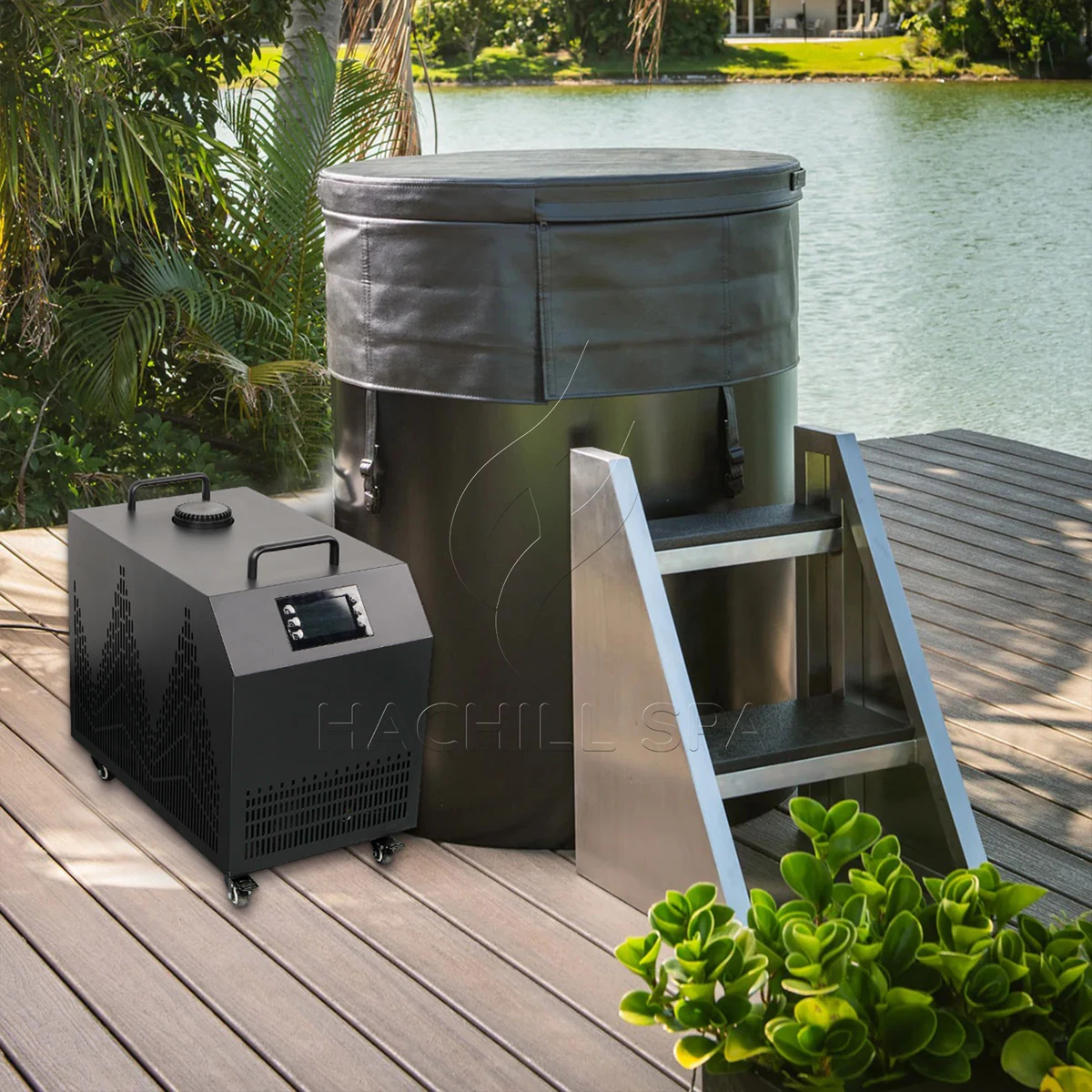
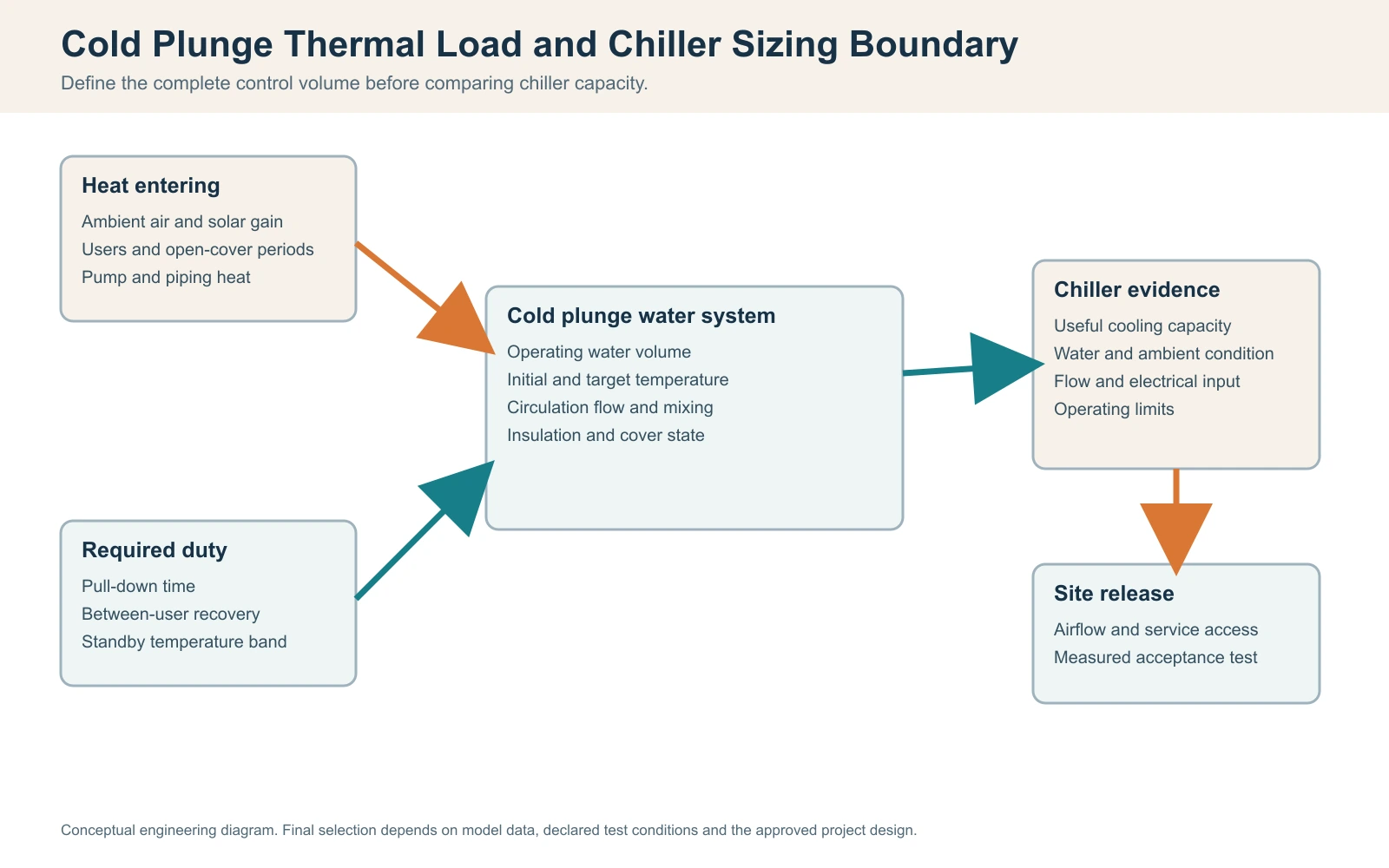
O dimensionamento do resfriador começa com um limite exato do sistema: volume de retenção de água, revestimento e casca, tubulação, filtro, bomba, trocador de calor, resfriador, controles, cobertura, ar do local e fornecimento elétrico. Indique se o volume cotado inclui mangueiras, tanque de equilíbrio, alojamento do filtro ou apenas o vaso. Um modelo relacionado ou uma fotografia da placa de identificação não é uma entrada de desempenho verificada.
| Elemento | Entrada necessária | Fonte de evidência | Condição aberta/em espera |
|---|---|---|---|
| Volume de água | Volume medido ou do desenho e estado | Desenho as-built/comissionamento | Somente tamanho nominal |
| Resfriador/trocador de calor | Modelo e configuração exatos | Ficha técnica/manual | Modelo relacionado |
| Circuito/filtro/bomba | Base de tubulação, filtro, vazão e altura manométrica | Registro hidráulico | Vazão não verificada |
| Cobertura/isolamento | Política de construção e operação | Especificação aprovada | Cobertura assumida |
| Ar/eletricidade do local | Ambiente de entrada, tensão, frequência, fase | Dados finais do local e utilidades | Clima genérico/dados de placa |
| Limite de controle | Setpoint, sensor, alarme e comunicações | Registro de controle liberado | Lógica sem congelamento |
Separar as funções de Resfriamento Inicial, Manutenção, Recuperação e Standby
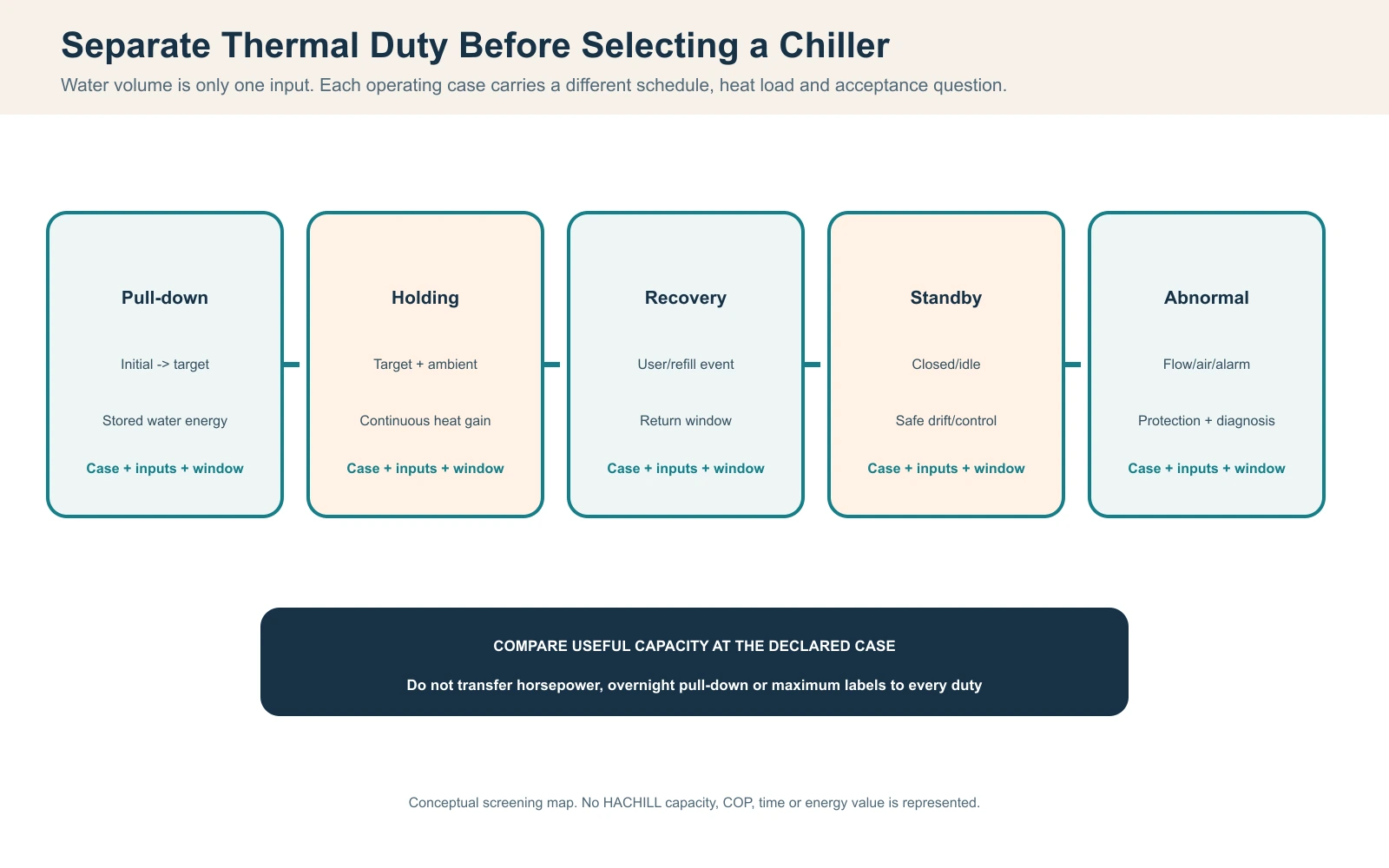
One chiller can face different thermal cases. Pull-down removes stored water energy; holding rejects heat entering from ambient, solar, pipework, equipment, cover leakage and users; recovery follows a user event or cleaning/refill; standby may still carry room or plant heat. Define start and target conditions, duration, cover position, user load, allowable drift and the operating schedule for each case.
| Case | Start/operating condition | Required output | Não deduza |
|---|---|---|---|
| Pull-down | Initial water to target, declared ambient | Average rate within window | Rated input power equals cooling |
| Manutenção | Target water, ambient, cover and site heat | Stable setpoint/allowable drift | Overnight test proves busy use |
| Recuperação | User/refill event and schedule | Return within declared window | One event represents all duty |
| Standby | Closed/idle system and plant heat | Safe control and limited drift | No heat gain |
| Abnormal/event | Filter restriction, high air, power or alarm | Protective response and diagnosis | Bypass protection |
| Variável | Change to test | Expected direction | Evidence boundary |
|---|---|---|---|
| Volume de água | Measured vs nominal state | Energy and average rate change | No field result |
| Delta T | Initial/target alternatives | Stored energy changes | Setpoint basis |
| Pull-down window | Required schedule cases | Required average rate changes | No capacity proof |
| Ambient/intake air | Declared hot/cool cases | Useful capacity may change | Site condition |
| Flow/filter state | Approved operating cases | Heat transfer may change | Hydraulic evidence |
| Cover/user load | Closed/open and duty cases | Holding/recovery load changes | Política operacional |
Calculate Water-Side Energy Without Inventing Performance
For a screening calculation, water energy is Q = m x cp x Delta T, where m is mass, cp is the selected water specific-heat basis and Delta T is the declared temperature change. If volume is used, state density and units so the conversion to mass is visible. The result is stored energy, not a promise that a chiller removes it in that time.
For a first-pass average rate, divide the declared energy by the required pull-down time and then add a separately stated allowance or heat-load case. Do not hide pipe, cover, user, solar, standby or equipment heat inside an unexplained percentage. Record rounding, sensor uncertainty, mixing assumption and whether the water volume is full, working or minimum.
| Entrada | Value/source | Unit discipline | Reason |
|---|---|---|---|
| Volume state | Measured/drawing and included components | L, m鲁 or declared basis | Defines mass |
| Density basis | Declared water condition/source | kg/L or kg/m鲁 | Converts volume to mass |
| Specific heat | Declared engineering basis | kJ/kg-K or equivalent | Energy factor |
| Initial/target | Measured or required setpoints | 掳C/掳F with conversion | Defines Delta T |
| Pull-down window | Required schedule | s, min or h | Converts energy to rate |
| Other loads | Separate measured/assumed cases | W or kW with source | Prevents hidden allowance |
| Step | Expression | What it proves | Limite |
|---|---|---|---|
| Mass | m = rho x V | Volume-to-mass conversion | Density is declared |
| Variação de temperatura | Delta T = Tinitial – Ttarget | Direction and magnitude | Mixed water assumed |
| Energia armazenada | Q = m x cp x Delta T | Screening energy | No chiller result |
| Average rate | Pavg = Q / t | Required average removal | Heat gains separate |
| Comparison | Useful capacity >= declared case | Offer screening | Exact test condition required |
Match Useful Cooling Capacity to Conditions
Cooling capacity is useful only with its water temperature, ambient temperature, flow, inlet condition, refrigerant circuit, control state and electrical basis. Input power, compressor horsepower and nominal capacity labels are different quantities. Ask for a condition-linked data point or test method rather than a single maximum value.
Compare offers on the same duty case and identify whether capacity is gross or net of pump, fan, heat exchanger and control behaviour. If the supplier cannot state the test boundary, keep the result as an estimate and make the missing condition an RFQ hold item.
| Condição | Supplier evidence | Comparação para compradores | Hold if |
|---|---|---|---|
| Water inlet/target | Exact test temperature and flow | Same water case | Condition absent |
| Ambient/intake | Measured or declared test air | Same condenser case | Remote weather only |
| Flow/filter | Approved flow and pressure state | Same hydraulic case | Nameplate flow only |
| Control state | Setpoint, cycling and protections | Same duty and controls | Protection bypassed |
| Elétrica | Voltage/frequency/phase/current | Target-market match | Utility mismatch |
| Result basis | Net/gross definition and uncertainty | Comparable useful output | Maximum label only |
Check Flow, Pipe Size, Pressure Loss and Pump Head
Heat transfer depends on water actually moving through the approved circuit. Small pipe, long hose, elbows, valves, a dirty filter, air, wrong pump direction or a restrictive heat exchanger can reduce flow even when the pump runs. Record pipe sizes and lengths, fittings, elevation, filter state, measured or approved proxy flow and the operating control state.
| Entrada | Acquire | Por que é importante | Atalho inválido |
|---|---|---|---|
| Pipe/hose ID and length | As-built measure and drawing | Pressure loss | Nominal connection only |
| Fittings/valves/elevation | Count and schematic | Total head | Straight-pipe assumption |
| Filter state | Condition and service record | Restriction | Clean filter assumption |
| Pump curve/head | Exact model and control speed | Available flow | Pump wattage |
| Heat exchanger requirement | Manual/data point | Transfer duty | Chiller nameplate |
| Air/prime state | Commissioning observation | Avoid dry running/air lock | Pump audible only |
Account for Ambient Air, Solar and Condenser Installation
Measure the air where the condenser actually draws it. Walls, roofs, screens, planting and solar load can create a hotter microclimate than a weather app or nearby shade. Check discharge-air recirculation, service clearances, debris, rain protection and whether the accepted cover or enclosure changes heat rejection.
| Entrada | Método | Acceptance use | Invalid state |
|---|---|---|---|
| Intake air | Logger at actual intake | Condition-linked capacity | Distant city data |
| Discharge air path | Final-site observation | Recirculation check | Open test arrangement |
| Solar/roof/screen | Timestamped site record | Concurrent heat gain | Shade differs |
| Debris/coil access | Inspection and service trial | Sustained airflow | Access assumed |
| Rain/condensation | Wet-state observation | Equipment protection | Weather claim |
| Elétrico/controle | Qualified record and alarm state | Protection behavior | Bypass/reset only |
Include Insulation, Cover, Pipe and User Heat Gains
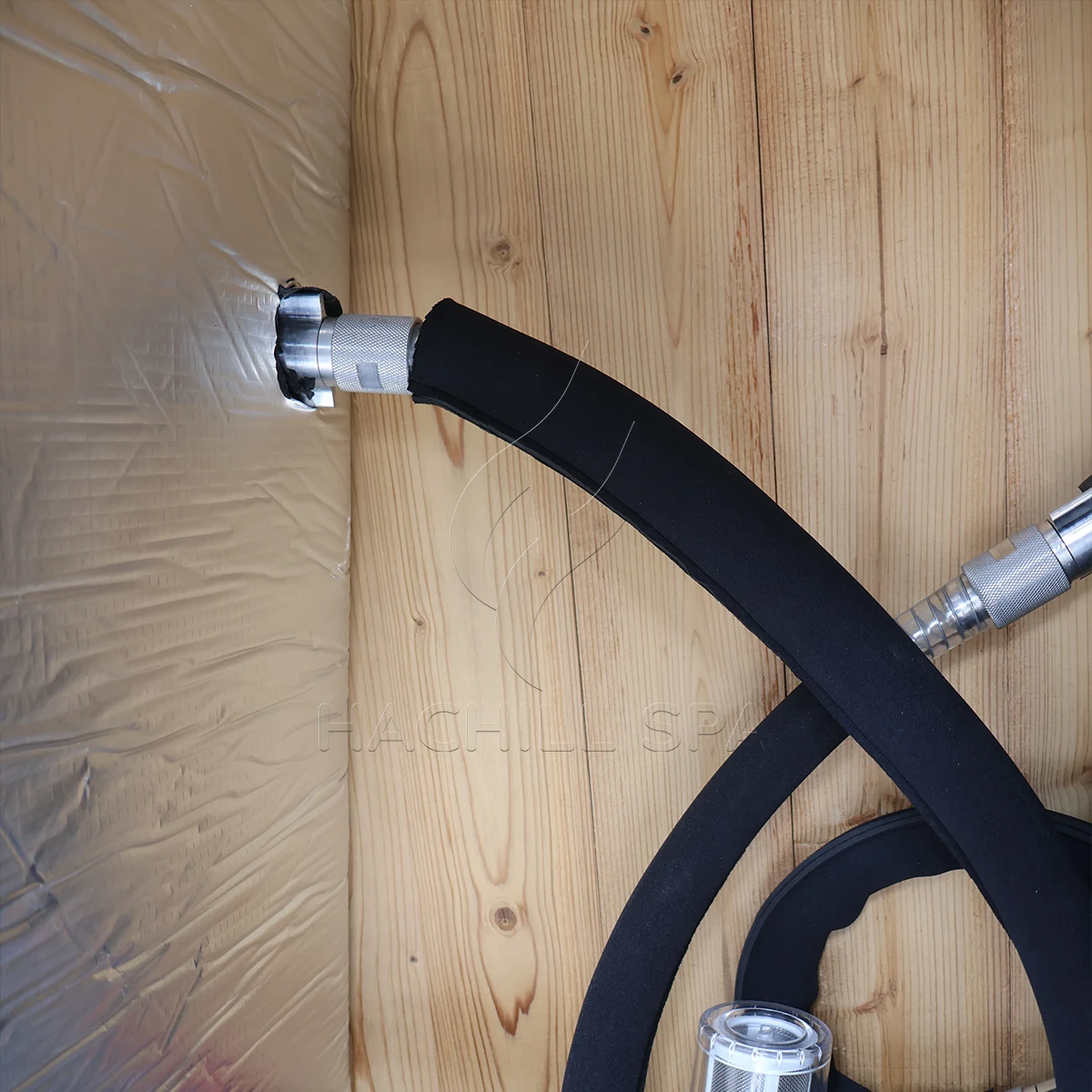
Holding duty is often governed by gains after pull-down. Record insulation construction and continuity, cover fit and handling, exposed pipe runs, equipment heat, room or outdoor air, solar, cleaning/refill and user entry. A cover can reduce heat gain but also changes condenser access and operating practice. Do not turn a visual cover claim into a quantified saving without a declared test.
| Source | Acquire | Effect on duty | Evidence boundary |
|---|---|---|---|
| Tub wall/base | Construction and thermal path | Standby/holding gain | No generic R-value |
| Cover/opening | Fit, policy and event log | Surface/user heat gain | Closed-only test |
| Pipe/equipment | Length, exposure and insulation | Continuous gain | Hidden route assumption |
| Users/refill/cleaning | Count, water state and schedule | Recovery load | Overnight proxy |
| Solar/room air | Final-site conditions | Ambient gain | Regional average |
| Thermal bridge/leak | Inspection and trend | Unexpected gain | Cause unknown |
Freeze Electrical and Control Interfaces Before Ordering
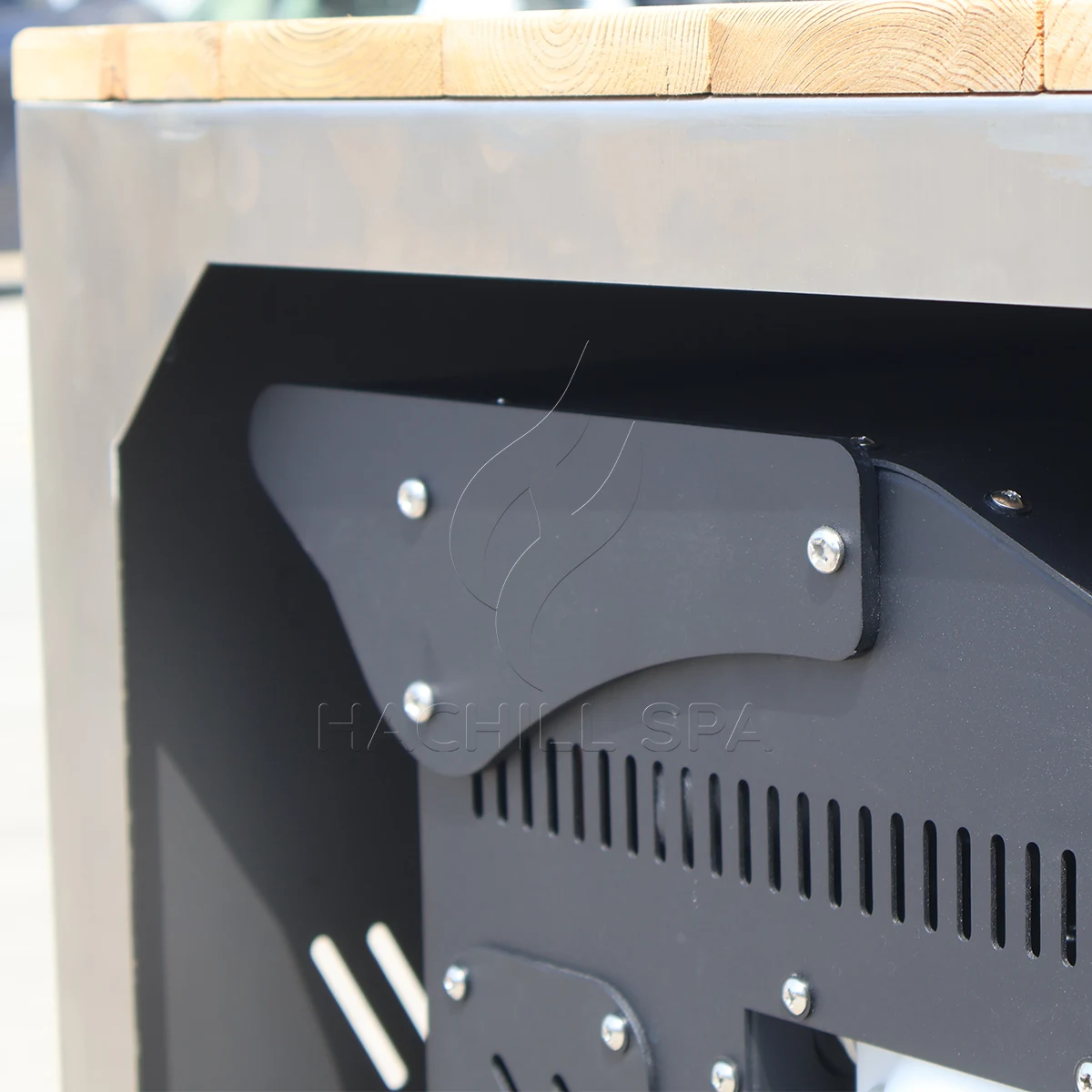
Voltage, frequency, phase, rated current, startup behavior, protection, disconnect, grounding, communication, sensor location and control ownership must be frozen for the target market. A cooling selection can be thermally suitable but unusable if the supply or protection does not match. Qualified local professionals determine installation and code compliance.
| Interface | Entrada necessária | Evidência | Hold condition |
|---|---|---|---|
| Voltage/frequency/phase | Target market utility | Nameplate and approved submittal | Mismatch or late change |
| Current/startup/protection | Qualified electrical basis | Design/test record | Protection assumed |
| Disconnect/grounding | Final location and responsibility | Qualified installation | Access/ground open |
| Sensors/setpoints | Location, range and control owner | Control record | Sensor basis unknown |
| Alarms/interlocks | Flow, temperature, pressure and outage logic | Functional test | Protection bypass |
| Communication/data | Protocol and handover | Approved integration record | Unowned interface |
Create a Defensible Condition-Linked Cooling Test
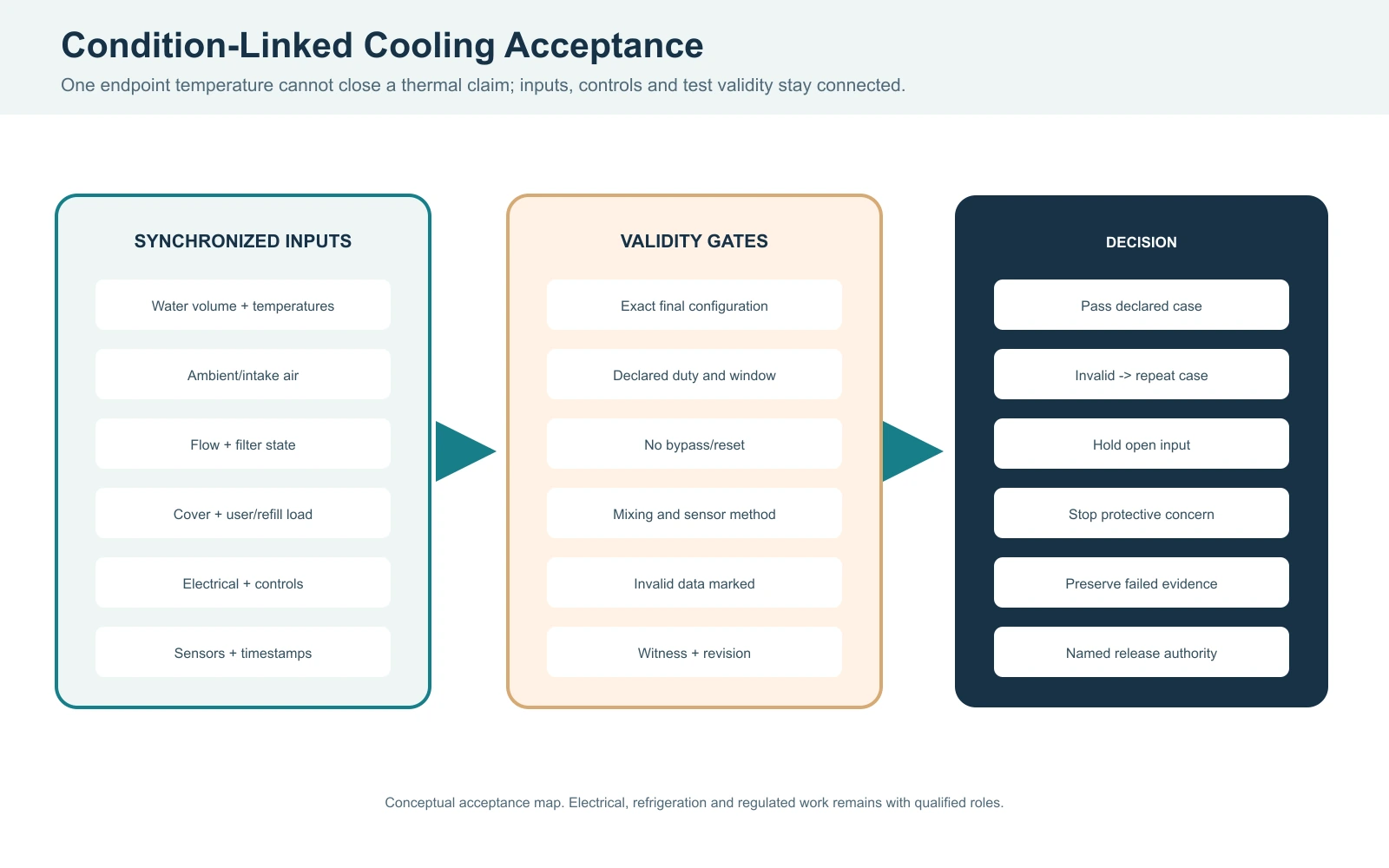
Before testing, declare the exact equipment, water volume, initial and target temperatures, ambient/intake air, flow and filter state, cover, user or refill load, electrical supply, controls, duration, data interval, stop conditions and acceptance window. Synchronize water, air, flow, control and alarm data. A single endpoint temperature cannot explain a thermal result.
Separate pull-down, holding and recovery tests. Mark data invalid if the final enclosure is changed, sensors move, water is not mixed, flow is outside the declared case, protection is bypassed or required inputs are missing. Preserve failed tests and repeat only after the cause is addressed.
| Etapa | Registro obrigatório | Pass boundary | Stop/invalid condition |
|---|---|---|---|
| Documentos | Exact model, limits, configuration and roles | All inputs frozen | Related-model evidence |
| Pull-down | Water/air/flow/control time series | Declared window and condition | Missing volume or sensor |
| Manutenção | Target, cover, ambient and drift trend | Declared allowable drift | Different cover/load |
| Recuperação | User/refill case and restart state | Declared schedule | Overnight proxy |
| Protection | Alarm/interlock and qualified response | Functions operate as designed | Bypass/reset |
| Liberação | Cause, correction, retest and authority | Signed condition-specific release | Open dependent check |
Grade Thermal Evidence and Assign Responsibilities
| Grau | Evidência | Permitted use | Limite |
|---|---|---|---|
| A | Witnessed exact-system test at declared condition | Condition-specific acceptance | Declared duration/method |
| B | Approved exact-model data point/manual | Sizing/submittal basis | Field condition separate |
| C | Component or calculation record | Screening/interface support | Complete performance unproven |
| D | Qualified estimate with assumptions | Planning/open item | Cannot close release |
| E | Horsepower label or generic claim | Orientation | No useful-capacity proof |
| Decisão | Fornecedor | Buyer/project | Qualified/local role |
|---|---|---|---|
| Model/capacity evidence | Provide exact test basis | Compare and freeze inputs | Review project case |
| Volume/thermal case | State assumptions | Supply measured/site data | Approve design basis |
| Hydraulic/air interfaces | State limits | Coordinate final site | Design/install/verify |
| Elétrico/controle | Supply interface data | Freeze target market | Qualified design/test |
| Acceptance/retest | Provide affected inputs | Witness/preserve records | Authorize regulated work/release |
HACHILL can review supplied-product inputs and an RFQ. It cannot replace the qualified local authority responsible for electrical, structural, refrigeration, public-health or building work.
Use Hold Points, Dispute Records and Controlled Retest
Hold release when a volume state, useful-capacity condition, flow, intake air, electrical interface, control protection, sensor location or duty case is unknown. Preserve test timestamps, instruments, configuration revision, water and air conditions, filter/flow state, cover/load, control state, photographs and witness identity. Identify cause before changing multiple variables.
| Issue | Evidence to preserve | Correction | Dependent retest |
|---|---|---|---|
| Capacity disagreement | Condition, units, data and test basis | Normalize inputs | Same duty case |
| Flow restriction | Pipe/filter/pump/air state | Correct hydraulic cause | Flow + thermal |
| High ambient trip | Intake/discharge and control log | Correct airflow/site | Hot-condition test |
| Electrical mismatch | Utility/protection/control state | Qualified correction | Protection + operation |
| Sensor/data dispute | Location/calibration/time series | Reposition/verify | Repeat affected case |
| Failed acceptance | Original report and witness | Cause/disposition | All affected gates |
Engineering scenario: a valid calculation is rejected because the field record is incomplete
Problema observado: The procurement team calculates a plausible average cooling rate, but the supplier and installer reach different conclusions during commissioning. The calculation lists the vessel volume and temperature change, while the site record omits the actual water level, mixing state, filter pressure, intake-air temperature, cover position, and control mode.
Causa provável: The parties are comparing different system boundaries and different duty cases. One result represents stored water energy under an assumed full volume; the other reflects a restricted loop, an open cover, and a warmer equipment enclosure. Neither result can be reconciled from a final water-temperature endpoint alone.
Como verificar: Freeze one test sheet with the exact model and configuration, instrument locations, time zone, sampling interval, water volume state, initial and target temperatures, intake and discharge air, flow or approved hydraulic proxy, filter condition, cover/load event, voltage/frequency/phase, setpoint, alarms, and witness names. Record the same fields at the start, during the run, and at release. Keep raw readings, photographs, calibration status and the calculation revision together.
Caminho de prevenção ou correção: Classify the calculation as a screening record until an exact-condition test is witnessed. If the field result differs, first normalize units and boundary conditions, then isolate one cause at a time: restore flow, correct airflow, stabilize the water mix, or repeat the declared duty case. Do not change the chiller, pump and controls simultaneously because that removes the evidence needed to assign responsibility. A release decision should identify the tested case, untested cases, open risks and the authority who accepts the limitation.
Evidence rule: Keep the original failed record in the project file. A corrected retest is evidence for the corrected condition, not proof that the earlier condition passed. Record who accepted the boundary, which cases remain untested, and which dependent checks must be repeated before release.
Issue a Normalized Chiller-Sizing RFQ
Send water volume and included components, initial and target temperatures, pull-down/holding/recovery schedule, ambient and condenser location, cover and insulation, user/refill load, pipe and filter arrangement, flow/head, voltage/frequency/phase, target market, indoor/outdoor condition, quantity, controls, certification target and acceptance witness. Ask each supplier to mark tested, calculated, estimated and open values.
| Campo | Why required | Supplier response | Closure |
|---|---|---|---|
| Exact volume/configuration | Sets control volume | Model, BOM and assumptions | Technical bid |
| Casos de carga | Sets useful output | Pull-down/holding/recovery basis | Test plan |
| Ambient/airflow | Sets condenser condition | Limits and site arrangement | Instalação |
| Hydraulic/flow | Sets heat-transfer condition | Pipe/filter/pump inputs | Comissionamento |
| Elétrico/controle | Sets target-market fit | Voltage, protection, sensors | Qualified review |
| Evidence/acceptance | Makes offers comparable | Data, witness and retest | Release gate |