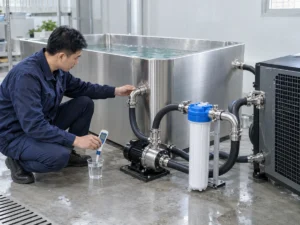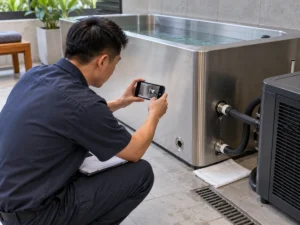
Réponse rapide : des conditions ambiantes plus chaudes peuvent allonger le temps de descente en température d'un bain froid — le temps nécessaire pour refroidir un volume d'eau défini, d'un état de départ connu à un état cible — par deux voies distinctes. Davantage de chaleur peut pénétrer dans l'eau, la cuve et les surfaces connectées, tandis qu'un refroidisseur à air peut aussi devoir rejeter de la chaleur dans des conditions d'air de condenseur plus chaudes.
Une mise en froid estivale plus lente ne non prouver à lui seul que le groupe froid est sous-dimensionné. Consignez la condition générale du site, distinguez-la de l’air entrant réellement dans le condenseur, et notez si le soleil, l’état de la couverture, le débit d’air, la recirculation, le débit d’eau, l’état du filtre ou d’autres variables d’essai ont changé. Comparez des observations de descente en température comparables avant de décider si le ralentissement est lié au site ou doit faire l’objet d’un examen de capacité distinct.
Mesurer la condition ambiante que le groupe de refroidissement perçoit réellement
“ Température ambiante ” ne correspond pas à une mesure universelle unique.
Un site peut présenter une valeur de station météo, une température de pièce, une mesure de référence à l'ombre près du bain froid et une température d'air différente à l'entrée du condenseur du groupe de refroidissement. Ces mesures peuvent toutes être utiles, mais elles répondent à des questions différentes.
Pour un groupe de refroidissement à air, la condition d'entrée d'air au condenseur est directement pertinent pour la limite de rejet thermique. À titre d’exemple de fabricant, Carrier 30RB technical data liste explicitement la température de l’air entrant au condenseur parmi ses conditions nominales. Cela ne fait pas du point de référence Carrier une exigence pour le cold plunge ; cela montre pourquoi une lecture météo éloignée peut manquer un microclimat local de l’équipement créé par des murs, des écrans, une enceinte ou de l’air de rejet chaud revenant vers l’entrée d’air.
| Mesure | Ce qu'elle indique | Ce que cela ne prouve pas |
|---|---|---|
| Ambiance extérieure ou ambiante de la pièce de référence | Condition générale du site pendant l'essai | L'air entrant dans le condenseur était identique |
| Ambiance à proximité de la cuve d'immersion | Environnement thermique autour de l'eau, de la cuve et de la tuyauterie exposée | Le groupe de refroidissement voyait la même condition |
| Air d'entrée ou d'admission au condenseur | Air représentatif du côté rejet de chaleur | L'ensemble du site présentait cette même température |
| Observation de l'air de refoulement | Si l'air chaud du condenseur dispose d'un chemin de sortie dégagé | La recirculation existe sans vérification du trajet d'air réel |
L'emplacement exact du capteur dépend de l'équipement et du site. Ce qui importe pour cette comparaison, c'est que le relevé indique où la provenance de la mesure et ne traite pas silencieusement une valeur ambiante comme une autre.
Cette distinction devient plus importante après une modification de l'installation. Un groupe de refroidissement peut avoir été testé dans un espace ouvert, puis fonctionner ensuite derrière un écran, près d'un mur ou dans une enceinte plus fermée. La température de référence ambiante ou extérieure peut sembler similaire alors que les conditions d'admission du condenseur changent.
Utiliser la température ambiante de référence pour le contexte du site, mais utiliser un relevé représentatif de l'air entrant dans le condenseur pour diagnostiquer la condition de rejet de chaleur.
Distinguer l'apport de chaleur côté eau du rejet de chaleur côté condenseur
Des conditions plus chaudes peuvent allonger la mise en froid par deux voies différentes. Les traiter toutes deux comme “ le groupe de refroidissement est plus faible en été ” masque la cause.
Voie 1 : davantage de chaleur entre dans le système d'eau froide
La chaleur se déplace des environnements plus chauds vers les surfaces plus froides par conduction, convection et rayonnement. Les recommandations sur les flux thermiques du département de l'énergie des États-Unis fournissent la base physique du bâtiment pour ces mécanismes.
Pour un bain froid, cela peut inclure la chaleur entrant par la paroi de la cuve, le rebord, les raccords et la tuyauterie exposés, ainsi que par la surface de l'eau lorsque le couvercle est ouvert. L'exposition directe au soleil constitue une voie de chaleur radiante distincte.
C'est pourquoi deux tests de refroidissement par ailleurs similaires peuvent différer lorsque l'un est à l'ombre et couvert, tandis que l'autre est en plein soleil avec une plus grande surface exposée. Le résultat peut refléter une charge thermique différente, et non un groupe de refroidissement différent.
L'isolation influe également sur ce côté de la limite, mais la méthode complète de comparaison d'isolation figure dans le guide de comparaison des bains froids isolés et non isolés.
Voie 2 : le groupe de refroidissement à air rejette la chaleur dans des conditions de condensation différentes
Le côté réfrigération comporte une voie ambiante distincte. Les groupes de refroidissement à air rejettent la chaleur vers l'air ambiant, et leur condition de fonctionnement évolue avec l'environnement de condensation. Les recommandations sur la charge de réfrigération explique que la température de condensation dépend du fluide de refroidissement, de l’ambiante de conception et du choix du condenseur, et que le comportement du compresseur/condenseur change selon les conditions de fonctionnement.
Cela étaye une conclusion liée aux conditions, et non un pourcentage universel de déclassement pour bain froid. La performance exacte relève toujours des données propres au refroidisseur sélectionné.
Un air de condenseur plus chaud peut modifier le régime de fonctionnement du système de réfrigération au moment même où un environnement plus chaud apporte davantage de chaleur côté eau froide.
Ces deux effets peuvent se produire simultanément, mais ils doivent néanmoins être diagnostiqués séparément.
Ce que signifie l'humidité ici
L'humidité joue un rôle important dans la condensation et le risque d'humidité autour des surfaces froides. Elle peut déterminer si la cuve, les raccords ou la tuyauterie descendent sous le point de rosée local et accumulent de l'humidité.
Ce guide ne non traite pas l'humidité comme un facteur de déclassement direct universel de la puissance du refroidisseur à air. Si un manuel d'équipement ou une courbe de performance précise identifie l'humidité comme une variable de fonctionnement pertinente, suivez cette documentation. Sinon, replacez l'humidité dans le contexte du site et de l'humidité ambiante plutôt que d'en faire une règle de puissance de refroidissement non étayée.

Écarter les problèmes de recirculation et de circulation d'air avant d'incriminer la capacité
Un refroidisseur peut sembler sous-dimensionné alors que le véritable problème est le circuit d'air autour du condenseur.
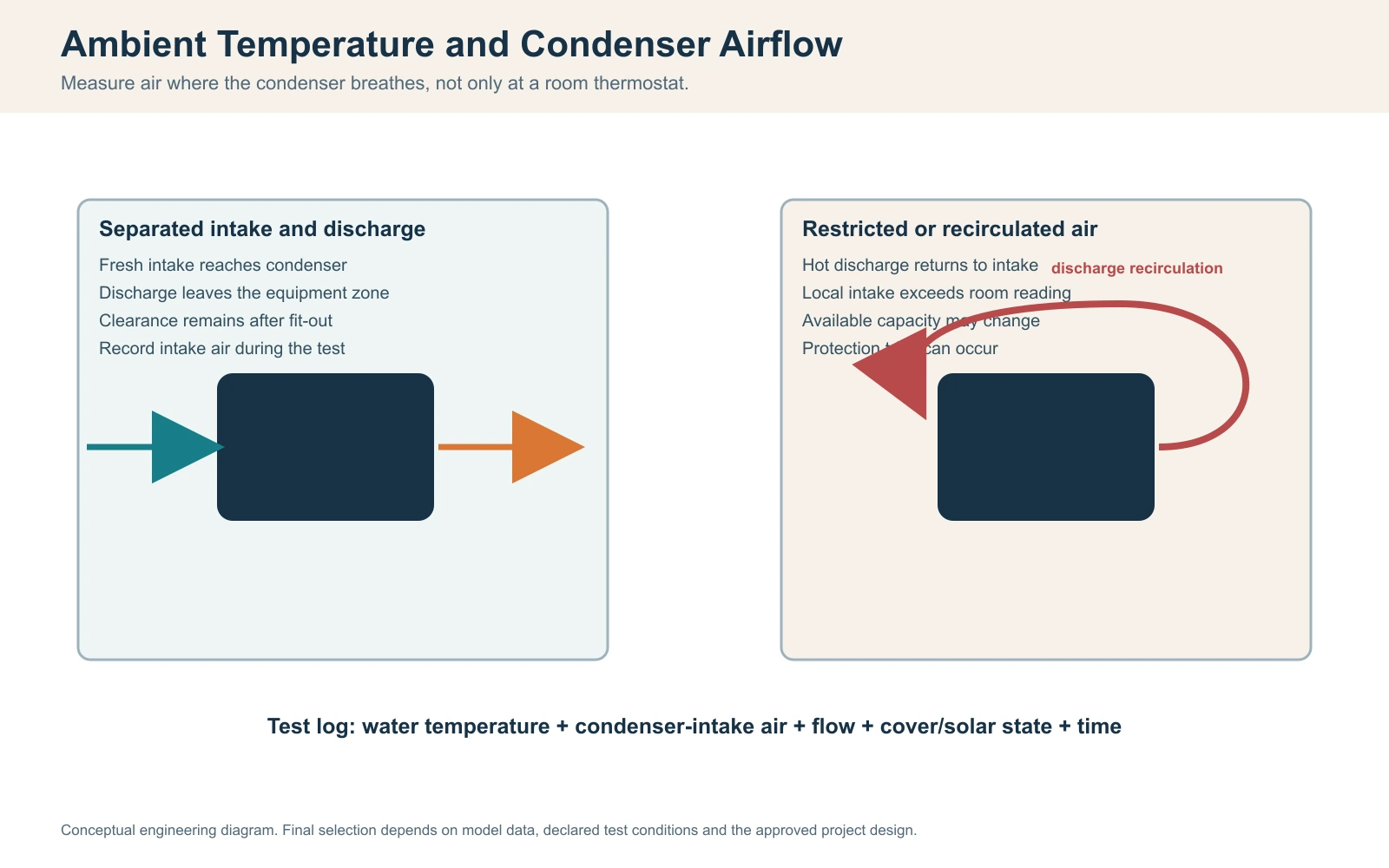
La recirculation d'air chaud se produit lorsque l'air rejeté par le condenseur revient vers l'entrée d'air au lieu de quitter la zone de l'équipement. Une restriction du débit d'air ou un manque d'air au niveau de la batterie peut survenir lorsque le condenseur ne peut pas aspirer ou rejeter suffisamment d'air libre en raison de l'implantation du site, de murs, d'écrans ou d'autres obstacles. Recommandations d'application Trane identifient la recirculation et la restriction du débit d'air du condenseur comme des conditions susceptibles de réduire la puissance et le rendement de l'unité.
Suivez cette séquence avant d'incriminer la puissance :
- Confirmez la comparaison. La descente en température est-elle réellement plus lente qu'une référence valide, ou la réclamation repose-t-elle sur une journée chaude avec des conditions de départ différentes ?
- Vérifiez l'air que le refroidisseur utilise réellement. Comparez la température ambiante de référence avec la température d'entrée d'air au condenseur.
- Inspectez le circuit d'admission et de refoulement. Recherchez un débit d'air obstrué, un air chaud refoulé revenant vers l'admission, l'ajout récent d'un écran ou des modifications d'enceinte.
- Vérifiez les facteurs non liés à l'air. L'état du débit et du filtre, la pratique de couverture, l'état initial de l'eau, l'état cible et l'état de commande/alarme comptent toujours.
- Refaites l'essai dans des limites déclarées avant de tirer une conclusion sur la capacité.
Exemple : la pièce semble fraîche, mais l'entrée d'air du refroidisseur est plus chaude
Supposons qu'un bain froid se trouve dans une pièce où la température ambiante générale semble acceptable. Le refroidisseur, cependant, est positionné là où son propre air chaud refoulé peut recirculer vers l'admission du condenseur.
La lecture de la pièce n'exclut pas un problème d'air au condenseur. La question diagnostique utile est de savoir si le refroidisseur aspire de façon répétée un air plus chaud que ne le suggère la condition de référence.
Il s'agit d'un problème d'air ambiant sur site à examiner avant de conclure que la puissance frigorifique est trop faible.
Exemple : modification des performances après l'ajout d'un écran ou d'une enceinte
Supposons que le même bassin d'immersion et le même groupe de refroidissement atteignent une température acceptable lors d'un essai sur site ouvert, mais que le refroidissement ralentisse après l'ajout d'un écran architectural ou d'une enceinte d'équipement.
La modification du site ne prouve pas automatiquement que l'écran a causé le ralentissement. Elle crée une tâche de vérification précise : contrôler si le débit d'air d'admission, le dégagement de refoulement ou la recirculation ont changé avec l'installation finale.
Si le circuit d'air du condenseur est corrigé et que la puissance déclarée n'est toujours pas atteinte, la question suivante relève d'une revue de capacité — et non d'une règle générique du type “ par temps chaud, il faut acheter un groupe de refroidissement plus puissant ”.
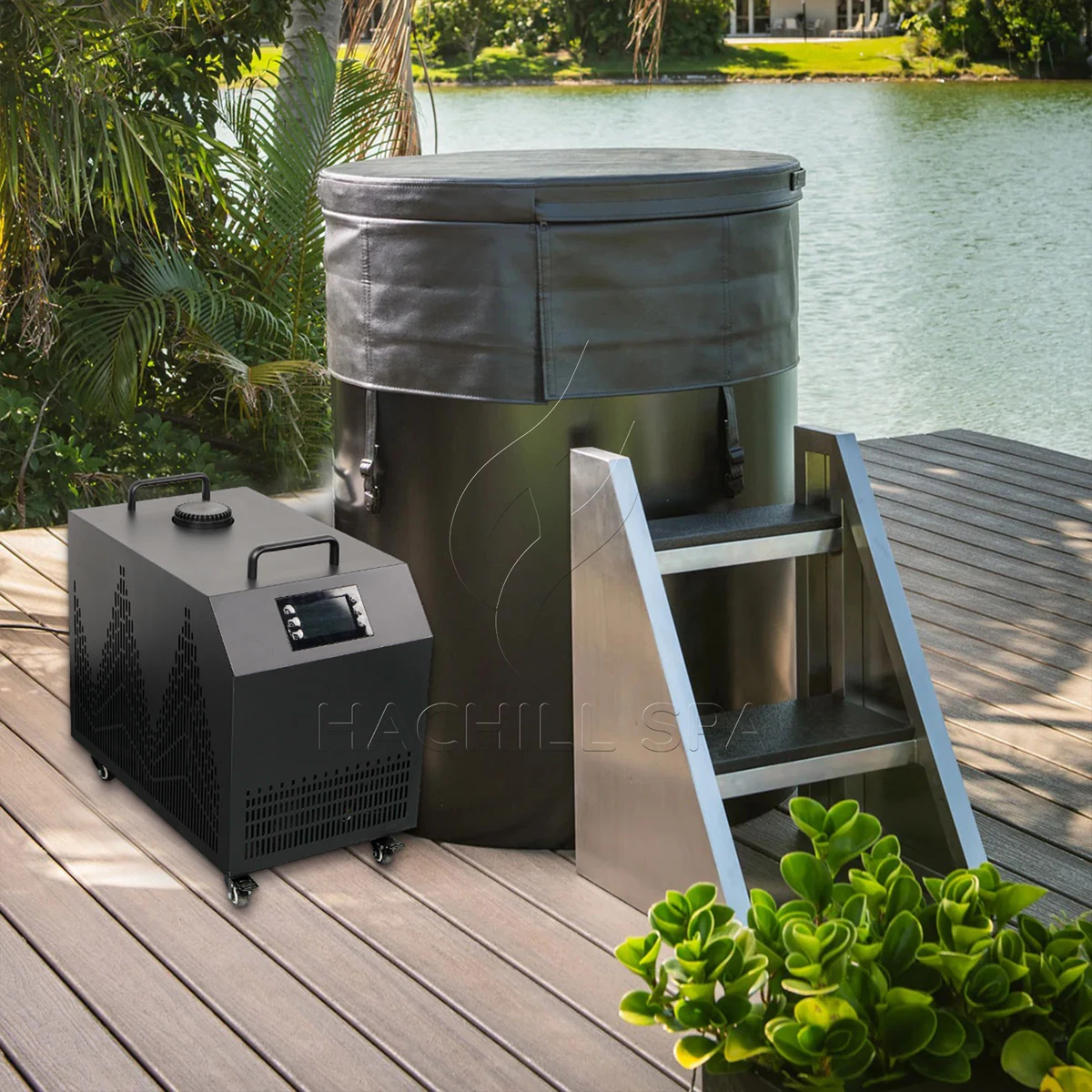
Comparer les essais de mise en froid dans des conditions ambiantes identiques
Les données ambiantes ne deviennent utiles que lorsque les essais de refroidissement comparés sont réellement comparables.
Un seul point final tel que « il a atteint la cible en deux heures » est une preuve faible si la condition initiale de l’eau, la condition cible, l’air d’admission du condenseur, l’exposition au soleil, l’état de la couverture ou la condition de débit ont changé entre les essais. Même lorsque le temps écoulé est la mesure principale, les essais comparés doivent couvrir la même plage définie de température d’eau ou divulguer clairement la différence.
La comparaison doit figer ou consigner clairement les variables susceptibles de modifier le résultat.
| Données de comparaison | Maintenir à l'identique ou consigner clairement | Pourquoi c'est important |
|---|---|---|
| Configuration du groupe de refroidissement et du système | Même équipement/configuration | Évite qu'une modification matérielle soit confondue avec un effet ambiant |
| État initial de l'eau | Base identique ou très proche | Modifie la charge thermique au démarrage |
| Condition cible de l'eau | Même cible et même règle de point final | Maintient un temps écoulé comparable |
| Débit d'eau et état du filtre | Même condition de fonctionnement approuvée | Le comportement du transfert thermique et de la protection peut changer |
| État du couvercle | Même planning | Modifie l’apport de chaleur en surface |
| Exposition solaire | Même exposition ou consigner la différence | Ajoute une voie thermique distincte |
| Ambiance de référence | Consigner de manière cohérente | Fournit le contexte du site |
| Air entrant dans le condenseur | Relever pendant l’essai | Représente la condition de rejet de chaleur du refroidisseur |
| Événements utilisateur / remplissage | À exclure de l'essai ou de l'horodatage | Ajoute une charge non ambiante |
| État de commande et d'alarme | Préserver tout au long | Explique les interruptions ou les événements de protection |
C’est un comparaison normalisée selon l'ambiance, pas une norme de laboratoire universelle.
La science de la mesure utilise le même principe général : la répétabilité dépend du contrôle des conditions de mesure pertinentes, tandis que les conditions modifiées doivent être identifiées plutôt que masquées. Du NIST terminologie de répétabilité et de reproductibilité soutient cette distinction.
Comparer la tendance, pas seulement le point final
Une série température-temps est plus utile qu'une seule température finale car elle peut montrer quand les conditions ont changé, si le refroidisseur s'est arrêté ou a cyclé, et si un événement a interrompu l'essai.
Si un essai commence à l’ombre et se termine en plein soleil, ou si une alarme de condenseur se produit en cours d’essai, le temps écoulé seul ne constitue pas une comparaison ambiante fiable.
De même, si la différence observée est faible par rapport à la variation d’un essai à l’autre, la conclusion prudente peut être que la comparaison n’est pas concluante, plutôt que de conclure que l’environnement ambiant a créé une pénalité de performance prouvée.
Le guide d'ingénierie thermique du bain froid et de dimensionnement du refroidisseur est responsable de l’ensemble du processus de charge thermique et de dimensionnement. Cette page n’a besoin que de suffisamment de données contrôlées pour décider si les conditions ambiantes/site expliquent de manière crédible le résultat de refroidissement modifié.
Déterminer si les conditions ambiantes expliquent le ralentissement
Une fois les mesures et les vérifications du site en place, choisissez la branche suivante à partir des données probantes plutôt que de la saison.
| État des preuves | Décision | Étape suivante |
|---|---|---|
| La condition ambiante/de site a clairement changé et explique de manière crédible la différence de performance | EXPLICATION DE L'AMBIANCE / DU SITE SUFFISANTE | Corrigez la condition du site lorsque cela est approprié, ou traitez le résultat comme dépendant de la condition |
| Un facteur de confusion a changé entre les tests | CORRIGER / RETESTER | Rétablir la limite de comparaison déclarée et répéter l’observation de descente en température |
| Des preuves essentielles sont manquantes | EN ATTENTE D'ÉLÉMENTS SUPPLÉMENTAIRES | Consigner l’air d’admission, l’état du débit/filtre, la limite d’essai, les alarmes ou l’identité de l’équipement |
| Le besoin valide reste non satisfait après avoir circonscrit les facteurs de confusion liés à l'ambiance et au site | PASSER À L'EXAMEN DE LA CAPACITÉ | Réévaluez la capacité à l’aide du processus décisionnel dédié aux changements de capacité |
Lorsque les preuves relatives à l'ambiance ou au site suffisent
L’ambiance est une explication crédible lorsque la condition modifiée est réellement observée et que l’écart de performance est cohérent avec cette limite modifiée — par exemple, une entrée de condenseur plus chaude vérifiée, une restriction de flux d’air sur site ou une condition solaire/couverture sensiblement différente entre les essais.
Cela ne certifie pas que toutes les autres parties du système sont correctes. Cela signifie que les preuves disponibles ne justifient pas de conclure immédiatement à un « refroidisseur sous-dimensionné ».
Quand corriger et retester
Si deux essais comparés ont utilisé un débit d’air, une pratique de couverture, une exposition solaire, un état de débit/filtre ou des conditions de départ différents, corrigez la comparaison avant de passer à la capacité.
Changer le refroidisseur en même temps que la limite d’essai rend le diagnostic plus difficile, pas plus facile.
Quand conserver
Suspendez le verdict sur la capacité si l’identité de l’équipement est incertaine, si l’admission du condenseur n’a pas été consignée, si un événement de protection n’est pas expliqué ou si l’état du débit/du filtre est inconnu.
« Il refroidit plus lentement en été » est une observation de départ, pas une spécification de remplacement.
Quand passer à l’examen de la capacité
Si le régime requis d'abaissement ou de récupération ne peut toujours pas être atteint après avoir circonscrit les facteurs ambiants/de site et autres facteurs confondants, la question dépasse le cadre de cette page.
Utilisez la guide de changement de capacité du refroidisseur de bain froid pour décider si les données probantes justifient de conserver la puissance, de corriger un autre problème du système, d’attendre davantage de données ou d’examiner une autre puissance.
“Augmenter maintenant” n’est pas une branche de diagnostic ambiant.
Utiliser les limites exactes de l'équipement avant toute affirmation de performance
Les conseils d'ingénierie généraux ont une limite stricte : la documentation exacte du refroidisseur fait foi pour les limites de fonctionnement exactes.
Différents refroidisseurs à air publient différentes plages de fonctionnement ambiant, dégagements, exigences de débit, alarmes et logiques de protection. Cette variation est en soi une raison de ne pas transformer le chiffre d’un fabricant en spécification universelle de bain froid.
| Affirmation générale que ce guide peut étayer | Informations exactes qui doivent provenir de la documentation de l'équipement |
|---|---|
| L’air entrant dans le condenseur influe sur les conditions de fonctionnement | Capacité ou rendement exact à une température ambiante donnée |
| La recirculation et un débit d’air restreint peuvent réduire les performances | Dégagement d'installation exact requis |
| La confirmation de débit ou la protection contre la perte de débit peut faire partie d'un schéma de commande de refroidisseur | Plage de débit autorisée exacte, méthode de preuve ou logique de protection |
| Un site chaud peut rapprocher l’exploitation d’une limite d’équipement | Enveloppe exacte de fonctionnement ambiant maximale/minimale |
| Les événements de protection invalident toute comparaison de performance claire | Logique d’alarme exacte, procédure de réinitialisation et action d’intervention |
| La capacité dépend des conditions | Cartographie exacte des performances pour le modèle sélectionné |
La protection contre les défauts de débit dépend aussi de l’équipement. Par exemple, Données d'application Trane Ascend ACR décrit un contacteur de débit d’eau installé en usine et surveillé par le régulateur pour protéger ce refroidisseur d’un fonctionnement en perte de débit. Considérez-le comme un exemple de modèle, et non comme une spécification universelle de commande de bain froid.
Si une condition non résolue de perte de débit, un déclenchement répété d’une protection ou une alarme de limite d’équipement est actif, arrêtez la comparaison et suivez la documentation exacte du refroidisseur ou une procédure de service qualifiée. Ne contournez pas un commutateur de débit, une protection de pression, une protection antigel ou un autre dispositif de sécurité simplement pour terminer un essai.
La même limite s’applique à la réfrigération et aux travaux électriques sous tension : cet article n’est pas une procédure de dépannage à distance.
Les limites ambiantes, le débit minimum, les dégagements, la logique du contrôleur, les seuils de pression ou la capacité en climat chaud spécifiques à HACHILL doivent rester ouverts, sauf s’ils sont confirmés pour le modèle exact sélectionné. Les références Carrier, Copeland et Trane présentes sur cette page étayent des principes d’ingénierie généraux ou des exemples de fabricants ; elles ne certifient pas une configuration de refroidisseur HACHILL non vérifiée.
Pour la compatibilité initiale du système sur les interfaces thermiques, hydrauliques, physiques, de commande et de site, utilisez Comment assortir un bassin d'immersion froide à un refroidisseur. Si un devis est comparé selon la puissance, la puissance frigorifique ou le COP, utilisez Cold Plunge Chiller HP vs Cooling Capacity avant de traiter l’étiquette comme un résultat de performance.
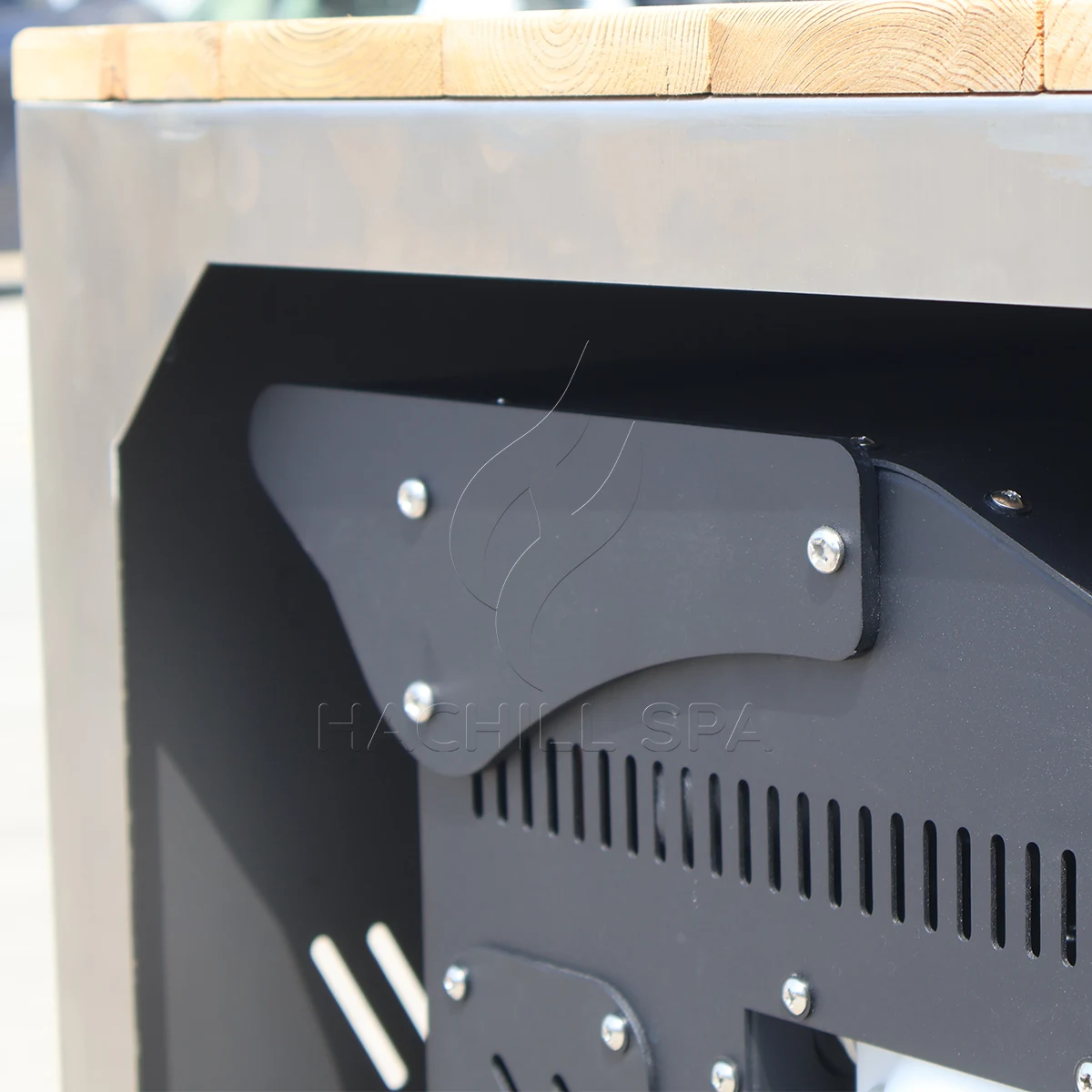
Foire aux questions
Le temps chaud signifie-t-il automatiquement que mon refroidisseur de bain froid est sous-dimensionné ?
Non. Des conditions plus chaudes peuvent augmenter l’apport de chaleur dans le système d’eau froide et aussi modifier les conditions d’air au condenseur pour un refroidisseur à air. La restriction du flux d’air, la recirculation, l’exposition solaire, l’état du débit/filtre et les conditions d’essai doivent être vérifiés avant de diagnostiquer une inadéquation de capacité.
Quelle température ambiante dois-je mesurer ?
Consignez l’ambiance générale du site ou de la pièce pour le contexte, mais distinguez-la de l’état de l’air représentatif de ce qui entre réellement dans le condenseur. Une lecture météo distante peut ne pas représenter l’entrée du refroidisseur en présence d’effets de recirculation locale ou de confinement.
La recirculation du condenseur peut-elle ralentir le refroidissement du bain froid ?
Oui, cela peut y contribuer. L’air chaud refoulé qui revient vers l’entrée du condenseur peut élever la condition locale de l’air à l’entrée et réduire les performances du refroidisseur. L’impact exact dépend de l’équipement et des conditions.
L’ombre peut-elle améliorer la performance de descente en température ?
L’ombre peut réduire l’apport de chaleur solaire sur les surfaces exposées de la cuve, de la couverture et de la tuyauterie. Elle ne prouve pas que la capacité du refroidisseur est correcte et ne corrige pas à elle seule un problème de circulation d’air du condenseur.
L'humidité réduit-elle directement la capacité du refroidisseur de bain froid ?
Pas comme règle universelle pour ce guide. L’humidité est hautement pertinente pour la condensation et le risque d’humidité autour des surfaces froides. Tout effet direct sur la capacité doit provenir de la conception exacte de l’équipement ou des données de performance du fabricant plutôt que d’une hypothèse générique.
Quand faut-il envisager un refroidisseur plus grand ?
Uniquement après que le régime requis est clairement défini et que les facteurs de confusion liés à l'ambiance/site, au débit, à la circulation d'air, à la commande et aux conditions d'essai sont suffisamment circonscrits. Si le régime valide reste non atteint, passez à une examen de la capacité plutôt que de surdimensionner à partir de la seule température ambiante.
Préparer un brief projet sur les conditions ambiantes
Si la performance d’abaissement nécessite encore un examen au niveau du modèle, envoyez les conditions du projet plutôt que seulement la phrase « il refroidit lentement par temps chaud ».
Inclure :
- identité du refroidisseur et du régulateur actuels ;
- volume d'eau réel si connu ;
- état initial de l'eau ;
- état cible de l'eau ;
- temps de descente en température représentatif ou enregistrement température-temps ;
- température ambiante de référence et lieu de mesure ;
- condition d’air entrant du condenseur, si disponible ;
- ensoleillement direct, ombre et état du couvercle ;
- murs, écrans, enceinte ou autres modifications autour du refroidisseur ;
- trajet d'admission et de refoulement d'air du condenseur ;
- état du débit et du filtre ;
- alarmes ou événements de protection ;
- installation intérieure ou extérieure ;
- destination et le contexte de site/électrique disponible si un examen du modèle exact est requis.
Garder les informations confirmées séparées des champs ouverts.
Cela donne à HACHILL une base plus claire pour décider si l’étape suivante est une correction des conditions du site, un nouvel essai apparié, un examen plus large du système ou une discussion sur le modèle/la capacité, sans transformer une observation par temps chaud en promesse d’équipement non étayée.