Guia de engenharia para banheira de imersão fria
Compras B2B e seleção de projetos para operadores comerciais, distribuidores, especificadores e marcas de bem-estar.
Resposta direta: Compre um cold plunge comercial como um sistema operacional completo, não como um vaso mais um tamanho anunciado do chiller. Antes de comparar cotações, defina a rotatividade de usuários, o volume real de água em operação, as temperaturas inicial e alvo, as condições ambientais na entrada do condensador, as expectativas de pull-down e de recuperação entre usuários, circulação, filtração e tratamento, entrada e saída, drenagem, alimentação elétrica, acesso de manutenção e requisitos do destino. Dois preços não são comparáveis até que o limite de fornecimento seja o mesmo: banheira, chiller, bomba, filtro, equipamento de tratamento, capa, controles, comissionamento, documentos, consumíveis e peças de reposição iniciais devem cada um ser identificados como fornecidos, fornecidos localmente ou excluídos.
O resultado útil de um guia de compra é uma lista restrita controlada e um RFQ que os fornecedores possam responder sem premissas ocultas. Este guia concentra-se em dados de decisão, evidências e verificações de aceitação. Ele não publica alegações não verificadas de capacidade, resfriamento, certificação, garantia ou entrega da HACHILL, e não trata um rótulo de produto comercial como aprovação para uso público.
Escopo da página: Esta página trata da decisão de compra em nível de sistema. Termos de categoria de produto pertencem à página de categoria de cold plunge; dimensões e configurações de modelo pertencem às páginas de produto; termos de fabricante, OEM e private label pertencem às páginas de serviço. A compatibilização detalhada da interface banheira-chiller pertence ao Guia de Compatibilização entre Banheira de Imersão Fria e Chiller, enquanto a qualificação do formato vertical pertence ao Guia de Compra de Banheira Vertical de Imersão Fria para Instalações Comerciais.
Nesta página
- Qualifique a aplicação comercial antes de comparar modelos
- Escreva o resumo operacional antes de ler o catálogo
- Avaliar pull-down e recuperação como funções separadas
- Defina o sistema completo de água, resfriamento e circulação
- Compare o formato da banheira com a tarefa do usuário
- Planeje o local, as utilidades, a drenagem e a rota de serviço
- Defina a sanitização como um programa operacional
- Colete dados de comissionamento e separe as causas
- Evidências de controle, responsabilidades e bloqueios de liberação
- Use portões de evidência antes do pagamento e do envio
- Escreva regras de aceitação e disputa antes do envio
- Planeje recebimento, comissionamento e operação inicial
- Entradas para RFQ de banheira de imersão fria comercial
- Matriz de comparação de cotações
Qualifique o regime comercial antes de comparar modelos de cold plunge
Uma banheira de imersão fria comercial é qualificada pela carga operacional e pelos limites de responsabilidade, não por um rótulo na cotação. Antes de comparar formato da cuba, potência do chiller ou opções de tratamento, congele pelo menos estas entradas: volume operacional de água, temperaturas inicial e alvo, tempo de pull-down requerido, pico de usuários por hora, temperatura de entrada do condensador de projeto e o tempo disponível para recuperação após uma sessão representativa. Acrescente regras de equipe, limpeza, fechamento e supervisão. Sem essas entradas, um fornecedor só pode cotar com base em premissas, e não em uma carga controlada.
O mesmo produto pode ser viável em um estúdio de recuperação supervisionado e inadequado em uma comodidade de hotel que opera por longos períodos com usuários mistos. A maior rotatividade adiciona calor corporal, introduz contaminantes com mais frequência, aumenta a perda de água na entrada/saída e comprime o tempo disponível para filtração e recuperação. Também altera a carga de trabalho do operador. Portanto, o comprador precisa de verificações separadas de térmica, hidráulica, gestão de água, ambiente e pessoal, em vez de uma declaração genérica de que a unidade é de grau comercial.
Registro de qualificação de banheira de imersão fria comercial
| Entrada de decisão | O que registrar | Por que pode desqualificar uma proposta |
|---|---|---|
| Padrão de operação | Horário de funcionamento, pico de usuários/hora, espaçamento entre sessões e períodos de fechamento | Controla a carga de recuperação, a carga de tratamento e a equipe |
| Carga de temperatura | Volume de operação, temperaturas inicial/alvo da água e tempo permitido | Define a energia da água e a saída necessária vinculada à condição |
| Ambiente de instalação | Interno/externo, temperatura ambiente de projeto, exposição solar/climática e caminho do ar do condensador | Altera o ganho de calor, a capacidade do resfriador e os requisitos de proteção |
| Interface do usuário | Método de entrada, usuários representativos, supervisão, abordagem úmida e espaço interno utilizável | Pode rejeitar um tanque que cabe no ambiente, mas não nas pessoas ou no modelo operacional |
| Interfaces do site | Carga preenchida, rota de entrega, energia, drenagem, ventilação e remoção para manutenção | Pode gerar obras ou impedir a instalação e a manutenção |
| Evidências e escopo | Configuração exata, componentes incluídos, condições de teste, documentos e responsabilidades locais | Evita orçamentos incomparáveis e suposições de conformidade sem fundamento |
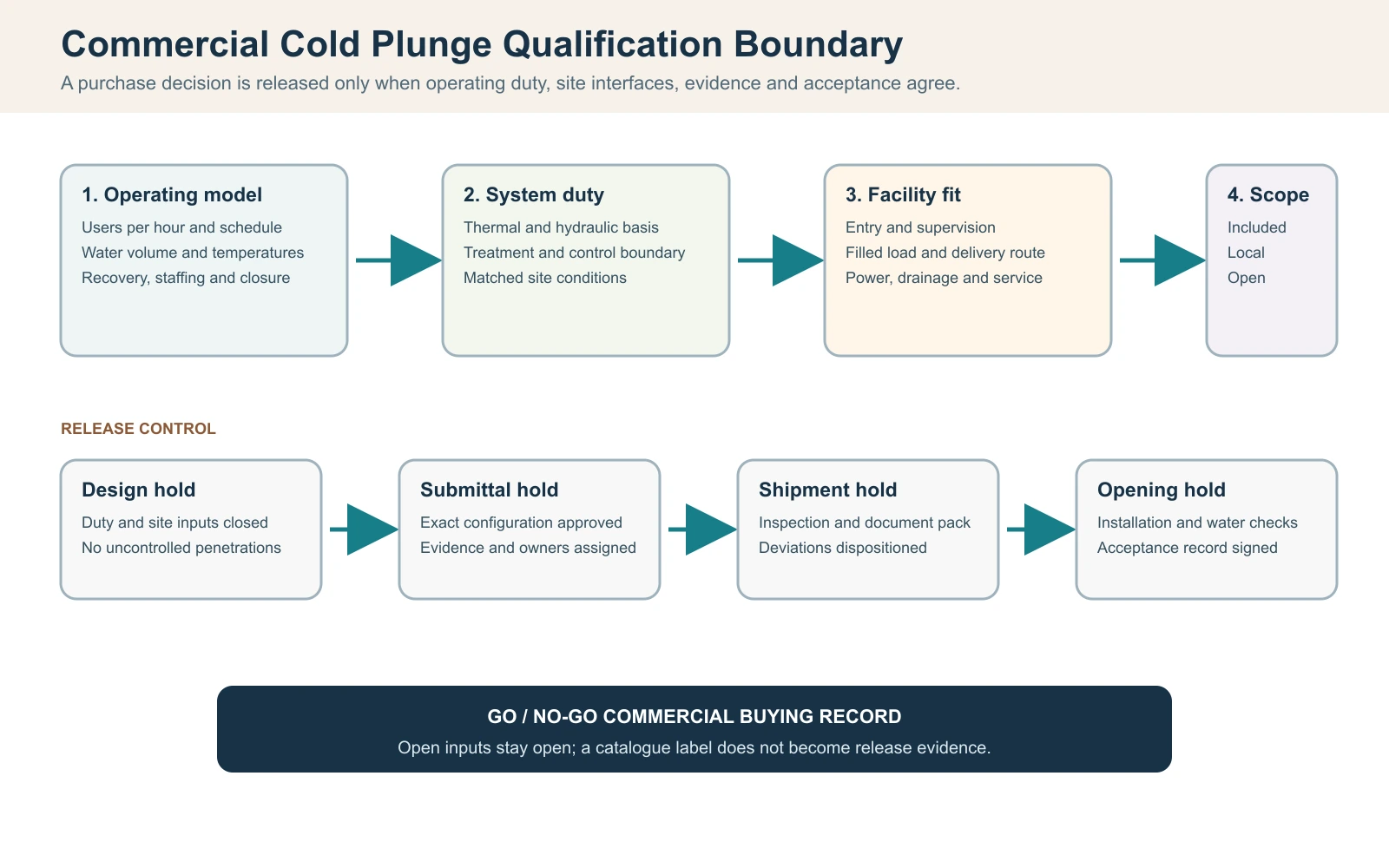
Regra de prosseguir/parar: não libere uma ordem de compra enquanto uma entrada necessária estiver representada apenas por um rótulo de catálogo, uma foto de aplicação ou uma suposição de fornecedor não confirmada. Registre-a como aberta, atribua um responsável e defina as evidências necessárias para encerrá-la.
Escreva o Resumo Operacional Antes de Ler o Catálogo
Uma residência usada por um proprietário treinado e um centro de recuperação atendendo sessões repetidas impõem cargas operacionais diferentes, mesmo quando o vaso visível é semelhante. Registre horário de funcionamento, pico de usuários por hora, espaçamento entre sessões, supervisão, estratégia de enchimento e drenagem, fechamentos para limpeza e a faixa de temperatura da água pretendida. Este é o briefing operacional contra o qual decisões de recuperação, tratamento, pessoal e espaço de serviço são verificadas.
O briefing também deve identificar se a instalação é interna ou externa, a faixa de temperatura ambiente de projeto, exposição solar, ventilação, risco de congelamento e o fornecimento elétrico disponível. Um resfriador selecionado apenas pelo volume de água pode atender a uma condição nominal de catálogo, mas falhar na recuperação entre usuários em uma área quente ou mal ventilada. Mantenha o desempenho necessário separado dos recursos preferenciais para que as alternativas possam ser comparadas de forma justa.
Avalie Pull-Down e Recuperação como Funções Comerciais Separadas
A primeira triagem térmica é o calor sensível removido da água. Para uma estimativa inicial de água líquida nessa faixa de temperatura, use Q = m x cp x Delta T, onde m é a massa de água em quilogramas, cp é aproximadamente 4.18 kJ/kg-K, e Delta T é a redução de temperatura. O resultado é uma triagem energética apenas da água: não inclui o calor que entra pelo vaso, superfície descoberta, tubulação, bomba, ambiente ou usuários, e não comprova a potência de um chiller específico.
Cálculo ilustrativo de resfriamento (pull-down)
Considere um caso de planejamento com 500 L de água em operação resfriando de 20 C para 10 C. Aproximando a massa de água como 500 kg, obtém-se 500 x 4.18 x 10 = 20,900 kJ, ou cerca de 5.81 kWh térmico. Se um sistema candidato puder fornecer 2.5 kW líquidos verificados de resfriamento útil em toda a faixa de condições relevantes, o tempo ideal considerando apenas a água é cerca de 5.81 / 2.5 = 2.32 horas.
Esse resultado de 2.32 horas não é uma promessa para o local. O tempo real é maior quando o calor ambiente e solar entra, a bomba adiciona calor, a tampa está aberta, o fluxo está fora da faixa exigida, o ar do condensador recircula ou a capacidade útil cai à medida que a água se aproxima do alvo. Use a capacidade líquida vinculada às condições ou um registro controlado de resfriamento do sistema completo, não a potência do compressor, os watts de entrada ou um ponto de capacidade medido com água mais quente.
Cálculo ilustrativo de recuperação pós-uso
Se uma sessão representativa eleva em 1.5 K o volume de água bem misturado de 500 L, o aumento de energia medido da água é de cerca de 500 x 4.18 x 1.5 = 3,135 kJ, ou 0.871 kWh térmico. Com os mesmos 2.5 kW líquidos verificados, o tempo ideal de recuperação somente da água é de cerca de 20.9 minutos. A recuperação real também inclui ganhos contínuos no local e ciclagem de controle. Meça a elevação de temperatura da sessão e o intervalo real entre usuários em vez de tratar um número de usuários por dia como o regime de pico.
Planilha ilustrativa de carga comercial
| Entrada | Valor ilustrativo | Evidência de projeto necessária |
|---|---|---|
| Volume de água em operação | 500 L | Configuração aprovada ou volume de enchimento medido |
| Temperatura inicial / alvo | 20 C / 10 C | Briefing operacional e registro de teste sincronizado |
| Energia somente com água | 5.81 kWh térmico | Cálculo com unidades e premissas |
| Capacidade líquida vinculada à condição | 2.5 kW ilustrativo | Dados de modelo/configuração em condições correspondentes de água, ambiente, vazão e alimentação |
| Puxador ideal | 2.32 h | Apenas resultado de triagem; valide o sistema instalado completo |
| Aumento medido da sessão | 1.5 K ilustrativo | Temperaturas da água bem misturada, antes/depois, e respectivos horários de medição |
| Recuperação ideal | 20.9 min | Adicione ganhos contínuos e comportamento de controle antes da aceitação |
A triagem de carga preenchida é separada: massa operacional total = produto seco + água + usuários máximos + cobertura/acessórios. Use a massa aprovada do produto e o volume operacional real e, em seguida, obtenha revisão estrutural qualificada quando necessário. Não infira a adequação do piso a partir do peso de transporte vazio.
Defina o Sistema Completo de Água, Resfriamento e Circulação
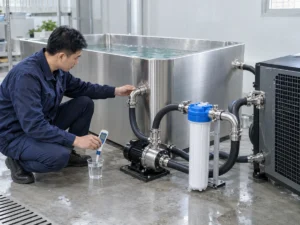
A banheira, a bomba de circulação, o filtro, o chiller e os equipamentos de tratamento formam um único circuito hidráulico. Diâmetro interno da tubulação, comprimento equivalente, conexões, posições de válvulas, estado do filtro e perdas de pressão dos componentes influenciam a vazão real através do trocador de calor. Uma bomba pode mostrar uma vazão máxima alta de catálogo, mas fornecer muito pouco depois que a resistência do circuito instalado é adicionada. Exija a faixa de vazão permitida para cada componente crítico e uma curva da bomba para o modelo exato e a frequência operacional; o casamento detalhado do circuito pertence então ao guia dedicado de banheira e chiller.
A comparação de resfriamento precisa do volume de água, temperaturas inicial e alvo, temperatura ambiente de projeto, tempo de redução necessário, carga de usuários repetidos e premissas de isolamento. A capacidade de resfriamento nominal deve estar vinculada às condições de teste declaradas. A potência em cavalos é um descritor do equipamento, não uma promessa direta de remoção de calor. A cotação deve declarar o que é medido, o que é calculado e o que permanece dependente do local.
Quando a lista final chegar à compatibilidade exata de tina, chiller, bomba, circuito e controle, continue com o Guia de Compatibilização entre Banheira de Imersão Fria e Chiller em vez de expandir essa análise de interface dentro deste guia de compra geral.
Compare o formato da banheira com a tarefa do usuário
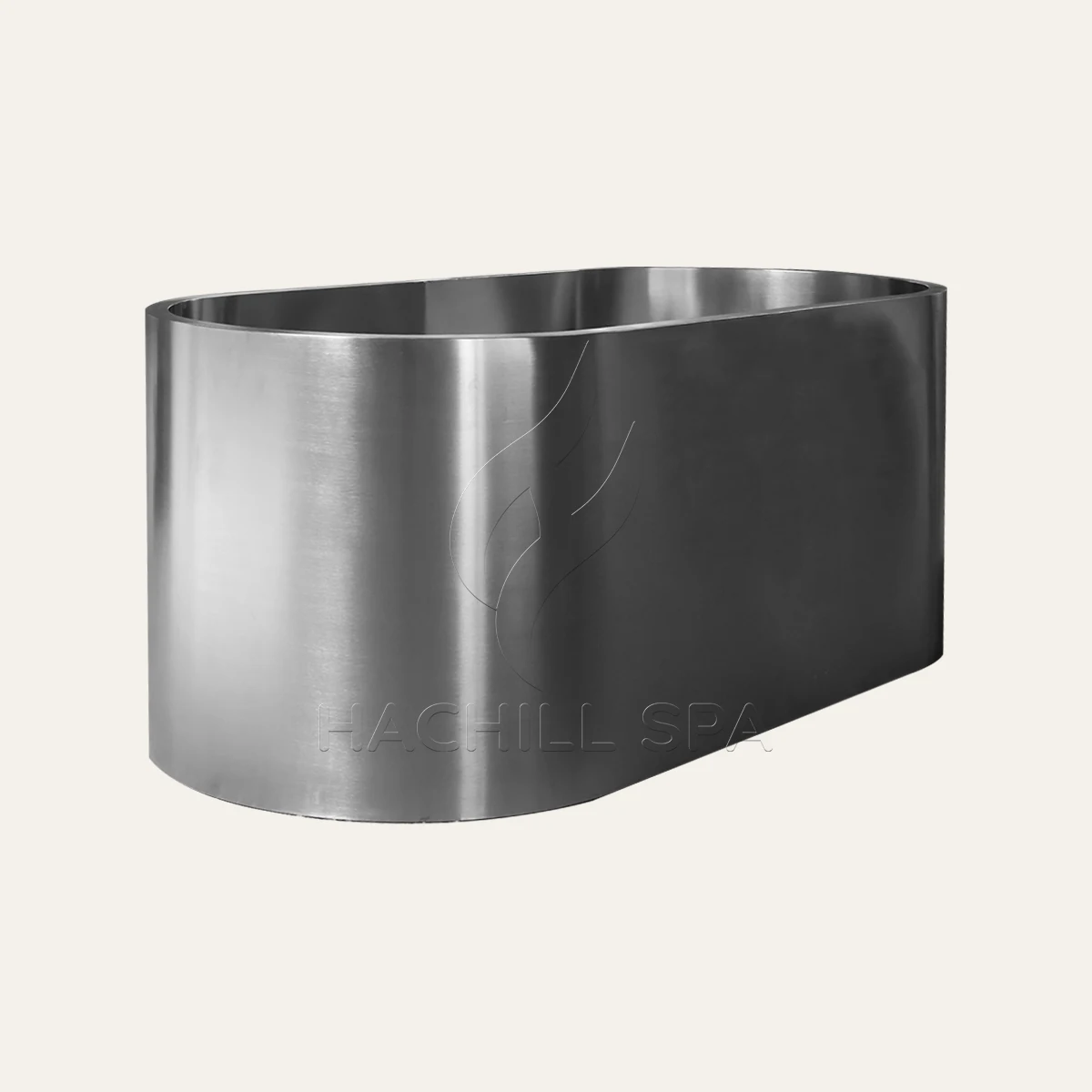
Banheiras verticais geralmente reduzem a área de planta, mas colocam mais ênfase na posição do degrau, apoio das mãos, folga superior e saída controlada. Banheiras horizontais usam mais área de piso e água, mas podem oferecer uma borda mais baixa e postura diferente. Nenhum formato é automaticamente mais seguro ou mais comercial. A escolha correta depende do perfil do usuário, supervisão da equipe, circulação em piso molhado, acesso para limpeza e o trajeto da área de troca até a zona de recuperação.
Confirme o espaço interno utilizável em vez de confiar nas dimensões externas ou em um rótulo de capacidade comercializado. Solicite o nível de água operacional, disposição de entrada, geometria interna, posição do dreno, pesos vazio e cheio, dimensões embaladas e pontos de içamento. Um desenho dimensional apoia o planejamento inicial; o desenho de pedido aprovado deve controlar fundações, portas, curvas de corredor e localizações finais de utilidades.
Se um formato vertical estiver sendo considerado, use o Guia de Compra de Banheira Vertical de Imersão Fria para Instalações Comerciais para a decisão de ir/não ir no nível de formato antes da seleção do modelo exato.
Cenário de engenharia: Os sistemas cotados não são equivalentes
Problema observado: Uma proposta parece mais barata, mas exclui o filtro, a bomba de circulação, a tampa, o comissionamento e os cartuchos sobressalentes.
Causa provável: A RFQ descreve um cold plunge, mas não congela o limite de fornecimento ou as entregas exigidas.
Como verificar: Crie uma matriz de inclusões linha a linha e reconcilie-a com a cotação, desenhos e lista de materiais.
Caminho de prevenção ou correção: Aprove uma matriz de responsabilidades antes da comparação de preços e leve-a para o pedido de compra.
Planeje o Local, as Utilidades, a Drenagem e a Rota de Serviço
Uma instalação de imersão fria gera respingos de água e pode produzir condensação em superfícies frias e tubulações. Coordene uma base nivelada e estruturalmente resistente, impermeabilização onde o conjunto construtivo exigir, drenagem, controle de derrapagem, ventilação ou desumidificação, proteção elétrica e uma rota acessível para inspecionar válvulas, filtros, elementos filtrantes e o chiller. Em locais de trabalho nos EUA onde a OSHA se aplica, 29 CFR 1910.22 exige que os pisos das salas de trabalho sejam mantidos limpos e, na medida do possível, secos; onde processos úmidos são usados, a drenagem deve ser mantida e locais secos para ficar em pé devem ser fornecidos na medida do possível. Esta é uma linha de base de local de trabalho, não um substituto para requisitos locais de saúde pública, construção, acessibilidade ou instalações aquáticas. A proteção elétrica final, aterramento, equipotencialização e provisões de GFCI ou RCD devem seguir as instruções exatas do equipamento e as regras locais aplicáveis.
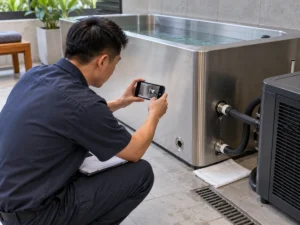
Não enclausure um chiller em armários sem confirmar as folgas de admissão, descarga e serviço. O fluxo de ar restrito do condensador aumenta a pressão de operação e pode reduzir a capacidade ou causar desligamentos por proteção. Da mesma forma, uma conexão de dreno visível em uma fotografia do produto não estabelece a rota de drenagem do local, a permissão de descarga ou o método de esvaziamento para condições de congelamento.
Defina a sanitização como um programa operacional
Filtragem, UV, ozônio ou outra tecnologia secundária não elimina a necessidade de um programa documentado de gestão da água. O operador ainda precisa dos limites de química, métodos de teste, registro, manutenção do filtro, intervalos de limpeza, resposta à contaminação e critérios de fechamento exigidos pelas regras operacionais aplicáveis. Em fevereiro de 2026, A NSF declarou que banheiras de água fria que incorporam sistemas de circulação, tratamento ou desinfecção já estão dentro do escopo da NSF/ANSI/CAN 50, incluindo sistemas pré-embalados e construídos em campo. Essa declaração de escopo não é uma alegação de certificação para qualquer modelo HACHILL, e os reguladores podem classificar ou aceitar banheiras frias de forma diferente conforme a jurisdição. Para contextos aquáticos públicos nos EUA, o Código de Saúde Aquática de Modelo do CDC permanece como orientação voluntária de modelo, e não lei federal, portanto a adoção e a aplicabilidade locais devem ser confirmadas.
Peça ao fornecedor que identifique cada componente de tratamento, sua ordem de instalação, condições de fluxo necessárias, pontos de serviço acessíveis, consumíveis e limites de compatibilidade. Frases de marketing como autolimpante ou livre de produtos químicos não substituem o desempenho documentado dos componentes, um procedimento operacional e aceitação local quando exigida. Quando a evidência estiver incompleta, mantenha a alegação fora da especificação e atribua um responsável para encerrá-la.
Para o programa detalhado de filtração, saneamento, testes e manutenção, use o Guia de cuidado da água da banheira de imersão fria; este guia de compra permanece responsável apenas por garantir que o programa operacional seja definido e atribuído antes da compra.
Cenário de engenharia: o chiller parece subdimensionado após a abertura
Problema observado: A água atinge a temperatura-alvo durante a noite, mas não recupera durante sessões consecutivas.
Causa provável: A seleção utilizou o volume do reservatório e uma condição de teste suave, enquanto a carga do usuário, as aberturas de porta ou tampa, o calor ambiente e o tempo de recuperação foram omitidos.
Como verificar: Registre as temperaturas de entrada e saída, as condições ambientais, a indicação de vazão e os horários de uso. Depois, compare esses dados com a base de seleção declarada.
Caminho de prevenção ou correção: Especifique separadamente as cargas de resfriamento inicial e de recuperação da temperatura entre usuários, e exija dados de desempenho nas condições relevantes.
Colete Dados de Comissionamento que Separem Causas de Produto, Local e Operação
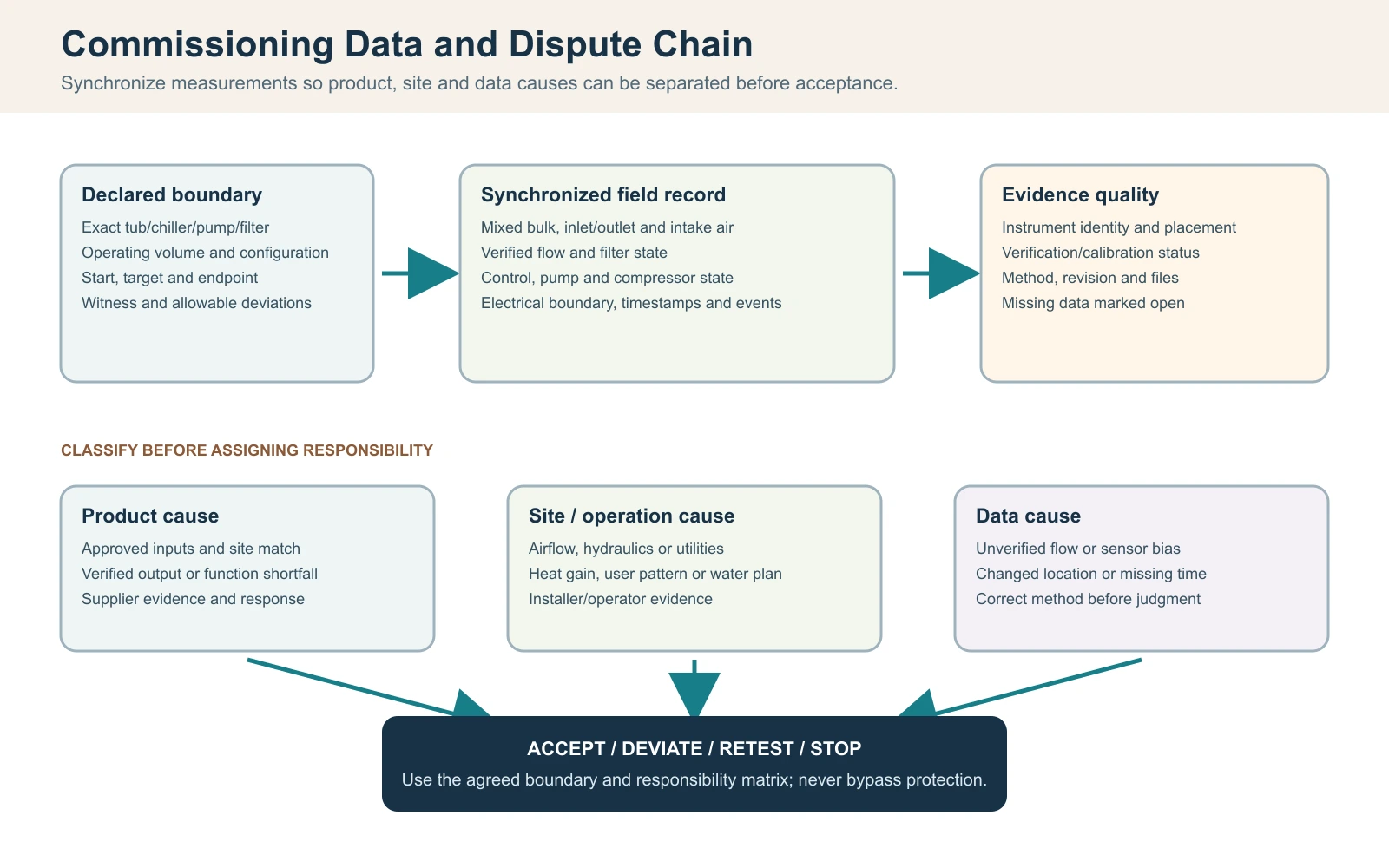
O comprador comercial precisa de registros sincronizados, pois a curva de temperatura, sozinha, não explica por que o desempenho mudou. Identifique a configuração exata da banheira, do chiller, da bomba, do filtro e do controle; registre a identificação dos instrumentos e a posição dos sensores; misture a água antes das leituras representativas do volume de água; e meça a temperatura ambiente na entrada de ar do condensador, não em um termostato de parede escolhido por conveniência. Registre os desvios em vez de alterar o histórico após o teste.
Registro de dados de comissionamento de banheira comercial de imersão fria
| Hora / evento | Água e ambiente | Estado hidráulico/controle | Evidência operacional |
|---|---|---|---|
| Antes do enchimento | Volume operacional aprovado e temperatura da água de origem | Posições das válvulas, estado do filtro e estado do dreno | Configuração, identidade do número de série e revisões do desenho |
| Início do teste | Água em massa misturada, entrada/saída do chiller e ar de entrada do condensador | Fluxo ou método verificado, modo da bomba, ponto de ajuste e estado da tampa | Tensão/frequência de alimentação e limite de entrada total, se medido |
| Intervalos fixos | Mesmas localizações de sensores e carimbos de data/hora | Estado do compressor/ventilador/bomba, alarmes e indicação de pressão do filtro | Abertura de porta/tampa, exposição solar e outros desvios |
| Sessão do usuário | Mistura de água a granel antes/depois e condição do ambiente | Estado dos controles e da circulação | Número de usuários, tempo de sessão e perda anormal de água |
| Ponto final | Mistura final de água a granel e ambiente de entrada | Transição de controle e evidência de fluxo estável | Tempo decorrido, testemunha, exceções e referências de ficheiros |
Use os registros para classificar a deficiência de desempenho. Uma causa ligada ao produto pode ser sustentada quando a configuração aprovada, as condições, a vazão e a infraestrutura correspondem ao previsto, mas o desempenho verificado permanece abaixo do limite acordado. Uma causa ligada ao local pode incluir restrição do ar no condensador, tubulação subdimensionada, carga térmica ambiente excessiva ou alimentação incorreta. Uma causa ligada aos dados inclui vazão não verificada, erro sistemático do sensor, mudança dos pontos de medição ou ausência de horários registrados. Não atribua responsabilidades antes de separar esses três grupos de causas.
Interrompa o teste e recorra à assistência qualificada se houver acionamentos repetidos das proteções elétricas ou de pressão, indício de vazamento de refrigerante, fiação danificada, superaquecimento, fumaça, água em conexões elétricas inseguras ou qualquer condição proibida pelo manual do modelo. Os operadores podem inspecionar condições visíveis e registros; não devem abrir compartimentos elétricos ou do circuito refrigerante, nem desativar uma proteção para concluir o teste.
Evidências de Controle, Responsabilidades e Bloqueios de Liberação
Hierarquia recomendada de evidências de compras em cinco níveis
| Nível | Evidência | Uso permitido |
|---|---|---|
| 1 | Registro de aceitação do pedido, acompanhado por testemunha nas condições acordadas | Aceitação contratual final dentro do limite escrito |
| 2 | Relatório de modelo/configuração independente ou acreditado em condições correspondentes | Comparação de alta confiança após revisão de escopo/aplicabilidade |
| 3 | Mapa de teste do fabricante específico do modelo com método, revisão e condições | Seleção de engenharia com limitações divulgadas |
| 4 | Cálculo transparente usando entradas aprovadas | Triagem e identificação de lacunas, não prova de desempenho entregue |
| 5 | Brochura genérica, etiqueta de categoria, HP, foto ou alegação verbal | Apenas descoberta; não é evidência de liberação |
Matriz de responsabilidades para banho de imersão em água fria comercial
| Decisão | Fornecedor | Comprador/operador | Instalador / profissional local | Evidência de liberação |
|---|---|---|---|---|
| Briefing operacional | Revisar viabilidade e entradas abertas | Definir usuários, cronograma, alvo e equipe | Revisar implicações de locais regulamentados | Base de serviço aprovada |
| Escopo do produto/sistema | Identificar a configuração exata fornecida | Aprovar inclusões, exclusões e substituições | Coordenar interfaces fornecidas localmente | Escopo e desenhos controlados |
| Estrutura/entrega | Fornecer dados aprovados de massa e manuseio | Fornecer restrições de rota e do local | Aprovar suporte, içamento e acesso quando necessário | Liberação de rota e fundação |
| Hidráulica/tratamento | Fornecer limites e instruções dos componentes | Plano próprio de operação/água | Instalar e verificar tubulações no local | Registros de fluxo, tratamento e drenagem |
| Conformidade elétrica/do local | Fornecer dados elétricos do modelo | Identificar destino e uso operacional | Projeto qualificado, proteção, aterramento e aprovação | Registros locais assinados quando necessário |
| Comissionamento | Apoiar verificações de produto acordadas | Fornecer operador e testemunha | Verificações regulamentares e de instalação concluídas | Registro de aceitação/desvios assinado |
Esta hierarquia de evidências é um método de controle de compras, não um padrão do setor. Uma sequência prática de projeto pode usar quatro bloqueios: bloqueio de projeto antes de trabalho irreversível no local; bloqueio de submissão antes do pedido de compra ou liberação para produção; bloqueio de embarque antes do despacho; e bloqueio de abertura antes de os usuários entrarem. Cada bloqueio deve ser encerrado somente quando a evidência nomeada estiver atualizada para a configuração encomendada. Uma referência normativa ajuda a definir um requisito ou escopo de teste; ela não prova por si só que um modelo HACHILL é certificado, aprovado ou aceito no mercado de destino.
Use portões de evidência antes do pagamento e do envio
As evidências devem se tornar mais específicas à medida que o projeto avança. Uma página de categoria pode apoiar a pesquisa inicial, mas a aprovação da lista de opções exige um quadro de especificações e um desenho do modelo. A liberação para produção exige a configuração aprovada, os requisitos elétricos do destino, materiais, acabamento, etiquetas, embalagem e plano de testes. A liberação para embarque exige registros de identificação, resultados de inspeção, evidências da embalagem e os documentos acordados no pedido. Nenhum desses registros, isoladamente, comprova conformidade além do modelo, mercado e revisão declarados.
Defina pontos de bloqueio para decisões que seriam caras de reverter. Não abra uma passagem no piso com base em uma posição preliminar do dreno, não compre o cabeamento do local a partir de uma foto de ambientação e não aprove um chiller apenas pela indicação de potência em cavalos. Suspenda essas ações até receber desenhos controlados das conexões, dados elétricos e condições de desempenho. Quando o destino exigir certificação, identifique a evidência exata e quem deve analisá-la, sem tratar CE, UL, ETL ou outra marca como termos intercambiáveis.
As condições de pagamento podem fazer referência a entregas objetivas sem prometer um resultado que o fornecedor não controla. Registros úteis incluem desenhos aprovados, uma lista de materiais fechada, verificações de fábrica acordadas, fotos da embalagem e não conformidades resolvidas. O desempenho no local continua dependendo da instalação, da vazão, da temperatura ambiente, da gestão da água e da operação. Por isso, as evidências de fábrica e de comissionamento devem permanecer separadas.
Documentos de destino precisam de sua própria verificação de liberação. Confirme o idioma do rótulo, as informações de classificação, o limite de plugue ou de fiação em campo, os manuais, o conteúdo de advertência, a identificação de peças de reposição e o escopo exato de modelo de qualquer registro de conformidade. Um documento de outra configuração, voltagem ou mercado pode ser um histórico útil, mas não consegue fechar o requisito do produto pedido. Quando NSF/ANSI/CAN 50, uma certificação elétrica, uma aprovação de saúde pública ou outro requisito específico do destino for relevante, registre a evidência do modelo/configuração exata e a parte responsável por aceitá-la. Mantenha evidências ausentes em aberto até que o revisor responsável as feche.
Escreva regras de aceitação e disputa antes do envio
A aceitação deve identificar a configuração exata, volume de operação, condição inicial/alvo, tempo permitido ou ponto de capacidade, temperatura ambiente de entrada do condensador, fluxo de água, estado de cobertura/solar, limite elétrico, locais de sensores, instrumentos, método de mistura, modo de controle, ponto final, testemunha e desvios permitidos. Se a condição sair da faixa acordada, marque a execução como inválida ou aplique apenas um método de correção pré-acordado. Não improvise uma correção após ver o resultado.
Registro de aceitação e disputas
| Contestação | Evidência a examinar | Providência imediata |
|---|---|---|
| O tempo de descida é mais longo | Volume de água, ganhos de calor, capacidade líquida correspondente, fluxo, controles e carimbos de data/hora | Mantenha o resultado aberto; classifique causas de produto/local/dados |
| As leituras de temperatura da água discordam | Identidade do sensor, posicionamento, mistura, resolução e estado de verificação | Não faça média de leituras incompatíveis; corrija o método e repita o teste |
| O escopo da cotação está incompleto | Escopo aprovado, desenhos, lista de embalagem e registro de substituições/alterações | Segure a receção ou instalação até que a responsabilidade seja resolvida |
| O desempenho do tratamento é contestado | Percurso hidráulico, estado dos componentes, registros de parâmetros químicos/testes e procedimento operacional | Perto dos usuários se o limite de água aprovado não puder ser demonstrado |
| Aparece dano visível ou vazamento | Recebimento de fotos, registro da caixa, identidade conjunta e registro do primeiro enchimento | Parar o enchimento/operação, preservar evidências e designar inspeção |
| Falta aprovação local | Requisito de destino, evidência de modelo/componente e revisão qualificada | Não comissionar ou abrir até que o caminho da autoridade responsável seja encerrado |
Acordar quem pode testemunhar, quem pode declarar um desvio, quem paga por um novo teste em cada categoria de causa e qual registro controla se houver conflito entre folheto, desenho e manual. Corrigir o documento governante por meio de controle de revisão, em vez de permitir que o pessoal do local selecione a declaração mais conveniente.
Planeje recebimento, comissionamento e operação inicial
A inspeção de recebimento deve ocorrer antes que a caixa seja descartada ou o produto seja movido por uma rota difícil. Corresponder a identidade do modelo e as quantidades à lista de embalagem, inspecionar superfícies e conexões acessíveis, registrar danos de transporte, confirmar componentes soltos e comparar revisões de documentos. Uma falta oculta descoberta após a instalação é mais difícil de alocar, enquanto uma marca de impacto não registrada pode ser posteriormente confundida com um defeito de fabricação.
O comissionamento deve verificar o sistema instalado em vez de repetir uma lista de verificação de fábrica. Confirmar suporte e nível, estanqueidade, posição da válvula, escorvamento, fluxo, estado do filtro, indicação de temperatura, resposta do controle, operação do tratamento, drenagem e acesso seguro. Registrar volume de água, condições ambientais e tempo ao avaliar o resfriamento. Parar e investigar vazamento persistente, fluxo desconhecido, disparos de proteção elétrica, ruído anormal ou resultado de temperatura fora do limite de teste acordado; não desativar intertravamentos para cumprir uma data de abertura.
O primeiro período de operação deve ter responsáveis nomeados para testes de água, manutenção de filtro, limpeza, resposta a alarmes e estoque de consumíveis. Compare a rotatividade real de pico de usuários, as condições de entrada do condensador e os intervalos de recuperação com as premissas de compra. Se a instalação operar de forma diferente do briefing aprovado, atualize os procedimentos e revise a capacidade do sistema antes de descrever o desvio como falha do produto. Esse feedback também deve ser levado para o próximo pedido ou especificação do distribuidor.
Encerre a entrega com uma lista de exceções em vez de uma assinatura de aceite genérica. Registre documentos pendentes, treinamento incompleto, conexões temporárias, lacunas de peças sobressalentes e desvios do layout aprovado. Atribua a cada item um responsável e evidência de conclusão. O operador também deve saber quais observações pertencem à manutenção de rotina, quais exigem o instalador e quais exigem o fornecedor do equipamento.
Para um distribuidor ou comprador de marca própria, alimente os achados recorrentes de recebimento e comissionamento de volta à especificação controlada. Conexões frouxas repetidas podem exigir uma verificação de embalagem ou pré-embarque; problemas recorrentes de fluxo de ar no local podem exigir um desenho de layout mais claro. Isso é uma evidência comercial mais forte do que adicionar alegações sem suporte à página de vendas, pois conecta a melhoria do produto a uma falha observável e a uma ação preventiva.
Entradas para RFQ de banheira de imersão fria comercial
Entradas para RFQ de banheira de imersão fria comercial
| Entrada | Por que isso muda a decisão | Evidência para solicitação |
|---|---|---|
| Uso e rotatividade | Altera recuperação, tratamento e carga de pessoal | Cronograma de operação e usuários por hora |
| Água e temperatura | Define massa térmica e remoção de calor | Volume de operação, temperaturas inicial/alvo e tempo |
| Ambiente e localização | Altera carga do condensador, ganho de calor e proteção contra intempéries | Faixa de temperatura ambiente de projeto e plano interno/externo |
| Hidráulica | Controla o fluxo real do trocador de calor e do filtro | Faixa de vazão, curva da bomba, tubulação e cronograma de equipamentos |
| Sanitização | Determina o tratamento e a carga de trabalho do operador | Lista de componentes, base de validação e plano de água |
| Utilidades e acesso | Pode desqualificar um sistema após a compra | Cronograma elétrico, drenagem e desenho de serviço |
Matriz de comparação de cotações
Matriz de comparação de cotações
| Item de linha | Incluído | Fornecido localmente | Evidência aberta |
|---|---|---|---|
| Cuba, isolamento e cobertura | Identificar o escopo exato do pedido | Registrar itens construídos no local | Materiais e desenho aprovado |
| Chiller e controles | Modelo e ponto de funcionamento | Invólucro para intempéries, se aplicável | Condições de teste de capacidade |
| Bomba, filtro e tratamento | Modelos e consumíveis | Canalização do local | Cálculo hidráulico e validação |
| Comissionamento e formação | Tarefas e registros | Trabalho de ofício licenciado | Critérios de aceitação |
| Peças sobresselentes e documentação | Pacote inicial | Inventário local | Idiomas e estado de revisão |
Lista de verificação do projeto
- Congele o briefing operacional e a premissa de rotatividade de usuários.
- Aprove a matriz completa de fornecimento e responsabilidades.
- Confirme a revisão do desenho, a rota embalada, o plano de içamento e a carga preenchida.
- Verifique a capacidade do chiller, as condições de teste, a faixa de fluxo e as folgas do condensador.
- Aprove as responsabilidades de tratamento, teste, limpeza e fechamento.
- Defina o acesso elétrico, de drenagem, ventilação e serviço no local.
- Registre as verificações de aceitação na fábrica, no recebimento e no comissionamento.
Informações a incluir em um RFQ
Envie dados em nível de modelo e específicos do local para que os fornecedores possam eliminar suposições antes da comparação de preços:
- Aplicação e mercado-alvo
- Usuários esperados por hora e cronograma de operação
- Requisitos de formato da banheira e de espaço útil
- Volume de água ou lista restrita de modelos aprovados
- Temperaturas inicial e alvo da água
- Faixa ambiente de projeto e tempo de recuperação
- Localização interna/externa e ventilação
- Tensão, frequência e fase
- Requisitos de tratamento e do operador
- Restrições de drenagem, entrega e serviço
- Documentos exigidos e conformidade com o destino
- Quantidade, marca e escopo de embalagem
Perguntas frequentes
O que os compradores comerciais devem comparar primeiro em uma banheira de imersão fria?
Compare primeiro o resumo operacional e o limite de responsabilidade. A rotatividade de usuários, a temperatura-alvo, as condições ambientais, o tempo de recuperação, a abordagem de saneamento, os serviços públicos e o acesso à manutenção determinam se dois sistemas são realmente equivalentes. O preço do tanque ou a etiqueta de potência do resfriador, por si só, não podem demonstrar isso.
Um rótulo comercial significa que a banheira de imersão fria é aprovada para uso público?
Não. Comercial é um termo de posicionamento do produto, não uma aprovação para uso público. Instalações públicas ou compartilhadas devem confirmar os requisitos de saúde pública, instalações elétricas, construção e acessibilidade do local de destino, além dos procedimentos operacionais e das evidências específicas do modelo. A NSF observa que a interpretação regulatória dos tanques de água fria varia conforme o estado e o município; por isso, a análise local responsável continua necessária.
Quais informações sobre o resfriador devem constar em uma solicitação de cotação (RFQ)?
Informe o volume de água operacional, as temperaturas inicial e alvo, a temperatura ambiente de projeto, os tempos desejados de resfriamento e recuperação, o padrão de uso, o isolamento, o local de instalação, a tensão e a frequência. Solicite a capacidade de resfriamento nas condições declaradas, a vazão necessária, as informações de conexão e os espaços livres do condensador.
A radiação UV ou o ozônio devem substituir os testes regulares da água?
Não. O tratamento secundário pode apoiar um programa de gestão da água projetado, mas não substitui o controle químico aprovado, a filtragem, a limpeza, os testes, o registro e a resposta à contaminação. O programa exato deve corresponder às instruções do equipamento, ao padrão de uso e às regras locais.
O que deve ser verificado quando a banheira de imersão fria chegar?
Verifique a condição da caixa, a identidade do modelo e do número de série, danos visíveis, conexões soltas, peças incluídas, revisões de documentos e a lista de embalagem aprovada antes de mover a unidade. Após a instalação, siga o procedimento de aceitação acordado para vazamentos, fluxo, controle, tratamento e temperatura antes de liberá-la para os usuários.
Recursos relacionados da HACHILL
Categoria de produto: banheira de imersão fria
Use a categoria de produto quando o briefing operacional estiver definido e a próxima tarefa for a pré-seleção da família de produtos.
Soluções comerciais de imersão em água fria
Use a página de solução comercial quando o tipo de local, o escopo do projeto e a implantação comercial forem mais importantes do que a comparação individual de produtos.
Guia de cuidados com a água para banheiras de imersão fria
Use o guia de cuidado com a água quando a decisão restante for filtração, saneamento, testes, limpeza ou registros operacionais de rotina.
Solicitar um orçamento de projeto
Use a rota de RFQ quando carga, escopo, interfaces do local e evidências exigidas estiverem definidos bem o suficiente para análise do fornecedor.
Base de referência
- NSF: Requisitos NSF/ANSI/CAN 50 para banheiras de imersão fria – orientação de escopo de fevereiro de 2026 declarando que banheiras frias com sistemas de circulação, tratamento ou desinfecção estão dentro da NSF/ANSI/CAN 50; isto não é uma alegação de certificação para qualquer modelo HACHILL.
- CDC 2024 Model Aquatic Health Code, 5ª Edição – Orientação-modelo atual dos EUA para instalações aquáticas públicas; não é lei federal e a adoção/aplicabilidade local deve ser confirmada.
- catálogo de normas da PHTA – Catálogo atual de normas ANSI/PHTA para piscinas públicas, spas e hot tubs; a aplicabilidade depende do projeto e da jurisdição.
- OSHA 29 CFR 1910.22 – Requisitos dos EUA para superfícies de caminhada e trabalho no local de trabalho, incluindo drenagem de processos úmidos e locais viáveis para permanência seca onde a regra se aplica.
- NIST Chemistry WebBook: Água – Referência de capacidade térmica da fase líquida que sustenta o valor aproximado de 4.18 kJ/kg-K na primeira passagem usado no cálculo ilustrativo de triagem.
Limite técnico e de segurança para o Guia de Compra de Banheiras de Imersão em Água Fria para Empresas e Compradores de Produtos: Manuais de produtos, desenhos aprovados, requisitos locais de construção, elétricos, de saúde pública e de acessibilidade, ofícios licenciados e profissionais qualificados de medicina ou segurança têm prioridade sobre orientação geral da web. Normas e orientações externas são usadas para definir perguntas de evidência, não para alegar certificação ou aprovação local para um modelo HACHILL. Este artigo não alega desempenho garantido no local ou benefício médico individual.