Cold Plunge Engineering Guide
B2B procurement and project selection for commercial operators, distributors, specifiers and wellness brands.
Direct answer: Buy a commercial cold plunge as a complete operating system, not as a vessel plus a headline chiller size. Before comparing quotations, define user turnover, actual operating water volume, start and target temperatures, condenser-intake ambient conditions, pull-down and between-user recovery expectations, circulation, filtration and treatment, entry and egress, drainage, electrical supply, service access and destination requirements. Two prices are not comparable until the supply boundary is the same: tub, chiller, pump, filter, treatment equipment, cover, controls, commissioning, documents, consumables and initial spares must each be identified as supplied, locally provided or excluded.
The useful output of a buying guide is a controlled shortlist and an RFQ that suppliers can answer without hidden assumptions. This guide concentrates on decision inputs, evidence and acceptance checks. It does not publish unverified HACHILL capacity, cooling, certification, warranty or delivery claims, and it does not treat a commercial product label as public-use approval.
Page scope: This page owns the system-level buying decision. Product-category terms belong to the cold-plunge category page; model dimensions and configurations belong to product pages; manufacturer, OEM and private-label terms belong to service pages. Detailed tub-to-chiller interface matching belongs to the Cold Plunge Tub and Chiller Matching Guide, while upright-format qualification belongs to the Upright Cold Plunge Buying Guide for Commercial Facilities.
On this page
- Qualify commercial duty before comparing models
- Write the operating brief before reading the catalogue
- Screen pull-down and recovery as separate duties
- Define the complete water, cooling and circulation system
- Compare tub format against the user task
- Plan the site, utilities, drainage and service route
- Define sanitation as an operating programme
- Collect commissioning data and separate causes
- Control evidence, responsibilities and release holds
- Use evidence gates before payment and shipment
- Write Acceptance and Dispute Rules Before Shipment
- Plan receiving, commissioning and early operation
- Commercial cold plunge RFQ inputs
- Quotation comparison matrix
Qualify Commercial Duty Before Comparing Cold Plunge Models
A commercial cold plunge is qualified by operating duty and responsibility boundaries, not by a label on the quotation. Before comparing vessel shape, chiller horsepower or treatment options, freeze at least these inputs: operating water volume, start and target temperatures, required pull-down time, peak users per hour, design condenser-intake temperature and the time available for recovery after a representative session. Add staffing, cleaning, closure and supervision rules. Without these inputs, a supplier can only quote against assumptions rather than a controlled duty.
The same product can be workable in a supervised recovery studio and unsuitable in a hotel amenity that operates for long periods with mixed users. Higher turnover adds body heat, introduces contaminants more frequently, increases entry/exit water loss and compresses the time available for filtration and recovery. It also changes operator workload. A buyer therefore needs separate thermal, hydraulic, water-management, room and staffing checks rather than one generic statement that the unit is commercial grade.
Commercial cold plunge qualification record
| Decision input | What to record | Why it can disqualify a proposal |
|---|---|---|
| Operating pattern | Opening hours, peak users/hour, session spacing and closure periods | Controls recovery duty, treatment workload and staffing |
| Temperature duty | Operating volume, start/target water temperatures and allowed time | Defines water energy and the required condition-linked output |
| Installation environment | Indoor/outdoor, design ambient, solar/weather exposure and condenser-air path | Changes heat gain, chiller output and protection requirements |
| User interface | Entry method, representative users, supervision, wet approach and usable internal space | Can reject a vessel that fits the room but not the people or operating model |
| Site interfaces | Filled load, delivery route, power, drainage, ventilation and service removal | Can create building work or prevent installation and maintenance |
| Evidence and scope | Exact configuration, included components, test conditions, documents and local responsibilities | Prevents unlike quotations and unsupported compliance assumptions |
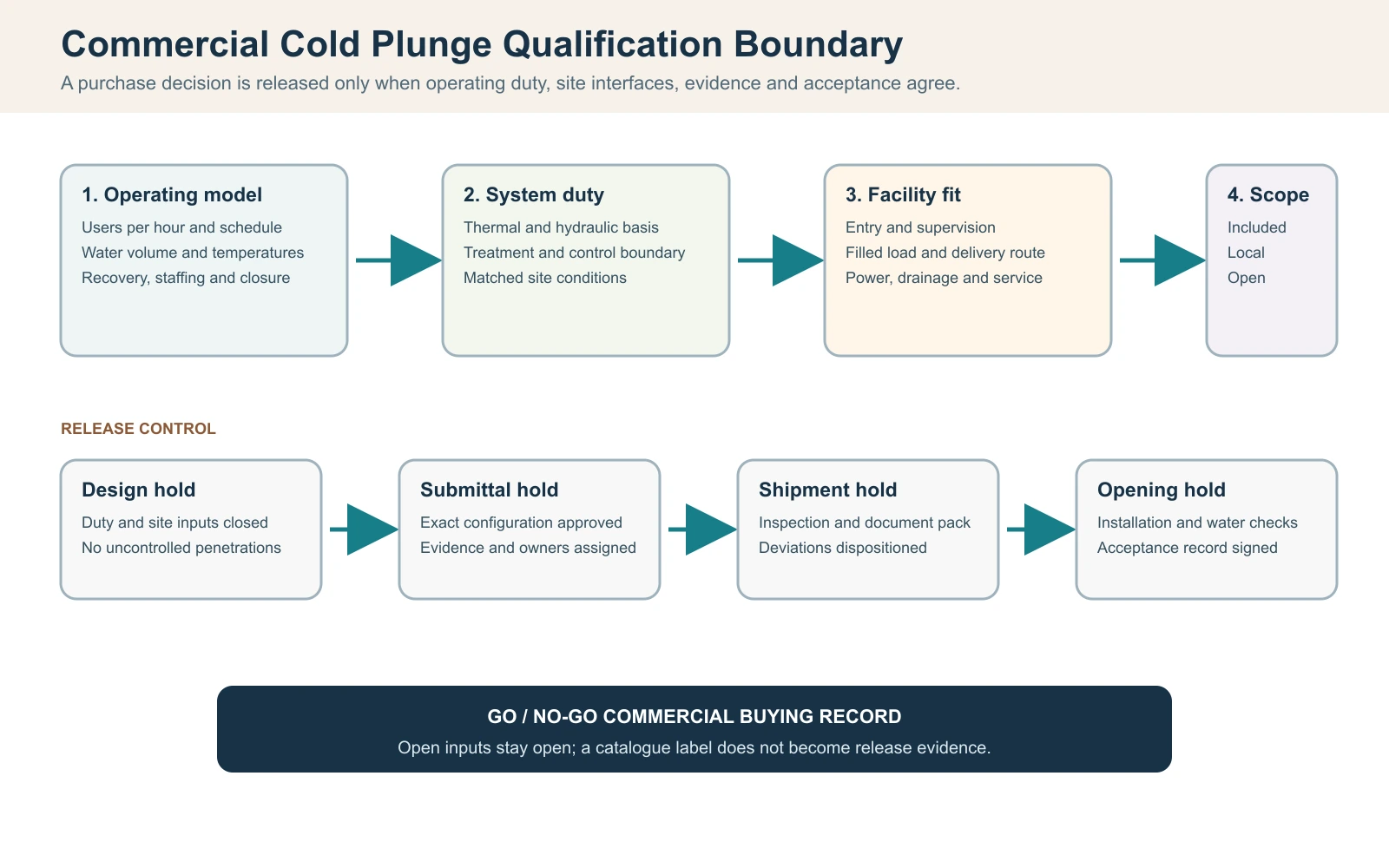
Go/no-go rule: do not release a purchase order while a required input is represented only by a catalogue label, an application photograph or an unmatched supplier assumption. Record it as open, assign an owner and define the evidence needed to close it.
Write the Operating Brief Before Reading the Catalogue
A residence used by one trained owner and a recovery centre serving repeated sessions impose different operating loads even when the visible vessel is similar. Record opening hours, peak users per hour, session spacing, supervision, fill-and-drain strategy, cleaning closures and the intended water-temperature range. This is the operating brief against which recovery, treatment, staffing and service-space decisions are checked.
The brief should also identify whether the installation is indoors or outdoors, the design ambient range, solar exposure, ventilation, freeze risk and the available electrical supply. A chiller selected from water volume alone may meet a nominal catalogue condition yet fail to recover between users in a hot or poorly ventilated plant area. Keep required performance separate from preferred features so alternatives can be compared fairly.
Screen Pull-Down and Recovery as Separate Commercial Duties
The first thermal screen is the sensible heat removed from the water. For a first-pass liquid-water estimate in this temperature range, use Q = m x cp x Delta T, where m is water mass in kilograms, cp is approximately 4.18 kJ/kg-K, and Delta T is the temperature reduction. The result is a water-only energy screen: it does not include heat entering through the vessel, uncovered surface, pipework, pump, room or users, and it does not prove the output of a particular chiller.
Illustrative pull-down calculation
Assume a planning case with 500 L of operating water cooling from 20 C to 10 C. Approximating water mass as 500 kg gives 500 x 4.18 x 10 = 20,900 kJ, or about 5.81 kWh thermal. If a candidate system can provide a verified net 2.5 kW of useful cooling throughout the relevant condition range, the ideal water-only time is about 5.81 / 2.5 = 2.32 hours.
That 2.32-hour result is not a site promise. Actual time is longer when ambient and solar heat enter, the pump adds heat, the cover is open, flow is outside the required range, condenser air recirculates or useful capacity falls as water approaches the target. Use condition-linked net capacity or a controlled complete-system pull-down record, not compressor HP, input watts or a capacity point measured at warmer water.
Illustrative post-user recovery calculation
If a representative session raises the well-mixed 500 L water volume by 1.5 K, the measured water energy increase is about 500 x 4.18 x 1.5 = 3,135 kJ, or 0.871 kWh thermal. At the same verified net 2.5 kW, the ideal water-only recovery time is about 20.9 minutes. Real recovery also includes ongoing site gains and control cycling. Measure the session temperature rise and the actual interval between users instead of treating a users-per-day figure as the peak duty.
Illustrative commercial duty worksheet
| Input | Illustrative value | Project evidence required |
|---|---|---|
| Operating water volume | 500 L | Approved configuration or measured fill volume |
| Start / target temperature | 20 C / 10 C | Operating brief and synchronized test log |
| Water-only energy | 5.81 kWh thermal | Calculation with units and assumptions |
| Condition-linked net capacity | 2.5 kW illustrative | Model/configuration data at matched water, ambient, flow and supply conditions |
| Ideal pull-down | 2.32 h | Screening result only; validate the complete installed system |
| Measured session rise | 1.5 K illustrative | Well-mixed before/after temperatures and timestamps |
| Ideal recovery | 20.9 min | Add ongoing gains and control behavior before acceptance |
Filled-load screening is separate: total operating mass = dry product + water + maximum users + cover/accessories. Use approved product mass and actual operating volume, then obtain qualified structural review where required. Do not infer floor suitability from the empty shipping weight.
Define the Complete Water, Cooling and Circulation System
The tub, circulation pump, filter, chiller and treatment equipment form one hydraulic circuit. Pipe inside diameter, equivalent length, fittings, valve positions, filter condition and component pressure losses influence actual flow through the heat exchanger. A pump can show a high catalogue maximum flow yet deliver too little once the installed loop resistance is added. Require the permitted flow range for each critical component and a pump curve for the exact model and operating frequency; detailed loop matching then belongs in the dedicated tub-and-chiller guide.
Cooling comparison needs water volume, initial and target temperatures, design ambient temperature, required pull-down time, repeated-user load and insulation assumptions. Rated cooling capacity must be tied to declared test conditions. Horsepower is an equipment descriptor, not a direct promise of heat removal. The quotation should state what is measured, what is calculated and what remains site-dependent.
When the shortlist reaches exact tub, chiller, pump, loop and control compatibility, continue with the Cold Plunge Tub and Chiller Matching Guide rather than expanding that interface analysis inside this general buying guide.
Compare Tub Format Against the User Task
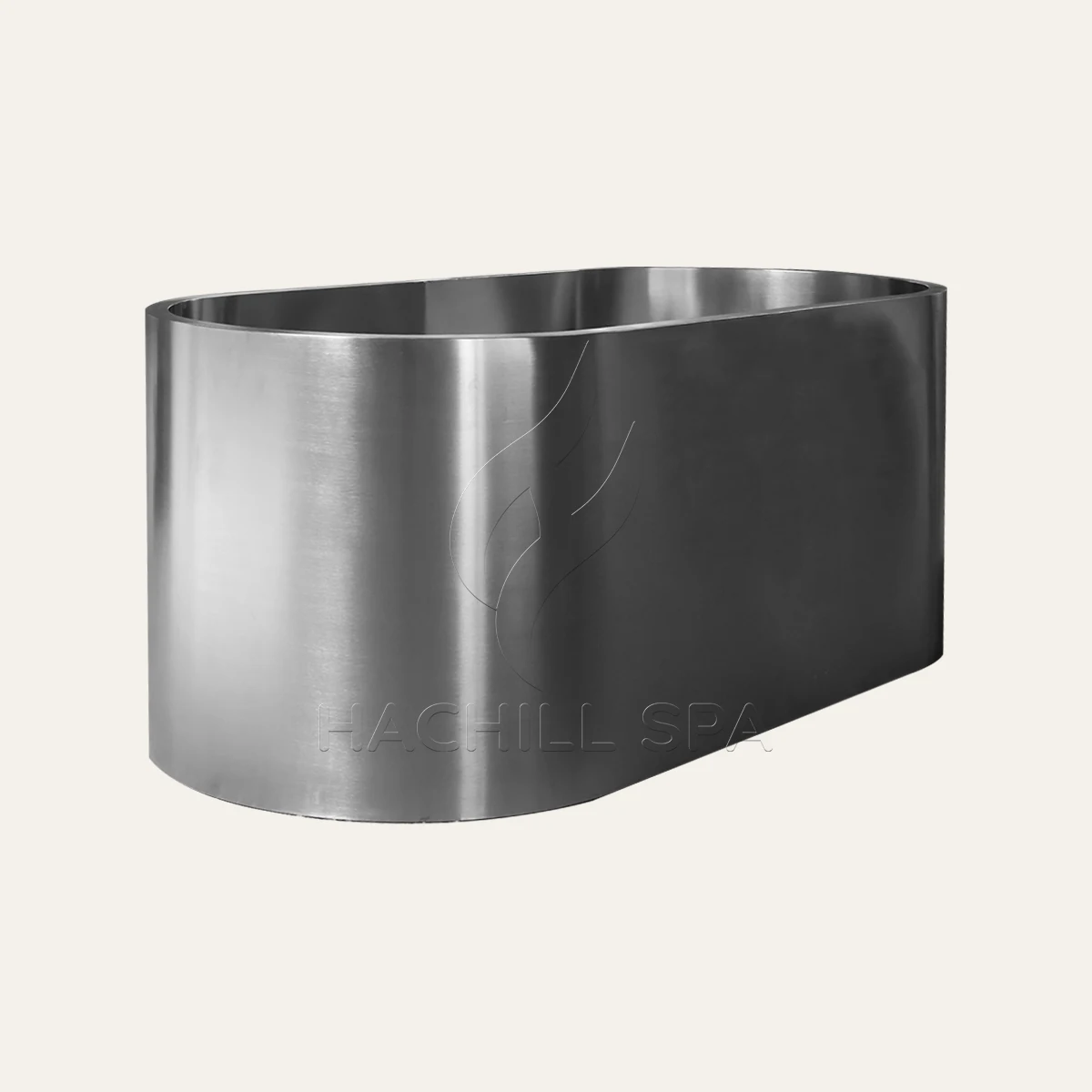
Upright tubs generally reduce plan area but place more emphasis on step position, hand support, overhead clearance and controlled exit. Laydown tubs use more floor area and water but may offer a lower rim and different posture. Neither format is automatically safer or more commercial. The correct choice depends on user profile, staff supervision, wet-floor circulation, cleaning access and the route from changing area to recovery zone.
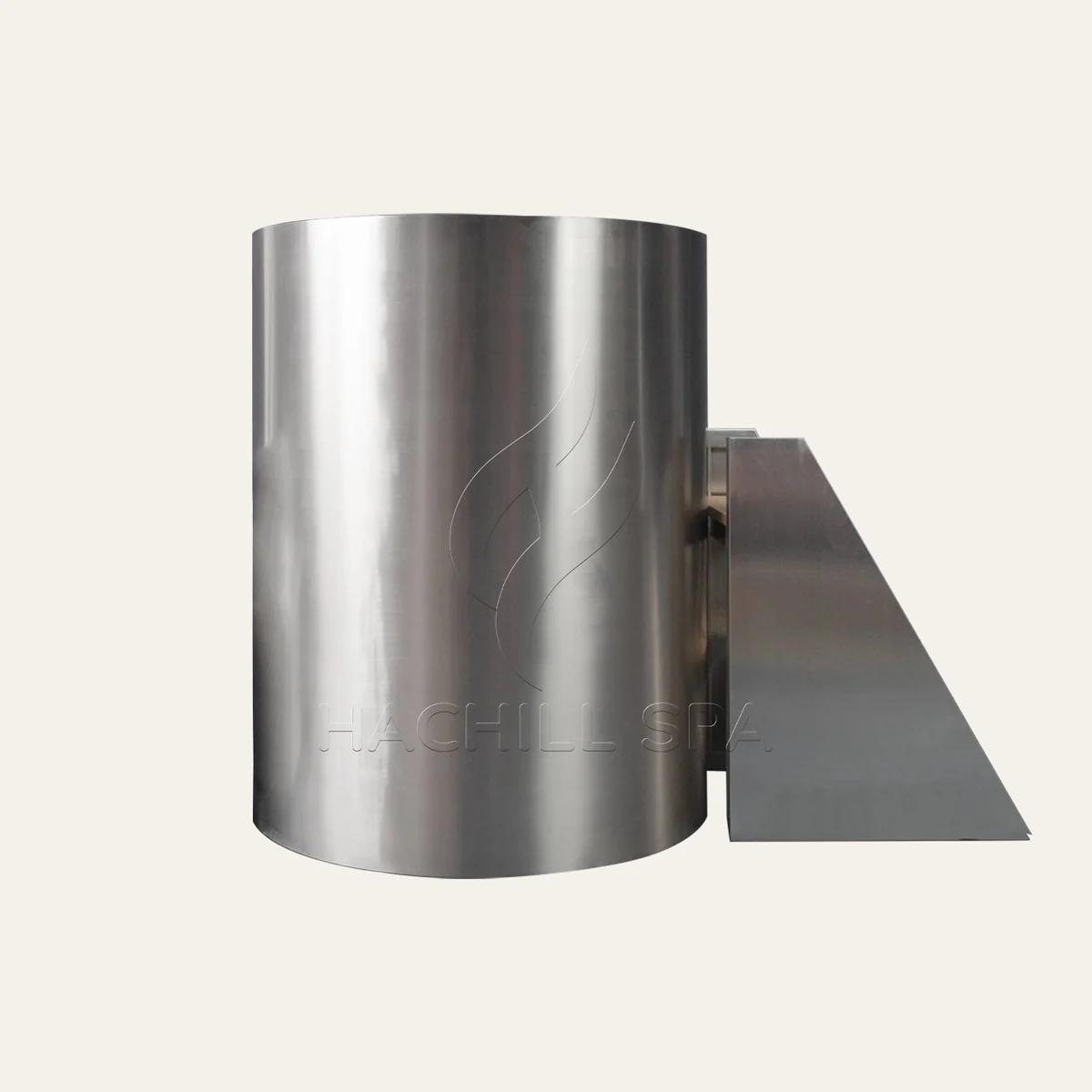
Confirm internal usable space rather than relying on external dimensions or a marketed capacity label. Ask for operating water level, entry arrangement, internal geometry, drain position, empty and filled weights, packed dimensions and lifting points. A dimension drawing supports early planning; the approved order drawing must control foundations, doorways, corridor turns and final utility locations.
If an upright format is being considered, use the Upright Cold Plunge Buying Guide for Commercial Facilities for the format-level go/no-go decision before exact-model selection.
Engineering scenario: The quoted systems are not equivalent
Observed problem: One proposal appears cheaper but excludes the filter, circulation pump, cover, commissioning and spare cartridges.
Likely cause: The RFQ describes a cold plunge but does not freeze the supply boundary or required deliverables.
How to check: Create a line-by-line inclusion matrix and reconcile it with the quotation, drawings and bill of materials.
Prevention or corrective path: Approve one responsibility matrix before price comparison and carry it into the purchase order.
Plan the Site, Utilities, Drainage and Service Route
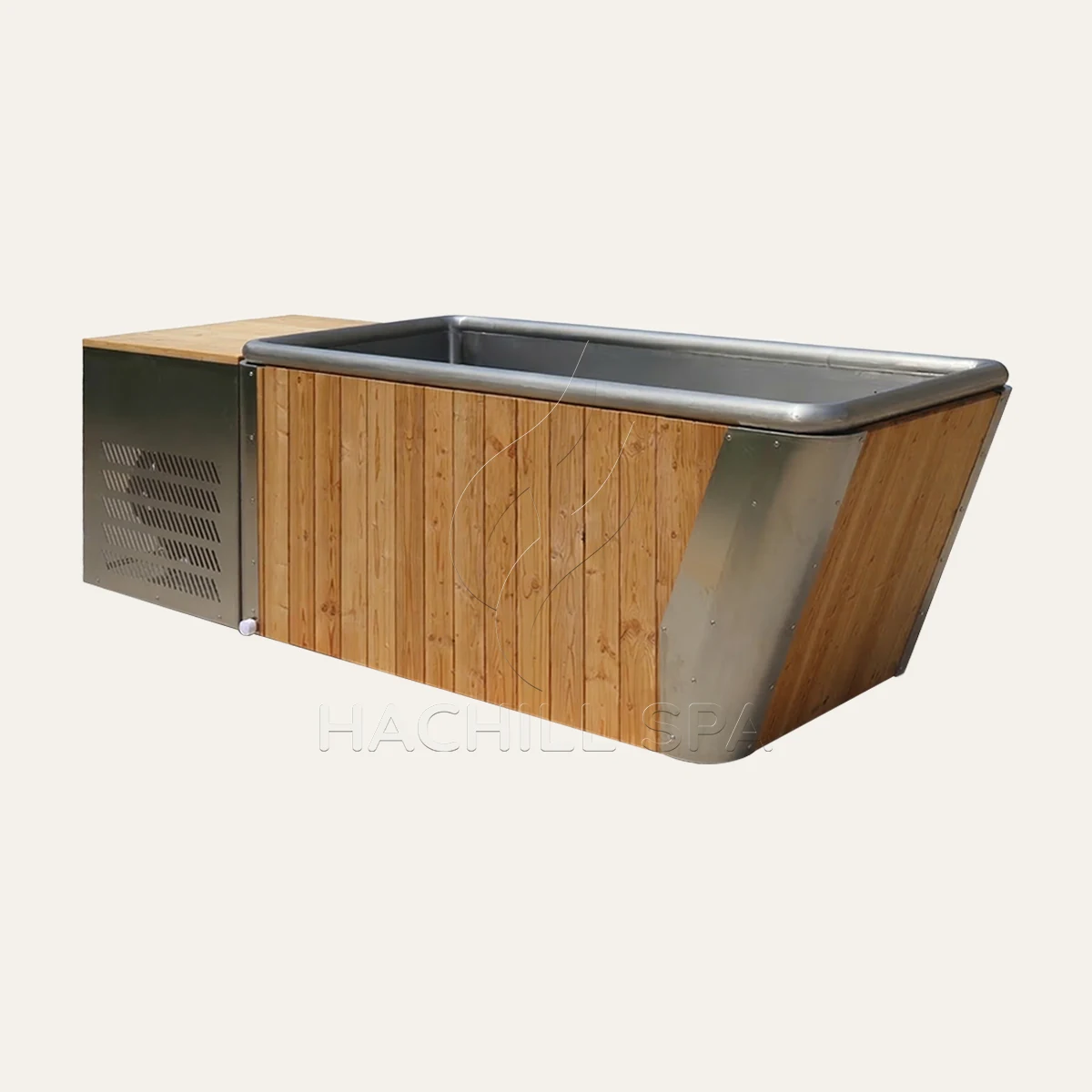
A cold plunge creates splash water and can produce condensation on cold surfaces and pipework. Coordinate a level load-bearing base, waterproofing where the building assembly requires it, drainage, slip control, ventilation or dehumidification, electrical protection and an accessible route to inspect valves, strainers, filters and the chiller. In U.S. workplaces where OSHA applies, 29 CFR 1910.22 requires workroom floors to be kept clean and, to the extent feasible, dry; where wet processes are used, drainage must be maintained and dry standing places provided to the extent feasible. This is a workplace baseline, not a substitute for local public-health, building, accessibility or aquatic-facility requirements. Final electrical protection, grounding, bonding and GFCI or RCD provisions must follow the exact equipment instructions and applicable local rules.
Do not box a chiller into cabinetry without confirming intake, discharge and service clearances. Restricted condenser airflow raises operating pressure and can reduce capacity or cause protection trips. Likewise, a drain connection visible in a product photograph does not establish the site drain route, discharge permission or drain-down method for freezing conditions.
Define Sanitation as an Operating Programme
Filtration, UV, ozone or another secondary technology does not remove the need for a documented water-management programme. The operator still needs the chemistry limits, test methods, logging, filter service, cleaning intervals, contamination response and closure criteria required by the applicable operating rules. In February 2026, NSF stated that cold tubs incorporating circulation, treatment or disinfection systems are already within the scope of NSF/ANSI/CAN 50, including prepackaged and field-built systems. That scope statement is not a certification claim for any HACHILL model, and regulators may classify or accept cold tubs differently by jurisdiction. For U.S. public aquatic contexts, the CDC Model Aquatic Health Code remains voluntary model guidance rather than federal law, so local adoption and applicability must be confirmed.
Ask the supplier to identify every treatment component, its installation order, required flow conditions, accessible service points, consumables and compatibility limits. Marketing phrases such as self-cleaning or chemical-free are not substitutes for documented component performance, an operating procedure and local acceptance where required. When evidence is incomplete, keep the claim out of the specification and assign an owner for closing it.
For the detailed filtration, sanitation, testing and maintenance programme, use the Cold Plunge Water-Care Guide; this buying guide remains responsible only for ensuring that the operating programme is defined and assigned before purchase.
Engineering scenario: The chiller looks undersized after opening
Observed problem: The water reaches target temperature overnight but cannot recover during consecutive sessions.
Likely cause: Selection used vessel volume and a mild test condition while user load, door or cover openings, ambient heat and recovery time were omitted.
How to check: Log inlet and outlet temperatures, ambient conditions, flow indication and user timing, then compare them with the declared selection basis.
Prevention or corrective path: State pull-down and between-user recovery duties separately and require performance data under relevant conditions.
Collect Commissioning Data That Separates Product, Site and Operating Causes
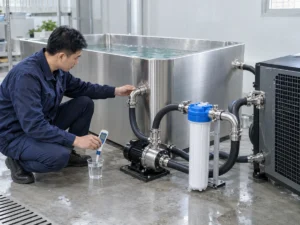
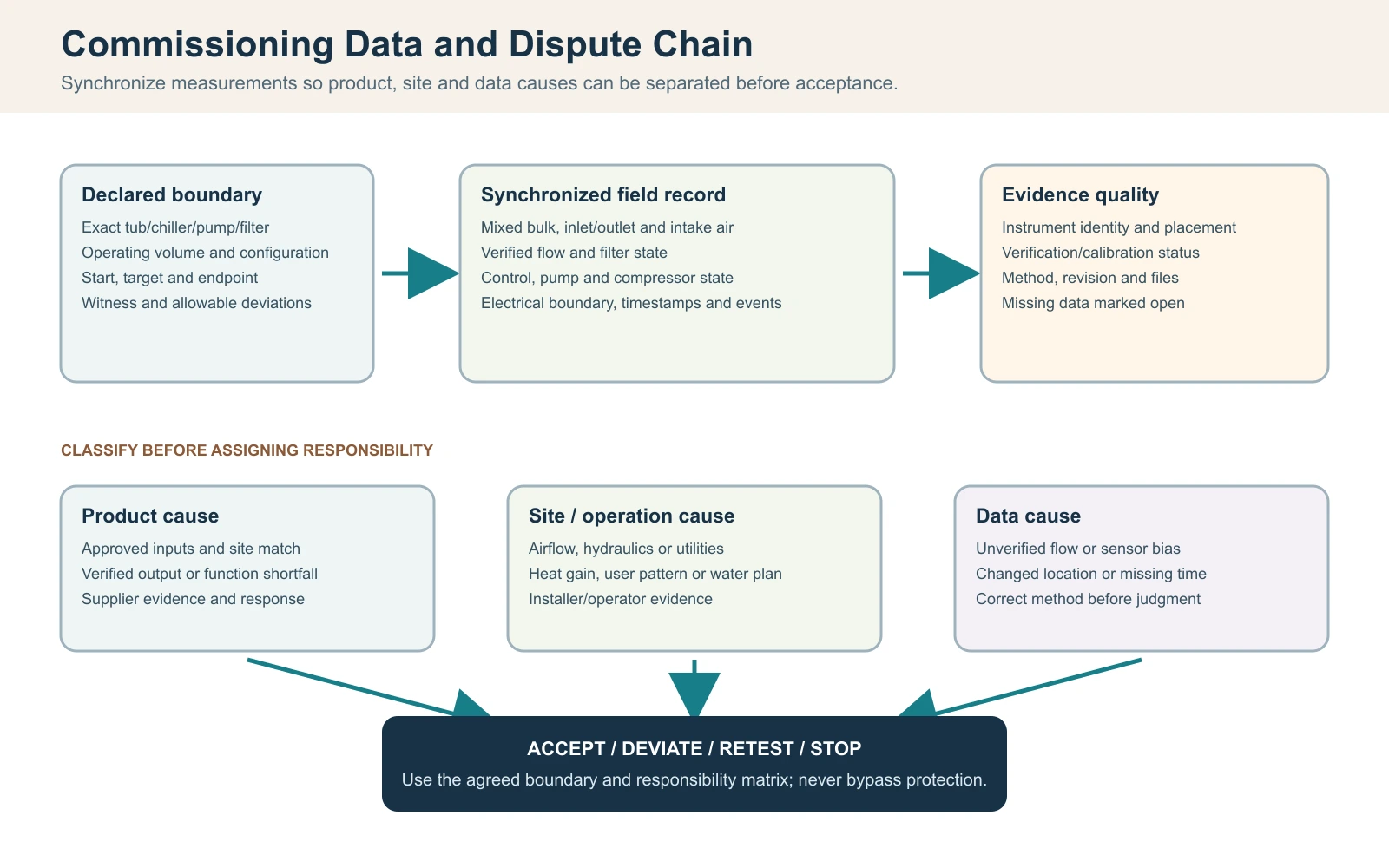
A commercial buyer needs a synchronized record, because an observed temperature curve alone cannot show why performance changed. Identify the exact tub, chiller, pump, filter and control configuration; record instrument identity and sensor position; mix the water before bulk readings; and place ambient measurement at the condenser intake rather than at a convenient room thermostat. Record deviations instead of correcting the log after the test.
Commercial cold plunge commissioning data log
| Time / event | Water and environment | Hydraulic/control state | Operational evidence |
|---|---|---|---|
| Before fill | Approved operating volume and source-water temperature | Valve positions, filter state and drain state | Configuration, serial identity and drawing revisions |
| Test start | Mixed bulk water, chiller inlet/outlet and condenser-intake air | Verified flow or method, pump mode, setpoint and cover state | Supply voltage/frequency and total-input boundary if measured |
| Fixed intervals | Same sensor locations and timestamps | Compressor/fan/pump state, alarms and filter pressure indication | Door/cover opening, solar exposure and other deviations |
| User session | Before/after mixed bulk water and room condition | Controls and circulation state | User count, session timing and abnormal water loss |
| Endpoint | Final mixed bulk water and intake ambient | Control transition and stable flow evidence | Elapsed time, witness, exceptions and file references |
Use the record to classify a shortfall. A product cause may be supported when the approved configuration, conditions, flow and utilities match but verified output remains below the agreed boundary. A site cause may include restricted condenser air, undersized pipework, excess ambient load or incorrect supply. A data cause includes unverified flow, sensor bias, changing locations or missing timestamps. Do not assign blame until these three cause groups are separated.
Stop the test and use qualified service when there is repeated electrical or pressure protection, refrigerant-leak indication, damaged wiring, overheating, smoke, water at unsafe electrical interfaces or any condition prohibited by the model manual. Operators may inspect visible conditions and records; they must not open electrical/refrigerant enclosures or bypass a protection control to complete a test.
Control Evidence, Responsibilities and Release Holds
Recommended five-level procurement evidence hierarchy
| Level | Evidence | Permitted use |
|---|---|---|
| 1 | Order-specific witnessed acceptance record at agreed conditions | Final contractual acceptance within the written boundary |
| 2 | Independent or accredited model/configuration report at matched conditions | High-confidence comparison after scope/applicability review |
| 3 | Model-specific manufacturer test map with method, revision and conditions | Engineering selection with disclosed limitations |
| 4 | Transparent calculation using approved inputs | Screening and gap identification, not proof of delivered performance |
| 5 | Generic brochure, category label, HP, photo or verbal claim | Discovery only; not release evidence |
Commercial cold plunge responsibility matrix
| Decision | Supplier | Buyer/operator | Installer / local professional | Release evidence |
|---|---|---|---|---|
| Operating brief | Review feasibility and open inputs | Own users, schedule, target and staffing | Review regulated site implications | Approved duty basis |
| Product/system scope | Identify exact supplied configuration | Approve inclusions, exclusions and substitutions | Coordinate locally supplied interfaces | Controlled scope and drawings |
| Structure/delivery | Provide approved mass and handling data | Provide route and site constraints | Approve support, lifting and access where required | Route and foundation release |
| Hydraulics/treatment | Provide component limits and instructions | Own operating/water plan | Install and verify site pipework | Flow, treatment and drain records |
| Electrical/site compliance | Provide model electrical data | Identify destination and operating use | Qualified design, protection, bonding and approval | Signed local records where required |
| Commissioning | Support agreed product checks | Provide operator and witness | Complete regulated and installation checks | Signed acceptance/deviation register |
This evidence hierarchy is a procurement-control method, not an industry standard. A practical project sequence can use four holds: design hold before irreversible site work; submittal hold before purchase-order or production release; shipment hold before dispatch; and opening hold before users enter. Each hold should close only when the named evidence is current for the ordered configuration. A standard reference helps define a requirement or test scope; it does not by itself prove that a HACHILL model is certified, approved or accepted in the destination market.
Use evidence gates before payment and shipment
Evidence should become more specific as the project advances. A category page can support early discovery, but shortlist approval needs a model-level schedule and drawing. Production release needs the approved configuration, electrical destination, materials, finish, labels, packaging and test plan. Shipment release needs identity records, inspection results, packing evidence and the document set agreed in the order. None of these records alone proves compliance outside its stated model, market and revision.
Set hold points around decisions that are expensive to reverse. Do not cut a floor penetration from a preliminary drain location, order site cabling from a lifestyle image or approve a chiller from a horsepower label. Hold these actions until controlled connection drawings, electrical data and performance conditions are issued. Where destination certification is required, name the exact evidence and responsible reviewing party instead of treating CE, UL, ETL or another mark as interchangeable wording.
Payment terms can reference objective deliverables without promising a result the supplier cannot control. Useful records include approved drawings, a frozen bill of materials, agreed factory checks, packing photographs and resolved nonconformities. Site performance still depends on installation conditions, flow, ambient temperature, water management and operation, so factory evidence and commissioning evidence should remain separate.
Destination documents need their own release check. Confirm label language, rating information, plug or field-wiring boundary, manuals, warning content, spare-parts identification and the exact model scope of any compliance record. A document from another configuration, voltage or market may be useful background but cannot close the ordered product requirement. Where NSF/ANSI/CAN 50, an electrical certification, a public-health approval or another destination-specific requirement is relevant, record the exact model/configuration evidence and the party responsible for accepting it. Keep missing evidence open until that responsible reviewer closes it.
Write Acceptance and Dispute Rules Before Shipment
Acceptance must identify the exact configuration, operating volume, start/target condition, allowed time or capacity point, condenser-intake ambient, water flow, cover/solar state, electrical boundary, sensor locations, instruments, mixing method, control mode, endpoint, witness and allowable deviations. If the condition moves outside the agreed band, mark the run invalid or apply only a pre-agreed correction method. Do not improvise a correction after seeing the result.
Acceptance and dispute register
| Dispute | Evidence to examine | Immediate disposition |
|---|---|---|
| Pull-down takes longer | Water volume, heat gains, matched net capacity, flow, controls and timestamps | Keep result open; classify product/site/data causes |
| Water temperature readings disagree | Sensor identity, placement, mixing, resolution and verification status | Do not average incompatible readings; correct method and retest |
| Quoted scope is incomplete | Approved scope, drawings, packing list and substitution/change log | Hold receiving or installation until responsibility is resolved |
| Treatment performance is disputed | Flow path, component state, chemistry/testing logs and operating procedure | Close to users if the approved water boundary cannot be demonstrated |
| Visible damage or leak appears | Receiving photos, crate record, joint identity and first-fill log | Stop fill/operation, preserve evidence and assign inspection |
| Local approval is missing | Destination requirement, model/component evidence and qualified review | Do not commission or open until the responsible authority path is closed |
Agree who can witness, who can declare a deviation, who pays for a retest under each cause category and which record controls if a brochure, drawing and manual conflict. Correct the governing document through revision control rather than allowing site personnel to select whichever statement is most convenient.
Plan Receiving, Commissioning and Early Operation
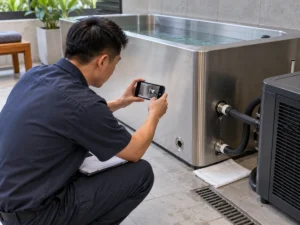
Receiving inspection should occur before the crate is discarded or the product is moved through a difficult route. Match model identity and quantities to the packing list, inspect accessible surfaces and fittings, record transport damage, confirm loose components and compare document revisions. A concealed shortage discovered after installation is harder to allocate, while an unrecorded impact mark can later be mistaken for a manufacturing defect.
Commissioning should verify the installed system rather than repeat a factory checklist. Confirm support and level, water tightness, valve position, priming, flow, filter state, temperature indication, control response, treatment operation, drainage and safe access. Record water volume, ambient conditions and timing when assessing cooling. Stop and investigate persistent leakage, unknown flow, electrical protection trips, abnormal noise or a temperature result outside the agreed test boundary; do not defeat interlocks to complete an opening date.
The first operating period should have named owners for water testing, filter service, cleaning, alarm response and consumable stock. Compare actual peak user turnover, condenser-intake conditions and recovery intervals with the purchase assumptions. If the facility operates differently from the approved brief, update procedures and review system capacity before describing the deviation as a product fault. This feedback should also be carried into the next order or distributor specification.
Close the handover with an exceptions list rather than a general acceptance signature. Record open documents, incomplete training, temporary connections, spare-part gaps and deviations from the approved layout. Give each item a responsible party and closure evidence. The operator should also know which observations belong to routine maintenance, which require the installer and which require the equipment supplier.
For a distributor or private-label buyer, feed recurring receiving and commissioning findings back into the controlled specification. Repeated loose fittings may require a packing or pre-shipment check; repeated site airflow problems may require a clearer layout drawing. This is stronger commercial evidence than adding unsupported claims to the sales page because it connects product improvement to an observable failure and preventive action.
Commercial cold plunge RFQ inputs
Commercial cold plunge RFQ inputs
| Input | Why it changes the decision | Evidence to request |
|---|---|---|
| Use and turnover | Changes recovery, treatment and staffing duty | Operating schedule and users per hour |
| Water and temperature | Defines thermal mass and heat removal | Operating volume, initial/target temperatures and time |
| Ambient and location | Changes condenser duty, heat gain and weather protection | Design ambient range and indoor/outdoor plan |
| Hydraulics | Controls real heat-exchanger and filter flow | Flow range, pump curve, pipe and equipment schedule |
| Sanitation | Determines treatment and operator workload | Component list, validation basis and water plan |
| Utilities and access | Can disqualify a system after purchase | Electrical schedule, drainage and service drawing |
Quotation comparison matrix
Quotation comparison matrix
| Line item | Included | Locally supplied | Open evidence |
|---|---|---|---|
| Tub, insulation and cover | Identify exact order scope | Record site-built items | Materials and approved drawing |
| Chiller and controls | Model and duty point | Weather enclosure if any | Capacity test conditions |
| Pump, filter and treatment | Models and consumables | Site plumbing | Hydraulic calculation and validation |
| Commissioning and training | Tasks and records | Licensed-trade work | Acceptance criteria |
| Spares and documentation | Initial package | Local inventory | Languages and revision status |
Project checklist
- Freeze the operating brief and user-turnover assumption.
- Approve the complete supply and responsibility matrix.
- Confirm drawing revision, packed route, lifting plan and filled load.
- Check chiller duty, test conditions, flow range and condenser clearances.
- Approve treatment, testing, cleaning and closure responsibilities.
- Define site electrical, drainage, ventilation and service access.
- Record factory, receiving and commissioning acceptance checks.
Information to include in an RFQ
Send model-level and site-specific inputs so suppliers can close assumptions before price comparison:
- Application and target market
- Expected users per hour and operating schedule
- Tub format and usable-space requirements
- Water volume or approved model shortlist
- Initial and target water temperatures
- Design ambient range and recovery time
- Indoor/outdoor location and ventilation
- Voltage, frequency and phase
- Treatment and operator requirements
- Drainage, delivery and service constraints
- Required documents and destination compliance
- Quantity, branding and packaging scope
Frequently asked questions
What should commercial buyers compare first in a cold plunge?
Compare the operating brief and responsibility boundary first. User turnover, target temperature, ambient conditions, recovery time, sanitation approach, utilities and service access determine whether two systems are genuinely equivalent. A vessel price or chiller horsepower label alone cannot show that.
Does a commercial label mean the cold plunge is approved for public use?
No. Commercial is a product-positioning term, not a public-use approval. Public or shared facilities must confirm the destination’s public-health, electrical, building and accessibility requirements, together with operating procedures and model-specific evidence. NSF notes that regulatory interpretations of cold tubs vary by state and municipality, so the responsible local review still matters.
What chiller information belongs in an RFQ?
Provide operating water volume, initial and target temperatures, design ambient temperature, desired pull-down and recovery times, user pattern, insulation, installation location, voltage and frequency. Ask for cooling capacity at declared conditions, required flow, connection information and condenser clearances.
Should UV or ozone replace routine water testing?
No. Secondary treatment can support a designed water-management programme, but it does not replace approved chemistry control, filtration, cleaning, testing, logging and contamination response. The exact programme must match the equipment instructions, use pattern and local rules.
What should be checked when the cold plunge arrives?
Check crate condition, model and serial identity, visible damage, loose fittings, included parts, document revisions and the approved packing list before moving the unit. After installation, follow the agreed leak, flow, control, treatment and temperature acceptance procedure before opening it to users.
Related HACHILL resources
Cold plunge product category
Use the product category when the operating brief is defined and the next task is product-family shortlisting.
Commercial cold plunge solutions
Use the commercial solution page when venue type, project scope and commercial deployment are more important than individual product comparison.
Cold plunge water-care guide
Use the water-care guide when the remaining decision is filtration, sanitation, testing, cleaning or routine operating records.
Request a project quotation
Use the RFQ route when duty, scope, site interfaces and required evidence are defined well enough for supplier review.
Reference basis
- NSF: NSF/ANSI/CAN 50 Requirements for Cold Plunges – February 2026 scope guidance stating that cold tubs with circulation, treatment or disinfection systems are within NSF/ANSI/CAN 50; this is not a certification claim for any HACHILL model.
- CDC 2024 Model Aquatic Health Code, 5th Edition – Current U.S. model guidance for public aquatic facilities; it is not federal law and local adoption/applicability must be confirmed.
- PHTA standards catalogue – Current catalogue of ANSI/PHTA standards for public pools, spas and hot tubs; applicability depends on the project and jurisdiction.
- OSHA 29 CFR 1910.22 – U.S. workplace walking-working-surface requirements, including wet-process drainage and feasible dry standing places where the rule applies.
- NIST Chemistry WebBook: Water – Liquid-phase heat-capacity reference supporting the approximately 4.18 kJ/kg-K first-pass value used in the illustrative screening calculation.
Technical and safety boundary for Cold Plunge Tub Buying Guide for Businesses and Product Buyers: Product manuals, approved drawings, local building, electrical, public-health and accessibility requirements, licensed trades and qualified medical or safety professionals take priority over general web guidance. External standards and guidance are used to define evidence questions, not to claim certification or local approval for a HACHILL model. This article does not claim guaranteed site performance or individual medical benefit.