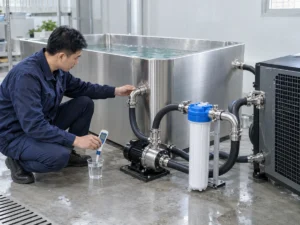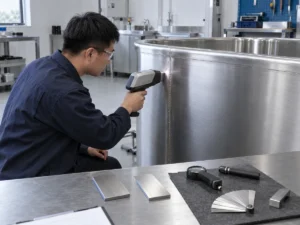
Cold Plunge Tub Materials Engineering Guide
Material comparison for brands, distributors, specifiers and commercial project buyers.
Direct answer: There is no universally best cold plunge tub material. Stainless steel can provide a robust welded water-retaining route, but alloy identity, weld cleanup, crevice geometry, water chemistry and insulation still control the result. Acrylic and fiberglass/composite systems can provide molded shapes and non-metallic wetted surfaces, but support, laminate construction, cleaner compatibility, UV exposure and repair method must be verified. Rotomolded polymer tubs add another one-piece molded route whose resin, wall construction, insulation and fittings are product-specific. Thermowood is commonly an exterior cladding or finish route in hybrid tubs, not proof of the water-retaining shell. Compare the complete construction against the actual water, cleaning, outdoor exposure, commercial duty and maintenance plan.
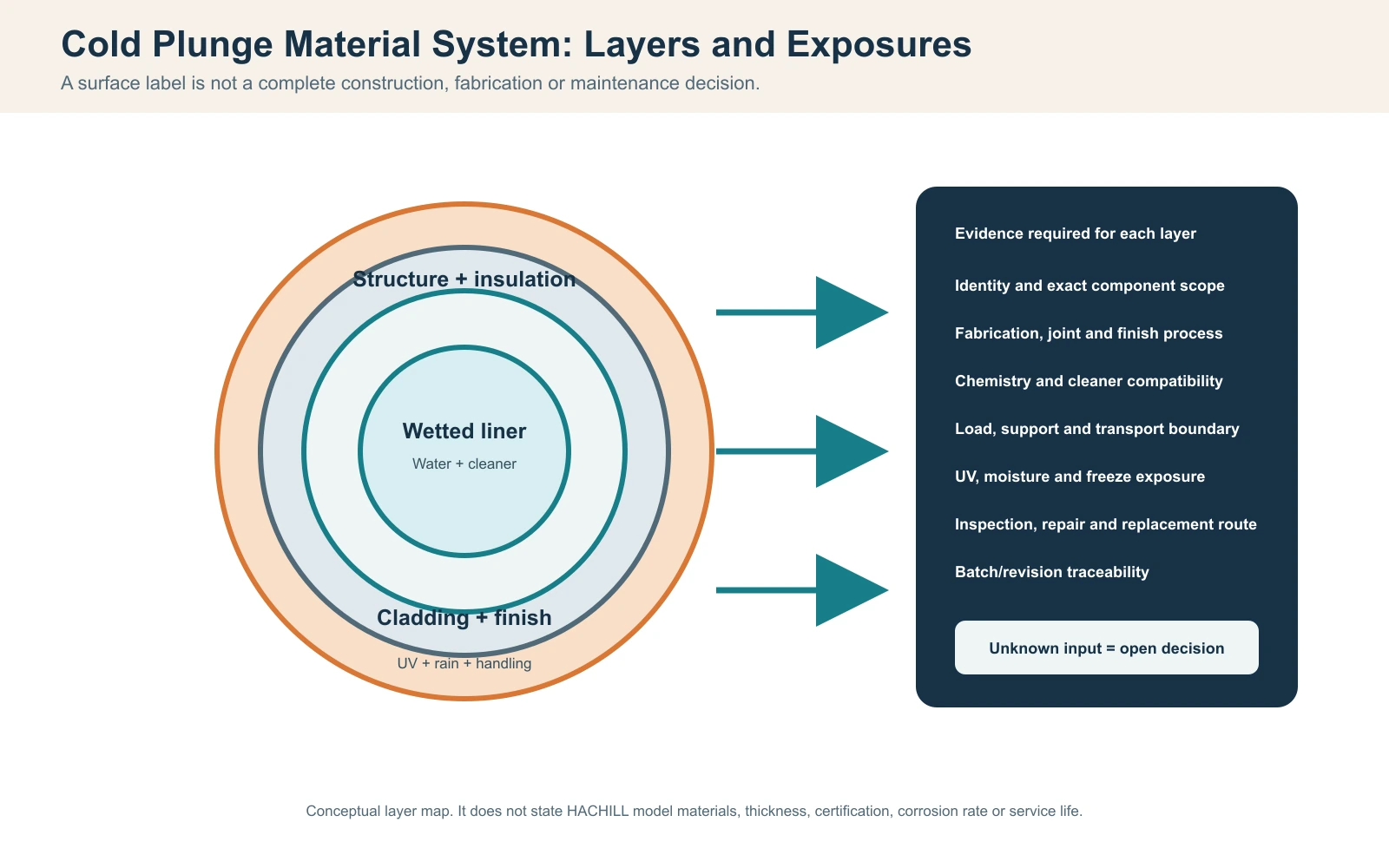
The useful buyer output is a material schedule that separates wetted liner, structure, insulation, cladding, fasteners, seals and finish, then links each layer to evidence, inspection and maintenance. Shell material alone does not establish thermal performance, corrosion resistance, repairability, service life or operating cost. This guide therefore compares decision logic rather than publishing unsupported HACHILL lifespan, corrosion-rate, thickness or certification claims.
Page scope: this article owns system-level cold plunge tub material comparison. The standalone 304-versus-316 query, exact model alloy or thickness, product certification status, complete cold-plunge system selection and model-specific finish options remain with their dedicated material, commercial buying or product records.
On this page
- Compare the Main Cold Plunge Material Routes
- Compare a Material System, Not a Single Surface Label
- Classify Exposure Before Naming the Preferred Material
- Verify Stainless Alloy and Surface Evidence Without Relying on Appearance
- Inspect Welds, Heat Tint, Crevices, Drainability and Passivation Records
- Compare Acrylic, Fiberglass, Composite and Rotomolded Polymer Systems
- Treat Thermowood and Other Cladding as a Moisture-Managed Envelope
- Check Fasteners, Dissimilar Metals, Seals and Penetrations as Separate Materials
- Connect Water Chemistry and Cleaning Records to Material Investigations
- Normalize Lifecycle Workload Without Inventing Lifespan or Cost
- Build a Traceable Sample and Production Inspection Plan
- Control Material Substitutions and Revision Changes
- Grade Material Evidence by Scope, Traceability and Independence
- Separate Cosmetic Variation, Fabrication Defect and Service Damage in Acceptance
- Issue an RFQ That Makes Material Assumptions Comparable
Compare the Main Cold Plunge Material Routes
Use the headline material only as the first filter. The procurement decision should compare what the material does in the complete tub, which exposures can change its performance, and what evidence is available for the exact ordered construction.
Cold plunge tub materials: quick buyer comparison
| Material route | What it can offer | What buyers must verify | Common comparison error |
|---|---|---|---|
| Stainless steel | Welded metal liner or body with inspectable joints and a defined alloy/finish route | Exact grade, component scope, weld treatment, surface condition, crevices, drainability, insulation and chemistry limits | Assuming 304 or 316 alone predicts corrosion resistance, hygiene, lifespan or cold retention |
| Acrylic / fiberglass-composite | Molded geometry with a polymer water-facing surface and separate reinforcement/support layers | Surface identity, backing/laminate, frame support, cleaner and UV limits, penetrations, repair method and insulation | Treating “acrylic” or “fiberglass” as a complete construction specification |
| Rotomolded polymer | One-piece molded body that can integrate shape, wall cavities or insulation depending on design | Polymer grade, wall/foam construction, UV declaration, fittings, support, cleaner limits and repair/replacement route | Assuming all molded plastics have the same UV, impact, insulation or chemical behavior |
| Thermowood-clad hybrid | Wood exterior appearance and touch while a separate liner performs the water-retaining function | Actual liner, wood species/modification, rear ventilation, drainage, fasteners, finish, replaceability and maintenance instructions | Treating exterior wood as the water barrier or as maintenance-free outdoor construction |
Selection rule: choose the route whose complete construction is documented for the project exposure and whose cleaning, inspection and repair tasks the operator can actually support. If the supplier cannot define the layers behind the marketing material label, the comparison is still open.
Compare a Material System, Not a Single Surface Label
A cold plunge material decision must separate the wetted liner, structural support, insulation, exterior cladding, fasteners, seals, penetrations and finish. These layers see different water, chemical, UV, temperature, load and maintenance conditions. A stainless-looking shell does not prove alloy, thickness, weld treatment or passivation, while a Thermowood label normally describes an exterior route rather than the water-retaining structure.
Start with the service environment and the failure consequences, then request evidence for the exact ordered configuration. The decision output should state which layer performs each function, what exposure it sees, how it is fabricated and cleaned, which document proves the claim, and what inspection releases production and delivery. A generic material advantage cannot close an interface that remains unspecified.
Cold plunge material-system map
| Layer | Primary function | Exposure questions | Release evidence |
|---|---|---|---|
| Wetted liner | Contain water and provide cleanable surface | Chemistry, deposits, cleaners, temperature and drain-down | Exact material/finish schedule and fabrication record |
| Structure/support | Carry water, user and handling loads | Point loads, moisture, movement and transport | Approved support drawing and material record |
| Insulation/enclosure | Limit heat gain and manage condensation | Wet-dry cycles, closed-cell/open-cell behavior and access | Section detail and approved construction |
| Cladding | Exterior finish and protection | UV, rain, splash, ventilation and cleaning | Exact species/system, finish and maintenance instructions |
| Fasteners/seals | Join and isolate interfaces | Crevices, galvanic contact, chemical and replacement | Bill of materials, compatibility and substitution control |
| Finish | Surface condition and appearance | Abrasion, repair, heat tint, coating and variation | Approved sample plus measurable acceptance criteria |
Release rule: material identity, fabrication quality and service conditions are separate gates. Passing one does not prove the others.
Classify Exposure Before Naming the Preferred Material
Build an exposure register for the water side, exterior and interfaces. Record disinfectant or sanitizer approach, normal and upset chemistry, chloride or salt additions, source-water variation, cleaning products, sunscreen and body-oil load, drain/refill frequency and idle periods. Separately capture indoor or outdoor location, coastal air, direct UV, rain, freeze-thaw exposure, humidity, standing water and ventilation behind cladding.
Use a project-defined exposure screen rather than invented corrosion rates or life predictions. Rank likelihood and consequence with clearly named categories, record the evidence behind each rating, and define in advance which findings require higher-grade evidence, a design change or specialist review. The screen is a prioritization tool only; it does not predict years of service. Thresholds must be set by the project team and checked against model instructions, chemistry design and local conditions.
Illustrative material exposure register
| Exposure | Project input | Affected layers | Required decision |
|---|---|---|---|
| Chlorides/salts | Source water, additions, concentration trend and splash | Liner, welds, fasteners and hardware | Alloy/fabrication/chemistry compatibility |
| Sanitizer and pH | Normal range, upset response and dosing point | All wetted materials and seals | Supplier limits plus operator control |
| Cleaning chemicals | Product, dilution, contact, rinse and tools | Surface, coating, seals and cladding | Approved cleaner and procedure |
| Coastal/UV/weather | Distance/exposure, shelter, solar and rain | Cladding, hardware and exterior finish | Protection, drainage and maintenance route |
| Freeze/wet-dry | Climate, shutdown and drain-down | Liner, joints, insulation and pipe interfaces | Model-specific protection and stop rules |
| Commercial handling | Users, cleaning cycles and delivery impacts | Surface, support and replaceable parts | Duty, inspection and repair plan |
Keep unknown inputs visible. If chloride trend, cleaner selection or outdoor shelter is undecided, the material choice is conditional rather than approved. Do not classify an unknown exposure as low risk simply because no data were supplied.
Verify Stainless Alloy and Surface Evidence Without Relying on Appearance
304 and 316 are alloy families, not complete durability statements. The more corrosion-resistant option may be appropriate for some chloride or coastal exposures, but neither is universally corrosion-proof. Surface condition, fabrication contamination, crevice geometry, deposits, water chemistry, cleaner use and maintenance can dominate local behavior. Exact grade claims require order-specific support.
Specify the designation system used, component scope and evidence required. A mill test certificate can link a heat or batch to chemistry and mechanical data, but only if traceability connects that material to the ordered component. A handheld positive material identification test may support identity when performed by a competent party with a documented method, yet it does not prove thickness, passivation, weld quality or future corrosion performance.
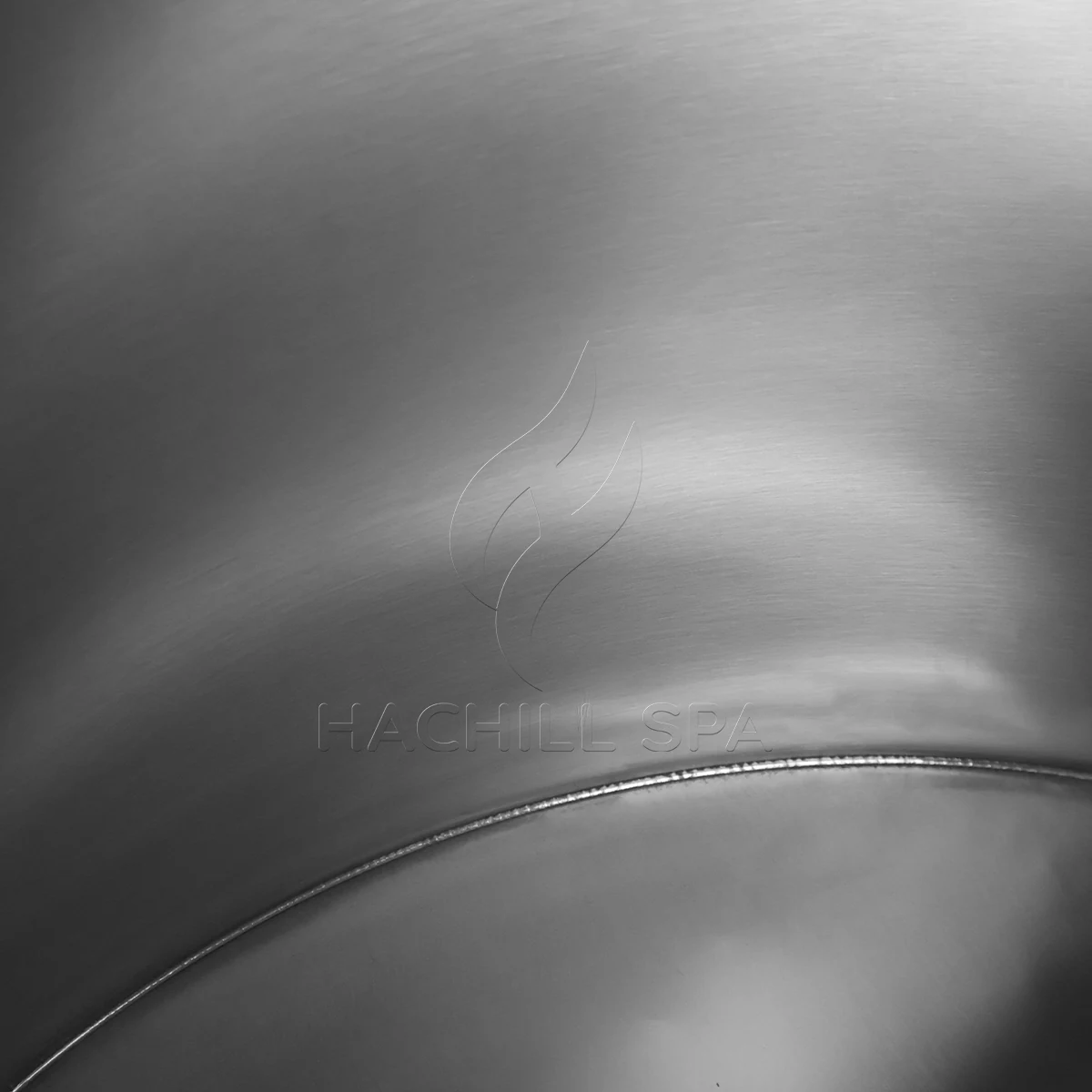
Distinguish brushed, polished, blasted, coated and other finishes by measurable or approved-sample criteria. A visual sample establishes appearance within declared lighting and viewing conditions, not hidden construction. Record directionality, permitted variation, protected-film removal and the repair method for transit marks.
Inspect Welds, Heat Tint, Crevices, Drainability and Passivation Records
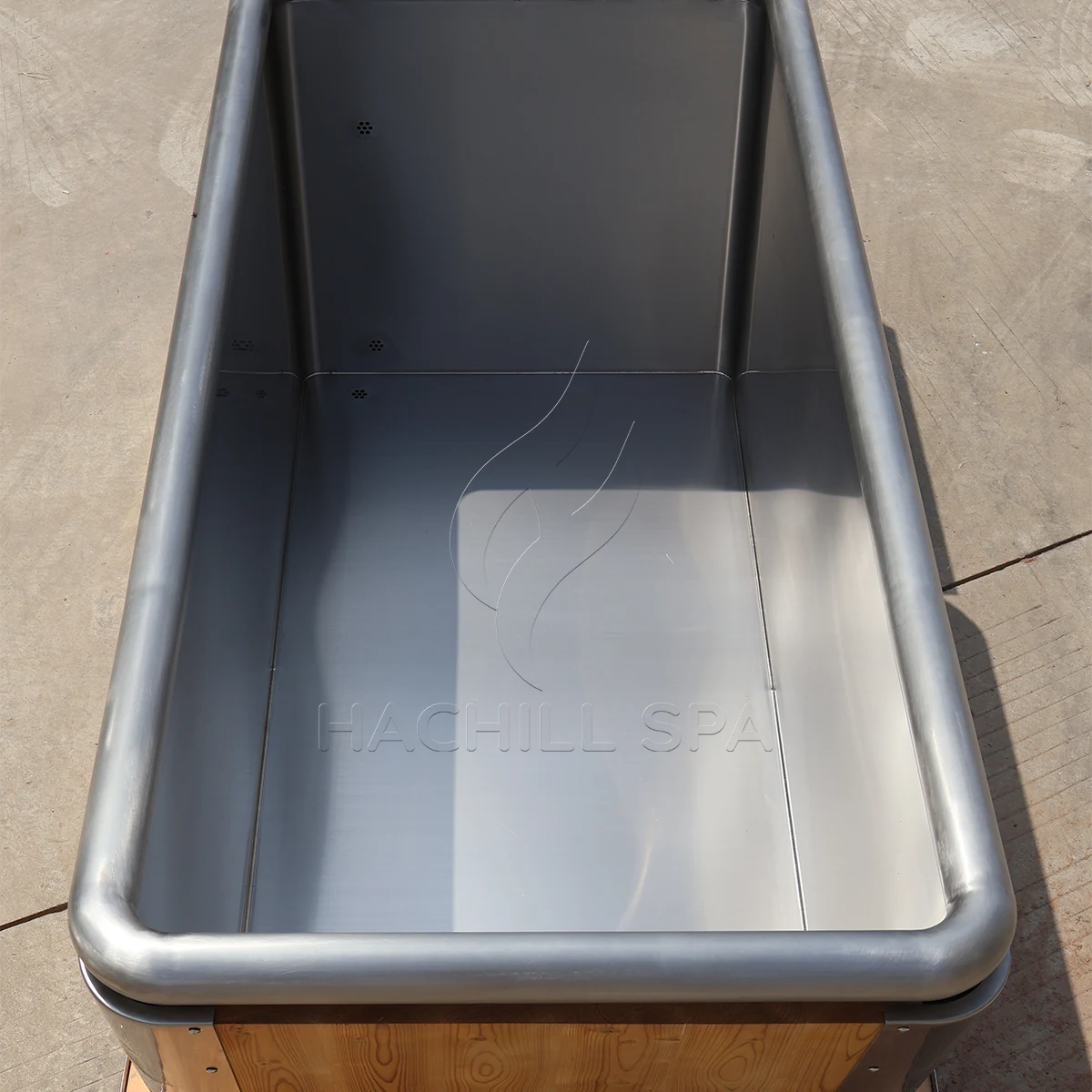
Welded stainless construction creates heat-affected zones, geometric transitions and potential contamination points. The Nickel Institute fabrication and post-fabrication cleanup guide is an appropriate technical background source for this fabrication boundary. The fabrication plan should define joint access, weld profile, heat-tint removal, grinding or polishing sequence, cleaning, pickling or passivation where specified, rinsing and final protection. A process name alone is insufficient; state scope, procedure revision and acceptance evidence.
Inspect drains, penetrations, corners, fittings and waterline details for crevices and trapped liquid. Drainability is a configuration property: fill a level unit under an approved test, drain by the intended route, then record residual locations and the approved removal/drying method. Do not promise complete drain-down from a photograph or one drain fitting.
The acceptance file should connect any specified pickling or passivation record to a witnessed drain/residual inspection for the same production revision. One process record cannot substitute for the other.
Stainless fabrication evidence schedule
| Feature | Evidence before production | Receiving/acceptance check |
|---|---|---|
| Base material | Grade, component scope and traceability requirement | Identity and document match |
| Welds | Procedure, workmanship criteria and accessible finish | Visual condition and approved NDT/leak evidence where required |
| Heat tint/oxide | Removal method and affected-zone scope | No unacceptable retained discoloration under agreed criteria |
| Pickling/passivation | Specified process, chemistry/control and record | Certificate/record matches component and revision |
| Crevices/drains | Detail drawing and cleanability review | Witnessed drain/residual inspection |
| Final surface | Approved sample, roughness/finish criterion if required | Lighting, viewing distance and defect classification |
Engineering scenario: A polished sample passes, but production welds stain
Observed problem: The approved flat coupon looks uniform, while fabricated corners later show local discoloration or deposits.
Likely cause: Sample approval covered appearance only and omitted weld heat tint, crevice geometry, final cleaning or site chemistry.
How to check: Compare the production weld/process record, affected-zone finish, drainability, water history and cleaner use with the approved criteria.
Prevention or corrective path: Approve a representative fabricated sample and process route, then inspect the same features in production.
Compare Acrylic, Fiberglass, Composite and Rotomolded Polymer Systems Through Support and Repair
Acrylic, fiberglass/composite and rotomolded polymer tubs must be evaluated as constructions rather than generic “plastic” categories. Ask which layer is water-facing, what provides structural stiffness, where the shell is supported, whether insulation is separate or integral, and how drains, jets, fittings and other penetrations are reinforced or sealed. Surface gloss or a one-piece appearance does not prove commercial duty, impact performance, UV resistance or repairability.
Request cleaner, sanitizer, solvent, UV and temperature limitations for the exact construction. Technical data for PMMA products, for example, show that chemical resistance varies by chemical and contact condition; that is a reason to verify the actual tub material and manual, not to transfer another acrylic supplier’s limits to the ordered shell. Concentrates, incompatible solvents, abrasive tools, unsupported spans and point loads can create different failure modes from normal diluted operating conditions.
Rotomolded products add another route: confirm the polymer designation, wall construction, foam or cavity details, UV declaration, fitting reinforcement and replacement or repair method. A molded body may reduce some seams, but fittings, drains, ports and accessories remain interfaces that require inspection.
Define repair classes before purchase. A superficial polish, acrylic repair, gelcoat repair, laminate repair or molded-shell replacement has different competence, material and verification needs. The buyer should know which damage is cosmetic, which requires structural review, whether colour match is achievable, and what post-repair leak or integrity check is required.
Polymer and composite comparison record
| Question | Acrylic route | Fiberglass/composite route | Rotomolded polymer route | Evidence |
|---|---|---|---|---|
| Water-facing layer | Sheet/surface identity and forming condition | Resin, gelcoat or liner system | Polymer designation and molded surface | Exact construction schedule |
| Support | Frame, backing and unsupported spans | Laminate stiffness, ribs and frame | Wall geometry, base support and filled-load path | Approved support drawing or construction record |
| Chemical limits | Cleaner, sanitizer and solvent restrictions | Resin/finish compatibility and rinse | Cleaner, sanitizer and stress-cracking restrictions where declared | Model-specific manual or material declaration |
| UV/exterior | Exposure limit and protection | Resin/finish weathering route | UV formulation, cover/protection and outdoor-use declaration | Declared use plus site exposure |
| Repair | Scratch/crack classification and approved method | Cosmetic versus laminate repair | Approved plastic repair or component replacement route | Repair instruction and acceptance check |
| Receiving | Distortion, cracks and surface defects | Impact, delamination indication and finish | Distortion, impact damage, fitting damage and wall condition | Agreed inspection/defect criteria |
Treat Thermowood and Other Cladding as a Moisture-Managed Envelope
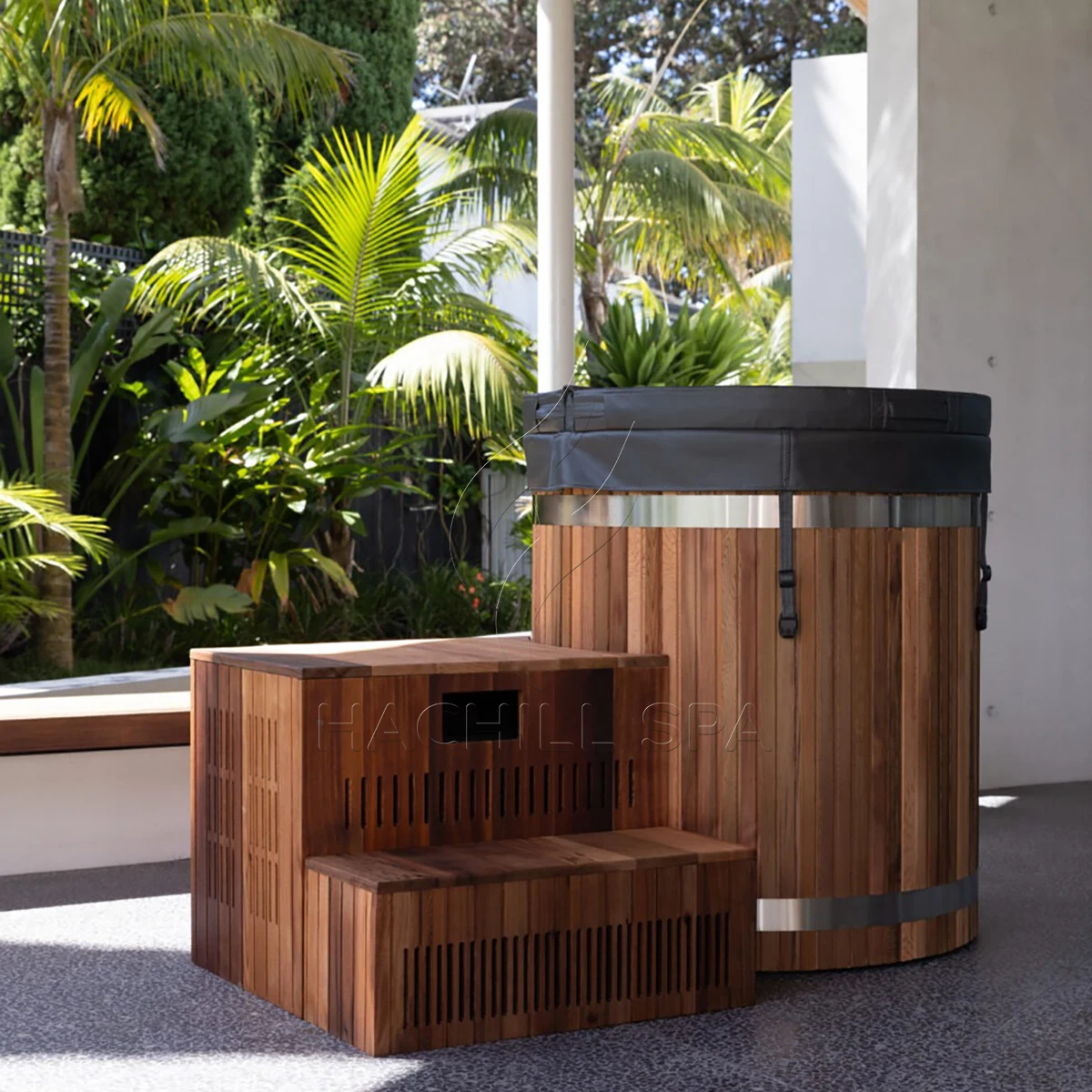
Exterior wood changes appearance, touch and brand positioning, but it should not be confused with the wetted liner unless the exact design says otherwise. Verify species or modification route, moisture condition at fabrication, board profile, end-grain treatment, rear ventilation, base clearance, fasteners, coating or oil, replaceability and access to the structure behind it.
Weather exposure can change exterior wood appearance and moisture condition, while repeated wetting and drying increase the importance of drainage, ventilation and joint detailing. The International ThermoWood Association identifies ThermoWood product classes for different application conditions, including exterior cladding, and directs users to product-specific technical guidance. The USDA Forest Products Laboratory Wood Handbook provides broader wood-moisture and dimensional-change background. Exact species, modification class, finish system and product instructions still control. Do not state a universal maintenance interval.
Record the cladding as a moisture-managed envelope, including rear ventilation, base drainage, end-grain exposure and the route for inspection or board replacement.
For current product-family options using this exterior route, review the HACHILL Thermowood cold plunge range; this materials guide still owns the cross-material comparison.
Engineering scenario: Exterior boards discolor at the base
Observed problem: Lower cladding darkens and remains wet after the rest of the tub dries.
Likely cause: Splash, standing water, blocked rear ventilation or missing base clearance was not included in the material review.
How to check: Inspect runoff, rear cavity, end grain, fasteners, coating record, cleaning products and site drainage.
Prevention or corrective path: Correct the moisture path, replace or refinish only under the approved method, and revise inspection triggers.
Check Fasteners, Dissimilar Metals, Seals and Penetrations as Separate Materials
Mixed assemblies can fail at interfaces even when each headline material is acceptable. Map every wetted and wet-prone fastener, hinge, drain, fitting, sensor pocket, sealant, gasket, adhesive and decorative trim. Record material, coating, isolation, replaceability and cleaning exposure. Nominally similar metals can still create crevices, while dissimilar metals may require isolation and drainage.
Seals and adhesives need compatibility with water chemistry, cleaners, temperature and joint movement. A statement that a sealant is waterproof does not prove adhesion to the selected substrate or resistance to the facility’s chemicals. Use supplier data and representative joint evidence where the interface is critical.
Connect Water Chemistry and Cleaning Records to Material Investigations
Material warranty and root-cause discussions need an operating record. Log source water, fill date, sanitizer or treatment method, pH and other model/manual-required fields, dosing events, unusual readings, drain/refill, cleaning product, dilution, contact time, rinse, tools and operator. For commercial use, record closure and corrective action when water or cleaning conditions leave the approved boundary.
Use synchronized evidence when investigating staining, pitting, coating change, crazing, swelling or seal damage. Photograph location and scale, record waterline relationship, deposits, underside and crevice condition, identify the exact component and batch, and preserve chemistry/cleaning history. A photograph alone cannot distinguish fabrication contamination, operating chemistry, external exposure or service damage.
The cleaner history must identify product, dilution, contact time, rinse, tool, operator and any deviation, rather than recording only that the tub was cleaned.
For routine filtration, sanitation and water-maintenance practice, continue to the Cold Plunge Water-Care Guide; this section remains limited to material-condition evidence and investigation.
Material-condition investigation log
| Record | Method/source | Why it matters |
|---|---|---|
| Component identity | Model, serial, batch, BOM and drawing revision | Connects condition to exact material system |
| Location/appearance | Scaled photos, waterline and adjacent interfaces | Separates local geometry and general exposure |
| Water history | Instrument, result, time, corrective action | Tests chemistry hypothesis and boundary compliance |
| Cleaner history | Product, dilution, contact, rinse, tool and operator | Tests compatibility and misuse hypotheses |
| Exterior exposure | UV, coastal air, rain, freeze and shelter | Tests non-water-side causes |
| Fabrication evidence | Material, weld, finish and repair records | Tests production-process hypotheses |
| Preserved sample | Controlled sample/coupon where agreed | Supports independent testing without destroying evidence |
Normalize Lifecycle Workload Without Inventing Lifespan or Cost
Compare material routes over a declared planning period using the same included tasks and labour boundary. List inspection, routine cleaning, deposit removal, polish or finish work, seal or trim replacement, specialist repair, closure time and consumables. Use site labour rates only when supplied by the buyer; otherwise report workload units and open cost fields.
Normalize work by task rather than by an invented service-life claim. A transparent planning method is annual workload = sum(task frequency x measured or approved task duration) + access/setup time. Leave frequency and duration open until they can be supported by model instructions, representative timed trials or facility history. Do not convert a lower preliminary workload into a guaranteed lower lifetime cost.
Lifecycle-maintenance workload worksheet
| Task | Frequency basis | Time/data source | Operational consequence |
|---|---|---|---|
| Inspection | Manual, exposure and early site findings | Timed representative inspection | Can detect corrosion, cracks, moisture or seal change |
| Routine cleaning | Use and water-care SOP | Timed clean/rinse/dry trial | Labour and closure window |
| Deposit/finish work | Observed trigger, not assumed calendar | Approved method and measured trial | Appearance and surface condition |
| Cladding treatment | Exposure and approved finish trigger | Site-specific record | Access, drying and weather window |
| Repair/replacement | Defect class and approved route | Supplier/local service evidence | Parts, competence and downtime |
| Documentation | Commercial/operator requirement | Log and review time | Supports warranty, QA and disputes |
Build a Traceable Sample and Production Inspection Plan
Approve samples by purpose. A colour/texture sample, fabricated weld sample, joint coupon, coating sample and complete first article answer different questions. Label each sample with product, material, finish, process, date and revision; record lighting and viewing distance for appearance. A marketing image is not a controlled master.
Define incoming material verification, in-process checks, first-off approval, batch sampling, final inspection and document review. The plan should name inspection method, sample size or frequency, defect classification, acceptance authority and record retention. If destructive testing is required, identify who supplies sacrificial coupons and how they represent production.
Material sample and production control plan
| Control point | Record | Release/hold rule |
|---|---|---|
| Incoming material | Identity, supplier lot, certificate and traceability | Mismatch or missing required evidence holds use |
| First-off fabrication | Representative weld/joint/finish and process revision | Buyer/supplier approval before batch continuation |
| In-process | Heat tint, finish, contamination, support and interface checks | Correct cause before affected work is hidden |
| Final appearance | Approved sample, lighting/distance and defect class | Separate cosmetic variation from functional defect |
| Functional | Leak, drainability and configuration-specific tests | Failure quarantines affected unit/batch per plan |
| Document pack | BOM revision, certificates, deviations and repairs | Dispatch hold until required records are complete |
Control Material Substitutions and Revision Changes
Private-label and project orders need a written substitution process. A proposed change in alloy source, timber, resin, coating, fastener, sealant, insulation or finish must identify reason, affected models/batches, equivalence basis, compatibility impact, appearance impact, test impact and documents requiring revision. “Equivalent” is a conclusion to be demonstrated, not a purchasing label.
The supplier proposes and supplies evidence; the buyer or named technical authority approves contractual change; relevant installers and operators are informed; qualified local reviewers reassess regulated interfaces when needed. Emergency availability pressure does not eliminate this sequence. Unapproved substitution is a nonconformance even if the completed product looks similar.
Material change-control responsibility matrix
| Decision | Lead | Required output |
|---|---|---|
| Exposure and operating boundary | Buyer/operator with treatment and site specialists | Approved environment, chemistry and cleaning inputs |
| Material/construction proposal | Supplier engineering/manufacturing | Exact schedule, process and evidence |
| Substitution proposal | Supplier | Impact/equivalence dossier and affected scope |
| Commercial/technical approval | Named buyer authority | Signed revision or rejection |
| Installation compatibility | Installer/design team | Updated interfaces and methods |
| Operation/maintenance update | Operator | Revised SOP, training and consumables |
| Final acceptance | Named witnesses/authority | Closed deviation and configuration record |
Grade Material Evidence by Scope, Traceability and Independence
Evidence is strongest when it identifies the exact component, production batch, configuration, process revision, condition, method and responsible issuer. An order-specific approved schedule and traceable production record normally outweigh a generic data sheet; a current model-specific manual outweighs a sales caption; a witnessed test outweighs an undocumented verbal assurance.
Material evidence hierarchy
| Grade | Example | Decision use |
|---|---|---|
| A | Traceable order/batch record, approved first article or witnessed acceptance | Release the stated component and condition |
| B | Current model-specific schedule, manual or scoped third-party report | Design/verify within declared scope |
| C | Controlled supplier engineering statement with assumptions | Close a named question after assumptions are accepted |
| D | Generic brochure, photograph, unlabelled sample or category claim | Discovery only; not procurement acceptance |
| Open | Missing component, batch, revision, condition or method | Hold the affected claim or substitution |
Certification language requires particular care. A standard overview explains scope; it does not prove that HACHILL or an individual model is certified. Check certificate holder, model list, edition, market and status from the actual record before publishing a certification claim.
Separate Cosmetic Variation, Fabrication Defect and Service Damage in Acceptance
Write acceptance rules before production. Define cosmetic viewing conditions, reference sample, permitted natural variation, measurable defect limits where appropriate, functional checks, document requirements and who can classify a finding. Natural wood variation, a superficial transit mark, unacceptable weld oxide, coating discontinuity and a structural crack cannot share one vague “quality” category.
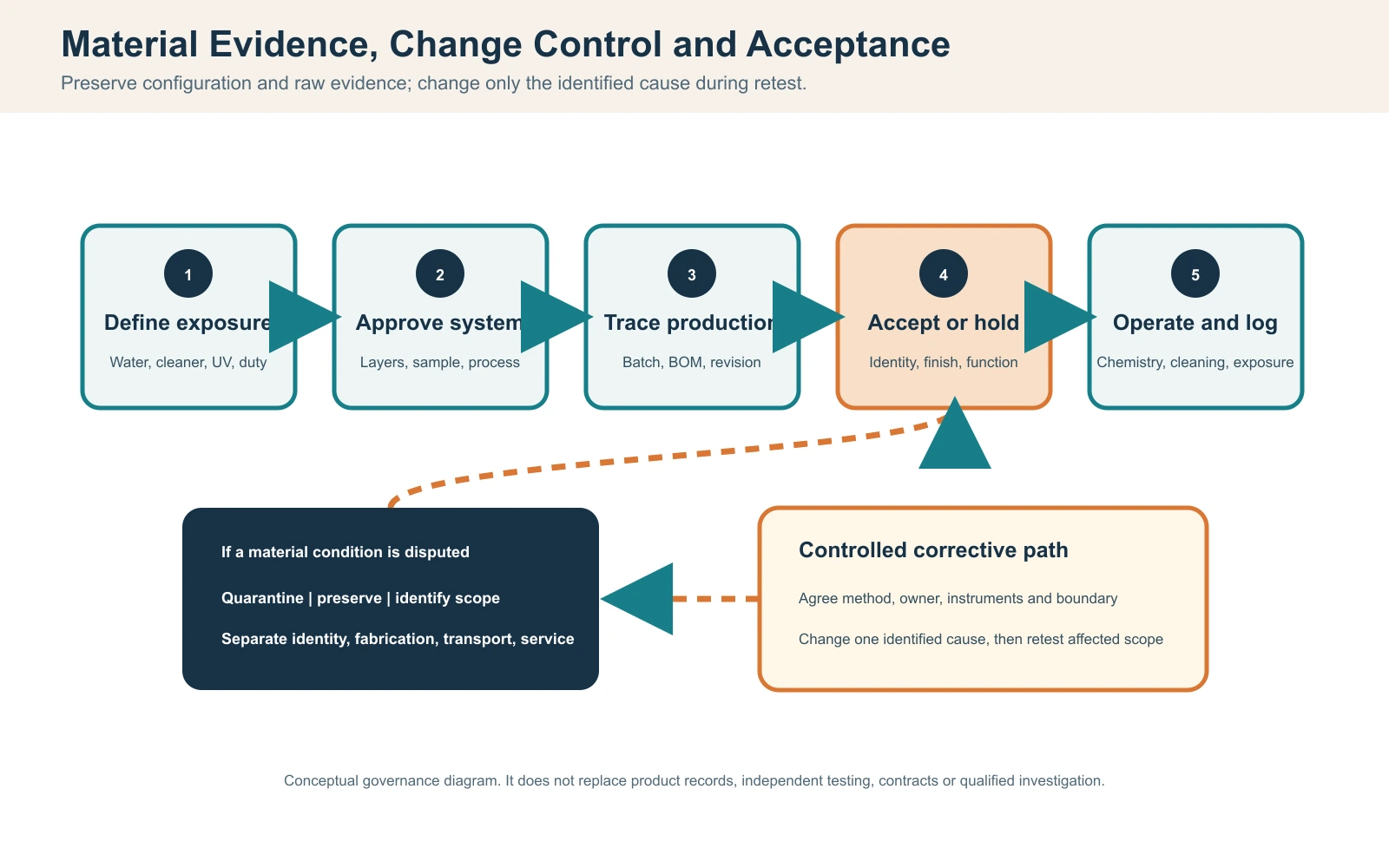
When a dispute occurs, quarantine the affected item or batch, preserve packaging and raw records, identify configuration and process revision, document water/cleaner/exposure history, and agree whether the question concerns identity, fabrication, appearance, transport, installation or operation. Do not polish, chemically clean or repair the evidence before both parties approve the investigation method.
Material acceptance and dispute register
| Finding class | Initial evidence | Stop/retest rule |
|---|---|---|
| Identity/traceability | Component, batch and required certificate/schedule | Hold when required identity cannot be connected |
| Cosmetic variation | Approved sample and viewing conditions | Classify before repair; re-inspect same conditions |
| Fabrication defect | Drawing/process/inspection and leak/drain evidence | Stop affected release; correct cause and retest affected scope |
| Transport/installation damage | Pre-shipment, crate, receiving and handling records | Preserve evidence and assign repair authority |
| Service condition | Chemistry, cleaner, exposure and maintenance log | Restore approved boundary; specialist review when needed |
| Repair | Approved method, materials, technician and post-check | No release until repair acceptance is recorded |
A retest should change only the identified cause and preserve all other valid conditions. If material, process, cleaner, water chemistry and test method all change together, the result cannot assign cause. Stop use for active leaks, structural cracking, sharp damage, unstable support, suspected electrical exposure, uncontrolled chemical attack or any repair that requires bypassing product protection; use qualified service and relevant local professionals.
Issue an RFQ That Makes Material Assumptions Comparable
Send the same layer map, exposure register, chemistry and cleaner boundary, site conditions, appearance requirements, traceability, sample plan, inspection, substitution control, packaging and maintenance data request to every supplier. Ask each bidder to mark comply, deviation, alternative or open with evidence. Price comparison before these fields align rewards hidden exclusions.
Cold plunge material RFQ normalization sheet
| RFQ field | Buyer input | Supplier response |
|---|---|---|
| Application/exposure | Indoor/outdoor, commercial duty, coastal/UV/freeze | Declared suitability and conditions |
| Water/cleaning | Treatment, chemistry control and cleaner SOP | Compatibility limits and prohibited products |
| Layer schedule | Required function and preferred routes | Exact liner, structure, insulation, cladding, fasteners and seals |
| Fabrication/finish | Weld, surface, joint and sample requirements | Process, acceptance and repair route |
| Evidence | Certificates/traceability/records required | Document scope, issuer and revision |
| Change control | Approval authority and notice timing | Substitution procedure |
| Lifecycle | Operator capability and access | Inspection, cleaning, consumables, parts and specialist tasks |
Frequently asked questions
Is 316 stainless steel always required for a cold plunge?
No. Material selection depends on water chemistry, chlorides, sanitizer control, cleaning products, coastal exposure, fabrication and maintenance. A project may justify a particular grade, but the decision should be documented rather than inferred from a generic rule.
Can buyers identify stainless steel grade from a photo?
No. Surface appearance cannot distinguish alloy reliably or prove thickness, weld treatment or passivation. Use the approved material schedule and order-specific evidence where a grade claim matters.
Is Thermowood maintenance-free outdoors?
No. Exterior behaviour still depends on the exact material, finish, UV and rain exposure, drainage, ventilation, fixings and maintenance instructions. Confirm the ordered specification and site plan.
Why do welds and drains matter in a stainless tub?
Weld heat-affected zones, rough finishing, crevices and trapped deposits can become local corrosion or cleaning risks. The fabrication and acceptance plan should address accessible weld quality, surface treatment and drainability.
Does the shell material determine how well a cold plunge holds temperature?
No. Shell material is only one part of the thermal system. Insulation thickness and continuity, cover design, water volume, piping, ambient conditions, circulation equipment and the chiller all affect heat gain and temperature control. Compare the complete construction and test conditions rather than assuming stainless, acrylic or polymer is inherently more efficient.
What material information belongs in an RFQ?
State the exposure, water-treatment method, requested wetted and exterior materials, finish, joint-treatment expectations, cleaner compatibility, evidence requirements and substitution approval process. Avoid unsupported thickness or grade values.
Related HACHILL resources
Cold plunge product category
Use the main cold-plunge category when the material route is only one input in the broader product-family decision.
Upright cold plunge range
Use this format category after the material direction is clear and the next decision is body format and model shortlist.
Laydown cold plunge range
Use this format category after the material direction is clear and the next decision is body format and model shortlist.
Thermowood cold plunge range
Use this finish route after deciding that a Thermowood-clad hybrid construction fits the project and the next step is current model comparison.
Commercial cold plunge buying guide
Use the commercial buying guide when material is only one part of a wider decision involving tub format, cooling, circulation, sanitation, utilities, documentation and RFQ scope.
Cold plunge water-care guide
Use the water-care guide when the open question is filtration, sanitation, routine water maintenance or operating records rather than material selection.
Request a project quotation
Use the RFQ route once exposure, material layers, evidence requirements and open assumptions are defined well enough for supplier review.
Reference basis
- Nickel Institute: Stainless Steel for Potable Water Treatment Plants – Background on chloride exposure, crevice geometry, stagnant conditions and interacting corrosion factors; it does not create a universal cold-plunge chloride limit.
- Nickel Institute: Fabrication and Post-Fabrication Cleanup of Stainless Steels – Background for heat tint, contamination, grinding, cleaning and post-fabrication treatment; exact production requirements remain configuration-specific.
- International ThermoWood Association: ThermoWood product classes and applications – Official background on ThermoWood processing, product classes and outdoor applications; exact HACHILL species, finish and maintenance instructions remain order-specific.
- USDA Forest Products Laboratory Wood Handbook – General wood-moisture and dimensional-change background.
- ACRYLITE acrylic chemical-resistance data – Illustrates that PMMA chemical compatibility depends on the chemical and exposure condition; it is not a compatibility certificate for another manufacturer’s tub shell.
Technical and safety boundary for How Product Buyers Compare Cold Plunge Tub Materials: Product manuals, approved drawings, local building, electrical, public-health and accessibility requirements, licensed trades and qualified medical or safety professionals take priority over general web guidance. This article does not claim certification, guaranteed site performance or individual medical benefit.
Turn the exposure record into a material brief
Send HACHILL the facility and user duty, water-treatment and cleaner plan, indoor/outdoor and coastal exposure, preferred material route if known, required construction layers, finish reference, evidence and inspection requirements, quantity, destination and branding scope. The team can review a configuration while unsupported fields remain explicitly open.