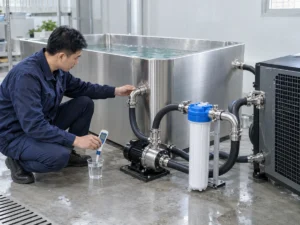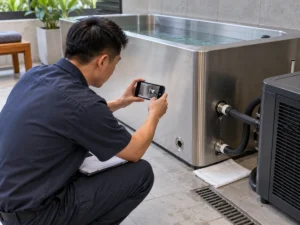
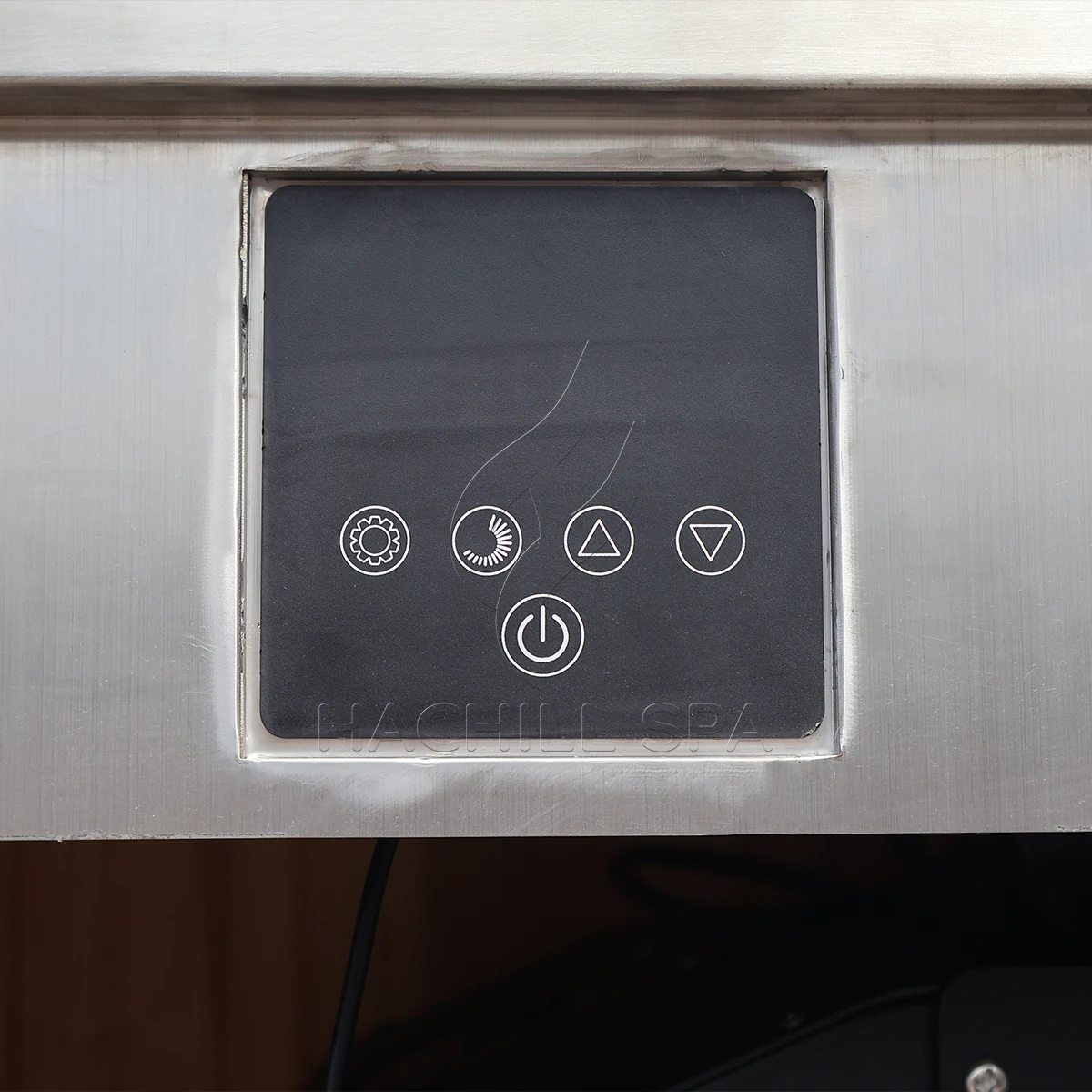
Quick answer: long compressor runtime does not by itself mean a cold plunge chiller is undersized, and frequent cycling does not by itself prove oversizing. Treat runtime as a symptom. First define whether the system is pulling down, holding temperature or recovering after use; then verify whether the required water condition is actually being met. Before changing capacity, rule out flow/filter restriction, condenser-air or site problems, active protection states, and control or sensor issues. If the required duty is still not met under valid operating conditions, review capacity. If the duty is met, do not change capacity solely because runtime looks high. If cycling is the concern, review the capacity-control-thermal-mass relationship against the exact equipment limits before downsizing.
Observed behavior → define the duty case → rule out system causes → assess capacity evidence → keep / correct and retest / capacity review / hold.
This guide owns the capacity-change decision. For detailed runtime measurement and duty-cycle interpretation, use Do Cold Plunge Chillers Run 24/7? Duty Cycle and Energy Use. For project-required cooling duty, use the Cold Plunge Thermal Engineering and Chiller Sizing Guide. For supplier HP versus useful cooling output, use Cold Plunge Chiller HP vs Cooling Capacity.
Start With the Observed Duty Case, Not a Runtime Percentage
Long runtime only becomes meaningful when you know what the chiller was being asked to do.
Initial pull-down, steady holding and recovery after use are different duty cases. A long run during a demanding pull-down or recovery period is not equivalent to a long run while the system is expected to hold a stable water condition under a lighter load.
So the first question is not:
“What duty-cycle percentage is too high?”
It is:
“What operating case produced this runtime, and was the required water condition being achieved within the equipment’s documented operating limits?”
That distinction matters because runtime percentage is not a direct measurement of capacity.
What runtime can tell you
Runtime can show that the refrigeration system is active for a large share of the observation window or that repeated cycling is occurring. It cannot, by itself, explain why.
A long run may occur with a legitimate high load, changed site conditions, reduced heat transfer, control behavior or an actual capacity mismatch. Those possibilities need to be separated before an upsize is justified.
If the open question is how to measure compressor runtime, distinguish system power from active compressor operation, or calculate duty cycle over a declared observation window, route that task to the dedicated runtime and energy guide.
Example: Long Runtime During a High-Load Case
Suppose a chiller runs for a long period during a clearly defined pull-down or other high-load condition, while the required water condition is still being achieved within the equipment’s documented operating context.
That observation does not, by itself, prove the chiller is undersized.
Capacity review becomes more justified when the required duty is not being met after the relevant load, flow, site and control conditions have been checked.
Use runtime to identify a capacity question; do not use runtime alone to close it.
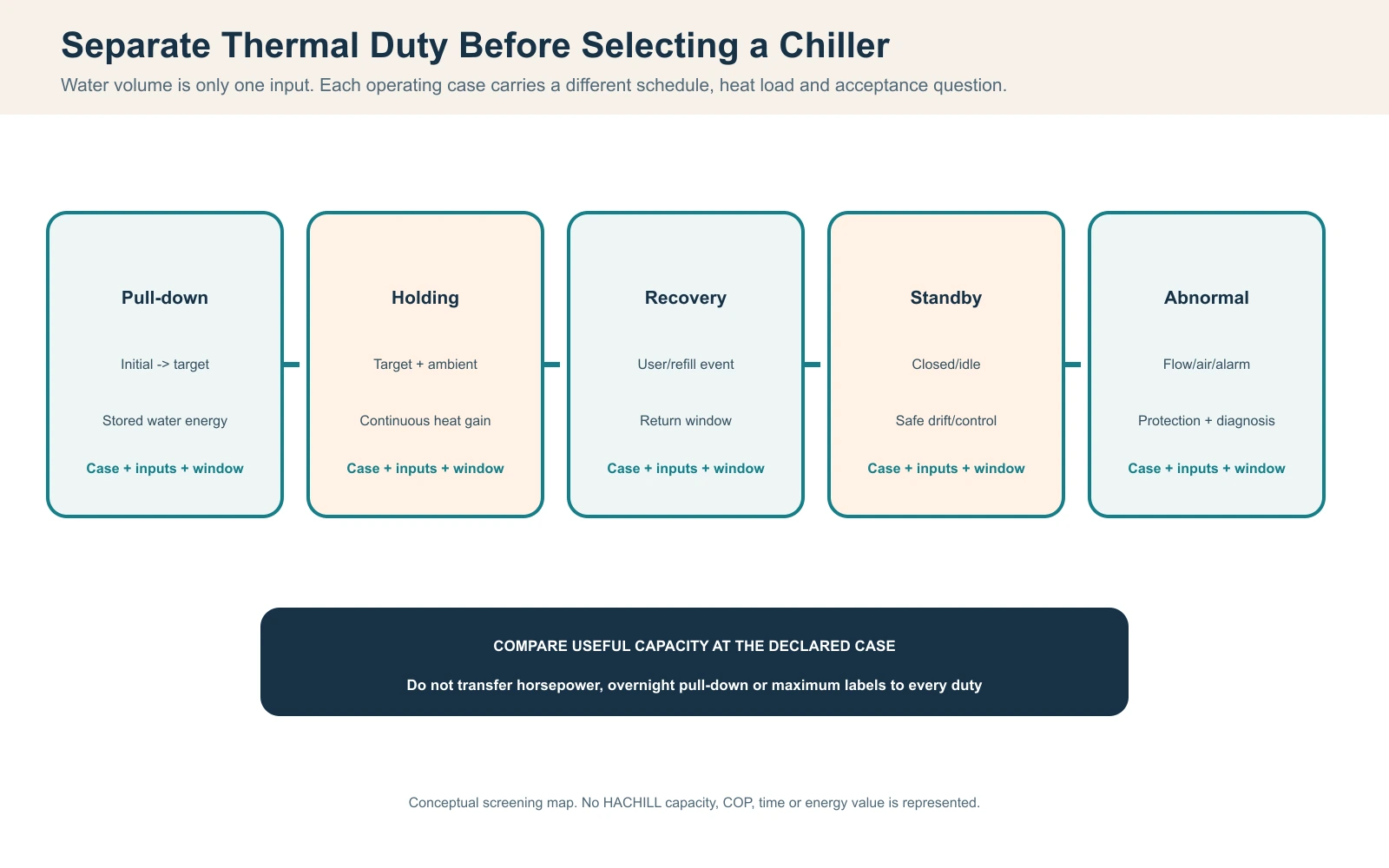
Rule Out System Problems Before Blaming Chiller Capacity
Before changing chiller capacity, rule out conditions that can imitate a capacity problem.
A useful order is:
- confirm the actual refrigeration state and the duty case;
- confirm the load and site conditions during the observation;
- verify water flow, filter condition and visible circulation within the exact equipment’s requirements;
- check the condenser air path and documented site/ambient limits;
- preserve alarm, protection and controller information;
- only then decide whether the evidence still points toward a capacity mismatch.
This is a troubleshooting boundary, not a remote refrigeration-service procedure.
Flow and protection come before capacity conclusions
Low or lost water flow can prevent the heat exchanger from operating as intended and can trigger equipment protection. Flow requirements and protection architecture are model-specific. As one manufacturer example, Trane’s CVHM chiller manual requires proof-of-flow devices on its evaporator and condenser water circuits and warns that omitting or jumping those devices can cause severe equipment damage. That example supports a conservative diagnostic rule here; it does not create a universal flow-switch design for every cold-plunge chiller.
If the installed chiller reports low flow, loss of flow or another protection state, do not bypass the protective device to continue a capacity test. Resolve the condition according to the exact equipment documentation or qualified service path, then repeat the declared duty observation.
The same boundary applies to freeze, pressure, electrical and compressor protection: a capacity comparison should not be created by defeating the protections intended to keep the equipment within its operating limits.
Condenser air and site conditions can change the result
A chiller does not operate independently of its surroundings. Warmer ambient conditions, restricted condenser airflow, recirculated discharge air, high use, added heat from connected equipment, or changes in piping and installation can alter the load or the useful performance available at the site.
That is why “the chiller used to work” and “the chiller now runs longer” do not establish, on their own, that the installed capacity was always wrong.
First ask whether the operating conditions changed. If site temperature is the main question, use How Ambient Temperature Changes Cold Plunge Pull-Down Time.
Controls and sensor behavior can also shape cycling
Repeated cycling can be affected by controller logic, sensor behavior, control differential, minimum on/off logic and other equipment-specific settings.
Those are not reasons to rewrite protected controller values arbitrarily. They are reasons to identify the exact controller and equipment instructions before assigning the problem to capacity.
The capacity question comes after the system question.
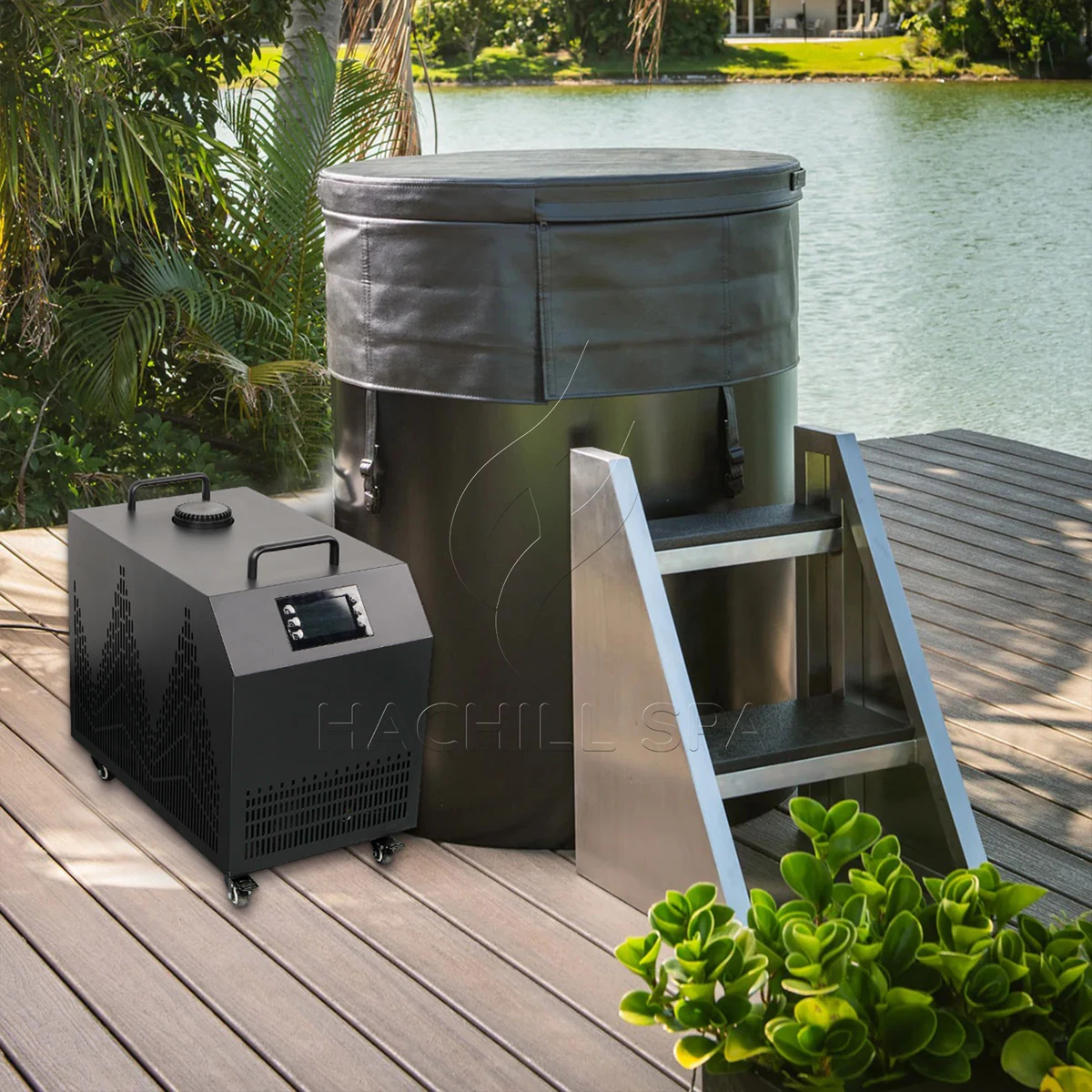
Understand What Oversizing Can—and Cannot—Explain
Oversizing is often treated as though it produces one predictable symptom. It does not.
Excess capacity can contribute to unstable light-load operation in some systems, particularly where changing load is managed mainly through simple on/off cycling. But the observed result also depends on control architecture, system water or thermal mass, actual load and the cycling limits of the exact compressor and controller.
Copeland refrigeration system-design guidance notes that simple on/off capacity control can produce compressor short cycling under light load and also identifies other short-cycling causes elsewhere in the same manual. That supports treating excessive capacity as one possible contributor, not as a diagnosis that can be inferred from cycling alone.
Oversizing and short cycling are different concepts
Oversizing describes the relationship between available capacity and the valid operating load.
Short cycling describes an observed operating pattern.
They can be related, but neither term proves the other.
A chiller can cycle repeatedly because of control logic, low system mass, flow problems, sensor behavior or other conditions. A larger-capacity system with effective capacity modulation can also behave differently from a fixed-output system under the same part-load condition.
Capacity-control architecture changes the trade-off
A fixed-output or simple on/off system typically responds to changing load differently from a system that can reduce capacity over part of its operating range.
That distinction matters when evaluating oversizing because two chillers with similar nominal capacity may not respond to light load in the same way.
Do not assume that a HACHILL or third-party cold plunge chiller uses variable-capacity control unless the exact equipment documentation confirms it.
System water volume can change cycling behavior
The effective water and thermal mass in the system affects how quickly the controlled water temperature changes as the compressor turns on and off. Carrier’s chilled-water loop-volume bulletin shows, in its own large-system context, that smaller loop volume can magnify temperature transients and reduce the time available for a chiller to respond to load change.
That is mechanism evidence, not a universal cold-plunge buffer-volume rule. The exact chiller controls, permitted flow, water volume and operating limits still govern the installed system. Nominal capacity alone cannot diagnose repeated cycling.
There is no universal short-cycle time
Different compressors, chillers and controllers can use different minimum on-times, minimum off-times, start delays or anti-recycle logic.
For that reason, this guide does not define a universal threshold such as “any cycle shorter than X minutes is short cycling.” Use the exact chiller, compressor and controller documentation.
Example: Repeated Cycling After a Capacity Increase
Suppose a larger replacement chiller is installed and repeated cycling becomes more noticeable under a light holding load.
That pattern is a reason to investigate the new capacity relationship. It is not enough to declare the replacement oversized.
Check the actual load, control strategy, equipment cycling limits, system water/thermal mass and flow conditions first. If those are appropriate and unstable part-load behavior remains, then the capacity/control relationship deserves deeper review.
Oversizing trade-off matrix
| Observation | What it may suggest | What it does not prove |
|---|---|---|
| Long run while required duty is met | The system is carrying a high or sustained load | The chiller is undersized |
| Long run while required duty is not met | Capacity mismatch is one possible cause | Capacity is the only cause |
| Repeated cycling under light load | Capacity/control/system-mass relationship deserves review | The chiller is definitely oversized |
| Larger replacement changes cycling behavior | Replacement interfaces and control behavior need re-verification | “Larger” was automatically the wrong choice |
| Stable operation across changing load | Capacity and control may be reasonably matched | No other installation issue exists |
Decide Whether Chiller Capacity Should Change at All
A capacity change should be the output of diagnosis, not the first troubleshooting step.
KEEP CURRENT CAPACITY
Use this branch when the declared duty is being met, no unresolved protection issue is present, and the main concern is simply that the compressor appears to run for a long time.
This does not certify the whole system as fault-free. It means the available evidence does not justify changing capacity solely because runtime looks high.
CORRECT SYSTEM / RETEST
Use this branch when a system condition can distort the capacity conclusion—for example, unresolved flow restriction, filter condition, condenser-air recirculation, sensor/control issues, changed site conditions or an active protection state.
Correct the responsible condition first, then repeat the observation under the same declared duty case.
Changing capacity and test conditions at the same time makes it harder to know which change produced the result.
CAPACITY REVIEW
Use this branch when the required pull-down, recovery or holding duty is still not being met after the relevant system conditions have been bounded and the exact equipment remains within its documented operating limits.
A capacity review does not mean “install the next larger chiller.”
It means there is now enough evidence to re-evaluate the current equipment against the actual load and required duty. The review may lead to a different capacity, control strategy, equipment architecture or another project decision.
HOLD FOR MORE EVIDENCE
Hold the capacity decision when a critical input is still unknown, such as:
- current chiller or controller identity;
- actual compressor state;
- water-flow status;
- an unexplained alarm or protection event;
- inconsistent test conditions;
- an undefined required duty;
- a complaint consisting only of “it runs a lot” or “it cycles a lot.”
A HOLD prevents a replacement decision from being made from weak evidence.
| Evidence state | Capacity decision |
|---|---|
| Required duty is met; no unresolved protection issue; runtime is the main concern | KEEP CURRENT CAPACITY |
| A system/interface problem is still visible | CORRECT SYSTEM / RETEST |
| Required duty is not met after relevant causes are bounded | CAPACITY REVIEW |
| Critical operating or equipment evidence is missing | HOLD FOR MORE EVIDENCE |
If excessive capacity is suspected, do not create an automatic “downsize now” branch. Downsizing still requires exact system, control and equipment evidence.
Re-Verify System Interfaces When Capacity Changes
A capacity change is not just a refrigeration-capacity decision. The exact replacement can change the requirements around the chiller.
| Interface | Re-verify for the exact replacement | Do not assume |
|---|---|---|
| Water / hydraulic side | Permitted flow range, connection details and hydraulic implications | The existing loop automatically suits the new unit |
| Condenser air / service space | Air path, intake/discharge clearances and service envelope | A different cabinet fits or breathes the same way |
| Controls / protection | Controller compatibility, flow proof, anti-cycle logic, alarms and protection architecture | Settings and safety functions transfer unchanged |
| Electrical | Voltage/phase, current, overcurrent/protection and connection requirements | Nominal capacity or HP defines the circuit |
| Physical connections | Connection sizes and installation interfaces | The replacement is a drop-in swap |
The exact replacement documentation owns these values.
A larger or smaller chiller does not necessarily change every interface. Capacity change is simply the point at which those interfaces must be verified again rather than assumed.
For complete tub-to-chiller interface matching, use How to Match a Cold Plunge Tub with a Chiller. For project-required thermal duty, use the thermal engineering and chiller sizing guide. If a replacement is being compared mainly by horsepower, use the HP versus cooling-capacity guide.
Electrical boundary
Do not infer breaker size, conductor size or fixed electrical requirements from chiller capacity alone.
Verify the exact replacement model and route fixed wiring and protection to the applicable equipment documentation, project requirements and qualified local electrical responsibility.
Use a Capacity-Change Release Gate Before RFQ
A capacity-change RFQ is ready when the problem is defined well enough for a supplier or technical reviewer to evaluate the existing system and the proposed change.
RFQ-ready does not mean the replacement capacity has already been approved.
| Question | RFQ READY | HOLD |
|---|---|---|
| Is the current equipment identified? | Chiller/controller identity or usable documentation is available | Existing equipment is unknown |
| Is the operating case defined? | Pull-down, holding, recovery or another declared duty is known | Only a vague complaint such as “runs too much” is available |
| Is the observed result documented? | Target/observed water condition and representative runtime/cycling behavior are recorded | No usable operating record |
| Are major system causes bounded? | Flow/filter, condenser-air/site and control/protection context have been checked | A protection or system problem remains unexplained |
| Is the reason for changing capacity clear? | The unmet duty or part-load problem is stated | The request is simply “quote a bigger chiller” |
| Can replacement interfaces be reviewed? | Site, electrical and installation context is available | The proposed unit is treated as a drop-in swap without verification |
If the HOLD column still describes the project, collect the missing information before turning a symptom into a capacity specification.
Frequently Asked Questions
Does a cold plunge chiller running continuously mean it is undersized?
No. Long runtime must be interpreted against the operating case, required water condition, load, site conditions and equipment limits. Runtime alone does not prove insufficient capacity.
Does short cycling prove a chiller is oversized?
No. Excess capacity can contribute to cycling in some load/control conditions, but control logic, system water volume, flow, sensors and compressor architecture can also affect cycling behavior.
Is a bigger chiller always better for faster recovery?
No universal rule supports that conclusion. More nominal capacity may change recovery potential, but it can also change the capacity/control relationship and the electrical, hydraulic, physical and airflow requirements that must be verified for the exact replacement.
Should I change chiller capacity before checking flow and airflow?
No. An unresolved flow, protection or condenser-air problem can distort the diagnosis. Correct or escalate those conditions before treating capacity as the root cause. Do not bypass protective devices to complete the test.
What information should I collect before replacing a cold plunge chiller?
Collect the current equipment identity, declared duty case, target and observed water condition, representative runtime or cycling behavior, flow/filter condition, condenser-air/site condition, alarms or protection events, control context and available electrical/site information.
Prepare a Chiller Capacity-Change RFQ
Before requesting a capacity-change review, prepare:
- current chiller and controller identity;
- tub or actual water volume where known;
- target and observed water condition;
- declared operating case;
- representative long-run or cycling observation;
- flow, filter and visible-circulation status;
- condenser-air and site conditions;
- alarm or protection history;
- current control/setpoint context;
- available electrical/site information;
- required recovery or operating schedule;
- the specific reason capacity change is being considered.
Separate confirmed information from open questions.
That gives HACHILL a clearer basis for reviewing whether the project should keep the existing capacity, correct another system issue first, or move into a replacement/capacity review.