Cold Plunge Water Care · Filtration · Sanitation · Maintenance
To keep cold plunge water clean, use six controls together: circulation, filtration, compatible sanitation, water testing, physical cleaning and condition-based water replacement. A filter removes selected debris, but it does not verify microbiological control, clean contaminated surfaces or replace a treatment method approved for the actual tub and components.
The correct routine depends on retained water volume, user load, pump and filter route, treatment compatibility, indoor or outdoor conditions and whether the plunge is privately or commercially shared. Confirm the complete water route before setting a schedule, and define who owns testing, cleaning, consumables, drainage, service and stop-use decisions. Model instructions, treatment-product labels and applicable local requirements take priority.
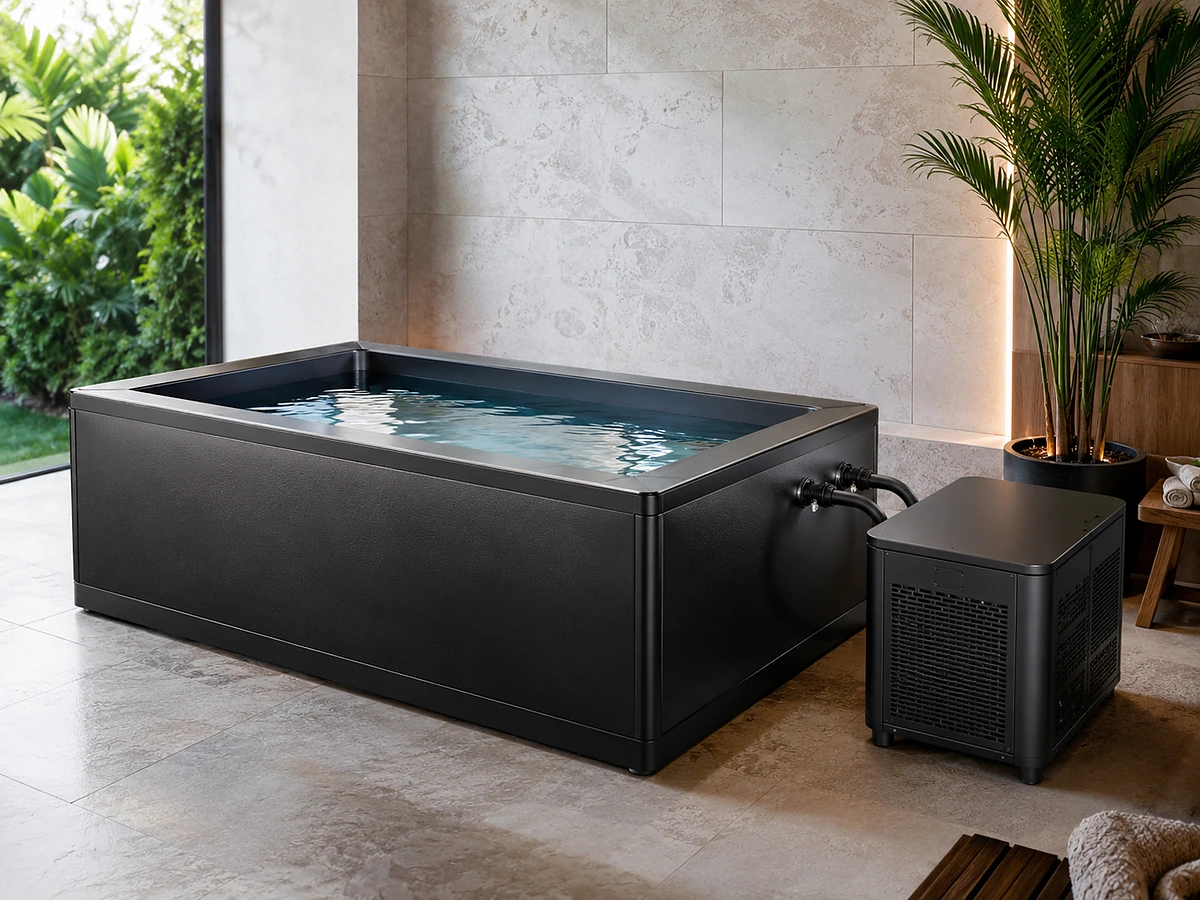
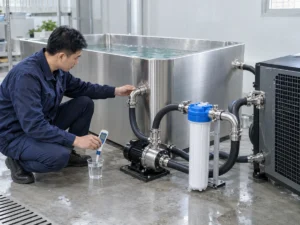
AI-generated conceptual visualization; not a verified HACHILL product model, customer installation or treatment specification.
Clean water is an operating result, not a visual assumption. The system must move water through the intended treatment route, remove selected debris, control contamination with compatible methods, verify conditions, clean surfaces and replace water when control cannot be maintained.
- Confirm whether the system is ice-only, pump-and-filter, integrated-chiller or commercial shared-use.
- Separate debris removal, sanitation, testing and physical cleaning into distinct responsibilities.
- Use both scheduled checks and condition-based triggers rather than relying on a universal calendar.
- Keep users out whenever water quality, flow, treatment control or equipment condition cannot be verified.
When This Guide Fits—and When It Does Not
This Guide Fits
- Residential cold plunges with retained and reused water
- Pump-and-filter or integrated-chiller systems
- Commercial planning before a final operating SOP is approved
- Buyers comparing filtration, sanitation, service access and consumables
This Guide Does Not Replace
- A model-specific water-care manual
- A sanitizer or cleaner product label
- A commercial venue contamination-response SOP
- Local electrical, drainage or public-health review
What Actually Keeps Cold Plunge Water Clean?
Clean cold plunge water is not produced by one component. It is the result of a controlled system in which each layer has a different job.
On smaller screens, scroll horizontally to view the full table.
| Control | Main Role | What It Cannot Replace |
|---|---|---|
| Circulation | Moves water through the treatment route | Filtration, sanitation or cleaning |
| Filtration | Captures selected suspended debris | A compatible sanitizer or physical cleaning |
| Sanitation | Controls risks not removed by ordinary filtration | Debris removal or surface scrubbing |
| Water testing | Verifies whether the selected treatment is within its operating limits | Treatment itself |
| Physical cleaning | Removes deposits, oils, slime and contamination from accessible surfaces | Continuous circulation or sanitation |
| Water replacement | Reduces accumulated contamination and resets the system | Ongoing maintenance between drains |
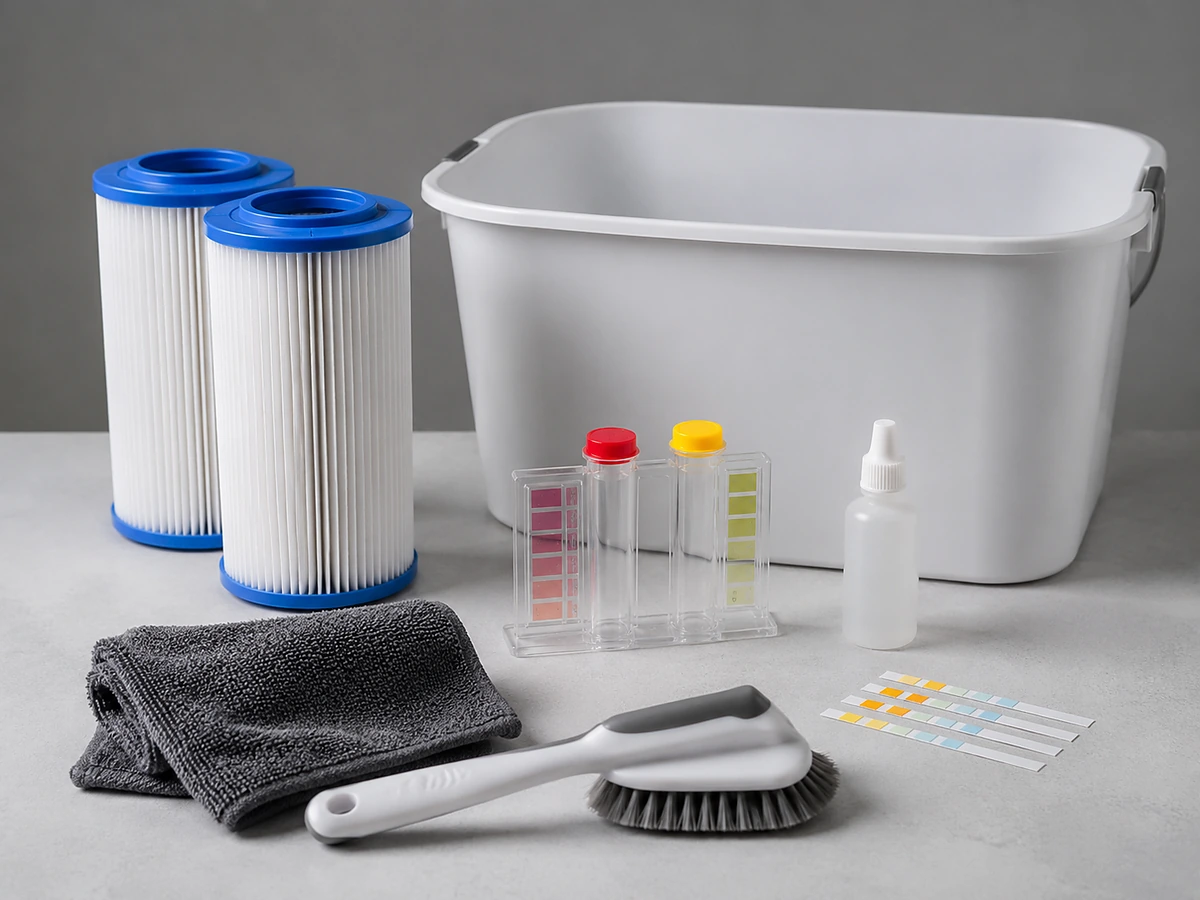
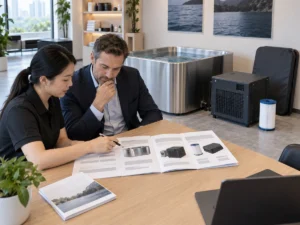
AI-generated conceptual visualization; not a verified HACHILL product model, customer installation or treatment specification.
Filtration Removes Debris, Not Every Water-Quality Risk
A cartridge or other confirmed filter can remove selected suspended material from the water passing through it. That may include hair, lint, leaves, skin particles and other debris, depending on the filter design and condition.
The limitation is important: a filter only acts on water that reaches it, and it only removes material within its intended capture range. It does not automatically control microorganisms, dissolved contaminants, body oils or contamination attached to the tub, waterline and plumbing.
A clean-looking cartridge is not proof of safe water. A heavily loaded cartridge is also not proof that the filter is defective; it may indicate high user load, poor pre-entry hygiene, outdoor debris or a mismatch between the system and its duty.
Sanitation Controls Risks That a Filter Cannot See
Sanitation is the part of the water-care plan that addresses risks ordinary debris filtration cannot reliably remove. The selected method must be compatible with the tub, seals, hoses, heat exchanger, pump, chiller and any ozone or UV components.
The correct product, dose, contact conditions and testing method cannot be chosen from a generic article. Follow the treatment-product label and the equipment manufacturer’s instructions. Commercial operators must also follow applicable public-health requirements.
Ozone or UV may be supplied as part of a treatment system, but their presence should not be interpreted as “no sanitation or testing required.” Their function depends on the exact design, flow, operating condition and validation scope. Confirm whether they are supplementary components and what residual control, if any, the complete system requires.
Cleaning and Water Replacement Reset the System
Circulation and treatment do not remove every deposit from accessible surfaces. Oils, cosmetics and organic material can collect at the waterline, around fittings, on the underside of the cover and inside serviceable components.
Physical cleaning removes this material before it becomes a persistent surface layer. Condition-based draining and refilling reduce accumulated water load and provide an opportunity to inspect the tub, filter, seals, hoses and accessible plumbing.
Water replacement is therefore not a substitute for cleaning. Draining dirty water without cleaning contaminated surfaces can allow the next fill to deteriorate quickly.
Identify Your Cold Plunge System Before Setting a Maintenance Routine
A useful maintenance plan starts by identifying the water-care route. Review the available cold plunge product routes before assuming that every system includes a pump, filter, ozone generator, UV unit or automatic chemical control.
If the open question is the complete commercial buying decision rather than water care alone, use the Cold Plunge Tub Buying Guide for Businesses and Product Buyers. This page remains the owner for filtration, sanitation, testing, cleaning, maintenance and stop-use decisions.
Do not build the maintenance plan from the tub appearance alone. The decisive inputs are the retained water volume, number of users, daily sessions, pump and filter route, sanitation method, drain access, chiller heat rejection, condensation control and the operating responsibility split between supplier, installer and operator.
On smaller screens, scroll horizontally to view the full table.
| System Route | Circulation and Filtration | Sanitation | Maintenance Burden | Main Limitation |
|---|---|---|---|---|
| Ice-only or drain-after-use tub | None or minimal | Depends on fill-and-drain procedure | Frequent draining and physical cleaning | Not designed for extended shared-water reuse |
| Pump-and-filter residential tub | Active circulation and a confirmed filter | Separate compatible method may be required | Filter service, testing, cleaning and periodic water replacement | Filter does not complete the water-care plan |
| Integrated chiller system | Chiller loop may include pump, filter and optional treatment components | Must be confirmed from the exact BOM and manual | Water care plus airflow, condensation and component service | “Integrated” does not prove every water-care function is included |
| Commercial shared-use system | Engineered circulation and treatment route | Defined by system design and local requirements | High: testing, records, staff, cleaning, consumables and escalation | Residential assumptions may be unsuitable |
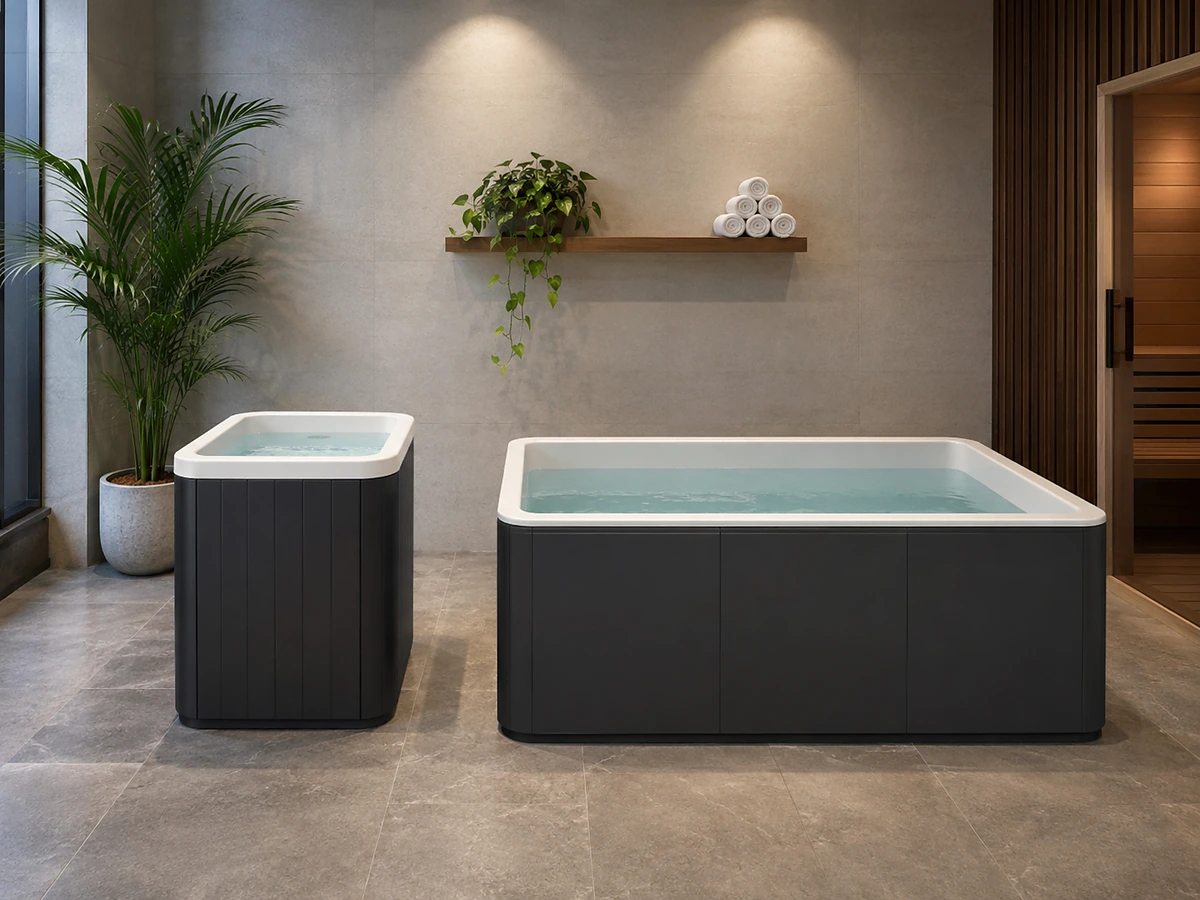
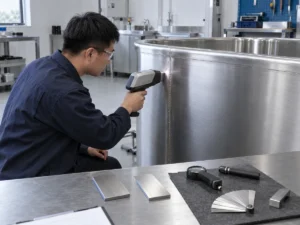
AI-generated conceptual visualization; not a verified HACHILL product model, customer installation or treatment specification.
Ice-Only or Drain-After-Use Tubs
A simple tub filled with tap water and ice may avoid a complex recirculation system, but it does not become maintenance-free. The tub still needs a safe drain route, physical cleaning, drying and protection from outdoor contamination.
Where water is retained between sessions, the risk profile changes. The user must decide whether the vessel and operating method are intended for reuse, and what treatment route supports that reuse.
Do not add a pump, chemical, improvised filter or portable electrical device near the water without confirming compatibility and electrical safety.
Pump-and-Filter Residential Systems
A pump-and-filter route can reduce visible debris and improve water movement. Its performance depends on the actual flow through the filter, the condition of the cartridge, inlet and outlet placement, hose routing and the amount of contamination entering the water.
The owner still needs a sanitation and testing plan compatible with the product. “Filtered water” and “sanitized water” are not interchangeable terms.
Integrated Chiller and Water-Care Systems
For integrated chiller systems, confirm the exact pump, filter, treatment components, flow route, ventilation, condensation control and service requirements from the selected model documentation. Do not infer the complete water-care configuration from a chiller label or product photograph.
For exact tub-to-chiller thermal, hydraulic, controls and site-interface matching, continue to the Cold Plunge Tub and Chiller Matching Guide. This water-care guide only carries the maintenance implications of the installed loop.
An integrated cold plunge may combine cooling, circulation and selected treatment components. However, the word “integrated” is not a specification.
Before purchase or operation, confirm:
- Usable water volume
- Pump and circulation route
- Filter type and service access
- Whether ozone, UV or another treatment component is included
- Compatible water-care products
- Drain and cleaning access
- Chiller ventilation and heat-rejection requirements
- Condensation management
- Replacement-filter and spare-parts availability
A chiller horsepower label does not prove the filtration rate, sanitation capability, pull-down performance or commercial duty of the complete system.
Commercial Shared-Use Systems
A shared plunge in a gym, recovery center, hotel or spa requires more than a residential cleaning checklist. For project-specific operating context, review cold plunge systems for recovery centers. User turnover increases the load from sweat, cosmetics, skin particles, dirt and surrounding-floor contamination.
The project must define operating hours, expected users, pre-entry hygiene, treatment and testing, maintenance records, filter service, cleaning turnover, water replacement, staff training, chemical handling and stop-use procedures.
The final plan must be reviewed against the selected system and applicable local requirements. A product that is acceptable for low-frequency private use is not automatically suitable for commercial shared use.
Circulation and Filtration: Keep Water Moving Through the Treatment System
Circulation transports water from the tub through the filter and other confirmed treatment components, then returns it to the vessel. If flow falls, each downstream component may receive less water than intended.
What the Circulation Pump Does
The pump must provide the flow required by the selected system without exceeding the operating limits of the filter, chiller, hoses or fittings. Actual performance depends on pipe or hose diameter, elevation, fittings, filter restriction and the complete hydraulic route.
Do not infer actual circulation from pump wattage, chiller horsepower or a marketing photograph. Request the confirmed flow requirement and approved connection layout for the selected configuration.
What a Cartridge Filter Can and Cannot Remove
A cartridge filter captures debris as water passes through its media. Its real performance depends on the media, surface area, condition and installed flow.
Do not publish or rely on a micron rating unless it is documented for the exact cartridge. Even a high-quality cartridge does not replace sanitation, testing or surface cleaning.
For a buyer, the practical questions are:
- What filter is included?
- Is the specification documented?
- Can it be removed without dismantling the complete system?
- Is a replacement locally available?
- What condition triggers cleaning or replacement?
- How is restricted flow identified?
Signs That Flow or Filtration Is Declining
Possible signs include:
- Weaker return flow
- Longer cooling or treatment cycles
- More visible debris
- Frequent pump noise changes
- A visibly loaded cartridge
- Air entering the water route
- Repeated filter blockage
- A system alarm, where provided
These symptoms do not prove a single cause. The filter may be loaded, but the problem could also involve a blocked inlet, air lock, kinked hose, closed valve, unsuitable connection or pump issue.
Follow the approved inspection sequence. Do not run the pump dry or open pressurized components without following the equipment instructions.
Cleaning Versus Replacing a Filter
Cleaning may restore flow when the media is serviceable and the manufacturer permits cleaning. Replacement is required when the cartridge is damaged, deformed, permanently loaded or has reached its approved service limit.
A universal calendar is not reliable because filter life changes with:
- User load
- Pre-entry hygiene
- Indoor or outdoor installation
- Cover use
- Water volume
- Treatment chemistry
- Flow conditions
- Cleaning method
- Media specification
Record the condition and service action rather than relying only on elapsed time.
Sanitation and Water Testing: Control What Filtration Cannot Remove
Filtration, sanitation and testing must be treated as separate tasks.
Why Filtration Does Not Replace Sanitation
A filter can reduce the physical load that consumes treatment capacity, but it does not reliably control every water-quality risk. Public cold-water venues need a coordinated water-quality program rather than a filtration-only approach. For current U.S. public-health context, the CDC Model Aquatic Health Code tools page now links to dedicated cold-water venue guidance covering circulation, filtration, disinfection, testing, cleaning, maintenance and inspection. That guidance is not a substitute for the selected equipment instructions or the authority having jurisdiction.
For a cold plunge, the correct treatment route must still be confirmed for the exact product. Do not copy a hot-tub or swimming-pool chemical program if the tub materials, temperature, water volume or treatment components differ.
Test the Water Instead of Judging by Appearance
Clear water can still be outside the selected treatment limits. Cloudy water may indicate filtration, circulation, treatment or contamination problems, but visual appearance alone cannot identify the cause.
Use the test method required by the selected sanitation system. For public cold-water venues, current CMAHC guidance notes that some standard test methods can be affected by low sample temperature; use equipment intended for the operating conditions or follow the approved sample-conditioning procedure rather than improvising a correction.
Check that:
- The test kit or instrument is compatible with the treatment method
- Reagents or sensors are within their usable condition
- Samples are taken consistently
- Results are recorded for commercial operation
- Corrective actions are defined
- Users are kept out when the system is outside the approved operating range
Do not exceed the treatment-product label or equipment limitations in an attempt to correct a problem quickly.
What Ozone and UV Can—and Cannot—Do
Ozone and UV systems act within a designed treatment route. Their effectiveness depends on flow, contact or exposure conditions, component condition and installation.
They do not physically scrub the waterline, remove all suspended debris or prove that every part of the vessel has been treated. Their presence also does not remove the need to inspect, clean, test and maintain the complete system.
Before quotation, request:
- The exact ozone or UV component
- Its role in the complete treatment system
- Required flow and operating conditions
- Replacement parts or lamp service requirements
- Alarm or failure indication, where applicable
- Ventilation or installation requirements
- The residual treatment or testing plan
Follow the Sanitizer Label and Equipment Manual
Treatment products are regulated or controlled differently by market. Use only products permitted for the intended application and compatible with the equipment. In the United States, follow the approved product label for regulated antimicrobial products; the U.S. EPA pesticide-label guidance is the relevant label-reference starting point.
The label and manual should determine:
- Where the product can be used
- Dose and preparation
- Required testing
- Contact conditions
- Handling and storage
- User-access conditions
- Corrective action
- Material compatibility
If the product label, equipment manual and local requirement conflict, stop and obtain clarification from the responsible manufacturer, treatment specialist or local authority.
Reduce Contamination Before It Enters the Water
The easiest contamination to manage is the contamination that never enters the tub.
Pre-Entry Hygiene
A shower before entry can reduce sweat, cosmetics, oils and visible dirt entering the water. For a commercial venue, the layout must make the expected hygiene procedure practical rather than relying only on a sign.
The operating policy should also address clean swimwear, footwear and obvious contamination concerns. Staff should follow the venue’s defined public-health and user-safety procedures rather than making medical diagnoses.
Control Oils, Dirt and Outdoor Debris
Body oils, lotions and cosmetics can create surface deposits, foam and filter load. Outdoor installations also receive leaves, dust, insects and soil.
Control measures may include:
- A clean entry path
- Foot-rinse or shower facilities where appropriate
- A compatible cover
- Clean steps and handrails
- No food or drink near the water
- Regular removal of visible debris
- Separation from landscaping or construction dust
These controls reduce the load on the system but do not replace sanitation.
Keep the Cover, Steps and Surrounding Floor Clean
The underside of the cover, steps and wet-zone floor can return contamination to the water or increase slip risk. Include them in the cleaning plan.
For indoor systems, condensation and ventilation also affect the surrounding environment. Verify drainage, floor falls, moisture management, service clearance and chiller heat rejection during project planning. If the open problem is moisture source identification or dew-point control rather than water sanitation, use the cold plunge condensation troubleshooting guide instead of expanding that separate diagnostic task here.
Build a Condition-Based Cold Plunge Maintenance Routine
A good routine uses both scheduled checks and condition-based triggers. The following framework is not a universal calendar.
On smaller screens, scroll horizontally to view the full table.
| Check Point | Residential Consideration | Commercial Consideration | Trigger for Action |
|---|---|---|---|
| Water appearance and odor | Check before use | Check before opening and during operation as required | Cloudiness, unusual odor, discoloration or foam |
| Surface condition | Inspect waterline, steps and cover | Include documented cleaning checks | Slippery or slimy deposit |
| Circulation | Confirm return flow | Confirm system status and record exceptions | Weak flow, air, noise or alarm |
| Filter | Inspect condition and flow | Track service and replacement | Persistent restriction or damaged media |
| Water testing | Follow selected treatment instructions | Defined frequency, records and corrective action | Result outside approved operating limits |
| Chiller environment | Check airflow and condensation | Include service clearance and room conditions | Restricted ventilation, leakage or overheating |
| Water replacement | Based on condition and system instructions | Based on load, water quality and operating plan | Repeated contamination, loss of control or scheduled reset |
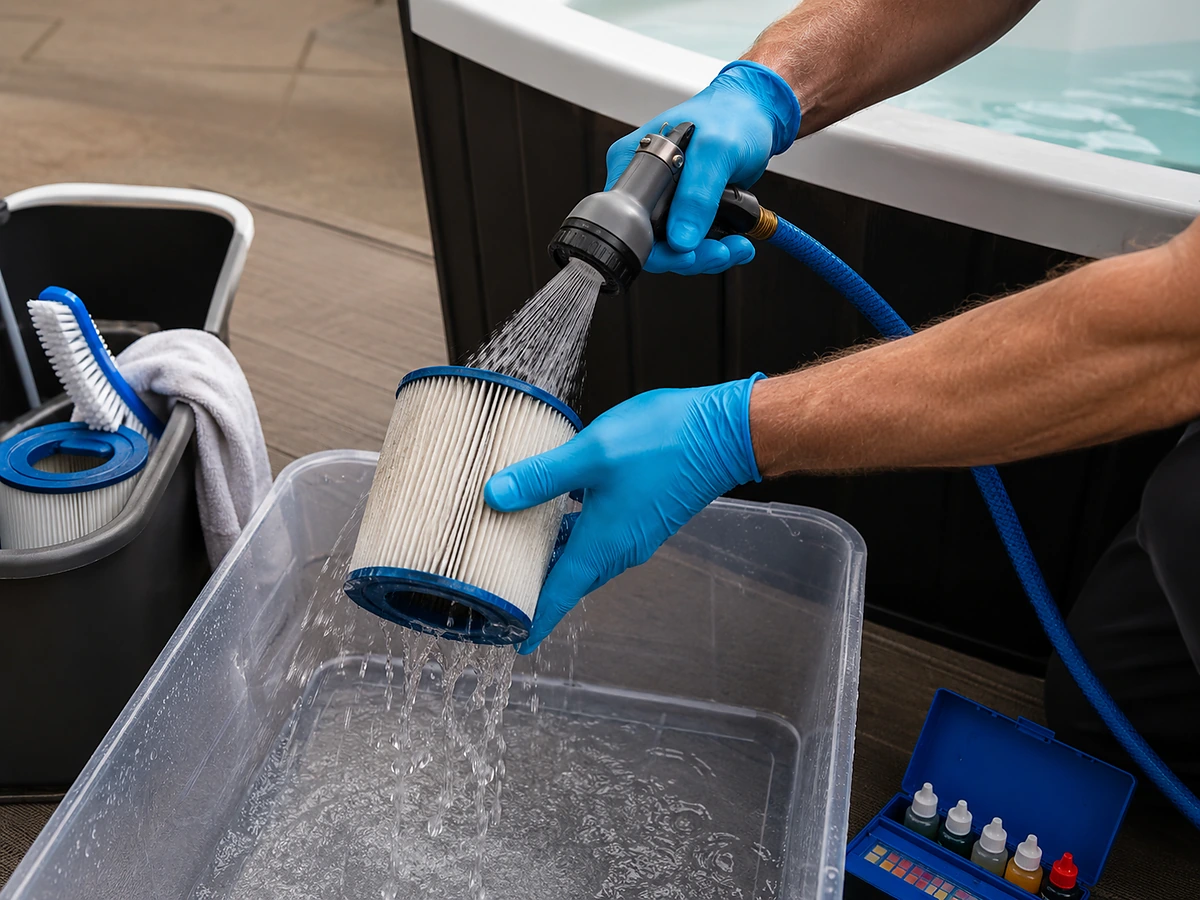
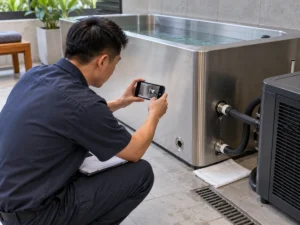
AI-generated conceptual visualization; not a verified HACHILL product model, customer installation or treatment specification.
Before Each Use
Check:
- Water appearance
- Unusual odor
- Surface condition
- Visible debris
- Cover condition
- Normal circulation
- Leaks
- Chiller airflow
- Safe access and surrounding floor
- Required water-test result
Do not use the plunge when the water-care system is outside its approved operating range or when contamination cannot be explained and corrected safely.
After Use or at the End of the Operating Day
Remove visible debris and inspect the waterline, cover and surrounding floor. Confirm that the system is left in the approved operating or shutdown condition.
A commercial operator should also complete the required water-care and maintenance record, including abnormal events and corrective action.
Scheduled Component Inspection
The inspection plan should include:
- Filter media
- Pump and return flow
- Hoses, fittings and seals
- Chiller air intake and exhaust
- Condensate route
- Ozone or UV components, where supplied
- Sensors or treatment feeders, where supplied
- Drain and cleaning access
- Electrical condition and wet-zone separation
Only trained or authorized personnel should open, repair or alter components beyond routine user maintenance.
Condition-Based Drain and Refill
Do not choose a drain interval from water age alone. Consider:
- User load
- Water volume
- Treatment stability
- Filter loading
- Visible or sensory changes
- Surface deposits
- Corrective-action history
- Manufacturer instructions
- Commercial requirements
Drain immediately when required by a contamination-response procedure, when the system cannot be returned to its approved limits or when the equipment instructions require it.
Use a Three-Level Maintenance Decision
A practical routine separates normal operating checks, corrective maintenance and stop-use events. This prevents staff from treating every issue as a simple filter-cleaning task.
On smaller screens, scroll horizontally to view the full table.
| Level | Typical Trigger | Expected Action | Who Should Approve Return to Use |
|---|---|---|---|
| Routine check | Normal appearance, normal flow and treatment within approved limits | Inspect, test, record and continue operation according to the system instructions | Owner or assigned operator |
| Corrective maintenance | Loaded filter, early deposits, minor flow reduction or water result needing adjustment | Remove users if required, inspect the cause, service accessible components and retest | Trained operator or service person defined by the operating plan |
| Stop use and escalate | Uncontrolled treatment, poor clarity, slime, known contamination, leakage or equipment fault | Close the plunge, isolate equipment as required, drain/clean or call qualified support | Authorized responsible person after corrective evidence is complete |
How to Drain, Clean and Refill a Cold Plunge
The exact procedure must follow the selected product manual and treatment instructions. The following sequence is a planning framework.
1. Stop Use and Prepare the Equipment
Keep users out of the plunge. Shut down or isolate electrical and treatment equipment according to the approved procedure.
Never handle powered equipment, plugs or extension connections with wet hands or while standing in water. Electrical installation and isolation must comply with local wet-area requirements.
2. Confirm the Drain Route
Direct wastewater to an approved location. Do not discharge treated water, cleaning water or cartridge-rinse water where it could create a nuisance, damage landscaping, enter an unsuitable storm-water route or violate local requirements.
Confirm whether neutralization or another disposal step is required for the selected treatment chemistry.
3. Remove and Service the Filter
Remove the cartridge or media only as instructed. Inspect it for loading, damage, deformation and deposits.
Clean or replace it using the permitted method. Do not use an incompatible cleaner that may damage the media or return unwanted residue to the system.
4. Clean the Tub and Waterline
Use a cleaner approved for the tub material and water-care system. Clean the interior surface, waterline, steps, hand-contact areas and underside of the cover.
Avoid abrasive tools or chemicals unless specifically permitted. Tub material alone does not prove compatibility with every sanitizer or cleaning product.
When cleaner, sanitizer or exposure compatibility becomes a material-selection question, use the Cold Plunge Tub Materials Buyer Comparison rather than expanding material-selection rules inside this maintenance guide.
5. Clean Confirmed Accessible Components
Clean only the plumbing, strainer, fitting or treatment components identified as user-serviceable. Do not dismantle the chiller, pump, sealed treatment equipment or electrical assemblies without authorization.
Where a line-cleaning procedure is required, use the exact product and sequence specified for the system.
6. Rinse, Inspect and Refill
Rinse as required, then inspect:
- Tub surfaces
- Seals and fittings
- Inlet and outlet
- Hoses
- Filter housing
- Drain closure
- Visible corrosion or damage
- Surrounding wet area
Refill with the approved water source and to the correct operating level.
7. Restart, Circulate, Treat and Verify
Restart the circulation and chiller according to the manual. Remove air from the system only using the approved procedure.
Apply the compatible sanitation method, allow the required treatment and circulation process, then test the water before access. Confirm normal flow, no leakage and stable equipment operation.
Troubleshooting Cloudy, Smelly, Foamy or Slippery Water
Symptoms help identify where to check, but they do not confirm a specific microorganism or chemical cause.
On smaller screens, scroll horizontally to view the full table.
| Symptom | Possible Causes | Safe First Checks | Stop-Use Boundary |
|---|---|---|---|
| Cloudy water | High debris load, weak filtration, treatment imbalance, contamination | Verify flow, filter, test result and recent user load | Keep users out when clarity or treatment cannot be restored |
| Unusual odor | Treatment problem, organic load, stagnant areas or contaminated surfaces | Test water, inspect waterline and review circulation | Stop use when cause is unknown or irritating conditions exist |
| Persistent foam | Cosmetics, oils, detergent residue or accumulated water load | Review pre-entry hygiene, cleaning products and water condition | Drain when corrective action does not restore control |
| Slippery or slimy surface | Surface contamination or possible biofilm | Stop use and inspect accessible surfaces and system | Drain, clean and follow the approved response procedure |
| Discoloration | Source water, corrosion, treatment reaction or contamination | Check source water, materials, treatment and visible damage | Stop when corrosion, unknown contamination or material failure is suspected |
| Weak flow | Loaded filter, blockage, air, valve, hose or pump issue | Follow approved flow and filter inspection | Shut down when the pump may run dry or components may be damaged |
| Rapid recurring contamination | Incomplete cleaning, high user load, poor hygiene or unsuitable system duty | Review the complete operating and maintenance plan | Escalate before reopening for repeated unresolved events |
- Keep users out when the cause or treatment condition is uncertain.
- Confirm circulation, filter condition, water-test result and recent contamination load.
- Perform only the corrective actions permitted by the equipment and treatment instructions.
- Drain, clean and refill when control cannot be restored or the response procedure requires it.
- Call the responsible supplier, installer, water-treatment specialist or local authority when the issue exceeds routine operator maintenance.
Cloudy Water
Do not add treatment products blindly. First confirm circulation, filter condition, treatment test results, user load and whether the tub and waterline were physically cleaned.
If the system cannot restore acceptable clarity and treatment control, keep it closed and drain or escalate according to the operating procedure.
Unusual Odor or Foam
Odor does not provide a reliable measure of sanitizer strength. Foam may come from body products, detergent residue, organic load or treatment conditions.
Review what entered the water, how the tub was cleaned and whether the existing water has accumulated a high load. Corrective action may require cleaning and replacement rather than more chemical.
Slippery Surfaces and Possible Biofilm
A slippery or slimy surface requires physical removal and investigation. Filtration and water treatment alone do not reliably remove deposits attached to surfaces and plumbing.
Keep users out, follow the approved drain and cleaning procedure and inspect accessible circulation components. Commercial operators should follow their contamination-response and escalation plan.
Weak Flow or Repeated Filter Blockage
Repeated blockage may indicate excessive debris, unsuitable filter capacity, poor access hygiene or a hydraulic problem. Do not simply replace cartridges without investigating why the loading is occurring.
For procurement, repeated high loading may show that the selected treatment route is not matched to the user throughput or environment.
When to Stop Use and Drain
Stop use when:
- Required treatment limits cannot be maintained
- Water clarity is inadequate
- Slime or biofilm is present
- There is known contamination requiring a response
- The circulation or treatment system is not operating correctly
- There is leakage, electrical concern or equipment damage
- The operating team cannot verify that corrective action has worked
Commercial reopening should follow the venue procedure and applicable local requirements.
Residential and Commercial Cold Plunge Maintenance Are Not the Same
User load changes the maintenance demand. A private plunge used by one household is not equivalent to a shared plunge serving many users. For a shared facility, maintenance planning must be tied to throughput, cleaning access, wet-area conditions and clearly assigned operating responsibility.
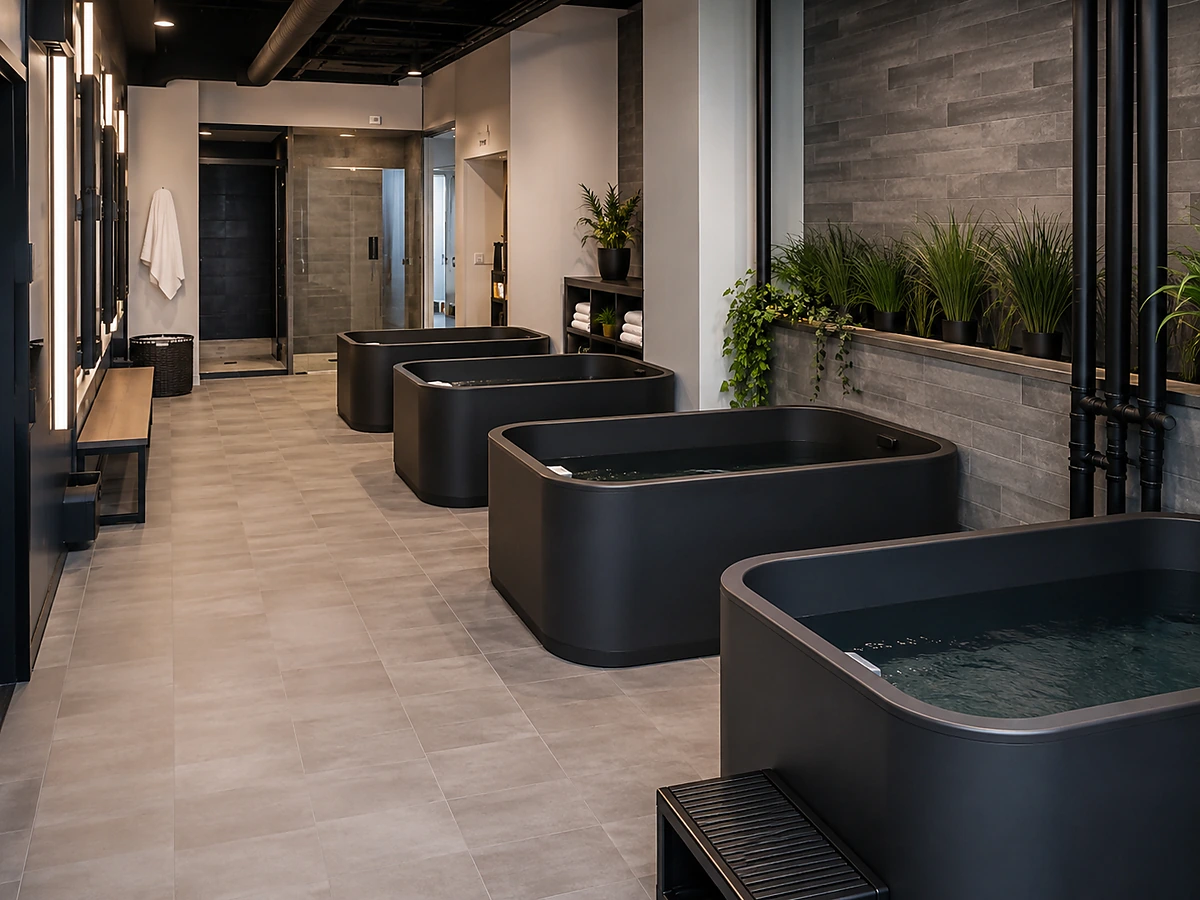
AI-generated conceptual visualization; not a verified HACHILL product model, customer installation or treatment specification.
User Load Changes the Maintenance Demand
Commercial planning should start with:
- Expected users per day
- Peak users per hour
- Session length and turnover
- Usable water volume
- Indoor or outdoor environment
- Pre-entry shower access
- Cleaning turnaround
- Treatment and testing route
- Staff availability
- Replacement filters and consumables
- Planned downtime
A larger tub is not automatically easier to maintain. More water may dilute some contamination, but it also increases the volume that must be circulated, treated, cooled and replaced.
Assign Staff Responsibilities
Define who is responsible for:
- Opening checks
- Water testing
- Filter inspection
- Cleaning
- Consumable replacement
- Chemical storage and handling
- Recordkeeping
- Contamination response
- Equipment shutdown
- Calling the installer, supplier or local authority
A written responsibility matrix reduces the risk that every task is assumed to belong to someone else.
Keep Water-Care and Maintenance Records
Useful records include:
- Test results
- Corrective actions
- User load or unusual events
- Filter cleaning and replacement
- Water replacement
- Surface and system cleaning
- Equipment alarms or faults
- Consumable use
- Staff initials
- Reopening approval
Records help the operator identify trends and help the supplier or installer distinguish an equipment issue from a water-care or operating issue.
Define a Stop-Use and Escalation Procedure
The operator must know when to close the plunge and who can authorize reopening. The procedure should cover water-treatment failure, poor clarity, visible slime, known contamination, pump or chiller failure, leakage, electrical concern and repeated unresolved water-quality problems.
Local public-health authorities may impose additional requirements for shared recreational water. Those requirements take priority over a generic maintenance article.
Define the Responsibility Matrix Before Opening
For a commercial project, water-care failure often comes from an undefined handover boundary rather than from one component. The quotation, installation scope and operating SOP should state who owns each task.
On smaller screens, scroll horizontally to view the full table.
| Task | Supplier / Manufacturer | Installer / Local Professional | Operator / Venue |
|---|---|---|---|
| Approved product configuration | Provide confirmed BOM, manuals and component scope | Verify site compatibility | Operate only the approved configuration |
| Electrical and wet-area installation | Provide equipment requirements | Design and install to local requirements | Keep access and isolation procedures available |
| Drainage and condensation | State equipment drain and condensate needs | Provide compliant route and floor management | Inspect for blockage, leakage and slip risk |
| Water-care method | State compatible materials and component limits | Support project integration where contracted | Select permitted products, test, record and correct |
| Filter and consumables | Identify exact replaceable parts | Provide service access | Inspect, clean, replace and hold agreed spares |
| Commercial hygiene and closure | Provide product-use boundaries | Support commissioning where contracted | Own venue SOP, staff training, records and stop-use decisions |
What Water-Care Information Should a Buyer or Operator Request?
A buyer or operator should request enough information to run, clean, test and service the complete water-care route. The goal is not to duplicate a general buying guide; it is to make sure the selected system can be maintained without assumptions.
This maintenance guide routes readers to the verified cold-plunge categories and project-support pages. Specific model materials, filtration components, sanitation options, dimensions and operating limits still require current model-level documentation.
Included Water-Care Components
Request a controlled list of what is included:
- Pump
- Filter housing and cartridge
- Strainer
- Ozone or UV component, if supplied
- Treatment feeder or controller, if supplied
- Hoses, fittings and valves
- Drain
- Cover
- Test equipment, if supplied
“Filtration included” is not enough. Ask for the exact filter and service method.
Consumables and Replacement Parts
Confirm:
- Filter model
- Replacement availability
- Recommended spare quantity
- Ozone, UV or sensor service parts where applicable
- Seals and hose components
- Compatible cleaning products
- Compatible sanitation products
- Storage and shelf-life considerations
- After-sales responsibility
Do not assume that a common-looking cartridge is interchangeable.
Cleaning and Service Access
Review the installation drawings for:
- Filter-removal clearance
- Pump and chiller access
- Air intake and exhaust
- Condensate drainage
- Tub drain access
- Hose and fitting inspection
- Safe electrical isolation
- Wet-zone floor drainage
- Space for cleaning and handling components
A compact installation that blocks filter or chiller service access can increase downtime and maintenance cost.
Commercial-Duty and Documentation Requirements
Before purchase-order release, confirm:
- Intended commercial or residential duty
- Usable water volume
- Expected user throughput
- Operating hours
- Water-treatment design responsibility
- Installer responsibility
- Local approval responsibility
- Maintenance manual
- Water-care instructions
- Component data sheets
- Electrical and plumbing information
- Cleaning and contamination-response requirements
- Inspection and handover records
- Spare-parts and after-sales scope
A product photograph, capacity label or chiller horsepower does not prove that the system is suitable for the intended commercial workload. Require model-level documentation for the actual supplied configuration.
Cold Plunge Water-Care Checklist
System
- Confirm usable water volume.
- Confirm pump and circulation route.
- Confirm filter type and service access.
- Confirm included ozone, UV or other treatment components.
- Confirm compatible sanitation method.
- Confirm drain and wastewater route.
- Confirm chiller ventilation and condensation management.
Before Use
- Water appearance is acceptable.
- No unusual odor, foam or discoloration.
- No slippery or slimy surface.
- Circulation is operating normally.
- Filter and inlet are not visibly blocked.
- Required treatment tests are within the approved operating range.
- Cover, steps and floor are clean and safe.
Maintenance
- Remove visible debris.
- Clean the waterline and accessible surfaces.
- Inspect and service the filter as required.
- Check hoses, seals and fittings.
- Keep chiller airflow clear.
- Record commercial checks and corrective actions.
- Drain, clean and refill when condition or instructions require it.
Stop Use
- Treatment control cannot be verified.
- Water is inadequately clear.
- Slime or biofilm is present.
- Known contamination has occurred.
- Flow, pump, chiller or treatment equipment has failed.
- Leakage, electrical concern or material damage is present.
- Repeated corrective action does not restore control.
This checklist supports—but does not replace—the selected equipment manual, treatment-product label, venue operating procedure or local public-health requirement.
Illustrative Operating and Project Scenarios
Illustrative Residential Scenario: Clear Water with an Unusual Odor
Problem: A privately used plunge looks clear, but an unusual odor develops shortly after refill.
Likely planning gap: The system has a cartridge filter, but no confirmed sanitation and testing routine.
Correction: Stop judging the water by appearance alone. Verify the filter, circulation, compatible treatment method, testing procedure and surface condition. Drain and clean if control cannot be restored.
Prevention: Treat filtration, sanitation, testing and physical cleaning as separate maintenance tasks.
This is an illustrative scenario, not a documented HACHILL customer case.
Typical Installation Planning Example: Filter Blocks Too Quickly
Problem: Return flow weakens and the filter requires frequent attention.
Likely planning gap: Outdoor debris, poor pre-entry hygiene and restricted service access are placing a high load on the cartridge.
Correction: Inspect the complete flow route, improve contamination control and verify that the filter and system duty match the use.
Prevention: Include cover use, entry-zone cleaning, filter access and replacement supply in the project brief.
This is a typical planning example, not a tested product result.
Composite Commercial Project Scenario: Residential Routine Used in a Shared Facility
Problem: Water quality deteriorates during peak use, but the venue has no records or defined stop-use criteria.
Likely planning gap: A residential maintenance routine was applied to a commercial user load.
Correction: Define testing, cleaning, filter service, consumables, records, staff responsibility, downtime and escalation. Review the project with local public-health and qualified installation professionals.
Prevention: State daily throughput and commercial operating requirements before quotation.
This is a composite commercial scenario and does not represent a named hotel, gym or recovery center.
Evidence and Responsibility Boundary
Use the Evidence at the Right Level
Cold-plunge water care is now supported by more directly relevant public-health guidance than a generic hot-tub analogy. The CDC Model Aquatic Health Code resource page links to CMAHC cold-water venue guidance that specifically addresses public cold-water systems, while the MAHC itself remains model guidance rather than automatic federal law. For private products and any project outside that scope, the model manual, treatment-product label and local authority still control.
Final water-care decisions depend on the selected tub, usable water volume, user load, pump and filter route, sanitation compatibility, water source, indoor or outdoor environment, drainage, ventilation, destination market, manufacturer instructions and applicable local public-health requirements. Qualified local professionals should review electrical, wet-area, drainage, water-treatment and commercial-hygiene requirements.
Final Water-Care Decision Summary
A reliable cold plunge maintenance plan is approved only after the actual water route, user load, treatment compatibility, cleaning access and operating responsibility are known.
- Do not treat filtration as sanitation.
- Do not treat clear or cold water as proof of control.
- Do not copy a universal dosing or water-change schedule.
- Stop use when water quality, circulation, treatment control or equipment condition cannot be verified.
- For commercial use, assign staff, records, escalation and reopening authority before operation.
Frequently Asked Questions
How often should cold plunge water be changed?
There is no universal interval. Water-change frequency depends on usable volume, user load, filtration, sanitation, testing, surface condition and the selected manufacturer’s instructions. Drain sooner when the system cannot maintain its approved operating limits or contamination requires a reset.
Can filtration replace a sanitizer?
No. A filter captures selected debris from water that passes through it. It does not replace a compatible sanitation method, water testing or physical cleaning.
Is cold water itself a sanitation method?
No. Low temperature should not be treated as a sanitation method. Reused water still needs a treatment, monitoring and cleaning plan appropriate to the system and use.
Can ozone or UV keep cold plunge water clean by itself?
Do not assume so. Ozone and UV operate within a designed flow route and may serve a supplementary role. Confirm the exact component, validation scope, maintenance and residual treatment requirements for the selected system.
How often should a cold plunge filter be cleaned or replaced?
Follow the exact filter and equipment instructions. Service frequency changes with user load, debris, flow, installation environment and media condition. Replace damaged, deformed or permanently loaded media rather than relying only on age.
When should a cold plunge be drained immediately?
Drain or follow the contamination-response procedure when required by the equipment instructions, when treatment control cannot be restored, when slime or biofilm is present, after defined contamination events or when repeated corrective action fails.
Can a residential cold plunge be used in a commercial facility?
Not automatically. Commercial use changes user load, cleaning turnover, testing, records, staff responsibility, downtime and local public-health requirements. Confirm that the complete system and documentation are suitable for the intended duty.
Prepare a Cold Plunge Water-Care and Maintenance Brief
For a model-level recommendation or commercial handover, prepare:
- Destination market and residential or commercial use
- Expected users, daily sessions and peak operating load
- Tub format and confirmed usable water volume
- Indoor/outdoor site, ambient conditions and service clearance
- Pump, filter, chiller and sanitation components included or required
- Water source, drainage, condensate and wet-area floor plan
- Testing, cleaning, records and stop-use responsibility
- Replacement filters, consumables, spare parts and after-sales expectations
- Required water-care manual, component data and maintenance records
Final selection depends on actual user capacity, use frequency, installation environment, climate, power supply, ventilation, drainage, water treatment, local regulations, destination-market requirements, manufacturer data and the agreed responsibility boundary between supplier, buyer, installer and operator.
Project brief: Request model-level water-care specifications by including the exact model, water volume, filtration route, operating environment and maintenance responsibilities.
Request Model-Level Water-Care Specifications
Send the project brief with the exact model or product family, usable water volume, user load, site conditions, treatment route and responsibility boundary so the quotation can be reviewed against the intended duty.