Commercial Buying Guide
A round wood-fired hot tub can suit resorts, glamping sites, outdoor wellness venues and distribution programs when the circular footprint works with guest access, stove operation and service space. For commercial procurement, approve the complete system—not just exterior diameter, stated person capacity or stove rating. Buyers need to confirm usable seating, actual water volume, stove and circulation route, filled load, chimney and drainage constraints, water-care compatibility, delivery access and controlled model documents.
Quick answer: Shortlist a round wood-fired hot tub only after the internal seating layout, stove and guard position, actual water volume, heat-up test conditions, foundation inputs, chimney package, commercial water-care route, delivery package and exact model documents are defined. Do not approve a tub from exterior size, visual appearance or a generic capacity claim alone.
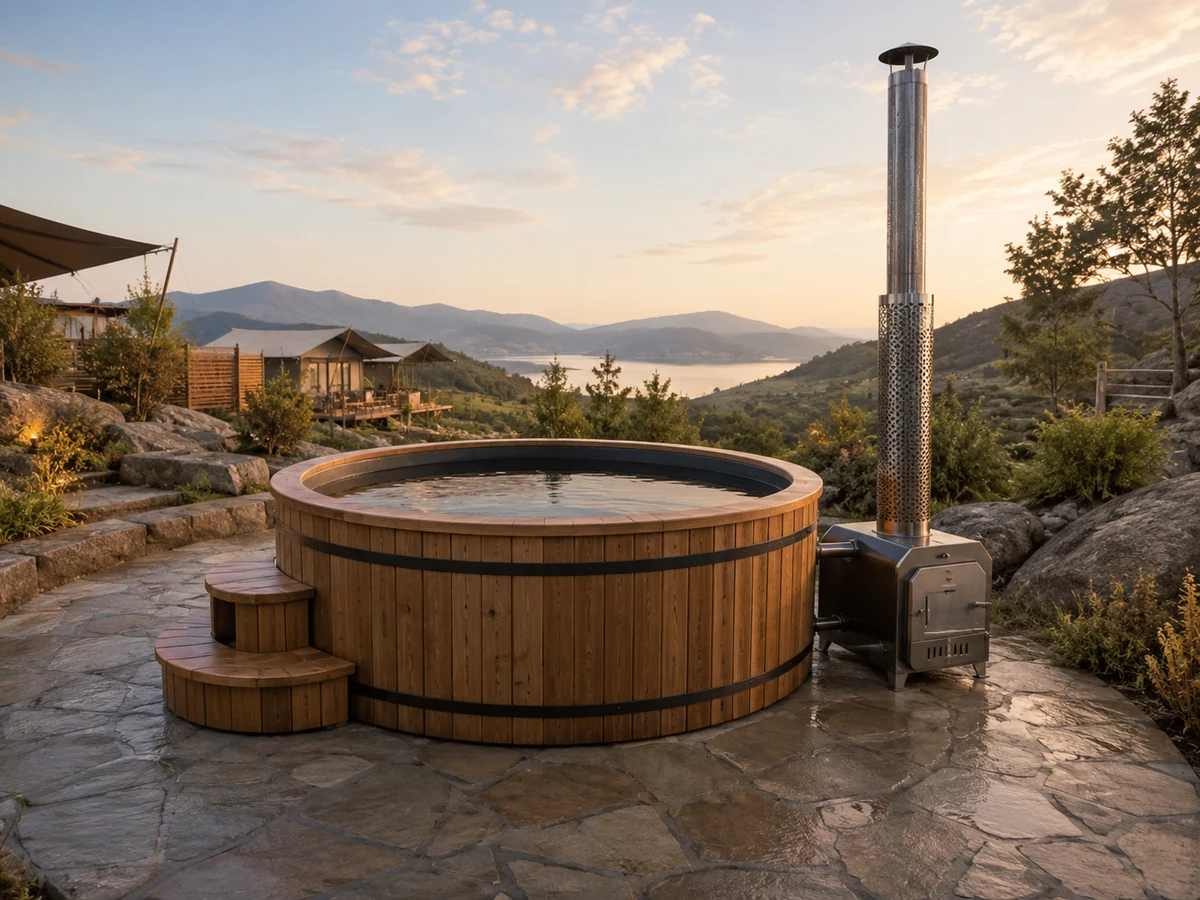
Conceptual asset; not a verified HACHILL model, customer project, chimney approval or installation drawing.
When Is a Round Wood-Fired Hot Tub the Right Format?
Round tubs are often selected because they create a central, social arrangement. Users face toward the middle rather than sitting in a straight line, and the form can work as a visible focal point in an open resort, spa or glamping setting.
The visual appeal of a round tub does not automatically make it the best geometry for every commercial site. The complete operating footprint includes the vessel, entry steps, stove, chimney, fuel-loading area, service access and drainage—not only the circular shell.
Projects where a round format may fit
- Open sites that benefit from central social seating.
- Resort or wellness settings where the tub is a visible focal point.
- Layouts where guests can enter without crossing the stove operator zone.
- Sites with enough service access for cleaning, fuel and inspection.
Projects that need closer review
- Narrow terraces or wall-aligned installations.
- Tight gates, corridors or turning routes.
- High-throughput venues with structured entry and exit flow.
- Facilities with defined accessibility, transfer or assisted-entry requirements.
Comparison tables may be scrolled horizontally on smaller screens.
| Project condition | Round format may fit | Review carefully | Possible no-fit |
|---|---|---|---|
| Central social seating | Strong format match | Confirm realistic user spacing | — |
| Open resort or glamping site | Visually suitable | Review fire, climate and drainage | — |
| Narrow linear terrace | — | Check wasted site space | Possible |
| High user turnover | Possible | Entry, exit and cleaning flow | Possible |
| Tight delivery route | — | Crate and turning radius | Possible |
| Roofed or canopied area | Possible | Chimney route and combustible construction | Possible |
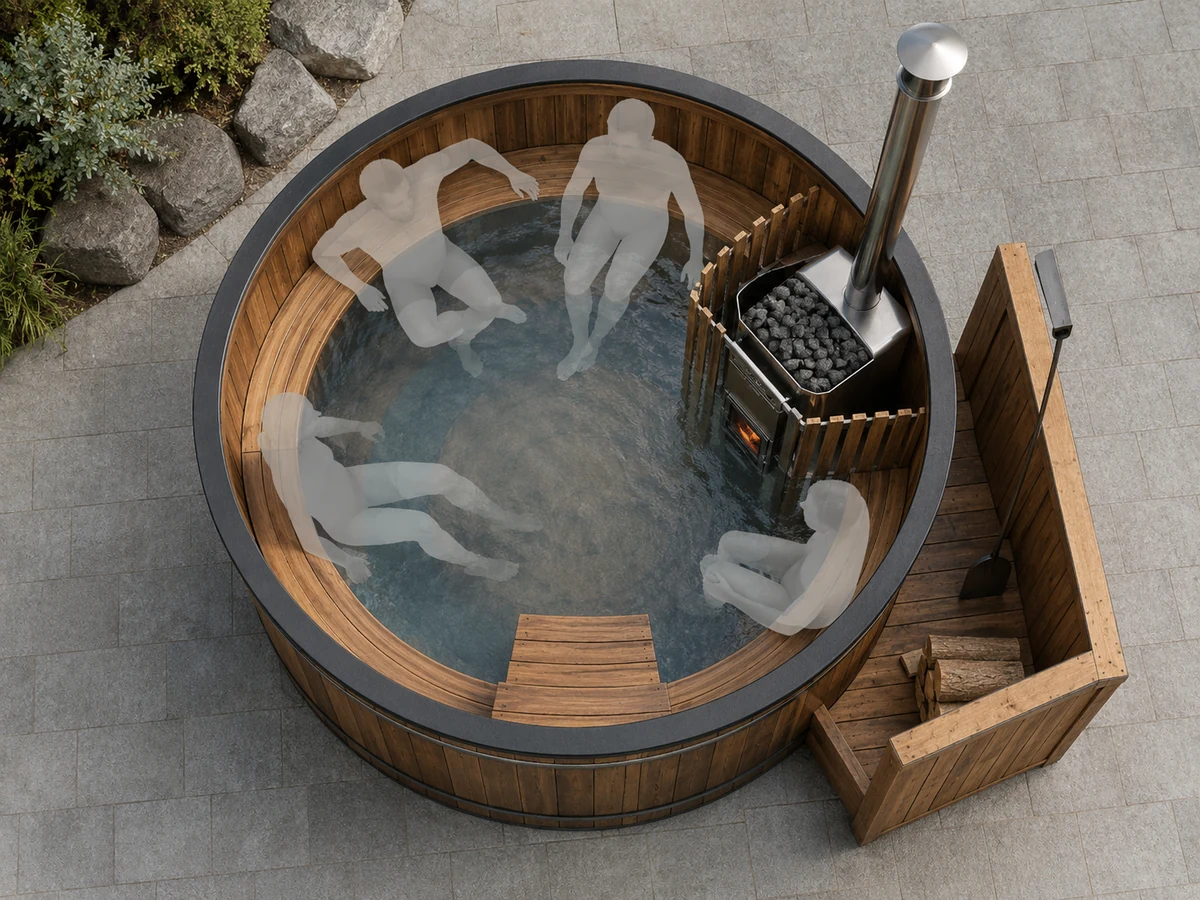
Conceptual asset; image details do not establish a universal stove, heater or circulation configuration.
How Much Usable Bathing Space Remains Inside the Round Tub?
A stated exterior diameter describes the outside of the product. It does not show how much bathing space remains after the wall structure, bench, stove, protective guard, internal steps, drain fittings and entry clearance are considered.
Exterior diameter versus usable diameter
Two tubs with similar exterior dimensions can provide different user space. One may have a deeper bench, thicker wall structure, larger internal stove or wider protective guard. Another may use an external stove and preserve more internal room while requiring additional space outside the vessel.
Why capacity labels need a seating drawing
A person-capacity label does not prove comfortable commercial seating. The realistic result depends on user body size, shoulder width, bench depth, water depth, central legroom, entry position and whether users need to move past one another.
| Input | Why it matters | Evidence required |
|---|---|---|
| External diameter | Defines total vessel footprint only | Dimensioned external drawing |
| Internal diameter | Better indicates bathing space | Internal dimension drawing |
| Bench geometry | Changes hip, shoulder and leg space | Seating layout |
| Stove intrusion | Reduces usable internal area | Stove-location drawing |
| Protective guard | Changes seating and movement | Approved configuration |
| Entry position | Affects circulation and safe access | Plan view |
| Intended users | Changes realistic capacity | Buyer project brief |
What the internal drawing should prove
The internal drawing should show the clear bathing diameter, bench depth and height, water depth, entry opening, stove body, guard envelope and any circulation or drain fittings. These details affect comfort, movement and operating volume. They also prevent a buyer from transferring a capacity claim from one stove route to another.
Internal or External Stove: What Changes for a Commercial Buyer?
The stove route changes seating, user safety, fuel handling, chimney position, maintenance access and the complete operating footprint.
For a deeper explanation of the heating loop and system boundaries, review how wood-burning hot tubs transfer heat. The exact stove, connection and circulation arrangement must still follow the selected model documents.
Internal stove implications
- May reduce usable bathing space.
- Places a hot surface and guard within the user zone.
- Brings fuel loading and ash handling closer to bathers.
- May restrict cleaning or internal access.
External stove implications
- Usually preserves more internal bathing area.
- Creates a separate hot-surface and operator zone.
- Requires verified water connections and circulation geometry.
- Increases the complete site and service footprint.
| Decision area | Internal stove | External stove |
|---|---|---|
| Bathing space | May reduce usable area | Usually preserves more internal area |
| User-zone hot surface | Located within the bathing zone | Located outside the vessel |
| Fuel loading | Closer to bathers | Separate operator position |
| Cleaning access | May require internal access | Often accessible externally |
| Site footprint | More compact vessel package | Larger complete operating footprint |
| Water connections | Integrated system route | External connections require verification |
| Best choice | Depends on the exact model, venue, operator workflow and local requirements | |
Circulation and overheat boundary
The selected stove route must maintain the circulation path required by the exact system. Pipe position, connection size, elevation relationship and service access cannot be inferred safely from a generic photograph. Restricted or incorrectly configured circulation can change heating behaviour and create an unsafe operating condition.
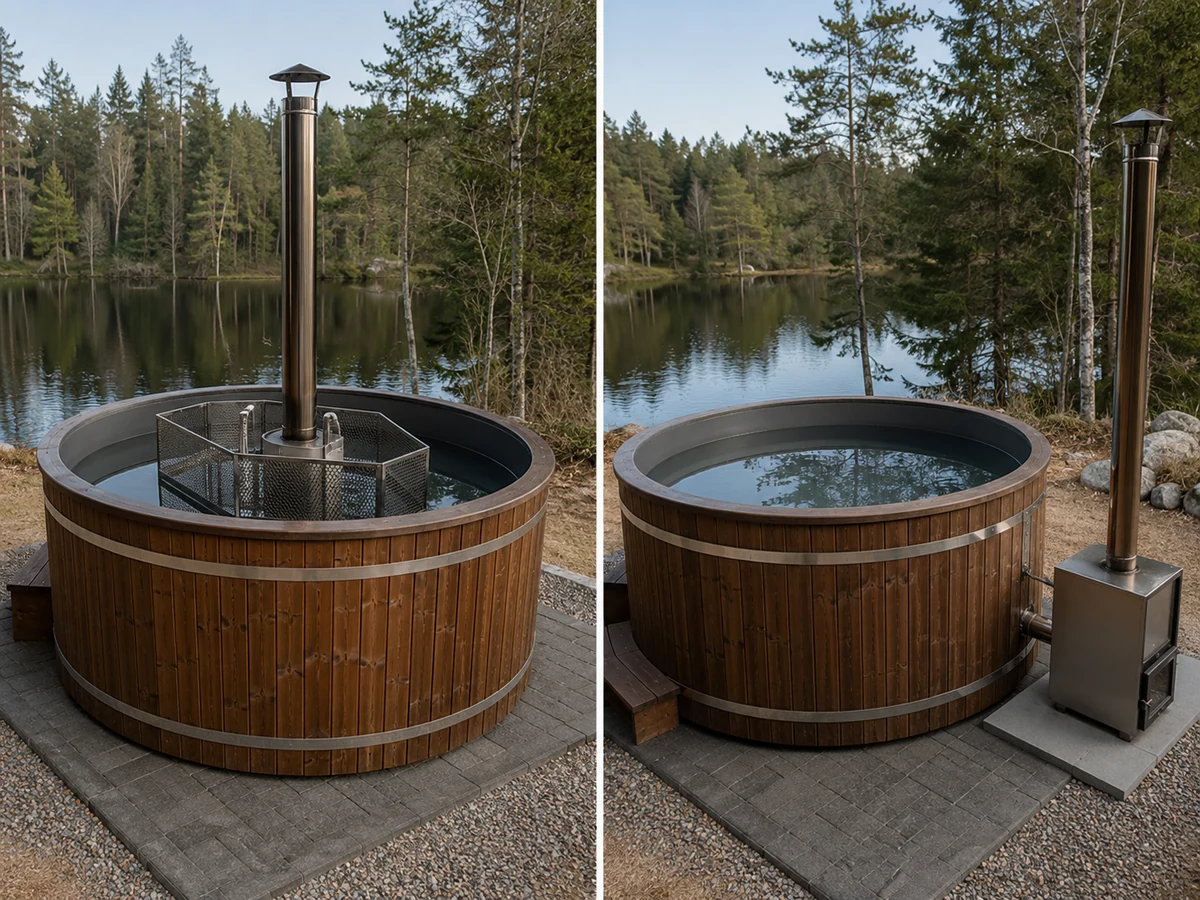
Conceptual asset; image details do not establish a universal stove, heater or circulation configuration.
What Determines Real Heat-Up Performance?
A stove rating or advertised time cannot define performance for every project. The result depends on the energy required to raise the actual water volume from its starting temperature to the intended operating temperature, together with delivered heat and ongoing heat loss.
For the dedicated evidence framework, see wood-fired hot tub heating-time variables. The linked guide owns heating-time depth; this page uses only the inputs needed for commercial comparison.
Why one time cannot apply to every project
- Usable water volume
- Starting and target water temperatures
- Outdoor temperature, wind and precipitation
- Vessel insulation and cover use
- Stove configuration and circulation route
- Fuel species, condition and moisture
- Combustion and chimney draft
- Operator practice and maintenance condition
A credible performance statement should disclose the exact model, water volume, starting temperature, target mixed-water temperature, ambient conditions, fuel condition, cover status, circulation method and measurement point.
Fuel condition remains an important test variable. As background, the EPA Burn Wise best-practices page recommends dry, seasoned wood and correct appliance operation. EPA now identifies Burn Wise as a historic record and states that the program has not been updated since October 30, 2025. Use it as background only; follow the selected stove instructions and current local air-quality and fire requirements.
| Performance input | Why it changes the result | What buyers should request |
|---|---|---|
| Actual water volume | More water requires more delivered heat for the same temperature rise. | Usable volume for the exact configuration |
| Starting and target temperatures | A larger temperature rise increases the heating demand. | Recorded start and final mixed-water values |
| Ambient and wind conditions | Exposure changes heat loss from the vessel and surface. | Test weather and installation context |
| Fuel condition | Moisture and fuel quality affect combustion and useful heat. | Fuel type and disclosed condition |
| Cover and insulation | They change heat loss during the test and normal operation. | Exact cover and insulated surfaces |
| Stove and circulation route | Configuration affects heat transfer and operating behaviour. | Model, connection layout and test setup |
Which Vessel, Liner, Cladding and Insulation Details Matter?
The phrase “wooden hot tub” does not fully describe the structure that contains the water. A product can combine a wetted vessel or liner, structural frame, exterior cladding, bench, bands, fasteners, insulation, base, cover and surface finish.
Wetted vessel versus exterior cladding
The wetted vessel is the material that directly contains the water. Exterior cladding is the visible outer finish and may be structural, partly structural or decorative. Wood appearance alone does not establish the liner material, hygiene compatibility, corrosion resistance or maintenance route.
What the wood name does not prove
A wood species name alone does not prove resistance in every climate, compatibility with commercial cleaning, freedom from checking or movement, or maintenance-free service. Construction details, moisture exposure, finish, storage and maintenance also matter.
| Area | Buyer question | Evidence required |
|---|---|---|
| Wetted vessel | What directly contains the water? | Exact vessel or liner specification |
| Exterior cladding | Is it structural or decorative? | Section or construction drawing |
| Bench | How is it supported and cleaned? | Internal layout |
| Insulation | Which surfaces are insulated? | Section detail |
| Bands and fasteners | What components are used? | Component schedule |
| Cover | Included, optional or buyer-supplied? | Quotation scope |
| Finish | What maintenance is required? | Finish and care instructions |
Environment and maintenance screening
Material approval should be tied to the real environment. Persistent rain, freeze–thaw cycles, standing moisture, high ultraviolet exposure, salt air and aggressive cleaning can change the maintenance burden. Buyers should request the intended finish, cleaning limitations, inspection points and replaceable-component route instead of treating the wood species or liner name as a complete durability claim.
For current HACHILL selection routes, review the round wood-fired hot tub product routes. Specifications shown on product pages remain model- and configuration-specific and should not be generalized to every round hot tub.
What Site, Foundation, Drainage and Fire Inputs Must Be Confirmed?
This guide addresses outdoor wood-fired systems. The selected site must support the filled vessel and keep guest circulation separate from stove operation, fuel handling, hot surfaces and drainage.
Foundation and filled load
Request the exact empty weight, usable water volume, base dimensions and support points. A qualified local professional should review the actual slab, ground or deck; a generic product photo cannot prove structural suitability.
Drainage and wet-area control
Confirm filling, overflow, splash and cleaning-water routes before installation. Water should not collect around the stove, steps or operator zone, and discharge must follow local requirements.
Stove and chimney review
Approve the exact stove, chimney components and route against nearby walls, roofs, canopies, trees, fuel storage and prevailing wind. In U.S. jurisdictions where it is adopted or referenced, NFPA 211 may form part of the chimney and solid-fuel appliance review. Its applicability and adopted edition must be confirmed locally; it does not replace the selected equipment instructions, local code or the authority having jurisdiction.
- Filled load and support condition
- Drainage and slip-control route
- Guest entry versus operator access
- Chimney route and nearby combustibles
- Fuel storage and ash handling
- Freeze and seasonal shutdown plan
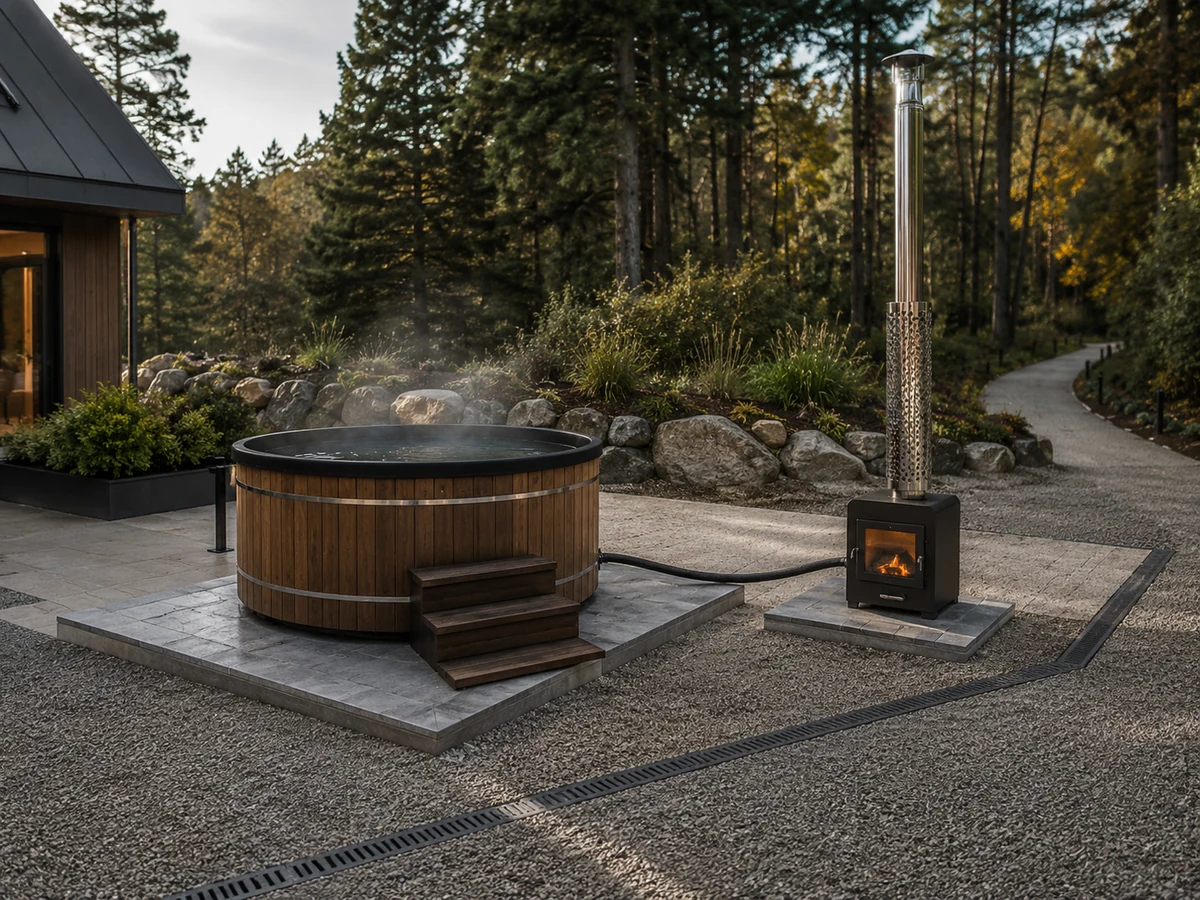
Conceptual asset; foundation, chimney and clearances require selected-model documents and local professional approval.
How Should Commercial Buyers Plan Water Care and Daily Operation?
Commercial suitability depends on the operating system as well as the tub. The venue must assign responsibility for filling, water monitoring, stove use, supervision, cleaning, draining, records and shutdown.
Shared or public use requires a locally accepted operating route
Heating the water is not sanitation. Before approving a tub for public, shared-hospitality or other regulated commercial use, confirm with the authority having jurisdiction how that product class is regulated and whether the proposed vessel can support the required circulation, filtration, disinfectant control, monitoring, water replacement, cleaning and recordkeeping. A fill-and-drain routine alone should not be assumed to satisfy local requirements.
The CDC hot-tub Legionella control guidance calls for proper disinfectant residual and pH, recommends automatic feed and control systems for public hot tubs, and emphasizes circulation through filtration, cleaning, trained staff and operating records. CDC also instructs operators to follow the authority having jurisdiction and points to the Model Aquatic Health Code as guidance where local regulations are absent. These are U.S. public-health references, not a universal approval for a particular wood-fired tub.
| Use pattern | Minimum decision before purchase |
|---|---|
| Occasional supervised private use | Startup, shutdown, cleaning and water-replacement procedure |
| Repeated guest sessions | Turnover, staff roles, water monitoring, records and fuel handling |
| Shared public or hospitality use | Confirm local regulatory classification, treatment and circulation requirements, supervision, monitoring and records with the AHJ |
| Seasonal closure | Complete drain-down, trapped-water control and restart procedure |
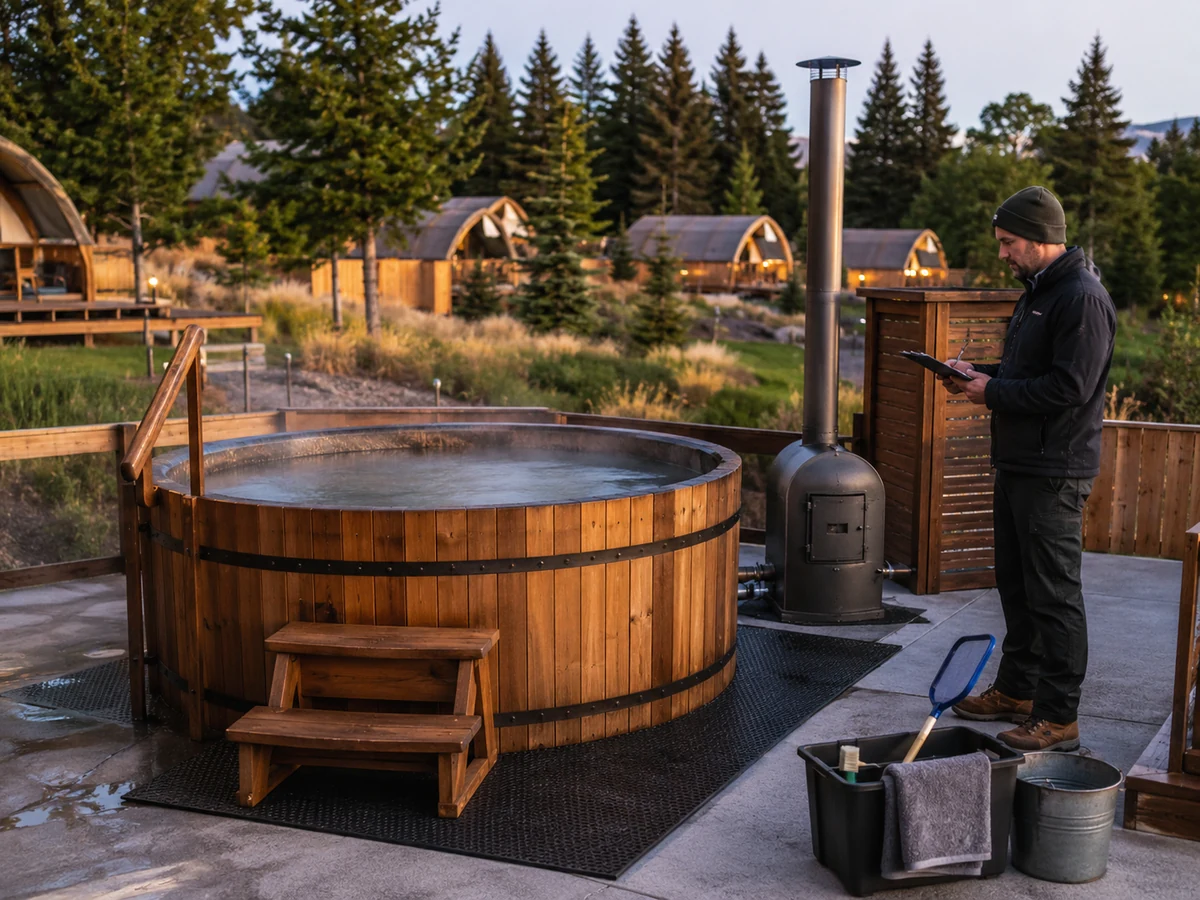
Conceptual asset; not a documented customer project or approved water-treatment procedure.
What Delivery and Assembly Constraints Matter?
A tub can fit the finished platform and still fail at the truck, gate, corner or unloading stage. Compare the finished product with the shipping package and the complete movement route.
- Crate dimensions, package count and package weights
- Truck, forklift or approved lifting access
- Gate width, turning points, slopes and overhead limits
- Temporary storage and assembly area
- Model identity and drawing revision at receiving
- Damage, missing components and document discrepancies
Quarantine a package if the stove, chimney, vessel, drain or approved revision differs from the purchase documents. Exact lifting points and handling methods must come from the supplier.
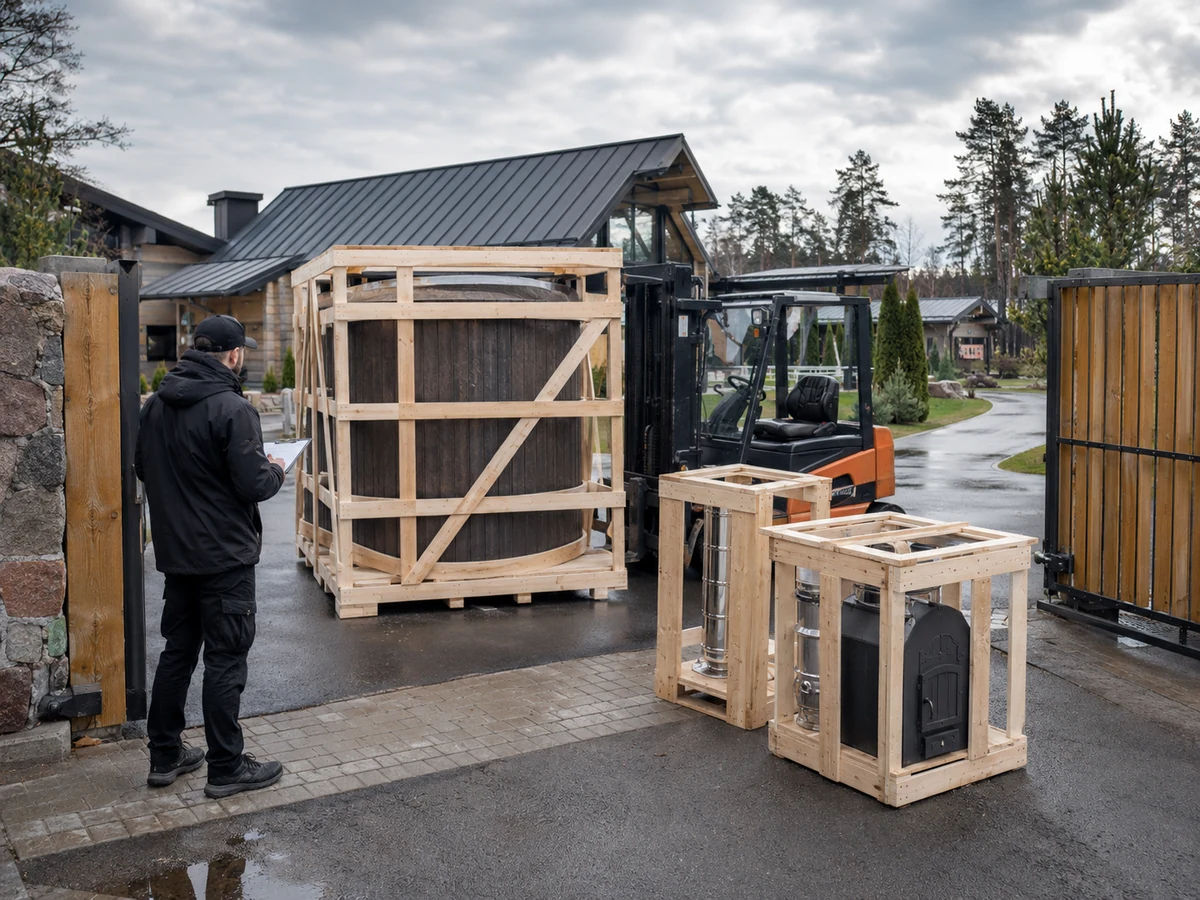
Conceptual asset; exact packaging, lifting points, weights and handling instructions must come from the supplier.
How Should Buyers Normalize Supplier Quotations?
Two quotations are comparable only when they describe the same vessel, stove route and included scope. A lower unit price may exclude chimney components, cover, steps, drain fittings, packaging, manuals or inspection.
| Comparison line | What must match |
|---|---|
| Tub and seating | Exact model, internal layout and usable bathing area |
| Stove system | Internal or external route, guard, connections and chimney scope |
| Included components | Cover, steps, drain, insulation, finish and accessories |
| Documents | Drawings, manuals, inspection scope and approved revision |
| Packaging and delivery | Crates, protection, handover point and buyer-supplied services |

Conceptual asset; documents do not represent an actual HACHILL quotation, certificate or customer order.
What Evidence Should Be Approved Before the Purchase Order?
A product-family brochure supports initial screening, but the purchase order should reference an exact model and controlled document revision.
- External and internal dimensions
- Seating, entry, stove and guard layout
- Stove, chimney and water-connection scope
- Vessel or liner, cladding and finish
- Drain, cover, steps and included accessories
- Packing dimensions, weights and package count
- Manuals and destination-market document scope
- Approved drawing and component revision
For OEM or private-label orders, visual sample approval is not enough. Branding, materials, stove route, drain, packaging and manuals should be tied to the approved revision. MOQ, customization, timing, warranty and spare-parts commitments remain quotation- and contract-specific.
Common Commercial Buying Mistakes
- Using the stated person capacity without an internal seating drawing.
- Treating exterior diameter as usable bathing space.
- Using stove rating as a universal heat-up guarantee.
- Ignoring the stove operator zone and guest movement.
- Approving the final site without crate and unloading dimensions.
- Comparing quotations with different included scopes.
- Assuming a wood-fired tub is automatically suitable for shared public use.
Composite scenario — overstated capacity: A venue approves a six-person label without subtracting the internal stove, guard, bench depth and entry envelope. The correction is to approve capacity against the internal layout and intended user profile.
Illustrative scenario — incomparable quotations: The lowest price excludes the chimney, cover, steps and packing scope. The correction is to normalize every included, optional and excluded line before purchase-order release.
Typical planning scenario — delivery obstruction: The tub fits the platform but cannot pass the gate. The correction is to approve crate dimensions, unloading equipment and the complete movement route before shipment.
These scenarios are illustrative and do not represent named HACHILL customers, projects, incidents or performance tests.
Prepare a Qualified Project Brief
Before requesting a model-level quotation, provide the intended venue, user profile, operating frequency, available footprint, preferred stove route, climate, foundation condition, chimney environment, water and drainage plan, delivery access, quantity and required document scope.
Final selection still depends on the exact model, manufacturer-confirmed data, local structural and fire review, commercial water-care approval, logistics and contractual scope.
Final Buyer Decision
Choose a round wood-fired hot tub when the circular footprint supports the intended guest flow and the site can separate bathing access from stove operation and service work. Hold or redesign the concept when usable seating is unproven, the chimney or foundation review remains open, the locally required commercial water-care route is unresolved, or the shipment cannot reach the site. Compare suppliers only after the same internal layout, stove scope, accessories, document revision and packaging scope are defined.
Frequently Asked Questions
Is a round wood-fired hot tub suitable for commercial use?
It can be, but commercial suitability must be confirmed for the exact model, user turnover, stove route, water-care plan, cleaning access, supervision and local requirements.
How many people can a round wood-fired hot tub hold?
Do not rely only on the stated capacity. Review the internal diameter, bench layout, water depth, entry position, stove intrusion and protective guard.
Is an internal or external stove better for a commercial venue?
Neither route is universally better. An internal stove may reduce bathing space, while an external stove increases the complete operating footprint and requires verified external connections and access.
How long does a wood-fired hot tub take to heat?
There is no universal time. The result depends on usable water volume, temperature rise, weather, cover, insulation, stove configuration, circulation, fuel condition and operation.
What foundation does a filled wood-fired hot tub need?
The foundation must support the exact filled vessel, users and equipment. The supplier should provide load inputs, and a qualified local professional should approve the real site, slab, platform or deck.
Does a commercial wood-fired hot tub need water treatment?
The required water-care route depends on the venue, use pattern, vessel configuration and local public-health requirements. Heating alone should not be treated as sanitation.
What chimney and fire-clearance information should be confirmed?
Confirm the exact stove and chimney components, route, supports, nearby combustible construction, operator area and local fire requirements. Do not apply a generic clearance to every system.
What documents should buyers request before placing an order?
Request the exact model, drawings, seating layout, stove and chimney scope, vessel materials, finishes, packing information, manuals, inspection scope, destination-market documents and approved revision.
Technical Scope and Review Boundary
This guide explains general commercial comparison principles for outdoor round wood-fired hot tubs. It does not certify a specific HACHILL model, stove, chimney, material, capacity, heat-up time or destination-market approval.
Final structural, fire, drainage, water-care, accessibility and commercial-facility decisions require the selected model documents and review by appropriately qualified local professionals and authorities. Quantity, customization, inspection, warranty, spare parts, shipping and timing remain quotation- and contract-specific.