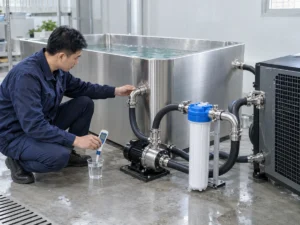
Direct answer: A wood-fired hot tub heats water through a connected system: wood burns in the stove, heat crosses the heater or heat-exchange surface into the water, heated water circulates back to the tub, and mixing distributes that energy through the bathing volume. Depending on the heater design, circulation may be driven naturally by thermosiphon or by a pump in a system specifically designed for forced circulation.
That sequence explains how a wood-burning hot tub works, but it does not define every installation or predict a universal heat-up time. Stove position, circulation architecture, chimney draft, fuel condition, usable water volume, heat loss, mixing and temperature measurement all affect whole-system behavior.
Scope: This guide separates general thermal principles from model-specific requirements. Exact plumbing geometry, minimum water level, pump compatibility, stove output, chimney arrangement, hot-surface or combustible clearances, operating limits and performance must be confirmed for the selected heater and installation site.
How a Wood-Fired Hot Tub Moves Heat From Fire to Water
A wood-fired hot tub has one continuous heat path:
wood combustion → heater heat transfer → water circulation → hot-water return → mixing through the tub
Each stage has a different job. The fire creates heat. The heater transfers part of that heat into water. Circulation carries the heated water away from the stove. Mixing determines whether the whole tub has reached a representative temperature.
Combustion creates heat, but the fire is only the starting point
Burning wood releases heat inside the stove or heater. Some of that energy can be transferred into the water circuit, while some leaves through combustion gases and hot surfaces.
A larger-looking fire therefore does not automatically mean that the complete tub is heating more effectively. Combustion condition, heater design and water-side heat transfer all matter.
The heater transfers heat into the water circuit
The exact internal construction varies by heater, but the functional requirement is the same: heat from combustion must cross a heater or heat-exchange surface into water.
Once the water around that heat-transfer surface warms, the energy still has to leave the heater and reach the rest of the vessel. That is the role of circulation.
Circulation carries heated water back to the tub
Some wood-fired hot tubs use natural circulation. Warmer water becomes less dense and tends to rise, while cooler, denser water can return toward the heater. When the heater and water connections are designed around this effect, the resulting loop is called thermosiphon circulation.
Other systems use a pump to create the required water movement. The two approaches use the same basic goal—move heat from the heater into the tub—but the equipment and installation requirements are not interchangeable.
Hot water returning to the tub still has to mix
Water close to the heater return can be warmer than water elsewhere in the vessel.
Until that heat has been distributed through the tub, a local temperature reading does not necessarily represent the full bathing volume. Return position, vessel geometry and the manufacturer’s specified mixing method all influence how quickly the water becomes more uniform.
The fire creates the heat, the heater transfers it, circulation moves it, and mixing determines the condition of the full tub.
Internal vs External Stoves: What Changes in the System
An internal stove and an external stove can both heat a wood-fired hot tub, but changing the stove location changes the physical architecture around the heating system.
The meaningful comparison is not “which stove type is always better?” It is what changes when the heat source moves inside or outside the vessel.
Internal or submerged stoves use space inside the tub
An internal stove occupies part of the vessel. As a result, the outside dimensions of the tub do not automatically tell you how much clear bathing space remains.
The heater itself, its protective separation and the surrounding user space need to be considered in the actual layout.
An internal arrangement can also keep the heater-to-water relationship physically compact. That may simplify some system interfaces, but it does not prove a universal heating-time or efficiency advantage.
External stoves preserve tub space but add water connections
An external stove places the heater outside the bathing vessel. More of the tub interior can therefore remain available to users.
The trade-off is that the system now depends on connections between the tub and the external heater. Those connections matter particularly when the heater relies on natural circulation. The water route, relative elevations and any restrictions have to match the design requirements for the selected equipment.
External placement also makes heater access, chimney routing and separation from users or nearby structures part of the site plan. Exact chimney dimensions and clearance distances are not generic values. They belong to the selected appliance instructions and the requirements that apply at the installation location.
| System variable | Internal / in-tub stove | External stove |
|---|---|---|
| Usable tub space | Heater occupies part of the vessel | More interior space can remain available |
| Water route | Heater is integrated closely with the vessel | Requires connections between tub and heater |
| Hot-surface planning | Hot equipment is within or immediately beside the bathing area | Hot equipment is outside the vessel but still needs controlled separation |
| Circulation geometry | Defined by the internal heater arrangement | External connection geometry becomes a major design variable |
| Service access | Must allow access around the in-tub heater | Requires working space around heater and connections |
| Heating performance | Cannot be inferred from location alone | Cannot be inferred from location alone |

How Water Circulates: Thermosiphon and Pumped Systems
The heater can transfer heat into water only if the water-side system operates as intended. Circulation is therefore one of the most important links between combustion and whole-tub heating.
Thermosiphon is density-driven natural circulation
ASHRAE defines thermosiphon as circulation driven by density differences between warmer and cooler fluids. In a wood-fired hot-tub loop designed for natural circulation, the same principle allows warmer water to move toward the upper return while cooler water moves back toward the heater.
As the water in the heater warms under normal operating conditions, the density difference can sustain a natural-circulation loop when the heater elevation, connection points and water route are designed for that arrangement.
The physics is general; the plumbing specification is not.
A real thermosiphon heater may depend on particular connection locations, pipe sizes, vertical relationships and routing. Restrictions, unsuitable valve positions or trapped air may also interfere with the intended flow.
Those details must come from the actual heater documentation. A generic rule from another system should not be copied into the installation.
Pumped circulation is a different heating-loop architecture
Other wood-fired systems use a pump to move water through the heater.
That does not mean a pump can simply be added to any thermosiphon heater. Real products exist in both natural- and forced-circulation architectures, but heater construction, allowable pressure, flow path and controls can be different. Pump compatibility is therefore a model-specific requirement, not an upgrade assumption.
There is also an important terminology distinction: heater circulation pump ≠ filtration or accessory pump.
A wood-fired heating loop may use thermosiphon while the overall hot tub still uses electricity for filtration, controls or other accessories. For that reason, “wood-fired” should not automatically be interpreted as “the entire hot tub requires no electricity.”
Water level and flow state matter before firing
A heater receiving combustion heat needs the water-side condition required by its design before the fire is started.
That may include a specified fill level, an open circulation route and a particular valve or pump state. Manufacturer guidance for gravity-circulation hot tubs commonly makes these conditions explicit; the actual limits must come from the selected heater manual.
If circulation is inadequate while heat continues to enter the heater, water inside the heater can overheat locally and may begin to boil. The safe shutdown, cooling and correction procedure remains equipment-specific.
Do not use fire as the first test of an uncertain circulation path.
If the water route is uncertain, compare the installation with the approved heater schematic and resolve the discrepancy before firing.
How Combustion and Chimney Draft Affect Heat Transfer
Water circulation explains how heat moves after entering the water circuit. Combustion determines how that heat is produced.
Wood condition, combustion air and chimney draft all affect the heat source available to the heater.
Fuel condition changes combustion behavior
Suitable dry fuel generally supports cleaner, more effective combustion than wet fuel; UK DEFRA guidance likewise distinguishes dry from wet wood while keeping its moisture and fuel rules within the UK air-quality context.
The exact fuel specification still belongs to the appliance instructions and any local fuel requirements. A moisture limit or fuel rule from one market should not automatically be presented as a worldwide hot-tub specification.
A heating claim is incomplete if the fuel condition behind the claim is unknown.
Natural chimney draft depends on buoyancy and the complete flue path
In a naturally drafting combustion system, heated combustion products rise through the chimney or flue because of buoyancy. Natural Resources Canada describes this same buoyancy-driven natural-draft principle.
This upward movement helps establish the draft needed for combustion.
The real draft condition depends on the complete appliance and flue arrangement. That is why exact chimney height, diameter, termination and clearance requirements should not be copied from a generic article.
Use the selected heater instructions together with the requirements that apply at the installation site.
Heater output is not the same as whole-tub heating performance
A heater may have a stated power or output value, but the buyer first needs to know what that rating represents.
Possible quantities include heat produced by the appliance, heat transferred toward the water under stated conditions, and observed temperature-rise performance of a complete tub-and-heater system. Those are not automatically the same measurement.
Even a useful water-side output figure cannot, by itself, predict the heat-up time of every tub.
Whole-system performance can also change with usable water volume, starting water temperature, fuel condition and firing state, circulation, ambient conditions, heat loss from the vessel and exposed connections, and cover use where permitted by the selected equipment.
So instead of asking only “Which stove has the higher kW rating?”, ask “What does that rating measure, under what conditions was it established, and what evidence describes the complete tub-and-heater system?”
If the main decision is how long the tub will take to heat, use the HACHILL wood-fired heating-time guide rather than turning the stove rating into a time estimate.

Why Mixing, Measurement and Stored Heat Matter
A wood-fired hot tub can develop warmer and cooler zones while it heats. Temperature control therefore depends not only on producing heat, but also on where the water is measured and whether the reading represents the whole tub.
A hot return does not prove the whole tub is equally warm
Water entering from the heater can create a warmer zone near the return before that energy has spread through the rest of the vessel.
A thermometer near that point may be accurate locally while giving a misleading impression of the average water condition.
The same issue can occur when warmer water remains closer to the surface while cooler water is present elsewhere.
Before using a measurement as a representative tub temperature, follow the selected system’s specified mixing and temperature-check procedure and measure away from a localized hot return unless the manual directs otherwise.
Define what temperature you are actually measuring
A wood-fired hot-tub system can have several relevant temperature states: water in or leaving the heater, water near the hot return, a warmer layer in the vessel, a cooler region elsewhere in the vessel, and representative mixed-water temperature.
These values do not answer the same question.
For a heating-performance comparison, the start and finish temperatures should describe a consistent, representative water condition. For normal use, temperature should likewise be assessed using the manufacturer’s operating procedure rather than a convenient hot-point measurement.
Detailed personal bathing-temperature guidance belongs to the separate HACHILL hot-tub temperature guide.
Wood heat does not stop instantly when fuel addition stops
Reducing or stopping new fuel does not necessarily remove all heat from an active wood-burning heater immediately.
If fire, embers and hot heater surfaces remain, heat can continue entering the water.
This is why wood-fired temperature management requires anticipation. The operator has to consider not only the current measured temperature but also whether the system is still receiving heat.
- Maintain the circulation state required by the heater.
- Mix the water according to the selected system’s procedure.
- Measure a representative part of the water volume rather than the hottest return point.
- Account for continuing heat from the active fire and hot heater.
- Follow the manufacturer’s firing, shutdown and temperature-control instructions.
This article explains the thermal logic behind that process; it does not replace the selected heater’s operating manual.
What Buyers Must Verify on the Actual Wood-Fired System
General engineering principles explain how a wood-fired hot tub works. They cannot supply specifications for a product that has not been identified.
Before comparing two systems, separate the information into four levels:
General physics → system architecture → model-specific data → site-specific requirements
This distinction prevents generic information from being turned into an unsupported product specification.
| Verify on the actual system | Why it matters | Evidence to request |
|---|---|---|
| Stove arrangement | Changes usable space, interfaces and service access | Approved product layout or drawing |
| Heater circulation method | Defines thermosiphon or pump-driven operation | Heater manual and water-route schematic |
| Required condition before firing | Controls correct heater operation | Operating instructions |
| Water-connection geometry | Can materially affect natural circulation | Model-specific installation drawing |
| Heater-output definition | Prevents unlike rating figures being compared | Technical data with rating basis |
| Usable water and bathing space | Changes thermal load and usable interior | Model data and approved drawing |
| Chimney / hot-surface requirements | Affect site planning and fire interface | Appliance documentation plus applicable local requirements |
| Temperature measurement method | Determines whether test results are comparable | Operating or test procedure |
| Heating-performance evidence | Needs defined water and test conditions | Complete model/test conditions |
Do not fill an unknown specification with another product’s number
If a model-specific value is unavailable, keep it open until it is confirmed.
Do not copy another heater’s pipe diameter, circulation slope or rise, minimum water level, pump requirement, chimney dimensions, heater output, heat-up time, efficiency or certification.
Those values can show what kind of information needs verification. They cannot define the selected HACHILL system.
For procurement and project approval, the HACHILL wood-fired hot-tub safety-documentation guide goes further into controlled drawings, manuals and product-specific evidence.
A practical system-comparison check
- Is the stove internal or external?
- How does water circulate through the heater?
- What usable water volume and bathing space remain in that configuration?
- What exactly does the quoted heater-output figure represent?
- Which approved drawing controls the heater connections?
- What chimney and hot-surface requirements apply?
- How is representative mixed-water temperature measured?
- What conditions support any quoted heating-time result?
If one of those answers is unknown, treat it as an open technical item, not as permission to substitute a generic assumption.
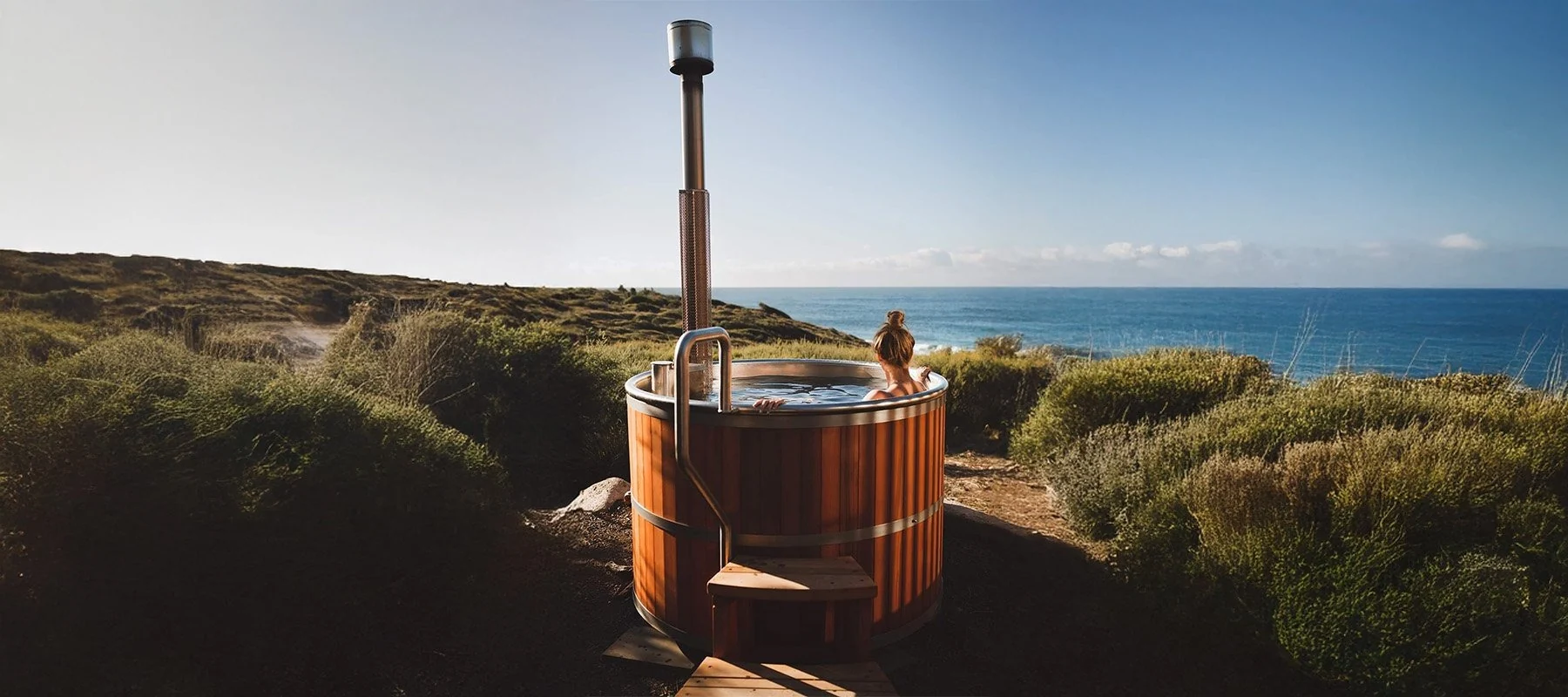
For HACHILL products, start with the current wood-fired hot-tub product family and then move to the exact configuration when the project geometry is known.
Frequently Asked Questions
Do wood-fired hot tubs always need a pump?
No. Some wood-fired heaters are designed around natural thermosiphon circulation, while others use forced circulation.
The selected heater documentation must confirm which arrangement applies. Do not add or remove a heating-loop pump based only on another system’s design.
A separate filtration or accessory pump is a different question, so a thermosiphon heater does not necessarily mean that the entire hot tub has no electrical equipment.
Can a wood-fired hot tub overheat if circulation is restricted?
Restricted heater flow can create dangerous local overheating in systems that depend on continuing water circulation while heat is being added.
Do not use a stronger fire to test uncertain circulation. Follow the equipment instructions and resolve water-route or installation problems before firing.
If the tub is not heating normally, use the HACHILL wood-fired hot-tub troubleshooting guide for the symptom/check/escalation path rather than improvising changes to the heater loop.
Does an internal stove heat faster than an external stove?
Not as a universal rule.
Stove location is only one variable. Heater design, water volume, fuel, circulation, ambient conditions, heat loss and the measurement method can all change observed heating performance.
Compare documented performance of the actual configurations rather than treating “internal” or “external” as a guaranteed speed ranking.
Do wood-fired hot tubs need electricity?
Not always for the heating loop. Some wood-fired heaters use thermosiphon circulation and need no electric circulation pump for heat transfer.
The complete hot tub may still use electricity for filtration, controls, lighting, massage equipment or other accessories. Check the actual system architecture rather than assuming that “wood-fired” means the whole tub is off-grid.
Reference Basis and Scope
The engineering distinctions in this guide use recognized thermosiphon principles, natural-draft combustion guidance, current dry-fuel guidance and model-specific heater documentation reviewed during research.
- ASHRAE terminology — engineering terminology for thermosiphon / natural-circulation concepts.
- Natural Resources Canada: combustion gases and natural draft — general natural-draft combustion context.
- UK DEFRA: Burn Better — dry-versus-wet wood guidance in its UK air-quality context.
- Kirami: hot-tub heating guidance — manufacturer example showing that gravity circulation, minimum fill condition and mixing instructions can be model-specific; it is not a HACHILL specification.
Manufacturer documentation was used only to verify that real wood-fired heater systems can have model-specific requirements for water level, circulation architecture, mixing and operation. Those requirements have not been converted into HACHILL specifications.
This guide therefore does not establish a HACHILL heater output, pipe size, circulation geometry, chimney clearance, heat-up time, efficiency, certification or model-specific operating limit.
Move From System Principles to the Actual Product
Once the heat path and circulation architecture are understood, identify the intended tub format and site, then confirm the selected heater, water volume, circulation method, connection requirements, chimney interface, operating method and evidence behind any performance claim.
For a defined HACHILL project, send the intended application, destination, project scale, site constraints and documentation requirements through the project enquiry process.
Send Your Wood-Fired Hot Tub Project Requirements