HACHILL engineering guide · Wood-Fired Hot Tub
Direct answer: To build a wood-fired hot tub safely, treat it as one integrated system: structure, bathing vessel, hot-water circuit and solid-fuel appliance. The safest DIY scope is usually site preparation, noncritical enclosure work and assembly of manufacturer-documented components. Do not improvise a stove, heat exchanger, chimney, pressure-containing part or circulation arrangement around a fire. Before construction, define the filled and occupied load, water-contact materials, drainage and freeze strategy, heater and circulation architecture, flue route, hot-surface protection, water care, temperature verification and commissioning responsibilities. Exact connection geometry, clearances, firing limits and shutdown steps are model- and jurisdiction-specific and should come from the selected equipment documentation and applicable local requirements.
A successful project is not proved by a vessel that holds water or a fire that makes the outlet pipe hot. The complete tub must remain structurally supported, watertight, serviceable, safely circulated and controllable through filling, firing, bathing, draining and cold-weather shutdown. Where a failure could cause fire, scalding, entrapment, structural collapse or uncontrolled boiling, use qualified design and a documented manufactured system rather than reverse-engineering from online photos.
Scope and responsibility: This is a planning, build-sequence and make-or-buy guide. It intentionally does not provide stove-fabrication dimensions, pressure-vessel instructions, model-specific pipe sizing, chimney clearances or bypass arrangements.
Start with the vessel, load and water boundary
The vessel and its support must be evaluated in the filled and occupied condition, not by empty product weight or floor area alone. The design input includes the tub structure, water, intended occupants, heater or other supported equipment, steps or platforms, and relevant site loads. Decks, elevated structures, roofs, slopes and uncertain foundations need project-specific structural review rather than a copied generic detail.
The water boundary is equally important. Timber, stainless steel, acrylic, composite shells and liner-based vessels use different joints, supports, penetrations and repair methods. Materials, seals and adhesives should have documented suitability for the actual hot-water, cleaning and water-treatment conditions. A stock tank, decorative container or repurposed vessel should not be assumed suitable for heated immersion simply because it can hold cold water.
Plan controlled drainage, cleaning access and a freeze strategy before the vessel is enclosed. Water trapped in inaccessible cavities, dead legs, fittings or timber interfaces can create hygiene, freeze-damage and durability problems even when the visible tub drains successfully.
Keep combustion and water heating within a documented system
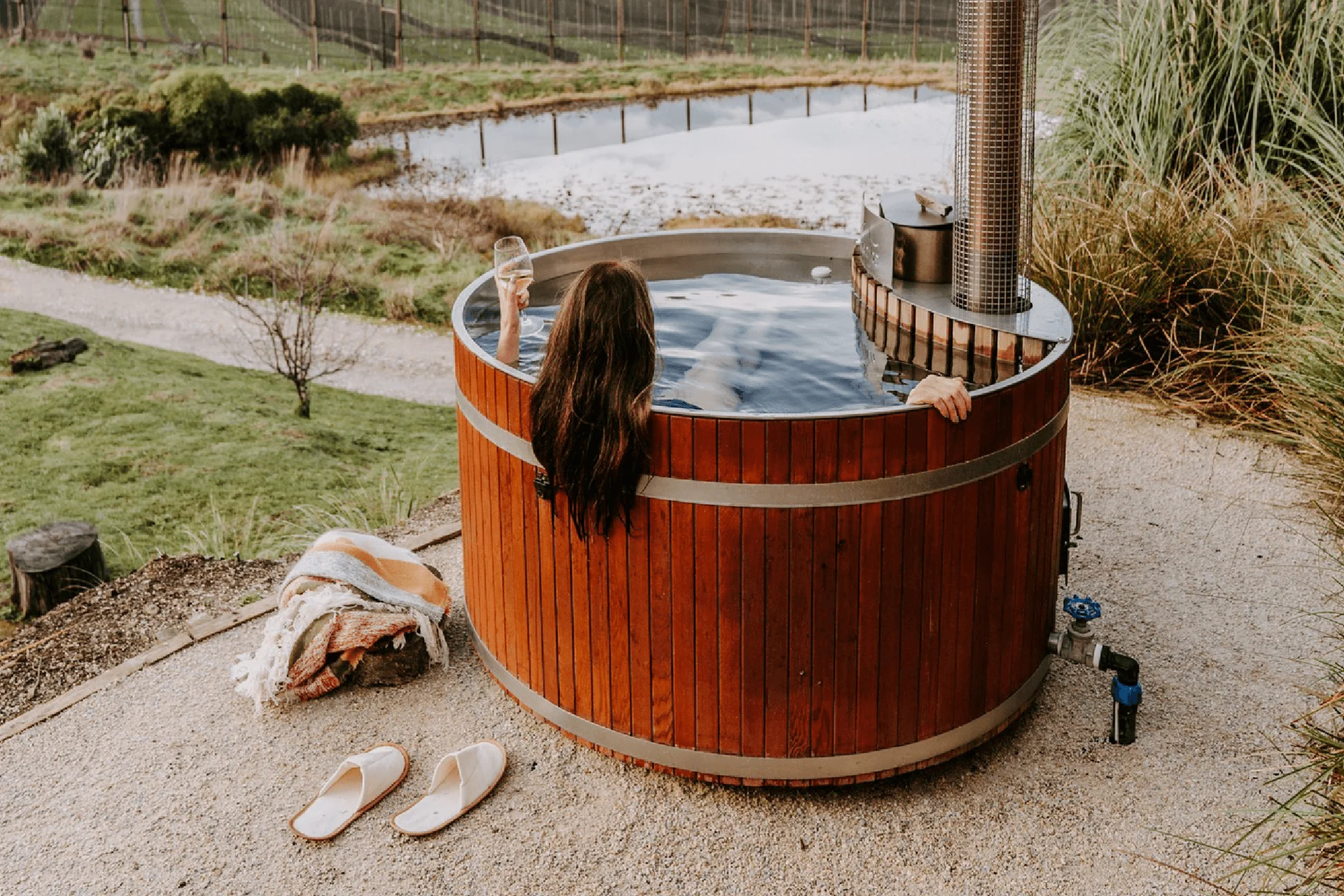
A wood-fired hot tub heater combines high-temperature combustion with a water-heating surface. The stove or heat exchanger, water level, connections, chimney, guards and operating procedure therefore need to be treated as one equipment system. Changing one part can alter circulation, heat transfer, draft or surface temperatures elsewhere.
Do not fabricate a closed or restrictable heated-water loop around a fire from generic online dimensions. Heated water expands and localized boiling can occur if circulation is lost or a hot heat exchanger becomes isolated. Use a purpose-designed, manufacturer-documented appliance appropriate to the intended application and destination market, and keep its required water path and operating limits intact.
Chimney routing, combustible separation and fire protection depend on the selected appliance, flue system, site and local rules. A generic internet clearance should not replace the current appliance instructions or the review required by the local authority or qualified installer. For U.S. projects, NFPA 211 is a relevant solid-fuel/chimney reference where applicable; it is not a universal clearance schedule for every market or heater.
Design circulation, mixing and temperature verification together
Natural-circulation and pumped systems solve the same thermal problem in different ways, and neither is automatically safer. A thermosiphon arrangement depends on the complete heater-and-pipe geometry specified for the equipment and must remain free of conditions that stop the intended natural flow. A pumped system adds pump, electrical, suction/outlet and control considerations. In both cases, the operator needs a documented pre-fire condition that confirms the required water level and circulation path.
The heater outlet temperature is not the bathing temperature. The return should be arranged and guarded so users are not exposed to a localized hot-water zone, and the tub should be mixed or circulated as the equipment instructions require before the representative water temperature is checked. Wood heat also has thermal inertia: reducing the fire does not make heat transfer stop instantly, so shutdown timing is part of temperature control.
For U.S. consumer-safety context, the U.S. Consumer Product Safety Commission states that hot-tub water should not exceed 104°F (40°C). That is a U.S. safety reference, not a substitute for destination-market rules, facility policy, user-specific medical advice or the selected product instructions. Pumped spa systems also require attention to suction and outlet entrapment hazards; do not adapt a pump circuit without the applicable product and local safety requirements.
Know when manufactured equipment is the better boundary
A manufactured hot-tub system can reduce unverified interfaces by supplying controlled drawings, a defined vessel and heating configuration, component documentation, installation instructions, labels, spare-part references and a clearer supplier responsibility boundary. It does not remove site duties: the project still owns the prepared base, access, local approvals, drainage, utilities where applicable, fire interfaces and final installation/commissioning.
DIY becomes a poor fit when the tub is used commercially or by the public, the existing structure is uncertain, the heater sits close to combustible construction, the climate creates freeze exposure, local permits or inspections apply, or the team lacks relevant structural, plumbing and solid-fuel competence. In those situations, the cost of documentation, serviceability and clearly assigned responsibility is part of the system—not an optional extra.
For U.S. public facilities, CDC’s Model Aquatic Health Code is guidance for public aquatic venues including hot tubs and spas; it is not federal law and only becomes enforceable where a jurisdiction adopts it. Other countries and local authorities use different rules. Confirm the actual jurisdiction before turning any public-use guidance into a project requirement.
Plan the build in a controlled sequence before fabrication
A useful “how to build” plan should control the project sequence without turning safety-critical heater construction into a DIY recipe. The following stages keep the structure, water system and heating package coordinated.
1. Define the use, site and responsibility boundary
State whether the tub is private residential, rental, hospitality or other commercial use; identify the destination market; record the site, access, climate/freeze exposure, nearby combustible construction, drainage route and available utilities. Decide which work belongs to the owner, supplier, structural designer, installer, plumber, electrician or fire/chimney trade before ordering components.
2. Establish the supported load and foundation concept
Use the actual vessel, intended water volume, occupancy and equipment layout as design inputs. Confirm that the ground, slab, deck or structure can support the completed installation and remain stable enough to protect the vessel and connections from movement. Where structural capacity is not obvious, have it checked rather than relying on a generic pad or deck assumption.
3. Select the vessel and maintainable water boundary
Choose a vessel system whose materials and joints are suitable for the intended hot-water and cleaning conditions. Define penetrations, drain, overflow if used, cleaning access and how concealed areas can dry. Keep repair access to gaskets, fittings and service points instead of permanently hiding them behind decorative cladding.
4. Select the heater, circulation and flue as one documented package
Choose the heating architecture before cutting vessel penetrations or fixing the deck layout. Use the selected equipment drawings and manual to determine connection positions, required circulation arrangement, water-level rules, guarding, flue components, combustion clearances and firing/shutdown procedure. If a project change alters those interfaces, recheck the system rather than assuming the original instructions still apply.
5. Coordinate user access, water care, drainage and freeze protection
Steps, handholds, covers, hot-surface guards, heater access and fuel handling should not conflict with the bathing path. Define how water will be filled, treated or replaced, drained and winterized. A freeze plan must account for the vessel and all connected water-containing components, not only the visible tub.
6. Commission before first use
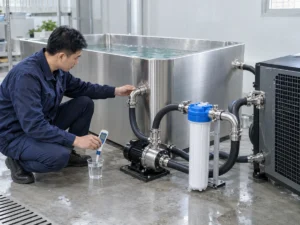
Before firing, verify the correct configuration, required water level, unobstructed circulation path, leak-free visible connections, installed guards, flue condition and temperature-measurement method. Operate the system only under the selected manufacturer procedure and applicable local requirements. Stop if circulation, leakage, abnormal boiling, draft, structural movement or temperature behavior is uncertain.
Set the make-or-buy boundary by failure consequence
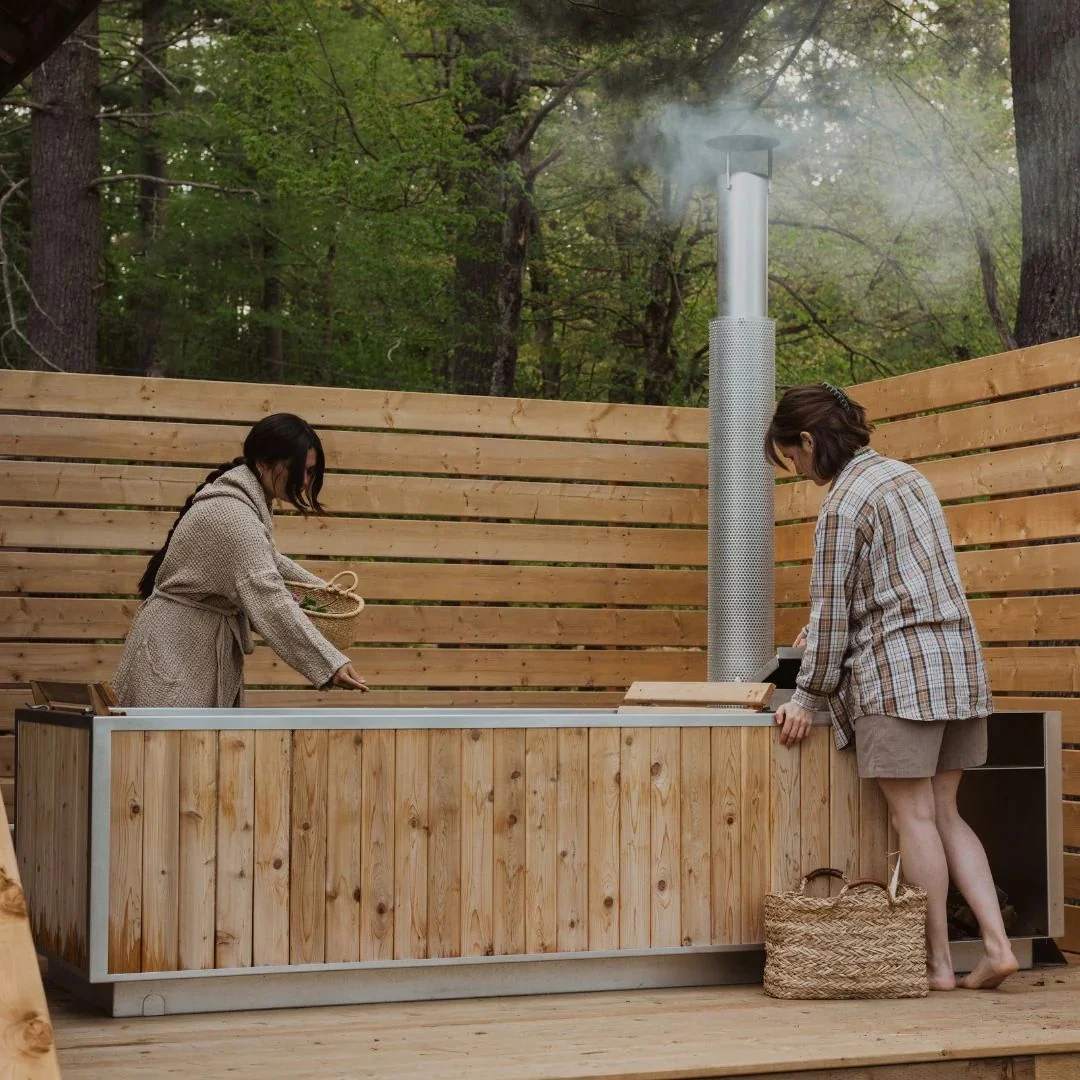
The useful question is not “Can this part be built locally?” but “What happens if this part is wrong, and who owns the evidence that it is right?” Noncritical surrounds, access paths or landscaping can be reasonable local scope. Structural water containment, combustion, hot-water circulation and flue work carry consequences that justify documented product design, qualified trade work or engineering review.
Keep the stove and hot-water safety path within the selected system
Do not fabricate or modify a wood-fired water heater from generic dimensions. The selected heater documentation should define the permitted water level, connections, circulation concept, guard, flue, firing and shutdown conditions. If the manual does not describe the intended installation, resolve that gap with the manufacturer or qualified designer before use.
Treat circulation and temperature control as one operating function
A leak-free connection does not prove adequate flow or safe mixing. Commission the complete system in its filled condition, confirm the intended circulation state, verify representative mixed-water temperature and define the no-fire/stop-use condition if circulation is uncertain. Do not add a valve or component that can isolate the heater contrary to the documented design.
Specify evidence for a purchased system
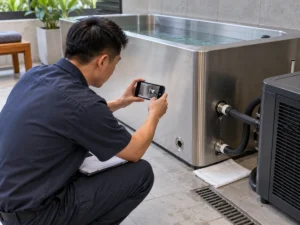
For a manufactured unit, ask for configuration-specific drawings or schematics, bill-of-material or component identity where relevant, material declarations where required, heater and flue documentation, installation/operation instructions, labeling, spare-parts approach, inspection scope and packing list. On receipt, inspect the vessel, connections, guards and shipped components before installation hides damage or missing parts.
Control OEM and repeat-production development
A one-off prototype that holds water and heats successfully is not yet a controlled commercial product. OEM, ODM or private-label development needs frozen requirements, version control, defined verification and packaging that stay aligned with the destination market and the approved configuration.
Freeze the technical specification before batch release
Confirm external and usable dimensions, intended water volume, vessel and water-contact materials, heating architecture, circulation method, connection interfaces, cover, steps, guard, drain, flue scope, any pump or control requirements, labels, manual set and destination requirements. Separate buyer preferences from mandatory acceptance criteria, then approve controlled drawings and the production configuration by revision.
Validate the sample against an agreed acceptance plan
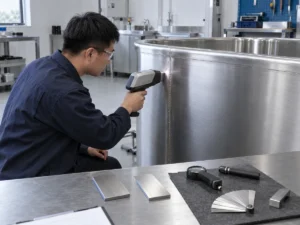
Inspect dimensions, surfaces, fasteners, penetrations, access and assembly. Where applicable to the agreed design, verify filled-vessel leakage, intended circulation, representative temperature behavior and operating checks under controlled conditions. Combustion and chimney evaluation must follow the actual appliance route and destination-market requirements rather than a generic workshop test.
Protect the approved version through packing and receiving
Define component-substitution rules, in-process checks, final inspection, accessory count, labels, manuals and package protection. At receipt, compare crate condition, model or batch identification, vessel, heater/flue parts, fittings and accessories with the packing list before field assembly conceals transport damage or configuration errors.
DIY vs manufactured: engineering decision table
| Work area | DIY / local scope can be reasonable when | Manufactured / qualified route is preferred when |
|---|---|---|
| Site and base | The prepared surface is clearly suitable for the completed installation and local work is within competence | Existing structural capacity is uncertain, the tub is elevated, or engineering/permit review applies |
| Vessel and water boundary | A documented vessel/kit is assembled without altering structural or water-critical details | Materials, liner, penetrations, support or repair access are uncertain, or the use is commercial/public |
| Stove / heat exchanger | Owner scope is limited to installing and operating the selected documented appliance as permitted | Fabrication, modification, compatibility or safety documentation would otherwise need to be created from scratch |
| Chimney / fire interface | The selected appliance instructions and local requirements clearly cover the site | Flue routing, combustible separation, roof/wall penetration or authority review is complex |
| Circulation | The complete documented arrangement is installed without redesign | Thermosiphon geometry, pumping, valves, suction/outlets or controls require project-specific design |
| Water care and operation | Private use has a clear filling, cleaning, temperature and shutdown routine | Shared/public operation requires regulated treatment, logs, staff procedures or health-department review |
Work-package responsibility matrix
| Scope | Possible owner / project scope | Supplier, qualified trade or designer scope |
|---|---|---|
| Site and landscape | Access planning, noncritical finishes, housekeeping and drainage coordination | Foundation/structure where calculation, permit or professional review is required |
| Vessel | Noncritical cladding or surround that does not block inspection/service | Water boundary, structural support, penetrations and material compatibility |
| Heating | Fuel storage and operator procedure within the appliance instructions | Stove/heat exchanger, guard, flue system and safety-critical hot-water connections |
| Circulation | Routine observation and cleaning allowed by the manual | Hydraulic arrangement, pump/suction protection where used, and thermosiphon geometry |
| Acceptance | Receiving record, visible condition check and operator log | Defined structural, leak, circulation, temperature, combustion/flue and regulatory inspections as applicable |
Project and pre-fire checklist
- Define private, rental, hospitality or other commercial use and confirm the destination jurisdiction.
- Verify the completed filled and occupied load for the actual foundation, deck or structure.
- Confirm vessel, liner, seal, adhesive and water-contact material suitability for the intended service.
- Use a purpose-designed, manufacturer-documented wood-fired heater/heat-exchanger configuration.
- Keep the documented circulation path open and do not add an arrangement that can isolate the hot heater contrary to instructions.
- Coordinate chimney, hot-surface guards, fuel handling and combustible interfaces from the selected appliance documentation and local requirements.
- Provide a representative mixed-water temperature check rather than relying on a hot return or one poorly located thermometer.
- Define filling, water care, drainage, cleaning and freeze-protection procedures before enclosure work hides service points.
- Before first fire, verify water level, visible leakage, circulation state, guards, flue condition and safe shutdown procedure.
- Stop use and obtain qualified review if structural movement, abnormal boiling, uncertain circulation, leakage, flue problems or unsafe temperature behavior appears.
Wood-fired hot tub design or sourcing inputs
For a manufactured or custom project, provide enough information to match the vessel, heating configuration and documentation to the actual site instead of requesting a generic “wood-fired hot tub.”
- Private, rental, hospitality or other commercial use
- Destination country/market and any known local approval requirements
- Available installation area, access route and base/deck context
- Intended occupancy, usable dimensions or target water volume
- Preferred vessel material, finish and maintenance expectations
- Wood-fired heater architecture, circulation method and chimney-route constraints
- Water filling, treatment, drainage and freeze conditions
- Guarding, steps, cover and service-access requirements
- Supplier, installer, local-trade and commissioning responsibility split
- Quantity, OEM/private-label needs, packaging and required acceptance documents
Frequently asked questions
Can I build a wood-fired hot tub from a stock tank?
Possibly, but the tank should not be treated as suitable merely because it holds water. Confirm the vessel material, coating or liner, temperature/water-treatment compatibility, support, penetrations, drain and heating-system interfaces for the intended hot-water use. The heater and circulation package should remain manufacturer-documented rather than improvised around the tank.
Can I make my own wood-fired water heater for the tub?
This guide does not provide heater-fabrication instructions. Fire combined with a restricted, airlocked or isolated water path can create boiling, steam and scalding hazards. Use a purpose-designed, documented heater or heat-exchanger package and follow its specified water level, circulation, flue and shutdown requirements.
Is thermosiphon safer than using a pump?
Neither is automatically safer. Natural circulation depends on the documented geometry and an unobstructed flow path; pumped systems add pump, electrical, suction/outlet and control considerations. Evaluate the complete system rather than choosing one method solely because it has fewer components.
What temperature should a wood-fired hot tub be?
The safe operating limit depends on the market, product instructions, venue policy and users. For U.S. consumer-safety context, CPSC states that hot-tub water should not exceed 104°F (40°C). Measure representative mixed water rather than the hot return, and follow the applicable local requirements and product instructions.
What can a contractor build locally?
Site preparation, access, noncritical enclosure work and some assembly may be local scope where competence and local rules allow. Structural support, the water boundary, combustion appliance, flue, circulation and regulated electrical/plumbing work should remain within the relevant drawings, product documents and qualified-trade responsibility.
When is DIY a poor choice?
DIY is a poor fit when the use is public or commercial, structural capacity is uncertain, the site has difficult fire/clearance constraints, freezing conditions are significant, regulated water treatment applies, or the team lacks the necessary structural, plumbing or solid-fuel competence. In those cases, a documented manufactured system with clearly assigned installation responsibilities is usually the more controllable route.
Related HACHILL resources
Compare manufactured wood-fired hot tubs
Use the product-family page after the project has defined site geometry, access, stove/chimney constraints and operating requirements.
Understand how wood-fired hot tubs work
Review the relationship between the stove, water circulation, chimney draft, mixing and operating control before choosing a system architecture.
Review wood-fired hot tub safety documentation
Use the buyer-documentation guide when the project moves from concept into controlled drawings, component identity, manuals, inspection records and configuration approval.
Review installation support
Use installation support to coordinate the selected product with the actual base, access, site interfaces and local-trade responsibilities.
Review wood-fired hot tub heating-time variables
Use the heating-time guide when the remaining question is water volume, temperature rise, fuel, circulation, weather or test conditions.
Troubleshoot a wood-fired hot tub that is not heating
Use the troubleshooting guide after installation when the problem is water level, circulation, fuel, draft, heat loss or measured temperature.
Reference basis
- U.S. Consumer Product Safety Commission: hot tub temperature safety — U.S. consumer-safety guidance stating that hot-tub water should not exceed 104°F (40°C); it does not approve a DIY design or replace local requirements.
- U.S. Consumer Product Safety Commission: pool, spa and hot-tub entrapment warning — U.S. safety context for suction/outlet hazards in pumped spa systems; exact current compliance requirements must be checked for the destination market and equipment.
- NFPA 211 standard information — U.S. reference route for chimneys, fireplaces, vents and solid-fuel-burning appliances where applicable; not a universal model-specific clearance table.
- CDC: current Model Aquatic Health Code edition — U.S. guidance for public aquatic venues, including hot tubs and spas. The MAHC is not federal law and becomes enforceable only where a jurisdiction adopts it.
- USDA Forest Products Laboratory: Wood Handbook — engineering reference for wood moisture relations, physical properties and structural material behavior relevant to non-heating wood construction decisions.
Safety and local responsibility: Structural, combustion, flue, pressure, hot-surface, suction/outlet and water-boundary failures can cause serious harm. Use the selected equipment documents, qualified design/fabrication/installation and local approval whenever the risk exceeds controlled owner or workshop capability. Stop operation when circulation, leakage, abnormal boiling, flue condition, structural stability or water temperature is uncertain.
Set a safe make-or-buy boundary
For manufactured or custom supply, send the use case, destination market, capacity, vessel/material preference, site conditions, base context, stove/circulation concept, chimney constraints, quantities and required documents. Site-built structural, combustion and regulated trade work remains subject to qualified local design, installation and approval.
Start a project enquiry