Wood-Fired Hot Tub Procurement Documentation
Quick Answer: Require a Controlled, Model-Specific Document Pack
Wood-fired hot tub buyers should require a controlled, model-specific document pack before approving the purchase order, shipment, installation or first fire. The pack should identify the exact tub, heating route, stove or heat exchanger, flue components, circulation method, accessories and governing revision. A catalog, family manual or component certificate cannot approve the complete system when its configuration or scope differs from the order.
The main procurement risk is accepting professional-looking files that cannot be traced to the ordered system. Define the required evidence at quotation, PO, production, shipment, installation and commissioning gates; then record issuer, scope, revision, open items and responsible party. Final approval also depends on the real site, foundation, access, drainage, climate, flue route, operating plan, local rules and manufacturer-confirmed data. Prepare a project brief and document register before requesting final approval.

AI-generated conceptual visualization; not a verified HACHILL model, customer project, certification image or approved installation drawing.
- buyers comparing suppliers or configurations;
- distributors, hotels, resorts and commercial operators;
- architects, installers, QA reviewers and OEM/private-label teams.
- a chimney, structural or thermosiphon design;
- a universal certification or legal-compliance opinion;
- a replacement for model instructions or qualified local review.
The Minimum Document Groups
At minimum, the buyer should expect the documentation request to cover:
- product identity and controlled specification;
- current general arrangement and interface drawings;
- tub, stove, chimney and accessory scope;
- installation and operating instructions;
- water-level, circulation, temperature and shutdown guidance;
- material and component evidence where claimed;
- inspection, test, deviation and release records;
- packing, receiving and damage-control information;
- commissioning and operator handover;
- commercial-use SOP and record requirements where applicable.
What the Pack Must Match
Every document should be checked against the same reference set:
- exact product or approved configuration;
- exact stove and chimney/flue route;
- drawing and manual revision;
- purchase order or project reference;
- intended residential or commercial use;
- installation country or destination market;
- included, optional and site-supplied components;
- responsible supplier, installer, operator and local professional.
If one of these references is unclear, treat the document as conditional rather than final.
Why a Generic Manual or Certificate Is Not Enough
A document is useful only when its scope can be traced to the ordered product and the decision it supports. A polished manual, report or certificate may still apply to another tub geometry, heating route, flue package, circulation method, accessory set or market.
Model and Configuration Mismatch
A mismatch may be obvious, such as the wrong product name, or subtle, such as the correct tub paired with the wrong stove or flue instructions. Verify:
- model, family or controlled configuration reference;
- tub geometry and intended use;
- internal or external heating route;
- natural-circulation or pumped water route;
- stove or heat-exchanger identity;
- chimney or flue component scope;
- included guard, cover, step, drain and accessory scope;
- options that change operation, cleaning or installation.
Revision and Translation Risk
Quotation drawings, shipped manuals and site instructions should share a controlled revision and approval status. Translated copies must preserve warnings, component names, responsibilities and operating steps; conflicts require a controlled correction.
Certificate Scope versus Product Scope
When a certification, report or declaration is offered, request:
- issuing organization;
- report or certificate number;
- issue and validity information;
- covered model, sample or component;
- tested or declared scope;
- standards or requirements referenced;
- exclusions and limitations;
- connection to the ordered product configuration.
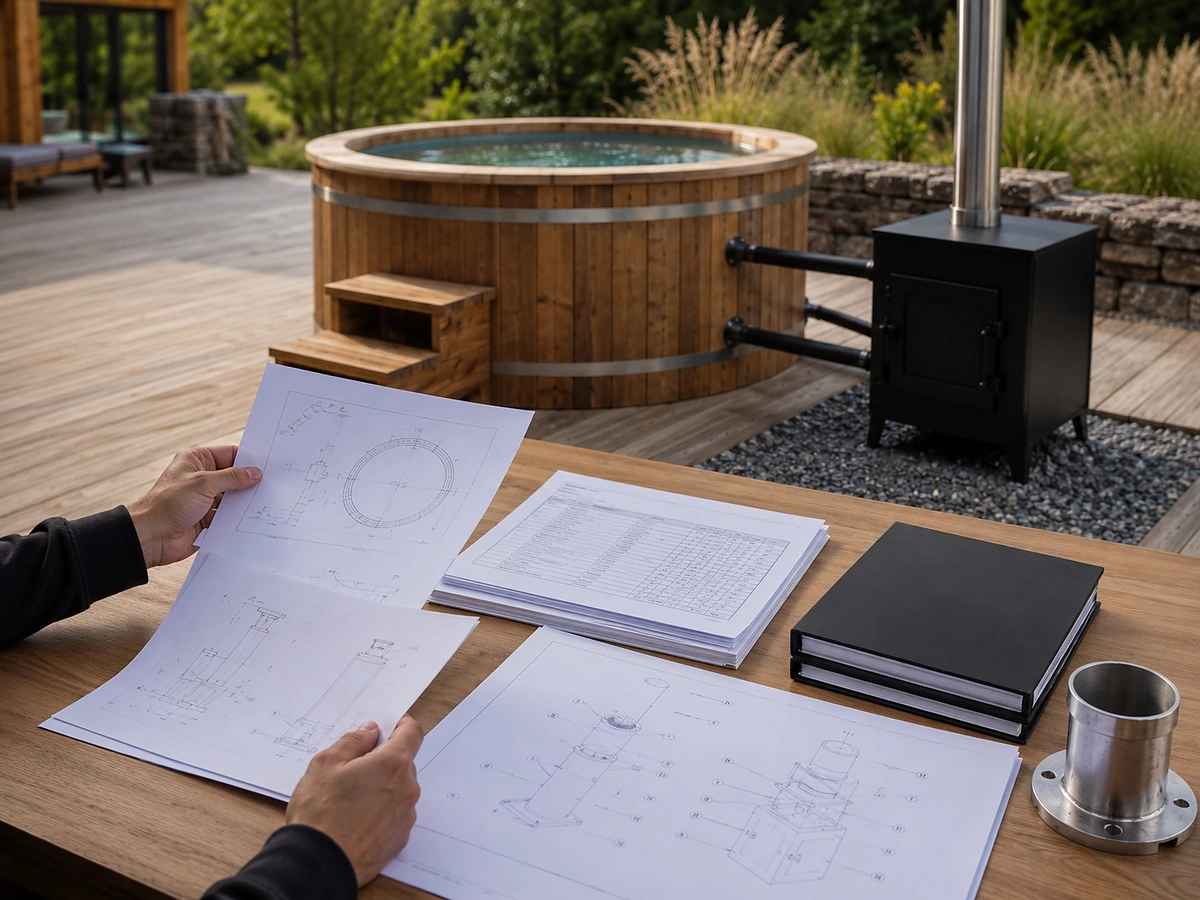
AI-generated conceptual visualization; not a verified HACHILL model, customer project, certification image or approved installation drawing.
Documents Buyers Should Require at Each Project Gate
Tie each document to the decision it controls. This exposes site, heating-system, responsibility and evidence gaps before the buyer commits.
Documentation by Project Gate
On smaller screens, swipe horizontally to review all table columns.
| Project Gate | Buyer Inputs | Supplier Documents | Local / Buyer Documents | Approval Output |
|---|---|---|---|---|
| Shortlisting | Venue, users, target market, product route | Preliminary configuration and document-availability statement | Initial site constraints | Qualified or not qualified |
| Quotation | Site, access, base, drainage, stove/flue concept, commercial use | Controlled specification, preliminary drawing, inclusions/exclusions, document list | Responsibility assumptions | Comparable quotation |
| PO Release | Approved route, options, quantity and required evidence | Approved revision set, component scope, applicable reports, labels/manual plan | Approved responsibility matrix | Technical PO attachment |
| Production Release | Final configuration and approved changes | BOM/configuration record, inspection plan, packaging and manual scope | Buyer approval record | Production authorization |
| Shipment | Order reference, delivery and receiving plan | Final inspection/release record, packing list, document pack and deviation status | Receiving checklist | Shipment authorization |
| Installation | Site readiness and responsible trades | Installation/assembly instructions and product-interface information | Local drawings, permits and professional review | Installation authorization |
| Commissioning | Installed condition and assigned operator | Commissioning, pre-fire and shutdown procedures | Local sign-off and training record | Commissioning acceptance |
| Operation | Venue and user policy | User, maintenance, water-care and stop-use instructions | SOPs, logs and local requirements | Operating authorization |

AI-generated conceptual visualization; not a verified HACHILL model, customer project, certification image or approved installation drawing.
Before Quotation
Before comparing prices, provide the intended use, market, site and commercial inputs needed to define the configuration.
- intended users and operating setting;
- residential or commercial use;
- installation country;
- round, rectangular or project route;
- outdoor exposure and climate;
- available footprint and access;
- base, water supply and drainage assumptions;
- preferred stove and chimney route;
- branding, quantity, packaging and logistics requirements;
- evidence and document expectations.
Before Purchase-Order Release
The PO technical attachment should identify the approved configuration, revisions, responsibilities, evidence and change-control route.
- product specification;
- drawing revision;
- component and accessory schedule;
- stove and chimney/flue scope;
- material and finish schedule where confirmed;
- document list;
- inspection and acceptance plan;
- responsibility matrix;
- change-control procedure;
- open-item register.
Before Shipment and Installation
Shipment release confirms the ordered product and document pack; installation release confirms local site readiness. They are separate decisions.
- final inspection and release record;
- order/configuration identification;
- packing list and package count;
- damage and exception record;
- manuals, warnings and labels;
- unresolved deviation status;
- installation and commissioning pack.
- approved site plan;
- foundation or structural review;
- access and handling plan;
- flue route and local fire review;
- drainage and water handling;
- assembly responsibilities;
- permit or authority open items.
Before Commissioning and Operation
Delivery is not commissioning. Before first fire and first use, the project should close the product-identity, water-route, flue, guard, temperature-verification, operator and stop-use items that apply to the selected system and site.
- required water level;
- water route and valve position;
- leak-free connections;
- approved stove and flue assembly;
- chimney support and termination review;
- hot-surface guards;
- temperature measurement method;
- safe firing and shutdown sequence;
- operator assignment;
- cleaning, water-care and maintenance;
- stop-use and escalation criteria.
Release Logic: What Each Document Status Allows
A document register needs an operational status, not only a filename. The status should control whether the buyer may compare quotations, release the purchase order, authorize shipment, begin installation or place the tub into service.
| Status | Meaning | Allowed Decision | Required Control |
|---|---|---|---|
| Accepted | The document is applicable, current and complete for the stated decision. | Proceed within the approved scope. | Retain the approved revision and trace it to the order. |
| Conditional | The document is usable only after a defined open item is closed. | Proceed only where the condition does not affect the current gate. | Name the owner, due point and evidence required for closure. |
| Rejected | The document is wrong, obsolete, contradictory, unverifiable or outside scope. | Do not use it for approval or installation. | Issue a controlled replacement or formal technical clarification. |
| For Information | The document provides context but is not acceptance evidence. | Use for orientation only. | Do not treat brochures, example records or generic manuals as release documents. |
Product Identity, Specification and Controlled Drawings
The product documentation pack should establish what is being purchased, not simply describe what the product family can potentially include.
Controlled Specification Sheet
A controlled specification should identify:
- product route or model;
- intended application;
- approved geometry and overall scope;
- heating route;
- circulation method;
- included and optional components;
- confirmed materials and finishes;
- accessories;
- packaging and delivery form;
- document scope;
- revision and approval status.
General Arrangement and Interface Drawings
The general arrangement drawing should show the information needed to coordinate the product with the site. Depending on the selected configuration, this may include:
- overall dimensions;
- installation orientation;
- access and service areas;
- stove position;
- inlet and outlet connections;
- chimney/flue route;
- drain and fill interfaces;
- step, guard or cover position;
- assembly interfaces;
- lifting or handling points where applicable.
Included, Optional and Site-Supplied Components
A useful component schedule separates:
- factory-supplied tub parts;
- stove or heat-exchanger parts;
- chimney/flue parts;
- guards and protective elements;
- circulation or plumbing components;
- drain and fill accessories;
- steps, covers and optional equipment;
- installation consumables;
- items supplied by the contractor or buyer.
This is especially important for chimney support, roof or wall penetrations, foundation work, drainage and local fire-protection items. The buyer should not assume they are included because they appear in a rendering or project photograph.
Revision and Change Control
Any change that affects material, stove, chimney, circulation, connection, guard, accessory, label, packaging or manual content should be evaluated against the approved scope. The change record should state:
- what changed;
- why;
- affected documents;
- technical or commercial impact;
- required buyer approval;
- release status.
Configuration Baseline Record
The baseline connects commercial selection, drawings, components, inspection and handover so a correct file is not applied to the wrong physical product.
| Baseline Field | Why It Changes the Outcome | Evidence to Lock |
|---|---|---|
| Tub route and geometry | Changes footprint, access, water volume, support and user arrangement. | Approved model/configuration reference and GA drawing. |
| Heating route | Changes stove position, water connections, service access and operating instructions. | Exact stove or heat-exchanger scope and connection drawing. |
| Flue package | Changes supplied sections, supports, guards and local installation interfaces. | Approved component schedule and installer/local-review open-item list. |
| Circulation method | Changes pre-fire checks, valve position, no-flow risk and troubleshooting. | Controlled water-route diagram and operating manual. |
| Materials and options | Changes maintenance, compatibility, packaging and replacement parts. | Order-specific material/option schedule. |
| Document revision | Determines which instructions, dimensions and acceptance criteria govern. | Master document register with current approved revision. |
Change-Impact Screening Before Approval
- Product fit: Does the change alter dimensions, seating, service clearance, water volume or access?
- Heating system: Does it change the stove, water route, flue components, guards or operating warnings?
- Site interface: Does it affect foundation inputs, drainage, handling, penetrations or local professional review?
- Evidence: Do drawings, manuals, BOM/configuration records, labels, inspection criteria and packing records need revision?
- Commercial scope: Does the change affect quantity, branding, packaging, spare parts, warranty boundaries or training?
A substitution is not automatically equivalent because it has a similar appearance or nominal rating. Keep the change open until the affected documents and responsibilities are updated in writing.
Stove, Chimney, Combustion and Hot-Surface Documentation
The stove and flue system carries the most obvious fire and combustion risk, but the document requirement should remain configuration-specific. Buyers need enough information to identify the supplied system and coordinate it with qualified local installation and authority review.
Stove and Heat-Transfer Documentation
Request the exact stove or heat-exchanger identification and the current installation and operating instructions for the supplied version. The documents should clarify:
- intended orientation;
- inlet and outlet relationship;
- required water condition before firing;
- approved fuel and operating limitations where confirmed;
- normal loading and shutdown procedure;
- ash removal and maintenance;
- accessible inspection points;
- overheat, boiling or no-flow warnings;
- guard or user-separation requirements;
- prohibited modifications.
For general U.S. residential wood-stove and chimney fire-safety context, the U.S. Fire Administration advises keeping combustibles away from heat sources and having heating equipment and chimneys professionally inspected and cleaned. This is background fire-safety guidance, not a clearance schedule or approval for a wood-fired hot-tub installation; model instructions and local requirements still govern the actual project.
A stove label or nominal output value does not establish safe installation or guaranteed heating time. Performance depends on the complete water and heat-loss condition, while installation depends on the actual site and local rules.
Chimney / Flue Route and Component Scope
The buyer should receive a controlled list or drawing of the supplied flue components. It should identify, where applicable:
- appliance connection;
- flue sections;
- bends or adapters;
- supports;
- weather cap or terminal;
- guards;
- seals or joints;
- components supplied by the installer;
- points requiring local design review.
For a jurisdiction-specific example, England’s Approved Document J addresses combustion air, discharge of combustion products, building protection, carbon-monoxide warning and information duties. It is not a global approval route.
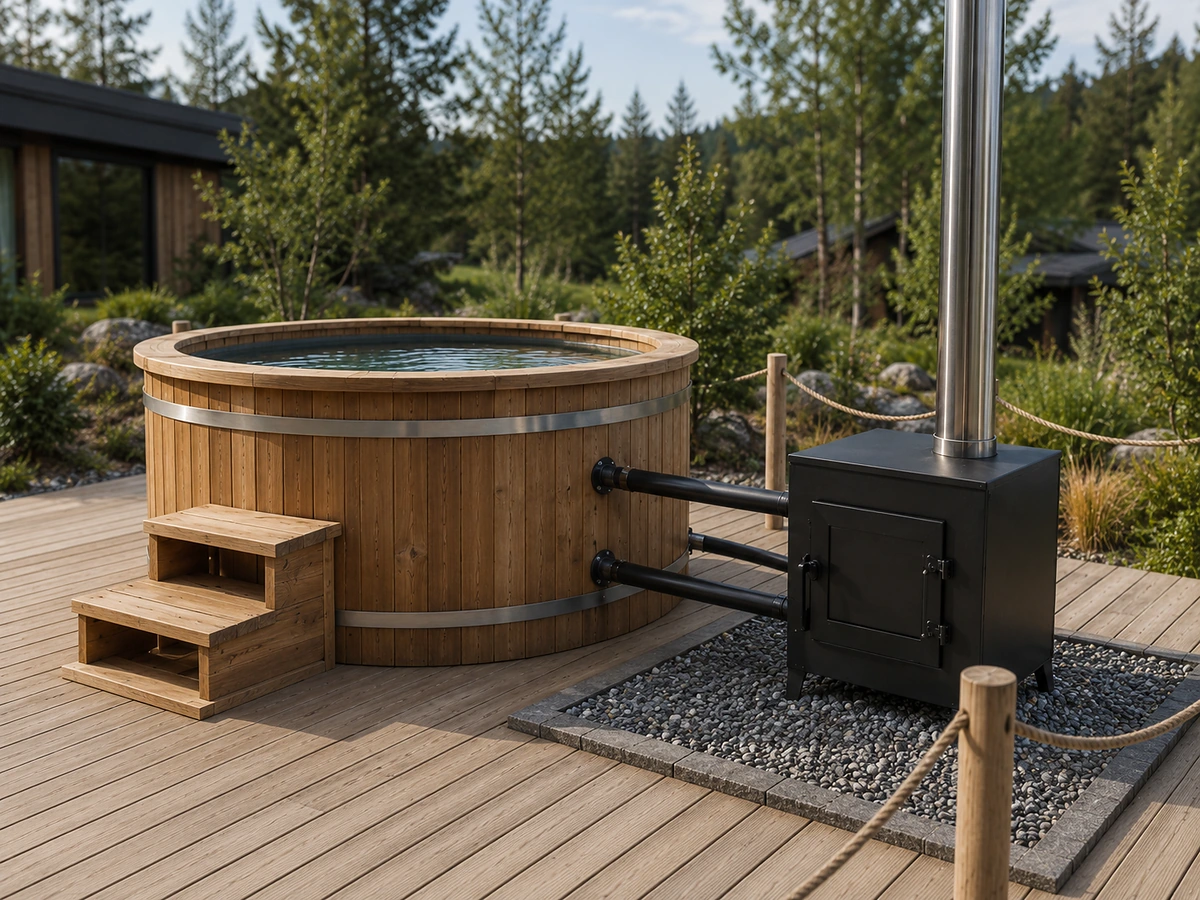
AI-generated conceptual visualization; not a verified HACHILL model, customer project, certification image or approved installation drawing.
Hot-Surface Guards and User Separation
The document pack should identify hot surfaces that may be accessible during normal operation and show which guards or barriers are included or required by the selected product instructions and site review. This matters when:
- the stove is adjacent to the tub;
- users walk near the flue;
- the product is installed in a hospitality venue;
- children or unsupervised users may enter the area;
- ash removal occurs near public circulation.
A photograph alone cannot prove that a guard provides the required protection. The installed arrangement must be reviewed against the actual site and user flow.
Local Fire and Installation Approval Boundary
The supplier can define the product, included components, operating instructions and known interfaces. The local qualified professional and authority remain responsible for matters such as:
- final flue routing;
- penetrations;
- required clearances;
- combustion-air conditions;
- building protection;
- carbon-monoxide measures where required;
- smoke-control restrictions;
- permit and inspection requirements.
The documentation pack should make this boundary explicit rather than leaving the buyer to infer responsibility.
Stove and Flue Documentation Acceptance Questions
- Identity: Can the stove, flue sections, adapters, supports and guards be traced to the approved configuration?
- Water condition: Do the instructions define required fill, connection and circulation conditions before firing?
- Operating boundary: Are fuel, loading, shutdown, ash handling and prohibited modifications addressed for the selected unit?
- Site interface: Does the pack distinguish supplied parts from local supports, penetrations, protection and authority review?
- User separation: Are hot surfaces and normal service/ash-removal zones identified for the actual venue?
- Open items: Are local clearances, final route, combustion air and permit responsibilities named rather than hidden behind a generic disclaimer?
The supplier’s component list and instructions establish the supplied scope. They do not replace a qualified local review of final flue routing, supports, penetrations, clearances, building protection or commercial-site approval.
Vessel, Circulation, Water Level, Temperature and Water-Care Documents
A wood-fired hot tub cannot be evaluated only as a combustion product. The vessel, water route, temperature verification, drainage and retained-water plan also require controlled information.
Fill Level and Pre-Fire Checks
The operating manual should state the model-specific fill and pre-fire requirements. The key buyer question is whether the system can be fired safely when:
- the tub is not full;
- a connection contains air;
- a valve is closed;
- an inlet or outlet is obstructed;
- the stove is isolated;
- the tub is draining or being serviced.
The manual should identify stop-use conditions and the safe shutdown route. It should not rely on the operator to “feel” whether water is circulating.
Circulation and Connection Diagram
The approved diagram should identify the water route between the tub and the heating system. It should distinguish natural circulation from a pumped route and show the connection orientation without forcing the buyer to reverse-engineer the system from photographs.
The document should also identify:
- valves and their normal operating position;
- fill and vent sequence;
- service points;
- restrictions on closing or isolating the loop;
- filter or pump interfaces where present;
- warning signs of blocked or uncertain circulation.
The article does not prescribe pipe dimensions or thermosiphon geometry. Those belong to the selected model and qualified system design.
Mixed-Water Temperature and Overheating Control
The documentation pack should define how the operator checks the mixed-water temperature before use. A local hot zone near the return or an inaccurate controller reading can create a different condition from the average tub temperature.
The procedure should state:
- measurement location;
- mixing requirement;
- instrument or verification method;
- pre-entry check;
- stop-use condition;
- escalation for abnormal readings.
A 2022 product-specific U.S. Consumer Product Safety Commission recall covered named Jacuzzi and Sundance electric hot-tub models because a temperature sensor could report an incorrect water temperature. CPSC instructed owners of the recalled units to use an accurate external thermometer before entry until repair. This supports the narrower procurement point that the selected system needs a defined temperature-verification and abnormal-reading response; it does not create a universal external-thermometer requirement for wood-fired tubs.
Drainage, Cleaning and Freeze Protection
The operating and maintenance documents should identify:
- drain location and method;
- whether water is retained or replaced;
- cleaning access;
- approved cleaning-product compatibility;
- drying and storage requirements;
- seasonal shutdown;
- freeze protection;
- disposal responsibility;
- restrictions on draining hot water or treatment chemicals.
Wood cladding does not determine the liner material or water-care method. The exact vessel, wetted materials and approved maintenance instructions must be confirmed for the selected product.
Operating Inputs That Must Remain Model-Specific
| Operating Input | Why It Matters | Required Document Outcome |
|---|---|---|
| Fill and pre-fire condition | Firing when the required water condition is not confirmed can create overheating, steam or equipment-damage risk depending on the selected system. | Model-specific fill, vent and pre-fire checklist. |
| Circulation route and valve state | Blocked or isolated flow changes heat transfer and shutdown risk. | Controlled connection diagram and normal operating positions. |
| Mixed-water temperature check | A local hot zone or inaccurate display may not represent the whole tub. | Measurement location, mixing step, instrument and stop-use rule. |
| Drain-down and freeze plan | Residual water can damage components or create unsafe restart conditions. | Seasonal shutdown, drainage and restart procedure for the selected route. |
| Retained-water care | User load, materials, temperature and treatment route affect cleaning and replacement. | Compatible water-care responsibility and maintenance framework. |
Do not convert these inputs into universal fill heights, pipe dimensions, temperature limits or maintenance intervals. Use the current model manual, component instructions, venue plan and applicable local requirements.
Site, Foundation, Access and Installation Responsibility Documents
The site package should be ready before production release or shipment, not after the product arrives.
Base, Load and Placement Inputs
The supplier should provide verified product inputs needed by the local designer, such as:
- product dimensions;
- confirmed dry or filled mass where available;
- support/contact arrangement;
- drain and service access;
- stove and flue relationship;
- required assembly access.
The local structural professional should determine the foundation, deck or supporting structure. The article does not prescribe one universal base because soil, frost, drainage, building structure and jurisdiction differ.
Delivery, Handling and Assembly
The buyer should request:
- packed dimensions and package count;
- component split;
- lifting or handling restrictions;
- gate, path and crane/forklift assumptions;
- assembly sequence;
- protected components;
- site-supplied fasteners or consumables;
- damage-report procedure;
- storage requirements before installation.
A product may fit the final location but still be impossible to move through the available route. Access is therefore part of the documentation brief, not just a logistics detail.
Drainage, Water and Weather Exposure
The site document package should resolve:
- water source;
- fill method;
- drain/discharge route;
- surrounding slip and splash management;
- rain and snow exposure;
- wind effect on the flue and heating load;
- cover storage and handling;
- seasonal shutdown;
- freeze conditions;
- nearby combustible or occupied areas.
The supplier can identify product interfaces and limitations. The local team must design and approve the site solution.
Installation Responsibility Matrix
A responsibility matrix should state who owns each activity.
| Task | Supplier / Manufacturer | Installer / Contractor | Buyer / Operator | Local Professional / Authority |
|---|---|---|---|---|
| Product configuration | Define supplied and approved scope | Verify interfaces | Approve intended use | Review where required |
| Foundation | Provide verified product inputs | Coordinate construction | Provide site data | Design/approve locally |
| Stove and chimney | Define supplied components and instructions | Install approved route | Maintain safe operation | Review fire/building compliance |
| Drainage | Define product interfaces | Install site route | Operate and maintain | Review local requirements |
| Commissioning | Provide procedure and product criteria | Execute contracted checks | Assign operator and accept handover | Sign off where required |
| Commercial operation | State product-use boundaries | Support contracted interfaces | Own SOPs, logs and closure decisions | Enforce applicable requirements |
Site Input Completeness Matrix
| Site Input | Why It Changes the Project | Primary Evidence / Owner |
|---|---|---|
| Foundation and support | Filled mass, soil, frost, deck structure and contact arrangement affect support design. | Manufacturer inputs plus qualified local structural design. |
| Delivery and assembly access | Packed dimensions, turns, gates and lifting route can block delivery even when the final footprint fits. | Packing/handling data plus buyer/contractor access plan. |
| Stove and flue location | Changes user separation, service access, weather exposure and fire-review scope. | Approved product interface plus local fire/building review. |
| Drainage and discharge | Affects cleaning, winter shutdown, slip control and local wastewater responsibility. | Product drain interface plus site drainage plan. |
| Climate and exposure | Rain, snow, wind and freezing conditions affect cover, heat loss, flue behavior and shutdown planning. | Site climate brief plus manufacturer-confirmed operating boundary. |
| Commercial user flow | Guest circulation, staff access, cleaning turnover and closure control affect layout and operating documents. | Venue plan, SOP ownership and local commercial review. |
A supplier drawing can provide verified product interfaces; it should not be presented as a structural calculation, site drainage design or local fire approval.
Material, Component and Destination-Market Evidence
Material Schedule and Wetted Components
Where material claims affect durability, corrosion, hygiene, maintenance or appearance, request an order-specific schedule covering the applicable:
- tub or liner;
- wetted metal;
- stove or heat exchanger;
- chimney/flue;
- cladding;
- coating or finish;
- fasteners;
- seals;
- hoses and fittings;
- steps, guards and covers.
The document should distinguish verified material from optional material and site-supplied material. A wood exterior does not prove the liner, stove or wetted-metal grade.
Component Manuals and Supplier Data
For third-party components, request the exact manufacturer and model documentation where it is part of the approved configuration. Examples may include:
- stove or heat exchanger;
- chimney/flue components;
- pump;
- filter;
- thermometer or control;
- cover hardware;
- electrical accessory.
Destination-Market Document Scope
The buyer should define the destination market before quotation and request a document list that states:
- applicable product or component evidence;
- label and warning language;
- manual language;
- installer or permit requirements;
- local inspection responsibility;
- unresolved market-specific items.
What Compliance Evidence Does—and Does Not—Prove
Do not treat “CE,” “UL,” “ETL” or another acronym as a universal certificate category. If a destination-market route is relevant, verify the actual evidence type, issuer or responsible manufacturer, covered model/component, applicable scope and current status. For example, EU guidance explains that CE marking is the manufacturer’s declaration that applicable EU requirements have been addressed and is supported by the relevant conformity-assessment route, technical documentation and EU Declaration of Conformity; it is not a central EU product-approval certificate. In the United States, OSHA’s NRTL framework recognizes laboratories to test and certify products only within their recognized scope.
Even valid product or component evidence does not automatically approve the foundation, flue route, drainage, public use, operating SOP or delivered configuration.
- the foundation is adequate;
- the flue route is locally approved;
- required clearances are achieved;
- the drain route is acceptable;
- the product is approved for public/commercial use;
- the operating SOP is adequate;
- the delivered unit matches the tested sample;
- the current order includes the same components.
These questions require separate evidence and approval.
Evidence Hierarchy: Stronger Does Not Mean Broader
| Evidence Level | What It Can Support | What It Cannot Automatically Prove |
|---|---|---|
| Order-specific controlled record | The approved configuration, revision, inspection or release for the stated order. | Local installation approval or facts outside the recorded scope. |
| Model-specific manual or drawing | Product interfaces, operation and warnings for the identified model/revision. | That the delivered unit matches the document without order traceability. |
| Component manufacturer document | The named stove, flue, pump, control or accessory within its component scope. | Compliance or performance of the complete assembled hot-tub system. |
| Report, certificate or declaration | The sample, model, component, test or declared scope stated by the issuer. | Universal market approval, site approval or unchanged production configuration. |
| Family brochure or website page | Available product routes, options and questions for qualification. | Final dimensions, materials, included parts, certification or acceptance evidence. |
For every evidence item, ask: “What exactly does this prove?” and “What remains outside its scope?”
Quality-Control, Inspection, Test and Release Records
Quality-control claims become useful when the buyer and supplier agree what will be inspected, how the result will be recorded and what blocks release.
Inspection and Test Plan
The inspection and test plan should identify:
- inspection point;
- acceptance criterion;
- responsible party;
- record produced;
- hold or witness requirement;
- nonconformance route;
- final release authority.
Not every product requires the same test scope. The plan should be written for the exact configuration and order.
Configuration and Functional Checks
Depending on the product and agreed scope, records may cover:
- model and drawing revision;
- dimensions;
- visible assembly condition;
- included hardware and accessories;
- tub/stove/chimney component match;
- connection orientation;
- drain and fitting condition;
- labels and warnings;
- manual and document pack;
- packing and protection.
Leak, flow or functional checks should only be claimed when the method and result are actually recorded for the order.
Nonconformance and Deviation Closure
A deviation should not disappear because the product is otherwise complete. The record should state:
- identified difference;
- affected order/document;
- cause;
- disposition;
- technical impact;
- buyer approval where required;
- corrected drawing or manual;
- final closure status.
The same rule applies when a supplier proposes an alternative component during production.
Final Release and Packing Evidence
Before shipment, the buyer should receive or approve the agreed:
- final inspection/release record;
- configuration reference;
- packing list;
- package count;
- product and accessory identification;
- damage/exception record;
- document pack;
- spare-parts scope;
- unresolved open-item status.
Generic factory photographs do not replace order-specific release evidence.
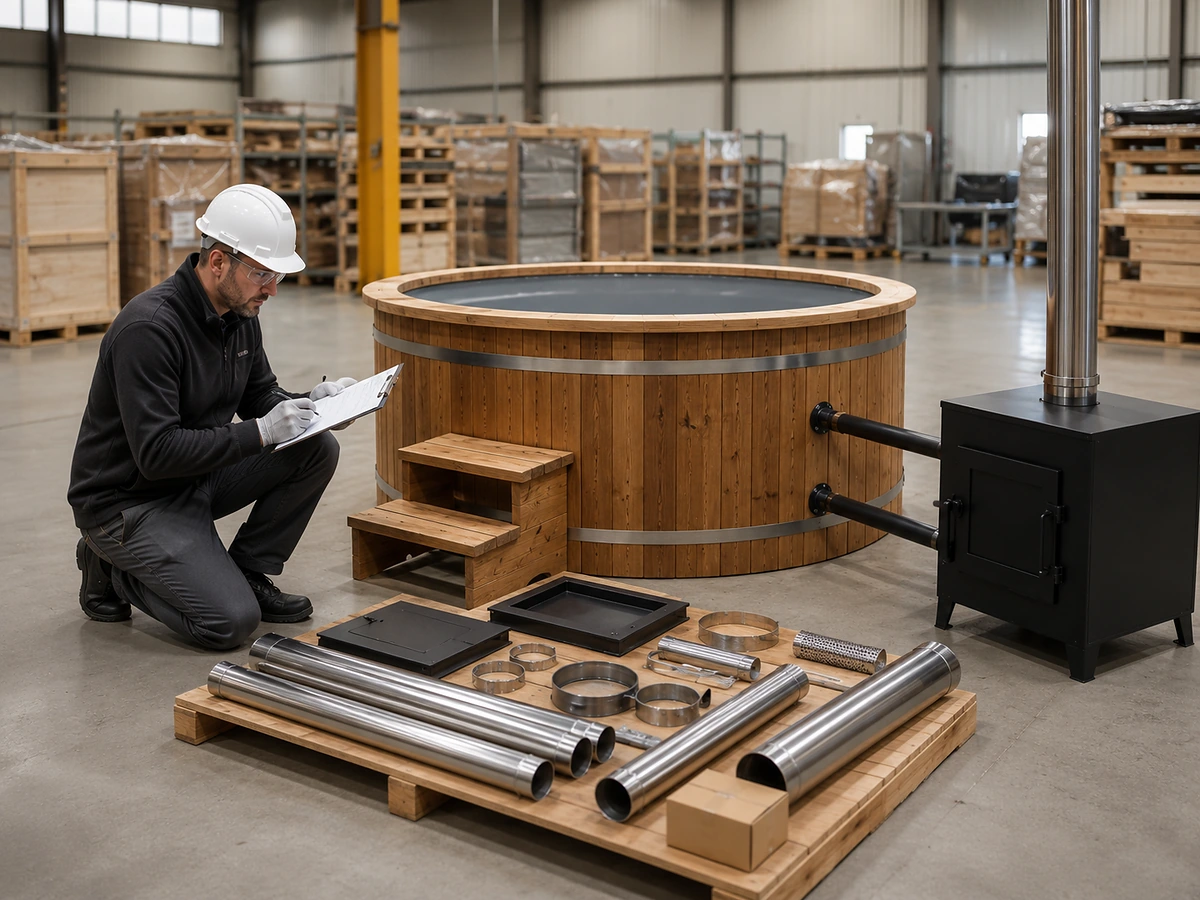
AI-generated conceptual visualization; not a verified HACHILL model, customer project, certification image or approved installation drawing.
Order-Specific Evidence Quality Ladder
- Level 1 — Statement: A supplier says an inspection or test is performed. Useful for qualification, but not proof of this order.
- Level 2 — Example record: A redacted comparable checklist shows the process format. It still does not prove the current unit was checked.
- Level 3 — Order record: The record identifies the order, model/configuration, revision, acceptance point and result.
- Level 4 — Closed release pack: The order record, deviations, packing scope, document pack and release authorization agree.
The buyer should define the required evidence level before production. Requesting “QC photos” after shipment is not equivalent to agreeing an inspection and release plan in advance.
Commissioning, Handover and Operator Documents
Commissioning connects the installed configuration, safe first fire and transfer of operating responsibility.
Pre-Fire Commissioning Checklist
The checklist should verify:
- correct product/configuration;
- installation completion;
- approved water level;
- open and unobstructed circulation route;
- leak-free connections;
- stove and flue assembly;
- guards;
- site drainage;
- temperature measurement method;
- safe shutdown method;
- responsible operator;
- open items.

AI-generated conceptual visualization; not a verified HACHILL model, customer project, certification image or approved installation drawing.
Operator Training and Safe-Use Instructions
The operator pack should explain:
- filling;
- pre-fire checks;
- fuel and firing procedure;
- water circulation;
- temperature checking;
- user access and supervision;
- hot-surface separation;
- ash handling;
- cleaning and water care;
- drain-down and freeze response;
- shutdown;
- stop-use and emergency escalation.
Maintenance, Spare Parts and Service Handover
The handover package should identify:
- inspection and cleaning tasks;
- frequency framework;
- replaceable parts;
- approved replacement specifications;
- service access;
- storage requirements;
- supplier and local service responsibilities;
- warranty boundaries;
- information required for a service request.
Stop-Use and Escalation Criteria
The operating documents should state when the tub must remain out of service. Examples include:
- uncertain water circulation;
- boiling, steam or hammering;
- smoke leakage;
- damaged flue;
- leakage near the stove or connections;
- deformed or overheated parts;
- unstable or damaged base;
- missing guard;
- uncontrolled water condition;
- unresolved installation or authority item.
Pre-Fire Hold Points
| Hold Point | Release Evidence | Do Not Proceed When |
|---|---|---|
| Product and installation identity | Installed configuration matches approved drawings and component scope. | Model, stove, flue or connection route is uncertain. |
| Water and circulation | Required fill, venting, valve state and circulation path are confirmed. | Water level, trapped air, blockage or isolation cannot be ruled out. |
| Stove and flue condition | Assembly, support, guards and local-review items are closed. | Flue damage, unsupported sections, smoke path or hot-surface protection is unresolved. |
| Site readiness | Base, access, drainage and surrounding area are accepted for the intended operation. | Instability, unsafe discharge, slip risk or service obstruction remains. |
| Temperature and shutdown | Measurement method, mixing, shutdown and escalation procedure are available. | No reliable check or trained shutdown owner is assigned. |
| Operator handover | Named staff have current manuals, training and record forms. | Responsibility is assumed but not assigned or documented. |
A hold point blocks first fire or use until the named owner confirms the required evidence and closes critical open items.
Documentation Red Flags That Should Stop Approval
Documents should be classified as accepted, conditional or rejected. A buyer should not approve a package simply because the folder contains many files.
Red-Flag Decision Table
| Finding | Risk | Required Action |
|---|---|---|
| Generic “all models” manual | Wrong configuration may be installed or operated | Hold approval until applicability is confirmed |
| Missing model/configuration reference | Product cannot be traced to the document | Request controlled identification |
| Missing revision or date | Obsolete instructions may be used | Reject as final issue |
| Manual conflicts with drawing | Site team may follow contradictory instructions | Issue controlled clarification |
| Certificate scope cannot be linked to product | False compliance assumption | Request scope and model linkage |
| Wrong stove/chimney component list | Unsafe assembly or missing site work | Correct the approved package |
| Uncontrolled translation | Warnings or steps may be altered | Issue controlled translation |
| Generic QC checklist | No proof of order inspection | Request order-specific release record |
| Unclosed deviation | Delivered scope differs from approval | Block release or formally accept impact |
| No commissioning procedure | First fire and handover remain uncontrolled | Do not authorize operation |
| No responsibility matrix | Site duties may be omitted | Keep project item open |
| Commercial operation documents absent | Staff, records and stop-use decisions are undefined | Hold commercial opening |
Use three actions: reject wrong, obsolete or contradictory evidence; conditionally accept defined open items with an owner and closure requirement; and keep structural, flue, drainage, public-health and permit decisions assigned to qualified local review.
Buyer Document Request Template and PO Release Gate
A good request does not ask only for “manuals and certificates.” It defines the product, project, evidence and approval process.
Information the Buyer Should Provide
- buyer type and destination market;
- venue and intended users;
- residential or commercial use;
- round, rectangular or project-specific route;
- site dimensions and access;
- climate and exposure;
- base/foundation responsibility;
- water supply and drainage;
- preferred stove and flue route;
- operating and water-care plan;
- quantity, branding and packaging;
- target delivery and installation sequence;
- required document language and format;
- required approval stages.
Documents the Supplier Should Return
- controlled product specification;
- current drawings;
- included/excluded component schedule;
- stove/chimney documentation;
- water/circulation and operating instructions;
- material/component evidence where applicable;
- destination-market document list;
- inspection and release plan;
- packaging and receiving information;
- installation and commissioning pack;
- maintenance and spare-parts scope;
- deviation and change-control procedure.
Approval Status: Accepted / Conditional / Rejected
Use the release-status definitions established earlier in the page; do not create a second, conflicting approval vocabulary.
Purchase-Order and Shipment Release Conditions
Release each gate only when the configuration, revisions, evidence, responsibilities, deviations and handover scope required for that decision are closed.
- exact configuration;
- controlled specification;
- drawing and manual list;
- evidence scope;
- responsibility matrix;
- change-control route;
- commercial and packaging scope.
OEM / Private-Label Version-Control Addendum
For OEM, ODM, distributor-brand or customized programs, the documentation baseline should connect the approved sample to production. Visual approval alone does not lock the stove, water route, BOM/configuration, warnings, manuals, packaging or replacement parts.
- Approved sample scope: Record which physical and functional features the sample represents—and which remain provisional.
- Drawing and BOM/configuration lock: Control the tub, stove, flue, fittings, guards, finish, labels, manuals and accessories by revision.
- Branding boundary: Separate logo, color and packaging changes from safety-critical component or instruction changes.
- Change notification: Define which substitutions require buyer review, updated evidence or a new sample.
- Production inspection: Match the inspection plan and release record to the approved production revision.
- After-sales continuity: Keep replacement-part identity, manual revision and service information aligned with shipped units.
A change that seems cosmetic may affect warnings, packaging protection, assembly instructions or replacement-part traceability. Screen every change against technical, documentary and commercial impact.
Buyer Checklists
Compact Document Release Check
- The model, stove, flue, accessories and drawing revision match the order.
- The document pack identifies current manuals, evidence scope and unresolved local items.
- Inspection, deviations, packing and shipment release are traceable to the order.
- Installation readiness covers base, access, drainage, flue route and responsible trades.
- First-fire controls cover fill, circulation, leakage, guards, temperature checking and shutdown.
- Operator training, maintenance, spare parts, records and stop-use authority are assigned.
Composite Procurement Scenarios
Illustrative Resort Scenario: Generic Manual, No Approved Flue Route
Observed problem: A resort construction team receives a generic wood-fired hot tub manual after the deck and surrounding finishes are complete. The manual describes a flue concept but does not match the selected stove package or show the actual route through the site.
Cause: The procurement team approved the quotation before the exact heating configuration, local fire-review scope and installation responsibility matrix were closed.
Correction: Installation is paused. The supplier issues a configuration-specific drawing and component list. The local qualified professional reviews the route, building protection, support and applicable approval requirements. Open items are assigned and tracked.
Prevention: Require the installation interface pack before purchase-order and construction release. Do not treat a category brochure as the approved site drawing.
Illustrative Distributor Scenario: Compliance Evidence Does Not Match the Configuration
Observed problem: A distributor receives a certificate during technical review, but the document covers a component or sample that cannot be linked to the ordered tub, stove and flue combination.
Cause: The RFQ requested generic “compliance documents” without identifying the exact product configuration, destination-market requirement, evidence type or scope.
Correction: The buyer requests the issuer, report/certificate number, covered model/sample, scope, limitations and connection to the ordered configuration. The document is kept conditional until applicability is established.
Prevention: Put the required evidence type, scope, model linkage and acceptance criteria in the technical PO attachment. Do not use compliance acronyms as a substitute for scope review.
Illustrative Receiving Scenario: Heating Components Do Not Match the Release List
Observed problem: The packing list and physical stove/chimney components differ from the final approved component schedule.
Cause: A production change was made without closing the drawing revision and deviation record.
Correction: The affected package is quarantined. The team compares physical parts, labels, manuals and the released configuration. The supplier either restores the approved scope or issues a formal deviation for impact review and buyer approval.
Prevention: Link receiving inspection to the final released component schedule, not to a quotation image or old packing list.
Frequently Asked Questions
What is the most important document for a wood-fired hot tub buyer?
No single document is sufficient. The controlled specification, current drawings, component scope, installation and operating manuals, responsibility matrix and release records must agree with the exact ordered configuration.
Is CE marking, a UL/ETL listing, or another certificate/report enough to approve the product?
No. The evidence route differs by market and by product or component. Verify the responsible issuer or manufacturer, exact model scope, applicable standard or regulatory basis, current status and connection to the ordered configuration. Product or component compliance evidence does not replace local structural, fire, drainage, installation or commercial-operation approval.
Should the stove and chimney have separate documentation?
The supplied stove and flue components should be identifiable in the approved component scope, with the applicable installation and operating instructions. The local qualified professional must still review the final route, support, penetrations, clearances and local requirements.
What should be approved before the purchase order is released?
Approve the exact configuration, controlled drawings, included/excluded scope, required evidence, responsibility matrix, change-control process, inspection plan, packaging scope and handover requirements.
Which records should arrive before shipment?
The agreed final inspection and release record, configuration reference, packing list, manual/document pack, deviation status, installation information and commissioning/handover documents appropriate to the order.
What documentation is different for hotels or resorts?
Commercial venues normally need additional staff responsibilities, operating and water-care SOPs, cleaning and monitoring logs, commissioning/training records, closure/reopening criteria and local authority review.
What should a buyer do when a manual and drawing conflict?
Do not choose one informally. Raise a controlled clarification, identify the governing requirement, issue corrected documents and update the revision register before installation or operation.
Prepare a Model-Specific Documentation Request
Before requesting a quotation or approval pack, prepare:
- buyer type and destination market;
- intended venue and user pattern;
- product route and preferred configuration;
- site, access, base, drainage and climate inputs;
- stove and chimney/flue concept;
- commercial or residential operation;
- required manuals, drawings, reports and release records;
- approval gates before PO, shipment, installation and operation;
- quantity, branding, packaging and logistics;
- installer, operator and local-professional responsibilities;
- spare-parts and after-sales expectations.
Send a project and document brief so the requested evidence can be matched to the selected configuration, destination market and approval stage.
Request a Model-Level Quotation
Ten Questions to Include in the Supplier Review
- Which exact tub, stove, flue and circulation configuration is being quoted?
- Which drawing and manual revisions govern the quotation and purchase order?
- Which components are included, optional or site-supplied?
- Which evidence applies to the exact model or component—and what is outside its scope?
- Which installation items require qualified local design, permits or authority review?
- What inspection and release records will identify this order?
- How are substitutions, deviations and document revisions approved?
- What must be closed before shipment, installation, first fire and first public use?
- Which operating, maintenance, spare-parts and training documents will be handed over?
- For commercial or OEM use, who owns logs, change control, stop-use and reopening decisions?
Official Evidence and Scope
These sources support general combustion, installation, temperature-verification, public-aquatic operation and compliance-evidence scope. They do not certify a HACHILL model, establish one global approval route or approve a specific project site.
- GOV.UK Approved Document J — A jurisdiction-specific example covering combustion air, discharge of combustion products, building protection and information duties.
- U.S. Fire Administration — Heating Fire Safety — Active general wood-stove, chimney-maintenance and combustible-separation guidance; not a wood-fired hot tub certification or model-specific clearance schedule.
- CDC Model Aquatic Health Code — current edition — The 2024 5th Edition is the current U.S. model-code guidance for public aquatic venues; adoption and applicability remain jurisdiction-specific.
- UK HSE HSG282 — Business-use spa-pool guidance covering design, commissioning, operation, maintenance, monitoring and inspection.
- U.S. CPSC hot-tub temperature recall example — A product-specific recall showing why the applicable temperature-verification method and abnormal-reading response should be explicit; it does not set a universal wood-fired-tub method.
- European Commission / Your Europe — CE marking — Official guidance on manufacturer responsibility, conformity assessment, technical documentation and the EU Declaration of Conformity; CE marking is not a central EU approval certificate.
- OSHA — Nationally Recognized Testing Laboratory program — U.S. context for laboratory recognition, product testing/certification and scope limitations.
Safety, Compliance and Limitations
This guide does not provide chimney or thermosiphon design, structural calculations, fixed clearances, universal water-treatment instructions, guaranteed heating time, certification claims, medical advice or jurisdiction-specific legal approval. Use current model/component instructions and qualified local structural, fire, flue, drainage and commercial public-health review. Keep the tub out of service whenever water level, circulation, leakage, temperature, flue condition, guards or installation status cannot be verified.