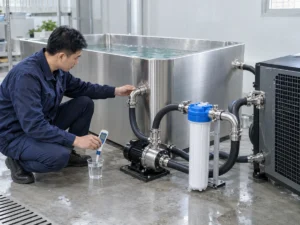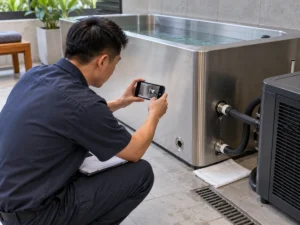
If a wood-fired hot tub is not heating, do not assume the stove has failed. Troubleshoot in this order: confirm the heater-side water level and circulation condition, then check combustion and chimney draft, then compare heat load and heat loss, and finally verify the temperature with representative mixed water. These branches separate a true heating fault from a circulation problem, a weak fire, harsher operating conditions or a misleading local temperature reading.
Do not use a larger fire as a circulation test. If the required water state or flow path cannot be confirmed, stop ordinary troubleshooting and use the actual heater manual, approved installation information or a qualified service route before increasing heat input.
This page is for abnormal-heating diagnosis. For the underlying stove, circulation and heat-transfer mechanism, see how wood-burning hot tubs work. If the tub is operating normally and your question is simply how long heating should take, use the separate wood-fired hot-tub heating-time guide.
Start With the Symptom: No Heat, Slow Heat or a Misleading Temperature Reading
“Not heating” can describe several different situations. Classifying the symptom first prevents a slow but functioning system from being treated like a circulation failure—and prevents a circulation problem from being treated like a weak fire.
| What you observe | First troubleshooting branch | Why it matters |
|---|---|---|
| Fire is active but representative mixed-water temperature shows little or no meaningful rise | Water level and circulation | Stronger firing does not resolve an uncertain heater-side flow condition |
| Water is warming, but much more slowly than a known normal session | Heat load and heat loss after basic circulation checks | Weather, starting conditions or thermal load may have changed |
| Water close to the heater return is hot while other areas remain noticeably cooler | Circulation and mixed-water measurement | A local hot zone does not prove the full tub is heating normally |
| Fire is difficult to establish or smoke behaves abnormally | Fuel, combustion and chimney draft | The problem may be on the combustion side rather than the water side |
| There is smoke spillage, leakage, clear heater-side overheating, steam or uncertain circulation | Stop ordinary troubleshooting | These conditions need a model-specific or professional escalation path |
A generic troubleshooting article cannot reliably identify a failed component from one symptom. It can, however, determine which branch should be checked next.
If the water is heating but simply taking longer than expected, compare the current session with previous normal sessions under reasonably similar conditions. A universal internet heat-up number is less useful than a repeatable change in the performance of the actual system.
Check Water Level and Circulation Before Adding More Fuel
If the tub shows little meaningful temperature rise, establish the heater-side water and circulation condition before making the fire stronger.
In a thermosiphon system, circulation is driven by the density difference between warmer and cooler water. ASHRAE defines thermosiphon as circulation induced by differences in fluid density. In practice, heated water can rise away from the heater while cooler water returns.
That physical principle is general. The plumbing specification is not.
Connection height, pipe routing, dimensions, valves and other installation details may be part of the design of a particular heater. Do not transfer those requirements from one manufacturer’s system to another.
Other wood-fired systems may use manufacturer-approved forced circulation. That is a different architecture. A pump used in the heater loop should also not automatically be confused with a filtration, jet or accessory pump elsewhere in the system.
Pump compatibility must be confirmed, not assumed
A slow-heating problem is not a reason to add, remove or bypass a circulation pump.
Some gravity-circulation heaters are designed around natural flow and impose their own restrictions on pump use. Other wood-fired systems are designed with powered circulation. The applicable heater documentation must decide which arrangement is correct.
For example, Kirami’s current heating guidance describes gravity circulation and model-specific water-level requirements for its own hot tubs. It is used here only as a manufacturer-specific example of why the actual heater documentation controls; it is not a HACHILL specification.
The same caution applies to an airlock. Trapped air can interrupt flow in some plumbed systems, but an airlock is only one possible cause of poor circulation. Other possibilities can include an unsuitable flow path, restriction, isolation, an incorrect water condition or another configuration problem.
That means “bleed the air” should not become a universal troubleshooting instruction. The safe procedure depends on the actual system.
Do not use a larger fire as a circulation test
Consider an external heater where the fire is burning but the mixed-water temperature barely changes.
The tempting response is to add more fuel.
But the important question is not yet “How strong is the fire?” It is:
Is water moving through the heater in the way this system was designed to move it?
If that condition is uncertain, increasing the fire adds heat without answering the circulation question.
A safer troubleshooting sequence is to:
- identify whether the heating loop uses thermosiphon or approved powered circulation;
- confirm the water condition required by the actual heater;
- confirm that the intended circulation route is not known to be isolated or restricted;
- compare the installed arrangement with the approved manual or drawing where available.
Do not substitute another heater’s pipe diameter, rise, slope, valve sequence, pump configuration or air-release procedure.
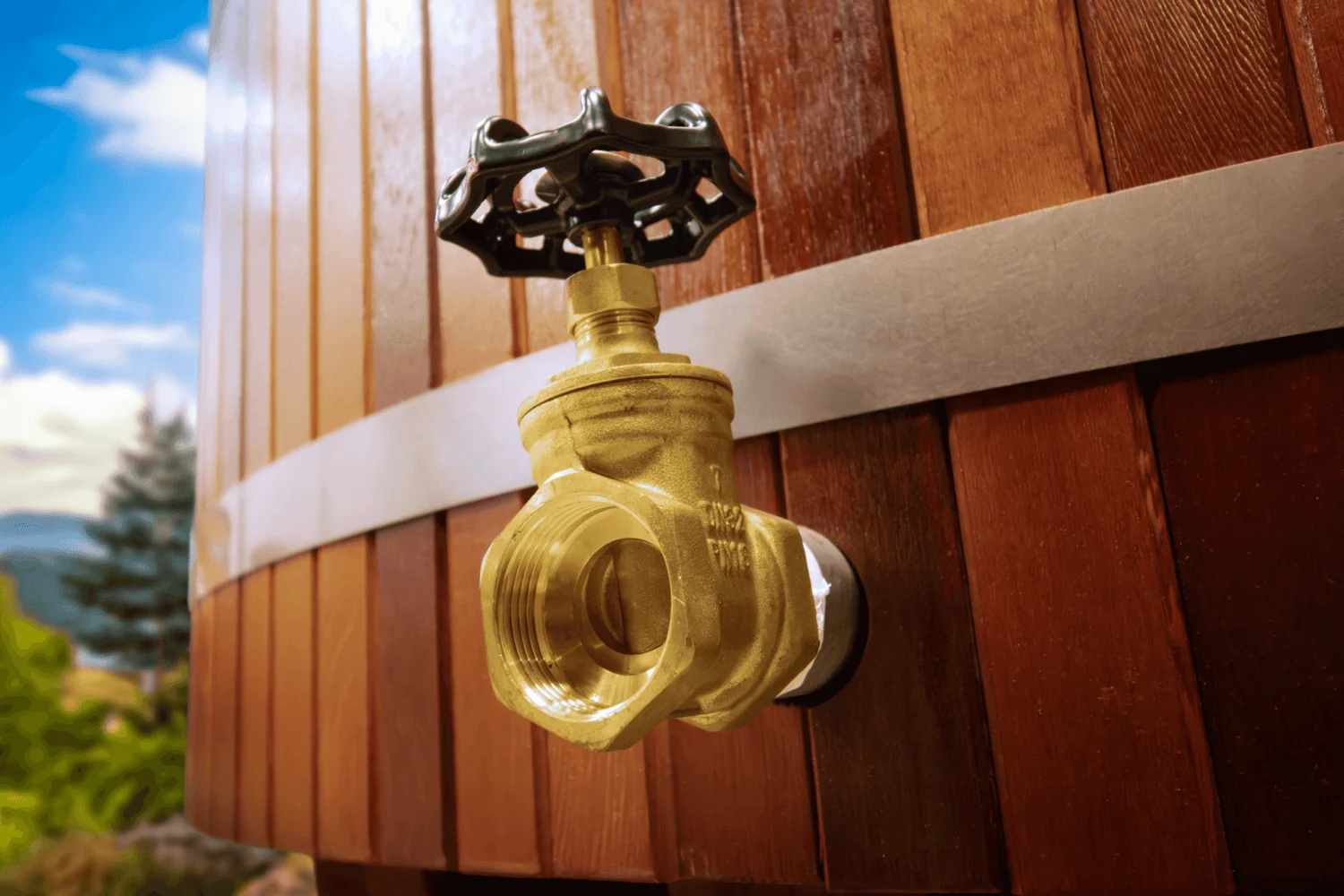
For the underlying heat-transfer and circulation mechanism, see how wood-burning hot tubs work. For model-specific pre-fire checks, circulation drawings and documentation requirements, use the wood-fired hot-tub safety-documentation guide.
If Circulation Is Normal, Check Combustion, Fuel and Chimney Draft
If the required water level and circulation path appear normal for the actual system, move to the combustion side.
The stove cannot deliver normal heat into the water if the fire itself is burning poorly. Fuel condition is one variable. UK DEFRA guidance states that dry wood produces less smoke and has better heat efficiency than wet wood. That does not turn a UK fuel rule or moisture threshold into a universal HACHILL specification; the selected appliance guidance still controls the acceptable fuel.
Look at the behaviour of the fire and exhaust system rather than jumping directly to a component diagnosis.
Useful questions include:
- Does the fire establish and remain stable?
- Has fuel condition changed from sessions that heated normally?
- Is there visible ash, soot or obstruction where the heater instructions identify normal maintenance access?
- Has anything changed around the chimney or flue?
- Is smoke moving through the intended exhaust path, or is it spilling where it should not?
Draft and combustion air are related, but they are not the same thing
Natural chimney draft relies on buoyancy to move hot combustion gases upward. Natural Resources Canada describes that buoyancy-driven principle and also identifies chimney or vent problems as potential contributors to poor draft and combustion-gas spillage.
A weak or unstable fire therefore does not prove one specific root cause. Fuel condition, combustion air, chimney condition and the appliance arrangement may all need to be considered.
This is also where generic troubleshooting needs a firm boundary. Do not respond to a draft problem with a one-size-fits-all chimney extension, different flue diameter or other improvised modification. Exact chimney dimensions, termination and clearances belong to the heater instructions and applicable local requirements.
Stop ordinary performance troubleshooting if smoke is spilling from the intended combustion or exhaust route. The actual appliance and flue arrangement need to be checked through the appropriate manufacturer, installer or qualified service route.
The key diagnostic distinction is:
A water-side problem limits the movement of heat after it reaches the heater. A combustion-side problem limits how effectively heat is being produced and exhausted in the first place.
Both can appear to the user as “the tub is not heating.”
Rule Out Heat Load and Heat Loss Before Blaming the Heater
A wood-fired hot tub can heat more slowly even when the heater itself has not failed.
The amount of water being heated, the starting water condition and the surrounding environment all change the thermal duty. At the same time, heat is continually being lost from the tub and exposed parts of the system.
That is why a useful troubleshooting comparison asks:
Has the system become slower under reasonably comparable conditions, or are the conditions themselves harder than before?
Check for changes such as:
- colder starting water;
- a different water volume;
- lower outdoor temperature;
- stronger wind or a more exposed site;
- a recent refill;
- changed insulation or heat-retention conditions;
- changed exposed plumbing or placement;
- different cover use, but only where the heater or tub manufacturer permits the cover to remain in place during heating.
A changed site can look like a failed heater
Suppose the tub used to heat normally but is now operating during colder, windier weather or in a more exposed location.
A slower rise in mixed-water temperature is useful information, but it does not prove the heater has become defective or undersized. The thermal load has changed too.
Before modifying the heater, compare:
- the current starting condition;
- the current environmental conditions;
- the current water volume;
- the current circulation behaviour;
- the current mixed-water temperature trend;
- a previous session that is known to have operated normally.
One slow session is weak evidence of an undersized stove. A repeatable deterioration under comparable conditions is much more useful for diagnosis.
For detailed discussion of expected heat-up time and the variables behind it, use the wood-fired hot-tub heating-time guide. This article only uses those variables to distinguish an abnormal system from a more demanding operating condition.
Verify the Problem With a Representative Mixed-Water Reading
A temperature reading close to the heater does not automatically represent the tub as a whole.
Heated water can form warmer and cooler regions during the heating process. In a hot tub, that means a hot return or warm layer may exist before the full water volume has reached the same condition.
The same Kirami heating guidance notes that water can be layered during heating and should be mixed when checking temperature in its tubs. That is a model-specific manufacturer example supporting the measurement distinction here, not a HACHILL operating specification.
This creates two common troubleshooting errors:
“The return water is hot, so the whole tub must be heating correctly.”
and:
“This one area still feels cool, so the heater must have failed.”
Neither conclusion is strong enough by itself.
For troubleshooting, compare the system using a representative mixed-water temperature rather than relying on one local hot or cold area.
| Temperature observation | What it can help show | What it does not prove |
|---|---|---|
| Hot water near the heater return | Heat may be reaching the return locally | The full tub is warming evenly |
| One noticeably warmer layer or area | Thermal stratification may be present | Representative whole-tub temperature |
| Mixed-water temperature rises consistently over time | The water volume as a whole is gaining heat | Exact heater efficiency or rated output |
| Mixed-water temperature changes very little | Further troubleshooting is justified | Which component has failed |
Consistency is more useful than chasing one unusually hot or cold reading. Where possible, compare sessions using a similar mixed condition, measurement approach, starting state and elapsed interval.
This is a diagnostic measurement question, not a recommendation for what bathing temperature an individual should use. HACHILL’s hot-tub temperature guide covers that separate operating and safety question.
Know When to Stop Troubleshooting and What to Record for Service
Troubleshooting should reduce uncertainty. It should not turn into increasingly invasive trial-and-error.
Stop ordinary owner-level troubleshooting when the problem moves beyond safe observation or when the actual model requirements can no longer be confirmed.
Stop and escalate rather than continuing to add heat or improvise repairs if the required water/circulation state cannot be established, the heater or water path is visibly leaking or damaged, smoke spills from the exhaust route, the chimney/flue appears damaged or obstructed, there are clear signs of heater-side boiling/steam/abnormal overheating, a powered system shows an electrical abnormality, or the installed arrangement cannot be verified against the applicable documentation.
These observations do not all prove the same failure. They share the same decision boundary: continuing to add heat or improvise repairs no longer provides a responsible troubleshooting path.
The exact shutdown procedure may also be model-specific. Follow the actual equipment instructions rather than copying a shutdown sequence from another wood-fired system.

Build a troubleshooting record before escalating
A supplier, installer or service professional can work with “the tub does not heat,” but a structured record is much more useful.
| Information to record | Why it matters |
|---|---|
| Exact tub and heater model | Identifies the correct manual and configuration |
| Internal or external heater arrangement | Establishes basic architecture |
| Thermosiphon or powered heating loop, if known | Determines which circulation logic applies |
| Main symptom | Separates no-heat, slow-heat, uneven-temperature and combustion branches |
| Water level and heater-side water condition before heating | Helps verify the model-specific prerequisites for safe heating |
| Starting and later mixed-water readings | Shows whether the full water volume is gaining heat |
| Elapsed heating interval | Adds performance context without assuming a universal normal time |
| Fuel condition | Adds combustion-side context |
| Ambient temperature and wind | Helps compare thermal load and heat loss |
| Recent refill, relocation, maintenance or plumbing change | Identifies what changed before the symptom appeared |
| Smoke, leaks, steam, unusual noise or other abnormal observations | Helps identify escalation and safety issues |
| Safe photos of the cold system, connections and flue | Helps compare the installed arrangement with available documentation |
| Exact manual or installation drawing | Establishes the model-specific requirements |
If the system previously worked normally, one of the most useful diagnostic questions is:
What changed between the last normal heating session and the first abnormal one?
The answer may point toward operating conditions, installation changes, circulation, combustion or equipment. It is usually more informative than replacing parts before the fault branch has been established.
For an existing HACHILL order or product issue, use the after-sales support route and provide the model plus the observations you already have. For a general business enquiry, use the contact page. If the issue has become a replacement, new-system or project-selection decision, move to the wood-fired hot-tub product family or request a quotation rather than treating a new purchase as a troubleshooting step.
Frequently Asked Questions
Should I add more wood if the tub is heating too slowly?
Not until the heater-side water level and circulation state required by the actual system have been established. If heater-loop flow is uncertain, a stronger fire does not identify the cause and may add heat to an already unsafe condition. Check the applicable heater instructions before increasing firing intensity.
Can an airlock stop a wood-fired hot tub from heating?
An airlock can interfere with flow in some plumbed or pumped systems, but it is only one possible cause of weak circulation. The correct venting or priming procedure is configuration-specific. Do not copy another manufacturer’s air-release method into an unknown system.
Does slow heating mean the wood-fired heater is undersized?
No. Water volume, starting condition, fuel, ambient temperature, wind and heat loss can all change observed heating performance. Compare the current session with the system’s known normal behaviour under reasonably similar conditions before treating heater size as the explanation.
What information should I send if the problem continues?
Provide the exact tub and heater model, circulation type if known, the observed symptom, starting and mixed-water readings, elapsed heating time, fuel and weather conditions, recent system changes, abnormal observations, and relevant photos or manuals. Those details make the next diagnostic step much easier to determine.
Reference Basis and Scope
- ASHRAE Terminology — thermosiphon terminology and density-driven circulation.
- Natural Resources Canada — natural draft, chimney/vent performance and combustion-gas spillage context.
- UK DEFRA: Burn Better — dry-versus-wet wood guidance in its UK air-quality context.
- Kirami: Hot tub heating guidance — used only as a manufacturer-specific example of gravity circulation, water-level and mixing requirements; it is not a HACHILL specification.
The manufacturer-specific material above is used only to show why water level, circulation arrangement, pump compatibility, priming or venting, and shutdown procedures must be checked against the actual heater documentation. No third-party requirement has been converted into a HACHILL specification.