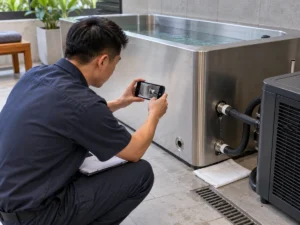
There is no single best hot tub temperature for everyone. For adults who are otherwise appropriate hot-tub users, about 100–102°F (38–39°C) is a commonly cited comfort range; Jacuzzi, for example, describes 100–102°F as a range many users prefer. Separately, current CDC guidance says hot-tub water should not exceed 104°F / 40°C.
Those figures serve different purposes. 100–102°F is a comfort reference; 104°F / 40°C is an upper boundary in current U.S. CDC guidance, not a target. Product instructions and applicable local rules may be more restrictive. Age, pregnancy, alcohol use, certain health conditions or medications can change the decision further.
Actual water temperature matters too. A controller setpoint, built-in sensor or hot area near the heater does not automatically represent the mixed water users actually occupy. This is particularly important with wood-fired hot tubs, where active combustion, embers and heated components can continue transferring heat as the target temperature approaches.
Best Hot Tub Temperature: Start With Comfort, Respect the 104°F Limit
For an adult who is otherwise an appropriate hot-tub user, about 100–102°F is a practical comfort reference. Jacuzzi currently describes 100–102°F as a range many hot-tub users prefer. Treat that as a named manufacturer comfort reference, not as a public-health prescription.
For U.S.-oriented public-health guidance, the firmer boundary is 104°F / 40°C. CDC says hot-tub water should not be hotter than this, and the 2024 Model Aquatic Health Code uses the same maximum for spas and heated aquatic venues within its scope.
| Temperature concept | What it means | What it does not mean |
|---|---|---|
| About 100–102°F | A commonly reported adult comfort or preference range | A CDC-recommended target for every adult |
| 104°F / 40°C | The upper boundary in current CDC guidance and the 2024 MAHC | A universal target or a substitute for stricter product/local limits |
| Lower temperature or no use | May be appropriate because of personal circumstances, symptoms or professional advice | One universal alternative setting for every higher-risk user |
The distinction matters because a maximum is easy to misread as a recommendation. If the product manual, facility policy or applicable jurisdiction sets a lower limit, follow the more restrictive requirement.
A suitable adult user does not need to push the water toward 104°F simply because the equipment can reach it. Comfort varies, and a lower temperature can be entirely reasonable.
The better question is:
What temperature is appropriate for the people using the tub, and have I verified the actual water temperature?
If the separate question is how long a wood-fired tub needs to reach the chosen target, that belongs to HACHILL’s wood-fired hot-tub heating-time guide rather than to the temperature-selection decision itself.
Safety Limits Can Override the Normal Comfort Range
A lower setting does not solve every hot-tub safety question. Some situations change the decision from “choose a cooler temperature” to do not use the hot tub, obtain healthcare guidance first, or stop the heat exposure.
Children under 5
Current CDC guidance says children younger than 5 should not use hot tubs.
That is stronger than advice sometimes found online suggesting that a young child can use a hot tub simply by lowering the water to a particular temperature. Reducing the setpoint does not replace the age restriction.
For older children, appropriate supervision and applicable public-health or facility rules still matter. A generic article should not invent one temperature-and-time formula for every child.
Pregnancy
Pregnancy should not be reduced to a single “safe hot-tub temperature.”
CDC guidance advises pregnant users to talk with a healthcare provider before using a hot tub. ACOG says it is best not to use a sauna or hot tub in early pregnancy, citing concern about elevated core body temperature and possible fetal risk.
The decision boundary is therefore healthcare guidance—not a universal HACHILL temperature-and-minutes chart.
Alcohol, health conditions and medications
CDC advises against drinking alcohol before or during hot-tub use.
Pool & Hot Tub Alliance safety guidance advises people with relevant health conditions to consult a doctor before hot-tub use and warns about alcohol or medications that may cause drowsiness or impair judgment. When there is uncertainty about a medical condition, medication or ability to tolerate heat, the safer route is healthcare guidance rather than guessing a lower setting.
This article cannot determine whether a specific disease, medicine or personal medical history makes hot-tub use appropriate.
Do not wait for a timer if you feel unwell
A planned soak time should never override symptoms.
MedlinePlus heat-emergency guidance lists symptoms including dizziness or lightheadedness, nausea, weakness and, in more serious heat illness, neurologic symptoms such as confusion or seizures. In a hot-tub context, possible heat-related warning signs include:
- dizziness or lightheadedness;
- nausea;
- unusual weakness;
- confusion.
Leave the heat exposure if these occur rather than remaining in the tub because a timer has not finished.
Severe symptoms such as seizure, marked confusion or loss of responsiveness require urgent medical attention.
This is also why a universal table such as “98°F for X minutes, 102°F for Y minutes and 104°F for Z minutes” is not used here. Duration matters, particularly as heat exposure becomes more intense, but the evidence does not support one simple temperature-to-time formula for every user.
A more defensible sequence is:
- determine whether the person is an appropriate hot-tub user;
- stay below the 104°F / 40°C maximum;
- choose a lower operating temperature where appropriate;
- stop exposure if heat-related symptoms develop;
- seek professional guidance when pregnancy, medical conditions or medications make suitability uncertain.
Measure the Mixed Water, Not Just the Setpoint or a Local Hot Zone
Choosing a temperature is only useful if the reading represents the water people are actually using.
Four different values can easily be confused:
- the temperature set on the controller;
- the temperature reported by a built-in sensor or display;
- a local hot or cool area;
- the temperature of the representative mixed water.
They are not necessarily the same.
Water can develop warmer and cooler layers while heating. Water returning from a heater may also create a local hot zone before the full vessel has equalized. A reading taken near that return can therefore overstate the condition of the rest of the tub.
The reverse mistake is possible as well. One cooler local reading does not automatically prove that the heating system is failing.
| Reading | What it tells you | What it cannot prove by itself |
|---|---|---|
| Controller setpoint | What the control system is being asked to achieve | Actual temperature throughout the occupied water |
| Built-in sensor/display | What that sensor or control system reports | That every part of the tub matches the display |
| Heater return or local hot zone | Local water condition | Representative whole-tub temperature |
| Mixed-water reading | A stronger basis for judging the tub as a whole | Exact heater efficiency or rated output |
Independent verification can matter when actual water temperature affects safety.
A U.S. Consumer Product Safety Commission recall involving certain Jacuzzi and Sundance hot tubs illustrates the distinction: inaccurate temperature readings were reported, and affected users were instructed to verify the water with an accurate external thermometer and ensure it did not exceed 104°F.
That incident does not mean hot-tub controllers are generally inaccurate. It demonstrates why a display should not be assumed infallible when the true water temperature matters.
For routine operation, follow the tub and heater instructions. Where they do not prescribe a measurement point, allow the water to circulate or mix before judging the vessel as a whole, and do not treat a reading taken directly at a heater return or another obvious local extreme as representative of the occupied water.
Exact thermometer placement, instrument specification, sensor tolerance and calibration procedure can be product- or facility-specific. Follow the actual equipment documentation where those details are defined.
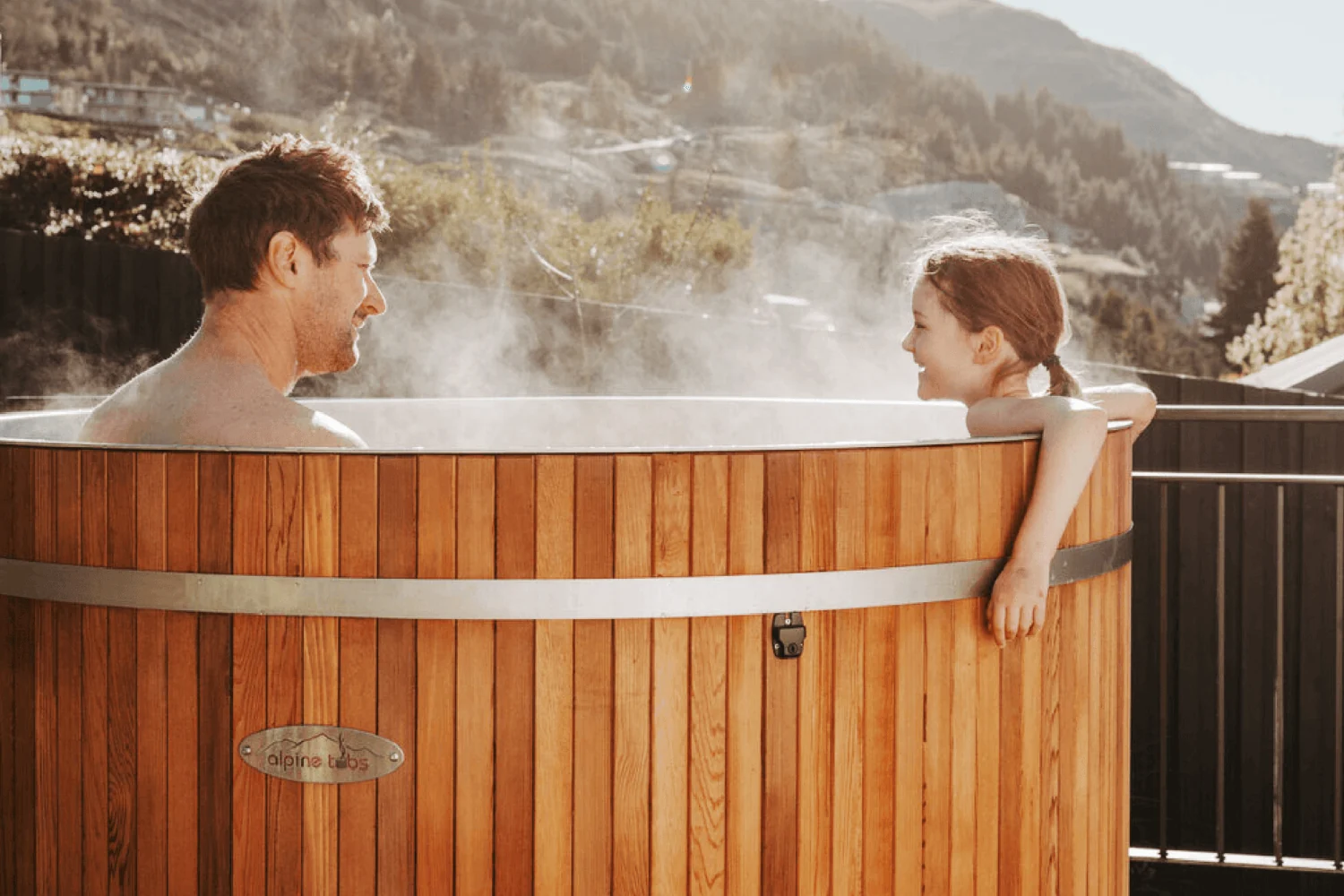
If mixed-water temperature is not rising normally, move to the separate HACHILL wood-fired hot-tub troubleshooting guide rather than changing the target temperature to compensate for a heating problem.
Wood-Fired Hot Tubs Need Active Temperature Control Near the Target
A wood-fired hot tub adds a control problem that a thermostat setpoint alone cannot solve: heat input may continue while the fire, embers and heated heater components remain active.
Temperature control therefore needs to begin before the water has already reached the final target.
Manufacturer guidance for some wood-fired systems explicitly tells operators to reduce fuel input before the final bathing temperature is reached to avoid overheating. For example, Kirami instructs operators of its own wood-fired tubs to begin reducing added logs before the final target. That is a manufacturer-specific example, not a HACHILL specification. The exact reduction point and operating sequence are specific to the heater design.
The common overshoot mistake
Consider a tub approaching the intended temperature.
The water is still slightly below target, so more fuel is added. By the time the next representative mixed-water measurement is taken, combustion, embers and the heated stove still have energy to transfer.
The operator has made the next control decision too late.
The useful lesson is not:
“Always reduce the fire at X°F.”
It is:
Anticipate the remaining heat input as the target approaches, then follow the actual heater instructions for fuel reduction and shutdown.
After an adjustment, allow the system to circulate and the water to mix as the approved system requires before judging the final temperature.

Heat loss changes control, not the safety ceiling
Cold weather, wind, water volume and other thermal conditions affect how quickly water gains or loses heat.
They can change:
- how quickly the tub approaches the target;
- how rapidly it cools;
- how often temperature needs to be checked;
- how the system behaves between heating and use.
They do not justify exceeding the applicable temperature limit. Under current CDC guidance, the upper boundary remains 104°F / 40°C.
A colder day is therefore a temperature-control problem, not permission to use a higher maximum.
| Control variable | Why it matters | What must be verified |
|---|---|---|
| Current mixed-water temperature | Shows the representative tub condition | Reading is not just a local hot zone |
| Remaining fire and embers | Heat can continue as the target approaches | Actual heater instructions |
| Circulation and mixing | Affect how evenly heat reaches the tub | Approved system configuration |
| Weather and heat loss | Change heating and recovery behaviour | Actual operating conditions |
| Cover use | Can change heat loss | Whether the specific tub/heater instructions permit it during firing |
| Fuel reduction or shutdown | Controls further heat input | Model-specific procedure |
Do not copy another heater’s fuel-reduction temperature, cover rule or shutdown sequence.
The deeper stove, circulation and heat-transfer mechanism belongs to HACHILL’s guide to how wood-burning hot tubs work. Keep heating faults separate from the target-temperature decision; the dedicated troubleshooting guide is linked earlier in this article.
Commercial Operators Need a Repeatable Temperature Procedure, Not Just a Setpoint
A hotel, resort, spa or rental operation needs more than a comfortable setpoint.
The operating question becomes:
Who verifies the actual water temperature, what is recorded, and when is the tub taken out of use?
For U.S. public aquatic facilities, CDC’s current Model Aquatic Health Code is a useful benchmark. The 2024 fifth edition sets a 104°F / 40°C maximum and states that, for heated aquatic venues, water temperature is to be recorded when the required disinfectant and pH tests are performed.
The MAHC is model guidance, not federal law by itself. State, local, tribal or territorial jurisdictions may adopt, modify or use it as a reference. Operators must therefore verify which requirements apply to the actual facility and whether the specific wood-fired installation falls within the local aquatic-code scope.
A setpoint is not an operating record
Consider a facility where staff record only the control-panel display.
The controller shows the intended setting, but nobody verifies the mixed water in the area guests actually occupy.
The weakness is not necessarily the controller itself. It is the operating process: the record has not established the actual exposure condition.
The following is a practical operating-log structure, not a verbatim MAHC checklist:
| Record item | Why it matters |
|---|---|
| Date and time | Establishes when the condition was checked |
| Representative water temperature | Records the actual operating condition |
| Controller/display reading | Allows comparison with the measured water |
| Responsible staff member | Establishes responsibility |
| Operating status | Shows whether the tub was open, adjusting or closed |
| Corrective action | Records what happened when conditions were outside policy |
| Equipment/manual issue | Flags when technical review is required |
For a commercial wood-fired tub, the operating policy should also define who is permitted to manage the fire and who verifies the final mixed-water temperature before guest use.
Guests should not be expected to determine whether a combustion system has reached a stable, verified operating condition.
Define no-use conditions before they occur
A commercial policy should define when normal use stops.
At minimum, use should not continue when:
- verified water temperature exceeds the applicable maximum;
- staff cannot reliably establish the actual water temperature;
- the system cannot be operated in accordance with its required equipment instructions;
- a condition meets a closure requirement imposed by the applicable authority having jurisdiction.
Exact legal closure requirements vary by jurisdiction and facility. They should not be invented from a generic article.
For model-specific manuals, temperature-control procedures and controlled safety documents, use HACHILL’s wood-fired hot-tub safety-documentation guide together with the applicable equipment documentation.

Frequently Asked Questions
Is 104°F too hot for a hot tub?
104°F / 40°C is the upper boundary, not a universal target. CDC guidance says hot-tub water should not exceed this temperature. Many users prefer a lower temperature, and some people require additional restrictions or should not use a hot tub.
What temperature do many adults prefer in a hot tub?
About 100–102°F is a commonly cited adult comfort range, and Jacuzzi describes it as a range many users prefer. That is a comfort reference, not a CDC recommendation and not a guarantee that the range is appropriate for every individual.
Can children use a hot tub if I lower the temperature?
For children younger than 5, CDC guidance says do not use hot tubs. Lowering the temperature does not replace that age restriction. Older children still require appropriate supervision and applicable public-health or facility rules.
Can you use a hot tub while pregnant?
Pregnant users should talk with a healthcare provider before hot-tub use. ACOG says it is best not to use a sauna or hot tub in early pregnancy. A generic temperature-and-time formula should not replace individualized medical guidance.
Why does my hot-tub display differ from the temperature I measure?
The controller setpoint, built-in sensor and representative mixed-water temperature are different concepts. Thermal layering and local hot zones can also produce different readings. Use a representative mixed-water measurement when deciding what temperature users are actually exposed to.
Should I wait until a wood-fired hot tub reaches the target before reducing the fire?
Not necessarily. Some wood-fired heater manufacturers instruct operators to reduce fuel before the final target because combustion, embers and heated components can continue transferring energy. The exact timing and procedure must come from the actual heater instructions.