What an infrared sauna is, how radiant heating works, and what buyers should compare
Quick answer: An infrared sauna is an enclosed cabin that uses electrically powered infrared emitters to deliver radiant energy toward users and interior surfaces. When that energy is absorbed, it becomes heat. The emitters, warmed surfaces and occupants also warm the cabin air, so an infrared sauna does not heat only the body. Unlike a traditional sauna, its primary heating route is emitter-based radiant transfer rather than a central sauna heater and heater-and-stone room environment. The exact experience depends on emitter type and placement, cabin geometry, seating position, controls, enclosure construction, ventilation and electrical configuration. Buyers should therefore compare the exact model and emitter layout—not only “far infrared,” “full spectrum,” total wattage or person-capacity labels.
- Compare the exact emitter layout, not only “far infrared” or “full spectrum” labels.
- Check usable seating and panel coverage rather than relying on person capacity.
- Confirm voltage, frequency, phase, connection route and local installation responsibility.
- Separate residential suitability from repeated commercial duty.
- Approve quotations against model-level drawings, controls, manuals and document scope.
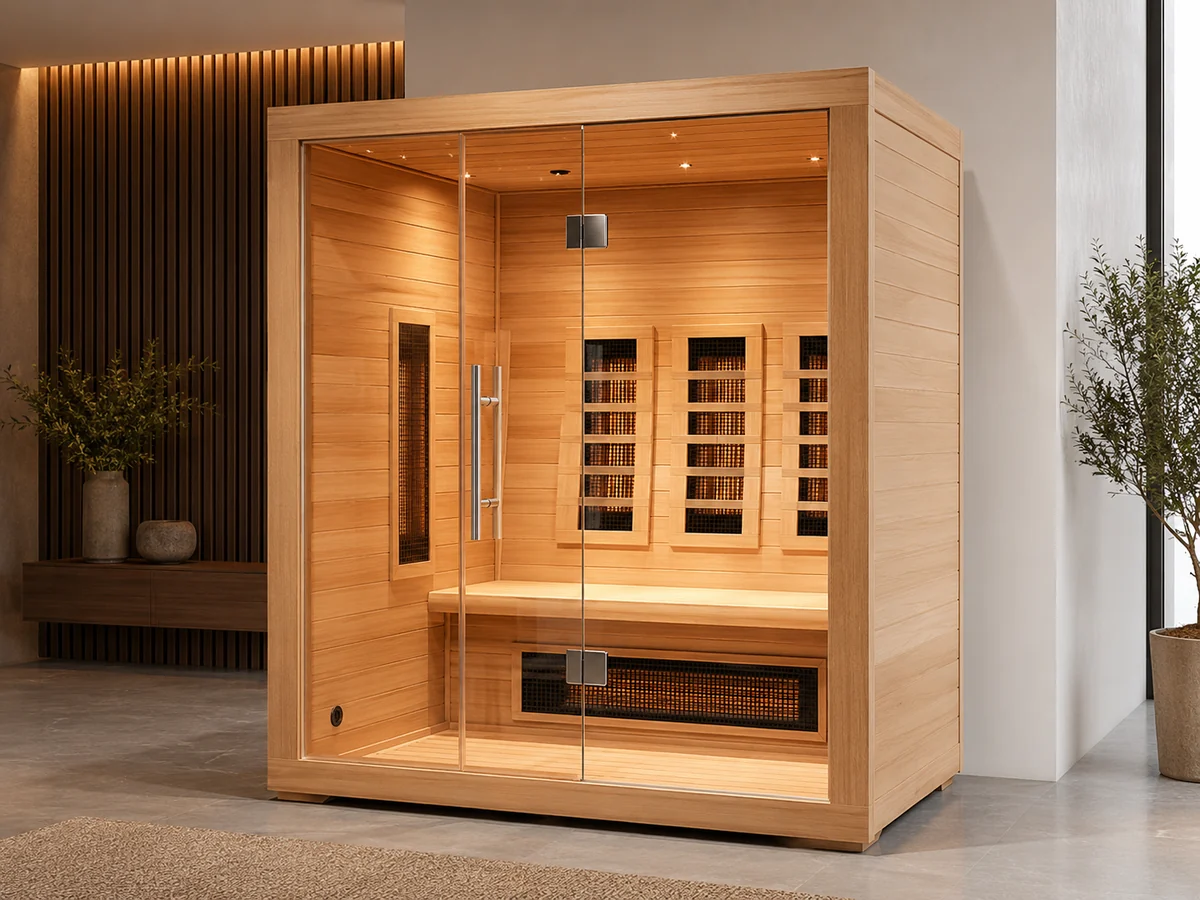
Conceptual visualization; not a verified HACHILL model, installation, certification or performance test.
Use this guide to understand the heating principle, infrared terminology, panel placement, usable seating, controls, site and electrical checks, and the model-level evidence needed before comparing quotations.
What Is an Infrared Sauna?
An infrared sauna is an enclosed heated cabin that uses electrically powered infrared emitting units positioned around the occupied area. The emitters release infrared radiant energy toward users and interior surfaces. When that energy is absorbed, it is converted into heat.
Infrared is non-ionizing optical radiation. The ICNIRP infrared overview describes the infrared region and its thermal-exposure context. That scientific classification helps explain what infrared is, but a wavelength label alone does not establish whole-cabin coverage, comfort, electrical suitability, commercial durability or a health outcome.
Infrared sauna in one sentence
An infrared sauna converts electrical energy into infrared radiation that warms exposed users and cabin surfaces and contributes to the overall thermal environment.
What it is not
It is not simply a traditional sauna with a new label, and it should not be evaluated from wavelength, panel count, total wattage or person capacity alone.
When Is an Infrared Sauna the Right Product Route?
Product-family selection should happen before buyers compare finishes, panel counts or optional features. An infrared sauna can be a suitable route when the intended experience, site, electrical system and operating model match the exact cabin configuration. It is not automatically the correct route for every sauna project.
Infrared may be suitable when
- The buyer specifically wants an emitter-based radiant-heating cabin.
- The installation environment matches the model’s indoor or approved outdoor scope.
- Usable seating and panel coverage can be checked from drawings.
- The exact electrical configuration is compatible with the destination market.
- The selected model is confirmed for the expected residential or commercial duty.
Another route may be better when
- The project requires the room environment and heater route associated with a traditional sauna.
- The site exposes an indoor-only cabin to rain, freezing conditions or uncontrolled moisture.
- The expected commercial throughput exceeds the model’s confirmed operating scope.
- The buyer cannot obtain model-level drawings, electrical data or installation instructions.
- Local electrical, building or facility requirements cannot be satisfied.
Do not decide until these are known
- Actual users and usable interior dimensions
- Daily use frequency and cleaning routine
- Emitter layout and normal seating positions
- Voltage, frequency, phase and connection route
- Installation environment and ventilation
- Destination-market document scope
How Does an Infrared Sauna Work?
From electrical input to radiant heat
- Electrical power is supplied to the infrared emitting units.
- The emitters convert part of that electrical input into infrared radiation.
- The radiation travels across the cabin toward exposed users and interior surfaces.
- Absorbed radiant energy is converted into heat.
- Heated surfaces exchange energy with the surrounding air and other surfaces.
- Controls and sensors regulate operating time, temperature and applicable protection functions.
Why the cabin air still becomes warmer
The statement that an infrared sauna heats the user rather than the air is incomplete. Direct radiant transfer is important, but emitter surfaces, benches, walls and glazing also warm. Those surfaces transfer energy to the cabin air, while enclosure losses, ventilation and user-generated heat and moisture further influence the conditions inside the cabin.
Temperature owner: For room-temperature ranges, measurement location and sensor interpretation, use the Sauna Temperature Guide. This page does not set a universal temperature or exposure duration.
The role of controls and sensors
A complete system may include a main controller, timer, temperature sensor, over-temperature protection and independent emitter zones. The presence of a feature name does not establish how it operates. Buyers should request the exact control description, sensor position, zone logic, user-access limitations and applicable protection functions for the selected model.
Why system balance matters
The operating result is created by several linked variables. Changing one variable can change the relevance of the others, which is why a supplier should not use one specification as a substitute for the complete design.
Emitter-to-user geometry
Distance, direction and the seated field of view affect which surfaces receive direct radiant energy.
Enclosure losses
Wall construction, glazing, door fit and surrounding-room conditions affect heat loss and operating stability.
Ventilation
Air replacement supports the intended cabin environment but can also change heat retention and user comfort.
Control and sensing
Sensor position, protected settings and zone logic affect how the system responds during operation.
What Do Near, Mid and Far Infrared Mean?
Infrared covers a broad wavelength region, so a single “infrared” label does not describe the complete output of a sauna emitter. ICNIRP uses the technical bands IR-A (780 nm–1.4 µm), IR-B (1.4–3 µm) and IR-C (3 µm–1 mm, also described as far infrared). Consumer terms such as near, mid and far infrared are useful only when the supplier also identifies the actual emitter construction and model configuration.
Far infrared
Far infrared is associated with the longer-wavelength part of the infrared region. A “far infrared sauna” label does not by itself prove radiant distribution, seated-body coverage, commercial durability, lower energy use or a particular wellness result.
Near and mid infrared
Some cabins combine emitters described as near- or mid-infrared with longer-wavelength emitters. These labels may correspond to different emitter constructions, surface temperatures, visible appearance, placement and user-distance requirements, so the exact technical data should be reviewed rather than inferred from the marketing term.
What “full spectrum” does—and does not—prove
“Full spectrum” is commonly used for a cabin that combines emitters associated with more than one infrared band. The label does not independently prove the output in each band, whole-cabin uniformity, lower energy consumption, superior commercial durability or better health outcomes.
Before approval, request the emitter schedule, exact locations, controlled zones and supporting technical information for the quoted configuration. If wavelength distribution is material to the purchase decision, ask what measurement or product data supports the claim.
Which Components Actually Change the Sauna Experience?
Emitter type and surface area
Infrared cabins may use different emitter constructions, including panel-style and lamp-style units. Buyers should compare emitter construction, rated input, active area, mounting method, required clearances, contact protection, replaceability, zone arrangement and model-level documentation.
Panel placement and radiant coverage
Radiant energy travels from the emitter toward surfaces within its field of view. Panel position therefore changes which areas of a seated user receive direct radiant exposure. A panel map is more useful than a total panel count.
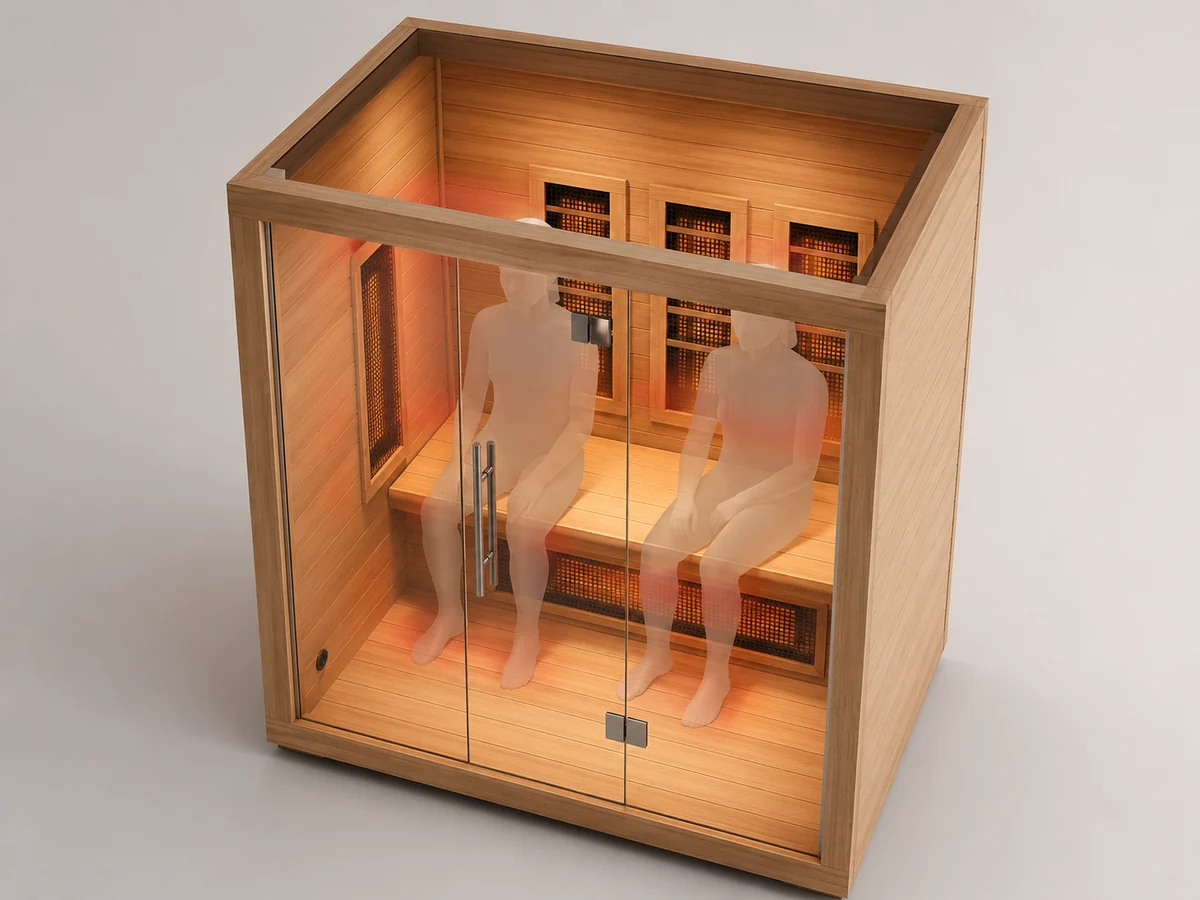
Simplified technical visualization; exact emitter layout, clearances and coverage must be confirmed for the selected model.
Cabin geometry and seating
Person capacity is a commercial label rather than a complete spatial specification. Review internal width, depth and height, bench dimensions, shoulder room, leg position, door swing, glazing area, emitter-to-user distance, usable floor area and access for cleaning and service.
Controls, sensors and zoning
Confirm which panels belong to each zone, whether zones are independently controlled, where temperature is measured, what happens if a sensor fails and which settings are accessible to users or staff.
Insulation, glazing and ventilation
The enclosure influences warm-up behaviour, surface temperature and operating stability. Review wall construction, insulation route, finishes, glazing, door fit, joints, ventilation openings and surrounding-room conditions. A named wood species alone does not prove durability or suitability for repeated commercial cleaning.
What Should Buyers Compare Between Infrared Saunas?
For a commercial buyer, the decision is not only which cabin has the highest power rating or longest feature list. The objective is to compare systems intended for equivalent users, venues, electrical markets and operating duties.
Residential or commercial venue, users, frequency and intended experience.
Space, access, moisture, ventilation and local installation constraints.
Emitters, panel layout, seating, enclosure, controls and service access.
Drawings, manuals, electrical data, inspection scope and market documents.
Approved revision, branding, packaging, accessories and responsibility boundaries.
A practical five-step comparison workflow
| Comparison area | What to request | Why it matters | Warning sign |
|---|---|---|---|
| Intended use | Residential or commercial application statement | Changes duty, cleaning and service expectations | Only a person-capacity claim |
| Interior space | Usable dimensions and bench layout | Determines user fit and body position | Exterior dimensions only |
| Emitters | Type, quantity, location and controlled zones | Changes radiant coverage and serviceability | “Full spectrum” without configuration details |
| Electrical | Voltage, frequency, phase, rated input and protection requirements | Determines installation feasibility | “Plug-and-play” without a market-specific specification |
| Controls | Timer, sensor, zones, lockout and protection functions | Affects operation and misuse control | Feature names without a control description |
| Construction | Wall build-up, insulation, door, glazing and finish | Affects enclosure behaviour and maintenance | Wood name used as complete construction proof |
| Serviceability | Replaceable parts and access procedure | Important for long-term operation | No component or spare-parts scope |
| Evidence | Drawings, manuals, test scope and applicable documents | Supports approval and market review | Generic certificate without model identification |
After defining equivalent comparison inputs, buyers can review HACHILL’s infrared sauna product routes and then confirm the exact model, emitter layout, electrical market and document scope before quotation.
Model-level specifications to request
- Exact model reference and approved configuration
- Dimensioned external and internal drawings
- Bench layout and emitter schedule
- Rated electrical input, voltage, frequency and phase
- Control functions and sensor position
- Installation clearances and ventilation provisions
- Material and finish schedule
- Packing dimensions, manuals and inspection scope
Commercial information that changes a quotation
Branding, finish, control interface, packaging, accessories, documentation language, quantity, destination, inspection scope, spare-parts package and installation responsibility can all change a quotation even when the basic cabin format is similar.
Infrared Sauna vs Traditional Sauna: What Is the Basic Difference?
An infrared sauna uses infrared emitting units positioned around the cabin. A traditional sauna normally uses a sauna heater to heat the room, surrounding surfaces and, where applicable, sauna stones.
The systems differ in heat-delivery route, room environment, heater and control architecture, ventilation design, electrical requirements, user experience and maintenance. Neither route is automatically better for every project.
For the full system-level comparison, use HACHILL’s Infrared Sauna vs Traditional Sauna guide. Buyers can also review the confirmed traditional indoor sauna route. This section remains intentionally brief so the present page retains its definition-and-buying-guide sovereignty.
What Site and Electrical Information Must Be Confirmed?
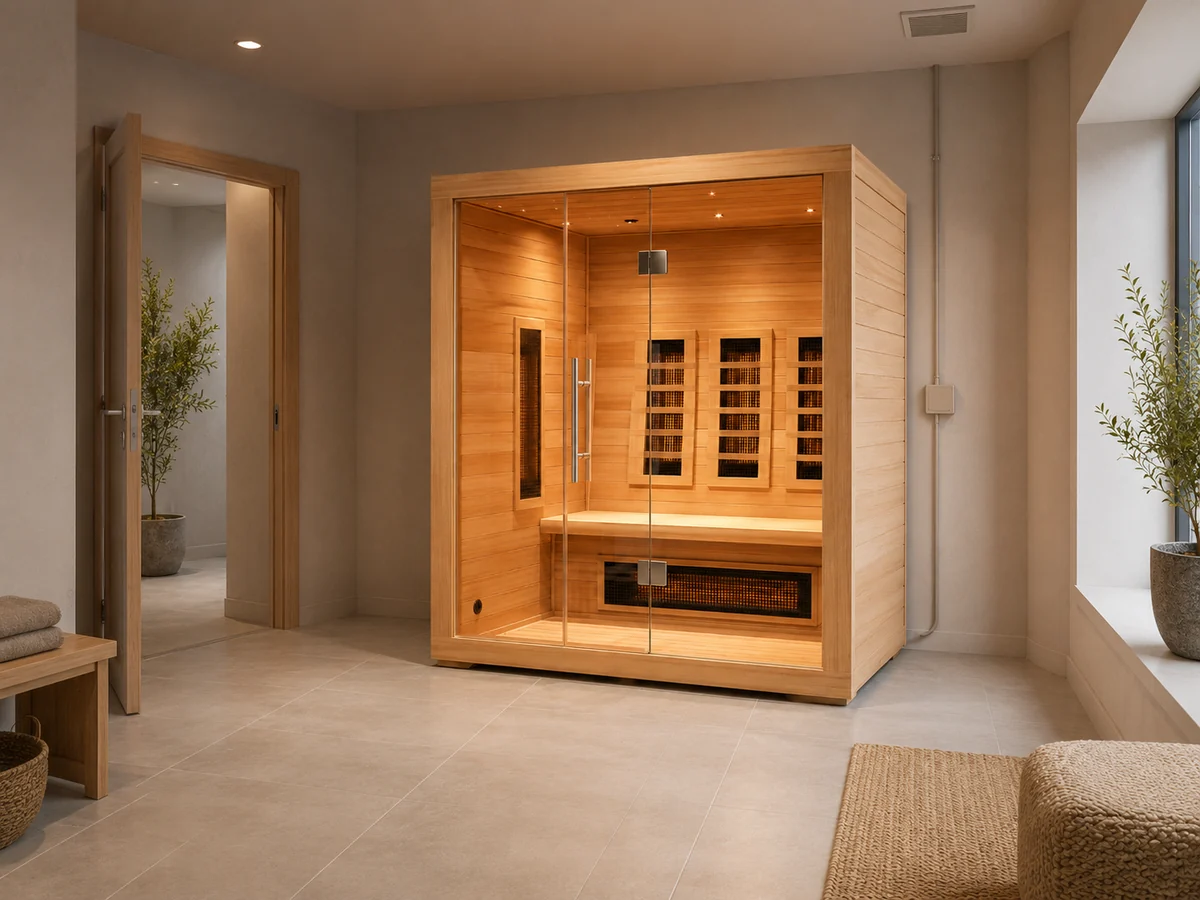
Conceptual site-planning visualization; final electrical design, clearances and installation must follow the selected model documents and local professional review.
Location and access
Confirm the installation country, indoor or outdoor environment, finished room dimensions, floor condition, surrounding moisture, delivery route, stair and doorway dimensions, assembly space and access for later component replacement.
An indoor cabin should not be assumed to be suitable for outdoor exposure. For indoor projects, review suitable indoor sauna options at category level, then confirm the exact model and site conditions.
Electrical supply
Rated power is not a complete electrical specification. The project still needs supply voltage, frequency, phase, connection method, circuit and isolation requirements, overcurrent protection, conductor selection, grounding or earthing provisions and local installation responsibility. The current consolidated IEC 60335-2-53 contains particular safety requirements for sauna heating appliances and infrared cabins within its scope. Its relevance does not prove that a quoted model complies with the standard, and it does not replace the selected model instructions or destination-market electrical review.
Ventilation and surrounding environment
Review the manufacturer’s intended inlet and exhaust arrangement, surrounding-room ventilation, ambient temperature, nearby wet areas, cleaning moisture, service access and heat-sensitive finishes.
Site and Utility Screening Checklist
- Installation country and project location
- Residential or commercial venue
- Indoor or outdoor environment
- Available floor area and ceiling height
- Delivery route and doorway dimensions
- Floor condition and level
- Nearby moisture or wet-area exposure
- Available voltage, frequency and phase
- Dedicated electrical supply
- Surrounding-room ventilation
- Cabin service clearance
- Local electrical, building and fire review
What Changes for Commercial Infrared Sauna Use?
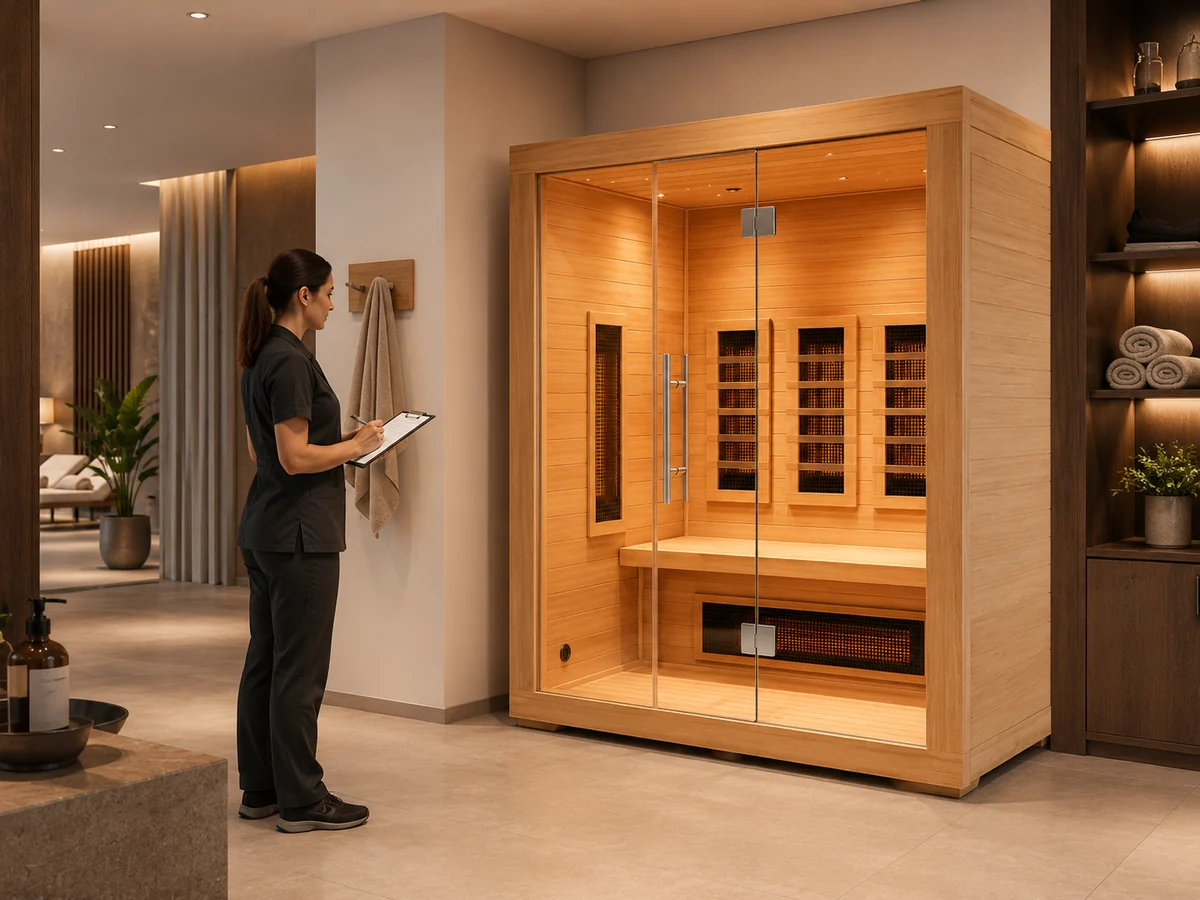
Conceptual commercial scene; not a documented customer project, approved operating procedure or verified HACHILL installation.
Commercial suitability cannot be inferred from cabin size, appearance or a residential capacity label. Confirm the intended sessions per day, user turnover, staff control, cleaning access, inspection route, replaceable components and spare-parts support for the exact model.
| Decision area | Residential use | Commercial use |
|---|---|---|
| Operating pattern | Lower-frequency personal use | Repeated sessions and peak periods |
| Control access | Owner-operated | Staff control or restricted settings may be required |
| Cleaning and inspection | Household routine | Defined turnover, inspection and record procedures |
| Serviceability | Occasional maintenance | Faster component access and spare-parts support are important |
| Model suitability | Confirmed for household use | Must be confirmed for the intended commercial duty |
What Evidence Should Buyers Request Before Quotation or Purchase?
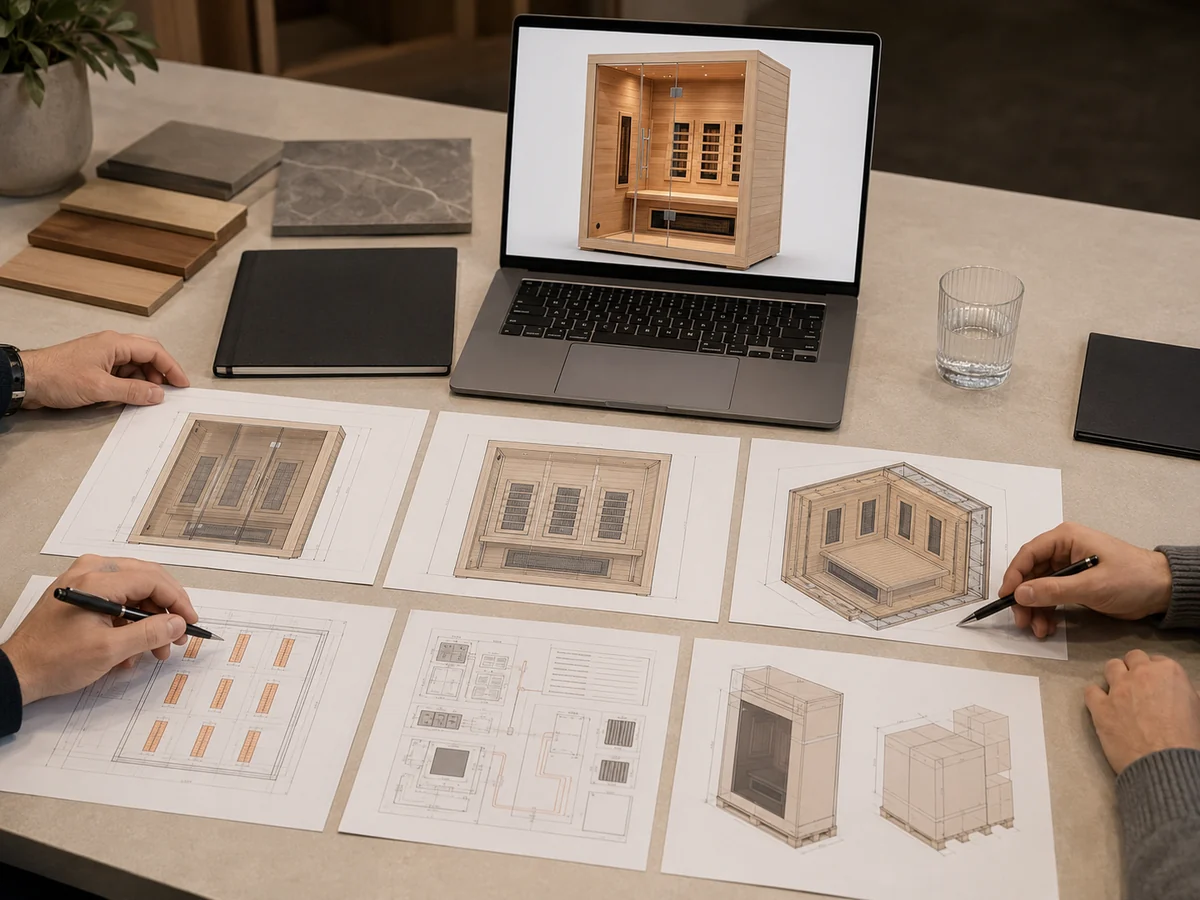
Conceptual procurement scene; documents are illustrative and do not represent an actual HACHILL model, certificate or test report.
Before comparing quotations, request enough model-level evidence to verify that each supplier is describing the same type of product and market configuration.
- Exact model and approved configuration
- Dimensioned external and internal drawing
- Emitter layout and controlled zones
- Electrical rating and connection requirements
- Installation, ventilation and clearance instructions
- Material and finish schedule
- Manuals, inspection scope and applicable destination-market documents
- Spare-parts and after-sales boundary
For OEM or private-label work, connect sample approval to a controlled drawing and configuration revision. A brochure, generic certificate or visible finish should not replace model-level approval documents.
Common Infrared Sauna Buying Mistakes
- Comparing only wavelength labels: far infrared and full spectrum do not show complete emitter layout or cabin behaviour.
- Comparing only total wattage: total power does not show where energy is directed or whether the electrical route matches the site.
- Treating capacity as a complete specification: cabins with the same label may differ materially in usable space and panel coverage.
- Ignoring panel position: rear, side and lower-leg emitters do not serve identical body positions.
- Assuming indoor and outdoor products are interchangeable: weather exposure changes the complete product and installation requirement.
- Accepting generic certificates: supplier or component documents do not automatically prove the selected complete model.
- Using a residential product for commercial duty without review: repeated use, cleaning and service expectations require model-level confirmation.
- Approving a sample without configuration control: visible appearance does not lock the emitter, controller, wiring, finish or packaging.
- Ignoring delivery access: a cabin that fits the finished room may not pass through the entrance, stair or lift route.
Illustrative procurement scenarios
Full-spectrum label: A distributor selects a cabin mainly because of the label. The correction is to request the emitter schedule, internal elevations and exact approved configuration.
Electrical mismatch: A quotation lists total power but not voltage, frequency, phase, connection method or local protection. The prevention is a required electrical checklist before PO release.
Commercial-use mismatch: A residential cabin is proposed for repeated daily use without reviewing duty cycle, cleaning, control access or spare parts. The project must return to model selection.
OEM version control: A sample appearance is approved without locking the panel layout and control components. Sample approval should be linked to a controlled drawing and configuration record.
These are illustrative composite situations and do not represent named customer projects.
What to Include in an Infrared Sauna Enquiry
Once the product route is clear, a useful enquiry should identify the exact conditions that affect model selection rather than relying only on a person-capacity label.
- Destination market and intended residential or commercial use
- Available room, doorway and delivery dimensions
- Expected users and operating frequency
- Indoor or approved outdoor installation environment
- Known voltage, frequency, phase and local installation responsibility
- Required controls, finishes, documentation, branding or packaging scope
Next action: Use those inputs to compare exact models and, when ready, request a model-level quotation.
Request an Infrared Sauna QuotationKey Takeaway for Buyers
An infrared sauna is an emitter-based radiant-heating cabin, and the product is only a good fit when the intended experience, seated-body coverage, cabin geometry, controls, electrical market, site conditions, operating frequency and model-level evidence align. Do not choose a model from a spectrum label, panel count, person-capacity claim or generic certificate alone.
Frequently Asked Questions
Does an infrared sauna heat the air?
Yes. Infrared emitters transfer radiant energy toward users and surfaces, but emitter surfaces and warmed interior materials also transfer heat to the air.
Is an infrared sauna the same as a traditional sauna?
No. An infrared sauna relies on emitters positioned around the cabin, while a traditional sauna is built around a sauna heater and the heated room environment, including stones where applicable. The two systems should be compared as different heating architectures rather than as the same sauna at different temperatures.
Is far infrared automatically better than other infrared types?
No. Compare emitter construction, position, coverage, controls, user distance, enclosure design and model-level evidence.
What does full-spectrum infrared sauna mean?
It generally describes a cabin marketed as using emitters associated with more than one infrared band. Request the actual configuration and technical evidence.
How many infrared panels should a sauna have?
There is no universal correct number. The required arrangement depends on panel size, emitter construction, cabin dimensions, seating positions and distance.
Can person capacity be used to compare infrared saunas?
Not by itself. Capacity should be checked against usable internal dimensions, bench space, user position and panel coverage.
Can a residential infrared sauna be used commercially?
Only when the selected model is confirmed for the intended commercial operating pattern, cleaning routine, control requirement and service scope.
What electrical information should be confirmed before ordering?
Confirm voltage, frequency, phase, rated input, connection method, required circuit and protection arrangements, grounding or earthing provisions, and who is responsible for the local electrical design and connection. Final requirements must follow the selected model documents and applicable local rules.
Evidence and Safety Boundary
Model-specific specifications, certifications, electrical configuration, commercial suitability and performance must be verified against the approved product documents and destination-market requirements.
General infrared and thermal-exposure statements should remain aligned with authoritative sources such as ICNIRP; product-specific claims require the selected model documents.
Official reference direction
- ICNIRP infrared overview — infrared bands and thermal exposure context.
- IEC 60335-2-53:2011+A1:2017+A2:2021 — particular safety requirements covering sauna heating appliances and infrared cabins within the standard’s scope.
HACHILL product-family and decision routes
Selection control: Do not approve an infrared sauna from a product-family description alone. The quotation should identify the selected model, approved configuration, drawing revision, electrical route and document scope.
Final selection limitation: The correct configuration depends on actual users, use frequency, installation environment, climate, available space, electrical supply, ventilation, delivery access, destination-market requirements, local regulations and confirmed manufacturer data.
Health and safety limitation: This content does not provide medical advice and does not claim that an infrared sauna diagnoses, treats, cures or prevents disease. People with health conditions or circumstances that may affect heat tolerance should seek advice from a qualified healthcare professional. Electrical, structural, ventilation, fire and commercial-facility requirements must be reviewed by appropriately qualified local professionals.