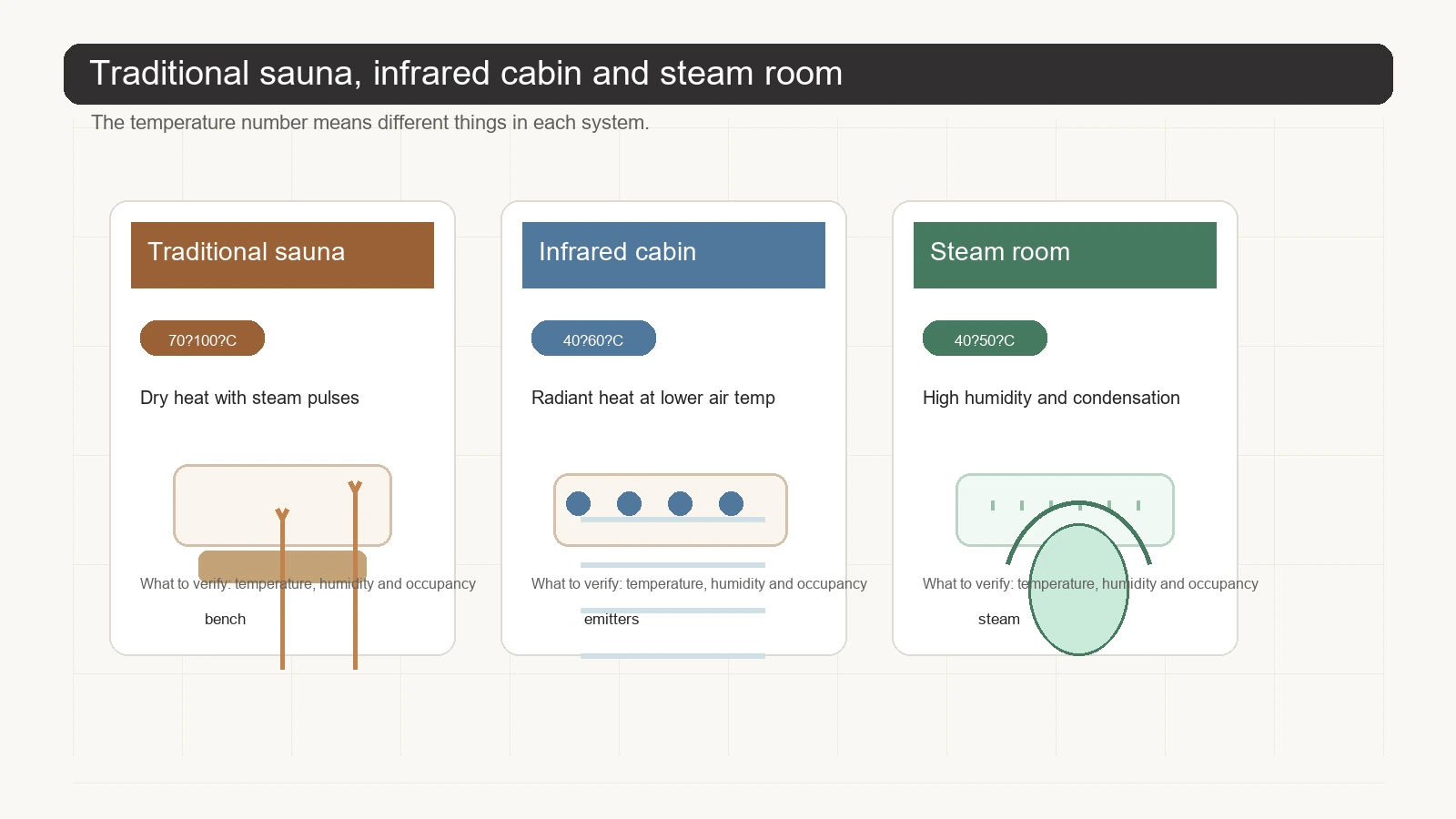
Direct answer: A traditional sauna commonly operates around 70–100°C (158–212°F), while an infrared cabin commonly uses a lower air temperature of about 40–60°C (104–140°F). Those are reference ranges, not universal setpoints. Traditional saunas can also be operated at lower temperatures, especially when the user prefers more humidity from water on the stones. A steam room is not a sauna; it uses much lower air temperature together with very high humidity, so its temperature should not be compared directly with a dry or Finnish-style sauna.
The number also depends on where and how it is measured. Air near the ceiling or a control sensor can be hotter than the occupied zone at the upper bench, and the lower bench can be cooler again. For equipment selection or project acceptance, record the sauna type, measurement location, room state, humidity or water-on-stones condition, and the approved heater/control limits before deciding whether a reading is normal.
Compare the Heat Environment Before Comparing Temperature
| Environment | Main heat route | What changes the experience | Common comparison error |
|---|---|---|---|
| Traditional sauna | Hot air, heated surfaces and sauna stones | Air temperature, bench height and short humidity pulses from water on stones | Treating one thermometer reading as the whole room |
| Infrared cabin | Radiant emitters plus warmed room air | Emitter layout, distance, control strategy and air temperature | Assuming lower air temperature means proportionally lower heat exposure |
| Steam room | Steam and high-moisture air | Very high humidity, surface condensation and generator control | Treating it as a humid version of a traditional sauna |
| Hybrid sauna | Mode-dependent combination | Which heating mode is active and how that system is approved to operate | Combining maximum settings from different modes |
A traditional electric sauna and a wood-burning sauna can occupy a similar temperature range, but their control methods are different. An electrically controlled system may use a dedicated temperature sensor, controller and high-limit protection, while a wood-burning heater is managed through firing rate, airflow and the heater/chimney installation. Do not transfer sensor or control instructions from one heater type to another.
Steam rooms are included here only as a comparison because users often group them with saunas in search. From an engineering standpoint, the enclosure, moisture load and control method are different enough that steam-room temperature should not be used to judge traditional-sauna or infrared performance.
Typical Sauna Temperature Ranges by Type
The ranges below are useful for orientation, but they are not universal operating requirements. Manufacturer instructions, product listing or certification conditions, local rules, user policy and the exact measurement point can impose a different limit.
| Type | Typical air-temperature reference | How to interpret it | Verify before setting |
|---|---|---|---|
| Traditional sauna | About 70–100°C / 158–212°F | Common Finnish-style reference band; lower-temperature operation is also possible, especially with more water on the stones and a large stone mass | Heater/control limits, sensor arrangement, ventilation and local requirements |
| Infrared cabin | About 40–60°C / 104–140°F | Air can be cooler because radiant emitters transfer energy directly toward occupants and surfaces | Cabin manual, emitter layout, controller range and intended seating position |
| Steam room (comparison only) | Often around 43–49°C / 110–120°F in commercial steam-bath controls | Much higher humidity makes the environment fundamentally different from a sauna | Steam-generator/control manual and local requirements |
| Hybrid system | No single universal range | Temperature depends on the active heating mode and approved sequence | Exact model documentation and control logic |
Harvia’s current guidance illustrates why a single “ideal” traditional-sauna temperature is misleading: it describes high-temperature sauna use around 80–100°C and also lower-temperature use around 50–60°C with more water on the stones. That is a useful reminder that the preferred sauna experience is a combination of heat, humidity and user preference rather than one fixed number.
For a global B2B specification, avoid promising the top of a typical range until the destination market and exact heater/control package are known. A product can be capable of a broad thermal range while its approved installation or local rules impose a lower operating ceiling.
Where You Measure Temperature Changes the Answer
| Location | What it tells you | What to record | Main error to avoid |
|---|---|---|---|
| Control sensor | What the control system is using for equipment logic | Approved position, displayed value and heater state | Assuming it equals the temperature at every bench |
| Upper-bench head zone | A practical occupied-zone reference | Height, distance from heater and stabilized room state | Moving the test point between comparisons |
| Lower-bench or foot zone | How strong vertical stratification is | Same time and instrument method as the upper reading | Ignoring a large upper-to-lower difference |
| Door, inlet or exhaust area | Evidence of leakage or local airflow effects | Door condition and ventilation state | Calling a local cool stream the room average |
| Touch surface | Surface condition rather than air temperature | Material, exact point and suitable surface instrument | Using an air thermometer to judge a contact surface |
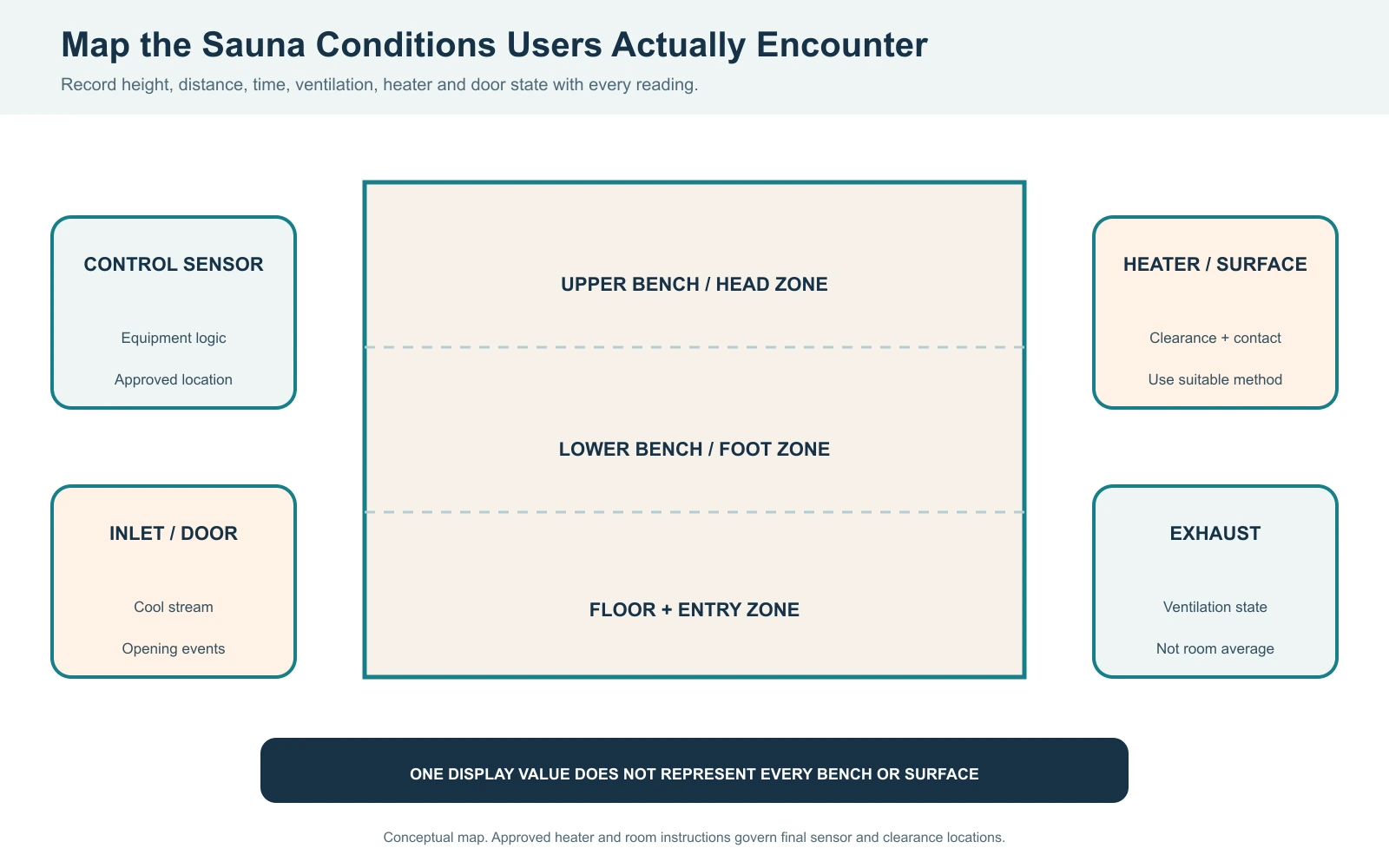
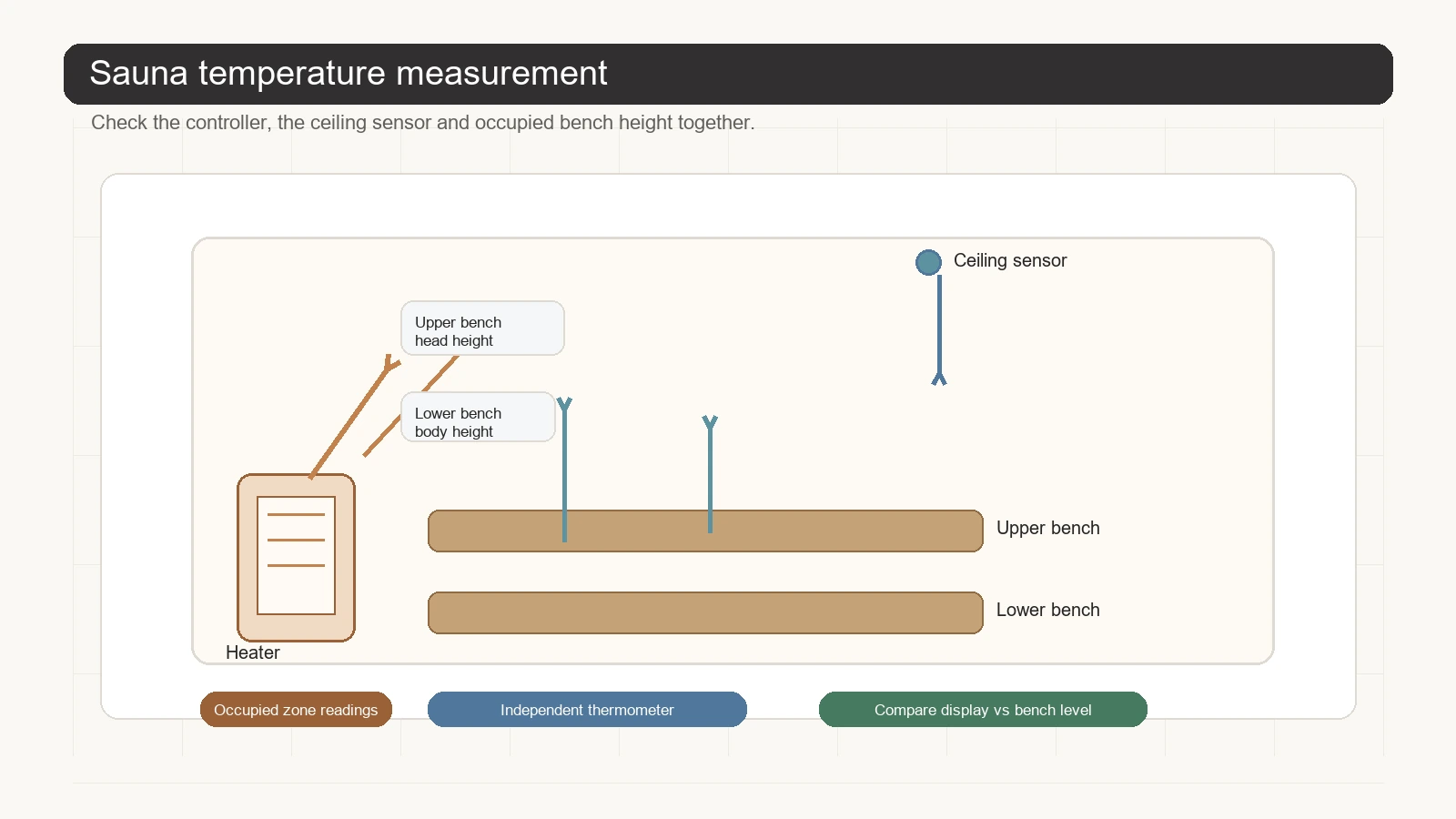
Use an instrument that is suitable for the expected temperature and for the type of measurement being made. For repeated commissioning or troubleshooting tests, identify the instrument, keep the test points fixed and record door openings, ventilation mode and heater operation on the same time basis.
Control-Sensor Temperature and Bench Temperature Are Not the Same Thing
Hot air stratifies, so readings generally increase with height. A sensor near the ceiling can therefore read higher than an independent thermometer positioned in the occupied zone. Door opening, supply-air location, heater position and room geometry can widen or narrow that difference.
For an electrically controlled sauna, the manufacturer’s specified sensor location is part of the equipment configuration. Do not move the control or high-limit sensor simply to make its reading match a handheld thermometer. Instead, compare the controller display with independent readings taken at declared occupied-zone points, then check the sensor position against the exact heater/control instructions.
For a wood-burning sauna, there may be no electronic room-control sensor at all. Temperature interpretation then relies more heavily on a stable thermometer location, the firing condition, room airflow and the bather’s selected heat and löyly pattern. This is another reason a “normal sauna temperature” cannot be separated from sauna type.
Room Volume Starts Heater Selection, but Heat Load Finishes It
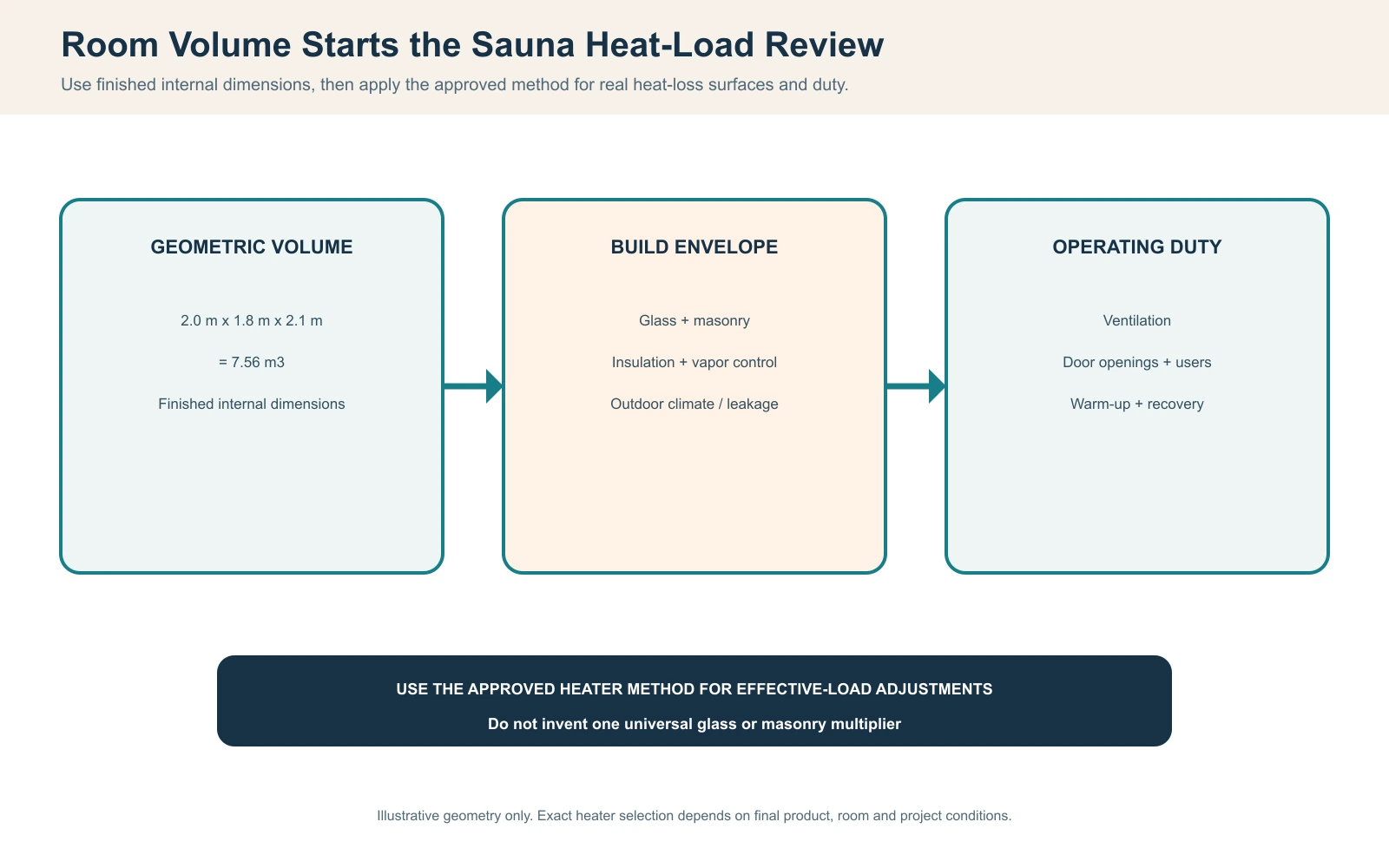
For a rectangular sauna, geometric volume is calculated from the finished internal length × width × clear height. For example, a 2.0 m × 1.8 m × 2.1 m room has a geometric volume of 7.56 m³. The arithmetic is universal; the heater-selection correction method is not.
Large glass areas, masonry or other uninsulated surfaces, outdoor winter conditions, unintended leakage, ventilation and frequent door opening can increase the effective thermal duty. Heater manufacturers may use their own methods to account for these conditions. Use the method supplied for the heater under consideration rather than inventing a universal glass-area multiplier or kW-per-cubic-metre rule.
| Input | Example | Why it matters | Boundary |
|---|---|---|---|
| Internal length | 2.0 m | Geometric room volume | Use finished internal dimension |
| Internal width | 1.8 m | Geometric room volume | Do not use exterior footprint |
| Clear height | 2.1 m | Volume and vertical heat distribution | Unusually high ceilings can affect useful heat at bench level |
| Geometric volume | 7.56 m³ | Initial heater-selection input | Not the final selection by itself |
| Glass/uninsulated area | Measure actual area | Can raise heat loss | Use heater-specific adjustment method |
| Climate, ventilation and door duty | Project-specific | Affects warm-up and recovery | Must reflect real operating conditions |
Why the Same Heater Can Produce Different Room Temperatures
A sauna stabilizes when the heat delivered to the room balances the heat being lost through the enclosure, glazing, ventilation and door openings. Heater output is therefore only one part of the result.
Glazing and uninsulated surfaces increase heat loss
Two rooms with the same internal volume can behave differently if one has a large glass front or more exposed masonry. This can lengthen warm-up and reduce recovery margin. Final room drawings are more useful for heater selection than person capacity alone.
Ventilation changes both comfort and thermal duty
Ventilation is necessary, but the airflow path matters. Excessive airflow or a short route from the inlet to the exhaust can remove heat before it reaches the occupied zone. Closing vents blindly is not a safe troubleshooting method. Check the ventilation arrangement required by the exact heater/system and the final room design.
Outdoor conditions can change the same sauna’s performance
An outdoor sauna tested in mild weather may behave differently in winter because the starting temperature and enclosure losses change. A buyer comparing warm-up claims should therefore ask for the ambient condition, starting room temperature and final construction behind the test.
Commercial recovery is different from initial warm-up
A hotel or gym sauna may reach its target before opening and still lose occupied-zone temperature after repeated door cycles. That is a recovery-duty issue. Raising the controller setpoint does not fix an undersized heater, excessive heat loss or poor airflow distribution.
Heater, Controller, Sensor and High-Limit Protection Must Be Treated as One System
This section applies primarily to electrically controlled traditional saunas and infrared cabins. The exact sensor position, controller range and protective devices are model-specific.
Do not treat sensor location as a universal industry dimension
Manufacturers specify sensor locations to match their own heater and control logic. A position used by one brand or model should not be copied to another system unless the documentation explicitly permits it. Record the approved location on the installation drawing and verify it during installation.
Do not use maximum setpoint as the design temperature
The highest selectable value on a controller is not proof that the occupied zone should be operated at that value or that the room can maintain it under real duty. Normal operating temperature should be chosen within the equipment’s approved range and verified under the actual room conditions.
Stop and investigate abnormal protective operation
Repeated high-limit trips, a damaged sensor cable, burning odor, abnormal discoloration near the heater, or a large unexplained disagreement between the control display and an independent instrument should trigger investigation. Do not bypass a protective device or repeatedly reset it without identifying the cause. Electrical work and safety-device diagnosis should follow the equipment instructions and applicable local requirements.
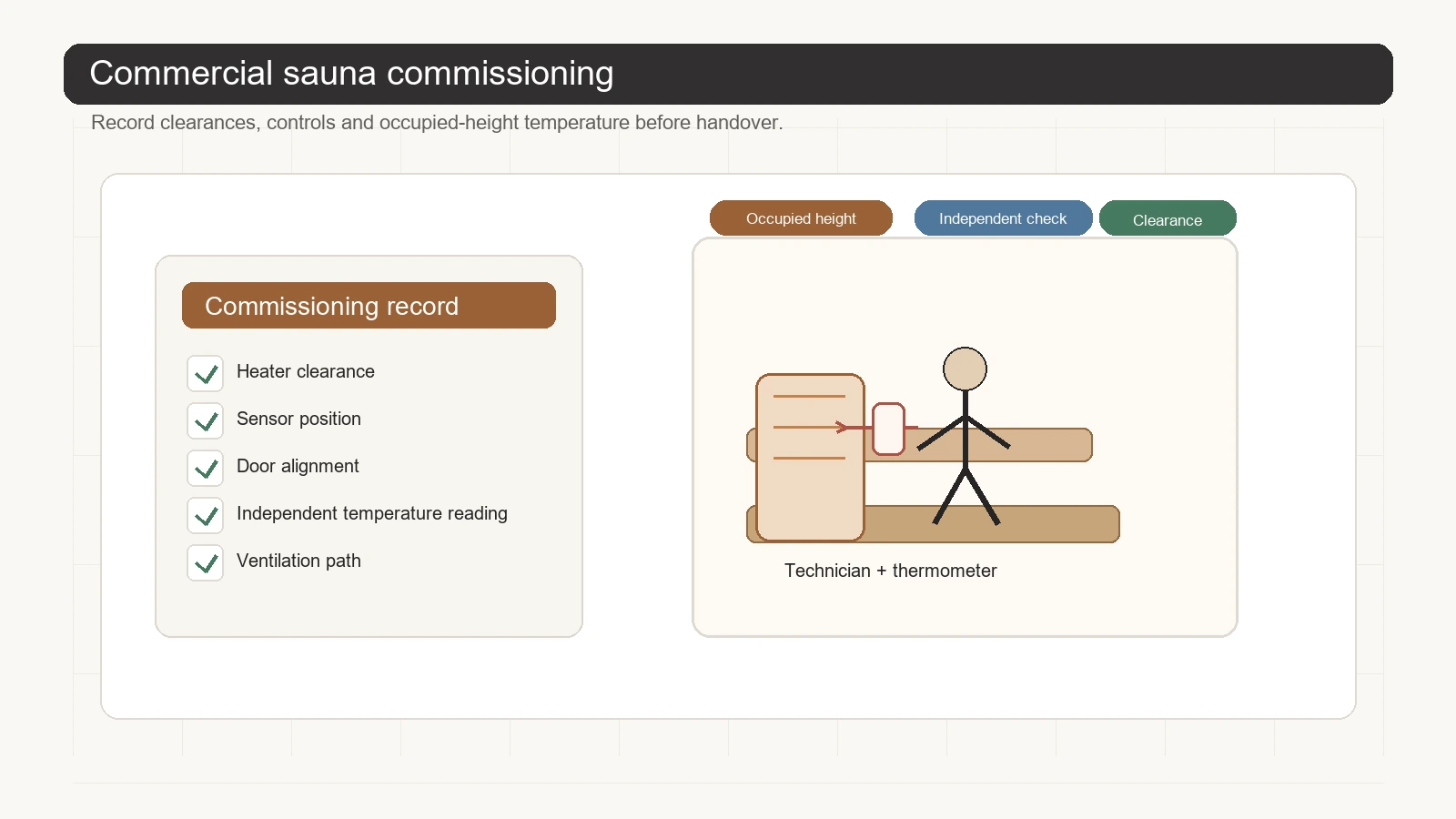
For Project Acceptance, Test Warm-Up, Stable Holding and Recovery Separately
A single stabilized reading can answer “how hot is it now?” but it cannot prove that a commercial sauna will recover between users or that it met the required warm-up window. B2B projects should separate the three duties.
| Test | Define before testing | Record | Main question |
|---|---|---|---|
| Warm-up | Starting ambient/room condition and target band | Elapsed time, controller, occupied-zone readings and heater state | Does the room reach the declared operating condition? |
| Stable holding | Target band, ventilation and door condition | Temperature trend, heater cycling and alarms | Can the room hold the condition without abnormal operation? |
| Occupied recovery | Representative door/user sequence | Upper/lower bench readings and recovery interval | Can the room recover at the intended use frequency? |
| Record | Why it matters | Do not omit |
|---|---|---|
| Starting condition | Separates cold-start performance from a preheated room | Ambient and room temperature |
| Measurement points | Makes repeat testing comparable | Height, location and instrument |
| Door/ventilation state | Changes room heat loss and airflow | Openings, fan mode and major door events |
| Heater/control state | Shows whether the system is cycling or continuously calling for heat | Setpoint and observed operating state |
| Final disposition | Separates observation from acceptance | Accept, correct or retest |
Why a Sauna May Not Reach the Expected Temperature
If a sauna is too cool, first determine whether the problem is the displayed value, the occupied-zone temperature, the warm-up time or the recovery performance. Those symptoms point to different checks.
| Symptom | Possible cause | What to check | Corrective direction |
|---|---|---|---|
| Controller reaches setpoint but benches feel cool | Sensor is in a hotter local zone or airflow bypasses the occupied zone | Fixed upper/lower bench readings, sensor position and airflow path | Correct verified installation or airflow cause within manufacturer instructions |
| Room warms very slowly | High heat loss, cold outdoor start, heater/load mismatch or supply issue | Final room volume, glazing, insulation, ambient condition, heater operation and electrical supply | Correct load, envelope or equipment issue rather than simply increasing setpoint |
| Temperature drops after repeated door openings | Insufficient recovery margin for commercial duty | Door-use sequence, heater cycling, ventilation and occupied-zone trend | Review duty, room losses and heater selection |
| Large upper-to-lower temperature difference | Strong stratification or ineffective airflow distribution | Bench heights, ceiling height and ventilation path | Review room geometry and approved ventilation arrangement |
| Repeated high-limit trip | Potential sensor, airflow, installation or equipment fault | Exact equipment instructions and qualified technical inspection | Stop repeated resets; correct the verified cause |
Choose the Operating Temperature from the Sauna Type and Use Case
For a private traditional sauna, the preferred temperature may be selected within the approved equipment range based on the desired balance of heat and löyly. For infrared, the cabin’s emitter design and intended seating position matter more than trying to reproduce a traditional-sauna air temperature.
Commercial projects have an additional question: can the room hold and recover the declared operating band under the actual door-opening and occupancy schedule? The answer should come from room and equipment data plus representative commissioning, not from the controller’s maximum setting.
Before a B2B order or project specification is frozen, confirm the sauna type, finished internal dimensions, glass/uninsulated surfaces, installation location, climate, ventilation concept, intended duty, heater or emitter configuration, electrical context and destination market. These inputs determine whether a temperature requirement is realistic for the final system.
Use the Right Evidence for Temperature Claims
| Evidence | Best use | Important boundary |
|---|---|---|
| Applicable code, standard or authority requirement | Jurisdiction-specific safety boundary | Only apply it where the market and scope match |
| Exact heater, controller or infrared-cabin manual | Setpoint range, sensor position, protective devices and installation requirements | Manufacturer/model-specific, not a universal sauna rule |
| Final room drawings and project specification | Heat-load and acceptance basis | Must match the built room |
| Repeatable mapped measurements | Commissioning and troubleshooting | Valid only for the recorded room state and measurement method |
| Display photo or subjective comfort report | Initial observation | Insufficient by itself for engineering acceptance |
IEC 60335-2-53 is relevant to the safety of electric sauna heating appliances and infrared cabins, but it should not be cited as though it defines one universal “ideal sauna temperature.” Likewise, a single heater manufacturer’s sensor or ventilation instruction should remain attributed to that equipment unless a higher-level requirement clearly applies.
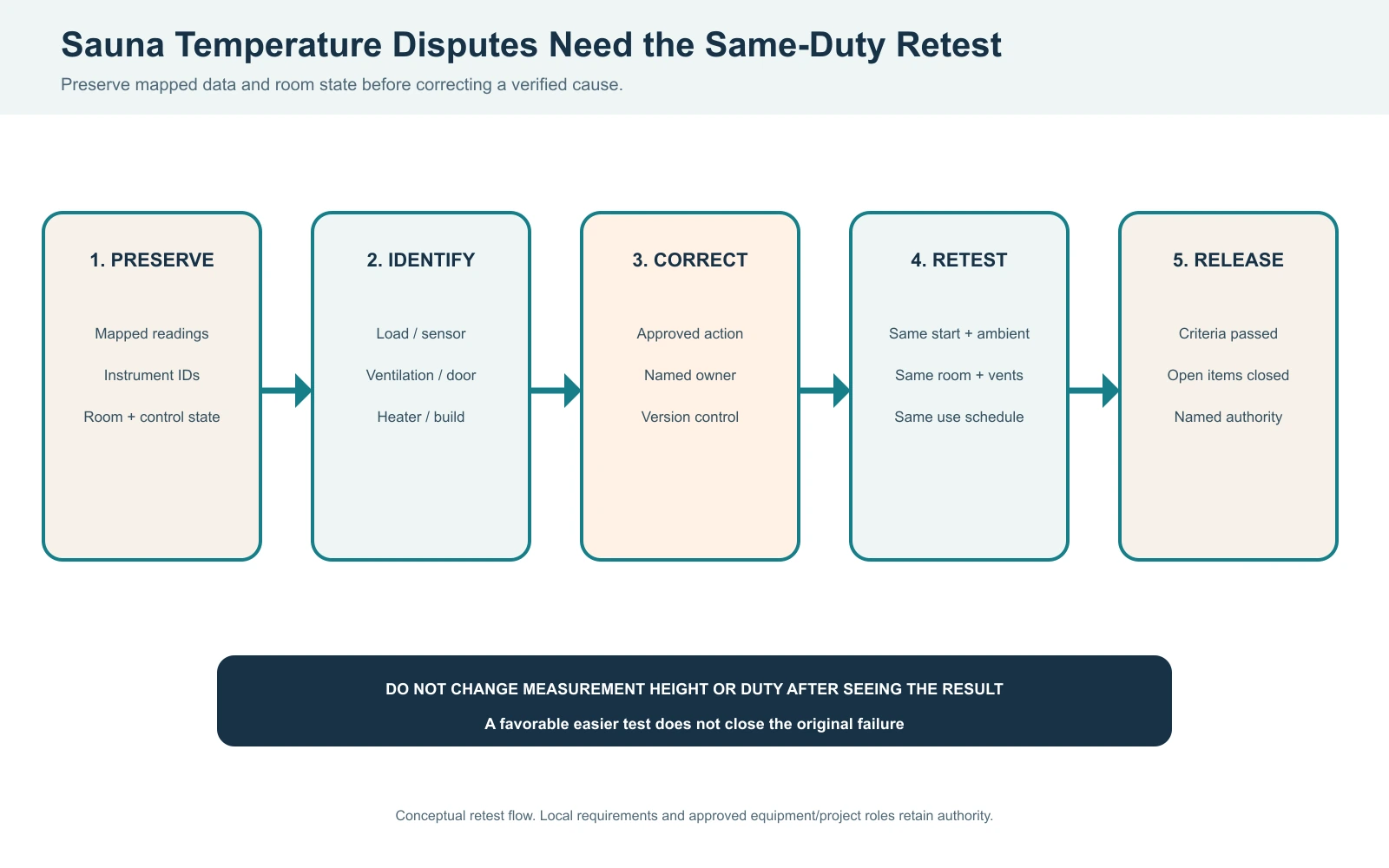
If Temperature Performance Is Disputed, Retest the Same Condition
Preserve the original readings before changing the setup. A valid retest should keep the measurement positions, instrument method, starting condition, ventilation state and representative door/use schedule consistent unless the approved corrective action intentionally changes one of those variables.
| Dispute | Preserve | Check first | Closure evidence |
|---|---|---|---|
| Display differs from occupied zone | Times, locations and instruments | Approved sensor position and fixed comparison points | Repeatable same-point comparison |
| Slow warm-up | Starting ambient, room condition and temperature trend | Heat load, heater operation and supply | Same-start retest after correction |
| Poor recovery | Door/use events and upper/lower readings | Commercial duty and thermal losses | Same representative schedule retest |
| Protective trip or alarm | Original alarm state and room condition | Manufacturer troubleshooting and qualified inspection | Approved technical release after cause is corrected |
Frequently Asked Questions
What temperature should a traditional sauna be?
A common reference range is about 70–100°C (158–212°F), but there is no single correct setpoint. Some traditional saunas are used at lower temperatures with more water on the stones. Stay within the heater/control limits and any local requirements, and compare temperatures at a declared measurement point.
Is 90°C (194°F) too hot for a sauna?
90°C is within the high end of common traditional-sauna practice, but that does not make it an appropriate target for every sauna, market or user. The exact equipment limits, humidity condition, measurement position and operating policy matter. Do not override controller or high-limit protection to reach a number.
Why is an infrared sauna cooler than a traditional sauna?
Infrared cabins use radiant emitters to transfer energy toward occupants and surfaces, so they can operate with lower room-air temperature. A common air range is about 40–60°C (104–140°F), but the exact range should come from the cabin and control documentation.
Where should sauna temperature be measured?
For equipment control, use the manufacturer’s specified sensor location. For independent room evaluation, keep a fixed occupied-zone point such as upper-bench head height and, when troubleshooting, add a lower-bench reading to show stratification. Do not relocate the control sensor merely to match a handheld thermometer.
Does pouring water on sauna stones raise the air temperature?
Water on properly heated sauna stones creates a short humidity pulse (löyly). The thermometer may not rise and can even fluctuate, but the increased moisture can make the heat feel more intense. Follow the heater instructions for appropriate water use and never pour water on equipment that is not designed for it.
Why does my sauna reach the setpoint but still feel cool?
The control sensor may be reading a hotter part of the room than the occupied zone, or heat may be bypassing the benches through airflow or excessive room losses. Compare fixed upper- and lower-bench readings, verify the approved sensor position and review ventilation and the final enclosure before increasing the setpoint.
Related HACHILL Resources
Compare HACHILL sauna categories
Start here when the project has not yet been narrowed to an indoor, outdoor, traditional or infrared route.
Review indoor traditional saunas
Use this route when the project requires a heater-and-stone traditional sauna rather than infrared heating.
Review indoor infrared saunas
Use this route when lower-air-temperature radiant heating is the intended indoor system.
Compare sauna, infrared and steam systems
Use the system-comparison guide when the decision is broader than temperature and also includes room construction, utilities and maintenance.
Discuss a sauna project specification
Send the room, market, quantity, heating type and available site information when a project needs model selection or quotation review.
Reference Basis
- Harvia: What is the correct sauna temperature? — Manufacturer guidance showing that traditional sauna comfort can span both higher-temperature and lower-temperature use rather than one universal ideal setpoint.
- Harvia: sauna buying guide — Manufacturer reference for commonly stated traditional-sauna and infrared-cabin air-temperature ranges.
- Finnish Sauna Society: Sauna Knowledge — Context for Finnish sauna practice, löyly and sauna-use terminology.
- IEC 60335-2-53 consolidated version — Safety-standard scope for electric sauna heating appliances and infrared cabins; this reference is not used to claim that IEC defines a universal ideal bathing temperature.
- MrSteam control installation and operating instructions — Equipment-manual example showing steam-bath temperature control in a lower air-temperature, high-humidity environment; steam rooms are not treated as traditional saunas.
Specify the Room and Duty Behind the Temperature Requirement
For a project review, provide the sauna type, finished internal dimensions, glazing or other uninsulated surfaces, indoor/outdoor location, ventilation concept, intended commercial duty, heater or infrared configuration, available electrical context, destination market and the temperature acceptance method. These inputs are more useful than asking for a maximum temperature alone.
Request a Sauna Project Review