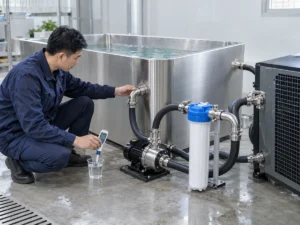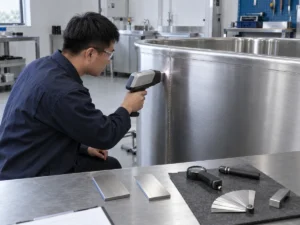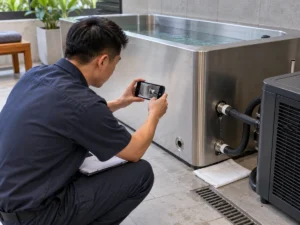
Quick answer: If an indoor cold plunge is “sweating,” first identify the water source. Condensation becomes physically plausible when the temperature of a real exposed surface reaches the dew-point condition of the surrounding room air or falls below it. Measure room air temperature and relative humidity together, determine the dew point, then compare it with the actual temperatures of the vessel exterior, cold piping, fittings, supports and other suspect surfaces. At the same time, inspect for plumbing leakage, splash and overflow; condensation can exist alongside a leak. Prevention usually requires one or both of two actions: lower the room-air dew point through appropriate moisture control, and keep critical exposed surfaces warmer through continuous, serviceable thermal control. Do not choose a universal RH target or size a dehumidifier from plunge volume alone. Verify the completed fix under representative operating conditions, including normal cooling, occupancy, nearby moisture sources and the actual ventilation/HVAC state.
Is It Condensation, a Leak, Splash or Overflow? Check the Water Source First
A wet floor does not tell you what caused the water. Before changing the room HVAC or adding insulation, separate four possible sources.
Condensation
Water vapor becoming liquid on a surface that is cold enough relative to the dew point of the surrounding air.
Leakage
Water escaping from a component intended to contain it, such as a joint or fitting.
Splash
Water moved outside the plunge during entry, exit, cleaning or normal use.
Overflow or abnormal release
Liquid water leaving the intended vessel or drainage path under an operating event.
These sources can look similar after the water reaches the floor, but they require different responses. Adding insulation will not repair a leaking union. Tightening plumbing will not lower the room dew point. A floor drain can receive liquid water, but it does not prevent a cold surface from condensing.
For the separate drainage and water-source planning task, see HACHILL’s Cold Plunge Drainage Planning guide.
Use timing and location to narrow the source
Record where the moisture first appears and what the plunge was doing at the time. A later spot check can miss the condition that produced the water.
- the exact wet location and when the moisture first appeared;
- whether the cooling/circulation system was operating;
- room air temperature and relative humidity measured together, with dew point determined when possible;
- the temperature and condition of the specific named surface being evaluated;
- whether fittings, joints or connections are visibly wet;
- whether users recently entered or exited;
- whether cleaning, drain-down or overflow occurred.
If relative humidity is used to assess condensation, pair it with air temperature. The same RH at a different air temperature does not represent the same dew point.
Diagnostic rule: Condensation being physically plausible does not establish that every drop came from condensation. A cold pipe can condense while a neighboring fitting is also leaking.
If the source is still uncertain, keep the diagnosis open rather than applying the preferred repair first.
Why Cold Plunge Condensation Happens: Dew Point vs Actual Surface Temperature
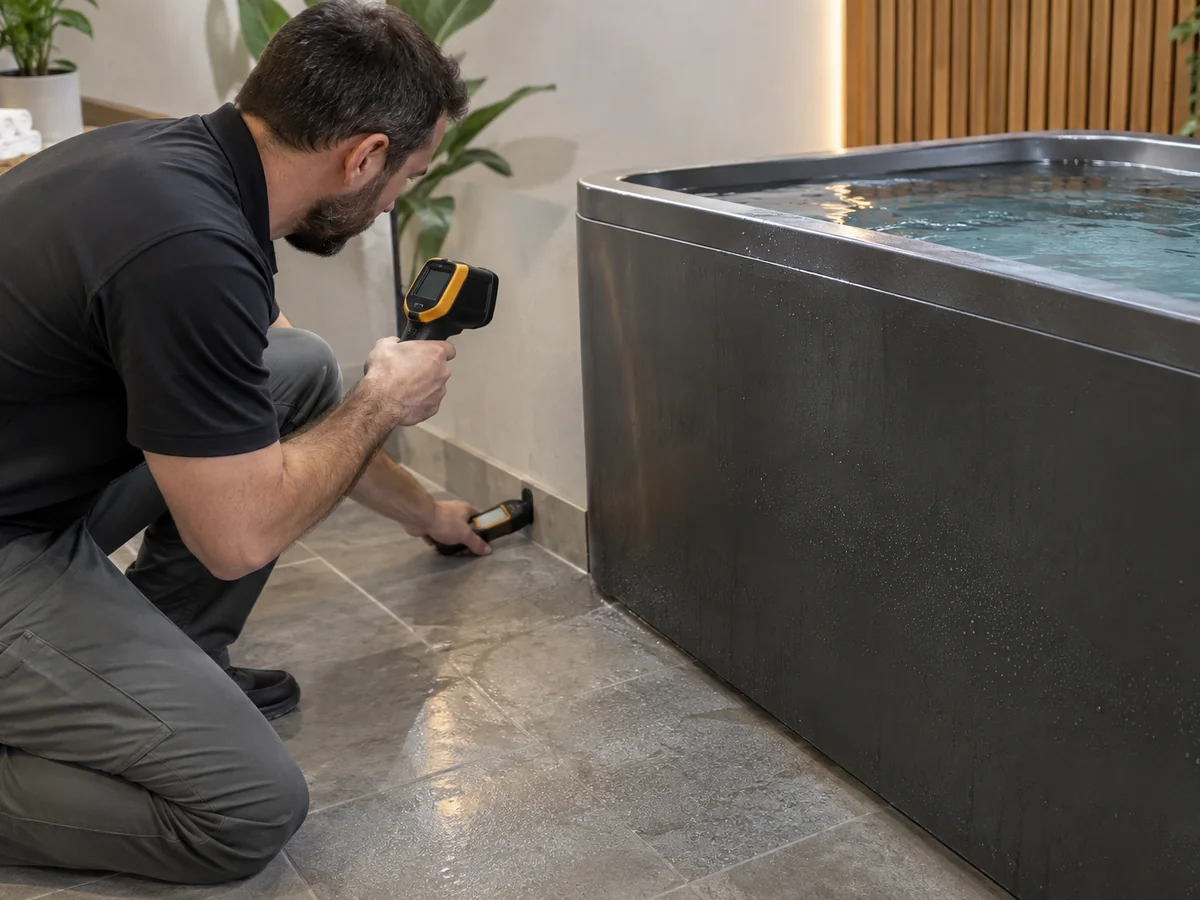
The central relationship is room-air dew point versus actual cold-surface temperature—not room relative humidity alone and not the cold-plunge water setpoint alone.
ASHRAE’s heat, air and moisture-control guidance describes surface condensation as occurring when a surface reaches the surrounding air’s dew-point condition. EPA’s building moisture-control guidance uses the same practical relationship: condensation depends on the moisture condition of the air and the temperature of the surface being evaluated.
Relative humidity is not dew point
Relative humidity and dew point both describe air moisture, but they do not mean the same thing. Relative humidity changes with air temperature. Dew point is the more direct reference for comparing the air condition with a particular cold surface.
That is why “the room is at X% RH” is not, by itself, a complete condensation assessment. Pair RH with the air temperature—or use an instrument that reports dew point—then compare that result with the actual surface being investigated. General indoor-humidity recommendations may be useful for broader moisture management, but they should not be converted into one universal cold-plunge pass/fail threshold.
The water setpoint is not the exterior-surface temperature
The controller may display one water temperature while different exterior components sit at different surface temperatures. An insulated wall, exposed fitting, pipe, metal support and service-panel surface do not necessarily have the same thermal path.
For diagnosis, identify the actual surface of interest rather than treating the entire plunge as one temperature.
Which Cold Surfaces Should You Check Around an Indoor Cold Plunge?
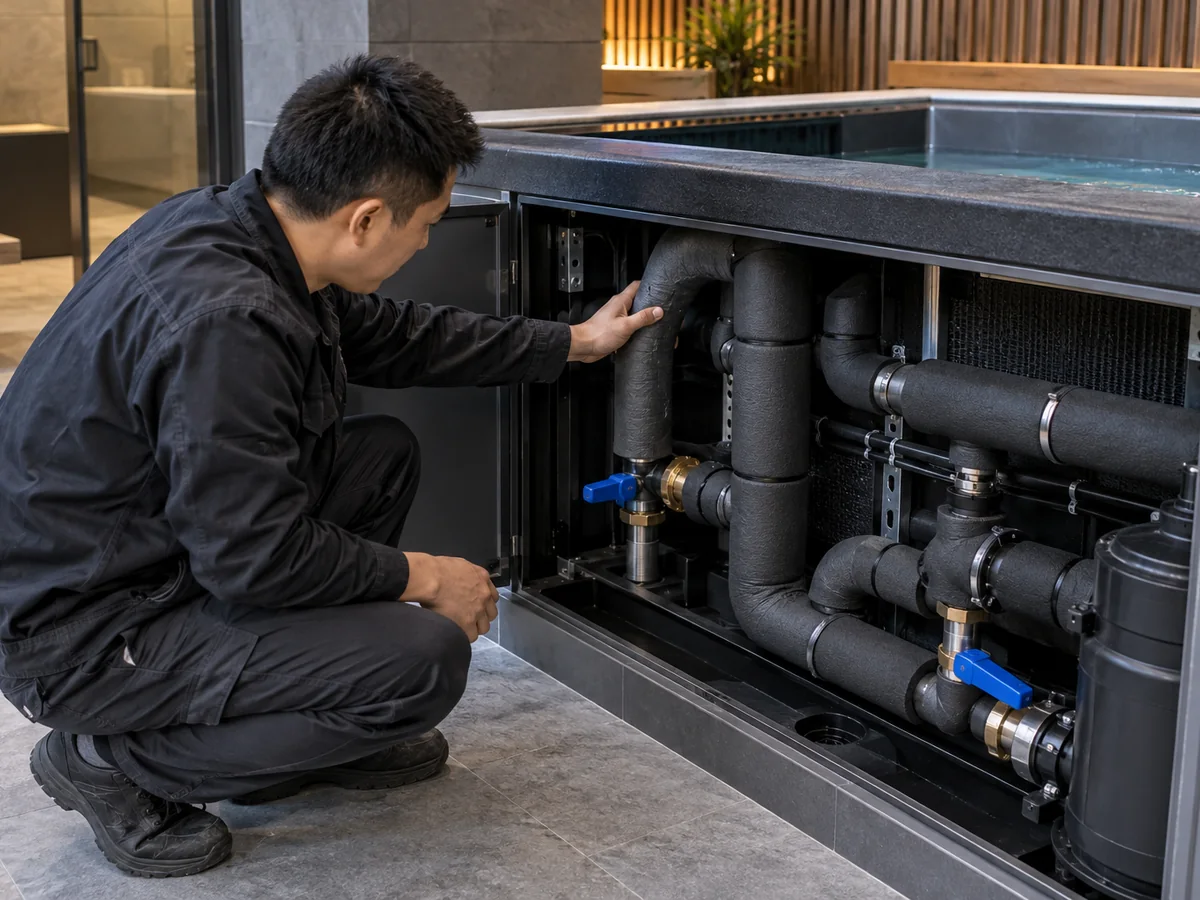
Treat the installed plunge as a network of cold surfaces, not one uniformly cold object. The exact construction is product-specific, so the list below is an inspection map—not a claim that every HACHILL model contains every component in the same arrangement.
Nearby finishes matter when repeated splash, condensation or an unresolved leak can reach a moisture-sensitive or hard-to-dry assembly.
Inspection rule: If a critical cold interface cannot be inspected, visible dryness elsewhere does not close the moisture question.
Measurement method matters too. ASHRAE’s current measurement guidance explains that infrared surface-temperature readings are affected by surface emissivity and reflected background radiation. Shiny or polished surfaces can therefore be challenging, and the instrument’s measurement area also needs to match the surface being checked. For a decision-critical surface, use a method appropriate to the material and verify a suspect reading rather than relying on one quick infrared spot value.
How to Prevent Condensation: Control the Air Side and the Cold-Surface Side
Once condensation is confirmed or strongly supported, there are two fundamental control directions: lower or control the air-side dew point and/or change the thermal condition of the cold surface. EPA’s building moisture guidance likewise treats condensation control as a coordinated air-moisture and surface-temperature problem rather than a one-number humidity rule.
Air-side control
Manage the room moisture condition so the dew point is lower relative to the relevant cold surfaces.
Surface-side control
Use appropriate thermal control so critical exposed surfaces are less likely to reach the condensation condition.
Air-side control: manage room moisture
Removing moisture from the room air can reduce its dew point. Dehumidification is one way to do that, but installing a dehumidifier is not the same as proving that the room is controlled.
The required moisture-control capacity depends on the actual room and operating conditions, not simply the number of gallons in the plunge. Relevant inputs can include room use, wet surfaces, occupancy, nearby showers or other moisture sources, outdoor-air conditions, ventilation strategy and the HVAC system’s moisture-removal responsibility.
This article therefore does not provide a universal “X-gallon plunge = Y-capacity dehumidifier” rule.
Ventilation is not dehumidification
Ventilation exchanges air. Dehumidification removes or controls moisture. They may be coordinated, but they are not interchangeable.
ASHRAE’s dedicated outdoor-air guidance is an important check against the “just add more ventilation” shortcut: outside air can add latent moisture load depending on outdoor conditions. More outdoor air helps condensation control only when the resulting air condition and HVAC response support the required indoor dew point.
Surface-side control: manage the cold surface condition
Thermal insulation can help change exterior surface temperatures by reducing heat transfer. But “add insulation” is not a complete specification.
- Is the insulation continuous?
- Are penetrations and fittings addressed?
- Are there thermal bridges?
- Are connected cold pipes included?
- Is vapor control appropriate to the assembly?
- Can the completed work still be inspected and serviced?
Prevention rule: Control the air condition, the cold-surface condition, or both—and verify the completed installation under the real operating condition.
Insulation, Vapor Control and Wet-Area Protection: What Each One Does—and Does Not Do
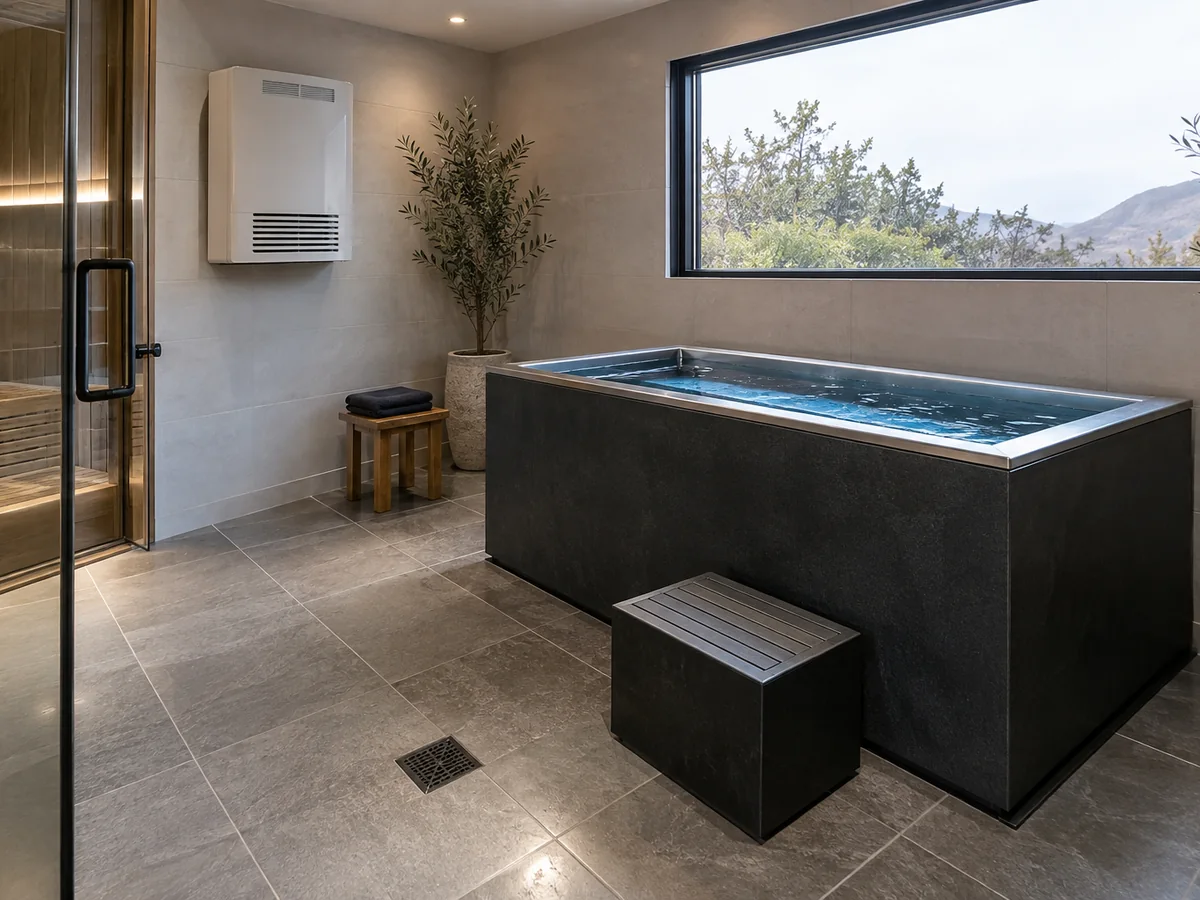
Four different controls are often mixed together in condensation discussions: insulation, vapor control, waterproofing and drainage. They solve different problems.
Insulation
Controls heat flow and can help keep the room-side surface of a cold assembly warmer.
Vapor control
Limits water-vapor transport through or around an assembly; the appropriate strategy depends on the actual construction and climate.
Waterproofing
Manages exposure to bulk or liquid water such as splash, overflow and cleaning water when specified as part of the wet-area assembly.
Drainage
Provides a route for collected liquid water where the installation is designed to receive it; it does not lower room dew point.
Insulation controls heat flow
Localized gaps can remain around joints, fittings, pipe transitions, supports, penetrations and service openings.
For a deeper look at insulation boundaries and testing logic, see HACHILL’s Insulated vs Uninsulated Cold Plunge Guide.
Vapor control is not another name for insulation
Vapor control addresses water-vapor transport through or around an assembly. Its design cannot be reduced to “put the vapor barrier on this side.”
DOE Building Science guidance explains why vapor-retarder strategy depends on climate and assembly characteristics.
Waterproofing manages liquid-water exposure
Wet-area protection can be important around a plunge because of splash, overflow, cleaning or abnormal water release.
Waterproofing ≠ condensation prevention. A properly designed wet-area assembly can manage bulk-water exposure while a separate cold pipe continues to condense.
Drainage routes liquid water
Drainage gives collected water somewhere to go. It does not change the fundamental condensation condition.
Drainage ≠ condensation control.
Hidden moisture makes access part of the design
EPA’s building moisture-control guidance highlights concealed moisture and plumbing access as important building-management issues.
- Can cold plumbing be inspected?
- Can fittings be reached?
- Can insulation transitions be checked?
- Can a service enclosure be opened?
- Can a suspected leak be distinguished from condensation?
- Can affected materials dry if they become wet?
A clean architectural enclosure is not automatically a moisture-safe enclosure if critical interfaces disappear behind permanent finishes. Service access does not prevent condensation by itself, but it makes diagnosis, drying and repair possible when something goes wrong.
Private Home vs Shared or Commercial Rooms: Why Moisture-Control Planning Changes
A private home installation and a shared commercial room should not automatically use the same moisture-control assumptions. The difference is not simply plunge size.
| Planning area | Private home | Shared / commercial room |
|---|---|---|
| Use pattern | Often fewer users and a more predictable schedule | May involve repeated use, longer operating hours and more wet traffic |
| Adjacent moisture sources | Depends on the actual room | May include showers, steam rooms, wet cleaning or other high-moisture spaces |
| Inspection responsibility | Owner / household project responsibility | Formal staff, maintenance and closure responsibilities may need definition |
| Design shortcut to avoid | Do not assume a home RH number solves every surface | Do not copy natatorium numerical design rules into a cold-plunge room without project-specific engineering |
Commercial means a different operating responsibility
A managed facility should define who inspects for moisture, investigates suspected leaks, reviews room conditions, checks service areas, coordinates HVAC/building service and can place the installation on HOLD when conditions are unresolved.
Electrical and code decisions remain project-specific
An indoor cold plunge can bring water, equipment and electrical systems into the same project. This article does not replace the exact equipment instructions, qualified trades, adopted code requirements or the local authority having jurisdiction.
For U.S. projects, NFPA 70, National Electrical Code (NEC) is a relevant code source, but the adopted edition and project applicability depend on the jurisdiction. Outside the United States, use the applicable local electrical requirements. In every market, the exact equipment instructions and qualified local trades remain part of the project-specific verification.
If the project is still deciding between an indoor and outdoor installation rather than solving a confirmed indoor-room problem, continue with HACHILL’s Indoor vs Outdoor Cold Plunge Guide.
Cold Plunge Condensation Checklist: What to Measure, Verify and Put on HOLD
Do not close the condensation question because someone installed a fan, wrapped a pipe or placed a dehumidifier in the room. Verify the conditions that actually caused the moisture.
READY
The moisture source and critical room, surface, assembly and access conditions are sufficiently understood for the current decision.
REVISE
The cause or risk is understood, but a specific room, thermal, access or wet-area condition still needs correction.
HOLD
A key input is still unknown, such as the moisture source, the condition of the relevant cold surface, how room moisture is meant to be controlled, or a project-specific requirement.
Record the project inputs that actually change the decision
| Project input | Why it matters |
|---|---|
| Room air temperature | Provides part of the air-condition basis |
| Room RH / dew point | Pair air temperature and RH—or use a direct dew-point reading—to define the air moisture condition |
| Named surface temperatures | Compare the actual suspect surfaces with the air condition and record the measurement location and method |
| Water operating condition | Provides system context but does not replace surface measurement |
| Where moisture appears | Helps distinguish condensation, leakage, splash and overflow |
| Cold-surface map | Captures vessel areas, piping, fittings and concealed interfaces |
| Insulation continuity | Identifies thermal-control gaps and transitions |
| Ventilation state | Record supply, exhaust, open doors and HVAC operating state when the moisture is observed |
| Dehumidification strategy | Defines the equipment, controls and operating responsibility intended to manage room moisture |
| Adjacent moisture sources | Captures showers and other wet-room contributors |
| Floor / wall protection | Defines the bulk-water exposure strategy |
| Inspection access | Allows concealed interfaces to be checked and repaired |
| Private vs shared use | Changes operating pattern and responsibility |
| Destination / AHJ | Determines project-specific regulatory requirements |
Decision rule: If the moisture source, air condition or relevant surface condition is still unknown, keep the project on HOLD rather than converting an assumption into an engineering conclusion.
After the room and installation conditions are defined: compare current cold-plunge formats and exact-model routes without inferring product construction from this condensation guide.
Frequently Asked Questions
Why is my cold plunge sweating indoors?
Condensation is physically plausible when an exposed surface reaches the dew-point condition of the surrounding room air or falls below it. But visible water does not prove condensation. Check plumbing leakage, splash and overflow in parallel, because more than one water source can exist at the same time.
Does a dehumidifier stop cold plunge condensation?
A correctly selected and controlled dehumidification strategy can lower the room-air dew point, but it does not repair a leak or eliminate every cold thermal bridge. Verify the room condition and the temperatures of the actual problem surfaces after the system is operating.
What humidity should a cold plunge room be?
There is no single relative-humidity percentage that functions as a universal cold-plunge condensation limit. Pair room RH with air temperature to determine dew point, compare that with the actual cold surfaces, and then apply the requirements of the real building, equipment and operating conditions.
How can I tell condensation from a leak?
Record where and when the water appears, compare room dew point with the suspect surface temperature, and inspect joints, fittings and other liquid-water sources. A condition that supports condensation does not exclude a simultaneous plumbing leak.
Does insulating a cold plunge stop condensation?
Insulation can help keep exposed room-side surfaces warmer, but the result depends on continuity, thermal bridges, fittings, piping, vapor-control details and the room-air condition. The label “insulated” does not prove that every cold interface is protected.