WOOD-FIRED HOT TUB MAINTENANCE GUIDE
Direct answer: Wood-fired hot tub maintenance should be built around the actual water, material, stove, flue and climate configuration—not a universal daily, weekly or monthly calendar. Treat water care, physical cleaning, stove care, chimney maintenance and winterizing as separate jobs, then let the current manual, observed condition and applicable operating requirements determine the interval.
In practice, most owners need to manage five separate maintenance tracks: retained-water control where water is kept between uses, material-compatible surface cleaning, stove and firebox checks, chimney or flue service, and drainage or freeze protection. A drain-and-refill setup can reduce retained-water management, but it does not remove cleaning, combustion-system or winterizing responsibilities. Shared or commercial use can add formal operating and public-health requirements. The goal is to assign each task to the correct component, procedure, cadence owner and escalation point.
Start With Your Wood-Fired Hot Tub Setup
Before deciding how often anything should be cleaned or serviced, identify how the tub is actually configured and operated.
- Is water drained after use or retained between sessions?
- What circulation, filtration or water-treatment equipment applies if water is retained?
- Which materials actually contact the water?
- Which stove or heater configuration is installed?
- Which chimney or flue components belong to that system?
- Which components can retain water during freezing conditions?
- Is the tub private-use only or shared/commercial?
- Which current product and component manuals govern maintenance?
These inputs determine the maintenance plan more reliably than the label “wood-fired hot tub.” For background on the relationship between the tub, heating system, water route and flue, see how wood-burning hot tubs work .
Drain-and-refill vs retained-water operation
A tub that is filled for a session and then drained has a different water-care task from one that retains the same water through repeated uses.
Retained water becomes an ongoing managed part of the system. Physical cleaning alone is not enough; the applicable water-treatment, monitoring, circulation and filtration requirements also matter.
A drain-and-refill setup changes that water-management burden, but it does not eliminate maintenance. Surfaces, the stove, flue, fittings, drainage path and freeze-sensitive components can still require attention.
The useful question is not simply “low maintenance or high maintenance?” It is which maintenance responsibilities exist in the chosen operating pattern.
Private use vs shared or commercial use
Do not scale a homeowner checklist directly into a hotel, resort, rental property, spa or other shared-use installation.
CDC guidance for public hot tubs treats commercial or shared systems as an operating environment that can require water monitoring, records, preventive maintenance and other controls. Requirements also depend on the jurisdiction and how the installation is classified.
In the UK, HSE guidance for spa-pool systems also addresses domestic-type hot tubs when they are used as part of a business activity.
For a commercial project, build the maintenance plan from the actual equipment documentation, facility operating plan and applicable public-health requirements—not from a consumer checklist alone.
Wood-Fired Hot Tub Water Care Is Not the Same as Cleaning
Water care and physical cleaning solve different maintenance problems.
A tub can look physically clean while retained water still requires treatment and monitoring. Conversely, water can be managed according to its treatment plan while residue, scale, debris or biofilm remains on physical surfaces.
CDC home hot-tub water guidance covers disinfectant and pH control for retained hot-tub water. CDC’s public hot-tub operating guidance separately addresses filtration or recirculation maintenance and physical surface cleaning. Those controls should not be treated as substitutes for one another.
Water quality, treatment and replacement
If water remains in the tub between sessions, it needs a water-management plan appropriate to that system.
Depending on the configuration and operating environment, that may involve:
- water testing;
- treatment or disinfection;
- circulation;
- filtration;
- cleaning; and
- partial or complete water replacement.
The exact combination and frequency should come from the installed system, manufacturer guidance, applicable water-management requirements and actual use conditions.
Do not use visual clarity as the main safety test. Clear-looking water does not prove that the required water conditions are being maintained. Filtration should not be treated as a substitute for disinfection either; if both are part of the system, they have different functions and maintenance responsibilities.
For the same reason, copying chemical doses or replacement intervals from another hot-tub brand is a poor shortcut. A recommendation developed for one material, treatment system, usage pattern or jurisdiction may not transfer safely to another.
Clean the actual wetted material
Before selecting a cleaner, ask: What surface is actually in contact with the water?
“Wood-fired” describes the heating method. It does not prove that every water-facing surface is wood.
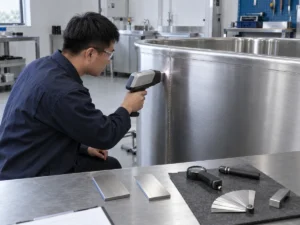
Mixed-material tubs may combine visible timber with stainless steel, liners, seals, fittings, coatings or other materials. Exterior wood care and water-side cleaning can therefore be completely different maintenance jobs.
Before applying a cleaner, scale remover, sanitizer or other chemical to a surface:
- identify the material;
- identify the contaminant or buildup;
- check compatibility with that material and connected equipment; and
- follow the instructions that apply to that system.
Do not automatically respond to staining or buildup by using a stronger chemical. Material compatibility comes first.
A useful maintenance rule: Instead of asking “How do I clean a wooden hot tub?”, ask “What material does this particular maintenance action affect?”
That question produces a more reliable answer for surfaces, seals, fittings, water equipment and mixed-material tubs.
Maintain the Stove and Firebox by Condition and Manual
Stove and firebox care includes routine cleanliness and condition checks, but the exact firing, ash-removal and servicing procedure belongs to the installed heater.
Useful owner-level checks include:
- ash or combustion debris that needs removal under the applicable instructions;
- visible condition of accessible stove surfaces;
- connections or fittings that show leakage or deterioration;
- obvious damage or abnormal change;
- required water-level or circulation conditions before firing; and
- anything that falls outside normal cleaning and inspection.
These checks are more useful than applying an arbitrary “clean every X days” rule.
Ash accumulation depends on use, while heater construction determines the approved cleaning method. More importantly, a clean firebox does not prove that the entire heating system is ready to operate.
Connections may still need verification. Required water conditions may need to be established before firing. Freeze exposure may change the restart procedure.
The maintenance plan should identify what the owner can observe and clean, while the current heater and tub documentation determines the model-specific procedure.
For project-level documentation boundaries, operating controls and handover requirements, see wood-fired hot tub safety documentation buyers should require .
If normal owner-level checks cannot confirm that the system is ready for its intended operation, stop treating the issue as routine maintenance.
Treat Chimney and Flue Maintenance as a Separate Safety Task
Firebox maintenance does not establish the condition of the chimney or flue.
The combustion path continues beyond the stove, and the flue system has its own joints, supports, internal condition, termination, installation requirements and service needs.
General U.S. Fire Administration heating-fire-safety guidance recommends having heating equipment and chimneys professionally cleaned and inspected each year. That recommendation is useful within its U.S. home-heating context, but it is not a model-specific HACHILL service schedule and does not replace the installed component instructions or applicable local requirements.
What an owner can check
- visible damage;
- looseness or displacement;
- unusual deposits around accessible areas;
- deterioration; or
- a visible change from the documented installation.
Observation should not turn into improvised chimney repair or an assumption that the complete internal flue is acceptable.
What belongs to the manual or qualified service
- component-specific inspection requirements;
- internal flue cleaning procedures;
- repairs or replacement;
- questions involving routing or supports;
- penetration details;
- clearances; and
- installation or local fire-code questions.
No single “clean the chimney every X months” statement should be presented as a universal wood-fired hot tub requirement unless the applicable system documentation supports it.
Stove cleanliness and flue condition are two different maintenance responsibilities.
Winterizing a Wood-Fired Hot Tub Starts With the Complete Water Path
An empty-looking tub is not automatically a fully drained system.
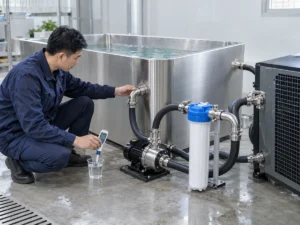
Depending on the configuration, water may remain in the heater, pipes, drain components, fittings or other water-containing equipment after the main bathing vessel appears empty. Pumps or filters, if fitted, may add further water-holding points.
Winterizing is therefore one of the maintenance tasks least suited to a generic one-size-fits-all procedure.
Seasonal shutdown and freeze-risk checks
Before freezing conditions, work through the complete water route:
- Identify every component that normally contains water.
- Confirm how each component is intended to drain or be protected.
- Check the current instructions for the vessel, stove, plumbing and any installed pump, filter or other water-containing equipment.
- Verify that the shutdown method matches the actual construction.
- Do not import another manufacturer’s winterizing sequence simply because both products are wood-fired hot tubs.
Manufacturer procedures can legitimately differ because product construction differs.
One system may require specific components to be fully drained, while another vessel construction may have a different storage requirement. Different instructions are expected when the underlying construction is different; they do not create a universal winterizing rule.
Draining the visible bathing vessel is not proof that every freeze-sensitive part of the system is empty.
Restarting after winter storage or freeze exposure
If the heater, a pipe, fitting, drain point or other water-containing component may have frozen, do not assume it is ready to operate simply because visible ice is gone.
Before restarting, verify:
- the required shutdown steps were completed correctly;
- accessible components show no obvious leakage or damage;
- required water level and, where applicable, circulation conditions are established before firing;
- freeze-exposed components do not require additional inspection; and
- the water-management system is ready for the new operating period.
If those conditions cannot be verified, restart has moved beyond routine maintenance and into a manual or service decision.
Build the Maintenance Schedule From Conditions, Manuals and Use
A daily, weekly, monthly and seasonal format can make a checklist easier to read. It should not create maintenance intervals that the equipment manufacturer, water-management plan or applicable authority never specified.
Assign each maintenance task to the correct cadence owner instead.
| Maintenance task | What should determine the interval |
|---|---|
| Before/after-use observations | Actual use and observable condition |
| Water monitoring and treatment | Water-management plan, installed system, manufacturer guidance and applicable public-health requirements |
| Surface cleaning | Surface condition and material-specific instructions |
| Stove/firebox cleaning and servicing | Use, condition and current component instructions |
| Chimney/flue maintenance | Flue instructions, condition, fire-safety context and qualified-service guidance where applicable |
| Seasonal shutdown and winterizing | Climate exposure plus the exact vessel, heater, plumbing and equipment configuration |
| Shared/commercial operating checks | Facility operating plan and applicable jurisdictional requirements |
Treating the calendar as the authority creates two predictable maintenance errors.
Under-maintenance happens when an owner waits for a generic calendar date even though the equipment’s actual condition already needs attention.
False precision happens when an article publishes an exact interval for a task that is really controlled by a product manual, water-treatment program, usage level or commercial operating requirement.
Before- and after-use checks
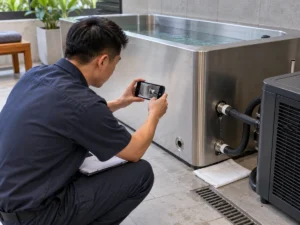
Per-use checks are useful when they focus on operating readiness. That may include checking for obvious leakage, confirming required operating conditions or noticing debris or deterioration that needs attention.
The exact checklist should still come from the equipment in use.
Condition-based maintenance
Some maintenance is better triggered by what you observe than by the calendar.
Visible buildup, leakage, abnormal deterioration or another change in expected condition may justify attention before a scheduled interval.
Condition-based maintenance does not mean repairing every problem yourself. The observed condition may determine when something needs attention while the manual or qualified service determines what happens next.
Manufacturer-defined and seasonal tasks
Where the product documentation specifies an interval or procedure, that instruction owns the task.
Winterization follows the same principle. Climate determines whether freezing is a concern; the construction of the vessel and water system determines how it should be protected.
A competitor’s maintenance schedule is not an industry-wide maintenance standard.
Commercial operation adds another maintenance owner
Shared-use installations need an additional operational layer.
Depending on the venue and jurisdiction, that can include formal water monitoring, records, operator responsibilities, preventive maintenance and defined corrective actions.
A hotel or resort should therefore combine the selected equipment documentation with the operating and public-health requirements that apply to the facility rather than simply increasing the frequency of a homeowner checklist.
Know When to Stop Routine Maintenance and Call for Service
Routine maintenance has an endpoint. If the required operating condition cannot be confirmed through the normal checks and actions allowed by the current instructions, move out of the DIY maintenance path.
| What you observe | Routine response | Stop or escalate when |
|---|---|---|
| Normal dirt, ash or accessible debris | Clean according to applicable instructions | Damage, abnormal deterioration or uncertainty appears |
| Water condition outside the intended control | Follow the applicable water-management process and verify the result | Required water condition cannot be restored or confirmed |
| Leak or questionable connection | Stop use and check the current instructions before further firing | The source, integrity or required operating condition cannot be confirmed |
| Possible freeze exposure | Follow the current shutdown/restart instructions | Heater, plumbing, fitting or another component may be damaged |
| Chimney or flue concern | Limit action to normal owner-level observation | Internal inspection, cleaning, repair, routing or installation questions are involved |
| Unknown condition after maintenance | Recheck against the current documentation | The system still cannot be verified as ready for operation |
Observe → perform the supported routine action → verify → stop or escalate if the required condition cannot be confirmed.
That boundary keeps maintenance from drifting into remote troubleshooting. A blog can help an owner identify that a condition has changed; it should not pretend to diagnose a damaged heater, compromised flue, freeze-damaged connection or persistent water-quality problem from a distance.
Frequently Asked Questions
How often should you maintain a wood-fired hot tub?
There is no universal interval for every maintenance task. Some checks depend on each use or observable condition, while water care, stove servicing, chimney maintenance and winterization may be controlled by the installed system, manufacturer instructions, climate and applicable operating requirements.
Can you leave water in a wood-fired hot tub between uses?
Only if the tub and water-management configuration are intended for retained-water operation and the applicable treatment, monitoring, circulation or filtration requirements are maintained. The required controls depend on the installed system, use pattern and jurisdiction. Freeze exposure can add further shutdown or protection requirements.
How do you clean a wood-fired hot tub?
First identify the material you are cleaning. Physical surface cleaning and water hygiene are separate jobs, and a cleaner that is suitable for one material or system should not automatically be assumed suitable for another.
How often should a wood-fired hot tub chimney be cleaned?
Do not apply one generic chimney-cleaning interval to every system. U.S. Fire Administration home-heating guidance recommends professional chimney inspection and cleaning each year, but that is not a universal model-specific schedule. Follow the installed flue or chimney instructions and the fire-safety requirements that apply to the actual installation.
How do you winterize a wood-fired hot tub?
Identify every component that can contain water, not just the main vessel, and follow the shutdown instructions for the actual tub, heater, pipes, drain points and installed equipment. An empty-looking tub is not proof that the complete system is freeze-safe.
Related Wood-Fired Hot Tub Resources
How Wood-Burning Hot Tubs Work
Understand the relationship between the heater, water route, circulation and chimney before applying maintenance rules.
Wood-Fired Hot Tub Safety Documentation
See which model-specific operating, installation and safety documents should own the final procedure.
HT18 Rectangular Wood-Fired Hot Tub
Review the rectangular HACHILL route when the project has already narrowed the format decision.
HT19 Round Wood-Fired Hot Tub
Review the round HACHILL route and confirm the actual model configuration before applying product-specific maintenance instructions.
Authoritative References
Build the Maintenance Plan Around the Actual Configuration
A useful wood-fired hot tub maintenance plan assigns each task to the correct condition, component, interval owner, procedure and escalation point. If you are still selecting a HACHILL wood-fired hot tub, start with the product family and then confirm the exact water-side materials, stove, chimney, drainage and operating configuration for the selected model.
Explore HACHILL Wood-Fired Hot Tubs