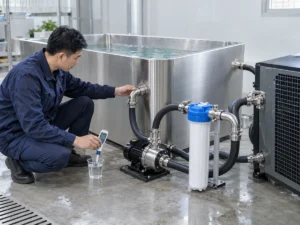
Quick answer: If you are comparing UV vs ozone for a cold plunge, neither technology is universally better. UV treats water only while it passes through a properly specified reactor and depends on flow, UV transmissivity, lamp output and maintained equipment condition. Ozone can provide oxidation and antimicrobial treatment when generation, injection, mixing/contact, monitoring and gas handling are correctly engineered. Neither technology should be assumed to replace filtration, physical cleaning, water verification or—where the use case requires it—a residual-disinfection strategy. Do not choose by tub volume, lamp wattage, ozone-generator output or marketing claims alone. Choose by treatment role, actual hydraulic and water conditions, maintenance capability, material compatibility and whether the plunge is private or shared/commercial. If those inputs are not defined, HOLD is more defensible than a guessed recommendation.
UV vs Ozone for a Cold Plunge: Which One Should You Choose?
Do not choose between UV and ozone by asking which technology sounds more powerful.
Ask instead: What treatment job must this component perform, and what evidence shows it can perform that job under the actual system conditions?
UV and ozone have different operating requirements. UV performance depends on water passing through a UV reactor under appropriate hydraulic, optical and equipment conditions. Ozone treatment depends on producing ozone, transferring it into the water, achieving the intended mixing/contact and handling unused gas appropriately. CDC’s Model Aquatic Health Code Annex provides public-aquatic technical context for those distinctions.
Generic rules such as “UV for small tubs, ozone for large tubs” are not a defensible engineering shortcut. Vessel volume matters, but it does not replace the actual circulation path, operating flow, user load, water condition, reactor validation or ozone contact design, service access and maintenance capability.
| Decision variable | UV | Ozone |
|---|---|---|
| Primary selection question | Can the reactor deliver the required treatment under its validated operating conditions? | Can the system generate, deliver and contact ozone as intended? |
| Specification trap | Lamp presence or wattage alone | Generator output alone |
| Key dependencies | Flow, UV transmissivity, lamp/sleeve condition and validated operating range | Generation, injection, contact, monitoring and gas handling |
| Persistent whole-vessel residual? | Should not be assumed | Should not be assumed |
| Filtration replaced? | No | No |
| Possible outcome | UV / HOLD | Ozone / HOLD |
For retained/shared recreational water, the public-health evidence used here treats UV and ozone as treatment layers rather than complete replacements for the rest of the sanitation system. NCCEH’s cold-plunge evidence brief states that UV and ozone do not provide residual disinfection in the shared/public-health context it examines.
Decision rule: Neither is universally better. Choose the technology whose treatment role and operating conditions match the complete system.
If the system has not yet defined those conditions, HOLD is more defensible than guessing.
What UV Actually Does—and What Determines Whether It Works as Intended
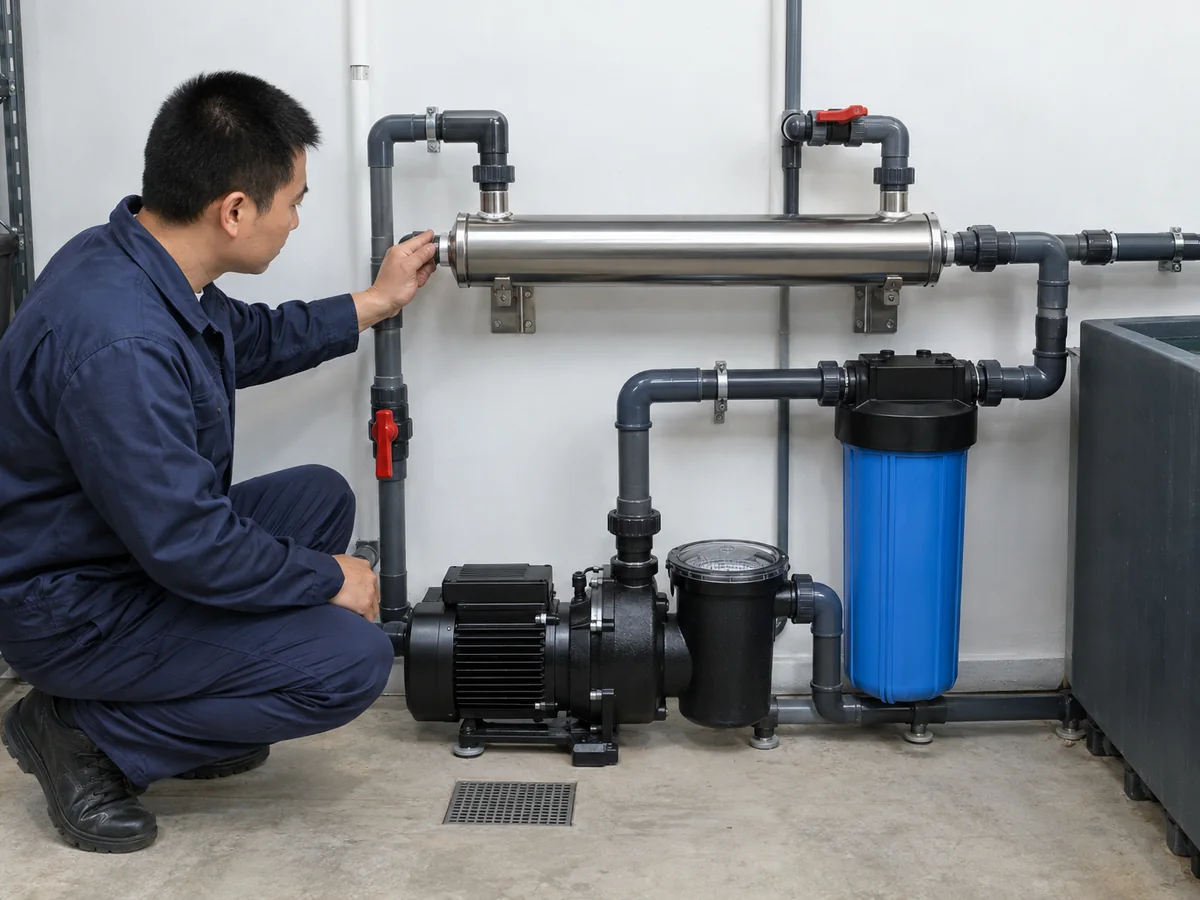
A UV system treats water while that water passes through the UV reactor. A UV lamp being switched on is not the same thing as proving that the water received the intended treatment.
Flow is part of the performance condition
A UV reactor has to operate within the conditions used to establish its performance. EPA’s Ultraviolet Disinfection Guidance Manual is a drinking-water UV validation reference, not a cold-plunge rule. The 2024 Model Aquatic Health Code explicitly uses EPA validation practices for public-aquatic UV equipment and requires model-specific validation documentation. Across those frameworks, operating flow, UV transmissivity, lamp output/intensity and the validated operating range are part of the performance basis.
A lamp-wattage specification cannot, by itself, establish whether the water is receiving adequate validated treatment.
Water that looks clear is not necessarily optically equivalent
UV treatment depends on how effectively ultraviolet light travels through the water. UV transmissivity, or UVT, is therefore an operating variable. A visually clear plunge does not tell you the UVT value or prove that the reactor is operating within the conditions assumed by its validation.
NCCEH notes that turbidity can affect UV disinfection effectiveness in cold-plunge water.
Lamp aging and fouling matter
UV equipment condition changes over time. EPA guidance identifies lamp aging and fouling of lamp sleeves or sensor windows as factors that can reduce effective UV performance, and it does not support treating one cleaning interval as universal for every installation.
Instead of asking only whether a plunge “has UV,” ask whether the proposed system can document its exact treatment component, operating range, flow basis, water-condition assumptions, monitoring and maintenance requirements.
Device installed ≠ treatment verified.
What Ozone Actually Does—and Why Generator Output Is Not the Whole Story
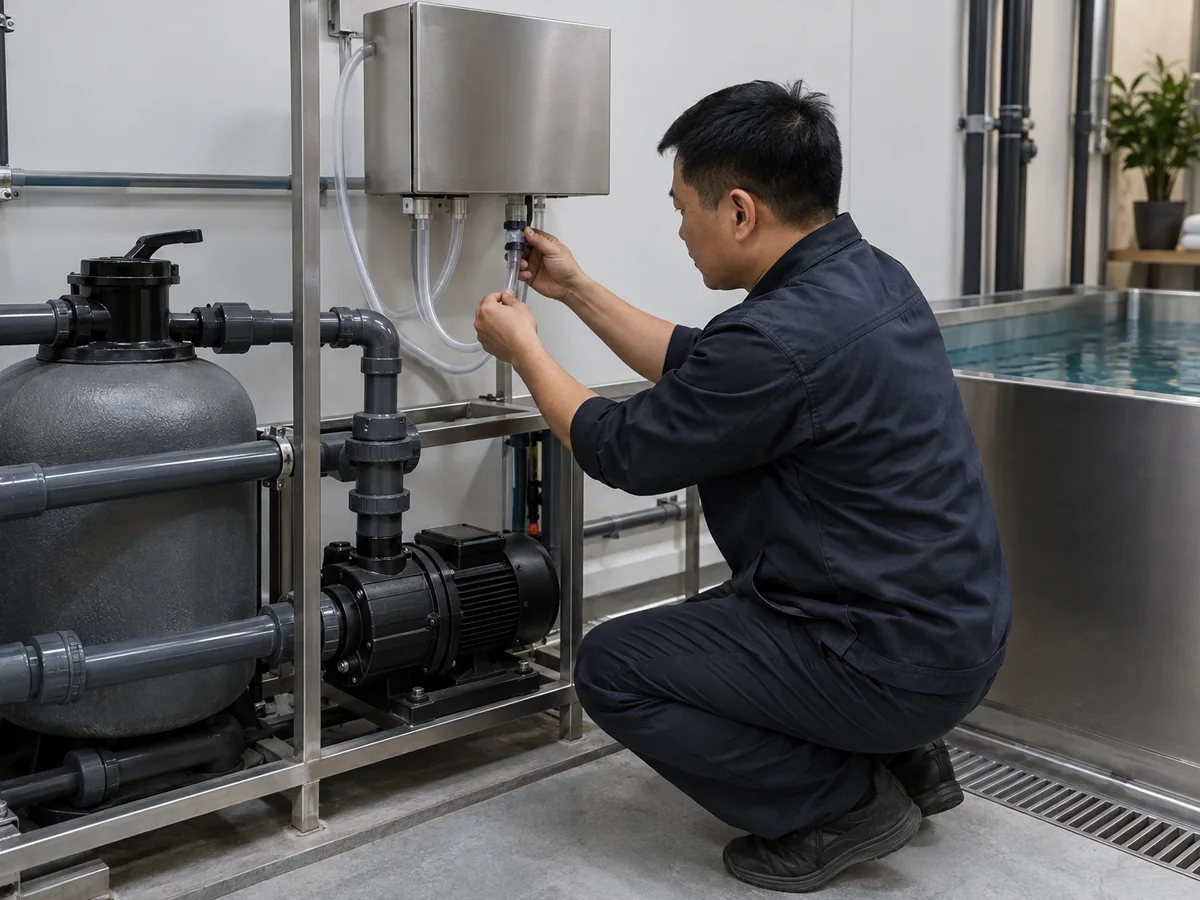
An ozone generator can produce ozone, but that does not by itself prove how much useful treatment the water receives.
Generated ozone is not the same as delivered treatment
An ozone-generator nameplate may describe production capability, but treatment depends on what happens after generation. Ozone must reach the water and interact with it under the conditions assumed by the treatment design.
In its public-aquatic scope, the 2024 MAHC code document treats an ozone system as more than a generator: it includes injection, reaction/contact equipment, gas handling/destruction and monitoring/control elements. Those public-aquatic code components should not be copied wholesale into every private residential specification, but they show why generator output alone is not a complete treatment claim.
Oxidation is not automatically complete sanitation
Ozone is a powerful oxidizer and can perform antimicrobial treatment under appropriately designed conditions. But “ozone oxidizes contaminants” does not establish that a cold plunge is fully sanitized. The first describes a treatment function; the second makes a whole-system water-safety claim.
Ozone should not be treated as permanent residual protection
In the cold-plunge/public-health framework reviewed for this article, ozone does not provide a persistent disinfectant residual throughout the retained water. A treatment zone in the circulation system should not be confused with ongoing residual protection everywhere in the vessel.
Gas handling is part of the decision
NIOSH’s ozone entry identifies ozone as a powerful oxidizer and lists inhalation as an exposure route, with eye, mucous-membrane and respiratory effects among the recognized hazards. That makes gas containment, destruction/venting strategy and leak response part of the equipment decision rather than an optional afterthought.
A buyer should ask how the proposed system gets from generator output to controlled treatment—and how unused ozone is handled safely. If the answer stops at the generator rating, the treatment case is incomplete.
What Neither UV nor Ozone Replaces: Filtration, Residual Protection and Water Verification
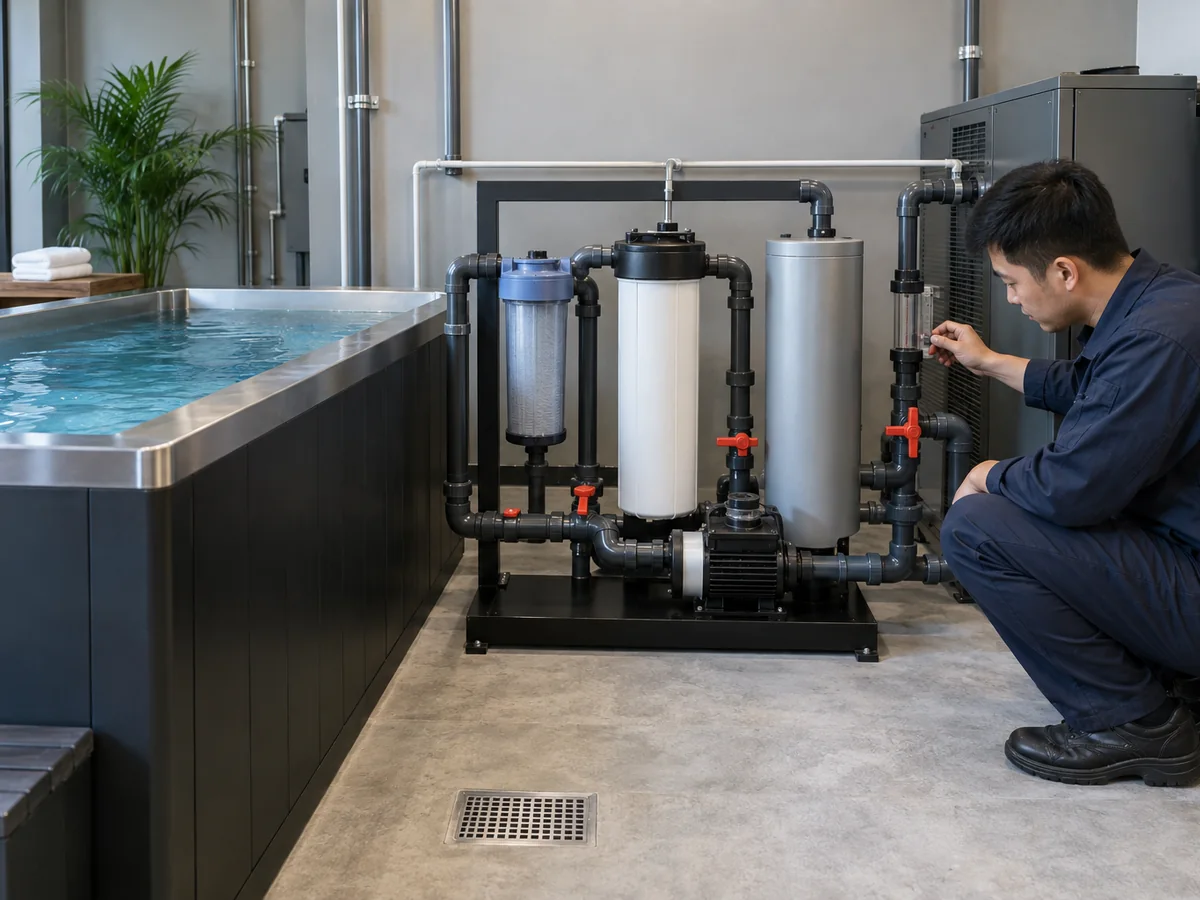
The most important mistake to avoid is treating one treatment device as the whole water-care system.
Filtration is not disinfection
A filter removes selected physical material from water passing through it. UV and ozone perform different treatment functions. One does not become unnecessary simply because another exists.
HACHILL’s Cold Plunge Water-Care Guide keeps circulation, filtration, sanitation, testing, physical cleaning and condition-based water replacement as separate controls.
Filtration ≠ disinfection.
Point treatment is not the same as residual protection
The more important system question is: What protects retained water outside the treatment device or treatment zone?
UV acts while water passes through the reactor. Ozone operates through its delivery and contact process and then decays. Neither should automatically be described as providing persistent disinfectant protection throughout the whole vessel.
For shared/public cold-plunge contexts, NCCEH’s cold-plunge evidence brief specifically recommends UV or ozone in combination with chlorine or bromine because UV and ozone do not provide residual disinfection. That statement should not be converted into a universal private-home legal rule.
“Chemical-free” is not a reliable whole-system claim
The presence of UV or ozone does not, by itself, prove that residual control, water testing, filtration, physical cleaning or equipment maintenance is unnecessary. The better question is which controls remain necessary after the treatment component has performed its own job.
Clear water is not enough
Visual appearance can identify obvious problems, but it cannot establish microbiological control or confirm that every treatment parameter is within its required operating range.
Clear water ≠ verified water condition.
Maintenance, Compatibility and Safety: What Can Disqualify UV or Ozone
Maintenance is part of treatment validity. A technically sound method can still be the wrong project choice if the system cannot keep the equipment inside the conditions that make the treatment claim credible.
A UV route should stay on HOLD when the operating basis is unclear
- The relevant operating flow is unknown.
- The validated operating range cannot be supplied.
- The water-condition assumptions are unclear.
- Lamp or sleeve condition cannot reasonably be maintained.
- Required service access is not available.
- Failure or off-spec operation cannot be identified.
These gaps do not prove that UV is unsuitable. They mean the UV treatment claim is not yet sufficiently verified.
An ozone route needs more than an installed generator
- Injection or mixing is undefined.
- The contact arrangement is unclear.
- Off-gas handling has not been addressed.
- Relevant indoor exposure controls are unresolved.
- Materials compatibility is unverified.
- Monitoring or failure response is unclear.
- Generator output is the only treatment evidence.
Compatibility must be configuration-specific
Because ozone is a strong oxidizer, material compatibility is a real system-design consideration. Exact compatibility belongs to the actual ozone equipment, operating conditions and component documentation—not to a universal material table.
Better maintenance question: Can the intended operator keep this system inside the conditions that make its treatment performance credible?
Private Home Plunge vs Shared or Commercial Use: Why the Treatment Decision Changes
A one-household plunge and a shared commercial plunge should not automatically receive the same UV-or-ozone recommendation. The important difference is not simply vessel size; it is the operating model.
| Decision area | Private home plunge | Shared / commercial plunge |
|---|---|---|
| Primary operating basis | Exact equipment instructions, treatment-product instructions, actual use pattern and applicable local requirements | Defined facility operating procedures plus applicable public-health/local requirements |
| User model | Known household/private users | Repeated shared use and formal operator responsibility |
| Verification need | Must match the actual private system | Often requires a more formal multi-barrier and documented operating approach |
| Regulatory shortcut to avoid | Do not automatically import every public-aquatic requirement | Do not assume a manufacturer feature alone proves compliance |
MAHC is a model code, not a universal U.S. law
CDC’s current Model Aquatic Health Code page identifies the MAHC as a model framework for public aquatic venues rather than federal law automatically applying to every U.S. cold plunge. Local adoption and modification matter. For a shared commercial project, confirm the actual authority having jurisdiction.
Standard scope is not product certification
NSF’s 2026 cold-plunge-specific NSF/ANSI/CAN 50 overview states that cold tubs with circulation, treatment or disinfection systems fall within the standard’s current scope. A standard covering a product category does not mean that a specific product is certified or listed.
This article does not assume that any HACHILL UV, ozone or complete cold-plunge system holds NSF/ANSI/CAN 50 certification without product-specific evidence.
For broader shared-use venue planning after the treatment comparison is complete, the HACHILL Recovery Centers solution page is the appropriate next-step owner.
Choose UV, Ozone, Both or HOLD: A Cold-Plunge Treatment Decision Matrix
At this point, select from the system inputs—not from which technology sounds more advanced.
UV
Shortlist when pass-through UV treatment is the intended role and the model’s validated operating conditions, monitoring, maintainability and wider water-management architecture can be documented.
OZONE
Shortlist when oxidation/antimicrobial treatment is the intended role and generation, delivery, mixing/contact, compatibility, monitoring, gas handling and maintenance are defined.
UV + OZONE
Consider only when each technology has a separate justified role and the combined system remains maintainable and compatible. The combination should not be treated as proof of residual protection or complete sanitation.
HOLD
Use when critical treatment, hydraulic, residual, maintenance, compatibility or regulatory inputs remain open.
What should you ask the supplier to confirm?
| Supplier input | Why it matters |
|---|---|
| Exact treatment component/model | Confirms which hardware is actually being evaluated |
| Intended treatment role | Prevents one component from being sold as the complete water-care program |
| Use model and expected bather load | Separates low-frequency private use from repeated shared/commercial duty |
| Operating flow / validated range | Critical to evaluating UV applicability |
| Relevant water-condition basis | Checks whether performance assumptions fit the actual water |
| Ozone generation, injection and contact basis | Separates generator output from delivered treatment |
| Residual-disinfection strategy | Defines protection outside the treatment step |
| Filtration and circulation architecture | Confirms treatment is connected to a complete loop |
| Monitoring / alarm / failure indication | Shows how off-spec operation may be detected |
| Maintenance requirements | Treatment confidence depends on maintained equipment condition |
| Material compatibility | Important for ozone-exposed components |
| Certification/listing evidence where claimed | Confirms the exact product and certification scope |
| Destination / AHJ basis for commercial projects | Requirements can vary by jurisdiction |
Better procurement question: What treatment has actually been defined, under what operating conditions, and what responsibilities remain outside that component?
After the treatment architecture is defined: review the cold-plunge format that fits the project. Exact pump, filtration, sanitation, UV, ozone or other water-treatment components still need confirmation for the selected configuration rather than being inferred from the tub format.
Frequently Asked Questions
Is UV or ozone better for a cold plunge?
Neither is universally better. UV and ozone perform different treatment roles and depend on different operating conditions. Choose according to treatment objective, system flow, residual strategy, maintenance, compatibility and use model. If those inputs are not yet defined, HOLD is more defensible than choosing from the technology name alone.
Can UV or ozone replace chlorine or bromine in a cold plunge?
Do not assume so. In the shared/public cold-plunge context reviewed by NCCEH, neither UV nor ozone provides residual disinfection, and the brief recommends using them with chlorine or bromine. That public-health guidance should not be converted into a universal private-home legal rule. Residential systems should follow the exact equipment instructions, treatment-product instructions and applicable local requirements.
Can ozone replace filtration in a cold plunge?
No. Filtration and ozone treatment perform different functions in a retained-water recirculating system. Ozone treatment does not remove the need to define the circulation and filtration route.
Can a cold plunge use both UV and ozone?
Potentially. Using both can make sense when each technology has a separate, evidence-supported job in the complete treatment architecture. Installing both should not be assumed to create a safer or better system automatically.
Does clear water mean a cold plunge is properly sanitized?
No. Visual clarity does not establish microbiological control, residual protection or that the treatment system is operating inside all of its required conditions. Use the verification method appropriate to the actual water-treatment system rather than appearance alone.