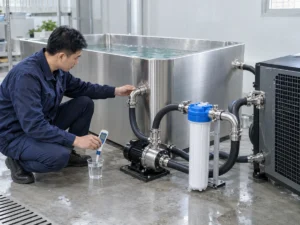
Réponse rapide : Si vous comparez UV ou ozone pour un bain froid, aucune des deux technologies n'est universellement meilleure. L'UV traite l'eau uniquement lorsqu'elle traverse un réacteur correctement dimensionné et dépend du débit, de la transmissivité UV, de la puissance de la lampe et de l'état de maintenance de l'équipement. L'ozone peut assurer une oxydation et un traitement antimicrobien lorsque la génération, l'injection, le mélange/contact, la surveillance et la gestion du gaz sont correctement conçus. Aucune de ces technologies ne doit être supposée remplacer la filtration, le nettoyage physique, la vérification de l'eau ou—lorsque le cas d'usage l'exige—une stratégie de désinfection résiduelle. Ne choisissez pas uniquement en fonction du volume de la cuve, de la puissance de la lampe, du rendement du générateur d'ozone ou d'allégations marketing. Choisissez en fonction du rôle de traitement, des conditions hydrauliques et de la qualité de l'eau réelles, de la capacité de maintenance, de la compatibilité des matériaux et du caractère privé ou partagé/commercial du bain froid. Si ces données ne sont pas définies, RETENUE est plus défendable qu'une recommandation supposée.
UV ou ozone pour un bain froid : lequel choisir ?
Ne choisissez pas entre UV et ozone en vous demandant quelle technologie semble la plus puissante.
Posez plutôt la question suivante : Quelle tâche de traitement ce composant doit-il accomplir, et quelles preuves montrent qu'il peut l'accomplir dans les conditions réelles du système ?
L'UV et l'ozone ont des exigences de fonctionnement différentes. La performance UV dépend du passage de l'eau dans un réacteur UV dans des conditions hydrauliques, optiques et d'équipement appropriées. Le traitement à l'ozone dépend de la production d'ozone, de son transfert dans l'eau, de l'obtention du mélange/contact prévu et de la gestion appropriée du gaz non utilisé. Annexe du Model Aquatic Health Code des CDC fournit un contexte technique public sur les eaux de baignade pour ces distinctions.
Les règles génériques telles que “ UV pour les petites cuves, ozone pour les grandes cuves ” ne constituent pas un raccourci d'ingénierie défendable. Le volume du bassin compte, mais il ne remplace pas le circuit de circulation réel, le débit de fonctionnement, la charge d'utilisateurs, la qualité de l'eau, la validation du réacteur ou la conception du contact avec l'ozone, l'accès de maintenance et la capacité de maintenance.
| Variable de décision | UV | Ozone |
|---|---|---|
| Question de sélection principale | Le réacteur peut-il assurer le traitement requis dans ses conditions de fonctionnement validées ? | Le système peut-il générer, diffuser et mettre en contact l'ozone comme prévu ? |
| Piège de spécification | La présence ou la puissance des lampes à elle seule | Le débit du générateur à lui seul |
| Dépendances clés | Débit, transmissivité UV, état des lampes/gaines et plage de fonctionnement validée | Génération, injection, contact, surveillance et gestion des gaz |
| Résiduel persistant dans l'ensemble de la cuve ? | Ne doit pas être présumé | Ne doit pas être présumé |
| Filtration remplacée ? | Non | Non |
| Résultat possible | UV / EN ATTENTE | Ozone / EN ATTENTE |
Pour les eaux de baignade retenues/partagées, les données de santé publique utilisées ici traitent l'UV et l'ozone comme des couches de traitement plutôt que comme des remplacements complets du reste du système d'assainissement. La note d'information sur les données probantes relatives aux bains froids du NCCEH indique que l'UV et l'ozone n'assurent pas de désinfection résiduelle dans le contexte d'eau partagée/santé publique qu'elle examine.
Règle de décision : Aucune des deux n'est universellement meilleure. Choisissez la technologie dont le rôle de traitement et les conditions d'exploitation correspondent au système complet.
Si le système n'a pas encore défini ces conditions, RETENUE est plus défendable que de deviner.
Ce que fait réellement l'UV — et ce qui détermine si le système fonctionne comme prévu
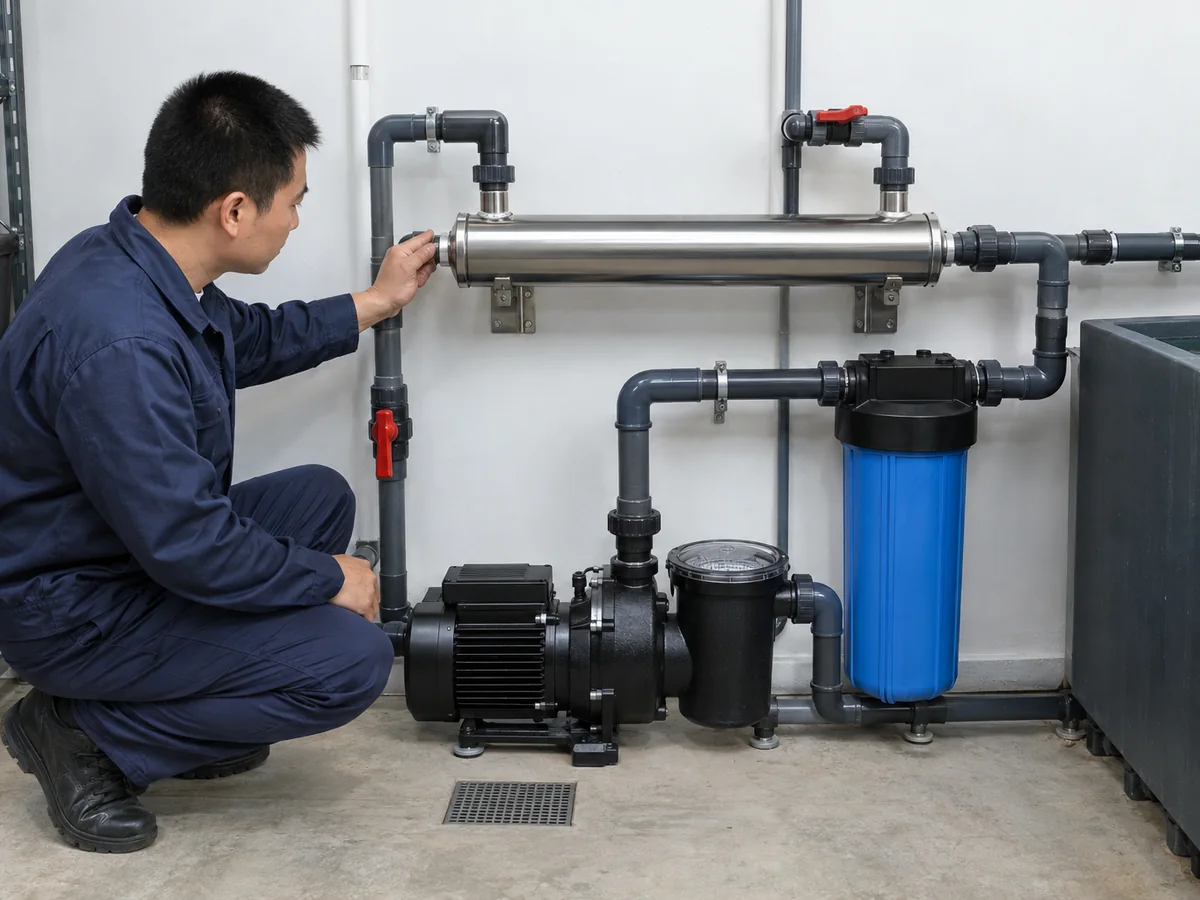
Un système UV traite l'eau pendant qu'elle traverse le réacteur UV. Le simple fait qu'une lampe UV soit allumée ne prouve pas que l'eau a reçu le traitement prévu.
Le débit fait partie des conditions de performance
Un réacteur UV doit fonctionner dans les conditions utilisées pour établir ses performances. Manuel d'orientation sur la désinfection par ultraviolets de l'EPA est une référence de validation UV pour l'eau potable, pas une règle pour les bains froids. Le 2024 Model Aquatic Health Code utilise explicitement les pratiques de validation EPA pour les équipements UV des eaux de baignade publiques et exige une documentation de validation spécifique au modèle. Dans ces cadres, le débit de fonctionnement, la transmissivité UV, la puissance/intensité de la lampe et la plage de fonctionnement validée font partie de la base de performance.
Une spécification de puissance de lampe ne peut, à elle seule, établir si l'eau reçoit un traitement validé adéquat.
Une eau visuellement claire n'est pas nécessairement optiquement équivalente
Le traitement UV dépend de l'efficacité avec laquelle la lumière ultraviolette traverse l'eau. La transmissivité UV, ou UVT, est donc une variable de fonctionnement. Un bassin d'immersion visuellement clair ne donne pas la valeur d'UVT ni ne prouve que le réacteur fonctionne dans les conditions supposées par sa validation.
Le NCCEH note que la turbidité peut affecter l'efficacité de la désinfection UV dans l'eau d'un bain froid.
Le vieillissement et l'encrassement des lampes comptent
L'état de l'équipement UV évolue dans le temps. Les recommandations de l'EPA identifient le vieillissement des lampes et l'encrassement des gaines de lampes ou des fenêtres de capteurs comme des facteurs pouvant réduire l'efficacité réelle de l'UV, et elles ne permettent pas de considérer un intervalle de nettoyage unique comme universel pour chaque installation.
Plutôt que de demander uniquement si un bain froid “ dispose d'UV ”, demandez si le système proposé peut documenter son composant de traitement exact, sa plage de fonctionnement, sa base de débit, ses hypothèses sur l'état de l'eau, ainsi que ses exigences de surveillance et de maintenance.
Appareil installé ≠ traitement vérifié.
Ce que fait réellement l'ozone — et pourquoi le rendement du générateur n'est pas toute l'histoire
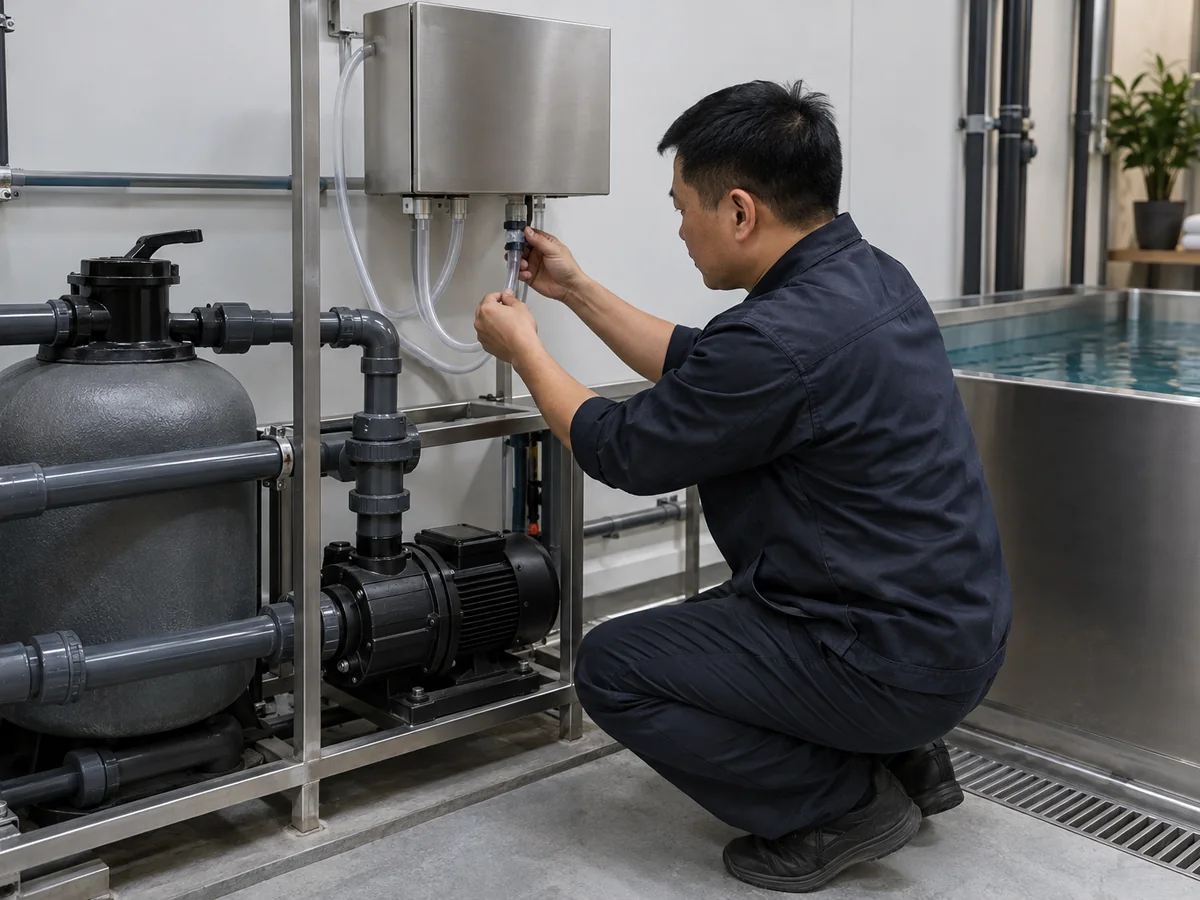
Un générateur d'ozone peut produire de l'ozone, mais cela ne prouve pas en soi la quantité de traitement utile reçue par l'eau.
L'ozone généré n'est pas équivalent au traitement délivré
La plaque signalétique d'un générateur d'ozone peut décrire une capacité de production, mais le traitement dépend de ce qui se passe après la génération. L'ozone doit atteindre l'eau et interagir avec elle dans les conditions supposées par la conception du traitement.
Dans son champ d'application relatif aux eaux de baignade publiques, le document de code MAHC 2024 traite un système à ozone comme plus qu'un générateur : il inclut l'injection, l'équipement de réaction/contact, la gestion/destruction du gaz et les éléments de surveillance/contrôle. Ces composants de code pour eaux de baignade publiques ne doivent pas être copiés intégralement dans chaque spécification résidentielle privée, mais ils montrent pourquoi le rendement du générateur seul ne constitue pas une allégation de traitement complète.
L'oxydation ne constitue pas automatiquement une désinfection complète
L'ozone est un oxydant puissant et peut assurer un traitement antimicrobien dans des conditions conçues de manière appropriée. Mais “ l'ozone oxyde les contaminants ” n'établit pas qu'un bain froid est entièrement désinfecté. La première formulation décrit une fonction de traitement ; la seconde avance une allégation de sécurité sanitaire de l'eau à l'échelle du système entier.
L'ozone ne doit pas être considéré comme une protection résiduelle permanente
Dans le cadre bain froid/santé publique examiné pour cet article, l'ozone n'apporte pas de résidu désinfectant persistant dans l'eau retenue. Une zone de traitement dans le circuit de circulation ne doit pas être confondue avec une protection résiduelle continue partout dans la cuve.
La gestion du gaz fait partie de la décision
l'entrée ozone du NIOSH identifie l’ozone comme un oxydant puissant et cite l’inhalation comme voie d’exposition, avec des effets oculaires, muqueux et respiratoires parmi les dangers reconnus. Cela fait du confinement du gaz, de la stratégie de destruction/ventilation et de la réponse aux fuites des éléments à part entière du choix d’équipement, et non une réflexion accessoire facultative.
Un acheteur doit demander comment le système proposé passe de la production du générateur à un traitement contrôlé—et comment l'ozone non utilisé est géré en toute sécurité. Si la réponse s'arrête à la puissance du générateur, le dossier de traitement est incomplet.
Ce que ni l'UV ni l'ozone ne remplacent : filtration, protection résiduelle et vérification de l'eau
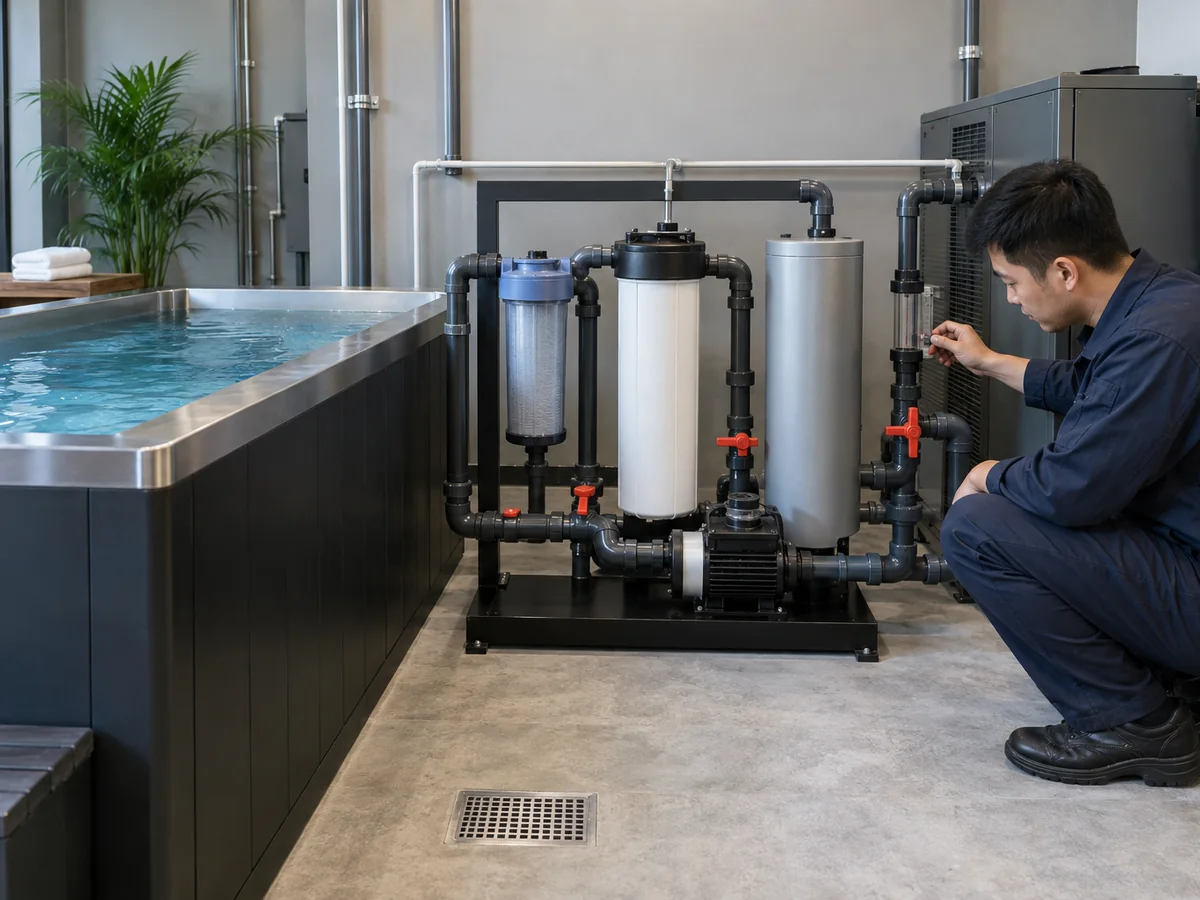
L'erreur la plus importante à éviter est de considérer un seul dispositif de traitement comme l'ensemble du système d'entretien de l'eau.
La filtration n'est pas une désinfection
Un filtre retire certains éléments physiques de l'eau qui le traverse. L'UV et l'ozone remplissent d'autres fonctions de traitement. L'un ne devient pas inutile simplement parce que l'autre existe.
HACHILL’s Guide d'entretien de l'eau des bains froids maintient la circulation, la filtration, la désinfection, les tests, le nettoyage physique et le remplacement de l'eau selon l'état comme des contrôles distincts.
Filtration ≠ désinfection.
Le traitement ponctuel n'équivaut pas à une protection résiduelle
La question système plus importante est : Qu'est-ce qui protège l'eau retenue en dehors du dispositif ou de la zone de traitement ?
L'UV agit lorsque l'eau traverse le réacteur. L'ozone opère via son processus de diffusion et de contact, puis se décompose. Ni l'un ni l'autre ne doit être automatiquement décrit comme assurant une protection désinfectante persistante dans l'ensemble de la cuve.
Pour les contextes de bains froids partagés/publics, La note d'information sur les données probantes relatives aux bains froids du NCCEH recommande spécifiquement l'UV ou l'ozone en combinaison avec du chlore ou du brome, car l'UV et l'ozone n'assurent pas de désinfection résiduelle. Cette affirmation ne doit pas être transformée en règle juridique universelle pour les particuliers.
“ Sans produits chimiques ” n'est pas une allégation fiable pour l'ensemble du système
La présence d'UV ou d'ozone ne prouve pas, à elle seule, que le contrôle des résiduels, l'analyse de l'eau, la filtration, le nettoyage physique ou la maintenance des équipements sont inutiles. La vraie question est de savoir quels contrôles restent nécessaires une fois que le composant de traitement a fait son propre travail.
Une eau claire ne suffit pas
L'aspect visuel peut identifier des problèmes évidents, mais il ne permet pas d'établir un contrôle microbiologique ni de confirmer que chaque paramètre de traitement se situe dans sa plage de fonctionnement requise.
Eau claire ≠ état de l'eau vérifié.
Maintenance, compatibilité et sécurité : ce qui peut disqualifier les UV ou l'ozone
La maintenance fait partie de la validité du traitement. Une méthode techniquement solide peut néanmoins être le mauvais choix pour un projet si le système ne peut pas maintenir l'équipement dans les conditions qui rendent l'allégation de traitement crédible.
Une filière UV doit rester en attente lorsque la base de fonctionnement n'est pas claire
- Le débit de fonctionnement pertinent est inconnu.
- La plage de fonctionnement validée ne peut pas être fournie.
- Les hypothèses relatives à l'état de l'eau ne sont pas claires.
- L'état de la lampe ou du manchon ne peut pas être maintenu de manière raisonnable.
- L'accès requis pour la maintenance n'est pas disponible.
- Une défaillance ou un fonctionnement hors spécifications ne peut pas être identifié.
Ces lacunes ne prouvent pas que l'UV est inadapté. Elles signifient que l'allégation de traitement UV n'est pas encore suffisamment vérifiée.
Une solution à l'ozone nécessite plus qu'un générateur installé
- L'injection ou le mélange n'est pas défini.
- La configuration de contact n'est pas claire.
- La gestion des gaz d'échappement n'a pas été traitée.
- Les mesures de contrôle pertinentes de l'exposition en intérieur ne sont pas résolues.
- La compatibilité des matériaux n'est pas vérifiée.
- La surveillance ou la réponse en cas de défaillance n'est pas claire.
- La puissance du générateur est la seule preuve de traitement.
La compatibilité doit être spécifique à la configuration
L'ozone étant un oxydant puissant, la compatibilité des matériaux constitue une véritable considération de conception du système. La compatibilité exacte relève de l'équipement à ozone réel, des conditions d'exploitation et de la documentation des composants, et non d'un tableau universel des matériaux.
Meilleure question de maintenance : L'exploitant prévu peut-il maintenir ce système dans les conditions qui rendent crédible la performance de son traitement ?
Bain froid domestique privé ou usage partagé/commercial : pourquoi la décision de traitement change
Un bain froid d'un seul foyer et un bain froid commercial partagé ne devraient pas recevoir automatiquement la même recommandation UV ou ozone. La différence importante n'est pas simplement la taille de la cuve ; c'est le modèle d'exploitation.
| Zone de décision | Bain froid domestique privé | Bain froid partagé / commercial |
|---|---|---|
| Base d'exploitation principale | Instructions exactes de l'équipement, instructions du produit de traitement, schéma d'utilisation réel et exigences locales applicables | Procédures d'exploitation définies de l'établissement, plus exigences de santé publique et locales applicables |
| Modèle d'utilisateur | Utilisateurs privés/domestiques connus | Usage partagé répété et responsabilité formelle de l'exploitant |
| Besoin de vérification | Doit correspondre au système privé réel | Exige souvent une approche d'exploitation plus formelle, multi-barrières et documentée |
| Raccourci réglementaire à éviter | Ne pas importer automatiquement toutes les exigences des installations aquatiques publiques | Ne pas supposer qu'une caractéristique du fabricant prouve à elle seule la conformité |
Le MAHC est un code modèle, pas une loi universelle aux États-Unis
Page actuelle du Model Aquatic Health Code des CDC identifie le MAHC comme un cadre modèle pour les installations aquatiques publiques, et non comme une loi fédérale s'appliquant automatiquement à chaque bain froid aux États-Unis. L'adoption et les modifications locales comptent. Pour un projet commercial partagé, confirmer l'autorité compétente réelle.
Le périmètre d'une norme n'est pas une certification produit
Aperçu 2026 de NSF’s sur la norme NSF/ANSI/CAN 50 spécifique aux bains froids indique que les bacs froids dotés de systèmes de circulation, de traitement ou de désinfection relèvent du champ d’application actuel de la norme. Une norme couvrant une catégorie de produits ne signifie pas qu’un produit spécifique est certifié ou répertorié.
Cet article ne présume pas qu'un système UV, à ozone ou complet de bain froid HACHILL détienne la certification NSF/ANSI/CAN 50 sans preuve spécifique au produit.
Pour la planification plus large d'un lieu à usage partagé une fois la comparaison des traitements terminée, la page solution HACHILL Recovery Centers constitue l'étape suivante appropriée.
Choisir UV, ozone, les deux ou HOLD : matrice de décision pour le traitement d'un bain froid
À ce stade, sélectionnez à partir des paramètres du système, et non selon la technologie qui semble la plus avancée.
UV
Retenez ce modèle dans la liste courte lorsque le traitement UV en passage est le rôle prévu et que l’on peut documenter les conditions de fonctionnement validées du modèle, la surveillance, la maintenabilité et l’architecture globale de gestion de l’eau.
OZONE
Retenez cette option lorsque le traitement d’oxydation/antimicrobien constitue le rôle prévu et que la production, la distribution, le mélange/contact, la compatibilité, la surveillance, la manipulation des gaz et la maintenance sont définis.
UV + OZONE
À envisager uniquement lorsque chaque technologie a un rôle distinct justifié et que le système combiné reste maintenable et compatible. La combinaison ne doit pas être considérée comme preuve de protection résiduelle ou d’assainissement complet.
RETENUE
À utiliser lorsque des données critiques de traitement, hydrauliques, résiduelles, de maintenance, de compatibilité ou réglementaires restent en suspens.
Que faut-il demander au fournisseur de confirmer ?
| Données fournisseur | Pourquoi c'est important |
|---|---|
| Composant/modèle de traitement exact | Confirme quel matériel est réellement évalué |
| Rôle de traitement prévu | Évite qu'un composant soit vendu comme le programme complet de traitement de l'eau |
| Utiliser le modèle et la charge attendue de baigneurs | Fait la distinction entre un usage privé à faible fréquence et un usage partagé/commercial répété |
| Débit de service / plage validée | Essentiel pour évaluer l'applicabilité des UV |
| Base pertinente des conditions de l'eau | Vérifie si les hypothèses de performance correspondent à l'eau réelle |
| Base de génération, d'injection et de contact de l'ozone | Distingue le rendement du générateur du traitement effectivement délivré |
| Stratégie de désinfection résiduelle | Définit la protection en dehors de l'étape de traitement |
| Architecture de filtration et de circulation | Confirme que le traitement est raccordé à une boucle complète |
| Surveillance / alarme / indication de défaillance | Montre comment un fonctionnement hors spécifications peut être détecté |
| Exigences de maintenance | La fiabilité du traitement dépend de l'état d'entretien des équipements |
| Compatibilité des matériaux | Important pour les composants exposés à l'ozone |
| Preuves de certification/homologation lorsque revendiquées | Confirme le produit exact et le périmètre de certification |
| Base de destination / AHJ pour les projets commerciaux | Les exigences peuvent varier selon la juridiction |
Meilleure question d'approvisionnement : Quel traitement a réellement été défini, dans quelles conditions d'exploitation, et quelles responsabilités restent en dehors de ce composant ?
Une fois l'architecture de traitement définie : examinez le format de bain froid adapté au projet. Les composants exacts de pompe, filtration, désinfection, UV, ozone ou autre traitement de l'eau doivent encore être confirmés pour la configuration retenue, et non déduits du format de la cuve.
Foire aux questions
L'UV ou l'ozone est-il préférable pour un bain froid ?
Aucun n'est universellement meilleur. L'UV et l'ozone remplissent des rôles de traitement différents et dépendent de conditions d'exploitation différentes. Choisissez selon l'objectif de traitement, le débit du système, la stratégie de résiduel, la maintenance, la compatibilité et le modèle d'utilisation. Si ces données ne sont pas encore définies, le maintien (HOLD) est plus défendable que de choisir sur la seule base du nom de la technologie.
Les UV ou l'ozone peuvent-ils remplacer le chlore ou le brome dans un bain froid ?
Ne le supposez pas. Dans le contexte de bain froid partagé/public examiné par NCCEH, ni les UV ni l’ozone ne fournissent de désinfection résiduelle, et la note recommande de les utiliser avec du chlore ou du brome. Cette orientation de santé publique ne doit pas être convertie en règle juridique universelle pour les habitations privées. Les systèmes résidentiels doivent suivre les instructions exactes de l’équipement, les instructions des produits de traitement et les exigences locales applicables.
L'ozone peut-il remplacer la filtration dans un bain froid ?
Non. La filtration et le traitement à l'ozone remplissent des fonctions différentes dans un système à recirculation d'eau retenue. Le traitement à l'ozone ne supprime pas la nécessité de définir le circuit de circulation et de filtration.
Un bain froid peut-il utiliser à la fois les UV et l'ozone ?
Potentiellement. L'utilisation des deux peut se justifier lorsque chaque technologie a une fonction distincte et étayée par des preuves dans l'architecture de traitement complète. L'installation des deux ne doit pas être supposée créer automatiquement un système plus sûr ou meilleur.
Une eau claire signifie-t-elle qu'un bain froid est correctement désinfecté ?
Non. La clarté visuelle n'établit pas le contrôle microbiologique, la protection résiduelle, ni que le système de traitement fonctionne dans toutes ses conditions requises. Utilisez la méthode de vérification appropriée au système de traitement d'eau réel plutôt que l'apparence seule.