Kurze Antwort: Wenn Ihre Frage lautet, welche Reihenfolge in der kombinierten Forschung zu Sauna und Kaltwasser direkter abgebildet wird, Sauna gefolgt von Kaltwasser-Immersion oder einer Kaltwasser-Abkühlungspause ist die klarer forschungsgestützte Abfolge. Studien aus den Jahren 2016, 2020, 2025 und 2026 verwendeten bei der Untersuchung akuter kardiovaskulärer oder thermischer Reaktionen durchgängig Wärme vor Kälte. Keine der zitierten Studien verglich direkt Sauna zuerst mit Kälte zuerst, um eine allgemein überlegene Reihenfolge zu bestimmen für Gesundheit, Erholung, Schlaf oder allgemeines Wohlbefinden. Die belastbare Schlussfolgerung ist daher eng gefasst: Sauna → Kälte ist in den verfügbaren kombinierten Protokollen besser abgebildet, nicht als für jede Person nachweislich am besten. Ihr Ziel, die medizinische Eignung, die Reaktion auf Wärme und Kälte, die Expositionsdosis und die Fähigkeit, sicher abzubrechen, sind wichtiger als das Kopieren eines Experiments. Trainingszeitpunkt, Tauchbeckentemperatur, Dauer und betrieblicher Ablauf in der Anlage sind separate Entscheidungen.
Sauna vor oder nach dem Kaltwasser-Tauchbecken? Was die Studien tatsächlich untersucht haben
Die stärkste Aussage, die diese Seite stützen kann, betrifft welche kombinierte Reihenfolge tatsächlich untersucht wurde, nicht welche Reihenfolge allgemein am besten ist. In den unten besprochenen Humanstudien kam die Sauna-Exposition vor der Kaltwasser-Immersion oder einer Abkühlungspause, die Kaltwasser einschloss.
| Studie | Was das Protokoll untersuchte | Was sie nicht festlegt |
|---|---|---|
| Radtke et al., 2016 37 Männer mit Herzinsuffizienz, koronarer Herzkrankheit oder ohne beides | Finnische Saunagänge, gefolgt von einem abschließenden Kaltwasser-Tauchbad; hämodynamische und autonome Reaktionen wurden gemessen. PubMed-Eintrag | Kein Vergleich mit Kaltwasser zuerst; keine Studie zur Reihenfolge in der Allgemeinbevölkerung. |
| Podstawski et al., 2020 55 junge, sitzende Männer | Sauna mit anschließendem Kaltwasser-Tauchbad wurde mit Sauna und anschließender kurzer Dusche/Ruhephase zur Abkühlung verglichen. Zeitschriftenabstract | Kein Vergleich Sauna zuerst versus Kaltwasser zuerst. |
| Szafraniec et al., 2025 28 normotone Frauen | Auf wiederholte finnische Sauna-Heizphasen folgten Abkühlphasen mit Kaltwasser-Immersion; die kardiovaskulären Reaktionen wurden erfasst. Studie in Scientific Reports | Kein Arm mit umgekehrter Reihenfolge und keine Aussage, dass eine Abfolge für alle Endpunkte am besten ist. |
| Owen et al., 2026 16 gesunde Erwachsene | In einem Crossover-Design wurde Sauna mit Luftkühlung mit einer Sauna-Abkühlung verglichen, die eine kurze Kaltwasser-Immersion umfasste. Studie in Experimental Physiology | Sie isoliert einen Effekt der Abkühlmethode innerhalb eines Sauna-zuerst-Protokolls; sie vergleicht nicht Kalt-zuerst mit Sauna-zuerst. |
Diese Studien belegen Sauna → Kalt eine belastbare, forschungsgestützte Abfolge, wenn jemand die untersuchte Reihenfolge nachvollziehen möchte. Sie belegt nicht, dass die umgekehrte Reihenfolge unwirksam, unsicher oder unterlegen ist, und sie begründet keine allgemeingültige Abschlussregel.
Diese Unterscheidung ist der Kern dieses Artikels: die Forschung nutzen, um zu beschreiben, was getestet wurde, ohne ein Studienprotokoll in eine persönliche Vorgabe umzuwandeln.
Häufige Abfolge bedeutet nicht bewiesenermaßen beste Abfolge
In der Beratung zu Sauna und Kälte werden häufig drei verschiedene Dinge vermischt: eine traditionelle Praxis, ein in einer Studie verwendetes Protokoll und vergleichende Evidenz, dass ein Protokoll ein besseres Ergebnis erzielt. Sie haben nicht dasselbe Evidenzniveau.
Eine Studie kann eine Abfolge untersuchen, ohne Abfolgen zu vergleichen
Wenn Forschende Teilnehmende zunächst eine Sauna und dann Kaltwasser nutzen lassen, können sie messen, was während dieses Protokolls geschieht. Sofern die Studie nicht zusätzlich die umgekehrte Reihenfolge mit einem geeigneten Design vergleicht, kann sie nicht zeigen, dass Sauna zuerst insgesamt ein besseres Ergebnis erzielt als Kälte zuerst.
Untersuchte Abfolge ≠ überlegene Abfolge.
Søberg 2021 belegt nicht, dass jeder mit Kälte abschließen sollte
Die Søberg-Studie von 2021 wird online häufig als Beleg dafür angeführt, dass Kontrastsitzungen immer mit Kälteexposition enden sollten. Die Originalforschung untersuchte erfahrene Winter schwimmende Männer und konzentrierte sich auf Thermoregulation, Kälteanpassung und Reaktionen im Zusammenhang mit braunem Fettgewebe. Sie hat nicht die Teilnehmenden nicht randomisiert Sauna zuerst versus Kälte zuerst zugeteilt, und sie hat nicht Kälte am Ende gegen Wärme am Ende als konkurrierende Verbraucherroutinen getestet. Der Original-Studieneintrag zeigt die tatsächliche Population und die Forschungsfrage.
Søberg 2021 war keine Studie zum Thema “immer mit Kälte abschließen”.
Ein Mechanismus ist nicht dasselbe wie ein Ergebnis
Hitze und Kälte lösen tatsächlich akute physiologische Reaktionen aus. Das bedeutet jedoch nicht, dass jeder plausible Mechanismus einen Nutzen für den Verbraucher belegt.
| Evidenzniveau | Was es aussagen kann |
|---|---|
| Akute physiologische Reaktion | Was sich während oder kurz nach der Exposition verändert |
| Studienprotokoll | Welche Bedingungen die Forscher tatsächlich getestet haben |
| Vergleichende Ergebnis-Evidenz | Ob eine Intervention bei einem definierten Ergebnis besser abschnitt als eine andere |
| Empfehlung für die persönliche Nutzung | Erfordert, dass Evidenz und Sicherheitsgrenze zur individuellen Fragestellung passen |
Physiologische Reaktion ≠ nachgewiesenes Ergebnis.
Startreihenfolge, Endreihenfolge, Übergangszeit und Anzahl der Runden sind unterschiedliche Fragen
Zu wissen, welche Modalität zuerst kommt, ergibt noch kein vollständiges Kontrasttherapie-Programm.
| Protokollvariable | Die eigentliche Frage |
|---|---|
| Startreihenfolge | Sauna oder Kaltwasser-Tauchbecken zuerst? |
| Endreihenfolge | Welche Anwendung kommt zuletzt? |
| Übergangszeit | Wie schnell wechseln Sie? |
| Anzahl der Runden | Wie oft wechseln Sie ab? |
| Temperatur | Wie heiß oder kalt ist jede Exposition? |
| Dauer | Wie lange dauert jede Exposition? |
Veröffentlichte Studien zu Sauna und Kaltwasser verwenden unterschiedliche Erwärmungsdauern, Abkühlungsstrukturen, Immersionsbedingungen und Zyklusdesigns. Zum Beispiel die 2025-Studie zu wiederholter Sauna und CWI und der 2026-Crossover-Studie zu CWI während Sauna-Abkühlungspausen verwendeten unterschiedliche Protokolle und beantworteten unterschiedliche akut-physiologische Fragestellungen. Keine von beiden ist eine universelle Routine, und keine vergleicht Sauna zuerst gegenüber Kaltwasser zuerst als konkurrierende Abfolgen.
Sauna zuerst bedeutet nicht automatisch, dass Sie mit Kälte abschließen müssen
Mit Hitze zu beginnen legt für sich genommen nicht fest, wie die abschließende Exposition aussehen sollte. Die für diesen Artikel geprüfte Forschung rechtfertigt keine allgemeingültige Regel, dass jeder immer mit Kälte abschließen, danach immer wieder aufheizen oder einen bestimmten Endzustand für Stoffwechsel, Erholung oder Schlaf nutzen sollte.
Es gibt hier keine allgemeingültige Frist für den unmittelbaren Übergang
Einige Forschungsprotokolle nutzen die Kaltwasserimmersion als Teil einer strukturierten Abkühlungspause; andere beinhalten zusätzliche Kühlung oder Ruhe. Das rechtfertigt nicht, ein Protokoll in eine Regel umzuwandeln, dass jeder innerhalb einer bestimmten Anzahl von Minuten ins kalte Wasser gehen muss.
Die Reihenfolge bestimmt auch nicht, wie viele Runden durchgeführt werden sollten
Eine Studie kann wiederholtes Erhitzen und Abkühlen verwenden, weil Forschende eine standardisierte Intervention benötigen. Diese Zyklusanzahl gehört zum Experiment, nicht automatisch zu einem allgemeinen Leser.
Ebenso sollten Studien zu Kontrastwassertherapie– abwechselnd heißes und kaltes Wasser – nicht als direkter Beleg für eine Abfolge aus Sauna und Kaltwasser-Tauchbecken behandelt werden.
Kontrastwassertherapie ≠ Beleg für die Reihenfolge Sauna und Kaltwasser-Tauchbecken.
Für Fragen zur genauen Exposition nutzen Sie die separaten HACHILL-Handbücher: Ratgeber zur Saunadauer, Ratgeber zur Dauer im Kaltwasser-Tauchbecken, und Ratgeber zur Wassertemperatur im Kaltwasser-Tauchbecken.
Eine Antwort zur Reihenfolge ist keine Dosierungsvorgabe.
Wann sollten Sie die nächste Hitze-Kälte-Transition pausieren, stoppen oder vermeiden?
Die geplante Abfolge sollte niemals Ihre tatsächliche Reaktion auf Hitze oder Kälte übersteuern.
Kaltwasserimmersion kann eine akute Kälteschockreaktion mit schnellen Veränderungen der Atmung und der kardiovaskulären Aktivität auslösen. Eine 2024 systematische Übersichtsarbeit und Metaanalyse zur Kälteschock-Habituation ergab, dass wiederholte Immersion mehrere Komponenten dieser Reaktion im Durchschnitt reduzieren kann. Habituation ist jedoch kein Beweis für individuelle Sicherheit und ersetzt weder einen leicht zugänglichen Ausstieg noch symptombasierte Abbruchregeln.
Die Sauna erzeugt eine separate Hitze- und Flüssigkeitsverlustbelastung. Cleveland Clinic Sauna-Hinweise empfiehlt, bei Schwindel, Schwäche, Atembeschwerden oder erheblichem Unwohlsein die Sauna zu verlassen, und empfiehlt in relevanten Situationen medizinischen Rat. Seine Kaltwasser-Tauchbecken-Hinweise empfiehlt ebenfalls, bei Benommenheit oder bedenklichem Unwohlsein herauszugehen, und weist auf kardiovaskuläre und respiratorische Belastung durch Kälteexposition hin.
WENN KEINE WARNSIGNALE VORLIEGEN
Das Fehlen eines bedenklichen Symptoms belegt für sich genommen keine medizinische Eignung. Bleiben Sie aufmerksam, wie Sie reagieren, und nutzen Sie diesen Abschnitt nicht als medizinische Freigabe.
PAUSIEREN ODER STOPPEN
Setzen Sie die nächste geplante Exposition nicht fort, wenn bei Ihnen Schwindel, Ohnmachtsgefühl, ungewöhnliche Schwäche, erhebliche Atembeschwerden, unkontrollierte Atmung beim Eintritt in die Kälte, Verwirrtheit, Koordinationsstörungen, Brustbeschwerden oder deutliches Unwohlsein auftreten.
KEIN ALLGEMEINES PROTOKOLL
Wenn die medizinische Eignung aufgrund eines relevanten Gesundheitszustands, einer Schwangerschaft, von Medikamenten, früherem Ohnmachtsanfall oder früherer Empfehlung zur Einschränkung von Hitze oder Kälte unklar ist, ist eine individuelle gesundheitliche Beratung geeigneter als eine Online-Abfolge.
Vertrautheit beseitigt nicht das Risiko
Wiederholte Kälteexposition kann einige Komponenten der durchschnittlichen Kälteschockreaktion verringern, aber Habituation ist keine Immunität. Ebenso macht vertraute Saunanutzung Dehydrierung, Überhitzung, Ohnmacht oder eine ungewöhnliche Reaktion nicht unmöglich.
Vertrautheit ≠ keine Hitze- oder Kältebelastung.
Alkohol sollte nicht verwendet werden, um die Routine leichter erscheinen zu lassen
Die Sauna-Sicherheitsberatung empfiehlt, die Sauna nach Alkoholkonsum zu meiden, und Schwitzen erhöht den Flüssigkeitsverlust. Ein anschließendes Kaltwasser-Tauchbecken macht eingeschränktes Urteilsvermögen, Dehydrierung oder einen anderen Grund, aus dem die Hitzesitzung ungeeignet war, nicht rückgängig.
Ändert Ihr Ziel oder Ihr Trainingskontext tatsächlich die Reihenfolge?

Manchmal ändert das Ziel die Entscheidung. Aber oft ändert es welche Evidenzseite Sie benötigen, anstatt eine neue Sauna-/Kaltwasser-Tauchbecken-Abfolge zu schaffen.
Krafttraining ist ein gutes Beispiel
A 2024 systematische Übersichtsarbeit und Metaanalyse fand, dass Kaltwasser-Immersion unmittelbar nach Krafttrainingseinheiten die Hypertrophiegewinne geringfügig abschwächen kann, während die zugrunde liegenden Studien insgesamt als mittelmäßig bis schlecht bewertet wurden. Die Autoren merken außerdem an, dass die analysierte Evidenz für CWI gilt, die innerhalb von etwa 15 Minuten nach Trainingsende durchgeführt wurde; sie belegt nicht die Wirkung eines gelegentlichen Tauchgangs mehrere Stunden später.
Diese Feststellung betrifft Zeitpunkt der Kälteexposition im Verhältnis zum Krafttraining. Es beweist nicht, dass Kälte zuerst nach dem Krafttraining besser ist, und eine Sauna vor dem Kaltbecken beseitigt die Timing-Frage nicht.
Trainingszeitpunkt ≠ allgemeine Sauna-/Kaltbecken-Sequenz.
Leser, die eine trainingsspezifische Entscheidung treffen, sollten HACHILL’s Cold Plunge vor oder nach dem Training Leitfaden, statt Sauna-first als Behelfslösung zu behandeln.
Erholungsversprechen benötigen ebenfalls ein Ergebnis, nicht nur einen Mechanismus
Eine Person kann sich nach Kälteexposition weniger verspannt fühlen oder die Empfindung bevorzugen. Das belegt nicht automatisch eine bessere langfristige Anpassung. Ebenso reicht die Tatsache, dass Wärme und Kälte unterschiedliche akute physiologische Reaktionen auslösen, nicht aus, um zu behaupten, dass ein Endzustand universell überlegene Erholung bewirkt.
Besseres Gefühl ≠ nachgewiesene bessere Anpassung.
Entspannung, Schlaf und Wachheit sind keine allgemeingültigen Reihenfolgeregeln
Manche Menschen beenden die Anwendung lieber warm, weil sie das als entspannend empfinden. Andere bevorzugen das Gefühl, kalt abzuschließen. Solche Vorlieben sind gültig, solange sie als Vorlieben beschrieben werden.
Die für diesen Artikel geprüfte Evidenz rechtfertigt es nicht, daraus allgemeingültige Aussagen zu machen, etwa: warm abschließen für wissenschaftlich optimalen Schlaf, kalt abschließen für überlegene Wachheit, kalt zuerst ist morgens am besten oder Sauna zuletzt ist abends immer besser.
Die Vorliebe kann den Ausschlag geben – aber Vorliebe ≠ medizinische Überlegenheit.
Ablauf wählen: forschungsnahes Muster, persönliche Vorliebe oder kein generisches Protokoll
Sobald Reihenfolge, Dosis und Sicherheit getrennt betrachtet werden, wird die Entscheidung deutlich klarer.
| Ihre Situation | Evidenzbasierter Weg | Was der Weg nicht bedeutet |
|---|---|---|
| Sie möchten die kombinierte Reihenfolge, die in der aktuellen Sauna- und Kaltwasser-Immersion-Forschung am direktesten abgebildet ist | FORSCHUNGSNAHE REIHENFOLGE — Sauna → Kalt | Nicht allgemein als beste Option belegt und keine persönliche Verordnung |
| Beide Reihenfolgen sind ansonsten geeignet, und es gibt keine zielspezifische Evidenz, die eine Überlegenheit belegt | PRÄFERENZ / KONTEXT | Eine Präferenz ist keine Gesundheitsaussage |
| Medizinische Eignung ist unklar oder es treten besorgniserregende Symptome auf | KEIN ALLGEMEINES PROTOKOLL | Erzwingen Sie keine Internet-Routine |
| Ihre Frage betrifft in erster Linie die Trainingsanpassung oder die Erholung nach dem Training | ZUSTÄNDIGKEIT FÜR TRAININGSZEITPUNKT | Die Sauna-Reihenfolge löst nicht die Frage des Trainingszeitpunkts |
| Ihre Frage betrifft Minuten, Wassertemperatur oder Anzahl der Durchgänge | ZUSTÄNDIGKEIT FÜR DOSIS / SICHERHEIT | Die Reihenfolge belegt keine Expositionsdosis |
FORSCHUNGSBASIERTE ABFOLGE
Wenn Ihr Ziel darin besteht, die in den hier betrachteten Studien dargestellte kombinierte Reihenfolge nachzubilden, Sauna gefolgt von Kaltwasser-Immersion ist die nähere Forschungsübereinstimmung. Das belegt weder Überlegenheit noch persönliche Eignung.
PRÄFERENZ / KONTEXT
Wenn beide Modalitäten ansonsten geeignet sind und die direkte Ergebnis-Evidenz keinen Gewinner für Ihr Ziel belegt, können Abschlusspräferenz und praktischer Kontext den Ausschlag geben.
KEIN ALLGEMEINES PROTOKOLL
Nutzen Sie individualisierte Anleitung statt einer Internet-Abfolge, wenn die medizinische Eignung ungeklärt ist, besorgniserregende Symptome auftreten, eine Beeinträchtigung vorliegt oder die Routine nicht belegte Expositionsannahmen erfordern würde.
Die Abfolge ist nicht immer die erste Frage, die geklärt werden muss.
Sobald die Evidenz- und Sicherheitsfrage geklärt ist: erkunden Sie die Gerätefamilien, die zum vorgesehenen Aufbau passen. Für einen definierten gewerblichen Standort folgen Sie dem Weg der Anlagenplanung, statt einen öffentlichen Abfolge-Artikel in ein Betriebsprotokoll umzuwandeln.
Für Einrichtungen: Planen Sie den Heiß–Kalt-Nutzerfluss, ohne ein universelles Protokoll vorzugeben
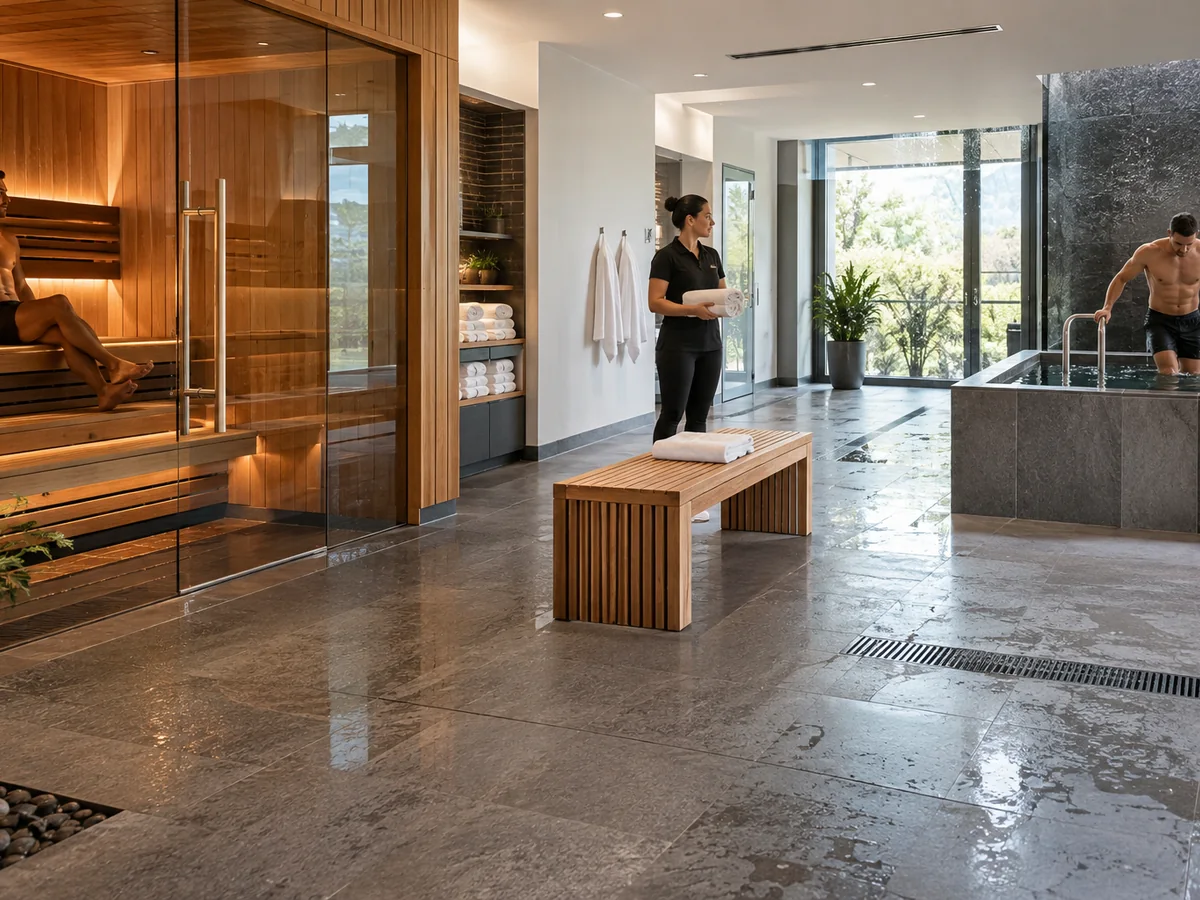
Ein gewerblicher Sauna-und-Cold-Plunge-Standort hat ein anderes Problem zu lösen: Menschen müssen sich sicher durch den Raum bewegen können, unabhängig davon, ob der geprüfte Betriebsablauf der Einrichtung Wärme → Kälte, Kälte → Wärme lautet oder einen separaten Erholungsschritt umfasst.
Ein Anlagenlayout sollte den Betriebsablauf unterstützen; es sollte nicht als medizinischer Nachweis behandelt werden, dass jeder Gast dieselbe Expositionsreihenfolge benötigt.
- Können sich nasse Nutzer zwischen Wärmezonen bewegen, ohne dass der Weg unnötig gefährlich wird?
- Gibt es eine glaubwürdige Entwässerungsstrategie entlang nasser Verkehrsbereiche?
- Gibt es einen Ort zum Innehalten oder Regenerieren, statt einen sofortigen Übergang zu erzwingen?
- Passen Sichtbarkeit des Personals und Verkehrsfluss zum Betriebsmodell?
- Können Privatsphäre und Nutzerbewegung koexistieren?
- Können Reinigung und Wartung erfolgen, ohne mit dem Gästefluss in Konflikt zu geraten?
Für US-amerikanische Arbeitsplatzkontexte, OSHA-Regeln für Geh- und Arbeitsflächen verlangen, dass Arbeitsraumböden im machbaren Umfang trocken gehalten werden, und verlangen Entwässerung, wo nasse Prozesse eingesetzt werden. Das ist eine nützliche Unterstützung für eine bewusste Nassbereichsverwaltung, doch sein Geltungsbereich ist Arbeitssicherheit — kein universeller Spa-Design-Code. Gebäude-, Barrierefreiheits-, Public-Health-, Elektro- und andere Anlagenanforderungen bleiben aufsichtsrechtlich und projektspezifisch.
von HACHILL Ausrüstungsplanung für Kontrasttherapie-Studio Die Seite verantwortet die weiterführende Anlagenaufgabe, einschließlich Zirkulation, Nass-/Trocken-Schnittstellen, Personalwegen und Betriebsplanung.
Eine Einrichtung kann daher für einen klaren Ablauf planen, ohne die Architektur in ein universelles Gesundheitsprotokoll zu verwandeln.
Häufig gestellte Fragen
Sollte man vor oder nach dem Kaltwasser-Tauchbad saunieren?
Wenn Sie die in den hier betrachteten kombinierten Studien verwendete Reihenfolge spiegeln möchten, ist Sauna gefolgt von Kaltwasserimmersion die nähere Forschungsentsprechung. Diese Studien haben Sauna zuerst nicht direkt mit Kalt zuerst als konkurrierende Routinen verglichen, daher belegen sie keine universell überlegene Reihenfolge.
Sollten Sie mit der Sauna oder dem Cold Plunge abschließen?
Die hier geprüfte Evidenz belegt keinen universellen Endzustand. Die Søberg-Winterbade-Studie beweist nicht, dass jeder kalt abschließen muss, und eine persönliche Vorliebe für den Abschluss sollte nicht in eine nicht belegte Stoffwechsel-, Erholungs- oder Schlafaussage umgewandelt werden.
Müssen Sie direkt von der Sauna ins kalte Wasser gehen?
Durch die hier geprüfte Evidenz ist keine allgemeine Frist für den unmittelbaren Übergang belegt. Forschungsprotokolle verwenden unterschiedliche Kühlstrukturen und Übergangszeitpunkte; daher sollte der Zeitpunkt einer einzelnen Studie nicht als Regel für jeden Nutzer behandelt werden.
Sagt die Wahl der Reihenfolge etwas darüber aus, wie viele Runden durchzuführen sind?
Nein. Startreihenfolge, Endreihenfolge, Übergangszeit, Zyklusanzahl, Temperatur und Dauer sind separate Entscheidungen. Das Zyklusdesign einer Studie ist Teil dieser Studie und nicht automatisch eine Vorgabe für die persönliche Nutzung.
Wer sollte es vermeiden, einer pauschalen Sauna-und-Kaltbad-Sequenz zu folgen?
Wer hinsichtlich der medizinischen Eignung unsicher ist, sollte sich nicht nur auf eine allgemeine Online-Abfolge verlassen. Relevante kardiovaskuläre Bedenken, Schwangerschaft, Medikamente oder Zustände, die die Hitze- oder Kältetoleranz beeinträchtigen können, frühere Ohnmacht, unerklärte Symptome oder besorgniserregende Symptome während einer Sitzung sind Gründe, individuelle Gesundheitsberatung zu nutzen, anstatt die nächste geplante Exposition zu erzwingen.