Réponse rapide : Si votre question est de savoir quel ordre est le plus directement représenté dans la recherche combinée sauna et eau froide, sauna suivi d'une immersion en eau froide ou d'une pause de refroidissement à l'eau froide est la séquence la plus clairement alignée sur la recherche. Les études publiées en 2016, 2020, 2025 et 2026 ont toutes utilisé la chaleur avant le froid pour examiner les réponses cardiovasculaires ou thermiques aiguës. Aucune de ces études citées n'a comparé directement sauna d'abord contre froid d'abord pour déterminer un ordre universellement supérieur pour la santé, la récupération, le sommeil ou le bien-être général. La conclusion défendable est donc limitée : sauna → froid est mieux représenté dans les protocoles combinés disponibles, et non prouvé meilleur pour chaque personne. Votre objectif, votre aptitude médicale, votre réponse à la chaleur et au froid, la dose d'exposition et votre capacité à arrêter en sécurité importent davantage que de copier une expérience. Le moment de l'entraînement, la température du bain froid, la durée et la circulation dans un établissement commercial sont des décisions distinctes.
Sauna avant ou après le bain froid ? Ce que les études ont réellement testé
La réponse la plus solide que cette page peut étayer concerne quel ordre combiné a réellement été étudié, et non quel ordre est universellement le meilleur. Dans les études humaines examinées ci-dessous, l'exposition au sauna précédait l'immersion en eau froide ou une pause de refroidissement incluant de l'eau froide.
| Étude | Ce que le protocole a testé | Ce qu'elle n'établit pas |
|---|---|---|
| Radtke et al., 2016 37 hommes atteints d'insuffisance cardiaque, de coronaropathie ou d'aucune des deux | Expositions au sauna puis immersion finale en eau froide ; les réponses hémodynamiques et autonomes ont été mesurées. Notice PubMed | Pas de comparaison froid en premier ; pas un essai d'ordre sur population générale. |
| Podstawski et al., 2020 55 jeunes hommes sédentaires | Le sauna suivi d'une immersion en eau froide a été comparé au sauna suivi d'une douche brève ou d'un repos en condition de refroidissement. Résumé de revue | Pas de comparaison sauna en premier versus froid en premier. |
| Szafraniec et al., 2025 28 femmes normotendues | Des phases répétées de chauffage en sauna finlandais étaient suivies de périodes de refroidissement incluant une immersion en eau froide ; les réponses cardiovasculaires ont été suivies. Étude publiée dans Scientific Reports | Pas de bras en ordre inversé et aucune affirmation qu'une séquence est optimale pour tous les résultats. |
| Owen et al., 2026 16 adultes en bonne santé | Dans un plan croisé, un sauna avec refroidissement à l'air a été comparé à un refroidissement de sauna incluant une brève immersion en eau froide. Étude publiée dans Experimental Physiology | Elle isole un effet de la méthode de refroidissement dans un protocole commençant par le sauna ; elle ne compare pas le froid d'abord au sauna d'abord. |
Ces études établissent sauna → froid une séquence défendable, appuyée sur la recherche, lorsque l'on souhaite reproduire l'ordre qui a été étudié. Ces travaux ne prouvent pas que l'ordre inverse est inefficace, dangereux ou inférieur, et ils n'établissent pas de règle de finition universelle.
Cette distinction est au cœur de cet article : utiliser la recherche pour décrire ce qui a été testé, sans transformer un protocole d'étude en prescription personnelle.
Une séquence courante ne signifie pas une séquence optimale prouvée
Trois idées différentes sont souvent confondues dans les conseils sur le sauna et le froid : une pratique traditionnelle, un protocole utilisé dans une étude, et des données comparatives montrant qu'un protocole donne un meilleur résultat. Ces éléments ne relèvent pas du même niveau de preuve.
Une étude peut examiner une séquence sans comparer les séquences
Si des chercheurs font suivre une séance de sauna d'une immersion en eau froide, ils peuvent mesurer ce qui se produit pendant ce protocole. À moins que l'étude ne compare aussi la séquence inverse avec une méthodologie appropriée, elle ne peut pas démontrer que le sauna en premier donne un meilleur résultat global que le froid en premier.
Séquence étudiée ≠ séquence supérieure.
Søberg 2021 ne prouve pas que tout le monde devrait terminer par le froid
L'étude Søberg de 2021 est souvent citée en ligne pour appuyer l'idée que les séances de contraste doivent toujours se terminer par une exposition au froid. La recherche originale portait sur des hommes expérimentés en nage hivernale et s'intéressait à la thermorégulation, à l'adaptation au froid et aux réponses liées au tissu adipeux brun. Elle n'a non pas randomisé les participants entre sauna en premier et froid en premier, et elle n'a pas comparé la finition par le froid à la finition par le chaud en tant que routines de consommation concurrentes. Le compte rendu de l'étude originale montre la population réelle et la question de recherche.
Søberg 2021 n'était pas un essai “ toujours terminer par le froid ”.
Un mécanisme n'équivaut pas à un résultat
La chaleur et le froid produisent de réelles réponses physiologiques aiguës. Cela ne signifie pas pour autant que chaque mécanisme plausible démontre un bénéfice pour l'utilisateur.
| Niveau de preuve | Ce qu'il peut vous indiquer |
|---|---|
| Réponse physiologique aiguë | Ce qui change pendant ou peu après l'exposition |
| Protocole d'étude | Les conditions réellement testées par les chercheurs |
| Preuve de résultat comparatif | Si une intervention a surpassé une autre pour un résultat défini |
| Recommandation d'usage personnel | Nécessite que les preuves et les limites de sécurité correspondent à la question individuelle |
Réponse physiologique ≠ résultat prouvé.
L'ordre de début, l'ordre de fin, le temps de transition et le nombre de cycles sont des questions distinctes
Savoir quelle modalité vient en premier ne donne pas une routine complète de thérapie par contraste.
| Variable de protocole | La question réelle |
|---|---|
| Ordre de début | Sauna ou bain froid en premier ? |
| Ordre de fin | Quelle exposition vient en dernier ? |
| Temps de transition | À quelle vitesse passez-vous d'une modalité à l'autre ? |
| Nombre de cycles | Combien de fois alternez-vous ? |
| Température | Quelle est la température de chaque exposition, chaude ou froide ? |
| Durée | Combien de temps dure chaque exposition ? |
Les études publiées sur le sauna et l'eau froide utilisent des durées de chauffage, des structures de refroidissement, des conditions d'immersion et des schémas de cycles différents. Par exemple, l' étude 2025 sur les séances répétées de sauna et d'immersion en eau froide et l' étude croisée 2026 sur l'immersion en eau froide pendant les pauses de refroidissement du sauna utilisaient des protocoles différents et répondaient à des questions de physiologie aiguë différentes. Ni l'un ni l'autre ne constitue une routine universelle, et aucun ne compare sauna d'abord contre froid d'abord en tant que séquences concurrentes.
Commencer par le sauna ne signifie pas automatiquement que vous devez finir par le froid
Commencer par la chaleur n'établit pas en soi ce que devrait être l'exposition finale. Les recherches examinées pour cet article ne justifient pas une règle universelle selon laquelle tout le monde devrait toujours finir par le froid, toujours se réchauffer ensuite, ou utiliser un état final spécifique pour le métabolisme, la récupération ou le sommeil.
Aucun délai de transition immédiate universel n'est établi ici
Certains protocoles de recherche utilisent l'immersion en eau froide dans le cadre d'une pause de refroidissement structurée ; d'autres incluent un refroidissement ou un repos supplémentaire. Cela ne justifie pas de transformer un protocole en une règle selon laquelle tout le monde doit entrer dans l'eau froide dans un nombre de minutes spécifique.
L'ordre ne détermine pas non plus le nombre de cycles à effectuer
Une étude peut recourir à des cycles répétés de chauffage et de refroidissement, car les chercheurs ont besoin d'une intervention standardisée. Ce nombre de cycles appartient à l'expérimentation et ne s'applique pas automatiquement à un lecteur général.
De même, les études sur la thérapie par contraste d'eau—alternance d'eau chaude et d'eau froide—ne doivent pas être considérées comme une preuve directe d'une séquence sauna puis bain froid.
Thérapie par contraste d'eau ≠ preuve de l'ordre sauna puis bain froid.
Pour les questions d'exposition précises, consultez les guides distincts de HACHILL : Guide de durée en sauna, Guide de durée en bain froid, et Guide de température du bain froid.
Une réponse sur l'ordre n'est pas une prescription de dose.
Quand faut-il faire une pause, arrêter ou éviter la transition chaud-froid suivante ?
La séquence prévue ne doit jamais primer sur votre réaction réelle à la chaleur ou au froid.
L'immersion en eau froide peut déclencher une réponse aiguë au choc thermique froid impliquant des modifications rapides de la respiration et de l'activité cardiovasculaire. Une revue systématique et méta-analyse de 2024 sur l'habituation au choc thermique froid a constaté que des immersions répétées peuvent réduire en moyenne plusieurs composantes de cette réponse. L'habituation n'est toutefois pas une preuve de sécurité individuelle et ne dispense pas de prévoir une sortie facile et des règles d'arrêt basées sur les symptômes.
Le sauna crée un stress distinct lié à la chaleur et à la perte de fluides. Recommandations de la Cleveland Clinic sur le sauna recommande de sortir en cas de vertiges, faiblesse, difficulté respiratoire ou inconfort important et préconise un avis médical dans les circonstances pertinentes. Ses conseils sur le bain froid conseille également de sortir en cas de sensation de tête légère ou d'inconfort préoccupant et souligne le stress cardiovasculaire et respiratoire lié à l'exposition au froid.
EN L'ABSENCE DE SIGNES D'ALERTE
L'absence de symptôme préoccupant ne prouve pas à elle seule l'aptitude médicale. Restez attentif à votre réaction et n'utilisez pas cette section comme un feu vert médical.
PAUSE OU ARRÊT
Ne forcez pas la prochaine exposition prévue si vous ressentez des vertiges, une sensation de faiblesse, une faiblesse inhabituelle, une difficulté respiratoire importante, une respiration incontrôlée à l'entrée dans le froid, une confusion, une mauvaise coordination, une gêne thoracique ou une détresse marquée.
AUCUN PROTOCOLE GÉNÉRIQUE
Si l'aptitude médicale est incertaine en raison d'une situation de santé pertinente, d'une grossesse, d'un médicament, d'un évanouissement antérieur ou d'un avis antérieur de limiter la chaleur ou le froid, un avis médical individualisé est plus approprié qu'une séquence en ligne.
La familiarité n'élimine pas le risque
Des expositions répétées au froid peuvent réduire certaines composantes de la réponse moyenne au choc thermique froid, mais l'habituation n'est pas une immunité. De même, une pratique familière du sauna ne rend pas impossibles la déshydratation, la surchauffe, la syncope ou une réaction inhabituelle.
Familiarité ≠ absence de stress thermique ou de froid.
L'alcool ne doit pas servir à rendre la routine plus facile
Les consignes de sécurité du sauna recommandent d'éviter le sauna après avoir consommé de l'alcool, et la transpiration augmente la perte de fluides. Un bain froid par la suite n'annule pas un jugement altéré, une déshydratation ou une autre raison pour laquelle la séance de chaleur était inappropriée.
Votre objectif ou le contexte de votre entraînement change-t-il réellement l'ordre ?

Parfois, l'objectif change la décision. Mais souvent, il change la page de preuves dont vous avez besoin, plutôt que de créer une nouvelle séquence sauna/bain froid.
La musculation est un bon exemple
A 2024 revue systématique et méta-analyse a constaté que l’immersion en eau froide pratiquée immédiatement après des séances de musculation pourrait atténuer modestement les gains d’hypertrophie, tout en jugeant les études sous-jacentes globalement de qualité passable à médiocre. Les auteurs notent également que les données analysées s’appliquent à l’immersion en eau froide (CWI) réalisée dans les 15 minutes environ suivant l’arrêt de l’exercice ; elles n’établissent pas l’effet d’une immersion occasionnelle plusieurs heures plus tard.
Ce constat concerne moment de l'exposition au froid par rapport à l'entraînement en résistance. Cela ne prouve pas que le froid d’abord est meilleur après la musculation, et placer un sauna avant le bain froid n’efface pas la question du timing.
Le moment de l'entraînement ≠ séquence générale sauna/bain froid.
Les lecteurs prenant une décision spécifique à l’entraînement doivent utiliser celles de HACHILL Bain froid avant ou après l'entraînement guide plutôt que de traiter le sauna en premier comme une solution de contournement.
Les allégations de récupération ont aussi besoin d'un résultat, pas seulement d'un mécanisme
Une personne peut ressentir moins de courbatures ou préférer la sensation après une exposition au froid. Cela n’établit pas automatiquement une meilleure adaptation à long terme. De même, le fait que la chaleur et le froid créent des réponses physiologiques aiguës différentes ne suffit pas à affirmer qu’un mode de finition produit universellement une récupération supérieure.
Se sentir mieux ≠ meilleure adaptation prouvée.
La relaxation, le sommeil et la vigilance ne sont pas des règles d’ordre universelles
Certaines personnes préfèrent terminer chaud parce qu’elles trouvent cela relaxant. D’autres préfèrent la sensation de terminer froid. Ce sont des préférences valables lorsqu’elles sont décrites comme des préférences.
Les données examinées pour cet article ne justifient pas de les transformer en affirmations universelles telles que terminer chaud pour un sommeil scientifiquement optimal, terminer froid pour une vigilance supérieure, le froid d’abord est préférable le matin, ou le sauna en dernier est toujours meilleur le soir.
La préférence peut départager—mais préférence ≠ supériorité médicale.
Choisir une séquence : schéma apparié à la recherche, préférence personnelle ou aucun protocole générique
Une fois que l’ordre, la dose et la sécurité sont séparés, la décision devient beaucoup plus claire.
| Votre situation | Parcours fondé sur les preuves | Ce que le parcours ne signifie pas |
|---|---|---|
| Vous souhaitez l'ordre combiné le plus directement représenté dans la recherche actuelle sur le sauna + CWI | SÉQUENCE ALIGNÉE SUR LA RECHERCHE — Sauna → froid | Non prouvé comme universellement meilleur et non une prescription personnelle |
| Les deux séquences sont par ailleurs appropriées et aucune preuve propre à l'objectif n'établit de supériorité | PRÉFÉRENCE / CONTEXTE | Une préférence n'est pas une allégation de santé |
| L'aptitude médicale est incertaine ou des symptômes préoccupants apparaissent | AUCUN PROTOCOLE GÉNÉRIQUE | Ne forcez pas une routine trouvée sur Internet |
| Votre question porte principalement sur l’adaptation à l’entraînement ou la récupération après l’effort | RESPONSABLE DU CALENDRIER D'ENTRAÎNEMENT | L’ordre des séances de sauna ne résout pas la question du moment d’entraînement |
| Votre question porte sur les minutes, la température de l’eau ou le nombre de tours | RESPONSABLE DOSE / SÉCURITÉ | La séquence n’établit pas la dose d’exposition |
SÉQUENCE CORRESPONDANT À LA RECHERCHE
Si votre objectif est de reproduire l'ordre combiné représenté par les études examinées ici, sauna suivi d'une immersion en eau froide correspond davantage à la recherche. Cela n'établit pas une supériorité ni une adéquation personnelle.
PRÉFÉRENCE / CONTEXTE
Lorsque les deux modalités sont par ailleurs appropriées et que les preuves directes de résultat ne permettent pas de départager pour votre objectif, la préférence de finition et le contexte pratique peuvent trancher.
AUCUN PROTOCOLE GÉNÉRIQUE
Utilisez des recommandations individualisées plutôt qu’une séquence trouvée sur Internet lorsque l’aptitude médicale n’est pas établie, que des symptômes préoccupants apparaissent, qu’une déficience est présente ou que la routine exigerait des hypothèses d’exposition non étayées.
La séquence n’est pas toujours la première question à résoudre.
Une fois la question des preuves et de la sécurité résolue : explorez les familles d’équipements adaptées à l’installation prévue. Pour un établissement commercial défini, poursuivez vers le parcours de planification des installations plutôt que de transformer un article sur une séquence publique en protocole d’exploitation.
Pour les établissements : planifier le parcours utilisateur chaud–froid sans prescrire un protocole universel unique
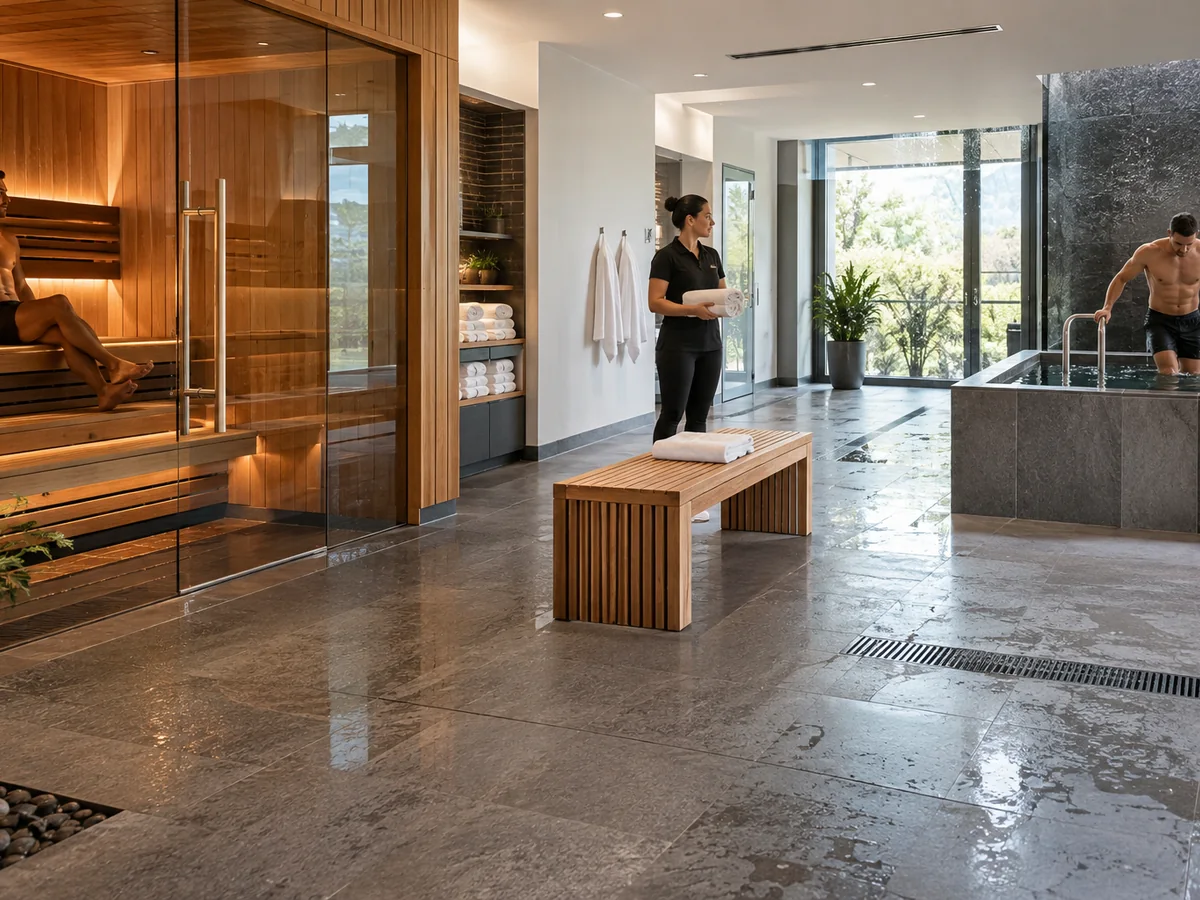
Un établissement commercial de sauna et bain froid a un problème différent à résoudre : les personnes doivent pouvoir circuler en sécurité dans l’espace, que le parcours d’exploitation examiné de l’établissement soit chaud → froid, froid → chaud ou comprenne une étape de récupération distincte.
L’agencement d’une installation doit soutenir le parcours d’exploitation ; il ne doit pas être traité comme une preuve médicale que chaque client a besoin du même ordre d’exposition.
- Des utilisateurs mouillés peuvent-ils circuler entre les zones thermiques sans parcours de marche inutilement dangereux ?
- Existe-t-il une stratégie d'évacuation crédible le long des zones de circulation mouillées ?
- Existe-t-il un espace pour faire une pause ou récupérer au lieu de forcer une transition immédiate ?
- La visibilité et la circulation du personnel conviennent-elles au modèle d'exploitation ?
- Confidentialité et circulation des utilisateurs peuvent-elles coexister ?
- Le nettoyage et l'entretien peuvent-ils avoir lieu sans interférer avec le flux des clients ?
Pour les contextes professionnels aux États-Unis, Règles OSHA relatives aux surfaces de marche et de travail exigent que les sols des ateliers soient maintenus secs dans la mesure du possible et exigent un drainage là où des procédés humides sont utilisés. Cela constitue un appui utile pour une gestion délibérée des zones humides, mais son champ d’application est la sécurité au travail—et non un code universel de conception de spa. Les exigences de construction, d’accessibilité, de santé publique, d’électricité et autres exigences d’installation restent propres à la juridiction et au projet.
HACHILL Planification de l’équipement d’un studio de thérapie par contraste page traite la tâche d’installation plus approfondie, y compris la circulation, les interfaces humide/sec, les parcours du personnel et la planification opérationnelle.
Un établissement peut donc concevoir un parcours clair sans transformer l’architecture en protocole de santé universel.
Foire aux questions
Faut-il prendre le sauna avant ou après un bain froid ?
Si vous souhaitez reproduire l’ordre utilisé dans les études combinées examinées ici, le sauna suivi d’une immersion en eau froide constitue la correspondance de recherche la plus proche. Ces études n’ont pas comparé directement sauna d’abord contre froid d’abord en tant que routines concurrentes, elles ne prouvent donc pas une séquence universellement supérieure.
Faut-il terminer par le sauna ou le bain froid ?
Les données examinées ici n’établissent pas un état de fin universel. L’étude Søberg sur la nage hivernale ne prouve pas que tout le monde doit terminer froid, et la préférence personnelle de fin ne doit pas être convertie en allégation non étayée sur le métabolisme, la récupération ou le sommeil.
Devez-vous passer directement du sauna à l'eau froide ?
Aucun délai universel de transition immédiate n’est établi par les données examinées ici. Les protocoles de recherche utilisent différentes structures de refroidissement et différents moments de transition ; le timing d’une étude ne doit donc pas être traité comme une règle pour chaque utilisateur.
Le choix de l’ordre vous indique-t-il combien de cycles effectuer ?
Non. L’ordre de départ, l’ordre d’arrivée, le temps de transition, le nombre de cycles, la température et la durée sont des décisions distinctes. Le design des cycles d’une étude fait partie de cette étude et ne constitue pas automatiquement une prescription pour un usage personnel.
Qui devrait éviter de suivre une séquence générique sauna puis bain froid ?
Toute personne dont l’aptitude médicale est incertaine ne doit pas se fier uniquement à une séquence générique trouvée en ligne. Des problèmes cardiovasculaires pertinents, une grossesse, des médicaments ou des affections susceptibles d’affecter la tolérance à la chaleur ou au froid, des antécédents d’évanouissement, des symptômes inexpliqués ou des symptômes préoccupants pendant une séance justifient de recourir à un avis médical individualisé plutôt que de forcer l’exposition prévue suivante.