Kort antwoord: Als uw vraag is welke volgorde directer wordt weergegeven in gecombineerd onderzoek naar sauna en koud water, sauna gevolgd door koudwateronderdompeling of een koudwater-afkoelpauze is de duidelijker onderzoeksmatige volgorde. Studies gepubliceerd in 2016, 2020, 2025 en 2026 gebruikten allemaal warmte vóór kou bij het onderzoeken van acute cardiovasculaire of thermische reacties. Geen van de aangehaalde studies vergeleek rechtstreeks sauna-eerst met koude-eerst om een universeel superieure volgorde te bepalen voor gezondheid, herstel, slaap of algemeen welzijn. De verdedigbare conclusie is daarom beperkt: sauna → kou is beter vertegenwoordigd in de beschikbare gecombineerde protocollen, niet bewezen het beste voor iedere persoon. Uw doel, medische geschiktheid, reactie op warmte en kou, blootstellingsdosis en vermogen om veilig te stoppen zijn belangrijker dan het kopiëren van één experiment. Timing van de training, temperatuur van de onderdompeling, duur en commerciële faciliteitsstroom zijn afzonderlijke beslissingen.
Sauna voor of na koudwateronderdompeling? Wat de studies werkelijk hebben getest
Het sterkste antwoord dat deze pagina kan ondersteunen, gaat over welke gecombineerde volgorde daadwerkelijk is onderzocht, niet welke volgorde universeel het beste is. In de hieronder besproken humane studies kwam saunablootstelling vóór koudwateronderdompeling of een afkoelpauze met koud water.
| Studie | Wat het protocol onderzocht | Wat het niet vaststelt |
|---|---|---|
| Radtke et al., 2016 37 mannen met hartfalen, coronaire hartziekte of geen van beide | Finse saunablootstellingen gevolgd door een laatste koudwateronderdompeling; hemodynamische en autonome reacties werden gemeten. PubMed-record | Geen vergelijking met koud water eerst; geen volgordeonderzoek in de algemene bevolking. |
| Podstawski et al., 2020 55 jonge sedentaire mannen | Sauna gevolgd door koudwateronderdompeling werd vergeleken met sauna gevolgd door een korte douche/rust-afkoelingsconditie. Tijdschriftabstract | Geen vergelijking tussen sauna-eerst en koude-eerst. |
| Szafraniec et al., 2025 28 normotensieve vrouwen | Herhaalde Finse-saunaverwarmingsfasen werden gevolgd door afkoelingsperioden met koudwateronderdompeling; cardiovasculaire reacties werden gevolgd. Onderzoek in Scientific Reports | Geen omgekeerde-volgorde-arm en geen claim dat één volgorde het beste is voor alle uitkomsten. |
| Owen et al., 2026 16 gezonde volwassenen | In een crossover-ontwerp werd sauna met luchtkoeling vergeleken met saunakoeling met een korte koudwateronderdompeling. Onderzoek in Experimental Physiology | Het isoleert een effect van de koelmethode binnen een sauna-eerst-protocol; het vergelijkt koude-eerst niet met sauna-eerst. |
Deze onderzoeken maken sauna → koud een verdedigbare, op onderzoek afgestemde volgorde wanneer iemand de onderzochte volgorde wil volgen. Ze bewijzen niet dat de omgekeerde volgorde ineffectief, onveilig of inferieur is, en ze vormen geen universele afsluitregel.
Dat onderscheid is de kern van dit artikel: gebruik het onderzoek om te beschrijven wat is getest, zonder een onderzoeksprotocol om te zetten in een persoonlijk voorschrift.
Veelvoorkomende volgorde betekent niet bewezen beste volgorde
Drie verschillende ideeën worden vaak door elkaar gehaald in advies over sauna en kou: een traditionele praktijk, een protocol uit een onderzoek, en vergelijkend bewijs dat het ene protocol een beter resultaat oplevert. Ze vormen niet hetzelfde bewijsniveau.
Een onderzoek kan één volgorde onderzoeken zonder volgordes te vergelijken
Als onderzoekers deelnemers eerst een sauna laten gebruiken en daarna in koud water laten gaan, kunnen ze meten wat er tijdens dat protocol gebeurt. Tenzij het onderzoek ook de omgekeerde volgorde vergelijkt met een passend design, kan het niet aantonen dat sauna-eerst een beter totaalresultaat oplevert dan kou-eerst.
Onderzochte volgorde ≠ superieure volgorde.
Søberg 2021 bewijst niet dat iedereen koud moet eindigen
De Søberg-studie uit 2021 wordt online vaak aangehaald ter ondersteuning van het idee dat contrastsessies altijd met koude moeten eindigen. Het oorspronkelijke onderzoek richtte zich op ervaren winterzwemmers en op thermoregulatie, koude-adaptatie en bruin vetweefsel-gerelateerde reacties. Het heeft betekent niet deelnemers gerandomiseerd naar sauna-eerst versus kou-eerst, en het heeft niet getest of eindigen met kou beter is dan eindigen met warm als concurrerende routines voor consumenten. Het oorspronkelijke onderzoeksrecord toont de werkelijke populatie en onderzoeksvraag.
Søberg 2021 was geen “altijd koud afronden”-onderzoek.
Een mechanisme is niet hetzelfde als een uitkomst
Warmte en kou veroorzaken echte acute fysiologische reacties. Dat betekent niet dat elk plausibel mechanisme een consumentenvoordeel aantoont.
| Bewijsniveau | Wat u eruit kunt afleiden |
|---|---|
| Acute fysiologische reactie | Wat verandert tijdens of kort na blootstelling |
| Onderzoeksprotocol | Welke omstandigheden onderzoekers daadwerkelijk hebben getest |
| Vergelijkend uitkomstenbewijs | Of de ene interventie beter presteerde dan de andere voor een gedefinieerd resultaat |
| Aanbeveling voor persoonlijk gebruik | Vereist dat de bewijslast en de veiligheidsgrens aansluiten bij de individuele vraag |
Fysiologische respons ≠ bewezen resultaat.
Startvolgorde, eindvolgorde, overgangstijd en aantal rondes zijn verschillende vragen
Weten welke modaliteit eerst komt, geeft je nog geen volledige contrasttherapie-routine.
| Protocolvariabele | De eigenlijke vraag |
|---|---|
| Startvolgorde | Eerst sauna of koudwaterbad? |
| Eindvolgorde | Welke blootstelling komt als laatste? |
| Overgangstijd | Hoe snel wisselt u? |
| Aantal cycli | Hoe vaak wisselt u af? |
| Temperatuur | Hoe warm of koud is elke blootstelling? |
| Duur | Hoe lang duurt elke blootstelling? |
Gepubliceerde onderzoeken naar sauna en koud water gebruiken verschillende verwarmingsduren, afkoelstructuren, immersieomstandigheden en cyclusontwerpen. Bijvoorbeeld de onderzoek uit 2025 naar herhaalde sauna en CWI en de 2026 cross-overstudie naar CWI tijdens afkoelingspauzes in de sauna gebruikten verschillende protocollen en beantwoordden verschillende vragen over acute fysiologie. Geen van beide is een universele routine, en geen van beide vergelijkt sauna-eerst met koude-eerst als concurrerende sequenties.
Sauna eerst betekent niet automatisch dat u met koud moet eindigen
Beginnen met warmte bepaalt op zichzelf niet wat de laatste blootstelling moet zijn. Het onderzoek dat voor dit artikel is bekeken, rechtvaardigt geen universele regel dat iedereen altijd met koud moet eindigen, daarna altijd opnieuw moet opwarmen, of één specifieke eindtoestand moet gebruiken voor metabolisme, herstel of slaap.
Er is hier geen universele deadline voor onmiddellijke overgang vastgesteld
Sommige onderzoeksprotocollen gebruiken koudwateronderdompeling als onderdeel van een gestructureerde afkoelpauze; andere bevatten extra afkoeling of rust. Dat rechtvaardigt niet dat één protocol wordt omgezet in een regel dat iedereen binnen een bepaald aantal minuten in koud water moet stappen.
De volgorde bepaalt ook niet hoeveel rondes u moet doen
Een onderzoek kan herhaald verwarmen en afkoelen gebruiken omdat onderzoekers een gestandaardiseerde interventie nodig hebben. Dat aantal cycli hoort bij het experiment, niet automatisch bij een algemene lezer.
Evenzo mogen studies naar contrastwatertherapie—afwisselend warm en koud water—niet worden behandeld als direct bewijs voor een sauna-plus-coldplunge-sequentie.
Contrastwatertherapie ≠ bewijs voor de volgorde sauna en coldplunge.
Voor vragen over exacte blootstelling verwijzen wij naar de afzonderlijke handleidingen van HACHILL: Gids voor saunaduur, Gids voor de duur van de koudebad, en Gids voor de temperatuur van het koudebad.
Een orderantwoord is geen dosisvoorschrift.
Wanneer moet u pauzeren, stoppen of de volgende warmte-koudeovergang vermijden?
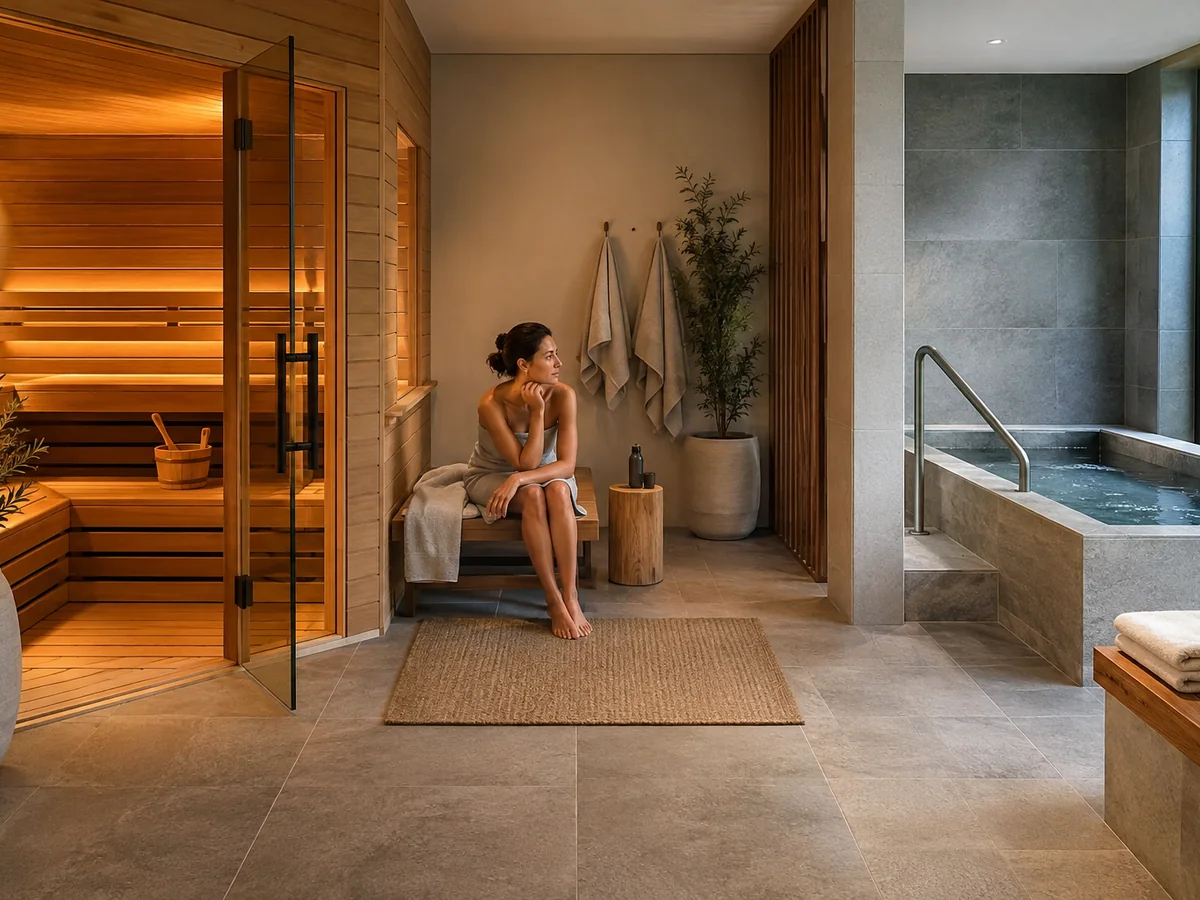
De geplande volgorde mag nooit zwaarder wegen dan uw werkelijke reactie op warmte of kou.
Koudwateronderdompeling kan een acute koudeshockreactie uitlokken met snelle veranderingen in ademhaling en cardiovasculaire activiteit. Een systematische review en meta-analyse uit 2024 naar habituatie aan koudeshock stelde vast dat herhaalde onderdompeling gemiddeld genomen verschillende componenten van die reactie kan verminderen. Habituatie is echter geen bewijs van individuele veiligheid en neemt de noodzaak van een gemakkelijke uitgang en op symptomen gebaseerde stopregels niet weg.
Sauna veroorzaakt een afzonderlijke stressfactor door warmte en vochtverlies. Cleveland Clinic saunabegeleiding adviseert te stoppen als duizeligheid, zwakte, ademhalingsmoeilijkheden of aanzienlijk ongemak optreedt en beveelt medisch advies aan in relevante omstandigheden. De richtlijnen voor koud onderdompelen adviseren eveneens te stoppen bij licht gevoel in het hoofd of verontrustend ongemak en wijzen op cardiovasculaire en ademhalingsstress door blootstelling aan kou.
INDIEN GEEN WAARSCHUWINGSSIGNALEN AANWEZIG ZIJN
De afwezigheid van een zorgwekkend symptoom vormt op zichzelf geen bewijs voor medische geschiktheid. Blijf alert op hoe u reageert en gebruik dit gedeelte niet als medisch groen licht.
PAUZEREN OF STOPPEN
Forceer de volgende geplande blootstelling niet als u duizeligheid, flauwvallen, ongewone zwakte, ernstige ademhalingsmoeilijkheden, ongecontroleerde ademhaling bij koude-instap, verwardheid, slechte coördinatie, ongemak op de borst of duidelijke ontreddering ontwikkelt.
GEEN GENERIEK PROTOCOL
Als medische geschiktheid onzeker is vanwege een relevante gezondheidsomstandigheid, zwangerschap, medicatie, eerder flauwvallen of eerder advies om warmte of kou te beperken, is individuele gezondheidszorgbegeleiding passender dan een online volgorde.
Bekendheid neemt het risico niet weg
Herhaalde blootstelling aan koude kan sommige componenten van de gemiddelde reactie op een koude schok verminderen, maar gewenning is geen immuniteit. Ook vertrouwd saunagebruik maakt uitdroging, oververhitting, flauwvallen of een ongebruikelijke reactie niet onmogelijk.
Bekendheid ≠ geen warmte- of koudestress.
Alcohol mag niet worden gebruikt om de routine gemakkelijker te laten aanvoelen
In de veiligheidsrichtlijnen voor sauna's wordt aanbevolen om saunagebruik te vermijden na het drinken van alcohol, en zweten verhoogt het vochtverlies. Een koude duik daarna maakt een verminderd beoordelingsvermogen, uitdroging of een andere reden waarom de hittesessie ongepast was niet ongedaan.
Verandert uw doel of trainingscontext daadwerkelijk de volgorde?

Soms verandert het doel de beslissing. Maar vaak verandert het welke bewijspagina u nodig heeft, in plaats van een nieuwe reeks sauna/koude duik te creëren.
Krachttraining is een goed voorbeeld
Een 2024 systematische review en meta-analyse ontdekte dat onderdompeling in koud water, gebruikt onmiddellijk na weerstandstrainingsessies, de winst van hypertrofie bescheiden kan verzwakken, terwijl de onderliggende onderzoeken over het algemeen als redelijk tot slecht van kwaliteit worden beoordeeld. De auteurs merken ook op dat het geanalyseerde bewijsmateriaal van toepassing is op CWI uitgevoerd binnen ongeveer 15 minuten na het stoppen van de inspanning; er wordt niet het effect vastgesteld van een incidentele duik enkele uren later.
Die bevinding gaat over timing van blootstelling aan koude ten opzichte van weerstandstraining. Het bewijst niet dat eerst koud zijn beter is na het tillen, en het plaatsen van een sauna vóór de duik neemt de vraag over de timing niet weg.
Trainingstijd ≠ algemene sauna/koude duikvolgorde.
Lezers die een trainingsspecifieke beslissing nemen, moeten die van HACHILL gebruiken Koude duik voor of na de training gids in plaats van sauna-eerst als oplossing te beschouwen.
Herstelclaims hebben ook een uitkomst nodig, niet alleen een mechanisme
Een persoon kan zich minder pijnlijk voelen of de voorkeur geven aan het gevoel na blootstelling aan koude. Dat leidt niet automatisch tot een betere aanpassing op de lange termijn. Op dezelfde manier is het feit dat hitte en kou verschillende acute fysiologische reacties veroorzaken niet voldoende om te beweren dat één eindtoestand een universeel superieur herstel oplevert.
Je beter voelen ≠ bewezen betere aanpassing.
Ontspanning, slaap en alertheid zijn geen universele orderegels
Sommige mensen geven er de voorkeur aan om warm af te ronden omdat ze dat ontspannend vinden. Anderen geven de voorkeur aan het gevoel koud te eindigen. Dit zijn geldige voorkeuren wanneer ze worden beschreven als voorkeuren.
Het bewijsmateriaal dat voor dit artikel is beoordeeld, rechtvaardigt niet dat ze worden omgezet in universele claims, zoals warm eindigen voor een wetenschappelijk optimale slaap, koud eindigen voor superieure alertheid, eerst koud is het beste in de ochtend, of als laatste in de sauna is altijd beter in de avond.
Voorkeur kan de band doorbreken, maar voorkeur is ≠ medische superioriteit.
Kies een reeks: op onderzoek afgestemd patroon, persoonlijke voorkeur of geen generiek protocol
Zodra volgorde, dosis en veiligheid gescheiden zijn, wordt de beslissing veel duidelijker.
| Jouw situatie | Bewijsbewuste route | Wat de route niet betekent |
|---|---|---|
| U wilt dat de gecombineerde orde het meest direct vertegenwoordigd is in lopend sauna+CWI-onderzoek | OP ONDERZOEK GEMATCHTE VOLGORDE — Sauna → koud | Niet universeel bewezen en geen persoonlijk recept |
| Voor het overige zijn beide bevelen passend en er is geen enkel doelspecifiek bewijs dat superioriteit aantoont | VOORKEUR / CONTEXT | Voorkeur is geen gezondheidsclaim |
| De medische geschiktheid is onzeker of er verschijnen zorgwekkende symptomen | GEEN GENERIEK PROTOCOL | Forceer geen internetroutine |
| Uw vraag gaat in de eerste plaats over trainingsaanpassing of inspanningsherstel | EIGENAAR VAN TRAININGSTIMING | De saunabestelling lost de vraag over de trainingstijd niet op |
| Jouw vraag is minuten, watertemperatuur of aantal rondes | DOSIS / VEILIGHEID EIGENAAR | De volgorde bepaalt de blootstellingsdosis niet |
OP ONDERZOEK GEMATCHTE VOLGORDE
Als het uw doel is om de gecombineerde volgorde weer te geven die wordt weergegeven door de hier besproken onderzoeken, sauna gevolgd door onderdompeling in koud water is the closer research match. Dat bewijst geen superioriteit of persoonlijke geschiktheid.
VOORKEUR / CONTEXT
Wanneer beide modaliteiten anderszins geschikt zijn en direct resultaatbewijs geen winnaar voor uw doel oplevert, kunnen finishvoorkeur en praktische context de knoop doorbreken.
GEEN GENERIEK PROTOCOL
Gebruik geïndividualiseerde begeleiding in plaats van een internetreeks wanneer de medische geschiktheid onopgelost is, er symptomen optreden, er sprake is van een beperking of de routine niet-ondersteunde blootstellingsaannames zou vereisen.
De volgorde is niet altijd de eerste vraag die moet worden opgelost.
Zodra de bewijs- en veiligheidsvraag is opgelost: verken de apparatuurfamilies die bij de beoogde opstelling passen. Voor een bepaalde commerciële locatie kunt u beter doorgaan met de planning van de faciliteit in plaats van een artikel uit de openbare reeks om te zetten in een operationeel protocol.
Voor faciliteiten: Plan de warm-koud-gebruikersstroom zonder één universeel protocol voor te schrijven
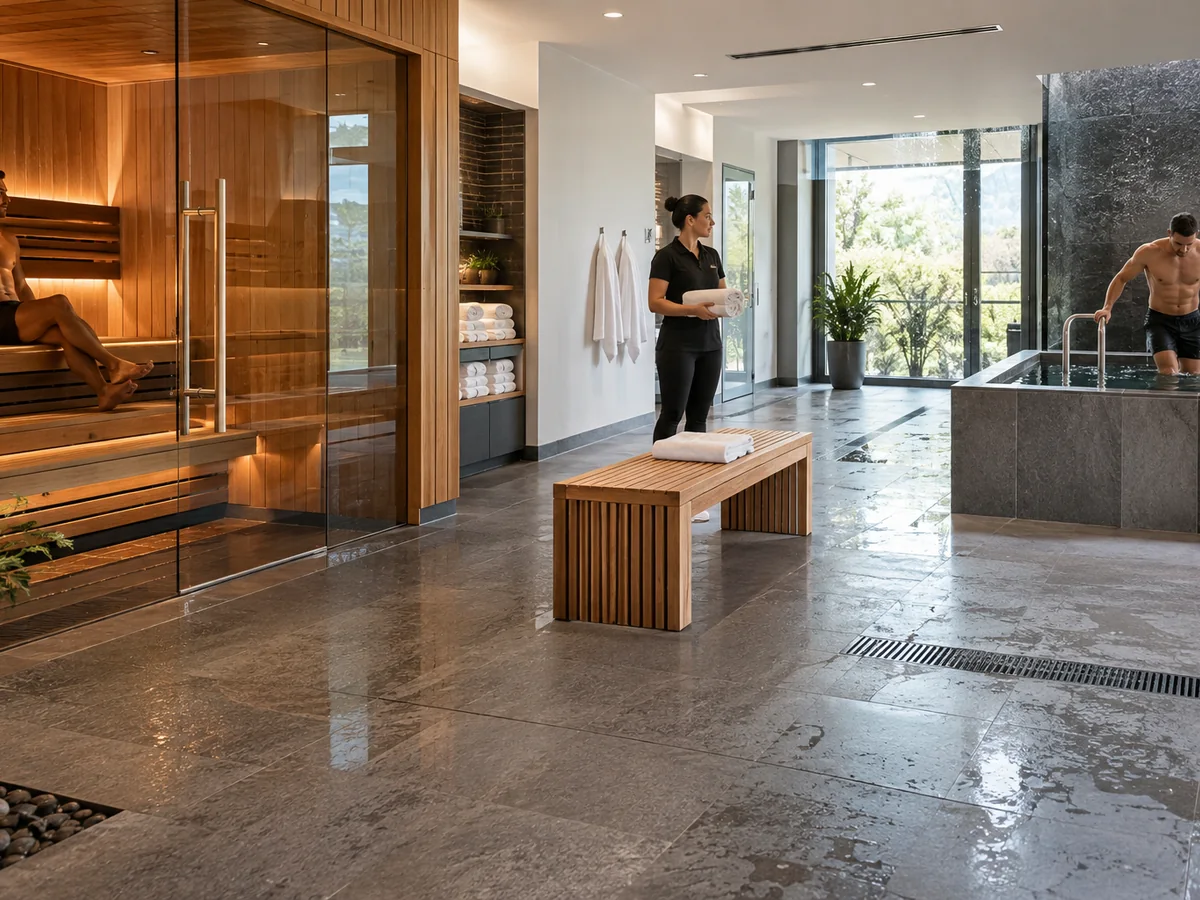
Een commerciële sauna-en-koude-dompellocatie heeft een ander probleem dat moet worden opgelost: mensen moeten zich veilig door de ruimte kunnen bewegen, ongeacht of de beoordeelde operationele reis van de faciliteit warmte → koude, koude → hitte is of een afzonderlijke herstelstap omvat.
Een inrichtingsindeling moet het operationele traject ondersteunen; het mag niet als medisch bewijs worden beschouwd dat elke gast dezelfde blootstellingsvolgorde nodig heeft.
- Kunnen natte gebruikers zich tussen thermische zones verplaatsen zonder een onnodig gevaarlijke looproute?
- Bestaat er een geloofwaardige drainagestrategie langs natte circulatiegebieden?
- Is er een plek om te pauzeren of te herstellen in plaats van een onmiddellijke transitie te forceren?
- Passen de zichtbaarheid en circulatie van het personeel bij het bedrijfsmodel?
- Kunnen privacy en gebruikersbewegingen naast elkaar bestaan?
- Kunnen schoonmaak- en onderhoudswerkzaamheden plaatsvinden zonder dat dit in conflict komt met de gastenstroom?
Voor Amerikaanse werkplekcontexten geldt OSHA-regels voor loop-werkoppervlakken vereisen dat de vloeren in de werkruimten zoveel mogelijk droog worden gehouden en vereisen drainage wanneer natte processen worden gebruikt. Dat is een nuttige ondersteuning voor doelbewust beheer van natte gebieden, maar de reikwijdte ervan is de veiligheid op de werkplek – en niet een universele ontwerpcode voor spa's. Eisen op het gebied van gebouwen, toegankelijkheid, volksgezondheid, elektriciteit en andere faciliteiten blijven jurisdictie- en projectspecifiek.
HACHILL’s Planning van studioapparatuur voor contrasttherapie pagina is eigenaar van de diepere facilitaire taak, inclusief circulatie, nat/droog interfaces, personeelsroutes en operationele planning.
Een faciliteit kan daarom ontwerpen voor een duidelijke reis zonder de architectuur in een universeel gezondheidsprotocol te veranderen.
Veelgestelde vragen
Moet u voor of na een koude duik in de sauna gaan?
Als je de volgorde wilt weerspiegelen die wordt gebruikt in de gecombineerde onderzoeken die hier worden besproken, is een sauna gevolgd door onderdompeling in koud water de beste onderzoeksmatch. In die onderzoeken werd sauna-eerst niet rechtstreeks vergeleken met eerst koud-eerst als concurrerende routines, dus ze bewijzen geen universeel superieure reeks.
Moet je afsluiten met de sauna of koude duik?
Het hier besproken bewijsmateriaal vestigt niet één universele eindtoestand. Het winterzwemmenonderzoek in Søberg bewijst niet dat iedereen koud moet eindigen, en persoonlijke voorkeur voor een finish mag niet worden omgezet in een niet-ondersteunde stofwisselings-, herstel- of slaapclaim.
Moet u rechtstreeks vanuit de sauna het koude water in?
Op basis van het hier beoordeelde bewijsmateriaal wordt geen universele deadline voor onmiddellijke transitie vastgesteld. Onderzoeksprotocollen gebruiken verschillende koelstructuren en overgangstijdstippen, dus de timing van één onderzoek mag niet als regel voor elke gebruiker worden beschouwd.
Geeft het kiezen van de volgorde aan hoeveel rondes je moet doen?
Nee. Startvolgorde, eindvolgorde, overgangstijd, aantal cycli, temperatuur en duur zijn afzonderlijke beslissingen. Het cyclusontwerp van een onderzoek maakt deel uit van dat onderzoek en is niet automatisch een voorschrift voor persoonlijk gebruik.
Wie moet het volgen van een generieke reeks sauna-en-koude-duik vermijden?
Iedereen wiens medische geschiktheid onzeker is, mag niet alleen vertrouwen op een generieke onlinereeks. Relevante cardiovasculaire problemen, zwangerschap, medicijnen of aandoeningen die de hitte- of koudetolerantie kunnen beïnvloeden, eerder flauwvallen, onverklaarde symptomen of betreffende symptomen tijdens een sessie zijn redenen om geïndividualiseerde gezondheidszorgbegeleiding te gebruiken in plaats van de volgende geplande blootstelling te forceren.