
إجابة مباشرة: اختر حوض غطس بارد أو حوضًا بناءً على واجب التشغيل، وليس التسمية. عادةً ما يدعم الحوض المدمج جلسات فردية خاضعة للتحكم بحدود تصنيعية محددة. بينما يقدم الحوض عادةً كمية مياه أكبر، وهيكلًا، وخدمات بناء، وإمكانية استخدام متزامن. يعتمد الشكل الصحيح على وضعية الجسم، وسهولة الوصول، والخصوصية، وتناوب المستخدمين، واستعادة الحرارة، ومعالجة المياه، والإشراف، والتصريف، ووصول الخدمة، ومن يملك كل واجهة من واجهات المشروع.
تغير كمية المياه الطاقة الحرارية المخزنة، لكنها وحدها لا تحدد حجم المبرد أو سعة المنشأة. تعتمد السعة التجارية أيضًا على الفاصل الزمني بين الجلسات، والاستعادة المقاسة، والتنظيف، وإطلاق المعالجة، والموظفين. قبل مقارنة المنتجات، ثبّت واجب المياه والمستخدم، وحدود الموقع، ومتطلبات الوجهة، واختبار القبول.
حدد حدود المنتج والمشروع أولاً
| التنسيق | الحدود النموذجية | قوة القرار | لا تفترض |
|---|---|---|---|
| حوض لشخص واحد | حزمة الوعاء والمعدات المصنّعة | جلسة مضبوطة ومدمجة | جميع أعمال التركيب مشمولة |
| حوض غطس عمودي | مساحة صغيرة، وضعية عمودية | تفضيل المساحة والغطس | دخول سهل لكل مستخدم |
| حوض غطس بوضعية الاستلقاء | مساحة أطول، وضعية استلقاء | الدخول ووضعية الجسم | نفس حجم الماء كالحوض العمودي |
| مسبح غطس بارد | جسم مائي أكبر أو مدمج في الموقع | خطة حركة أو متعددة المستخدمين | قواعد حمامات السباحة لا تنطبق أبدًا |
| بنك الأحواض | أحواض جلسات متعددة معزولة | السعة التسلسلية والعزل | مهمة علاجية مشتركة واحدة |
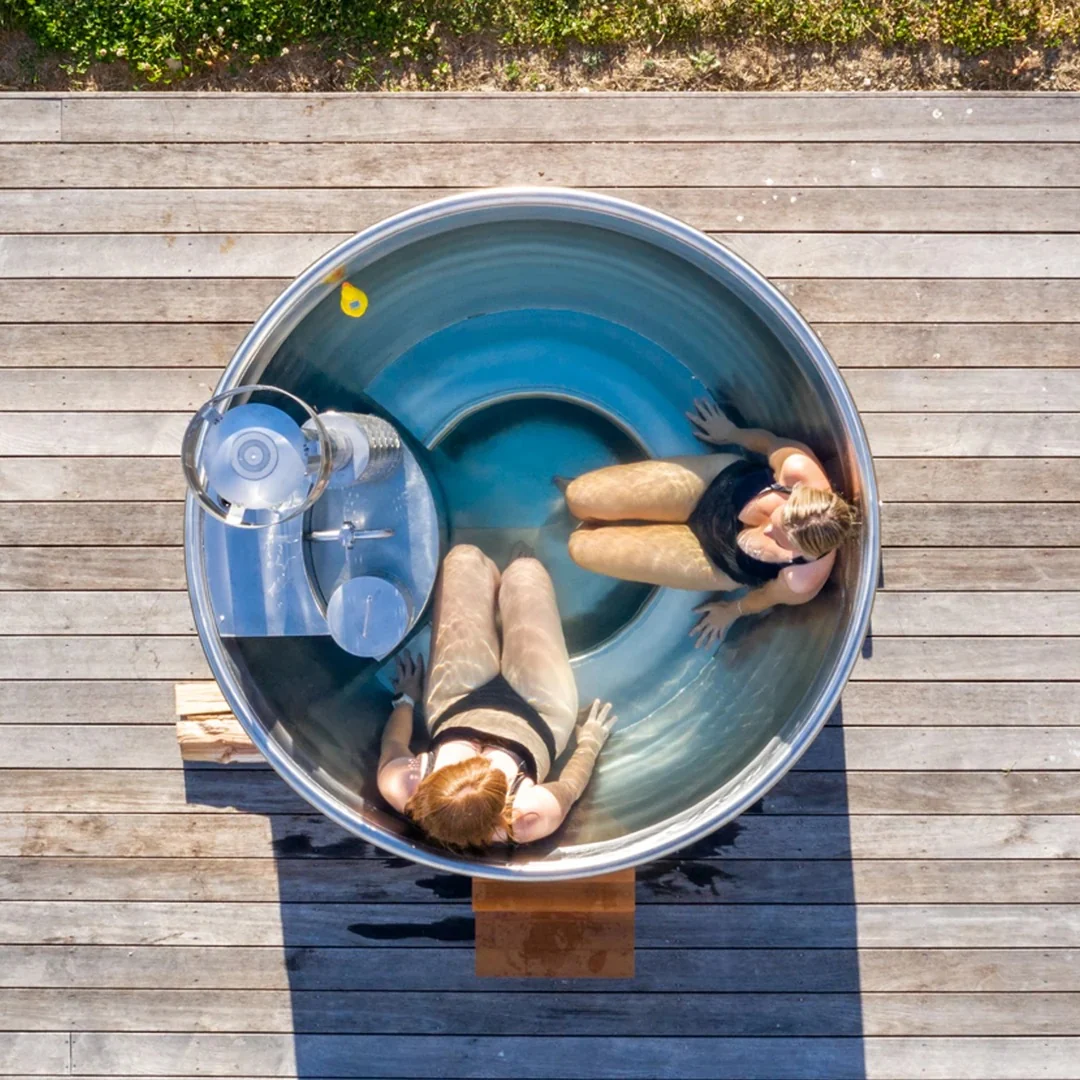
اطلب من الموردين ذكر الأبعاد الداخلية القابلة للاستخدام، وحجم المياه التشغيلي، وترتيب الدخول، وحدود المعدات، والاستخدام المقصود. قد يتم تسويق حوض كبير كحمام سباحة، بينما قد يحمل حوض مدمج صغير مسؤوليات بناء ومعالجة شبيهة بحمامات السباحة. لغة العقد والتصنيف المحلي أكثر أهمية من الأسماء التسويقية.
حدد وضعية المستخدم، والوصول، والخصوصية، والإشراف
| إدخال | تأثير الحوض | Pool implication | الإثبات |
|---|---|---|---|
| Posture/depth | Defined upright or reclined geometry | More variable positions | Usable drawing and trial |
| Entry/exit | Step, seat, rail and rim | Stairs, deck and edge | Accessibility/risk review |
| Privacy | Separated sessions possible | Shared-space planning | Operating policy |
| Supervision | One controlled station | More users/space to observe | Staffing and sightline plan |
| Emergency response | Direct single-user access | Deck and multi-user route | Site procedure and drill |
Do not select from footprint alone. A tall vessel may reduce floor area but create a harder entry for some users. A larger pool may permit movement but increases deck, slip, supervision and rescue considerations. Individual health suitability remains outside the equipment comparison and requires qualified guidance where needed.
Calculate Water Volume, Then State What the Number Cannot Prove
For a simple rectangular preliminary screen, volume equals length x width x average water depth. An illustrative pool at 2.0 m x 1.5 m x 1.2 m contains 3.6 m3, or about 3,600 L before displacement and freeboard. An illustrative 400 L tub has one ninth of that water mass. For the same 5 K change, the ideal stored-water energy is also nine times larger: about 20.9 kWh thermal versus 2.32 kWh thermal, using water specific heat near 4.18 kJ/kg-K.
| إدخال | Pool example | Tub example | الحدود |
|---|---|---|---|
| حجم المياه | 2.0 x 1.5 x 1.2 = 3.6 m3 | 400 L declared | Verify actual geometry/displacement |
| Approximate mass | 3,600 kg | 400 kg | Water-only approximation |
| تغيّر درجة الحرارة | 5 كلفن | 5 كلفن | Not a user recommendation |
| Stored energy | About 20.9 kWh thermal | About 2.32 kWh thermal | Excludes ongoing heat gains |
| Ratio | 9 x tub water mass | Reference | Does not size equipment alone |
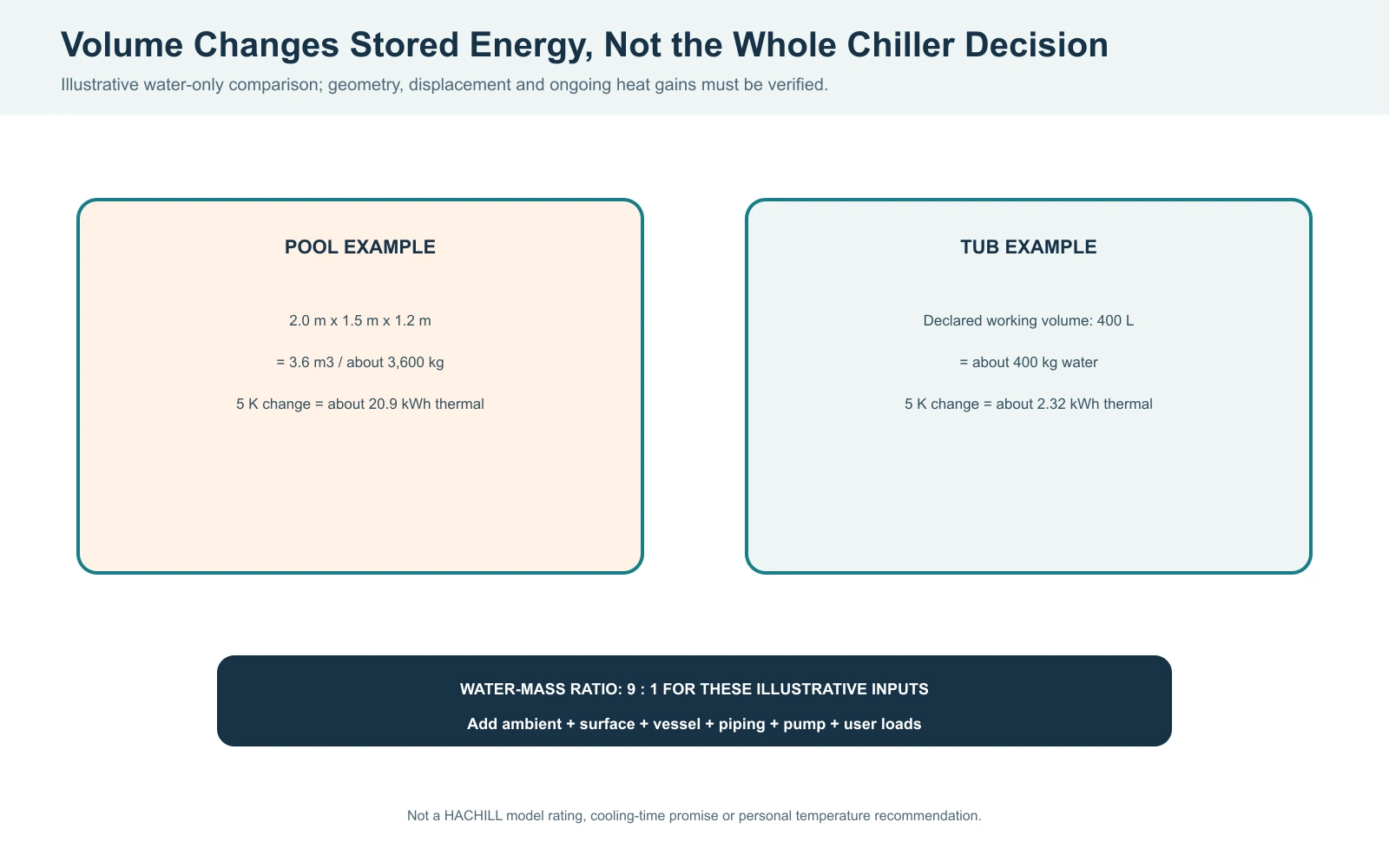
Real cooling includes vessel, piping, ambient, surface, solar, pump and user loads. Pool shape may require a measured fill volume or approved hydraulic calculation. Do not multiply a nominal exterior box when benches, slopes, freeboard and displacement materially change working water.
Separate Simultaneous Occupancy From Serial Throughput
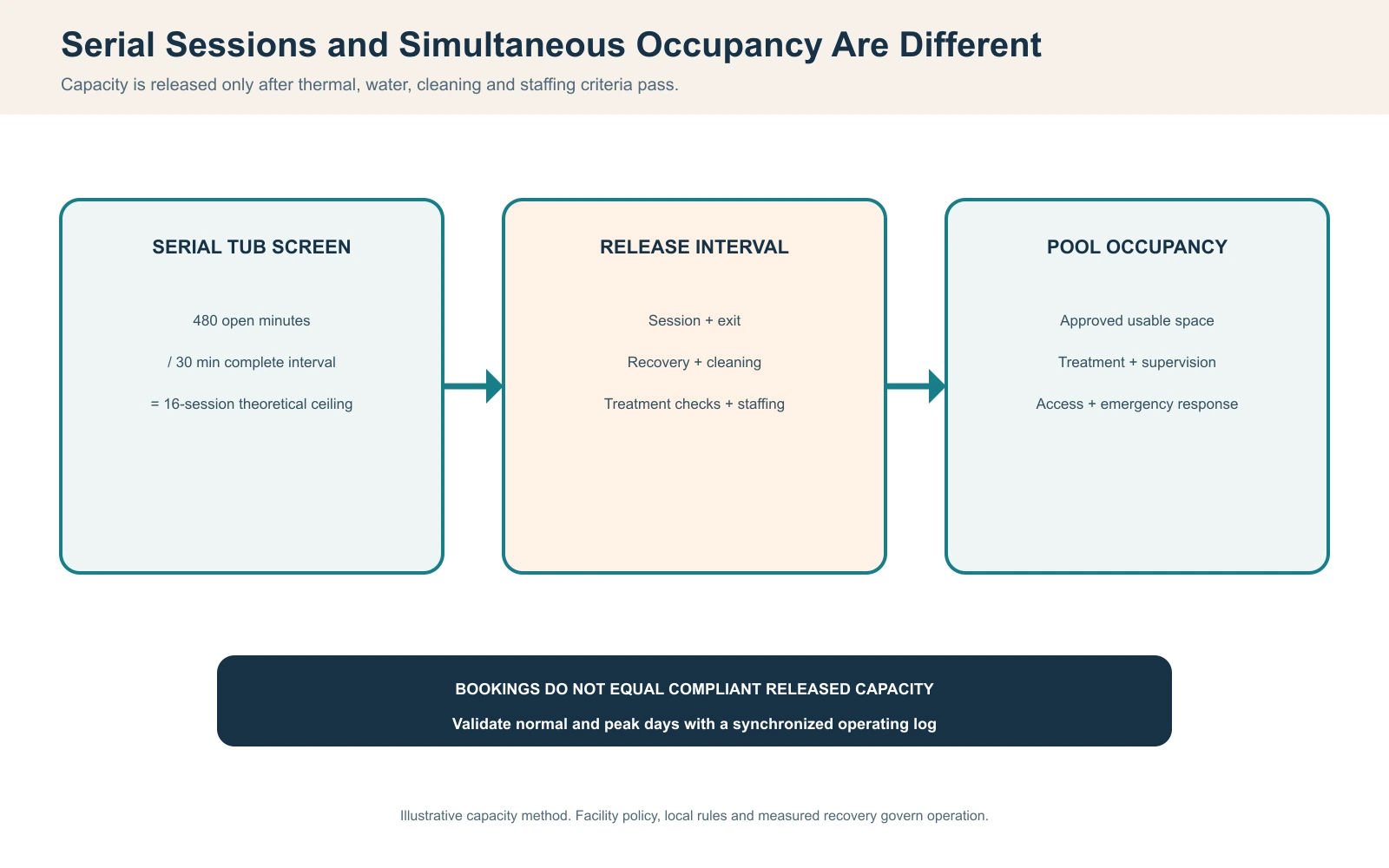
For an illustrative single tub, an eight-hour operating day provides 480 minutes. If the complete average interval is 30 minutes, the theoretical ceiling is 480 / 30 = 16 serial sessions. The real released capacity is lower when recovery, cleaning, treatment, checks, staff breaks or closures exceed that interval. A pool may host more than one user only when usable space, supervision, treatment and policy approve simultaneous occupancy.
| Capacity term | إدخال | Calculation/use | اختصار غير صالح |
|---|---|---|---|
| Open minutes | 480 min example | Available schedule | Assume no closures |
| Complete interval | 30 min example | Session + recovery + cleaning | Use immersion time only |
| Theoretical serial ceiling | 480 / 30 | 16 sessions before disruptions | Guarantee 16 released sessions |
| Simultaneous pool use | Approved occupants | Policy/design input | Area alone sets capacity |
| Actual released capacity | Operating log | Count compliant releases | Bookings equal successful use |
Compare Circulation, Mixing, Filtration and Treatment Duty
| القرار | Compact tub | Larger pool | دليل القبول |
|---|---|---|---|
| Circulation path | Short package loop possible | Multiple inlets/returns may be needed | Approved schematic and flow |
| Mixing | Local jet can bias sensor | Dead zones/short circuit risk | Mapped temperature/sampling |
| الترشيح | Single-user turnover still matters | Greater water/user burden | Pressure/flow and filter record |
| Treatment | Use and local rules govern | Public/commercial rules may govern | Water-management plan |
| Drain/clean | Smaller isolated vessel | More water and closure planning | Drainage and cleaning test |
Commercial water management cannot be inferred from the word “cold.” Confirm the authority having jurisdiction, bather load, turnover method, residual or treatment approach, sampling, recordkeeping, closure criteria and operator competence. Equipment suppliers can state interfaces; facility operators own routine water release unless the contract assigns otherwise.
Compare Structure, Access, Drainage and Service Interfaces
| الواجهة | Tub focus | Pool focus | Responsible evidence |
|---|---|---|---|
| البنية | Filled point/distributed load | Large permanent water/building load | Qualified structural review |
| Waterproofing | Splash, drain and leak containment | Tank/deck/joint system | Issued construction detail |
| الوصول | Packaged delivery and service panels | Construction sequence/plant access | Route and replacement plan |
| Drainage | Drain/refill and overflow | Pool/deck and larger discharge | Functional test |
| Plant/airflow | Integrated/external chiller clearance | Plant room, pipe and ventilation | Commissioned configuration |
A pool often shifts risk from product selection into building coordination. Waterproofing joints, penetrations, floor falls, deck drainage, plant access and future equipment removal must be designed. A tub reduces but does not remove these duties: the filled load, leak path, drain, electrical protection, condenser airflow and service clearance still need verification.
Compare Thermal Load and Recovery, Not Nominal Horsepower
| إدخال | لماذا يهم | سجل | Selection error |
|---|---|---|---|
| Start/target water | Stored energy change | Declared temperatures | Target omitted |
| Pull-down time | Required net removal rate | Preparation window | Minimum setpoint used as capacity |
| Ambient/sun | Ongoing load and capacity condition | Design range/exposure | Indoor rating used outdoors |
| Cover/insulation | Holding heat gain | Construction/use schedule | Perfect cover assumed |
| Users/recovery | Peak release interval | Representative load | Empty overnight test only |
| Flow/airflow | Available heat transfer | Commissioned values | Refrigeration blamed first |
Compare model performance at the stated entering-water and ambient conditions, not only horsepower or electrical input. Longer pipes, pump heat and an open surface can materially change duty. A pool's larger water mass can reduce rapid temperature swings once stable, but it also requires more energy for a given pull-down and may carry greater surface and user load.
Review Common Format-Selection Failures
Test the Representative Use Before Final Acceptance
| مرحلة | الإثبات | سؤال القبول | المالك |
|---|---|---|---|
| التكوين | Final vessel, piping, plant and controls | Matches approved revision? | Supplier/installer |
| Hydraulic/water | Flow, mixing, filter and treatment | Release criteria pass? | Commissioning/operator |
| حراري | Pull-down, holding and recovery log | Declared duty passes? | Buyer/supplier in scope |
| User route | Entry, exit, deck and supervision | Approved user plan works? | Facility/project team |
| Handover | Training, limits, spares and open items | Named roles accept? | Project owner |
Grade Evidence and Assign Responsibility
| Grade | الإثبات | الاستخدام | الحدود |
|---|---|---|---|
| A | Applicable requirements and approved user policy | Safety/operating boundary | Jurisdiction and facility specific |
| B | بيانات الطراز في الظروف المذكورة | Equipment comparison | Not site guarantee |
| C | Issued drawings and hydraulic/treatment design | Project implementation | Must match final build |
| D | Traceable commissioning and operating logs | Acceptance/capacity | Recorded duty only |
| E | Product name, photo or footprint | Orientation | No performance authority |
| القرار | Supplier | Designer/installer | Facility/operator |
|---|---|---|---|
| Product limits | State accurate scope/data | Coordinate interfaces | Approve intended use |
| Structure/site | Provide loads/clearances | Design compliant works | Preserve access |
| نظام المياه | State equipment interfaces | Design/install complete loop | Test, log and release |
| User capacity | State physical limits | Support route/design | Set policy/staffing |
| Dispute/retest | Preserve model evidence | Preserve build evidence | Preserve operating evidence |
No single party owns every pool interface. The vessel supplier cannot certify an undisclosed floor or building drain; the operator cannot redefine model limits; the installer cannot set clinical suitability. Record named decision owners and the authority having jurisdiction before selection.
Preserve the Failed Duty and Retest the Same Boundary
| Dispute | Preserve | Immediate action | Closure |
|---|---|---|---|
| Volume/capacity | Working volume, schedule and releases | Stop unsupported claim | Representative capacity log |
| Temperature/mixing | Mapped points, flow and state | Hold affected use | Same-point retest |
| معالجة المياه | Samples, users and treatment state | Apply closure policy | Operator/authority release |
| Site/interface | Drawing, installed condition and access | Assign correction owner | Inspection evidence |
| Recovery failure | User events, ambient and curve | Reduce throughput | Same-load retest |
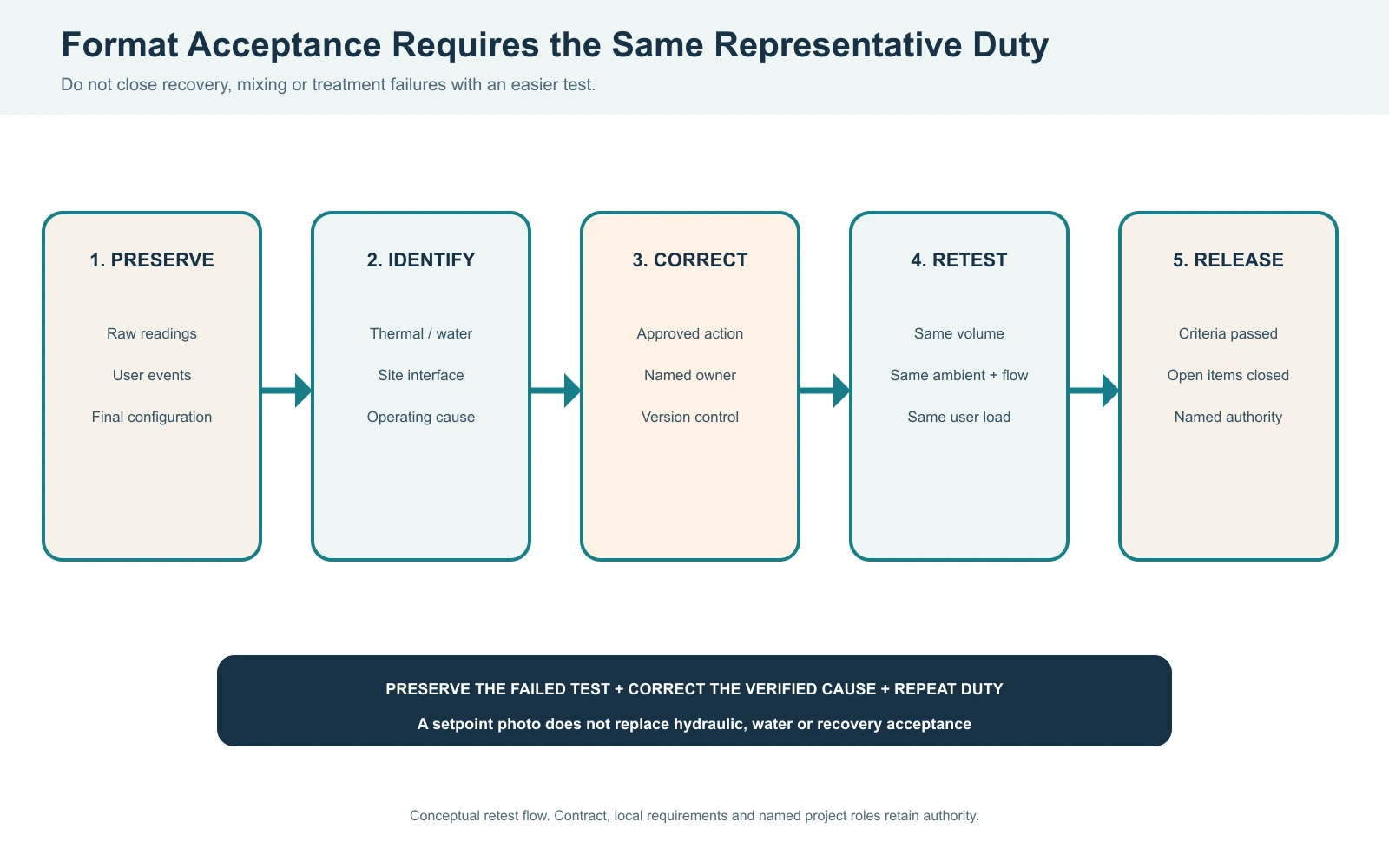
Do not close a pool recovery failure with an empty overnight test or close a mixing dispute with a reading beside the supply jet. Keep raw data, instrument IDs, drawings and configuration versions. Retest the same start condition, water volume, ambient, flow, user load and measurement method unless the approved change intentionally revises the project boundary.
الأسئلة الشائعة
ما الفرق بين حوض الغطس البارد وحوض الغطس البارد؟
عادةً ما يتسع حوض الغطس لشخص واحد في كل مرة ضمن وعاء مصنّع مدمج، بينما يتميز المسبح عمومًا بحجم مياه أكبر وقد يُبنى في الموقع أو يُصمم لاستيعاب حركة أو إشغال أكبر. الأسماء غير موحدة. قارن بين الأبعاد القابلة للاستخدام، ووضعية المستخدم، والإشغال، وحجم المياه، والدورة، والمعالجة، والحمل الحراري، والهيكل، والوصول، ومسؤولية التشغيل.
هل حوض الغطس البارد أفضل للنادي الرياضي؟
ليس تلقائيًا. قد يدعم المسبح تجربة استخدام مختلفة أو سعة متزامنة، لكنه يزيد أيضًا من الأعباء الإنشائية والهيدروليكية ومعالجة المياه والإشراف والواجهة البنائية. قد يوفر مجموعة من الأحواض جلسات متسلسلة منفصلة وعزلًا أسهل. قم بنمذجة جدول الحجز والاستشفاء والتنظيف والموظفين والخصوصية وإمكانية الوصول ومتطلبات الصحة العامة المحلية قبل الاختيار.
هل يحتاج حوض الغطس البارد الأكبر إلى مبرد مياه أكبر؟
عادةً ما يحتوي على طاقة مياه مخزنة أكبر، لكن الحجم وحده لا يحدد حجم المبرد. ظروف المياه الابتدائية والمستهدفة، فترة خفض درجة الحرارة، التعرض للمحيط وأشعة الشمس، الغطاء، العزل، الأنابيب، حرارة المضخة، حمل المستخدم، التدفق وظروف المكثف كلها عوامل مهمة. استخدم أداء الطراز في الظروف المذكورة وتحقق من النظام الكامل تحت الحمل المعلن.
كيف ينبغي حساب سعة أحواض الغطس البارد التجارية؟
حدد ما إذا كانت السعة تعني الإشغال المتزامن أو الجلسات المتتابعة. للاستخدام المتتابع، ابدأ بدقائق التشغيل مقسومة على الفاصل الزمني الكامل للجلسة، ثم قلل لمراعاة وقت الاستشفاء المُقاس والتنظيف وإطلاق المعالجة والتوظيف. للاستخدام المتزامن، تأكد من المساحة القابلة للاستخدام، والوصول الآمن، والإشراف، وتصميم معالجة المياه. عدد المقاعد أو المساحة الأرضية وحده لا يحدد السعة التشغيلية.
ما هي المعلومات التي يجب أن أرسلها لاتخاذ قرار بين المسبح والحوض؟
حدد التطبيق، وضعية المستخدم، احتياجات الوصول، عدد المستخدمين في الذروة، فترة الحجز، الإشغال المتزامن، أبعاد الغرفة والمدخل، ظروف المياه والمحيط، متطلبات السحب والتعافي، الإمداد الكهربائي، التصريف، التهوية، معلومات الأرضية أو الأساس، خطة العلاج، التوظيف، الوجهة، الكمية والمسؤولية عن التصميم والتركيب والتشغيل.
Related HACHILL Resources
Cold plunge systems
Review product formats after user, site and operating duty are defined.
Commercial cold plunge planning
Coordinate treatment, throughput, access and facility responsibility.
Cold plunge chiller sizing
Turn volume, ambient and recovery inputs into a complete thermal-duty review.
Cold plunge project cost
Compare installed and operated scope after the format is selected.
Request a format review
Submit user, water, site, utility, treatment and quantity inputs.
Reference Basis
- CDC Model Aquatic Health Code - US public aquatic facility reference; adoption and applicability are local.
- NSF/ANSI/CAN 50 - equipment and chemical evaluation scope for pools, spas and related recreational water facilities.
- NFPA 70, National Electrical Code - US electrical framework; the locally adopted edition governs.
Cold plunge pool-versus-tub RFQ inputs
- Application, user posture, accessibility and privacy
- Peak users, simultaneous occupancy and booking interval
- Working water volume and usable internal dimensions
- Starting/target water, ambient, pull-down and recovery
- Circulation, filtration, treatment and sampling plan
- Room, access, foundation/floor and drainage
- Chiller location, airflow and service/replacement route
- Voltage, frequency, phase and destination
- Supervision, cleaning, logging and release procedure
- Quantity, documentation and acceptance method
Choose the Format From Measured Duty
Send HACHILL the user plan, water and thermal duty, booking interval, treatment approach, room and access dimensions, structural and drainage boundary, utilities, destination and quantity. The team can review tub or pool interfaces without turning a format label into a performance promise.
Request a Project Review