
إجابة مباشرة: A cold plunge system may remain powered and circulate water 24 hours a day, but that does not mean its refrigeration compressor should run continuously. Compressor run time depends on whether the system is pulling down warm water, holding a stable temperature or recovering after users. Continuous compressor operation can be expected under a declared high load; it becomes a diagnostic signal when the water condition, ambient, flow and operating schedule do not justify it.
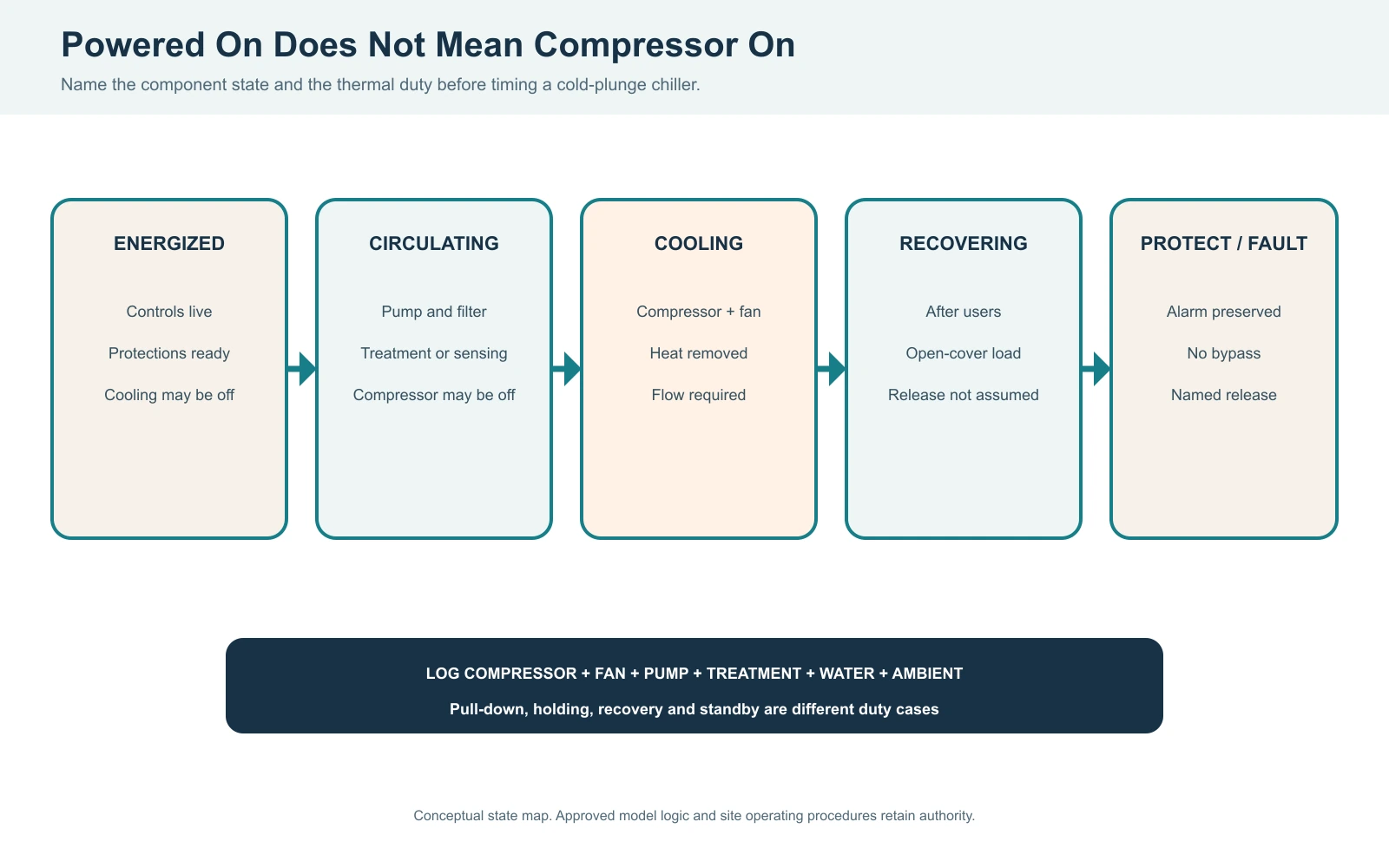
احكم على مدة التشغيل من الأدلة المتزامنة، وليس من الصوت وحده أو من أيقونة وحدة التحكم. افصل بين حالات الضاغط ومروحة المكثف ومضخة التدوير وجهاز المعالجة والسخان ووحدة التحكم. سجّل درجة حرارة المياه في منطقة الاستخدام ودرجة حرارة الإمداد والعودة والظروف المحيطة وحالة التدفق وموضع الغطاء وأحداث المستخدم والإنذارات والطاقة الكهربائية على أساس زمني واحد. توضح هذه المدخلات ما إذا كان التشغيل الطويل تبريدًا مفيدًا أو مشكلة في حمل الموقع أو قيدًا في جانب المياه أو قيدًا في جانب الهواء أو خطأ في التحكم.
حدد كل حالة تشغيل قبل توقيت المبرد
عبارة “المبرد يعمل” غامضة جدًا للتشخيص. قد تكون شاشة التحكم نشطة بينما يكون التبريد مكتملًا. قد تعمل مضخة التدوير للحفاظ على الترشيح والاستشعار. قد تبدأ مروحة المكثف فقط مع الضاغط، أو تتبع منطقًا معتمدًا مختلفًا. تتضمن بعض الأنظمة أيضًا الأوزون، أو الأشعة فوق البنفسجية، أو الجرعات، أو السخانات، أو تسلسلات الحماية من التجمد. حدد المكوّن والحالة المقاسة.
| الحالة | ما قد يعمل | الإثبات | خطأ شائع |
|---|---|---|---|
| استعداد نشط | وحدة التحكم والحمايات | الحالة واستهلاك طاقة منخفض مستقر | تم الإبلاغ عنه كتبريد نشط |
| التدوير/المعالجة | المضخة والفلتر والمعالجة | التدفق وقدرة المكونات | صوت المضخة يُسمى الضاغط |
| التبريد النشط | الضاغط والمروحة والمضخة | الإخراج المعتمد أو الاتجاه الكهربائي | أيقونة ندفة الثلج تُعامل كدليل |
| إزالة الجليد/الحماية | التسلسل الخاص بالطراز | الكود والدليل والاتجاه | إعادة ضبط الحماية بشكل متكرر |
| خطأ/قفل | قد تبقى أدوات التحكم نشطة | حالة الإنذار والنظام الأصلية | الخطأ في فهم الصمت على أنه إيقاف |
يمكن أن يساعد مقياس المشبك أو عداد الطاقة الفرعي أو مخرج التحكم المعتمد في تحديد الحالات، ولكن يجب إجراء القياس بواسطة شخص مؤهل عندما يتعلق الأمر بالوصول الكهربائي. لا تفتح اللوحات أو تعطّل أقفال الأمان. بالنسبة للعمليات الروتينية، عادةً ما يكون التسلسل الموثق واتجاه الطاقة غير التدخلي أكثر فائدة من التخمين بناءً على الضوضاء.
فصل مهام التبريد السريع، والحفاظ على درجة الحرارة، والاستشفاء، والاستعداد
| حالة التشغيل | Start/stop boundary | Dominant load | القرار |
|---|---|---|---|
| التبريد الأولي | Declared warm start to operating band | Stored water and vessel heat | Meets preparation window? |
| Steady holding | Stable band over declared period | Ambient, surface, pipe and pump gains | Cycling is stable? |
| Post-user recovery | User exit to next permitted release | User heat and open-cover time | Fits booking interval? |
| Standby/closure | Unoccupied scheduled state | Treatment and freeze/heat protection | Approved low-load mode? |
A compressor can run for a long uninterrupted period during pull-down without indicating a fault. That same pattern during a covered, unoccupied holding test may be abnormal. Conversely, rapid repeated starts can be more concerning than a steady long run because they may indicate poor sensor placement, inadequate system volume, unstable flow, excessive capacity, incorrect differential or another control problem.
Collect Synchronized Evidence Instead of Estimating by Sound
Use one clock and a fixed sampling interval that can capture meaningful cycling. Record raw values before calculating averages. A daily total without water and ambient conditions cannot explain why energy changed, while a temperature curve without component states cannot establish whether cooling was available.
| Timestamp | Component state | Water/site condition | Event and disposition |
|---|---|---|---|
| Test start | Compressor, fan, pump, treatment | Volume, temperatures, ambient, cover | Protocol and instruments confirmed |
| Fixed interval | On/off state and alarms | Occupied, supply, return, flow | Continue or hold |
| User event | State before/after entry | User count and open time | Start recovery clock |
| Band entry | Cooling state and cycling | Independent governing water value | Accept or remain closed |
| Test end | Run minutes and energy register | Ambient range and configuration | Accept, diagnose or retest |
Preserve controller exports, meter files and photographs with timestamps. State instrument identity and resolution. If an automated logger samples every minute while manual water readings occur every hour, document that difference. Do not invent precision by interpolating unobserved component states.
Calculate Duty Cycle and Whole-System Energy Transparently
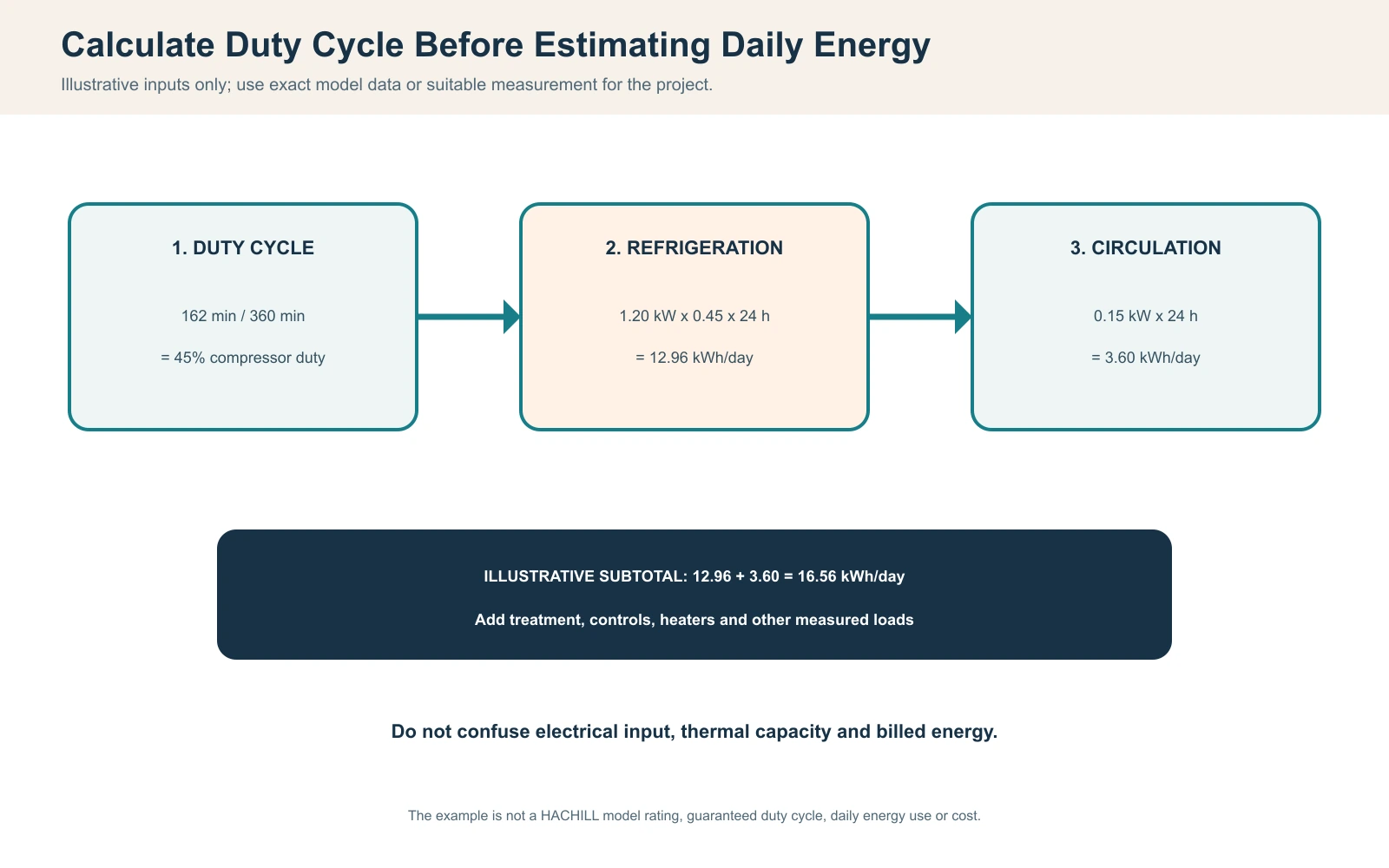
Compressor duty cycle is compressor-on time / elapsed observation time x 100%. In an illustrative six-hour holding window, 162 compressor-on minutes gives 162 / 360 x 100 = 45%. The percentage is meaningful only with the recorded water band, ambient, cover, flow and user condition. It is not a universal target.
| إدخال | مثال | الحساب | الحدود |
|---|---|---|---|
| الملاحظة | 360 min | Declared stable window | Not initial pull-down |
| Compressor on | 162 min | Measured state total | Not system power-on time |
| دورة التشغيل | 45% | 162 / 360 x 100 | Valid only for test conditions |
| Off/cycle time | Preserve raw sequence | Review starts and stops | Average can hide short cycling |
For a second illustrative screen, assume active refrigeration draws 1.20 kW and operates at 45% over 24 hours: 1.20 x 0.45 x 24 = 12.96 kWh. If a 0.15 kW circulation load operates continuously, it adds 0.15 x 24 = 3.60 kWh. Before other auxiliaries, the illustrative total is 16.56 kWh/day. Actual input must come from the exact equipment or a suitable meter; tariffs, taxes and demand charges are separate.
| Load | Example power/time | Daily energy | لا تستنتج |
|---|---|---|---|
| التبريد النشط | 1.20 kW x 45% x 24 h | 12.96 kWh | Cooling capacity or model rating |
| الدوران | 0.15 kW x 24 h | 3.60 kWh | All pumps use this power |
| Treatment/controls | Model-specific | Add measured value | Zero because it is small |
| Illustrative subtotal | Two declared loads only | 16.56 kWh/day | Guaranteed site energy or cost |
Map the Loads That Change Compressor Run Time
| Load path | المدخلات المطلوبة | Effect | تحقق |
|---|---|---|---|
| Ambient/open surface | Air, humidity, surface area and open time | Holding heat gain | Trend against ambient |
| Solar/weather | Sun, wind, rain and enclosure | Variable outdoor load | Compare representative periods |
| Users | Count, spacing and immersion | Recovery load | Log each event |
| Flow/water side | Pump, filter, valves, pipe size | Heat-transfer capacity | Verify approved flow method |
| Condenser air side | Intake, discharge, clearance, coil | Available refrigeration capacity | Check recirculation and blockage |
| Cover/insulation | Fit, continuity and schedule | Reduces holding load | Record actual use |
A frequent purchasing error compares electrical horsepower or nominal capacity without its rating conditions. Available cooling can change with entering water and condenser-air conditions. Pump heat and exposed warm piping add load. A filter restriction can reduce heat transfer and trigger protection even when the compressor itself is healthy.
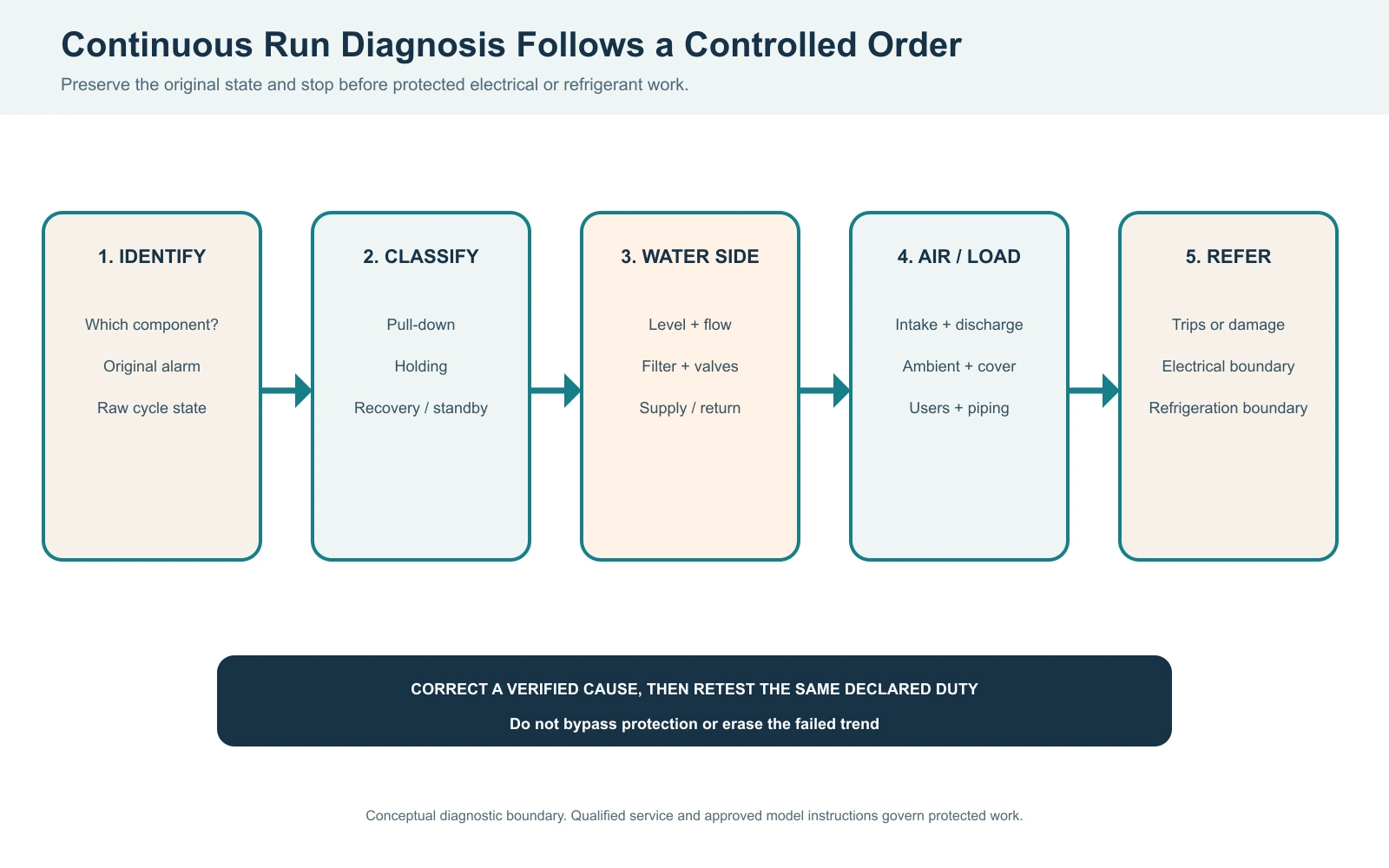
Diagnose Continuous Running and Short Cycling in the Correct Order
| Pattern | Possible condition | تحقق أولاً | Stop/referral boundary |
|---|---|---|---|
| Long run, water cooling | Valid pull-down/high load | Curve vs declared duty | Protection or model limit reached |
| Long run, little change | Heat load, flow, air or refrigeration issue | State, temperatures, flow, airflow | Qualified service if unresolved |
| Rapid starts/stops | Sensor, differential, flow or sizing issue | Raw cycle sequence | Repeated trips or abnormal current |
| Pump only, stable water | Normal treatment/sensing sequence | Approved control logic | Unexpected loss of flow |
| Silent with alarm | Protection or lockout | Preserve original code | Do not bypass or repeatedly reset |
Begin with simple external conditions: correct state identification, water level, approved valve positions, filter condition, visible leaks, unobstructed condenser paths and recorded alarms. Do not open energized equipment, touch damaged wiring or perform refrigerant work. Isolate and refer leaks near electrical parts, repeated breaker/GFCI/RCD operation, burning odor, damaged cables, abnormal mechanical noise, ice where not intended or repeated safety trips.
Review Common Field Scenarios
Test the Representative Commercial Schedule
An overnight empty-tub test does not prove recovery between bookings. Define acceptance before testing: starting water condition, operating band, ambient boundary, cover schedule, flow state, user or simulated load, booking interval, allowed alarms, measurement method and responsible release role.
| Test | الإثبات | سؤال القبول | المالك |
|---|---|---|---|
| Pull-down | Temperature curve and component states | Required preparation window met? | Buyer/supplier in scope |
| الإبقاء | Stable period, cycling and energy | Band held without unresolved trips? | Commissioning lead |
| الاستشفاء | User event to next release | Booking interval sustainable? | Operator/project owner |
| Protection | Alarm and closure response | Correct action demonstrated? | Qualified technical role |
| Handover | Baseline, limits, logs and training | Future trend can be compared? | Project owner |
Baseline data should represent an agreed operating condition, not the easiest day. Record configuration and software/control settings so later changes can be traced. A rising energy trend may indicate weather or user changes, a cover left open, dirty filters, impaired airflow, flow loss or another fault; the baseline makes those alternatives testable.
Grade Evidence and Assign Responsibility
| Grade | الإثبات | الاستخدام | الحدود |
|---|---|---|---|
| A | Applicable requirements and approved model documents | Safety and equipment limits | Market/model specific |
| B | Approved performance data at stated conditions | Selection comparison | Not site guarantee |
| C | Approved drawings, sequence and acceptance protocol | Project implementation | Must match final build |
| D | Synchronized field temperatures, states, flow and energy | Acceptance and diagnosis | Only recorded conditions |
| E | Sound, icon, isolated photo or anecdote | Initial observation | Not diagnostic proof |
| القرار | Supplier | Installer/operator | Qualified service/project role |
|---|---|---|---|
| Model limits | Provide stated-condition data | Stay in approved envelope | Verify regulated interfaces |
| Site configuration | State airflow/flow needs | Install and preserve access | Commission final system |
| Routine log | Explain states and alarms | Measure, maintain and retain | Verify instruments as required |
| Fault diagnosis | Support equipment evidence | Preserve fault and stop | Electrical/refrigeration work |
| Acceptance dispute | Provide model evidence | Provide site/load evidence | Independent decision if agreed |
An equipment supplier cannot control an unreported enclosure or operating schedule. An operator should not alter refrigerant or protected electrical systems. A service party cannot redefine the buyer's acceptance criteria after a failed test. Put the measurement and decision owners into the project record before commissioning.
Preserve the Failed Condition and Retest the Same Boundary
| Dispute | Preserve | Correction control | Retest evidence |
|---|---|---|---|
| Continuous run | States, curve, ambient, flow, airflow, load | Approved cause/action | Same holding or recovery duty |
| Energy exceeds estimate | Meter basis, tariffs, all component loads | Reconcile assumptions | Representative measured period |
| Short cycling | Raw start/stop sequence and settings | Version-controlled change | Same band and load |
| Protection trip | Original code and physical state | Qualified release only | Protection response verified |
| Throughput failure | User events and release readings | Capacity/schedule decision | Same representative load |
Do not delete the failed trend, change the observation window or compare a corrected shaded test with the original high-ambient failure without declaring the difference. Keep raw files, configuration versions and instrument IDs. Acceptance closes only when the agreed criteria pass under the agreed boundary and the named authority signs the disposition.
الأسئلة الشائعة
هل يجب أن أترك مبرد حوض الغطس البارد يعمل طوال الوقت؟
اتبع تعليمات الطراز المعتمدة وخطة تشغيل الموقع. قد يبقى النظام نشطًا حتى تعمل أدوات التحكم أو الدورة الدموية أو المعالجة بينما يعمل الضاغط فقط عند الحاجة إلى التبريد. قبل جدولة التشغيل المستمر، تأكد من متطلبات التدفق والترشيح وتهوية المكثف والحماية من التجمد والإمداد الكهربائي ووصول الصيانة والتشغيل دون مراقبة للطراز والموقع المحددين.
هل من الطبيعي أن يعمل ضاغط مبرد حوض الغطس البارد بشكل مستمر؟
قد يكون ذلك طبيعيًا أثناء التبريد الأولي، أو في ظروف محيطة دافئة، أو أثناء التعافي بعد استخدام المستخدمين. يستدعي التحقيق عندما تكون المياه المشغولة مستقرة بالفعل، أو الحمل المعلن منخفضًا، أو تغير زمن التشغيل عن خط أساس تم التحقق منه. سجّل درجات حرارة المياه، والظروف المحيطة، ونقطة الضبط، والتدفق، وحالة الغطاء، ومدخل ومخرج المكثف، والإنذارات، وحالة الضاغط قبل الحكم على الوحدة.
كيف أحسب دورة تشغيل مبرد حوض الغطس البارد؟
Choose a declared observation window and record compressor-on minutes, not merely system power-on time. Duty cycle equals compressor-on time divided by elapsed time, multiplied by 100 percent. State the test condition and how cycling was identified. A controller icon is weaker evidence than a measured electrical trend or an approved control output, and one favorable hour does not represent a commercial day.
لماذا يعمل المضخة عندما يكون حوض الغطس البارد باردًا بالفعل؟
قد يدعم مضخة التدوير الترشيح أو المعالجة أو استشعار درجة الحرارة أو الحماية من التجمد حتى أثناء إيقاف التبريد. منطق المضخة يختلف حسب الطراز. تحقق من التسلسل المعتمد ومواضع الصمامات وحالة الفلتر والتدفق الفعلي. لا توقف التدوير المطلوب لمجرد تقليل وقت التشغيل الظاهري، لأن التدفق المنخفض أو الراكد قد يضعف معالجة المياه والاستشعار ونقل الحرارة.
ما هي المعلومات المطلوبة لتقدير استهلاك الطاقة اليومي لحوض الغطس البارد؟
سجّل القدرة الفعلية للضاغط والمروحة والمضخة والسخان وجهاز المعالجة أو الطاقة المُقاسة؛ وأوقات تشغيل كل منها على حدة؛ وحجم الماء؛ ودرجات حرارة الماء الابتدائية والمستهدفة؛ ونطاق درجة الحرارة المحيطة؛ وحالة الغطاء والعزل؛ وجدول استخدام المستخدم؛ ووضع التدوير؛ وتدفق هواء المكثف؛ وتعرفة الكهرباء المحلية. احتفظ بالسعة الحرارية والمدخلات الكهربائية والكيلوواط-ساعة المُفوترة منفصلة. تحقق من التقديرات بفترة قياس ممثلة.
Related HACHILL Resources
Cold plunge systems
Review verified configurations after the operating duty and site boundary are defined.
Commercial cold plunge planning
Coordinate thermal duty, water treatment, access, throughput and operating responsibility.
Cold plunge chiller sizing
Connect run time and recovery evidence to the complete heat-load sizing method.
Cold plunge temperature settings
Define the measured operating band before judging compressor run time.
اطلب مراجعة للمشروع
Submit water, ambient, schedule, recovery, utility and destination inputs.
Reference Basis
- ASHRAE Handbook: Refrigeration - reference route for refrigeration principles; stated model and site data still govern performance.
- NFPA 70, National Electrical Code - US electrical safety framework; the adopted local edition and authority having jurisdiction govern installation.
- IEC 60335-2-60 - particular safety requirements for whirlpool baths and whirlpool spas; applicability depends on product and market scope.
Cold plunge run-time and energy RFQ inputs
- Water volume, starting condition and operating band
- Required pull-down, holding and peak recovery duty
- Peak users, booking interval and cover schedule
- Indoor/outdoor location, ambient range and solar exposure
- Insulation, piping, circulation, filtration and treatment
- Chiller placement, condenser airflow and service access
- Voltage, frequency, phase and destination requirements
- Available component power, energy and alarm records
- Measurement, logging and acceptance protocol
- Quantity, branding and documentation requirements
Specify the Duty Behind the Expected Run Time
Send HACHILL the water volume, starting and operating conditions, ambient range, pull-down and recovery requirement, user turnover, circulation and treatment plan, utilities, destination and quantity. The team can review equipment and project interfaces without promising a universal duty cycle or daily energy figure.
Request a Project Review