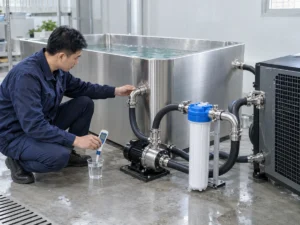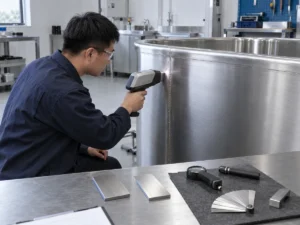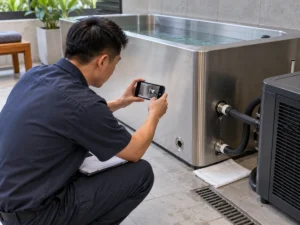
Une méthode contrôlée pour comparer des bains froids isolés et non isolés sur les phases de descente en température, de maintien et de récupération.
Réponse directe : Un bain froid isolé peut réduire l'apport de chaleur à travers les limites qui sont réellement isolées — comme la paroi de la cuve, la base, la couverture ou la tuyauterie raccordée — mais une comparaison équitable du refroidissement doit modifier uniquement la limite d'isolation déclarée. Faites correspondre la masse d'eau, la température initiale et cible, le refroidisseur, la circulation, l'état du filtre, l'exposition ambiante, le programme de couverture, les capteurs et la charge d'utilisateurs. Évaluez séparément l'abaissement, le maintien et la récupération. Sinon, un temps de refroidissement plus court peut provenir d'un refroidisseur, d'un débit, d'une couverture ou d'une condition d'essai différents plutôt que de l'isolation. Cette page explique comment comparer et interpréter les tests ; elle ne revendique pas de résultat de performance HACHILL A/B publié.
Ce guide s'adresse aux acheteurs de produits, aux exploitants commerciaux, aux distributeurs, aux installateurs et aux ingénieurs de projet qui ont besoin d'une méthode reproductible, et non d'un pourcentage d'économies non étayé. Il explique comment examiner l'énergie côté eau, collecter des données comparables, inspecter les ponts thermiques et l'humidité, évaluer les preuves, attribuer les responsabilités et clore un résultat contesté.
Portée de la page : Cet article traite de la méthode et de l'interprétation de la comparaison isolé/non isolé, et non d'un résultat universel de performance de refroidissement. Les pages produit traitent de la construction exacte, des accessoires inclus et des données du modèle. Un résultat s'applique uniquement à la configuration testée et aux conditions déclarées.
Effet principal : L'isolation réduit le flux de chaleur à travers la limite qu'elle couvre en continu.
Contrôle critique : Maintenez le système de refroidissement, la masse d'eau et l'exposition égaux.
Cas de décision : Séparez la descente en température, le maintien et la récupération.
Preuves nécessaires : Conserver les séries chronologiques brutes, les révisions, les événements et les registres de témoins.
Définissez précisément ce que signifie “ isolé ”
Le mot isolé ne constitue pas une spécification complète. Consignez le matériau, la propriété thermique déclarée lorsqu’elle est vérifiée, l’épaisseur installée, la couverture, les joints, la compression, la protection contre la vapeur et la révision. Identifiez ensuite chaque rupture dans la couche. Un panneau mural peut être isolé alors que le rebord, le cadre, la base, la porte d’accès, les raccordements de tuyauterie et le couvercle restent exposés. Ces chemins peuvent être prépondérants dans une petite cuve ou sur un site humide.
Décidez si la comparaison porte sur la construction des parois, les cuves complètes ou les systèmes installés. Si un échantillon utilise une couverture isolée et que l'autre est ouvert, le test mesure deux systèmes, et non l'isolation des parois seule. Cela peut rester utile, mais le rapport et le titre du résultat doivent le préciser.
| Élément de limite | Enregistrer | Pourquoi c'est important | Ne pas supposer |
|---|---|---|---|
| Paroi et base de la cuve | Matériau, couverture, joints, compression | Contrôle le gain de chaleur conductif | L'épaisseur nominale équivaut à la performance installée |
| Bord, cadre et pieds | Construction continue ou pontée | Peut contourner le champ isolé | Les petites surfaces sont négligeables |
| Couvercle | Construction, ajustement et programme ouvert/fermé | Contrôle la charge de surface supérieure | Une couverture est automatiquement incluse |
| Tuyauterie et raccords | Longueur, diamètre, exposition et isolation | Ajoute des gains de chaleur externes et des chemins de condensation | L'isolation du bain couvre la boucle |
| Enceinte de l'équipement | Chemin d'air et ouvertures de service | Affecte le rejet de chaleur et l'humidité | Une meilleure isolation est toujours utile |
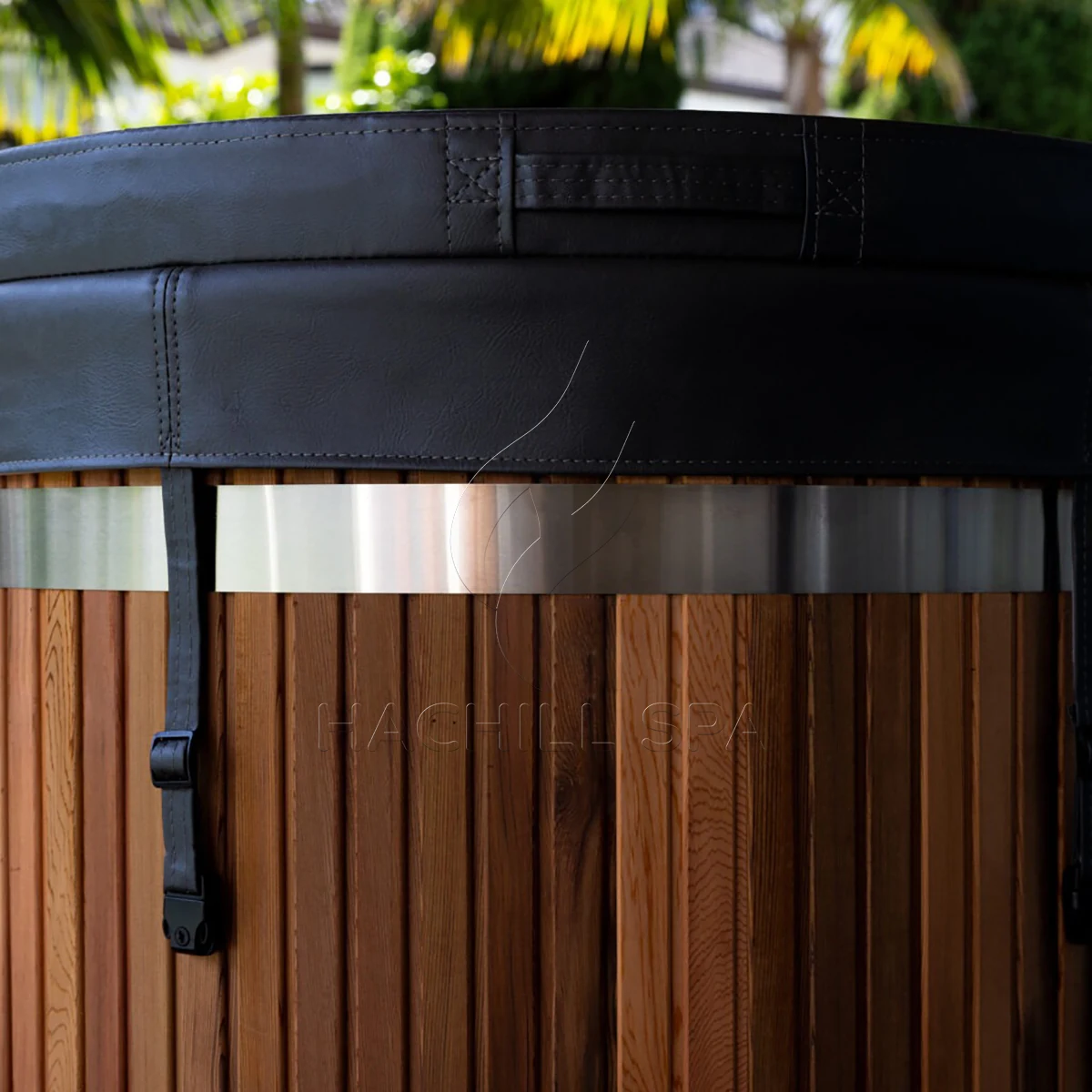
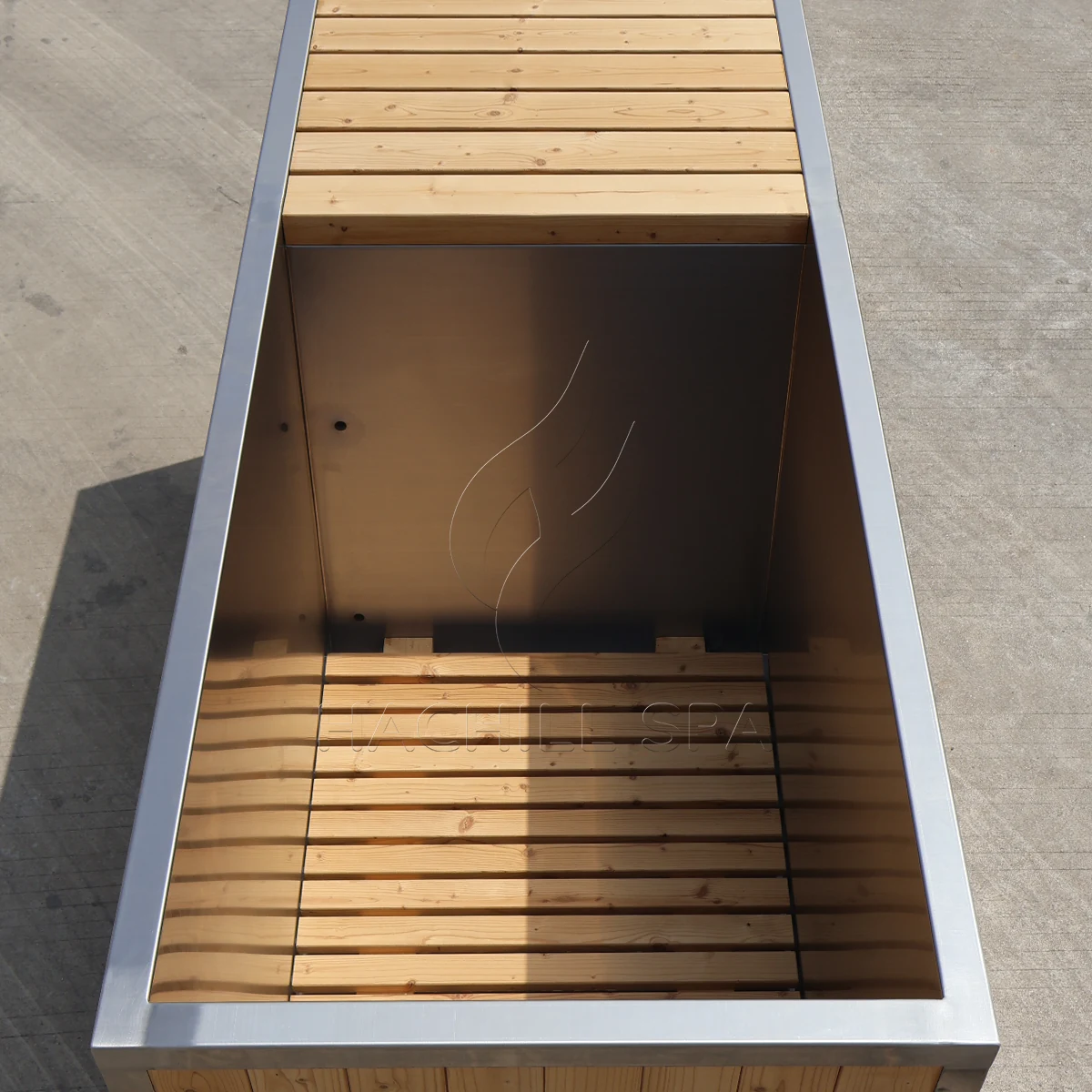
Ne déduisez pas une construction cachée à partir d'une photographie du produit. Pour l'achat, demandez un dessin de coupe approuvé ou un programme de construction spécifique au modèle. Si le fournisseur ne peut pas vérifier un champ, marquez-le comme ouvert. Un champ ouvert est plus sûr que de transformer une étiquette de catégorie en propriété contractuelle.
Séparer l'abaissement, le maintien et la récupération
L'isolation n'influence pas chaque état de fonctionnement de la même manière. Pendant la phase de descente en température, la chaleur stockée dans l'eau peut dominer et un refroidisseur de grande capacité peut masquer une différence plus faible dans les gains de chaleur continus. Pendant le maintien à couvercle fermé, les gains de chaleur environnementaux et le comportement de régulation deviennent plus visibles. La récupération ajoute des personnes, de l'eau de remplissage, du temps couvercle ouvert et des événements opérationnels.
| Cas de service | Règle de démarrage | Observation principale | Conclusion invalide |
|---|---|---|---|
| Pull-down | Eau initiale et cible déclarées | Tendance température-temps | Un seul point final prouve les économies d'isolation |
| Maintien | Cible stable et état du couvercle déclaré | Gain de chaleur, cyclage ou apport au fil du temps | Le résultat du jour au lendemain prédit l'opération occupée |
| Récupération | Événement utilisateur ou de remplissage horodaté | Tendance de retour et réponse de régulation | Le test de traction vers le bas prouve la récupération |
| Anormal | Événement de débit, de flux d'air, de fuite ou de protection | Réponse de protection et d'arrêt | Contourner la protection pour terminer un cycle |
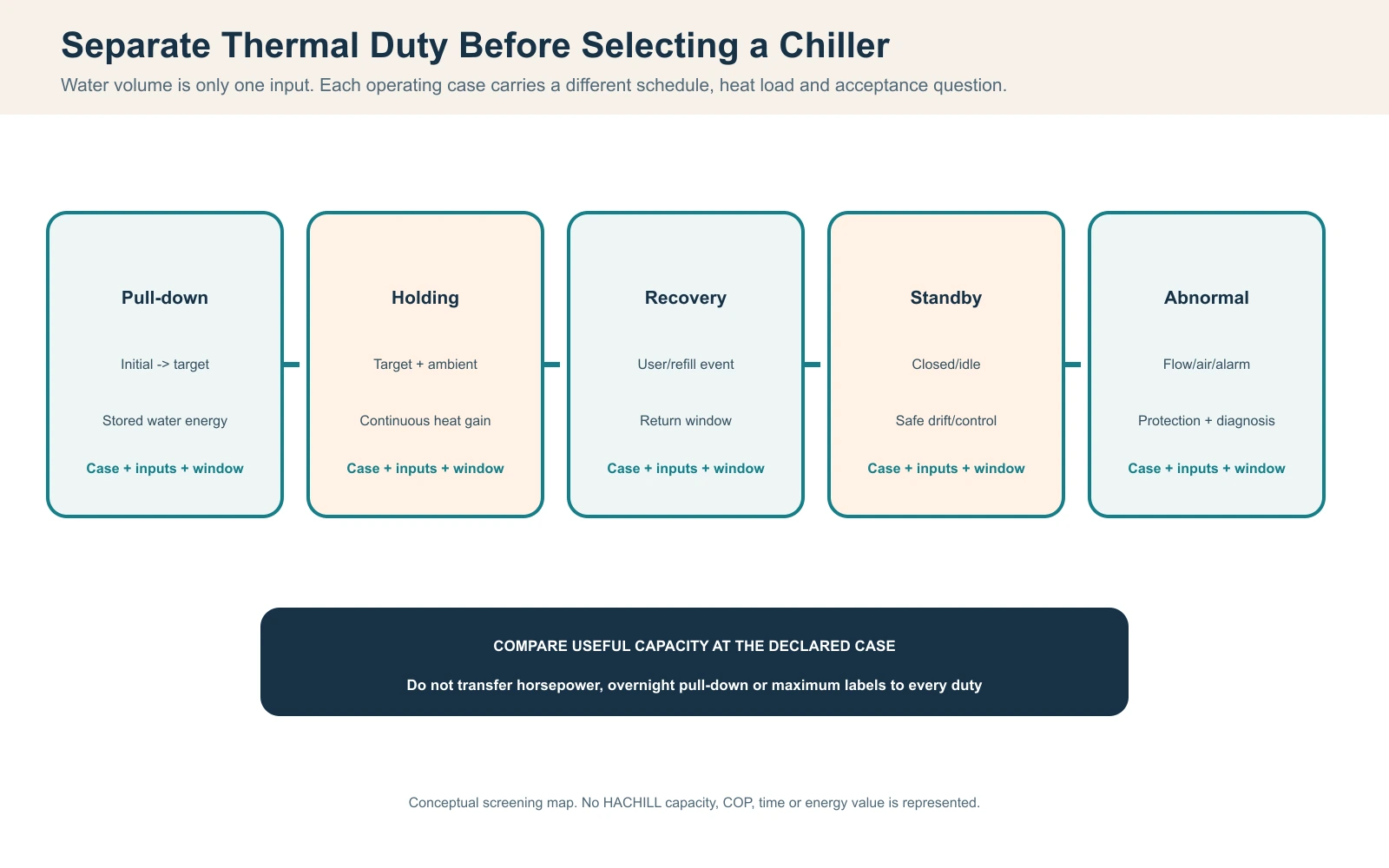
Déclarez la fenêtre d'observation et la règle de démarrage/arrêt avant l'examen des données. Un système qui fonctionne en continu pendant une descente en température volontairement chaude n'est pas automatiquement sous-dimensionné. Un système qui cycle pendant un maintien à faible charge n'est pas automatiquement surdimensionné. Le cas de charge et l'historique de charge donnent son sens au temps de fonctionnement.
Utiliser le calcul énergétique côté eau comme filtre
Le filtre énergétique de l'eau stockée est Q = m × cp × ΔT, où Q est l'énergie thermique, m la masse d'eau, cp la chaleur spécifique de l'eau et ΔT la variation de température requise. Maintenez des unités cohérentes. Ce calcul est utile car il oblige l'acheteur à définir la masse d'eau en fonctionnement et la variation de température avant de comparer les allégations de refroidissement.
| Entrée | Valeur de planification indicative | Utilisation | Limite |
|---|---|---|---|
| Masse d'eau, m | 500 kg | Énergie de l'eau stockée | Vérifiez la masse en fonctionnement ou déduisez-la du volume mesuré à partir d’une base de densité déclarée. |
| Chaleur spécifique, cp | 4.18 kJ/kg-K | Propriété de l'eau dans le filtre | Valeur indicative représentative près de la température ambiante ; utilisez des données de propriétés propres aux conditions pour les travaux formels. |
| Variation de température, ΔT | 20°C à 10°C = 10 K | Variation de température de l'eau requise | N'inclut pas le réservoir ni les gains thermiques continus |
| Q = m × cp × ΔT | 20,900 kJ, environ 5.8 kWh thermiques | Compare la charge de l'eau stockée | Ni consommation électrique ni temps écoulé |
Pour l'exemple étiqueté, 500 kg × 4.18 kJ/kg-K × 10 K donne 20,900 kJ, soit environ 5.8 kWh d'énergie thermique. La valeur de 4.18 kJ/kg-K est une propriété indicative arrondie pour l'eau liquide proche de la température ambiante ; un calcul formel devrait utiliser une base de propriétés appropriée pour la température et la composition du fluide réelles. Il ne s'agit pas d'une performance produit HACHILL, d'un résultat mesuré sur site ni d'une promesse d'énergie électrique. Cela exclut la masse thermique de la cuve, la chaleur entrant pendant le fonctionnement, la chaleur de la pompe, le comportement de la commande, les événements de dégivrage ou de protection et les différences entre capacité de refroidissement nominale et sur site.
Un premier calcul de temps peut comparer la charge thermique totale à la capacité de refroidissement dans des conditions déclarées, mais la puissance en chevaux et la puissance électrique absorbée ne constituent pas la capacité de refroidissement. Même une division basée sur la capacité n'est qu'une estimation prévisionnelle tant que les conditions réelles, le débit et les performances complètes du système ne sont pas vérifiés.
Rédigez un protocole d'essai apparié avant de commencer
Un test apparié défendable modifie la variable d'isolation prévue et maintient les autres entrées égales. Utilisez la même géométrie de cuve lorsque c'est possible. Si deux cuves physiques sont nécessaires, enregistrez la surface, la masse d'eau, les matériaux, le volume des tuyauteries connectées et toutes les différences de construction. Randomisez l'ordre des essais ou alternez les configurations lorsque c'est pratique afin qu'une pièce ou des conditions météorologiques changeantes ne favorisent pas systématiquement un échantillon.
| Variable | Comment contrôler | Preuve | Maintenir le test si |
|---|---|---|---|
| Eau | Même masse de fonctionnement mesurée et même chimie | Remplir le relevé et la référence de niveau | La base de volume diffère |
| Boucle de refroidissement | Même refroidisseur, tuyauterie, pompe et filtre propre | Photo de configuration et relevé de débit | L'état du débit ou du filtre est inconnu |
| État initial et état cible | Même tolérance de mélange et de démarrage | Lectures de séries chronologiques | Un échantillon commence plus froid |
| Environnement | Air d'admission, humidité, vent et charge solaire comparables | Journal du capteur local | L'application météo remplace la lecture sur site |
| Couverture et charge utilisateur | Même calendrier horodaté | Journal des événements | Les périodes d'ouverture diffèrent |
| Instrumentation | Mêmes capteurs, mêmes emplacements et même intervalle | Registre des instruments | Modifications de l'emplacement des capteurs |
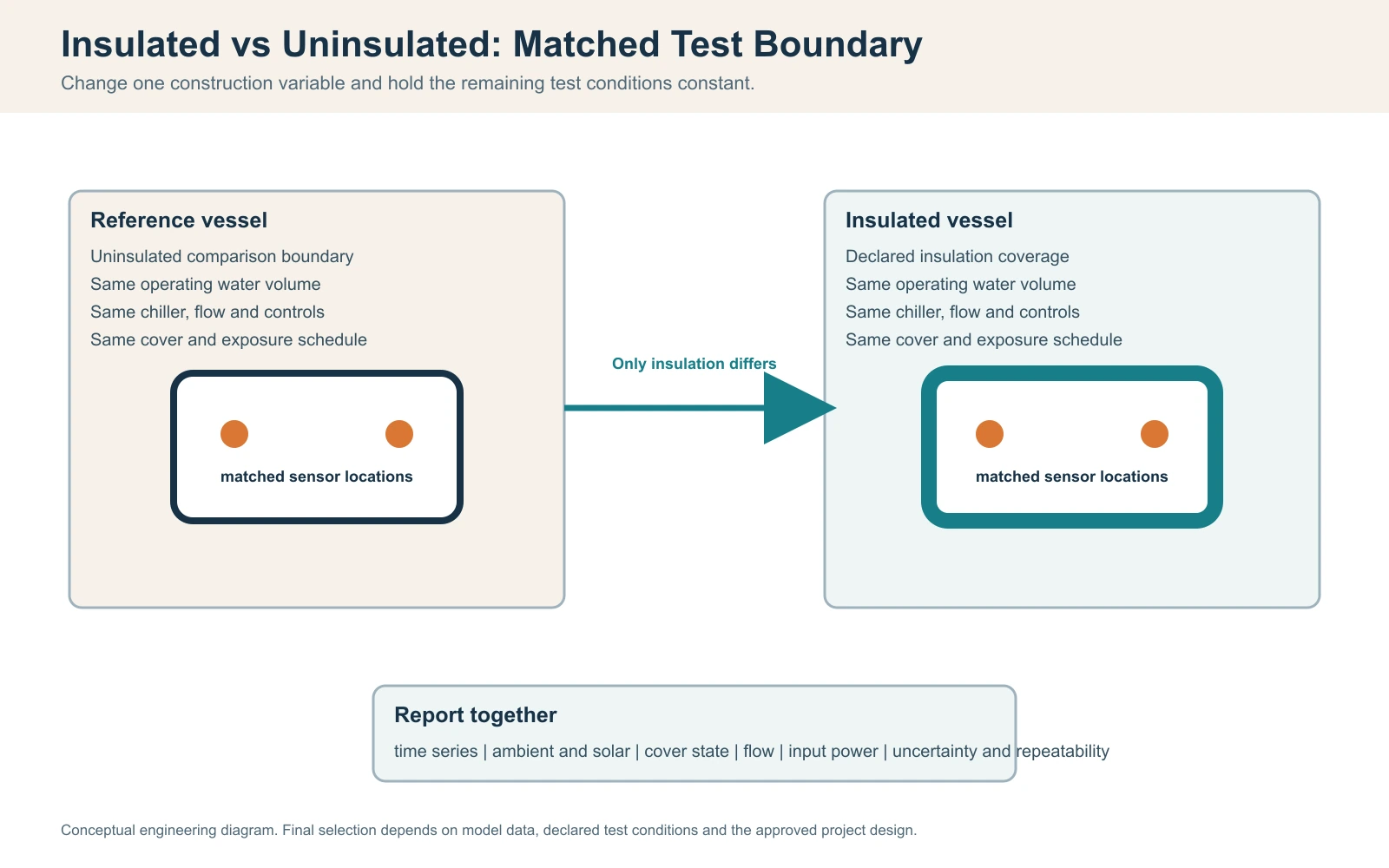
Définissez les règles de stabilisation, de mélange et de point final. Par exemple, l'essai ne doit pas commencer simplement parce qu'un capteur franchit brièvement une valeur. Précisez comment l'eau est mélangée, où la température est mesurée, quelle tolérance déclenche le chronomètre, quelle cible met fin à l'essai et comment une interruption est traitée. Le protocole doit également préciser si le couvercle reste fermé, quand la pompe de circulation démarre, et si le système complet ou seulement un composant est mesuré.
Les essais répétés sont les plus importants lorsque l'amélioration revendiquée est faible. Conservez chaque trace valide. Supprimer un essai gênant sans règle d'exclusion documentée transforme une comparaison technique en rapport sélectif.
Collectez des données synchronisées qui peuvent expliquer la différence
Une capture d'écran du contrôleur enregistre un instant ; elle n'établit pas ce qui s'est passé pendant un test. Utilisez une base de temps commune et un intervalle fixe pour la température de l'eau, l'air local et l'humidité, l'appel de refroidissement, l'état de fonctionnement du compresseur ou du refroidisseur, les alarmes, les preuves de débit, l'état du filtre et les événements de couverture/utilisateur. Enregistrez l'identité du capteur, son emplacement, ses unités et les informations de vérification ou d'étalonnage disponibles.
| Champ | Méthode | Utilisation de la décision | Problème de preuve |
|---|---|---|---|
| Température de l'eau | Points fixes avec règle de mélange déclarée | Tendance et point final | Le capteur près de l'entrée fausse le résultat |
| Ambiance et humidité | À l'admission du produit et du condenseur | Normalisez les conditions de chaleur et de point de rosée | Enregistrement météo à distance uniquement |
| État du débit/du filtre | Mesure approuvée ou proxy déclaré | Vérifiez la condition de transfert de chaleur | Aucun enregistrement après le service de filtrage |
| État de refroidissement/commande | Horodatage des appels, des cycles et des alarmes | Expliquer le comportement en service | La réinitialisation efface l'historique |
| Événements de couvercle/utilisateur/remplissage | Horodater chaque événement | Séparer la charge imposée | Uniquement le souvenir du personnel |
| Puissance électrique absorbée | Limite de compteur définie par un rôle qualifié | Comparer le même périmètre de système | Compresseur seul vs système complet |
| Risque | Signe observé | Vérifier | Traitement |
|---|---|---|---|
| Décalage du capteur | Les capteurs parallèles divergent | Co-localiser avant/après l'exécution | Corriger ou inclure l'incertitude |
| Mauvais mélange | Différentes profondeurs montrent des gradients | Utiliser le mélange déclaré et les emplacements | Ne pas choisir un point favorable |
| Dérive ambiante | Les exécutions ont lieu dans des conditions météorologiques différentes | Comparer les journaux locaux synchronisés | Répéter ou limiter la conclusion |
| Hystérésis de contrôle | Seuils de démarrage/arrêt différents | Enregistrer le point de consigne et les appels réels | Normaliser avant comparaison |
| Variation d'une exécution à l'autre | L'effet est inférieur à la dispersion | Répéter les deux configurations | Rapport non concluant |
Placez le capteur ambiant là où il représente le produit et l'aspiration du condenseur plutôt que sur un mur éloigné ou un service météo. Un capteur d'air de soufflage ne doit pas être confondu avec la température ambiante. Les capteurs d'eau près de l'entrée d'eau froide peuvent indiquer une température plus froide que celle de l'eau en vrac si le mélange est médiocre. Enregistrez au moins l'emplacement et la règle de mélange afin qu'un autre examinateur puisse interpréter la courbe.
Si l'apport d'énergie est comparé, figez le périmètre du compteur. Un compteur au niveau du système entier qui inclut la pompe et les commandes n'est pas directement comparable à une lecture au compresseur uniquement. Utilisez du personnel qualifié pour les mesures électriques réglementées et n'ouvrez jamais un équipement sous tension simplement pour réaliser un test de type blog.
Inspecter les ponts thermiques, la condensation et la maintenabilité
Lorsqu’une surface froide descend sous le point de rosée local, l’humidité peut se condenser. Une isolation continue et un contrôle de la vapeur peuvent augmenter la température de surface extérieure, mais les interstices peuvent déplacer la condensation vers le rebord, les raccords, le cadre ou les ouvertures de service. L’absence d’humidité visible sur un panneau ne prouve pas que l’enceinte complète est sèche.
| Emplacement | Mécanisme possible | Inspection | Voie corrective |
|---|---|---|---|
| Bord et cadre | Discontinuité de l'isolation | Carte de température de surface et de condensation | Examiner la continuité et le détail approuvé |
| Pénétrations de tuyaux | Raccord froid rencontre air chaud et humide | Inspection à sec avant et après l'exécution | Sceller/Isoler selon la méthode approuvée |
| Base et pieds | Pont structurel ou eau piégée | Contrôle de l'accès et du drainage | Rétablir le drainage et inspecter les matériaux |
| Enceinte de service | entrée de vapeur ou fuite | Localiser la source d'humidité | Ne pas masquer tant que la cause n'est pas éliminée |
| Isolation elle-même | Matériau humide, comprimé ou déplacé | Enregistrement de construction lié à la révision | Remplacer/réparer selon la spécification approuvée |

Inspecter avant, pendant et après chaque cycle. Distinguer la condensation d'une fuite d'eau en séchant la zone, en observant le moment où elle apparaît et en traçant la source selon une procédure approuvée. Une isolation humide peut perdre en performance, retenir des contaminants ou masquer la corrosion. Ne pas sceller l'espace tant que la source, le matériau affecté et le chemin d'évacuation n'ont pas été examinés.
L'isolation ajoutée ne doit pas bloquer le flux d'air du condenseur, la ventilation de la pompe, les drains, les panneaux de service ou les dégagements requis. Une amélioration thermique qui rend l'inspection ou la réparation impraticable peut créer un risque de projet plus important. Inclure l'accès de service et la méthode de remplacement dans la décision de comparaison.
Interpréter la courbe complète, pas un seul point final
Comparer les courbes température-temps, pas seulement le moment où un capteur affiché atteint la cible. Examiner la pente initiale, le comportement près de la cible, les appels de régulation, la dérive ambiante et toute alarme ou événement. La descente en température peut sembler similaire alors que le comportement en maintien diffère, ou un résultat plus court peut disparaître lorsque la température de départ et le débit sont normalisés.
| Observation | Explication possible | Vérification suivante | Ne pas affirmer |
|---|---|---|---|
| Mise à la terre plus rapide | Gain de chaleur plus faible ou autre entrée modifiée | Limite appariée et tendance complète | Gain de temps universel |
| Descente en température similaire | La puissance de refroidissement domine la charge du réservoir d'eau | Test de maintien et incertitude | L'isolation n'a aucune valeur |
| Cycle d'arrêt plus long | Charge de maintien plus faible ou régulation différente | État de la bande de contrôle et du capteur | Pourcentage d'énergie garanti |
| La condensation se déplace vers le bord | Le pont thermique demeure | Carte de surface/humidité | Aucun risque de condensation |
| Entrée plus élevée en une seule exécution | La portée de l'ambiance, du débit, du couvercle ou du compteur diffère | Normaliser toutes les entrées | L'isolation a causé la différence |
Rapporter le résultat dans une phrase liée aux conditions : quelle configuration a été testée, sous quelle ambiance et quel programme de couvercle, avec quelle masse d'eau et quelle boucle de refroidissement, pour quel cas de service. Éviter de transformer une observation de développement en pourcentage universel. Un test dans une pièce intérieure douce ne prouve pas la même différence en plein soleil, en air humide ou dans un programme commercial chargé.
Scénarios d'ingénierie courants qui produisent une fausse conclusion
Scénario 1 : le couvercle, et non le mur, crée le résultat
Problème : L'échantillon isolé atteint la cible plus tôt, mais son couvercle est resté fermé tandis que la référence a été ouverte pour des vérifications.
Cause : Le gain de chaleur en surface et l'évaporation ont changé avec la construction du mur.
Vérifier : Comparer le journal des événements, les horodatages du couvercle et les traces complètes.
Prévention : Utiliser une pratique de couvercle identique ou étiqueter la sortie comme une comparaison de système complet.
Scénario 2 : aucune différence de refroidissement n'est traitée comme preuve que l'isolation n'a aucune valeur
Problème : Les deux échantillons présentent un temps de refroidissement similaire.
Cause : Le service d'eau stockée et la capacité de refroidissement dominent le test court tandis que les différences de gain de chaleur sont dans la variation de mesure.
Vérifier : Examinez la répétabilité, puis effectuez un essai de maintien déclaré.
Prévention : Séparez les cas de service et définissez une différence minimale détectable avant de formuler une revendication.
Scénario 3 : apparition de condensation après une rénovation d'isolation
Problème : Les panneaux latéraux restent secs, mais l'humidité s'accumule au niveau des raccords et de la base.
Cause : Un contrôle discontinu de la vapeur ou un pont thermique concentre la condensation sur le chemin froid restant.
Vérifier : Cartographiez les conditions de surface et d'humidité et éliminez les fuites.
Prévention : Examinez la continuité, le drainage et les ouvertures de service comme un ensemble avant de fermer l'enceinte.
Distinguer les preuves d’essai de la responsabilité du projet
Les comparaisons de produits deviennent difficiles lorsque les parties utilisent le même mot pour des preuves différentes. Une photo de modèle peut confirmer l'apparence mais pas l'isolation cachée. Un calcul peut évaluer la charge thermique mais pas la performance sur le terrain. Un essai contrôlé du système final peut soutenir l'acceptation uniquement pour la condition déclarée. Utilisez un niveau de preuve dans le registre de décision afin qu'une hypothèse de planification ne soit pas confondue avec une preuve de libération.
| Niveau | Preuve | Utilisation autorisée | Limite |
|---|---|---|---|
| A | Essai apparié témoin sur la configuration finale déclarée | Acceptation spécifique aux conditions | Conditions testées uniquement |
| B | Essai contrôlé sur modèle exact avec méthode complète | Comparaison d'offres et planification | Réconcilier les différences de site |
| C | Enregistrement de dessin, calcul ou composant lié à la révision | Examen de conception et revue des interfaces | Aucune preuve de terrain finale |
| D | Estimation qualifiée avec hypothèses | Planification budgétaire et des points ouverts | Doit être vérifié |
| E | Photo, étiquette ou résumé marketing | Orientation uniquement | Ne peut pas appuyer l'acceptation de performance |
| Décision | Fournisseur | Acheteur ou équipe de projet | Rôle local qualifié |
|---|---|---|---|
| Configuration | Émettre la portée de construction liée à la révision | Geler la comparaison requise | Examiner les interfaces du site |
| Méthode d'essai | Indiquer les limites du produit et les preuves disponibles | Approuver les variables et les témoins | Vérifier les mesures/travaux réglementés |
| Conditions du site | Indiquer les besoins en débit d'air, hydrauliques et d'accès | Fournir un environnement et un calendrier précis | Installer et mettre en service |
| Réception | Fournir les enregistrements et les preuves de correction | Préserver la référence et signer la décision | Autoriser la libération de sécurité lorsque requis |
| Contrôle des modifications | Notifier les substitutions/révisions | Évaluer les critères affectés | Retester l'interface affectée |
Le fournisseur doit identifier la configuration et les preuves disponibles ; l'acheteur ou l'équipe projet doit figer les cas d'utilisation requis, les conditions du site et les témoins ; des professionnels locaux qualifiés doivent effectuer l'installation et les mesures réglementées. Le langage de compatibilité ne transfère pas la responsabilité de la structure, du drainage, de la protection électrique, de la ventilation ou de l'approbation pour usage public.
Déterminez comment un résultat contesté sera retesté
Les critères d'acceptation doivent nommer la révision de configuration, le cas de service, la condition de départ, la cible, la fenêtre d'observation, les écarts autorisés, les instruments, les témoins et les enregistrements requis. Éviter un critère tel que “ la cuve isolée refroidit plus vite ” sans une différence minimale valide et une méthode pour l'incertitude. Lorsque la différence se situe dans la plage de variation normale d'un essai à l'autre, la signaler comme non concluante.
| Problème | Préserver | Correction | Règle de retest ou de libération |
|---|---|---|---|
| Conditions non concordantes | Journaux bruts et photos de configuration | Rétablir une limite concordante | Répéter les deux cas |
| Litige capteur ou compteur | Identifiants d'instruments et données d'origine | Vérifier ou remplacer l'instrument | Répéter les mesures affectées |
| Écart de débit ou de flux d'air | Alarmes, filtres, tuyauterie et registres d'admission | Rétablir la condition approuvée | Répéter le cas thermique |
| Humidité ou fuite | Photos, horodatage et état du matériau | Identifier la source et la réparation approuvée | Contrôle des fuites/humidité avant l'essai thermique |
| Révision de construction | Anciens et nouveaux plans plus avis de modification | Évaluer la limite affectée | Le résultat antérieur ne s'applique que si l'équivalence est justifiée |
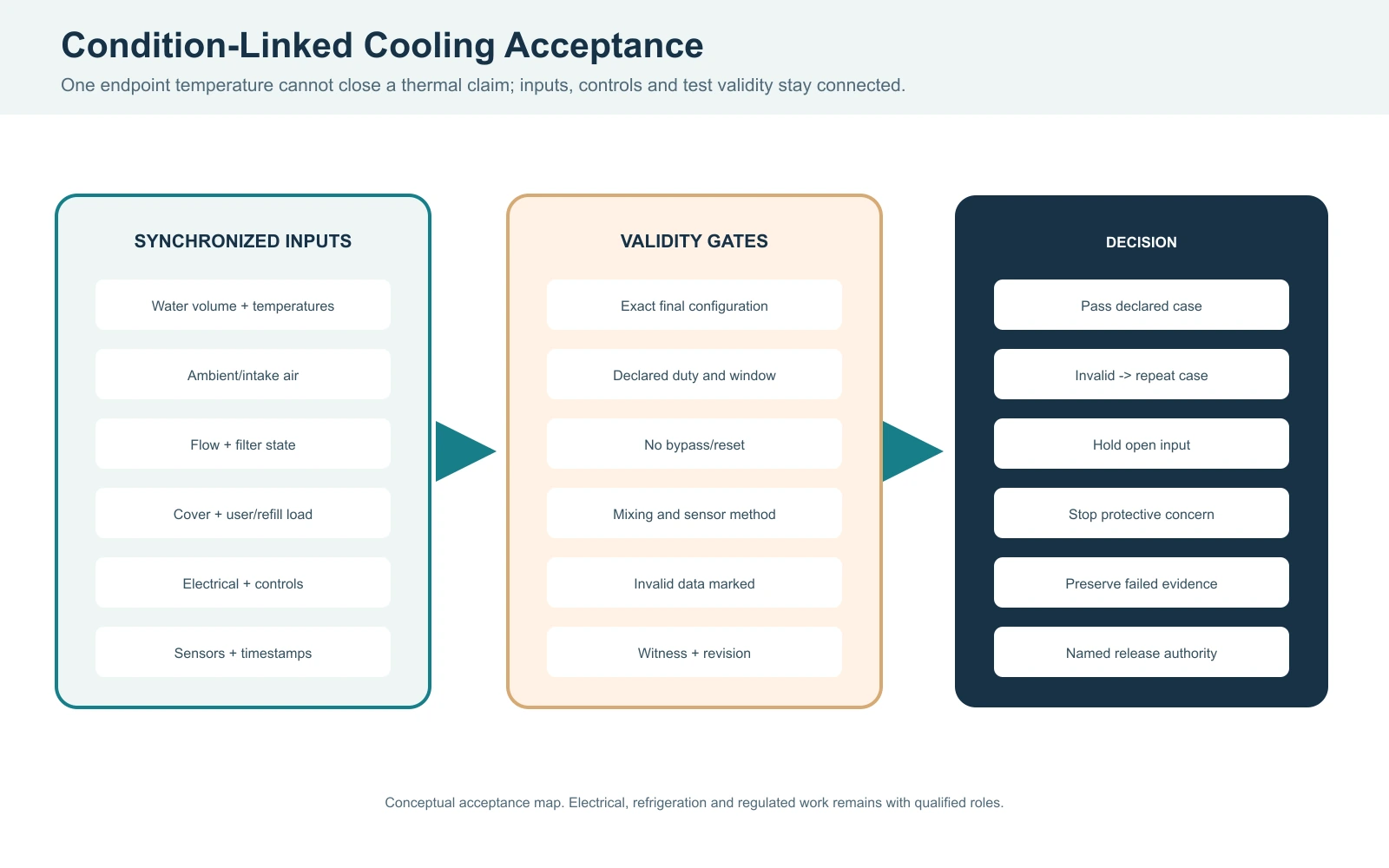
Conservez l'enregistrement défaillant ou contesté. Corrigez une cause vérifiée à la fois et retestez le cas affecté dans les mêmes limites. Un test corrigé prouve la condition corrigée ; il n'efface pas l'écart d'origine. Si la construction change après le test, émettez un enregistrement de modification et décidez si l'équivalence peut être justifiée ou si la comparaison doit être répétée.
Condition d'arrêt : Arrêtez en cas de fuite, d'équipement électrique humide, de perte de débit, de déclenchements répétés de protection, de condensation non contrôlée pénétrant dans les matériaux ou les espaces de service, de condition d'eau dangereuse, ou de toute limite produit/manuel. Les travaux sur le réfrigérant, l'électricité fixe et autres travaux réglementés nécessitent un personnel qualifié.
Intégrer la comparaison à la réception et à la RFQ
À la réception, comparez l'identité modèle/numéro de série, l'état de la caisse, les dommages visibles, les pièces incluses, les raccords desserrés et les révisions de documents avec la commande approuvée. Photographiez les exceptions avant l'installation. Inspectez les détails d'isolation ou de couverture uniquement là où l'accès est autorisé ; ne démontez pas une enceinte d'une manière qui affecte la sécurité ou la garantie simplement pour vérifier une allégation marketing.
Mettez en service selon la procédure approuvée : support de niveau, étanchéité, état des vannes, amorçage, débit, filtres, commandes, indication de température, traitement, drainage et alarmes. Enregistrez les conditions ambiantes et de l'eau locales pour toute observation de performance. Gardez l'acceptation sur site séparée d'un essai de développement fournisseur.
Informations à inclure dans une demande de prix pour comparaison d’isolation
- Application et usage commercial ou résidentiel
- Volume d'eau de fonctionnement et géométrie
- Conditions d'eau initiales et cibles
- Climat intérieur/extérieur et exposition solaire
- Limite d'isolation et preuve de construction
- Construction de la couverture et calendrier d'utilisation
- Agencement du refroidisseur, de la circulation, du filtre et des tuyauteries
- Objectifs de refroidissement, de maintien en température et de récupération
- Plan de condensation, d'évacuation des eaux et d'accès pour la maintenance
- Tension, fréquence, phase et destination
- Méthode d'essai, témoins et enregistrements de réception
- Quantité, marquage et périmètre documentaire
HACHILL peut examiner les intrants relatifs à la famille de produits et au projet sans transformer les champs ouverts en promesses. La construction exacte, les performances, la certification et le périmètre inclus doivent rester liés au modèle sélectionné, à la destination et aux documents approuvés.
Foire aux questions
L'isolation permet-elle de refroidir plus rapidement un bain froid ?
Elle peut réduire la chaleur entrant par les surfaces qu'elle couvre, mais la descente en température dépend également de la masse d'eau, de la température de départ et de la température cible, de la capacité de refroidissement réelle, du débit, de l'exposition ambiante et de la pratique de couverture. Une comparaison valide contrôle ces variables et rapporte la courbe complète température-temps. Un résultat plus rapide entre deux produits différents ne peut pas être attribué uniquement à l'isolation.
Quelle est la meilleure façon de comparer les bains froids isolés et non isolés ?
Utilisez un protocole apparié avec la même masse d'eau en fonctionnement, le même refroidisseur, la même boucle de circulation, le même filtre propre, les mêmes positions de capteurs, les mêmes conditions initiales et cibles, la même exposition ambiante locale et le même programme de couverture. Enregistrez l'eau, l'air, l'humidité, l'état de la commande, les preuves de débit et les événements à intervalles synchronisés. Répétez les deux configurations lorsque la différence observée est proche de la variation normale du test.
Puis-je calculer le temps de refroidissement d'un bain froid en fonction du volume d'eau ?
Le volume d'eau permet de calculer un bilan énergétique à l'aide de Q = m × cp × ΔT, mais il ne détermine pas le temps de refroidissement sur site. La cuve, les apports de chaleur continus, les conditions d'essai de la capacité de refroidissement, le débit, les commandes et les pertes jouent également un rôle. Ne divisez par la capacité que comme estimation de planification explicitement bornée, et non comme un résultat garanti de refroidissement.
Une isolation plus épaisse est-elle toujours plus performante ?
Pas automatiquement. Les propriétés thermiques, la continuité, la compression, les joints, la protection contre l'humidité et les ponts thermiques déterminent la limite installée. L'ajout de matériau peut également affecter l'accès d'entretien, le drainage ou le flux d'air de l'équipement. Comparez les détails de construction approuvés et les preuves d'essai plutôt que la seule épaisseur, et maintenez les affirmations exactes sur les modèles liées à la révision applicable.
Quand faut-il arrêter un test de comparaison d'isolation ?
Arrêt en cas de fuite, d'équipement électrique mouillé, de perte de circulation, de déclenchements répétés de la protection, de condensation dangereuse, de condition d'eau incontrôlée ou de toute limite indiquée dans les instructions/manuel. Conservez les relevés et alarmes d'origine avant toute correction. Une personne qualifiée doit effectuer les travaux réglementés d'électricité, de réfrigération ou de sécurité, et l'équipement concerné doit être retesté après avoir documenté la cause.
Base de référence
- Unités SI du NIST – Température — unités de température et conventions d'intervalle pour les relevés d'essai.
- NIST Chemistry WebBook – Eau — Données de capacité thermique de l’eau liquide étayant la propriété de présélection arrondie utilisée dans l’exemple énergétique.
- Guide de contrôle de l'humidité de l'EPA américaine — principes de point de rosée et de condensation pour les surfaces froides et l'examen du contrôle de l'humidité.
- Code de santé aquatique modèle CDC — lignes directrices pour les installations aquatiques publiques ; il ne s’agit pas d’une loi fédérale et l’applicabilité dépend de l’adoption locale.
- Aperçu des exigences NSF/ANSI/CAN 50 relatives aux cuves d’immersion froide — contexte de périmètre pour les cuves froides avec systèmes de circulation, de traitement ou de désinfection ; il ne s'agit pas d'une déclaration de certification HACHILL.
Limite technique : Les documents produit approuvés, les exigences locales de construction, d’électricité et de santé publique, les corps de métier qualifiés et l’autorité compétente ont priorité sur ce guide général. Les normes et recommandations s’appliquent uniquement dans leur domaine d’application déclaré et leur juridiction adoptée. Aucun temps de refroidissement, économie d’énergie, propriété d’isolation, certification ou résultat médical exact de HACHILL n’est revendiqué ici.
Transformez la comparaison en cahier des charges
Envoyez le volume d'eau, les conditions initiales et cibles, l'exposition ambiante, le calendrier de couverture, la boucle de refroidissement, les cas de service, la destination, la quantité et les preuves d'essai requises. HACHILL peut examiner un modèle ou une gamme de produits tout en laissant les champs non vérifiés ouverts.