

Руководство по планированию купели с дровяным подогревом
Купель с дровяным подогревом обычно требует несколько часов для нагрева, но единого времени для всех систем не существует. Полезная оценка зависит от полезного объёма воды, требуемого повышения температуры, конструкции печи и циркуляции, сухого топлива, изоляции, использования крышки, погоды и способа измерения конечной температуры смешанной воды. Используйте это руководство, чтобы оценить рабочий диапазон и решить, какие данные запросить перед выбором модели.
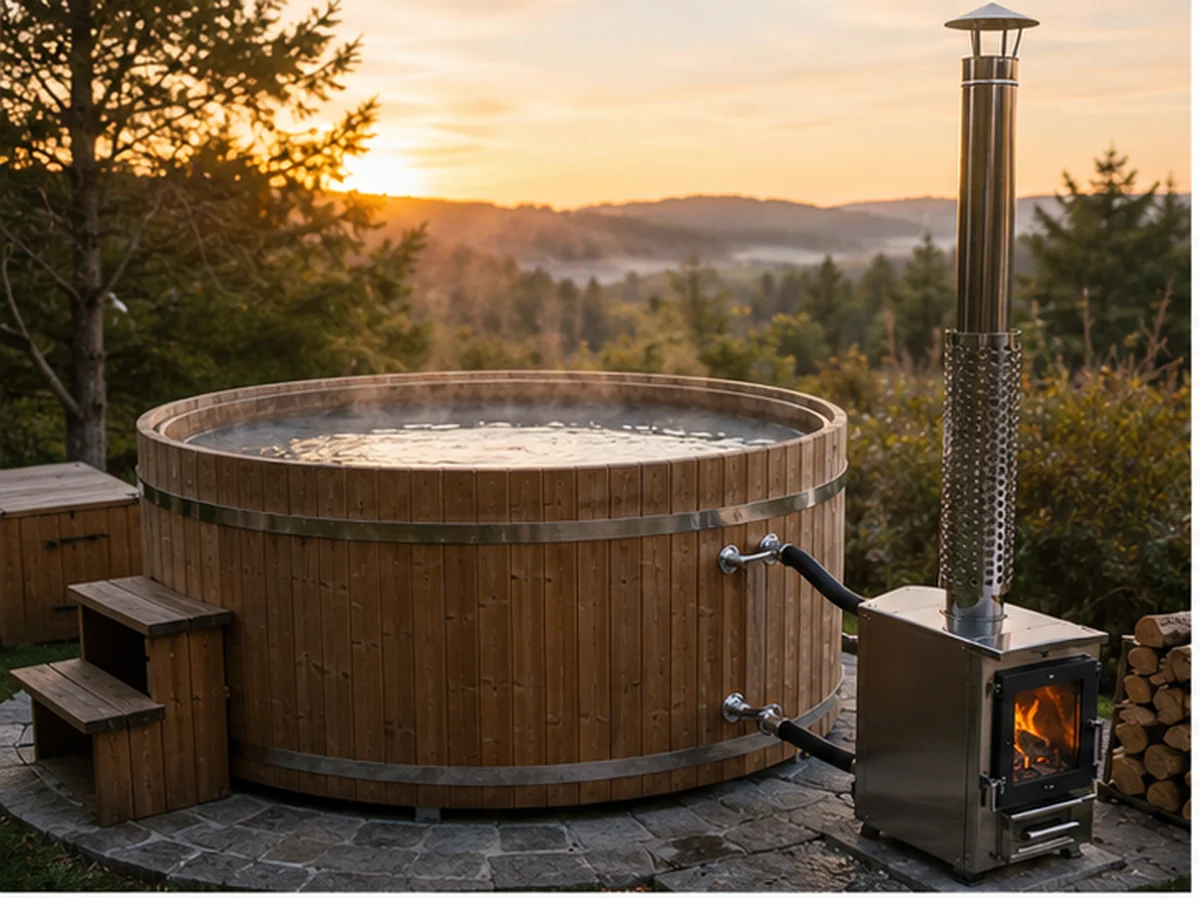
Концептуальная визуализация; не является проверенной моделью HACHILL или результатом испытаний.
Краткий ответ
Многие опубликованные системы купелей с дровяным подогревом сообщают о примерно двух-четырёх часах при определённых условиях. Относитесь к этому только как к ориентировочному диапазону, а не как к гарантии модели HACHILL. Купель меньшего размера с хорошей теплоизоляцией, заполненная более тёплой водой, может нагреться быстрее; крупногабаритная зимняя установка с влажными дровами, воздействием ветра или плохой циркуляцией может занять значительно больше времени.
- Полезный объём воды и требуемый перепад температур
- Точная печь, путь теплопередачи и циркуляции
- Одобренное сухое топливо и стабильное горение
- Крышка, теплоизоляция и открытые участки трубопровода
- Температура окружающей среды, ветер и метод эксплуатации
Уточняйте любые показатели времени нагрева для выбранной модели, одобренной конфигурации и задокументированных условий испытаний. Покупателям также следует сравнить доступные варианты купелей с дровяным подогревом перед запросом оценки для конкретной модели.
Когда оценка времени нагрева полезна, а когда нет
- Сравните объём воды и повышение температуры.
- Заложите реалистичное время на подготовку.
- Учитывайте зимние условия или открытые площадки.
- Сравнивайте условия испытаний поставщиков.
- Подбор печи к купели
- Соответствие требованиям к дымоходу, зазорам и пожарной безопасности
- Финальная схема циркуляции и монтажа
- Пригодность для коммерческой гигиены или укомплектования персоналом
Сколько времени требуется купели с дровяным подогревом для нагрева воды?
Для предварительного планирования закладывайте несколько часов, а не рассчитывайте, что купель будет готова сразу после наполнения. Часто называют диапазон примерно от двух до четырёх часов, но реальные сеансы могут выходить за его пределы. Компактная купель с водой умеренной температуры, сухим топливом, слабой ветровой нагрузкой и хорошо подобранным путём теплопередачи может нагреваться быстрее. Купель большего размера, наполненная очень холодной водой зимой, может потребовать значительно больше времени.
Типичный диапазон — это лишь отправная точка
Утверждение о времени нагрева становится полезным только тогда, когда известны условия, на которых оно основано:
- Полезный объём воды
- Начальная температура смешанной воды
- Целевая температура смешанной воды
- Температура окружающей среды и ветер
- Точная конфигурация печи и купели
- Тип топлива и влажность
- Состояние покрытия и изоляции
- Метод циркуляции и измерения
Нагрев при холодном заполнении и повторный нагрев — разные задачи
Heating freshly filled water from 8°C to 38°C requires a 30°C temperature rise. Reheating retained water from 25°C to 38°C requires only 13°C. Even with the same tub and stove, the thermal task is therefore different. Adding cold water after cleaning, evaporation or bather use can also extend the recovery period.
Определите начало и окончание теста нагрева
- Измерьте температуру смешанной исходной воды.
- Зафиксируйте полезный объём заполнения.
- Растопите печь по утверждённой процедуре.
- Эксплуатируйте систему в документированных условиях.
- Перемешивайте или циркулируйте воду в соответствии с инструкцией.
- Измерьте конечную температуру смешанной воды.
Горячий слой у поверхности или высокая температура вблизи выхода печи не доказывают, что вся купель достигла целевой температуры.
Почему не существует универсального времени нагрева купели с дровяным подогревом
Время нагрева определяется энергией, необходимой воде, и чистой скоростью, с которой вся система передаёт энергию этой воде. Теоретическое требование следует из удельной теплоёмкости воды; данные о свойствах воды NIST предоставляют инженерную основу для этого расчёта:
This estimates the energy absorbed by the water. It does not automatically include chimney loss, radiation from the stove and pipework, heat escaping through the tub and water surface, changing combustion, wet fuel, unstable circulation or outdoor exposure.
Полезный объём воды важнее количества мест
Две купели, рассчитанные на одинаковое количество пользователей, могут иметь разные внутренние размеры, объём, вытесняемый скамьями, уровень наполнения, объём, вытесняемый печью, и фактический объём заливаемой воды. Оценивайте по утверждённому полезному объёму воды, а не только по внешним размерам или номинальной вместимости в людях.
Номинальная мощность печи не означает фактический нагрев воды
Полезная передача тепла зависит от всей системы: геометрии топки и теплообменника, площади контакта с водой, условий горения, тяги в дымоходе, циркуляции, схемы трубопроводов, температуры воды, теплопотерь и обслуживания. Уточняйте, получено ли опубликованное время нагрева в результате полного испытания купели с печью или это только номинальное значение мощности печи.
Переменные, влияющие на время нагрева купели с дровяным подогревом
На небольших экранах проводите пальцем по горизонтали, чтобы увидеть всю таблицу.
| Переменная | Что уточнить | Почему это меняет время нагрева |
|---|---|---|
| Полезный объём воды | Фактический объём в литрах или галлонах на рабочей линии заполнения | Больше воды требует больше энергии |
| Начальная температура | Температура смешанной воды перед розжигом | Более холодная вода требует большего перепада температур |
| Целевая температура | Предполагаемая конечная температура смешанной воды | Более высокая целевая температура увеличивает потребность в энергии |
| Конфигурация печи | Точно согласованная комбинация печи, теплообменника и купели | Определяет путь передачи тепла |
| Циркуляция | Естественная циркуляция, одобренный насос или ручное перемешивание | Влияет на теплопередачу и равномерность температуры |
| Состояние топлива | Одобренный тип топлива, влажность и размер поленьев | Влияет на стабильность горения и полезное тепло |
| Тяга дымохода | Approved flue arrangement and unobstructed airflow | Affects combustion performance |
| Cover and insulation | Exact configuration and permitted use during heating | Changes surface and envelope heat loss |
| Погодные условия | Ambient temperature, wind and precipitation | Changes external heat loss |
| Обслуживание | Clean heat-transfer surfaces and unrestricted flow | Fouling and restrictions may reduce performance |
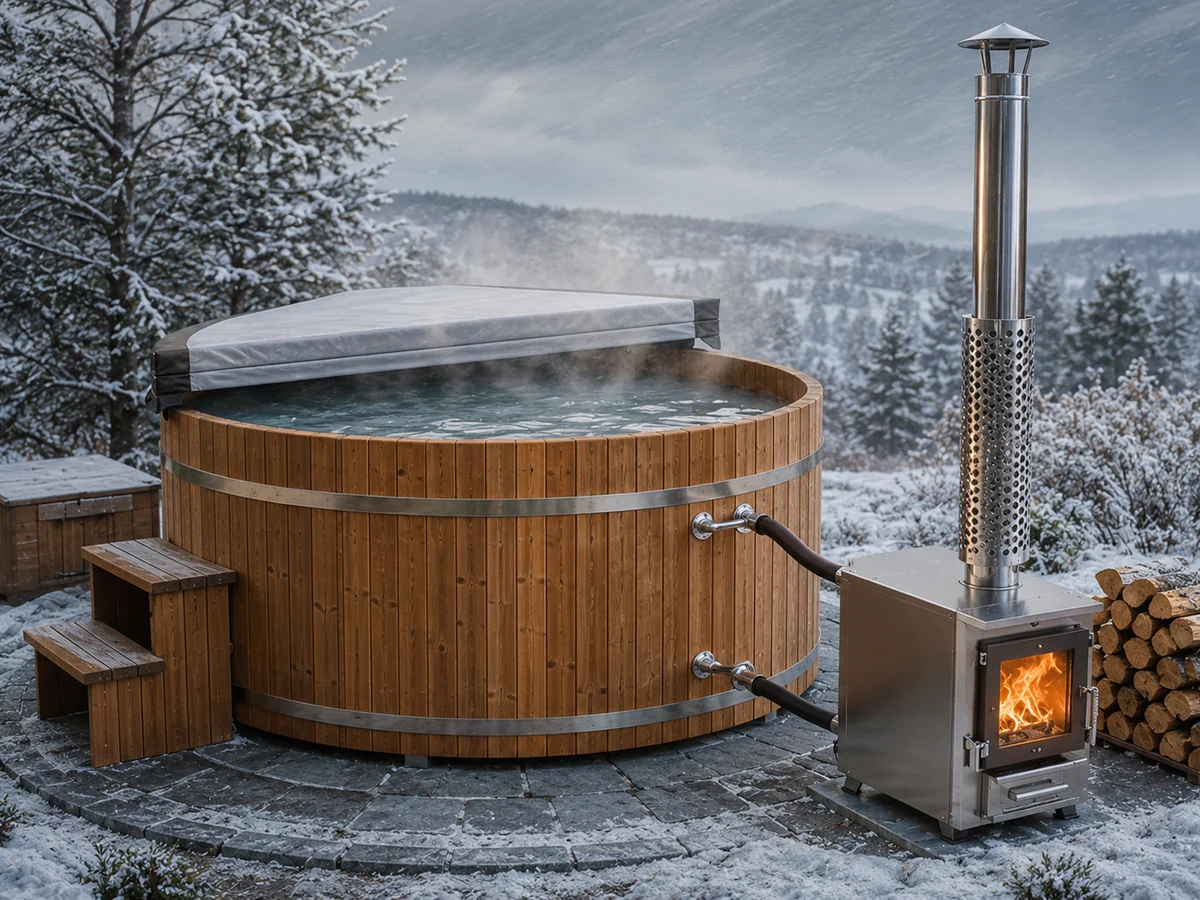
Conceptual winter operating scene; not a verified HACHILL model test or universal heating-time result. The cover position is illustrative only and must follow the selected product instructions and safe stove and chimney clearances.
Water Volume and Temperature Rise
Water volume and required temperature rise create the basic heating load. Record the actual source-water temperature in winter instead of applying summer data unchanged.
Stove and Heat-Transfer Route
Internal, external and other approved heat-exchange arrangements have different flow paths, water displacement, pipe exposure and maintenance requirements. Neither route is automatically faster in every configuration.
Circulation and Temperature Stratification
Natural-circulation systems depend on temperature differences, pipe position, slope and unrestricted flow. Approved pumped systems depend on pump selection and piping resistance. Do not add a pump to a natural-circulation system unless the manufacturer has approved the modification.
Fuel Quality and Combustion Control
Wet fuel consumes part of the fire's energy evaporating moisture instead of heating the water. Use only fuel permitted by the stove instructions and local rules. Do not burn painted or treated timber, bonded board, household waste or fuels excluded by the manufacturer.
Cover, Insulation and Heat Loss
A compatible insulated cover may reduce surface heat loss, but it must not create a clearance or fire risk around the stove or chimney. Exact construction and permitted use during heating must be verified.
Weather, Wind and Seasonal Conditions
Cold air and wind increase heat loss. Site planning should account for winter temperature, wind exposure, precipitation, fuel storage, cover storage, freeze protection, drain-down procedures and safe access around the combustion equipment.
How to Estimate Heating Time Before Lighting the Stove
1. Confirm Usable Water Volume
Use the selected model's approved fill volume. Do not substitute the external tub volume without accounting for benches, stove displacement, wall geometry and operating fill line.
2. Measure the Temperature Rise
Record the starting mixed-water temperature, intended target temperature and the difference between them.
Because the heating load depends on the endpoint, review how to select and verify the mixed-water target temperature. For general public-health context, the CDC advises that hot-tub water should not exceed 40°C (104°F); the actual project target may need to be lower.
3. Identify the Approved Configuration
Confirm the stove route, circulation method, pipe arrangement, chimney, fuel, cover and temperature measurement method.
4. Apply Real Site Conditions
Include ambient temperature, wind, fuel moisture, cold-fill versus reheat, cover use and any cleaning or refill requirement.
5. Add an Operating Margin
A scheduled operation should allow time for filling, ignition, stable circulation, mixing, temperature verification, cleaning checks, water-care checks where applicable and safe reduction of combustion intensity.
Internal and External Stoves Affect the Heating System Differently
На небольших экранах проводите пальцем по горизонтали, чтобы увидеть всю таблицу.
| Consideration | Internal Stove | External Stove |
|---|---|---|
| Heat path | Integrated with the tub water | Heat transferred through external connections |
| Water displacement | May reduce usable water volume | Usually outside the bathing area |
| Bather protection | Requires protection from hot surfaces | Firebox can be separated from bathers |
| Circulation dependency | Depends on exact internal design | Strongly affected by pipe layout and elevation |
| External heat loss | May use fewer external water connections | Pipework and stove casing can add losses |
| Heating-time conclusion | Must be based on the complete model | Must be based on the complete installed circuit |
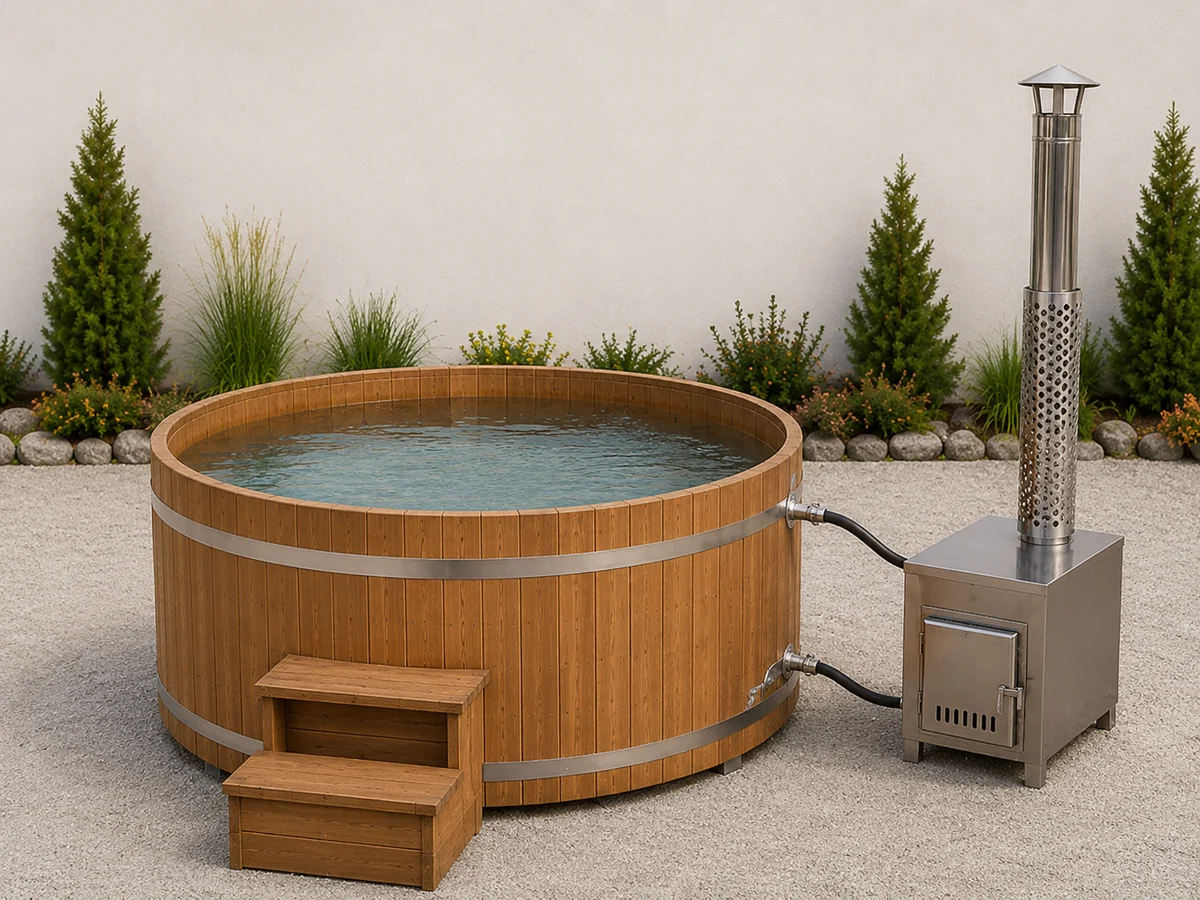
Conceptual external-stove configuration; connection geometry, chimney and clearances must follow the selected product documents and local requirements.
The correct route is not determined by heating time alone. User access, usable water volume, cleaning, available space, combustion separation, foundation, pipe layout, maintenance and local fire requirements also affect the choice.
For the complete relationship between combustion, thermosiphon or approved pumped circulation, chimney draft and mixed-water temperature, review как купели с дровяным подогревом передают тепло.
Site and Installation Inputs That Affect Heating
Heating performance cannot be separated from installation. Confirm these inputs before applying a test result to a real project:
- Foundation and level: support the filled load and preserve the approved stove and pipe geometry.
- Pipe route: verify connection height, slope, diameter and length for the selected system.
- Chimney and draft: use approved components and comply with local fire and smoke requirements.
- Drainage and refill: include the effect of cleaning, partial refill and source-water temperature.
- Freeze conditions: define drain-down, storage and seasonal shutdown procedures.
Final foundation, chimney, combustion, drainage and public-use requirements must be reviewed by the local installer and competent authority.
Seasonal and Operating Scenarios
Mild-Weather Cold Fill
A residential user fills a tub during mild weather with dry fuel and limited wind exposure. Heating may fall within the commonly marketed planning range, but the owner should still record the water volume, starting temperature and mixed final temperature before treating the result as repeatable.
Winter Cold Fill
The same tub starts with colder water and greater heat loss. The correct response is to extend the operating window, protect fuel from moisture and review freeze-management procedures—not to overfire the stove.
External-Stove Circulation Issue
The stove burns normally but the tub heats unevenly. Possible causes include air in the circuit, unsuitable connection geometry, restricted flow or inadequate mixing. The operator should follow the approved inspection procedure instead of altering pipework or adding a pump without manufacturer review.
Resort Opening-Time Planning
Staff allow only the estimated firing time and omit filling, ignition, mixing, temperature verification and water-care checks. The corrected schedule works backward from guest access and assigns a trained operator to each preparation stage.
These scenarios are illustrative composites and do not represent named HACHILL customer projects.
Safe Ways to Reduce Heating Time
The objective is to reduce avoidable heat loss and unstable combustion—not to push the equipment beyond its approved limits.
Prepare the Water Circuit Before Lighting
- Fill to the required operating level.
- Confirm heating surfaces and the water circuit are submerged as required.
- Open the approved circulation path.
- Check for visible blockage or leakage.
- Confirm the chimney and required clearances are ready.
- Follow the selected model's start-up instructions.
Use Approved Dry Fuel
Use properly stored, dry fuel of a type and size permitted by the stove instructions. General wood-burning practice from the US EPA supports using dry fuel and maintaining the appliance as instructed. Never use gasoline, kerosene or similar accelerants, and do not burn painted timber, treated wood, bonded board or household waste.
Control Heat Loss Without Creating a Fire Hazard
Where approved, use the correct insulated cover, protect exposed water pipework, maintain insulation and reduce wind exposure through safe site planning. Do not place improvised insulation or wind barriers near hot surfaces or flue components.
Mix and Measure Before Adding More Fuel
The stove and embers may continue transferring heat after the water approaches the operating target. Reduce firing intensity according to the instructions, allow circulation, mix where required and measure at a representative location before adding more fuel.
When Slow Heating May Indicate a Problem
A slower session is not always caused by cold weather. Compare the current session with the approved baseline and previous operating records.
На небольших экранах проводите пальцем по горизонтали, чтобы увидеть всю таблицу.
| Observed Condition | Possible Explanation | Safe Response |
|---|---|---|
| Weak or smoky combustion | Wet fuel, restricted air, ash build-up or poor draft | Use only approved routine checks; stop if smoke spills into the operating area. |
| Hot return but uneven tub temperature | Stratification, air lock or restricted circulation | Follow the approved mixing and circulation procedure; do not modify the pipework. |
| Heating time increases over repeated sessions | Fuel change, fouling, cover damage or measurement drift | Compare logs and perform only the approved maintenance tasks. |
| Overshoot, boiling, steam or violent water movement | Late fuel addition, blocked flow or unstable circulation | Prevent access and follow the manufacturer shutdown procedure. |
When the result is substantially slower than the verified baseline, follow the Устранение неисправностей нагрева купели с дровяным подогревом sequence before adding more fuel or changing the circulation route.
What Heating-Time Evidence Should a Buyer Request?
На небольших экранах проводите пальцем по горизонтали, чтобы увидеть всю таблицу.
| Evidence Item | Why It Matters | Decision Supported |
|---|---|---|
| Exact tub and stove configuration | Prevents one model's result being applied to another | Product comparison and quotation |
| Usable water volume and temperature rise | Defines the real heating load | Technical plausibility |
| Ambient conditions, cover and insulation | Shows the test's heat-loss boundary | Site comparison |
| Fuel type, moisture and circulation method | Explains combustion and heat-transfer conditions | Repeatability review |
| Measurement method and test repetitions | Prevents a local hot spot or one-off result becoming the headline figure | Performance evidence |
| Approved drawings, component scope and responsibilities | Connects the performance claim to the purchased configuration | Purchase-order release and handover |
Model-level heating evidence should be reviewed together with the approved configuration, drawings, components and manufacturing and quality-control review.
A seat count, lifestyle image, generic category brochure or nominal stove rating is not sufficient evidence by itself.
Heating-Time Planning for Resorts and Commercial Venues
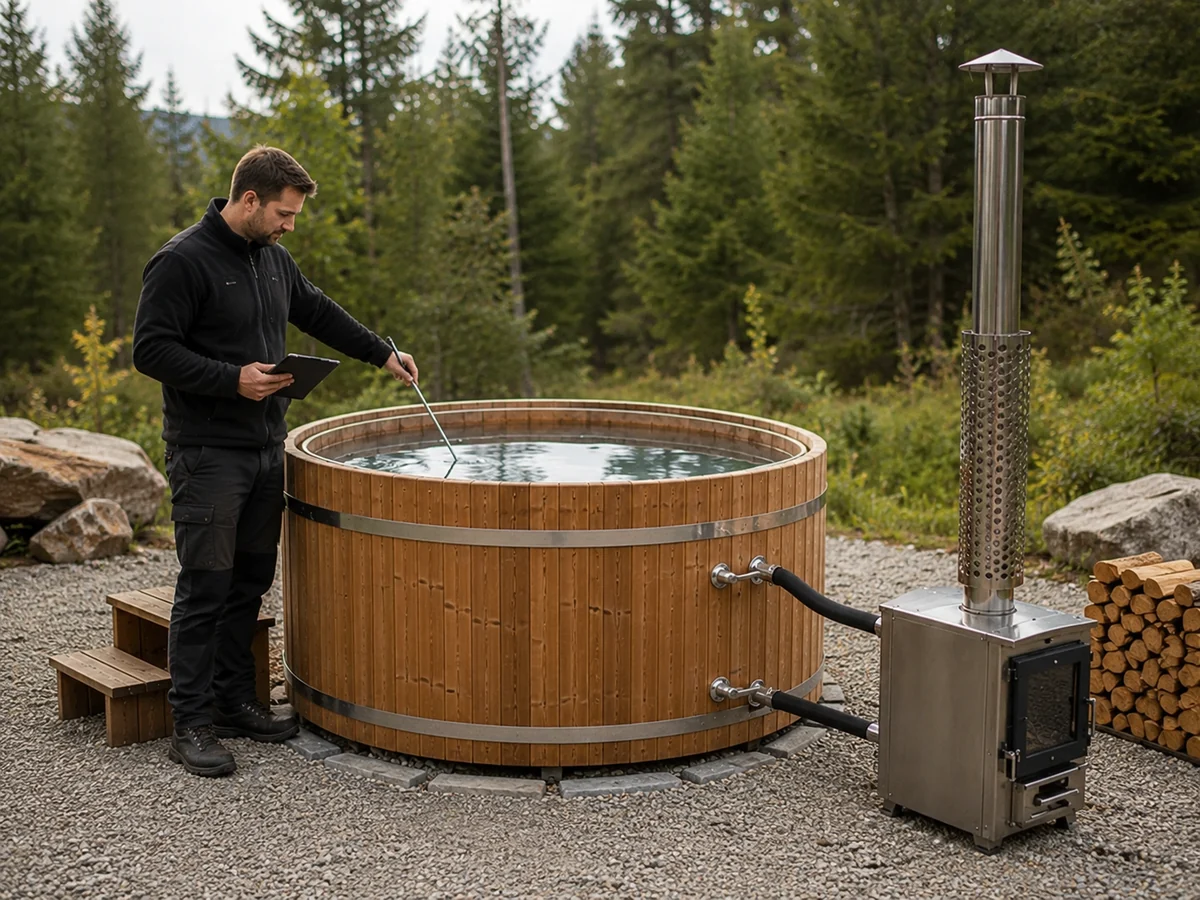
Conceptual operating scene; it does not represent a named customer site, approved commercial installation or specific HACHILL operating procedure.
Commercial buyers should coordinate heating time with guest flow, staffing, cleaning, utilities and handover through hotel and resort wellness project planning.
Work Backward from Opening Time
- Site and equipment inspection
- Water filling
- Fire preparation and ignition
- Нагрев
- Mixing and temperature verification
- Water-care checks
- Guest-access approval
- Monitoring during use
- Cleaning and shutdown
Define the Operator and Monitoring Procedure
Assign responsibility for fire management, temperature logging, fuel storage, water quality, cleaning, guest separation, emergency shutdown, ash handling and freeze procedures.
Confirm Whether Wood-Fired Operation Fits the Venue
На небольших экранах проводите пальцем по горизонтали, чтобы увидеть всю таблицу.
| Ответственность | Manufacturer / Supplier | Buyer / Venue | Installer / Local Professional |
|---|---|---|---|
| Approved product configuration | Provide confirmed model and component scope | Approve intended use and operating brief | Confirm compatibility with the site |
| Foundation and access | Provide known product dimensions and loads where available | Provide site data and delivery constraints | Design and verify the final foundation and handling route |
| Chimney and fire compliance | Provide product instructions and approved components | Identify venue and local requirements | Verify installation, clearances and approvals |
| Water care and commercial hygiene | State included equipment and product limitations | Define operating, cleaning and monitoring policy | Review local public-health and drainage requirements |
| Heating-time record | Provide model-level baseline when available | Maintain site logs and operating margins | Investigate installation-related deviation where applicable |
Define the Responsibility Boundary Before Handover
На небольших экранах проводите пальцем по горизонтали, чтобы увидеть всю таблицу.
| Operating Task | Key Inputs | Why It Matters |
|---|---|---|
| Initial cold fill | Full water volume, source-water temperature and opening time | Usually creates the largest single heating load |
| Temperature recovery | Bather load, exposure, partial refill and fire state | Determines whether repeated sessions are practical |
| Cleaning and refill | Water-care policy, drain volume and refill temperature | May create an additional daily heat-up cycle |
Separate Initial Heat-Up, Recovery and Daily Throughput
A wood-fired route may be unsuitable where the venue cannot provide trained operation, compliant chimney and clearances, secure fuel storage, smoke compatibility, reliable water care, guest separation, sufficient preparation time, freeze protection and local approval.
Heating-Time Checklist Before Purchase or First Use
- Exact tub model and configuration
- Exact stove and heat-transfer route
- Полезный объём воды
- Starting water temperature
- Intended target temperature
- Required total temperature rise
- Internal or external stove
- Natural or approved pumped circulation
- Approved fuel type
- Fuel moisture condition
- Cover and insulation configuration
- Ambient temperature and wind exposure
- Chimney and clearance review
- Foundation and drainage
- Freeze-management procedure
- Temperature-monitoring method
- Operator responsibility
- Supplier test conditions
- Local fire, smoke and installation requirements
Minimum Inputs for a Model-Level Review
Final selection depends on actual user capacity, usage frequency, installation environment, climate, foundation, fuel conditions, drainage, water-care routine, transport access, project requirements, local regulations and confirmed manufacturer data.
- Estimate from usable water volume and required temperature rise.
- Evaluate the complete tub, stove and circulation configuration—not the stove rating alone.
- Add a site and operating margin for fuel, weather, cover use, mixing and verification.
- Request documented test conditions before accepting a model-level heating-time claim.
Часто задаваемые вопросы
Сколько времени обычно занимает нагрев купели с дровяным подогревом?
Предварительный диапазон планирования обычно составляет около двух-четырёх часов, но небольшие системы могут работать быстрее, а крупные установки или установки в холодную погоду могут занять больше времени. Уточните точный объём воды, повышение температуры, конфигурацию печи и условия испытаний.
Всегда ли большая дровяная печь нагревает купель быстрее?
Нет. Время нагрева зависит от всей системы: печи, теплообменника, циркуляции и купели. Большая номинальная мощность не гарантирует, что больше тепла безопасно поступит в воду.
Почему купель с дровяным подогревом нагревается дольше зимой?
Зимняя эксплуатация часто сочетает более холодную заливочную воду с большими теплопотерями через поверхность воды, стенки и открытые компоненты. Ветер и влажное топливо могут дополнительно увеличить время нагрева.
Нагревает ли внутренняя печь быстрее, чем внешняя?
Не обязательно. Внутренние печи имеют короткий путь нагрева, тогда как внешние системы в большей степени зависят от конструкции соединения и циркуляции. Сравнивайте полностью протестированные конфигурации, а не только расположение печи.
Может ли крышка сократить время нагрева?
Совместимый утеплённый чехол может снизить потери тепла с поверхности. Его следует использовать в соответствии с инструкциями к изделию и держать вдали от опасных условий эксплуатации печи или дымохода.
Как рассчитать время нагрева по объёму воды?
Сначала рассчитайте энергию, необходимую для нагрева фактического объёма воды на требуемую разницу температур. Затем разделите на расчётную полезную теплоту, переданную воде, а не на номинальную мощность печи, и учтите реальные теплопотери.
Что поставщик должен указать в заявлении о времени нагрева?
Укажите точную модель, полезный объём воды, начальную и целевую температуру, условия окружающей среды, конфигурацию печи, способ циркуляции, состояние топлива, наличие крышки и метод измерения.
Prepare a Wood-Fired Hot Tub Heating Brief
A qualified review needs more than a target heating time. Prepare the intended application, usable water volume, starting and target temperatures, climate, stove and circulation preference, fuel, foundation, chimney, drainage, water-care routine, delivery access and operating schedule.
For commercial or OEM projects, also provide daily throughput, staffing, destination market, quantity, branding, packaging and required technical or compliance documents.
Final heating performance, installation and commercial suitability must be confirmed for the selected model and approved project configuration.
Submit a wood-fired hot tub project brief