Guide de planification du bain nordique chauffé au bois
Un bain à remous chauffé au bois nécessite généralement quelques heures pour chauffer à partir d’un remplissage à froid. Pour une planification préliminaire, environ 2–4 heures est une plage de marché utile, mais ce n’est pas une spécification universelle ni une garantie d’un modèle HACHILL. Le temps réel dépend du volume d’eau utilisable, de la température de départ et de la température cible, de la conception du poêle et de la circulation, du combustible sec, de l’isolation, de l’utilisation de la couverture, du vent et des conditions ambiantes. Utilisez les conditions d’essai exactes de la baignoire et du poêle — et non un temps d’accroche générique — pour comparer des modèles ou planifier un calendrier d’exploitation commercial.
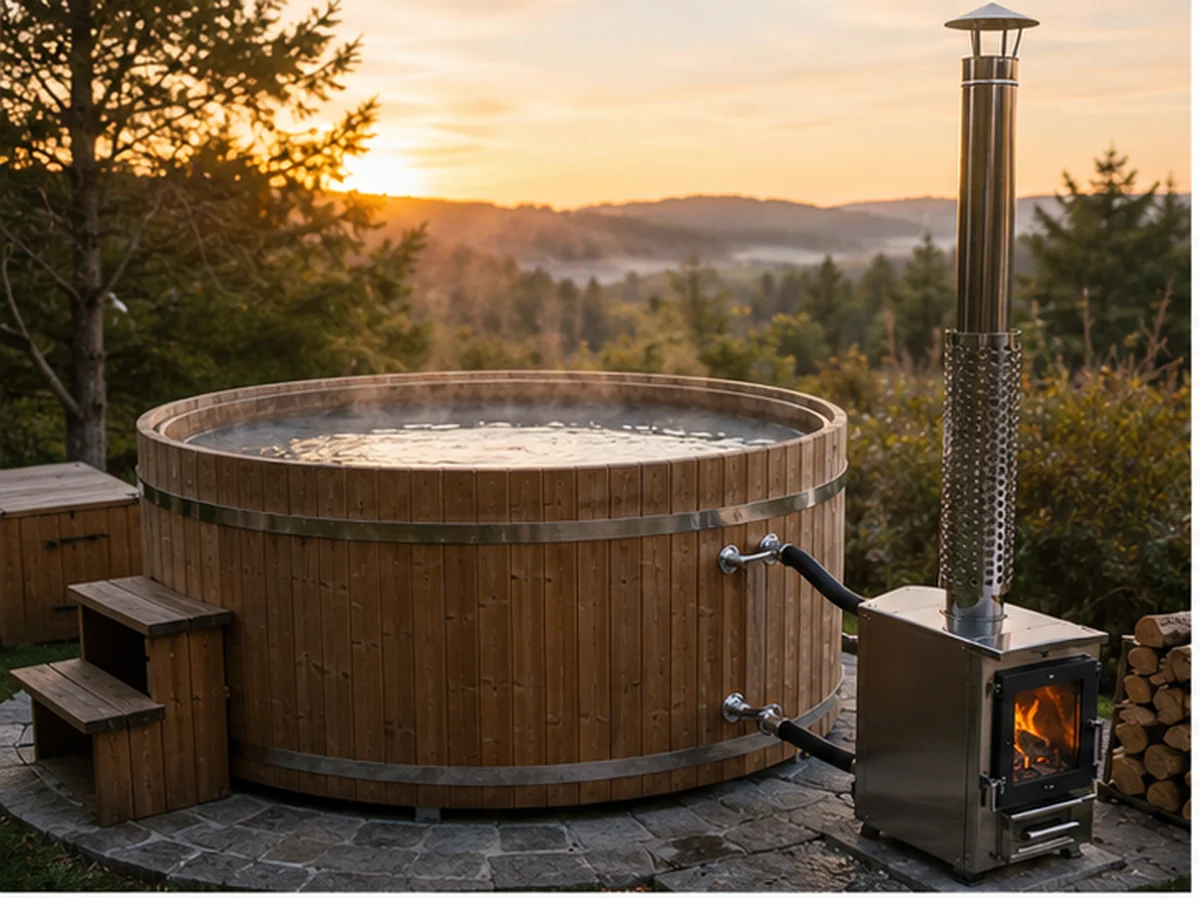
Visualisation conceptuelle ; pas un modèle HACHILL vérifié ni un test de performance.
Réponse rapide
Pour la planification préliminaire, un bain à remous chauffé au bois est souvent traité comme un tâche de chauffage de 2–4 heures, mais les systèmes réels peuvent sortir de cette plage. Le chiffre n’est utile que lorsque le volume d’eau, la température de départ, la température cible, la configuration du poêle, le parcours de circulation, l’état du combustible et la météo sont connus. Une baignoire plus petite avec une eau de remplissage tempérée et de faibles pertes thermiques peut chauffer plus tôt ; une installation hivernale à grand volume avec de l’eau froide, du combustible humide, une exposition au vent ou une circulation faible peut prendre beaucoup plus de temps.
- Volume d'eau utile et élévation de température requise
- Poêle exact, transfert de chaleur et circuit de circulation
- Combustible sec approuvé et combustion stable
- Couvercle, isolation et tuyauterie exposée
- Température ambiante, vent et méthode d'utilisation
Confirmez toute durée de chauffe par rapport au modèle sélectionné, à la configuration approuvée et aux conditions d'essai documentées. Les acheteurs doivent également comparer les gamme de baignoires à remous chauffées au bois avant de demander une estimation au niveau du modèle.
Pour le contrôle documentaire, les preuves de configuration et les exigences de jalon de validation, utilisez le Guide d'achat — Documentation de sécurité des bains nordiques chauffés au bois. Cette page reste la référence pour l’estimation du temps de chauffe et les variables de chauffage.
Quand une estimation du temps de chauffe est utile—et quand elle ne l'est pas
Utile pour la planification
- Comparez le volume d'eau et la montée en température.
- Prévoyez une fenêtre de préparation réaliste.
- Adaptez en fonction de l'hiver ou des sites exposés.
- Comparez les conditions de test des fournisseurs.
Pas suffisant pour une approbation
- Correspondance poêle-bain
- Conformité cheminée, dégagements ou incendie
- Conception finale de la circulation et de l'installation
- Adéquation hygiène ou personnel pour un usage professionnel
Limite de décision : utilisez une estimation pour filtrer les options et préparer les questions. N’émettez un bon de commande qu’après confirmation du bain, du poêle, de la circulation, des conditions du site et du périmètre de preuves exacts.
Combien de temps faut-il pour chauffer un bain nordique chauffé au bois ?
Une réponse de planification pratique est environ 2–4 heures pour de nombreux systèmes au bois, mais il s'agit d'une plage indicative et non d'une spécification transférable. Les exemples de modèles publiés varient parce que la taille du bain, le volume d'eau, la conception du poêle et les conditions d'essai diffèrent. Un bain compact avec une eau de remplissage à température modérée, un combustible sec, une faible exposition au vent et un circuit de transfert thermique efficace peut chauffer plus tôt ; un bain plus grand rempli d'eau très froide en hiver peut prendre beaucoup plus longtemps. Considérez toute affirmation au niveau du modèle comme dépendante des conditions et vérifiez le volume d'eau, l'élévation de température, la configuration et la méthode d'essai qui la sous-tendent.
Une fourchette typique n'est qu'un point de départ
Une déclaration sur le temps de chauffage n'est utile que si les conditions qui la sous-tendent sont connues :
- Volume d'eau utile
- Température initiale de l'eau mélangée
- Température cible de l'eau mélangée
- Température ambiante et vent
- Configuration exacte du poêle et du bain
- Type de combustible et état d'humidité
- État de la couverture et de l'isolation
- Méthode de circulation et de mesure
Le chauffage à froid et le réchauffage sont des tâches différentes
Chauffer de l’eau fraîchement remplie de 8°C à 38°C nécessite une élévation de température de 30°C. Réchauffer de l’eau conservée de 25°C à 38°C ne nécessite que 13°C. Même avec la même cuve et le même poêle, la tâche thermique est donc différente. L’ajout d’eau froide après un nettoyage, une évaporation ou une utilisation par des baigneurs peut également prolonger la période de remise en température.
Définir le début et la fin du test de chauffage
- Mesurez la température initiale de l'eau mélangée.
- Enregistrez le volume de remplissage utile.
- Allumez le poêle selon la procédure approuvée.
- Faites fonctionner le système dans les conditions documentées.
- Mélangez ou faites circuler l'eau comme indiqué.
- Mesurez la température finale de l'eau mélangée.
Une couche chaude près de la surface ou une température élevée près de la sortie du poêle ne prouve pas que l’ensemble du bain a atteint la température cible.
Pourquoi il n'existe pas de temps de chauffe universel pour les bains nordiques chauffés au bois
Le temps de chauffage est régi par deux quantités distinctes : l’énergie requise par l’eau et la moyenne net chaleur réellement transférée à cette eau. Données NIST sur la capacité thermique de l'eau liquide étaye une approximation de planification d’environ 4.18 kJ/kg·K près des températures normales d’un bain à remous.
Formule de planification : énergie de chauffage de l’eau en kWh ≈ volume d’eau en litres × élévation de température en °C × 0.00116. Cela utilise environ 1 kg d’eau par litre comme hypothèse pratique d’estimation.
Le calcul estime uniquement l’énergie absorbée par l’eau. Il n’inclut pas automatiquement les pertes de cheminée, le rayonnement du poêle et de la tuyauterie, la chaleur qui s’échappe par la cuve et la surface de l’eau, une combustion variable, un combustible humide, une circulation instable ou l’exposition extérieure.
Calcul illustratif : Une cuve hypothétique de 1,200 litres chauffée de 10°C à 38°C présente une élévation de température de 28°C et nécessite environ 39 kWh d'énergie théorique de l'eau. Si le transfert de chaleur net moyen mesuré vers l'eau était de 15 kW, le résultat idéalisé serait d'environ 2.6 heures ; à 10 kW net, environ 3.9 heures. Ces chiffres de puissance nette sont des exemples de calcul, et non des puissances typiques de poêle ou des données de modèle HACHILL. Le temps de chauffe réel peut être plus long, car les pertes et la combustion varient tout au long du cycle de combustion.
Le volume d'eau utile importe plus que le nombre de places
Deux cuves prévues pour le même nombre d’utilisateurs peuvent avoir des dimensions intérieures, un déplacement de banc, des niveaux de remplissage, un déplacement de poêle et un volume d’eau rempli réel différents. Estimez à partir du volume d’eau utilisable approuvé, et non uniquement des dimensions extérieures ou de la capacité nominale de personnes.
La puissance nominale du poêle ne correspond pas à la puissance de chauffage de l'eau délivrée
Le transfert utile dépend du système complet : géométrie du foyer et de l’échangeur, surface de contact avec l’eau, condition de combustion, tirage de cheminée, circulation, agencement des tuyaux, température de l’eau, pertes thermiques et maintenance. Demandez si un temps de chauffe publié provient d’un essai complet cuve-poêle ou seulement d’une valeur nominale de poêle.
Les variables qui modifient le temps de chauffe d'un bain nordique chauffé au bois
Sur les petits écrans, faites glisser horizontalement pour voir le tableau complet.
| Variable | Ce qu'il faut confirmer | Pourquoi cela modifie le temps de chauffe |
|---|---|---|
| Volume d'eau utile | Litres ou gallons réels à la ligne de remplissage de fonctionnement | Plus d'eau nécessite plus d'énergie |
| Température de départ | Température de l'eau mélangée avant l'allumage | Une eau plus froide nécessite une plus grande élévation de température |
| Température cible | Température finale de l'eau mélangée souhaitée | Une cible plus élevée augmente la demande en énergie |
| Configuration du poêle | Combinaison exacte approuvée de poêle, d'échangeur et de baignoire | Définit le trajet de transfert de chaleur |
| Circulation | Circulation naturelle, pompe approuvée ou mélange manuel | Influence le transfert de chaleur et l'uniformité de la température |
| État du combustible | Type de combustible approuvé, taux d'humidité et taille des bûches | Influence la stabilité de la combustion et la chaleur utile |
| Tirage de la cheminée | Configuration de conduit approuvée et circulation d'air non obstruée | Influence les performances de combustion |
| Couvercle et isolation | Configuration exacte et utilisation autorisée pendant le chauffage | Modifie les pertes de chaleur de surface et d'enveloppe |
| Météo | Température ambiante, vent et précipitations | Modifie les pertes de chaleur externes |
| Maintenance | Surfaces de transfert de chaleur propres et débit sans restriction | L'encrassement et les restrictions peuvent réduire les performances |
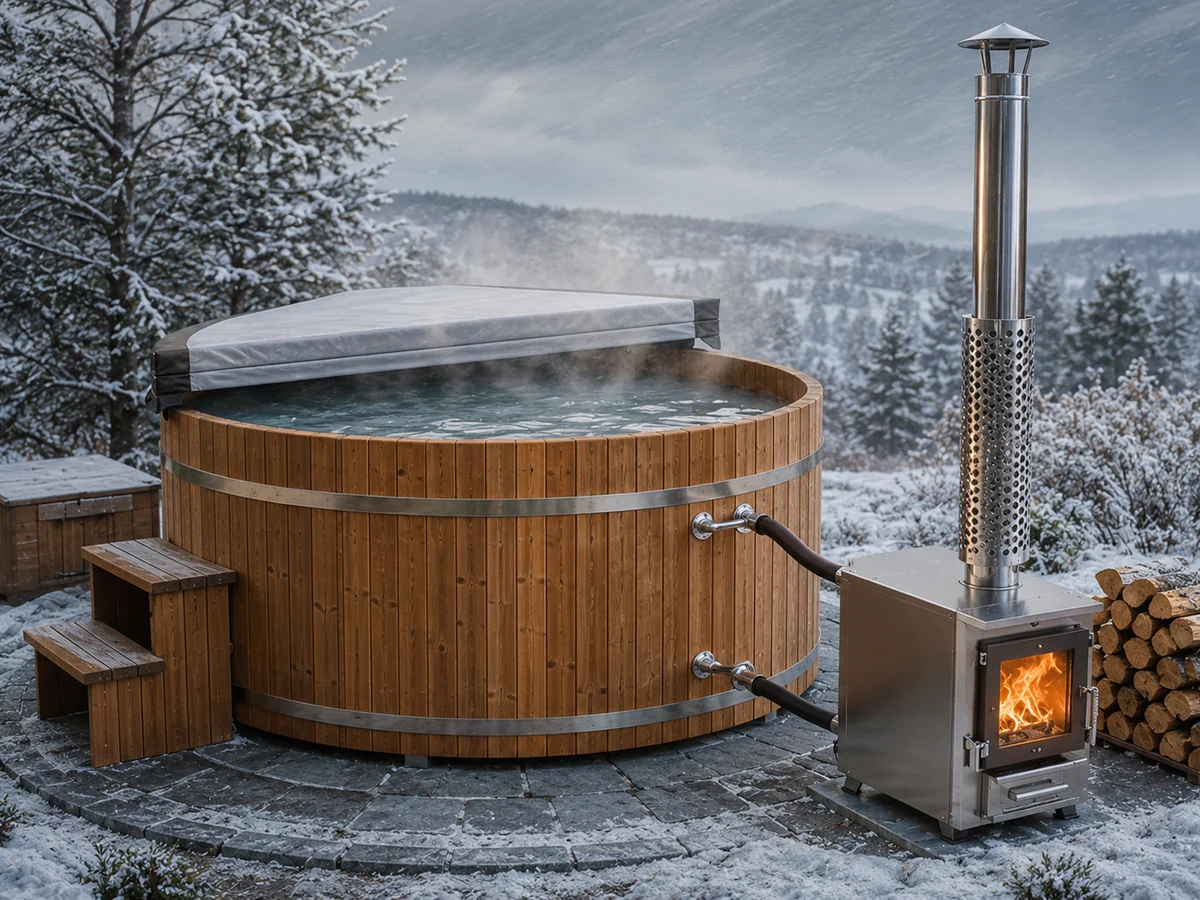
Scène de fonctionnement hivernale conceptuelle ; pas un test vérifié du modèle HACHILL ni un résultat universel de temps de chauffage. La position de la couverture est uniquement illustrative et doit suivre les instructions du produit sélectionné et les distances de sécurité pour le poêle et la cheminée.
Volume d'eau et élévation de température
Le volume d’eau et l’élévation de température requise constituent la charge de chauffage de base. Relevez la température réelle de l’eau source en hiver au lieu d’appliquer sans modification les données estivales.
Poêle et voie de transfert de chaleur
Les configurations d’échange thermique internes, externes et autres configurations approuvées présentent des trajets d’écoulement, des déplacements d’eau, une exposition des tuyaux et des exigences de maintenance différents. Aucune voie n’est automatiquement plus rapide dans toutes les configurations.
Circulation et stratification de température
Les systèmes à circulation naturelle dépendent des différences de température, de la position des tuyaux, de la pente et d’un débit non entravé. Les systèmes pompés approuvés dépendent du choix de la pompe et de la résistance de la tuyauterie. N’ajoutez pas de pompe à un système à circulation naturelle, sauf si le fabricant a approuvé la modification.
Qualité du combustible et contrôle de la combustion
Le combustible humide consomme une partie de l’énergie du feu pour évaporer l’humidité au lieu de chauffer l’eau. Utilisez uniquement le combustible permis par les instructions du poêle et les règles locales. Ne brûlez pas de bois peint ou traité, de panneaux collés, de déchets ménagers ni de combustibles exclus par le fabricant.
Couverture, isolation et perte de chaleur
Une couverture isolante compatible peut réduire les pertes de chaleur par la surface, mais elle ne doit pas créer de risque de distance de sécurité insuffisante ou d’incendie autour du poêle ou de la cheminée. La construction exacte et l’utilisation autorisée pendant le chauffage doivent être vérifiées.
Conditions météorologiques, vent et saisons
L’air froid et le vent augmentent les pertes de chaleur. La planification du site doit tenir compte de la température hivernale, de l’exposition au vent, des précipitations, du stockage du combustible, du stockage de la housse, de la protection contre le gel, des procédures de vidange et de l’accès sécurisé autour de l’équipement de combustion.
Comment estimer le temps de chauffe avant d'allumer le poêle
1. Confirmer le volume d'eau utilisable
Utilisez le volume de remplissage approuvé du modèle sélectionné. Ne remplacez pas le volume extérieur du bain sans tenir compte des bancs, du déplacement du poêle, de la géométrie des parois et de la ligne de remplissage en fonctionnement.
2. Mesurer l'élévation de température
Enregistrez la température initiale de l'eau mélangée, la température cible prévue et la différence entre les deux.
Étant donné que la charge de chauffage dépend du point final, consultez comment sélectionner et vérifier la température cible de l'eau mélangée. Pour le contexte général de santé publique, le CDC conseille que l'eau des spas ne dépasse pas 40°C (104°F); l’objectif réel du projet devra peut-être être plus bas.
3. Identifier la configuration approuvée
Confirmez le circuit du poêle, la méthode de circulation, l’agencement des tuyaux, la cheminée, le combustible, la couverture et la méthode de mesure de la température.
4. Appliquer les conditions réelles du site
Incluez la température ambiante, le vent, l'humidité du combustible, le remplissage à froid par rapport au réchauffage, l'utilisation de la couverture et tout besoin de nettoyage ou de remplissage.
5. Ajouter une marge de fonctionnement
Une exploitation planifiée doit prévoir du temps pour le remplissage, l’allumage, une circulation stable, le mélange, la vérification de la température, les contrôles de nettoyage, les contrôles d’entretien de l’eau le cas échéant et la réduction sûre de l’intensité de combustion.
Utilisez le niveau de preuve approprié : un calcul théorique vérifie la plausibilité globale ; un essai contrôlé sur modèle établit une référence pour une configuration approuvée ; des relevés de site répétés constituent la meilleure base pour la planification quotidienne. Gardez constants le niveau de remplissage, la méthode de mélange et les emplacements de mesure.
Les poêles internes et externes affectent différemment le système de chauffage
Sur les petits écrans, faites glisser horizontalement pour voir le tableau complet.
| Considération | Poêle interne | Poêle externe |
|---|---|---|
| Chemin de chaleur | Intégré à l'eau de la baignoire | Chaleur transférée par des connexions externes |
| Déplacement d'eau | Peut réduire le volume d'eau utilisable | Généralement hors de la zone de baignade |
| Protection des baigneurs | Nécessite une protection contre les surfaces chaudes | Le foyer peut être séparé des baigneurs |
| Dépendance à la circulation | Dépend de la conception interne exacte | Fortement influencé par la disposition des tuyaux et l'élévation |
| Perte de chaleur externe | Peut utiliser moins de raccordements d'eau externes | La tuyauterie et l'enveloppe du poêle peuvent ajouter des pertes |
| Conclusion sur le temps de chauffage | Doit être basé sur le modèle complet | Doit être basé sur le circuit installé complet |
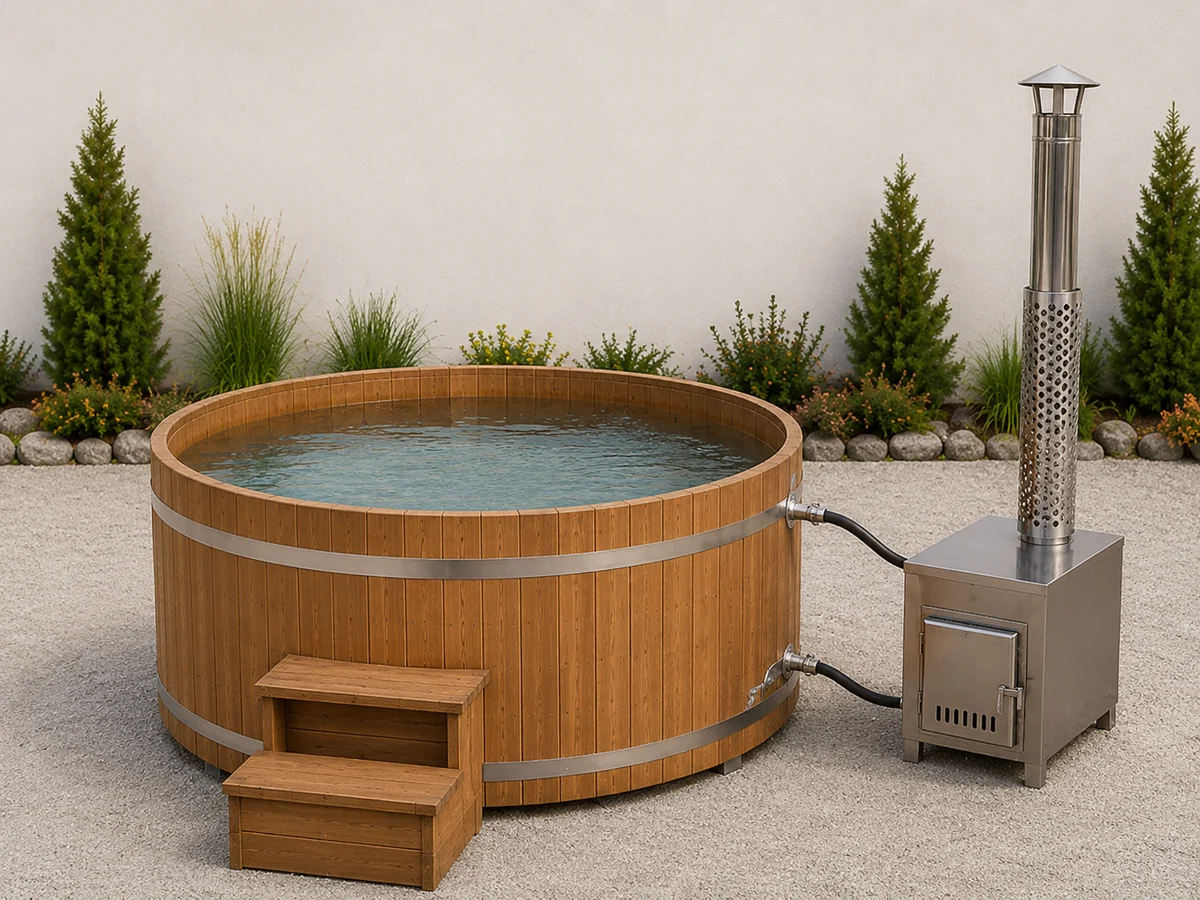
Configuration conceptuelle d'un poêle externe ; la géométrie des raccordements, le conduit de cheminée et les dégagements doivent suivre les documents du produit sélectionné et les exigences locales.
La bonne voie ne se détermine pas uniquement par le temps de chauffe. L’accès des utilisateurs, le volume d’eau utilisable, le nettoyage, l’espace disponible, la séparation de la combustion, la fondation, la disposition des tuyaux, la maintenance et les exigences locales en matière d’incendie affectent aussi le choix.
Pour la décision d'achat commerciale plus large concernant le format rond, y compris les places assises, l'adaptation au site, l'entretien de l'eau et le périmètre du devis, utilisez le Guide d'achat du bain nordique rond chauffé au bois.
Pour la relation complète entre la combustion, le thermosiphon ou une circulation pompée approuvée, le tirage de cheminée et la température de l’eau mélangée, consultez comment les bains nordiques chauffés au bois transfèrent la chaleur.
Données du site et de l'installation qui affectent le chauffage
Les performances de chauffage ne peuvent pas être dissociées de l’installation. Confirmez ces données d’entrée avant d’appliquer un résultat de test à un projet réel :
- Fondation et niveau : supportent la charge remplie et préservent la géométrie approuvée du poêle et du conduit.
- Tracé du conduit : vérifiez la hauteur de raccordement, la pente, le diamètre et la longueur pour le système sélectionné.
- Cheminée et tirage : utilisez des composants approuvés et respectez les exigences locales en matière d'incendie et de fumée.
- Vidange et remplissage : incluez l'effet du nettoyage, du remplissage partiel et de la température de l'eau source.
- Conditions de gel : définissez les procédures de vidange, de stockage et d'arrêt saisonnier.
Les exigences finales de fondation, de cheminée, de combustion, de drainage et d'usage public doivent être examinées par l'installateur local et l'autorité compétente.
Scénarios saisonniers et de fonctionnement
Scénario résidentiel illustratif
Remplissage à froid par temps doux
Un utilisateur résidentiel remplit un bassin par temps doux avec du combustible sec et une exposition au vent limitée. Le chauffage peut être plus rapide que dans des conditions plus froides ou plus exposées, mais le propriétaire doit tout de même consigner le volume d’eau, la température de départ et la température finale après mélange avant de considérer le résultat comme reproductible.
Scénario saisonnier illustratif
Remplissage à froid en hiver
Le même bassin démarre avec une eau plus froide et des pertes de chaleur plus importantes. La réponse correcte consiste à prolonger la fenêtre de fonctionnement, à protéger le combustible de l’humidité et à revoir les procédures de gestion du gel—et non à surchauffer le poêle.
Scénario technique composite
Problème de circulation avec le poêle externe
Le poêle brûle normalement mais le bassin chauffe de façon inégale. Les causes possibles incluent de l'air dans le circuit, une géométrie de raccordement inadaptée, un débit restreint ou un mélange insuffisant. L'opérateur doit suivre la procédure d'inspection approuvée au lieu de modifier la tuyauterie ou d'ajouter une pompe sans examen du fabricant.
Scénario commercial composite
Planification de l'heure d'ouverture d'un complexe
Le personnel ne prévoit que le temps de chauffe estimé et omet le remplissage, l’allumage, le mélange, la vérification de la température et les contrôles d’entretien de l’eau. Le planning corrigé part de l’accès des clients et affecte un opérateur formé à chaque étape de préparation.
Ces scénarios sont des composites illustratifs et ne représentent pas des projets clients nommés de HACHILL.
Moyens sûrs de réduire le temps de chauffe
L'objectif est de réduire les pertes de chaleur évitables et la combustion instable—et non de pousser l'équipement au-delà de ses limites approuvées.
Préparer le circuit d'eau avant l'allumage
- Remplir jusqu'au niveau de fonctionnement requis.
- Confirmez que les surfaces de chauffe et le circuit d'eau sont immergés comme requis.
- Ouvrez le circuit de circulation approuvé.
- Vérifiez l'absence de blocage ou de fuite visible.
- Confirmez que la cheminée et les dégagements requis sont prêts.
- Suivez les instructions de démarrage du modèle sélectionné.
Utilisez un combustible sec approuvé
Utilisez un combustible sec et correctement stocké, d’un type et d’une taille autorisés par les instructions du poêle. Les conseils archivés Burn Wise de l’US EPA soutiennent le bois sec et bien séché et déconseillent de brûler des produits en bois enduits, peints, traités sous pression ou collés, ainsi que des déchets ménagers. Le programme de l’EPA a cessé de mettre à jour ce document en 2025, de sorte que les instructions du poêle sélectionné et les règles locales en vigueur restent déterminantes.
Contrôlez les pertes de chaleur sans créer de risque d'incendie
Lorsque cela est approuvé, utilisez la couverture isolée correcte, protégez la tuyauterie d’eau exposée, maintenez l’isolation et réduisez l’exposition au vent par une planification sûre du site. Ne placez pas d’isolation improvisée ni de barrières coupe-vent près des surfaces chaudes ou des composants de conduit de fumée.
Mélangez et mesurez avant d'ajouter du combustible
Le poêle et les braises peuvent continuer à transférer de la chaleur après que l’eau approche de la cible de fonctionnement. Réduisez l’intensité de combustion conformément aux instructions, laissez circuler, mélangez si nécessaire et mesurez à un emplacement représentatif avant d’ajouter davantage de combustible.
Quand un chauffage lent peut indiquer un problème
Une séance plus lente n'est pas toujours causée par le temps froid. Comparez la séance actuelle à la référence approuvée et aux enregistrements d'exploitation précédents.
Sur les petits écrans, faites glisser horizontalement pour voir le tableau complet.
| État observé | Explication possible | Réponse sûre |
|---|---|---|
| Combustion faible ou fumeuse | Combustible humide, air restreint, accumulation de cendres ou mauvais tirage | Utilisez uniquement les contrôles de routine approuvés ; arrêtez si de la fumée se répand dans la zone d'exploitation. |
| Retour chaud mais température du bain inégale | Stratification, poche d'air ou circulation restreinte | Suivez la procédure de mélange et de circulation approuvée ; ne modifiez pas la tuyauterie. |
| Le temps de chauffe augmente au fil des sessions répétées | Changement de combustible, encrassement, dommage du couvercle ou dérive de mesure | Comparez les journaux et effectuez uniquement les tâches de maintenance approuvées. |
| Dépassement, ébullition, vapeur ou mouvement violent de l'eau | Ajout tardif de combustible, écoulement bloqué ou circulation instable | Empêchez l'accès et suivez la procédure d'arrêt du fabricant. |
Lorsque le résultat est nettement plus lent que la référence vérifiée, suivez la Dépannage du chauffage des bains nordiques chauffés au bois séquence avant d'ajouter plus de combustible ou de modifier le circuit de circulation.
Arrêtez le fonctionnement et obtenez une assistance qualifiée pour une circulation bloquée, une ébullition incontrôlée, de la vapeur, une fuite, un refoulement de fumée, des composants de conduit endommagés ou un mouvement structurel.
Quelles preuves de temps de chauffe un acheteur doit-il demander ?
Sur les petits écrans, faites glisser horizontalement pour voir le tableau complet.
| Élément de preuve | Pourquoi c'est important | Décision soutenue |
|---|---|---|
| Configuration exacte du bain et du poêle | Empêche le résultat d’un modèle d’être appliqué à un autre | Comparaison de produits et devis |
| Volume d'eau utile et élévation de température | Définit la charge thermique réelle | Plausibilité technique |
| Conditions ambiantes, couverture et isolation | Montre la limite de perte de chaleur de l’essai | Comparaison du site |
| Type de combustible, humidité et méthode de circulation | Explique les conditions de combustion et de transfert de chaleur | Examen de la répétabilité |
| Méthode de mesure et répétitions des tests | Empêche qu'un point chaud local ou un résultat ponctuel ne devienne le chiffre principal | Preuves de performance |
| Plans approuvés, périmètre des composants et responsabilités | Relie l'allégation de performance à la configuration achetée | Validation du bon de commande et transfert |
Les preuves de chauffage au niveau du modèle doivent être examinées conjointement avec la configuration approuvée, les plans, les composants et l'examen de fabrication et de contrôle qualité.
Une déclaration utile : dans des conditions documentées, la configuration exacte baignoire-et-poêle a chauffé le volume d’eau utilisable indiqué depuis la température de départ enregistrée jusqu’à la température d’eau mélangée enregistrée dans la période mesurée.
Un nombre de places, une image lifestyle, une brochure de catégorie générique ou une puissance nominale du poêle ne constituent pas une preuve suffisante en soi.
Planification du temps de chauffe pour les complexes et les établissements commerciaux
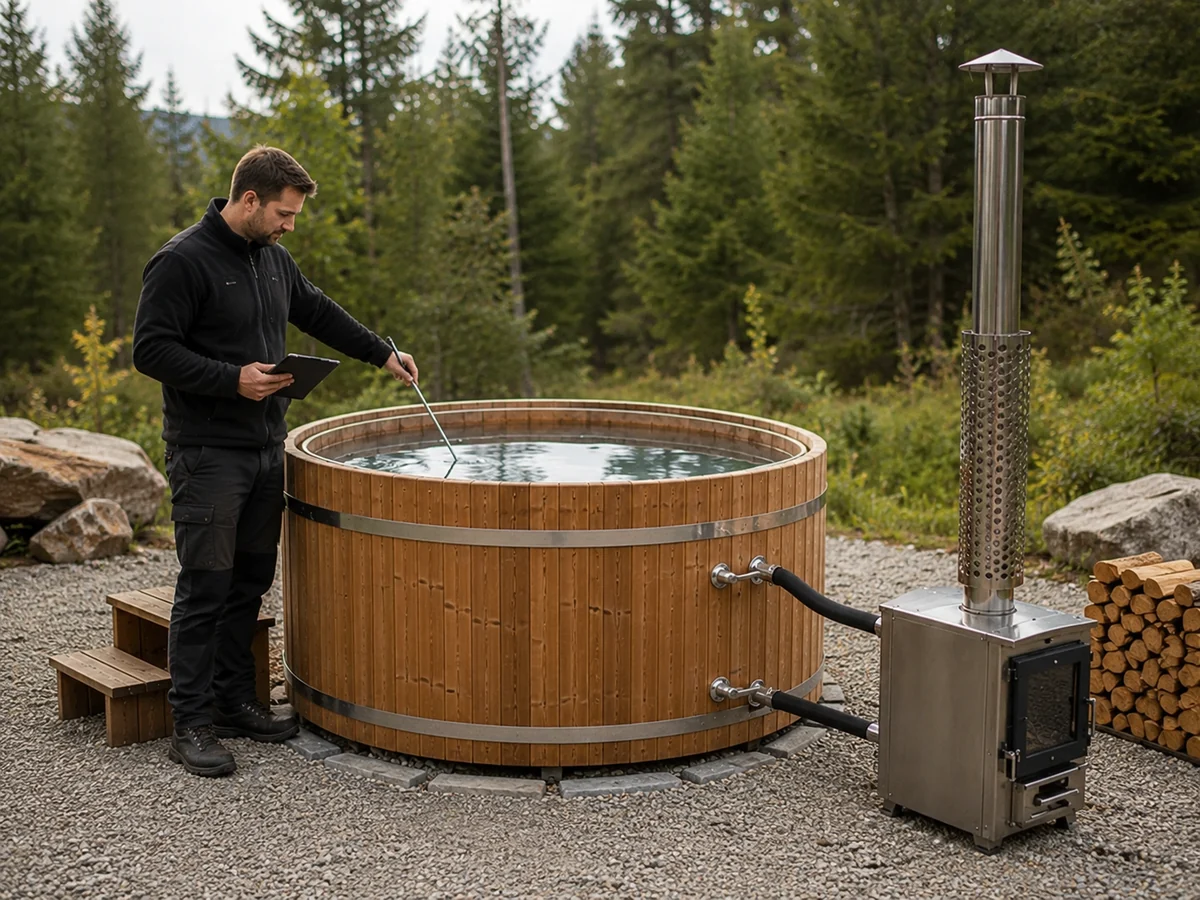
Scène d'exploitation conceptuelle ; elle ne représente pas un site client nommé, une installation commerciale approuvée ou une procédure d'exploitation HACHILL spécifique.
Les acheteurs commerciaux doivent coordonner le temps de chauffe avec le flux de clients, le personnel, le nettoyage, les utilités et la remise via la planification de projets de bien-être hôteliers et de complexes.
Remonter le temps à partir de l'heure d'ouverture
- Inspection du site et des équipements
- Remplissage d'eau
- Préparation du feu et allumage
- Chauffage
- Vérification du mélange et de la température
- Contrôles de l'entretien de l'eau
- Approbation de l'accès des clients
- Surveillance pendant l'utilisation
- Nettoyage et arrêt
Définir la procédure d'exploitation et de surveillance
Attribuez la responsabilité de la gestion du feu, de l’enregistrement des températures, du stockage du combustible, de la qualité de l’eau, du nettoyage, de la séparation des invités, de l’arrêt d’urgence, de la gestion des cendres et des procédures de gel.
Confirmer si l'exploitation au bois convient au lieu
Sur les petits écrans, faites glisser horizontalement pour voir le tableau complet.
| Responsabilité | Fabricant / Fournisseur | Acheteur / Lieu | Installateur / Professionnel local |
|---|---|---|---|
| Configuration produit approuvée | Fournir le modèle confirmé et le périmètre des composants | Approuver l'utilisation prévue et le cahier des charges d'exploitation | Confirmer la compatibilité avec le site |
| Fondations et accès | Fournir les dimensions et charges connues du produit lorsque disponibles | Fournir les données du site et les contraintes de livraison | Concevoir et vérifier les fondations finales et l'itinéraire de manutention |
| Conformité de la cheminée et du feu | Fournir les instructions du produit et les composants approuvés | Identifier le lieu et les exigences locales | Vérifier l'installation, les dégagements et les approbations |
| Soin de l'eau et hygiène commerciale | Préciser l'équipement inclus et les limites du produit | Définir la politique d'exploitation, de nettoyage et de surveillance | Examiner les exigences locales en matière de santé publique et d'évacuation des eaux |
| Registre des temps de chauffe | Fournir la référence au niveau du modèle lorsque disponible | Tenir les journaux de site et les marges d'exploitation | Enquêter sur les écarts liés à l'installation le cas échéant |
Définir la limite de responsabilité avant la remise
Sur les petits écrans, faites glisser horizontalement pour voir le tableau complet.
| Tâche d'exploitation | Entrées clés | Pourquoi c'est important |
|---|---|---|
| Premier remplissage à froid | Volume d'eau total, température de l'eau source et heure d'ouverture | Génère généralement la plus grande charge de chauffage |
| Récupération de température | Charge de baigneurs, exposition, remplissage partiel et état du feu | Détermine si des sessions répétées sont réalisables |
| Nettoyage et remplissage | Politique de traitement de l'eau, volume de vidange et température de remplissage | Peut créer un cycle de chauffe supplémentaire quotidien |
Séparer le premier chauffage, la récupération et le débit quotidien
Une solution au bois exige un examen supplémentaire lorsque le site ne peut pas assurer une exploitation formée, une cheminée et un plan de dégagement approuvés, un stockage de combustible sécurisé, un emplacement compatible avec la fumée, un entretien fiable de l’eau, une séparation des clients, un temps de préparation suffisant, une protection contre le gel et les approbations locales requises. Ces contraintes d’exploitation peuvent rendre une autre solution de chauffage plus pratique pour certains sites.
Liste de contrôle du temps de chauffage avant achat ou première utilisation
- Modèle et configuration exacts du bain
- Poêle et circuit de transfert de chaleur exacts
- Volume d'eau utile
- Température de l'eau de départ
- Température cible prévue
- Élévation totale de température requise
- Poêle intérieur ou extérieur
- Circulation naturelle ou par pompe approuvée
- Type de combustible approuvé
- État d'humidité du combustible
- Configuration de la couverture et de l'isolation
- Température ambiante et exposition au vent
- Examen de la cheminée et des dégagements
- Fondation et drainage
- Procédure de gestion du gel
- Méthode de surveillance de la température
- Responsabilité de l'opérateur
- Conditions d'essai du fournisseur
- Exigences locales en matière d'incendie, de fumée et d'installation
Application : Usage résidentiel, en station, spa ou autre usage commercial
Capacité : Utilisateurs prévus, volume d'eau utilisable et séances quotidiennes
Climat : Températures d'été et d'hiver, vent et exposition
Mode de chauffage : Poêle intérieur ou extérieur et préférence de circulation
Site : Plan de fondation, cheminée, drainage, accès et gel
Combustible : Type de bois approuvé disponible, stockage et contrôle de l'humidité
Entretien de l’eau : Routine de remplissage, vidange, nettoyage, assainissement et nouveau remplissage
Usage commercial : Heures d'ouverture, opérateur formé, besoins de surveillance et de récupération
Approvisionnement : Quantité, marquage, emballage, destination et portée documentaire
Données minimales requises pour une évaluation au niveau du modèle
La sélection finale dépend de la capacité réelle des utilisateurs, de la fréquence d’utilisation, de l’environnement d’installation, du climat, de la fondation, des conditions de combustible, du drainage, de la routine d’entretien de l’eau, de l’accès pour le transport, des exigences du projet, des réglementations locales et des données confirmées du fabricant.
Références de preuve et de sécurité
- NIST Chemistry WebBook : capacité thermique de l’eau liquide pour la base technique du calcul préliminaire eau-énergie.
- Guide de sécurité des spas du CDC pour le contexte général de sécurité relatif à la température maximale de l'eau de 104°F (40°C).
- Pratiques Burn Wise archivées de l’US EPA pour les principes généraux relatifs aux combustibles secs et aux combustibles interdits. Le programme Burn Wise a cessé de mettre à jour ce contenu en 2025 ; les instructions actuelles de l’appareil et les règles locales restent déterminantes.
Ces sources ne soutiennent que des principes généraux d’ingénierie ou de sécurité. Elles n’établissent pas de temps de chauffe testé, de certification, d’approbation d’installation ou de conformité au marché pour un quelconque modèle HACHILL.
Résumé de la décision :
- Estimation à partir du volume d'eau utilisable et de l'élévation de température requise.
- Évaluer la configuration complète du bain, du poêle et de la circulation, et non la seule puissance du poêle.
- Ajouter une marge de site et d'exploitation pour le combustible, la météo, l'utilisation du couvercle, le mélange et la vérification.
- Demander les conditions d'essai documentées avant d'accepter une affirmation de temps de chauffe spécifique à un modèle.
Foire aux questions
Combien de temps faut-il généralement pour chauffer un bain nordique chauffé au bois ?
Environ 2–4 heures constituent une plage de planification préliminaire utile pour de nombreux systèmes, mais elle n’est pas universelle. Confirmez le volume d’eau exact, l’élévation de température, la configuration du poêle, le circuit de circulation, l’état du combustible, la météo et la méthode d’essai pour le système sélectionné.
Un poêle à bois plus grand chauffe-t-il toujours un bain nordique plus rapidement ?
Le temps de chauffe dépend de l'ensemble du poêle, de l'échangeur, de la circulation et du système de bain. Une puissance nominale plus élevée ne garantit pas qu'une plus grande quantité de chaleur atteigne l'eau en toute sécurité.
Pourquoi un bain nordique chauffé au bois met-il plus de temps à chauffer en hiver ?
En hiver, l'eau de remplissage est souvent plus froide et les pertes de chaleur sont plus importantes au niveau de la surface de l'eau, des parois et des composants exposés. Le vent et un combustible humide peuvent prolonger davantage la durée de chauffe.
Un poêle intérieur chauffe-t-il plus vite qu'un poêle extérieur ?
Pas nécessairement. Les poêles internes offrent un circuit de chaleur court, tandis que les systèmes externes dépendent davantage de la conception des raccordements et de la circulation. Comparez des configurations complètes testées plutôt que la seule position du poêle.
Un couvercle peut-il réduire le temps de chauffage ?
Une housse isolante compatible peut réduire les pertes de chaleur en surface. Elle doit être utilisée conformément aux instructions du produit et tenue à l'écart de toute condition dangereuse liée au poêle ou au conduit de fumée.
Comment puis-je estimer le temps de chauffage en fonction du volume d'eau ?
Estimez l’énergie de l’eau à partir de litres × élévation de température × 0.00116 kWh, puis divisez par une estimation défendable de la chaleur nette moyenne transmise à l’eau — pas par la puissance brute du poêle. Ajoutez une marge pour les pertes de surface, de tuyauterie, de cuve et de combustion.
Que doit inclure un fournisseur avec une indication de durée de chauffe ?
Précisez le modèle exact, le volume d'eau utile, la température de départ et la température cible, les conditions ambiantes, la configuration du poêle, la méthode de circulation, l'état du combustible, l'état du couvercle et la méthode de mesure.
Préparer un dossier de chauffage pour bain nordique au bois
Un examen qualifié nécessite plus qu’un temps de chauffe cible. Préparez l’application prévue, le volume d’eau utilisable, les températures de départ et cible, le climat, les préférences de poêle et de circulation, le combustible, la fondation, la cheminée, le drainage, la routine d’entretien de l’eau, l’accès de livraison et le planning d’exploitation.
Pour les projets commerciaux ou OEM, fournissez également le débit quotidien, les effectifs, le marché de destination, la quantité, l’image de marque, l’emballage et les documents techniques ou de conformité requis.
Les performances de chauffage finales, l’installation et l’adéquation commerciale doivent être confirmées pour le modèle sélectionné et la configuration de projet approuvée.
Soumettre un dossier de projet de bain nordique au bois
Portée technique et limites de l'examen : Ce guide HACHILL explique les variables de chauffage des bains nordiques au bois, l'estimation préliminaire de la charge thermique, les conditions d'exploitation et les données de projet B2B. Il ne s'agit pas d'un manuel d'installation spécifique à un modèle ni d'un certificat de performance. Le volume d'eau exact, la configuration du poêle, les performances de chauffage, la cheminée, les dégagements, le combustible, l'entretien de l'eau et l'adéquation commerciale doivent être confirmés pour le produit sélectionné et le marché de destination par le fabricant, l'installateur et les professionnels locaux compétents.