

Guida alla pianificazione della tinozza nordica riscaldata a legna
Una tinozza nordica riscaldata a legna di solito richiede diverse ore per riscaldarsi, ma nessun tempo vale per tutti i sistemi. La stima utile deriva dal volume d'acqua utilizzabile, dall'aumento di temperatura richiesto, dal design della stufa e della circolazione, dal combustibile secco, dall'isolamento, dall'uso del coperchio, dalle condizioni meteorologiche e dal modo in cui viene misurata la temperatura finale dell'acqua miscelata. Usa questa guida per stimare una finestra operativa e decidere quali prove richiedere prima di scegliere un modello.
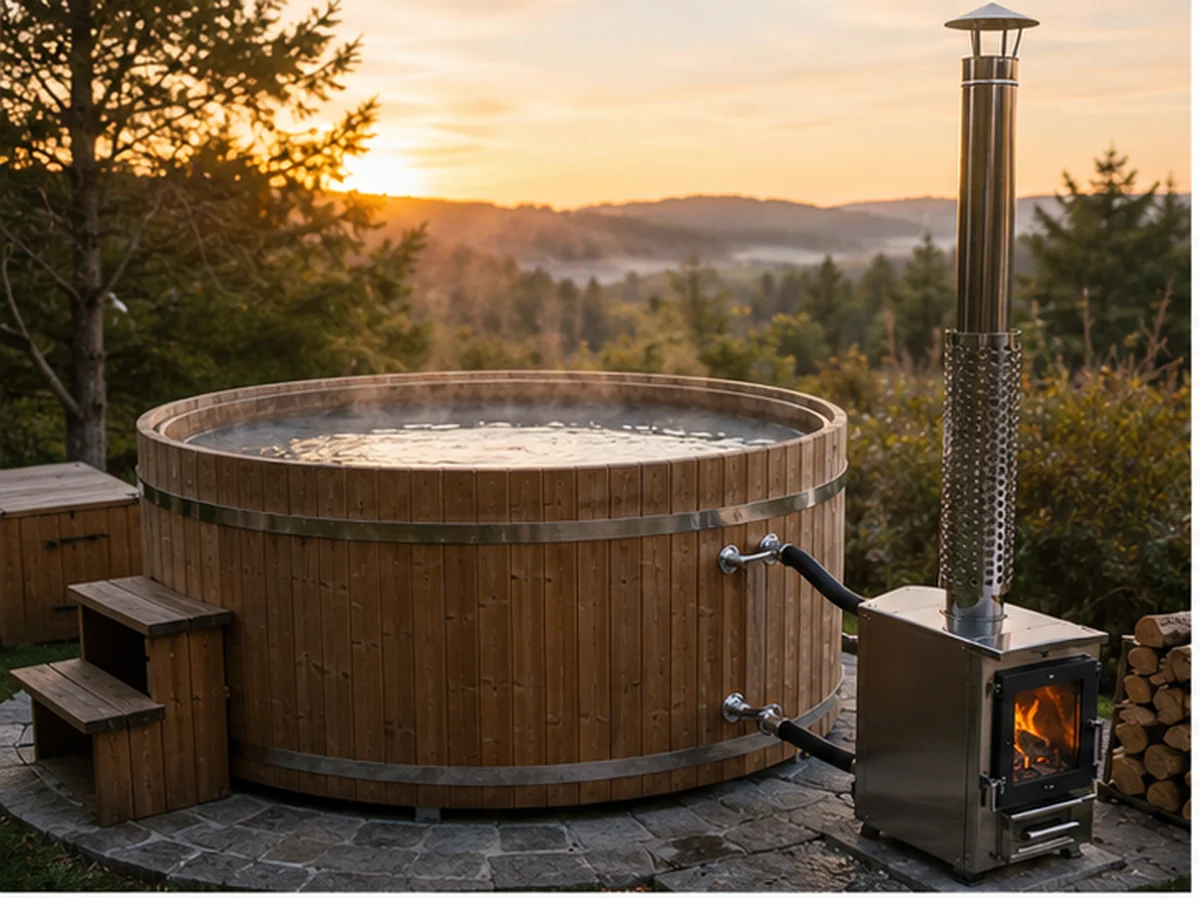
Visualizzazione concettuale; non è un modello HACHILL verificato né un test di prestazioni.
Risposta rapida
Molti sistemi di tinozze nordiche riscaldate a legna pubblicati riportano circa due o quattro ore in condizioni definite. Consideralo solo come un intervallo di pianificazione, non una garanzia del modello HACHILL. Una vasca più piccola e ben isolata riempita con acqua più mite può essere più veloce; un'installazione invernale ad alto volume con combustibile umido, esposizione al vento o scarsa circolazione può richiedere notevolmente più tempo.
- Volume d'acqua utilizzabile e aumento di temperatura richiesto
- Stufa esatta, trasferimento di calore e percorso di circolazione
- Combustibile secco approvato e combustione stabile
- Copertura, isolamento e tubazioni esposte
- Temperatura ambiente, vento e metodo di funzionamento
Conferma qualsiasi valore di tempo di riscaldamento rispetto al modello selezionato, alla configurazione approvata e alle condizioni di test documentate. Gli acquirenti dovrebbero anche confrontare le disponibili opzioni di tinozze nordiche riscaldate a legna prima di richiedere una stima a livello di modello.
Quando una stima del tempo di riscaldamento è utile—e quando non lo è
- Confronta il volume d'acqua e l'aumento di temperatura.
- Consenti una finestra di preparazione realistica.
- Adatta per l'inverno o siti esposti.
- Confronta le condizioni di test del fornitore.
- Abbinamento stufa-vasca
- Conformità di camino, distanze o antincendio
- Progettazione finale di circolazione e installazione
- Idoneità igienica o di personale per uso commerciale
Quanto tempo impiega una tinozza nordica riscaldata a legna a scaldarsi?
For preliminary planning, allow several hours rather than assuming the tub will be ready immediately after filling. A commonly quoted range is approximately two to four hours, but real sessions can fall outside it. A compact tub with moderate-temperature fill water, dry fuel, low wind exposure and a well-matched heat transfer route may heat more quickly. A larger tub filled with very cold water during winter may require substantially longer.
Un intervallo tipico è solo un punto di partenza
Un'indicazione sul tempo di riscaldamento diventa utile solo quando si conoscono le condizioni alla base:
- Volume d'acqua utilizzabile
- Temperatura iniziale dell'acqua miscelata
- Temperatura target dell'acqua miscelata
- Ambient temperature and wind
- Exact stove and tub configuration
- Fuel type and moisture condition
- Cover and insulation condition
- Circulation and measurement method
Cold-Fill Heating and Reheating Are Different Tasks
Heating freshly filled water from 8°C to 38°C requires a 30°C temperature rise. Reheating retained water from 25°C to 38°C requires only 13°C. Even with the same tub and stove, the thermal task is therefore different. Adding cold water after cleaning, evaporation or bather use can also extend the recovery period.
Define When the Heating Test Begins and Ends
- Measure the mixed starting-water temperature.
- Record the usable filled volume.
- Light the stove using the approved procedure.
- Operate the system under documented conditions.
- Mix or circulate the water as instructed.
- Measure the final mixed-water temperature.
A hot layer near the surface or a high temperature near the stove outlet does not prove that the complete tub has reached the target temperature.
Why There Is No Universal Wood-Fired Hot Tub Heating Time
Heating time is governed by the energy the water requires and the net rate at which the complete system transfers energy into that water. The theoretical requirement follows the specific heat capacity of water; the NIST water-property data provides the engineering basis for this calculation:
This estimates the energy absorbed by the water. It does not automatically include chimney loss, radiation from the stove and pipework, heat escaping through the tub and water surface, changing combustion, wet fuel, unstable circulation or outdoor exposure.
Usable Water Volume Matters More Than Seat Count
Two tubs intended for the same number of users may have different internal dimensions, bench displacement, fill lines, stove displacement and actual filled water volume. Estimate from the approved usable water volume, not only external dimensions or nominal person capacity.
Rated Stove Output Is Not Delivered Water Heating
Useful transfer depends on the complete system: firebox and exchanger geometry, water-contact surface, combustion condition, chimney draft, circulation, pipe arrangement, water temperature, heat loss and maintenance. Ask whether a published heating time comes from a complete tub-and-stove test or only a nominal stove value.
The Variables That Change Wood-Fired Hot Tub Heat-Up Time
On smaller screens, swipe horizontally to view the full table.
| Variabile | What to Confirm | Why It Changes Heating Time |
|---|---|---|
| Volume d'acqua utilizzabile | Actual litres or gallons at the operating fill line | More water requires more energy |
| Starting temperature | Mixed-water temperature before lighting | Colder water requires a larger temperature rise |
| Target temperature | Intended final mixed-water temperature | A higher target increases energy demand |
| Stove configuration | Exact approved stove, exchanger and tub combination | Defines the heat-transfer route |
| Circolazione | Natural circulation, approved pump or manual mixing | Affects heat transfer and temperature uniformity |
| Condizione del combustibile | Approved fuel type, moisture and piece size | Affects combustion stability and useful heat |
| Chimney draft | Approved flue arrangement and unobstructed airflow | Affects combustion performance |
| Copertura e isolamento | Exact configuration and permitted use during heating | Changes surface and envelope heat loss |
| Meteo | Ambient temperature, wind and precipitation | Changes external heat loss |
| Manutenzione | Clean heat-transfer surfaces and unrestricted flow | Fouling and restrictions may reduce performance |
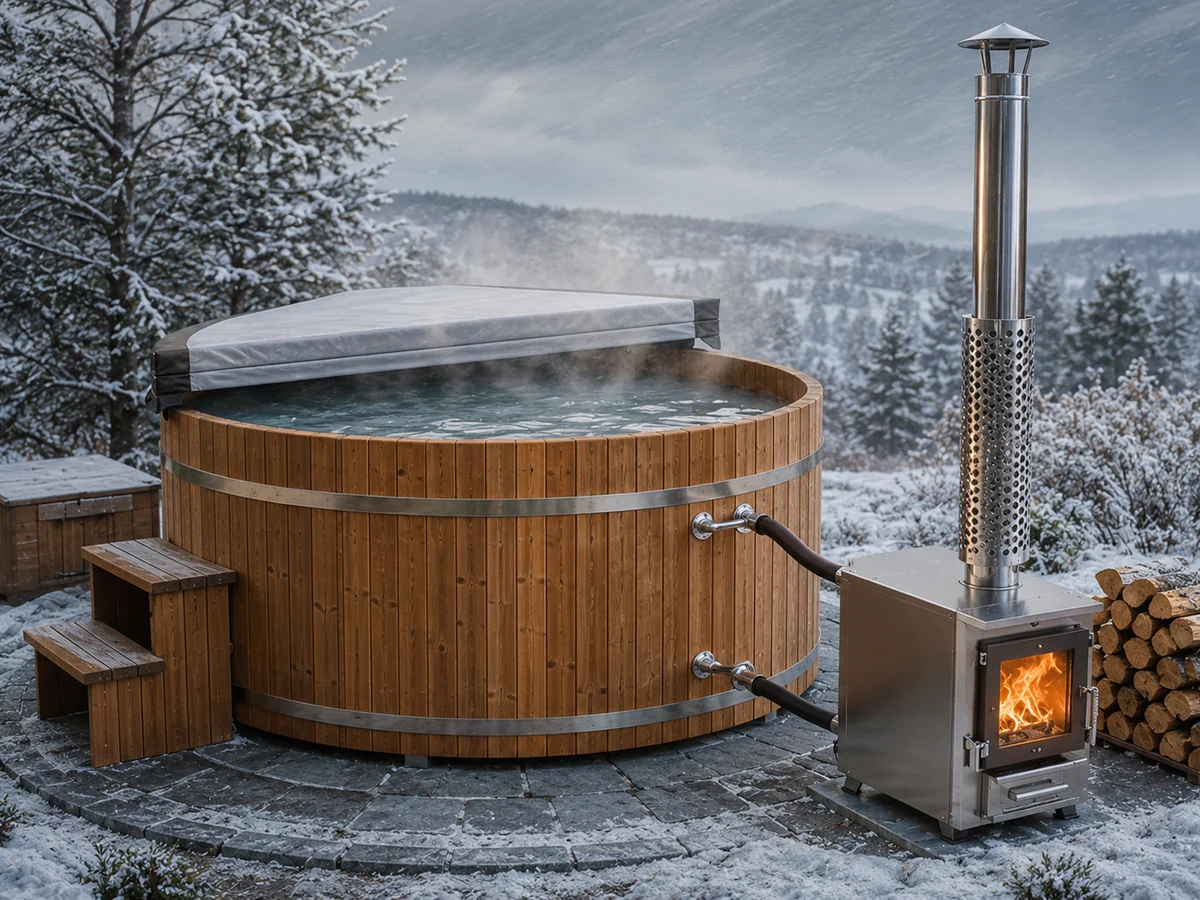
Conceptual winter operating scene; not a verified HACHILL model test or universal heating-time result. The cover position is illustrative only and must follow the selected product instructions and safe stove and chimney clearances.
Water Volume and Temperature Rise
Water volume and required temperature rise create the basic heating load. Record the actual source-water temperature in winter instead of applying summer data unchanged.
Stove and Heat-Transfer Route
Internal, external and other approved heat-exchange arrangements have different flow paths, water displacement, pipe exposure and maintenance requirements. Neither route is automatically faster in every configuration.
Circulation and Temperature Stratification
Natural-circulation systems depend on temperature differences, pipe position, slope and unrestricted flow. Approved pumped systems depend on pump selection and piping resistance. Do not add a pump to a natural-circulation system unless the manufacturer has approved the modification.
Fuel Quality and Combustion Control
Wet fuel consumes part of the fire's energy evaporating moisture instead of heating the water. Use only fuel permitted by the stove instructions and local rules. Do not burn painted or treated timber, bonded board, household waste or fuels excluded by the manufacturer.
Cover, Insulation and Heat Loss
A compatible insulated cover may reduce surface heat loss, but it must not create a clearance or fire risk around the stove or chimney. Exact construction and permitted use during heating must be verified.
Weather, Wind and Seasonal Conditions
Cold air and wind increase heat loss. Site planning should account for winter temperature, wind exposure, precipitation, fuel storage, cover storage, freeze protection, drain-down procedures and safe access around the combustion equipment.
How to Estimate Heating Time Before Lighting the Stove
1. Confirm Usable Water Volume
Use the selected model's approved fill volume. Do not substitute the external tub volume without accounting for benches, stove displacement, wall geometry and operating fill line.
2. Measure the Temperature Rise
Record the starting mixed-water temperature, intended target temperature and the difference between them.
Because the heating load depends on the endpoint, review how to select and verify the mixed-water target temperature. For general public-health context, the CDC advises that hot-tub water should not exceed 40°C (104°F); the actual project target may need to be lower.
3. Identify the Approved Configuration
Confirm the stove route, circulation method, pipe arrangement, chimney, fuel, cover and temperature measurement method.
4. Apply Real Site Conditions
Include ambient temperature, wind, fuel moisture, cold-fill versus reheat, cover use and any cleaning or refill requirement.
5. Add an Operating Margin
A scheduled operation should allow time for filling, ignition, stable circulation, mixing, temperature verification, cleaning checks, water-care checks where applicable and safe reduction of combustion intensity.
Internal and External Stoves Affect the Heating System Differently
On smaller screens, swipe horizontally to view the full table.
| Consideration | Internal Stove | External Stove |
|---|---|---|
| Heat path | Integrated with the tub water | Heat transferred through external connections |
| Water displacement | May reduce usable water volume | Usually outside the bathing area |
| Bather protection | Requires protection from hot surfaces | Firebox can be separated from bathers |
| Circulation dependency | Depends on exact internal design | Strongly affected by pipe layout and elevation |
| External heat loss | May use fewer external water connections | Pipework and stove casing can add losses |
| Heating-time conclusion | Must be based on the complete model | Must be based on the complete installed circuit |
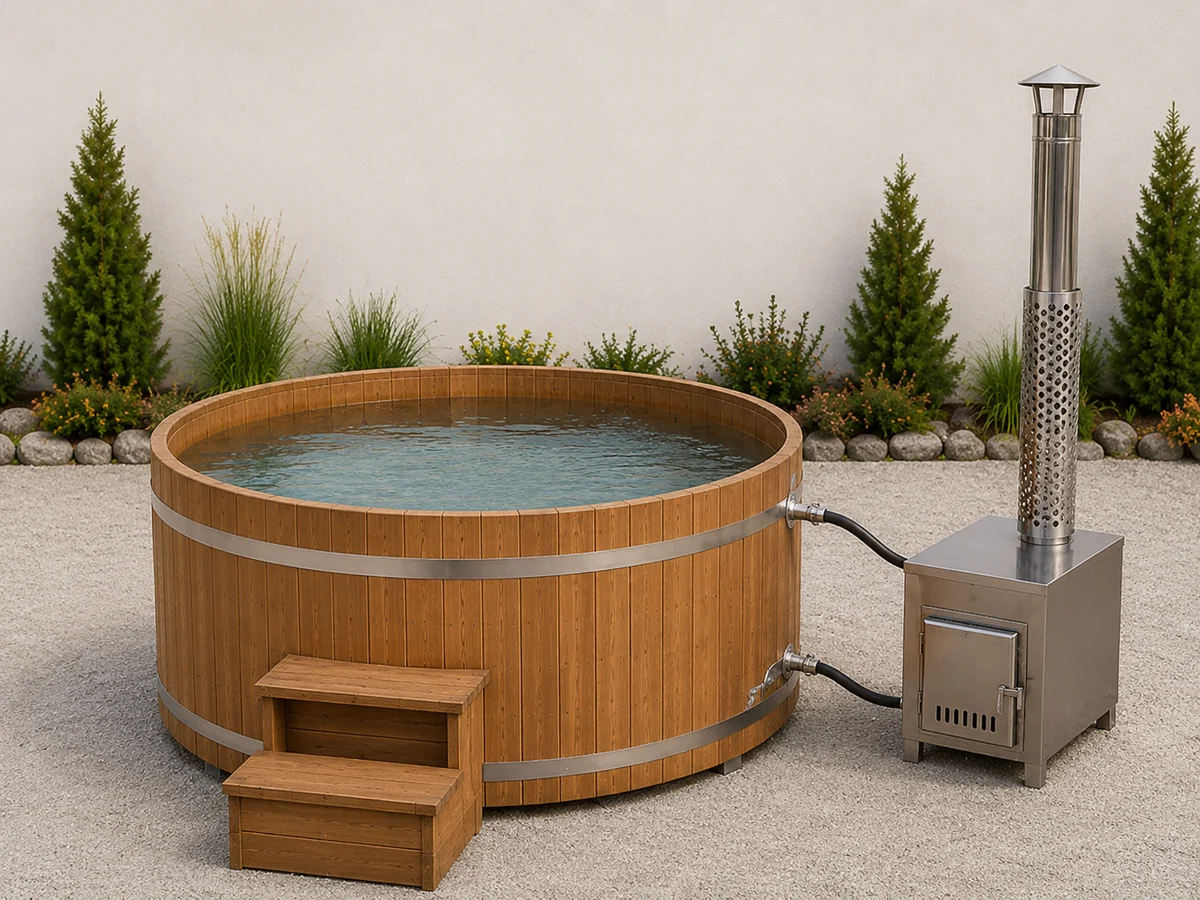
Conceptual external-stove configuration; connection geometry, chimney and clearances must follow the selected product documents and local requirements.
The correct route is not determined by heating time alone. User access, usable water volume, cleaning, available space, combustion separation, foundation, pipe layout, maintenance and local fire requirements also affect the choice.
For the complete relationship between combustion, thermosiphon or approved pumped circulation, chimney draft and mixed-water temperature, review come le tinozze nordiche riscaldate a legna trasferiscono il calore.
Site and Installation Inputs That Affect Heating
Heating performance cannot be separated from installation. Confirm these inputs before applying a test result to a real project:
- Foundation and level: support the filled load and preserve the approved stove and pipe geometry.
- Pipe route: verify connection height, slope, diameter and length for the selected system.
- Chimney and draft: use approved components and comply with local fire and smoke requirements.
- Drainage and refill: include the effect of cleaning, partial refill and source-water temperature.
- Freeze conditions: define drain-down, storage and seasonal shutdown procedures.
Final foundation, chimney, combustion, drainage and public-use requirements must be reviewed by the local installer and competent authority.
Seasonal and Operating Scenarios
Mild-Weather Cold Fill
A residential user fills a tub during mild weather with dry fuel and limited wind exposure. Heating may fall within the commonly marketed planning range, but the owner should still record the water volume, starting temperature and mixed final temperature before treating the result as repeatable.
Winter Cold Fill
The same tub starts with colder water and greater heat loss. The correct response is to extend the operating window, protect fuel from moisture and review freeze-management procedures—not to overfire the stove.
External-Stove Circulation Issue
The stove burns normally but the tub heats unevenly. Possible causes include air in the circuit, unsuitable connection geometry, restricted flow or inadequate mixing. The operator should follow the approved inspection procedure instead of altering pipework or adding a pump without manufacturer review.
Resort Opening-Time Planning
Staff allow only the estimated firing time and omit filling, ignition, mixing, temperature verification and water-care checks. The corrected schedule works backward from guest access and assigns a trained operator to each preparation stage.
These scenarios are illustrative composites and do not represent named HACHILL customer projects.
Safe Ways to Reduce Heating Time
The objective is to reduce avoidable heat loss and unstable combustion—not to push the equipment beyond its approved limits.
Prepare the Water Circuit Before Lighting
- Fill to the required operating level.
- Confirm heating surfaces and the water circuit are submerged as required.
- Open the approved circulation path.
- Check for visible blockage or leakage.
- Confirm the chimney and required clearances are ready.
- Follow the selected model's start-up instructions.
Use Approved Dry Fuel
Use properly stored, dry fuel of a type and size permitted by the stove instructions. General wood-burning practice from the US EPA supports using dry fuel and maintaining the appliance as instructed. Never use gasoline, kerosene or similar accelerants, and do not burn painted timber, treated wood, bonded board or household waste.
Control Heat Loss Without Creating a Fire Hazard
Where approved, use the correct insulated cover, protect exposed water pipework, maintain insulation and reduce wind exposure through safe site planning. Do not place improvised insulation or wind barriers near hot surfaces or flue components.
Mix and Measure Before Adding More Fuel
The stove and embers may continue transferring heat after the water approaches the operating target. Reduce firing intensity according to the instructions, allow circulation, mix where required and measure at a representative location before adding more fuel.
When Slow Heating May Indicate a Problem
A slower session is not always caused by cold weather. Compare the current session with the approved baseline and previous operating records.
On smaller screens, swipe horizontally to view the full table.
| Observed Condition | Possible Explanation | Safe Response |
|---|---|---|
| Weak or smoky combustion | Wet fuel, restricted air, ash build-up or poor draft | Use only approved routine checks; stop if smoke spills into the operating area. |
| Hot return but uneven tub temperature | Stratification, air lock or restricted circulation | Follow the approved mixing and circulation procedure; do not modify the pipework. |
| Heating time increases over repeated sessions | Fuel change, fouling, cover damage or measurement drift | Compare logs and perform only the approved maintenance tasks. |
| Overshoot, boiling, steam or violent water movement | Late fuel addition, blocked flow or unstable circulation | Prevent access and follow the manufacturer shutdown procedure. |
When the result is substantially slower than the verified baseline, follow the risoluzione dei problemi di riscaldamento della tinozza nordica a legna sequence before adding more fuel or changing the circulation route.
What Heating-Time Evidence Should a Buyer Request?
On smaller screens, swipe horizontally to view the full table.
| Evidence Item | Why It Matters | Decision Supported |
|---|---|---|
| Exact tub and stove configuration | Prevents one model's result being applied to another | Product comparison and quotation |
| Usable water volume and temperature rise | Defines the real heating load | Technical plausibility |
| Ambient conditions, cover and insulation | Shows the test's heat-loss boundary | Site comparison |
| Fuel type, moisture and circulation method | Explains combustion and heat-transfer conditions | Repeatability review |
| Measurement method and test repetitions | Prevents a local hot spot or one-off result becoming the headline figure | Performance evidence |
| Approved drawings, component scope and responsibilities | Connects the performance claim to the purchased configuration | Purchase-order release and handover |
Model-level heating evidence should be reviewed together with the approved configuration, drawings, components and manufacturing and quality-control review.
A seat count, lifestyle image, generic category brochure or nominal stove rating is not sufficient evidence by itself.
Heating-Time Planning for Resorts and Commercial Venues
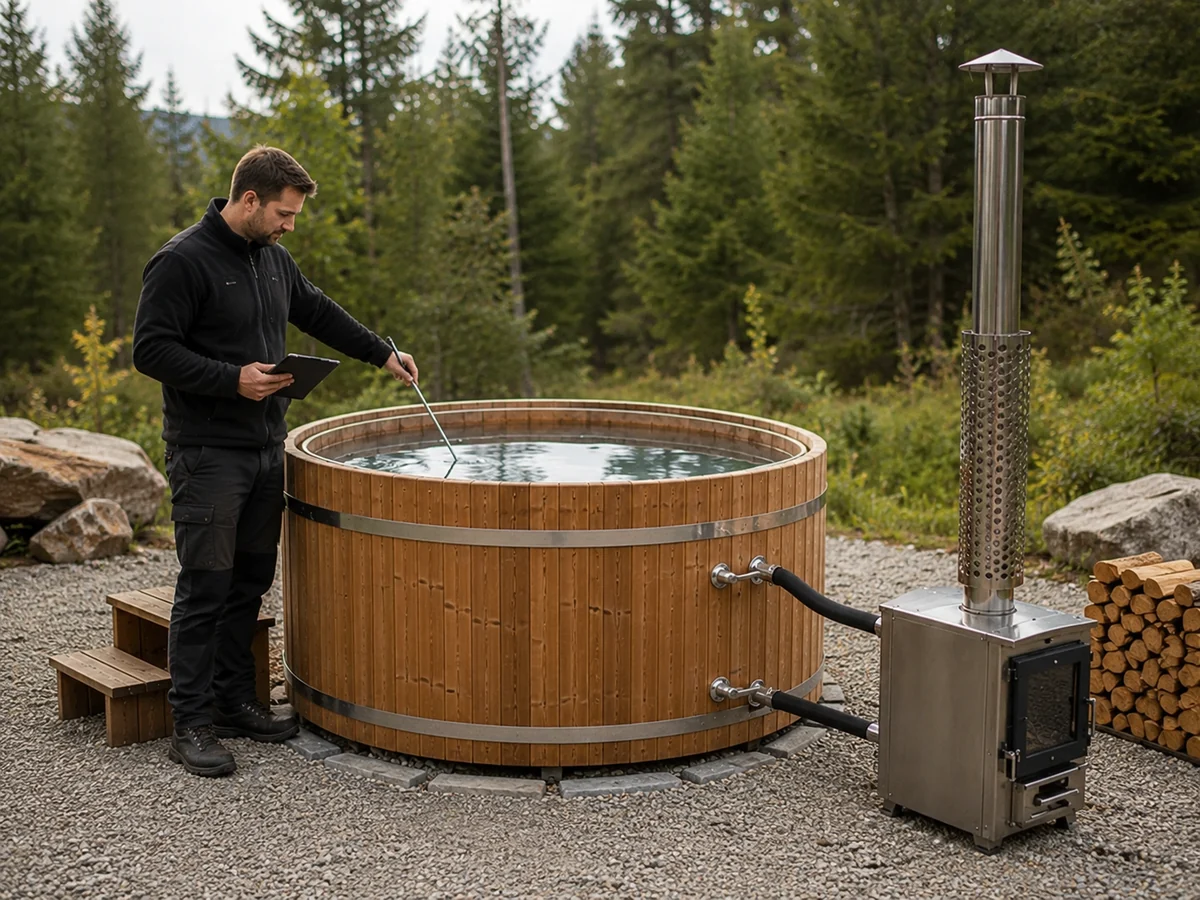
Conceptual operating scene; it does not represent a named customer site, approved commercial installation or specific HACHILL operating procedure.
Commercial buyers should coordinate heating time with guest flow, staffing, cleaning, utilities and handover through hotel and resort wellness project planning.
Work Backward from Opening Time
- Site and equipment inspection
- Water filling
- Fire preparation and ignition
- Riscaldamento
- Mixing and temperature verification
- Water-care checks
- Guest-access approval
- Monitoring during use
- Cleaning and shutdown
Define the Operator and Monitoring Procedure
Assign responsibility for fire management, temperature logging, fuel storage, water quality, cleaning, guest separation, emergency shutdown, ash handling and freeze procedures.
Confirm Whether Wood-Fired Operation Fits the Venue
On smaller screens, swipe horizontally to view the full table.
| Responsabilità | Manufacturer / Supplier | Buyer / Venue | Installer / Local Professional |
|---|---|---|---|
| Approved product configuration | Provide confirmed model and component scope | Approve intended use and operating brief | Confirm compatibility with the site |
| Foundation and access | Provide known product dimensions and loads where available | Provide site data and delivery constraints | Design and verify the final foundation and handling route |
| Chimney and fire compliance | Provide product instructions and approved components | Identify venue and local requirements | Verify installation, clearances and approvals |
| Water care and commercial hygiene | State included equipment and product limitations | Define operating, cleaning and monitoring policy | Review local public-health and drainage requirements |
| Heating-time record | Provide model-level baseline when available | Maintain site logs and operating margins | Investigate installation-related deviation where applicable |
Define the Responsibility Boundary Before Handover
On smaller screens, swipe horizontally to view the full table.
| Operating Task | Key Inputs | Why It Matters |
|---|---|---|
| Initial cold fill | Full water volume, source-water temperature and opening time | Usually creates the largest single heating load |
| Temperature recovery | Bather load, exposure, partial refill and fire state | Determines whether repeated sessions are practical |
| Cleaning and refill | Water-care policy, drain volume and refill temperature | May create an additional daily heat-up cycle |
Separate Initial Heat-Up, Recovery and Daily Throughput
A wood-fired route may be unsuitable where the venue cannot provide trained operation, compliant chimney and clearances, secure fuel storage, smoke compatibility, reliable water care, guest separation, sufficient preparation time, freeze protection and local approval.
Heating-Time Checklist Before Purchase or First Use
- Exact tub model and configuration
- Exact stove and heat-transfer route
- Volume d'acqua utilizzabile
- Starting water temperature
- Intended target temperature
- Required total temperature rise
- Internal or external stove
- Natural or approved pumped circulation
- Approved fuel type
- Fuel moisture condition
- Cover and insulation configuration
- Ambient temperature and wind exposure
- Chimney and clearance review
- Foundation and drainage
- Freeze-management procedure
- Temperature-monitoring method
- Operator responsibility
- Supplier test conditions
- Local fire, smoke and installation requirements
Minimum Inputs for a Model-Level Review
Final selection depends on actual user capacity, usage frequency, installation environment, climate, foundation, fuel conditions, drainage, water-care routine, transport access, project requirements, local regulations and confirmed manufacturer data.
- Estimate from usable water volume and required temperature rise.
- Evaluate the complete tub, stove and circulation configuration—not the stove rating alone.
- Add a site and operating margin for fuel, weather, cover use, mixing and verification.
- Request documented test conditions before accepting a model-level heating-time claim.
Domande frequenti
Quanto tempo impiega di solito una tinozza nordica riscaldata a legna a scaldarsi?
Un intervallo di pianificazione preliminare è spesso di circa due-quattro ore, ma i sistemi più piccoli possono essere più rapidi e le installazioni di grandi dimensioni o in climi freddi possono richiedere più tempo. Confermare il volume d'acqua esatto, l'innalzamento della temperatura, la configurazione della stufa e le condizioni di prova.
Una stufa a legna più grande riscalda sempre più velocemente una tinozza nordica?
N. Il tempo di riscaldamento dipende dall'intero sistema di stufa, scambiatore, circolazione e vasca. Una potenza nominale maggiore non garantisce che più calore raggiunga l'acqua in sicurezza.
Perché una tinozza nordica riscaldata a legna impiega più tempo a riscaldarsi in inverno?
Il funzionamento invernale spesso combina acqua di riempimento più fredda con una maggiore dispersione di calore dalla superficie dell'acqua, dalle pareti e dai componenti esposti. Vento e combustibile umido possono prolungare ulteriormente il periodo di riscaldamento.
Una stufa interna riscalda più velocemente di una stufa esterna?
Non necessariamente. Le stufe interne hanno un percorso di calore breve, mentre i sistemi esterni dipendono maggiormente dal design di collegamento e circolazione. Confronta configurazioni complete e testate piuttosto che la sola posizione della stufa.
Una copertura può ridurre i tempi di riscaldamento?
Una copertura isolante compatibile può ridurre la dispersione di calore superficiale. Deve essere utilizzata secondo le istruzioni del prodotto e tenuta lontana da condizioni pericolose della stufa o del camino.
Come posso stimare il tempo di riscaldamento in base al volume d'acqua?
Calcola prima l'energia necessaria per riscaldare il volume d'acqua effettivo attraverso l'aumento di temperatura richiesto. Poi dividi per il calore netto stimato ceduto all'acqua, non per la potenza nominale della stufa, e tieni conto delle perdite di calore reali.
Cosa dovrebbe includere un fornitore in una dichiarazione sui tempi di riscaldamento?
Richiedi il modello esatto, il volume d'acqua utile, la temperatura iniziale e target, le condizioni ambientali, la configurazione della stufa, il metodo di circolazione, lo stato del combustibile, la copertura e il metodo di misurazione.
Prepare a Wood-Fired Hot Tub Heating Brief
A qualified review needs more than a target heating time. Prepare the intended application, usable water volume, starting and target temperatures, climate, stove and circulation preference, fuel, foundation, chimney, drainage, water-care routine, delivery access and operating schedule.
For commercial or OEM projects, also provide daily throughput, staffing, destination market, quantity, branding, packaging and required technical or compliance documents.
Final heating performance, installation and commercial suitability must be confirmed for the selected model and approved project configuration.
Submit a wood-fired hot tub project brief