\n\n
A cold plunge filter cartridge should not be replaced on a universal calendar. Start with the maintenance interval specified for the installed filtration system and cartridge, then replace sooner if the cartridge reaches its documented service limit, develops damage, or no longer returns to a serviceable condition after the cleaning procedure approved for that filter.
\n\n
The important distinction is between scheduled maintenance and actual cartridge condition. Usage, debris exposure, and operating conditions can change how quickly a filter becomes loaded. At the same time, weak circulation does not automatically prove that the cartridge has failed. If a correctly serviced filter does not resolve the symptom, the next step is to investigate the wider circulation system rather than repeatedly fitting new cartridges.
\n\n
Start With the Approved Replacement Interval, Not a Universal Calendar
\n\n
The first question is not “How many weeks should every cold plunge filter last?” It is “Which maintenance instruction applies to this filtration system?”
\n\n
Published cold plunge maintenance schedules vary substantially between manufacturers, products, and duty conditions. That variation is important because it shows why an interval taken from another cold plunge should not be transferred to your own equipment. A residential unit, a higher-use facility, a different filter housing, and a different cartridge design may all have different service instructions.
\n\n
For a HACHILL cold plunge, the applicable interval therefore needs to be confirmed against the exact product and filtration configuration. Do not assume that one cartridge type, part number, micron rating, cleaning method, or replacement interval applies to every HACHILL model; confirm the exact product and filtration configuration. For an existing unit, use the maintenance instructions for your HACHILL product as the route to model-specific documentation and support.
\n\n
Treat the approved interval as the planned inspection and replacement baseline, not as permission to ignore cartridge condition until a date arrives. A filter can require earlier attention when actual service conditions load it faster than expected. Conversely, a cartridge should not be discarded early solely because another brand or another installation follows a shorter schedule.
\n\n
A useful maintenance record should identify the cold plunge model, filtration configuration, cartridge reference if available, installation conditions, previous cleaning or replacement date, and any recurring circulation symptoms. That gives the next service decision a product-specific history instead of relying on memory or a generic online recommendation.
\n\n
Replace the Cartridge Early When Condition Shows It Has Reached Its Limit
\n\n
A calendar cannot tell you whether filter media is still serviceable. Condition can.
\n\n
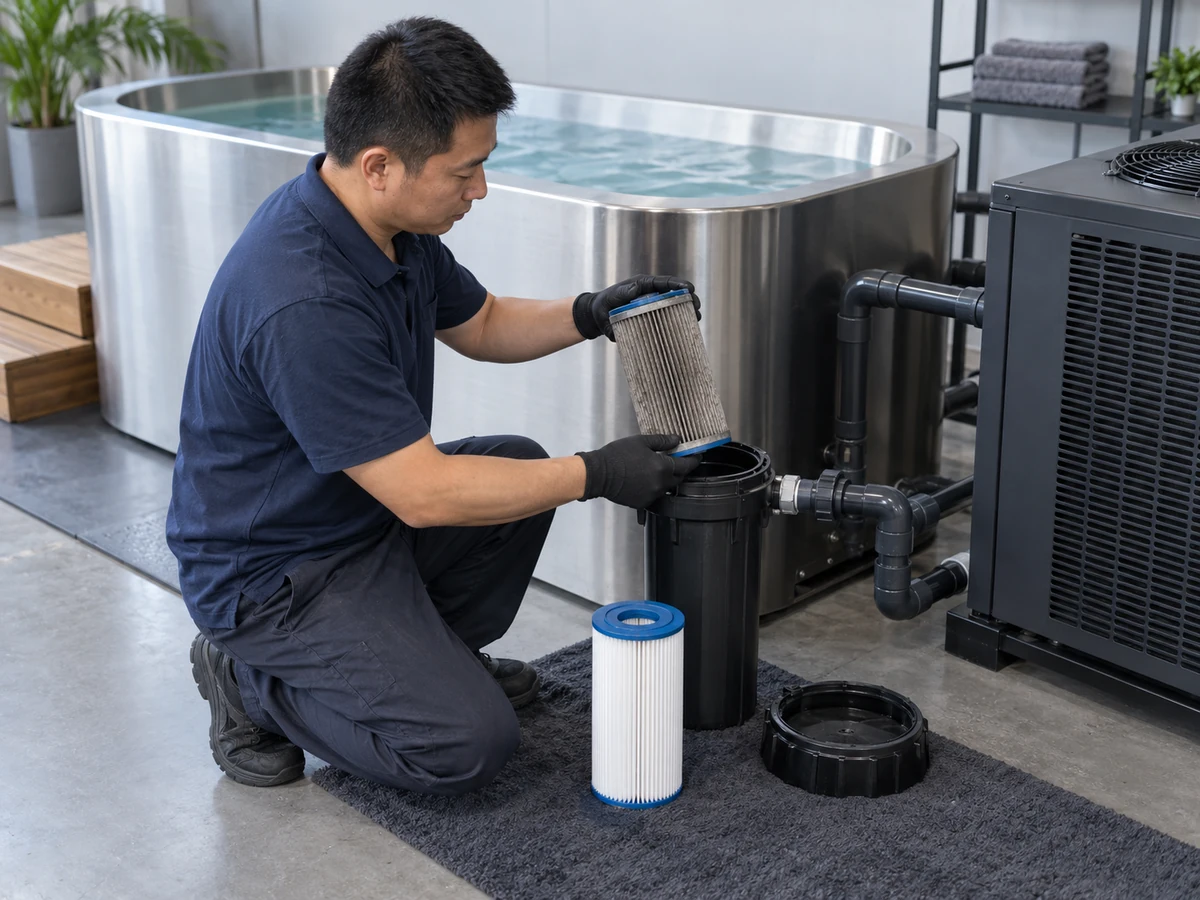
For cartridges that are specifically designed to be cleaned and reused, an approved cleaning procedure may restore the media to usable service. But this does not mean every cartridge can be washed indefinitely, nor does it mean that every dirty-looking cartridge has reached the end of its life.
\n\n
The key question is what happens after permitted cleaning and inspection.
\n\n
If the media remains intact, the applicable instructions allow reuse, and normal filtration behavior is restored, continued service may be appropriate. If restriction persists, cleaning intervals become progressively shorter, the media or support structure is damaged, or another manufacturer-defined service limit has been reached, replacement becomes the more defensible maintenance action.
\n\n
The exact trigger remains cartridge-specific. Appearance alone is not enough to create a universal rule. Discoloration, for example, may indicate loading, but a particular color or visual condition should not be treated as an automatic replacement threshold unless the applicable cartridge documentation says so.
\n\n
A practical decision framework is:
\n\n
| Observed state | Appropriate maintenance direction | Important boundary |
|---|---|---|
| Cartridge remains serviceable and no abnormal condition is observed | Continue / monitor | Stay within the applicable inspection and service schedule. |
| Cartridge is loaded but its instructions permit cleaning and the media remains serviceable | Clean and reassess | Use only the cleaning method approved for that cartridge. |
| Approved cleaning does not restore a serviceable condition, the media is damaged, or an applicable service limit has been reached | Replace | Confirm the correct replacement cartridge before installation. |
| Low flow or another symptom persists after correct cartridge service | Investigate | Widen the diagnosis beyond the filter instead of repeatedly replacing cartridges. |
\n
\n\n
This approach avoids two common maintenance errors: replacing usable filters simply because a generic calendar says to, and continuing to clean a cartridge after its service condition indicates that replacement is due.
\n\n
Why Cartridge Life Changes With Actual Operating Load
\n\n
A filter cartridge collects material from the circulating water. As material accumulates in the media, resistance through the cartridge can increase. In a pumped circulation system, greater resistance can affect the amount of water moving through the filtration loop.
\n\n
That basic mechanism is why operating conditions matter.
\n\n
A cold plunge exposed to more debris or a heavier user load can place a different burden on its filter than an otherwise similar installation with lighter use and better contamination control. An outdoor installation may also face environmental debris that an indoor installation does not. These variables do not produce a universal replacement multiplier, but they explain why two cartridges installed on different systems may not reach the same service condition at the same time.
\n\n
This is also why maintenance should track trend and condition, not only age. A cartridge that increasingly requires attention over shorter intervals may be giving useful evidence that its practical service condition has changed. The correct conclusion still depends on the applicable cartridge instructions and the rest of the system, but the trend is more informative than treating elapsed time as the only variable.
\n\n
Filtration should also be kept separate from sanitation. A cartridge removes suspended debris as part of the water-treatment system; changing it does not by itself establish that the water is adequately sanitized or that a shared-use installation meets local operating requirements. Disinfection, testing, physical cleaning, circulation, and filtration have different responsibilities. For the broader system, see HACHILL’s guide to cold plunge water care.
\n\n
For this reason, a visibly clean new filter should not be treated as proof that the entire water-care program is correct.
\n\n
When Low Flow Is Not Enough to Blame the Cartridge
\n\n
A loaded cartridge can increase resistance and contribute to reduced circulation. That makes the filter a logical item to inspect when flow appears weaker than expected.
\n\n
It does not make low flow a diagnosis of filter failure.
\n\n
The useful maintenance question is whether correct cartridge service changes the symptom. If the installed filter is due for inspection, follow its applicable service procedure. Where cleaning is permitted, clean and reassess it. Where replacement is required, fit the correctly identified replacement and observe whether the circulation condition returns to normal.
\n\n
If the symptom remains after the cartridge has been correctly serviced, the diagnostic boundary has changed. Continuing to replace filters without new evidence is unlikely to identify a problem elsewhere in the water circuit.
\n\n
Other circulation components and operating conditions can also influence flow. Depending on the exact system, the next review may involve the pump, upstream debris restrictions, plumbing or hose restrictions, air entering the circuit, valves or other water-path conditions. These are categories for further diagnosis, not a claim that any one of them is the cause.
\n\n
\n\n
This matters for both reliability and procurement. A maintenance team that treats every circulation complaint as a “bad filter” may consume replacement cartridges while leaving the actual system problem unresolved.
\n\n
There is also no justified universal pressure or flow threshold that applies across cold plunge filtration systems. Some filtration systems provide pressure, differential-pressure, flow, or alarm information, but any numeric service threshold must come from the documentation for the installed system. A threshold published for another filter cannot be copied into a HACHILL maintenance rule.
\n\n
Confirm the Replacement Cartridge Before You Fit It
\n\n
Knowing that a cartridge should be replaced is only half of the job. The replacement itself must match the installed filtration system.
\n\n
Do not approve a replacement cartridge because it looks similar to the old one.
\n\n
Start with the cold plunge model and the actual filtration configuration. Then identify the filter housing or affected assembly, the current cartridge reference where available, and the relevant product revision or parts documentation. If the manufacturer specifies dimensions, media type, filtration rating, interface details, or another identification characteristic, those become part of the compatibility check for that system.
\n\n
\n\n
A cartridge can appear to fit while differing in another characteristic that matters to the filtration system. Without current product documentation, those differences should remain unconfirmed rather than being guessed from photographs, nominal size, or a marketplace listing. Use HACHILL’s replacement-part compatibility route when the correct cartridge cannot be confirmed from current product documentation.
\n\n
For an existing HACHILL product, a useful replacement request should therefore include the product model, filtration configuration, any available cartridge or filter-housing identifier, relevant documentation or revision information, and a description of the condition that prompted replacement. If the request follows a circulation problem, include what was observed before and after filter service.
\n\n
Recording the installation date or service date of the new cartridge also improves the next maintenance decision. Over time, the facility can compare cartridge condition and service history against the applicable maintenance instructions rather than rebuilding the history each time a filter is changed.
\n\n
\n\n
Need model-specific support? If you need to confirm maintenance documentation or replacement-cartridge identity for an existing HACHILL cold plunge, provide the product model, installed filtration configuration, available cartridge identification, and current service symptoms.
\n
\n
\n\n
\n
\n\n