
Direct answer: Sauna cost is the sum of equipment, building interfaces, utilities, logistics, installation, compliance work and commissioning, followed by energy, cleaning, inspection, service and downtime during operation. A product-only price cannot answer an installed-project or lifecycle question.
Compare costs only after freezing destination, sauna type, finished size, glazing, heater route, electrical supply, site conditions, delivery access, commercial duty and required evidence. Use current project quotations and local rates. This page does not publish unverified HACHILL prices, market averages, freight rates, energy consumption, labor or payback claims.
Freeze the Cost Basis Before Comparing Any Number
| Input | Required record | Cost effect | Source/owner |
|---|---|---|---|
| Destination | Country, site, currency, tax basis and required compliance path | Changes product configuration, documents and local work | Buyer/project lead |
| Sauna scope | Type, finished dimensions, users, glazing, heater and controls | Defines equipment and room load | Designer + supplier |
| Delivery format | Site-built components, kit, flat pack or assembled cabin | Changes freight, access and labor | Buyer + logistics |
| Building interface | Base, floor, drainage, ventilation, power and weather work | Often excluded from product quote | Local designer/trades |
| Operating duty | Sessions, door openings, warm-up, occupancy and cleaning | Drives energy, wear and downtime exposure | Operator |
| Acceptance evidence | Submittals, inspection, commissioning and handover | Adds work but reduces dispute risk | Project authority |
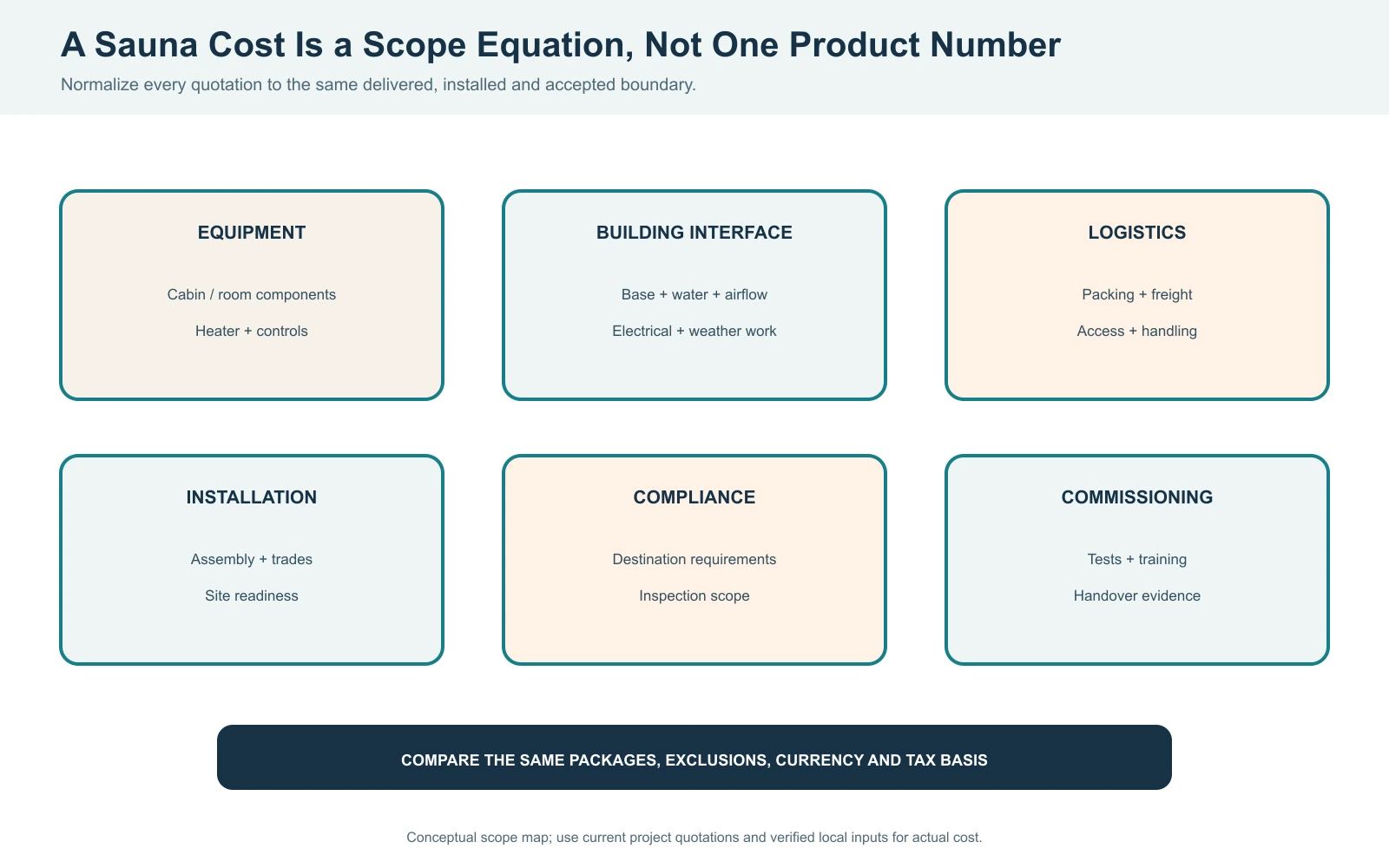
A useful cost answer must declare whether it means equipment-only purchase, delivered package, installed room, or multi-year commercial ownership. Those are different questions. Record currency, tax treatment, price-validity date and exchange-rate basis where relevant. A quote without these conditions may look precise but cannot be compared reliably.
No verified HACHILL price list, freight rate, local labor rate or universal market average is supplied here. Collect those values from a current scoped quotation and qualified local providers. This article explains the calculation and evidence path so the inputs are comparable.
Separate Capital Cost Into Controllable Packages
| Package | Typical contents | Common exclusion | Evidence |
|---|---|---|---|
| Equipment | Cabin/room components, heater, controls, benches and declared accessories | Building work and local connections | Approved bill of materials/submittal |
| Building interface | Base, framing, waterproofing, drainage, weather and ventilation work | Unknown existing-condition repair | Issued drawings and local quote |
| Utilities | Electrical supply, protection, isolation and declared connections | Service upgrades outside work area | Qualified MEP scope |
| Logistics | Packing, freight, customs basis, site handling and protection | Demurrage, storage or abnormal lifting | Route survey and logistics quote |
| Installation | Assembly, glazing, heater/controls and trade coordination | Rework caused by unready site | Method and labor scope |
| Compliance/commissioning | Required review, inspection, tests, training and handover | Unstated authority fees | Acceptance schedule |
The sauna package may include the structure, lining, benches, door, lighting and controls, but inclusions vary. Record whether the heater, stones, guard, control panel, wiring accessories and ventilation components are supplied. For outdoor models, add foundation or base work, roof drainage, weather protection and site access.
Site costs are local. Licensed electrical work, mechanical ventilation, waterproofing, lifting, permits and finishing can exceed expectations when they are discovered after ordering. Obtain site-trade allowances before committing to a product whose power or access requirements are not confirmed.

A low equipment number can be valid and still produce a high installed total when the site requires an electrical upgrade, structural base, waterproof transition, difficult access or weather protection. Do not call those automatically supplier overrun; first determine whether the original quote included the interface.
Normalize Supplier Quotations to the Same Scope
Use a common package list and add only documented exclusions. The following calculation uses dimensionless cost units, not dollars and not a market-price claim. It demonstrates why the lowest equipment line may not be the lowest comparable total.
| Cost package | Quote A | Quote B | Normalization note |
|---|---|---|---|
| Equipment | 100 units | 118 units | Declared package basis |
| Freight/handling | +18 | Included | Use same destination and delivery term |
| Site interfaces | +22 | +12 | Use verified local scope |
| Installation | +15 | +14 | Same trade and completion boundary |
| Commissioning/evidence | +5 | +6 | Same release package |
| Comparable total | 160 units | 150 units | 100+18+22+15+5; 118+0+12+14+6 |
Cost units preserve the arithmetic without inventing real pricing. Replace each unit with a current quote or approved estimate and retain its source. If a value is an allowance, label it separately from a firm price and state the quantity or event that will convert it.
Create one schedule listing internal dimensions, heat system, visible materials, glazing, controls, electrical supply, packaging, Incoterm, destination and installation responsibility. Ask suppliers to mark every included, optional and excluded line. This exposes whether a low price omits a heater, local connection or export packaging.
For OEM or distribution projects, add sample cost, tooling or engineering charges, spare parts, documentation, packaging artwork and inspection. Unit price alone does not describe the cost of bringing a repeatable product to market.

Calculate Operating Energy From Measured Duty, Not Nameplate Alone
Energy for a test period can be estimated as the sum of input power multiplied by run time in each state: E = sum(P x t x load fraction). For a hypothetical calculation only, a declared 9 kW heater operating at full input for 1.2 hours and an average 40% duty for the next 2 hours gives (9 x 1.2) + (9 x 0.40 x 2) = 18.0 kWh. This is arithmetic, not a HACHILL model result or typical consumption claim.
| State | Input to collect | Calculation | Boundary |
|---|---|---|---|
| Cold start | Verified input and elapsed run state | P x full/partial run time | Ambient and room must be recorded |
| Holding | Cycling or metered interval | Metered kWh or P x duty fraction x time | Do not assume full nameplate continuously |
| Door/user recovery | Events, occupancy and recovery interval | Incremental measured energy | Commercial schedule specific |
| Auxiliaries | Fans, controls, lights or pumps where present | Separate meter/input record | Configuration specific |
| Cost | Measured kWh and local tariff structure | kWh x applicable tariff | Demand, tax and time-of-use may differ |
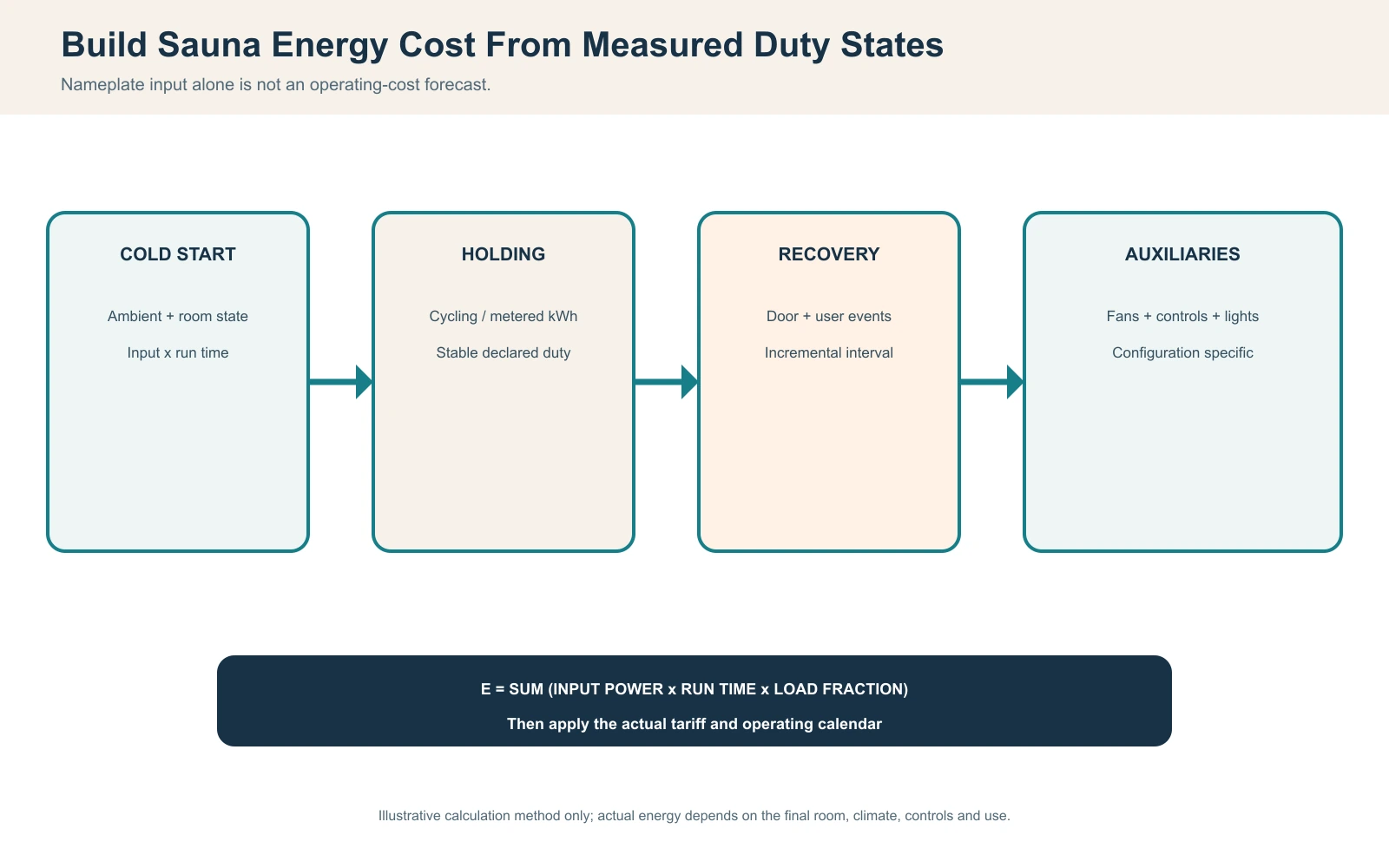
A heater's rated input is the maximum electrical demand while energized; it is not necessarily the average consumption across a complete session. Estimate energy as rated input multiplied by warm-up plus cycling time, then multiply by local tariff. Use supplier data or a monitored trial for a more reliable duty factor.
Insulation, glazing, room volume, starting temperature, ventilation and door openings affect run time. A commercial sauna with repeated entry has a different energy profile from a residential cabin used twice per week. State those assumptions whenever a monthly figure is presented.
Annualizing one test requires an operating calendar: sessions per day, operating days, seasonal ambient conditions, preheat policy, door schedule and downtime. A nameplate-only estimate often overstates holding energy yet may understate heavy commercial recovery. Meter the final room under declared duty where the decision justifies it.
Test the Assumptions Most Likely to Move the Budget
| Variable | Base evidence | Sensitivity test | Action if material |
|---|---|---|---|
| Glazing/effective load | Issued elevation and heater method | Approved design revision | Recheck heater, supply and warm-up |
| Electrical capacity | Site survey and load record | Upgrade/no-upgrade scenarios | Obtain qualified quote early |
| Delivery access | Measured route and package dimensions | Manual handling vs lift plan | Freeze logistics method |
| Labor | Defined tasks and local rates | Normal vs restricted access | Clarify exclusions/productivity |
| Energy tariff | Current tariff and billing structure | Season/time-of-use cases | Use operator finance basis |
| Downtime | Criticality and service plan | Planned vs extended outage | Stock parts or support path |
Sensitivity analysis is not a reason to add arbitrary contingency percentages. Identify the variable, establish a base source, test a reasonable project-specific alternative and record who owns the mitigation. Unknown site conditions should remain visible allowances until investigation closes them.
Build Lifecycle Cost From Service Events and Operating Records
| Cost driver | Quantity/event basis | Evidence | Planning response |
|---|---|---|---|
| Cleaning | Area, frequency and labor method | Operator procedure | Design for access and drying |
| Inspection | Scheduled safety/build checks | Maintenance plan | Assign qualified roles |
| Wear/replacement parts | Model-specific list and intervals when verified | Manual/service data | Avoid invented lifetimes |
| Timber/surface care | Exposure, cleaning and finish method | Condition inspections | Use compatible products |
| Energy | Metered or calculated duty x tariff | Test log and bill basis | Update after use changes |
| Downtime | Lost availability and response path | Facility record | Define spares/support priority |
Heating elements, stones, controls, lights, door hardware and high-use timber surfaces are service items. The replacement interval depends on duty, water quality, cleaning practice and component design, so fixed lifetime claims are unreliable. Ask for part identification, access method and lead time.
A design that costs slightly more but allows heater, sensor and lighting service without dismantling the cabin can reduce future downtime. Commercial buyers should include planned inspection and temporary closure in lifecycle planning.
Nameplate power is useful for electrical design but does not by itself predict monthly energy cost. Operating hours, warm-up, standby policy, heat loss and local tariff determine the bill.
Calculate energy from measured run time
For an existing or sample installation, use a suitable energy meter and record representative warm-up and operating periods. For a proposed project, state heater input, expected sessions, warm-up policy, door-opening pattern and climate assumptions. Do not publish an exact annual saving unless both alternatives were measured or modeled under the same documented conditions.
Include cleaning, inspection and replaceable parts
Commercial operating cost includes staff time, approved cleaners, heater-stone inspection, ventilation service, door and hardware adjustment, controller support and planned replacement access. A design that requires extensive dismantling for a routine component increases downtime. Ask suppliers to identify service tasks and parts availability without assuming a fixed lifetime or warranty not present in the quotation.
Evaluate downtime as a project risk
A residential owner may tolerate a delayed repair; a hotel or recovery facility may lose bookable capacity. Document which faults can be diagnosed remotely, which spares are practical to hold and who is responsible for local electrical or building work. This does not create a guarantee, but it makes support scope comparable across bids.
Lifecycle comparison is valid only when the alternatives use the same analysis period, operating calendar, tariff basis, maintenance scope and residual assumptions. Do not claim payback from unverified energy savings or service life. Present uncertain inputs as a range or scenario and keep the source next to the value.
Price Freight, Access, Receiving and Serviceability Early
A useful cost estimate is a scope model, not a market-wide price claim. Each package should state who supplies it, what assumption drives it and which evidence will close the allowance.
Separate the cabin package from the building interface
The sauna quotation may include timber walls, benches, heater and controls while excluding the structural base, waterproof floor, ventilation ductwork, feeder cable, protective devices, fire stopping, permits and final installation. List each interface explicitly. A lower product price can become the higher installed cost when local trades must redesign missing details or reopen finished work.
Price access, freight and on-site handling early
An assembled cabin may reduce site labor but require a larger delivery path, lifting plan and protected storage. A flat-pack package shifts more labor and quality control to the installer. Compare Incoterms, packaging dimensions, unloading responsibility, final room access and damage-inspection procedures on the same basis. Freight without destination handling is not a complete delivered cost.
Use allowances only where the input is genuinely unknown
Glazing, finish grade, heater system, voltage, ventilation controls and commercial-duty requirements should be frozen before final quotation. Keep provisional sums for unresolved civil or utility work, but identify the closing document and decision date. Otherwise an allowance becomes an untraceable source of change orders rather than a controlled budget item.

Measure doors, corridors, stairs, turning space, roof access and lifting zones against the packed delivery format. Confirm who unloads, stores, protects and moves the package. If a completed cabin cannot reach the room, the redesign cost is a logistics-interface failure, not a heater-price issue.
Service access affects future cost. Controls, sensors, heaters, lighting, ventilation components and removable panels need an approved access path. A lower purchase price can be offset by destructive access or long downtime, but the decision must use actual service requirements rather than a generic premium claim.
Grade Cost Evidence Before It Enters the Approval Total
| Grade | Evidence | Allowed use | Boundary |
|---|---|---|---|
| A | Current firm quotation or contract with defined scope | Approved commitment | Validity and change terms apply |
| B | Qualified local trade/logistics quote from issued information | Project budget input | Site conditions must match |
| C | Measured commissioning, meter or maintenance record | Operating/lifecycle forecast | Recorded duty only |
| D | Documented allowance with quantity and source | Visible uncertainty | Not a firm price |
| E | Online average, recollection or marketing claim | Early question only | Do not approve as project evidence |
Every cost line should carry source, date, currency, tax basis, scope revision, status and owner. Evidence grade does not mean a supplier quote is infallible; it means the assumptions and contractual boundary are visible enough to reconcile later.
Assign Cost Responsibility at Each Project Interface
| Decision | Supplier | Designer/trades | Buyer/operator |
|---|---|---|---|
| Equipment scope | Define supplied items, options and exclusions | Verify interfaces | Approve configuration |
| Site/building work | State product needs | Survey, design and price local work | Provide access/site data |
| Logistics | Provide packing/delivery data and term | Plan local handling where assigned | Confirm route and consignee duties |
| Compliance | Provide available model evidence accurately | Define local project/installation requirements | State destination and requested evidence |
| Commissioning | Provide product procedures/support scope | Perform qualified tests | Provide duty and release criteria |
| Operating cost | Provide verified input data | Validate installed configuration | Meter, tariff and schedule owner |
Responsibility follows information and control. The supplier cannot price an unseen service upgrade; the local contractor cannot certify an unspecified product; the operator cannot attribute changed energy cost to equipment without preserving duty and tariff data. Name owners before award.
Approve the Budget With Hold Points and Change Rules
Commercial buyers need a price that can survive technical review, procurement and handover. The quotation should link each allowance to a drawing, data sheet or named project responsibility.
Freeze the destination-market specification
Confirm installation country, voltage, frequency, phase, required equipment documentation, control language, accessibility needs and commercial use pattern before final price approval. Certification language must distinguish an available option, a design prepared for assessment and a specific listed or certified model. Request current evidence for the offered configuration rather than relying on a logo in a generic brochure.
Set inspection and change-control rules
Define drawing revision, approved materials and component substitutions before production. State which dimensions, finish samples, heater/control data, labels, manuals, packaging and functional checks require buyer approval. An undocumented component replacement can affect electrical data, service parts and local compliance even when the external cabin appearance is unchanged.
Close the budget at receiving and commissioning
Use the packing list to inspect quantity, crate condition, glass and timber surfaces, labels and accessories before assembly. Hold final acceptance until utilities, controls, heater protection, temperature distribution, ventilation, door and documentation are checked. Record open items and responsible parties; a delivered crate is not the same as a commissioned commercial sauna.
Recommended hold points are: basis freeze, approved submittal, site-readiness survey, logistics release, pre-installation change cutoff, receiving inspection, commissioning and final account reconciliation. At each point, list open allowances, required evidence and the person authorized to proceed.
A change request should state the original requirement, proposed change, reason, technical impact, cost/time effect, evidence and approval. Verbal substitutions or late destination changes can affect plug, voltage, documentation, labeling, protection and installation scope; they must not be hidden inside a single total.
Reconcile Cost Disputes Against the Original Scope and Measured Quantity
| Dispute | Preserve | Recalculate | Closure evidence |
|---|---|---|---|
| Freight/handling overrun | Delivery term, package data, route and event log | Agreed logistics boundary | Carrier/site reconciliation |
| Electrical upgrade | Original site data and equipment supply requirement | Issued upgrade scope | Qualified quote and approval |
| Energy variance | Meter data, ambient, duty, tariff and configuration | Same-period/same-duty basis | Controlled measurement review |
| Installation labor | Task scope, site readiness and change log | Measured variation | Approved time/quantity record |
| Damage/replacement | Packing and receiving photos | Transit vs site responsibility | Agreed disposition |
| Missing evidence | Submittal and contract requirements | Outstanding deliverable value/status | Documented acceptance or correction |
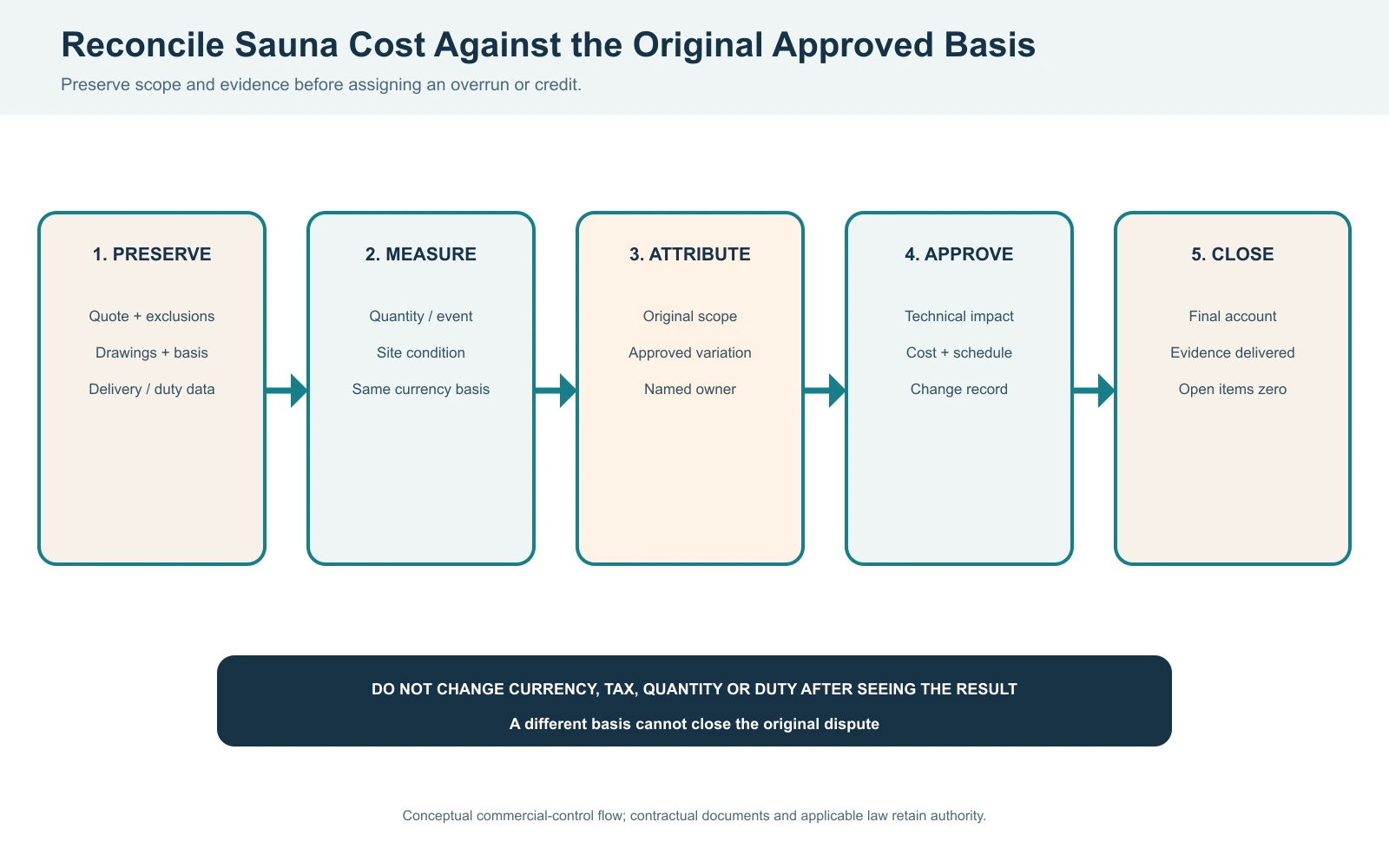
Do not change the cost basis after seeing an unfavorable result. Preserve the original quote, exclusions, drawings, operating assumptions, receiving evidence and change approvals. Recalculate on the same currency, tax, quantity and duty basis unless a formally approved change replaces it.
Destination requirements change after order review
Problem: Plug, supply, labeling or documentation must change late.
Likely cause: Destination and compliance scope were not frozen before selection.
How to check: Compare the original basis, approved submittal and new authority or buyer requirement.
Prevention/correction: Issue a controlled change showing technical, cost and schedule impact; do not describe optional preparation as completed certification.
Frequently Asked Questions
What is included in the cost of a sauna?
It depends on the quote boundary. Separate equipment, building interfaces, utilities, logistics, installation, compliance work and commissioning. Record taxes, delivery terms, exclusions and local work so quotations use the same installed scope.
How can I estimate sauna electricity cost?
Measure or model startup, holding, recovery and auxiliary energy separately. Multiply verified kWh by the applicable local tariff, including time-of-use or demand elements where relevant. Record ambient conditions, room configuration and operating schedule before annualizing.
Is a prefab sauna cheaper than a site-built sauna?
Not universally. Prefab can reduce some site variability, while site-built can fit architecture and local trades. Compare delivered and installed scope, access, utilities, weather interfaces, evidence, service access and lifecycle assumptions on the same basis.
Why is the equipment quote lower than the installed sauna budget?
Product quotes often exclude base work, waterproofing, drainage, ventilation, electrical upgrades, access/lifting, local permits, installation and commissioning. These are real project interfaces, not necessarily supplier price changes.
What should I send for a comparable sauna quotation?
Provide destination, currency/tax basis, sauna type, finished dimensions, users, glazing, heater route, utilities, site/access details, delivery format, commercial duty, required evidence, quantity and timeline. Mark any unknown input as an allowance to close later.
Related HACHILL Resources
Compare sauna categories
Review the available sauna system routes before requesting current pricing.
Review the sauna build plan
Define site, envelope, utilities and commissioning interfaces that affect installed cost.
Review engineering support
Coordinate drawings, evidence and project acceptance requirements.
Review OEM and ODM scope
Keep manufacturer and private-label terms on the commercial manufacturing page.
Define thermal acceptance
Use mapped measurement and declared duty rather than maximum settings.
Request a scoped quotation
Submit verified project inputs for a comparable response.
Reference Basis and RFQ Data
- U.S. Department of Energy energy-use estimation - general method linking power, operating time and energy cost.
- IEC 60335-2-53 - safety-standard scope reference for sauna heating appliances and infrared cabins; this is not a certification claim.
- ICC Incoterms rules information - commercial reference for defining delivery-cost and responsibility terms.
Sauna cost RFQ data sheet
- Destination, currency, tax and delivery-term basis
- Sauna type, finished dimensions, glazing and users
- Heater route, voltage, frequency and phase
- Indoor/outdoor site, climate, base, drainage and ventilation
- Delivery access, lifting, storage and installation responsibility
- Commercial schedule, cleaning and commissioning duty
- Required product evidence, manuals, drawings and inspection
- Quantity, branding, packaging and project timeline where applicable
Build a Comparable Sauna Cost Brief
Send HACHILL the destination, room/cabin scope, dimensions, glazing, heater route, utilities, delivery/access conditions, use schedule, evidence requirements and quantity. A scoped response is more useful than an unsupported market average.
Request a Scoped Sauna Quotation