Quick answer: build the assortment around customer jobs, not model count
A strong outdoor sauna assortment starts with the customers and projects a distributor actually serves—not with a target number of models.
Define the buyer task, enclosure route, site and climate, electrical context, delivery path, documentation and local support before deciding which products deserve a permanent place in the range. Every SKU should solve a distinct problem or fill a clear portfolio role. If two products serve essentially the same buyer task while adding different training, parts, documents or logistics, the larger assortment may create more complexity than value.
For distributors, a useful range should answer three questions:
- Who is this product for?
- Can it be quoted, delivered, installed and supported repeatedly in the target market?
- What customer or project problem does it solve that the current range does not already cover?
That is a more reliable basis for outdoor sauna assortment planning than simply carrying more models.
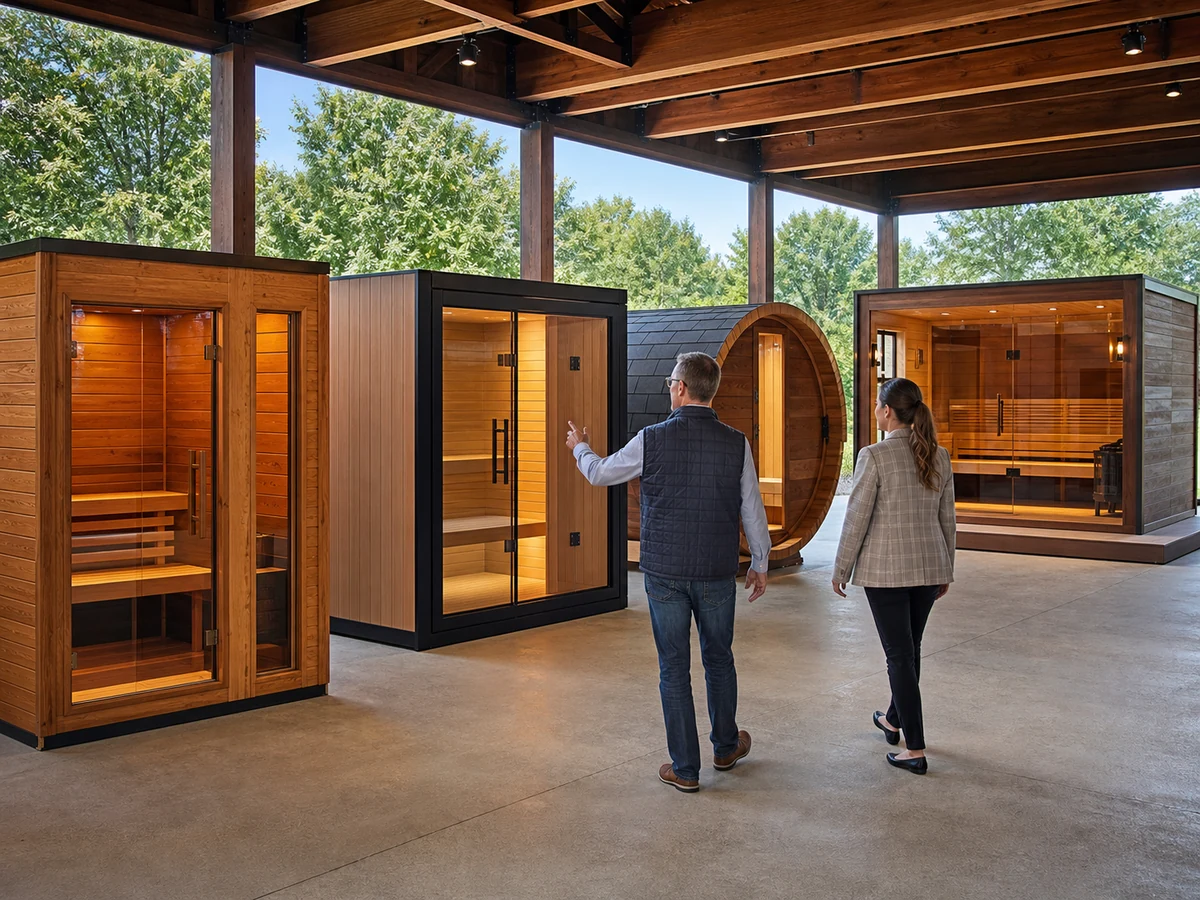
Define market cells before choosing outdoor sauna models
Do not begin with a list of products.
Begin with the market cells the distributor expects to serve: residential backyard projects, resorts and hotels, gyms and recovery spaces, glamping sites, dealer showrooms, compact urban installations or other clearly defined applications.
A market cell is more useful than a broad buyer label because it combines who is buying with where and how the product will be sold, installed and supported.
For example, “hotel” alone does not determine the correct assortment. Two hospitality projects may have different climates, electrical systems, site access, documentation requirements and local service capability.
Market cell qualification matrix
| Input | What to define | Why it changes the assortment |
|---|---|---|
| Target market | Country or sales region | Destination requirements and electrical context can differ |
| Buyer task | Backyard, hospitality, glamping, gym, showroom or another use | Defines the problem the range needs to solve |
| Sales channel | Project sale, showroom, stock program or dealer network | Changes how much information must be ready before sale |
| Site and climate | Rain, wind, frost, coastal air, solar exposure and drainage | Changes site and enclosure review |
| Utilities | Voltage, frequency, phase and known electrical context | Prevents a public heater value from becoming a final electrical assumption |
| Delivery | Access, handling, unloading and storage | Can eliminate an otherwise suitable product |
| Documentation | Drawings, manuals, labels, packing information and destination needs | Affects quotation and order readiness |
| Service route | Distributor, installer, local partner or another defined owner | Determines whether the product can be supported after installation |
| Order pattern | Display, project order, repeat order or another pattern | Helps distinguish a strategic range item from a one-off request |
| Open items | Anything still unknown | Keeps assumptions visible instead of turning them into specifications |
A useful assortment therefore begins with a market-and-support map, not a model count.
If the distributor cannot yet describe the buyer task, market conditions and support route for a proposed product, that product can remain a candidate without being treated as a fully established range item.

Give every SKU one primary portfolio role
Every outdoor sauna model in the assortment should have a reason to be there.
That reason should be meaningful to the buyer—not simply a different model name or a small visual variation.
A product may deserve a place because it serves a compact site, a larger user group, a particular enclosure preference, a different delivery constraint or a specifically required heat configuration.
Map each portfolio route to a buyer job
Before assigning a governance status such as Core or Hold, define what job the route is supposed to perform for the buyer. A SKU can be strategically important because of the customer task it serves even before the distributor decides how broadly to stock, display or promote it.
| Portfolio role | Best-fit buyer task | What to verify |
|---|---|---|
| Entry display route | Dealer showroom and straightforward residential shortlisting | Clear visuals, stable quote package and a support story the sales team can explain consistently |
| Compact site route | Small patios, glamping units or projects with limited access | Footprint, delivery envelope, electrical context and service clearance |
| Signature outdoor route | Resort, garden or destination-wellness projects | Weather scope, capacity, foundation interface and local installation plan |
| Hybrid configuration route | Projects with a defined need for a specialized Hybrid heating configuration | Permitted operating concept, controls, electrical load, ventilation assumptions and user instructions |
Then classify how each SKU should be governed
| Portfolio role | When it makes sense | What must be clear |
|---|---|---|
| Core | Serves a recurring buyer task in the target market | Product owner, documentation, delivery and support route |
| Supporting | Covers a need the core range does not solve | The difference is meaningful rather than cosmetic |
| Pilot candidate | Potential demand exists but market or support assumptions still need validation | Open items remain visible and controlled |
| Hold | Critical inputs remain unresolved or the product overlaps heavily with the current range | Do not force it into the assortment |
“Pilot candidate” is a planning label in this guide, not a formal HACHILL commercial program status.
Use an overlap test before adding another SKU
Ask one simple question:
If this model were removed from the proposed assortment, what customer decision would become harder to solve?
A useful addition should preserve at least one meaningful distinction, such as:
- a different enclosure or site constraint;
- a different capacity or project role;
- a different delivery or access solution;
- a clearly defined heating requirement;
- a different buyer or support need.
If removing a model barely changes the range from the buyer’s point of view, it may be adding operational complexity without adding a meaningful customer solution.
That matters because every additional SKU can create more work in sales training, quotations, technical explanation, drawings and documents, spare-parts identification, packaging and delivery, installation coordination, after-sales support and repeat-order change control.
More choice is not enough on its own. A wider catalog needs a clear buyer or project reason for every additional SKU.
Separate enclosure geometry from heating configuration
Outdoor sauna assortment planning becomes clearer when two different decisions are not mixed together.
For the current HACHILL outdoor architecture, Barrel, Cube and Outdoor Cabin are enclosure routes. Hybrid Outdoor is a specialized heating configuration, rather than a fourth enclosure geometry.
First choose the enclosure route
The enclosure should solve the site, layout and buyer task.
Barrel sauna
A Barrel route can be shortlisted where curved geometry, outdoor presentation and the available Barrel model range fit the site and user group. Exact model details belong on the relevant Barrel product pages rather than being treated as one category-wide specification.
Outdoor cabin sauna
A Cabin route offers conventional room-like geometry, but individual models still have their own proportions, access, roof and site requirements. Capacity alone should not control the selection.
Cube sauna
Cube routes can fit modern design-led projects, but models with the same marketed capacity can still have different product envelopes. Site and model comparison remain necessary.
Then decide whether the project actually needs Hybrid
Hybrid should be a second decision axis.
The better sequence is:
- Which enclosure route fits the project?
- Does the project have a real requirement for a specialized Hybrid heat configuration?
A Hybrid route should not be added merely because a distributor wants another “type” in the catalog.
Where Hybrid is relevant, the actual operating concept, equipment, controls, electrical load, ventilation assumptions and user instructions still need to be defined for the selected configuration. Use the Hybrid outdoor sauna category when that specialized route is relevant.
Two-axis assortment logic
| Decision axis | Distributor question |
|---|---|
| Enclosure | Does Barrel, Cube or Outdoor Cabin best fit the site and buyer task? |
| Heating configuration | Does the project require the applicable standard route, or a specifically defined Hybrid configuration? |
This distinction prevents Hybrid from being compared as if it were simply another enclosure shape.
Screen climate, utilities and market compatibility before range release
An outdoor sauna that fits one market is not automatically ready for another.
Climate, utilities, installation practices, destination requirements and service capability can all change what a distributor can reliably quote and support.
Screen the actual exposure, not just the climate label
“Cold climate,” “wet climate” or “coastal market” is too broad for a final decision.
Useful screening inputs include:
- direct and wind-driven rain;
- frost or freeze-thaw conditions;
- snow and runoff;
- coastal exposure;
- direct solar exposure;
- foundation and drainage conditions;
- service access after installation.
Use the outdoor sauna climate specification guide when exposure needs deeper project review, and the outdoor sauna weatherproofing checklist when roof, drainage, openings and base interfaces need closer attention.
These inputs are useful for assortment screening, but they should not be converted into unsupported claims about a specific HACHILL model’s wind rating, service life or weatherproof certification.
Electrical compatibility needs a separate check
A public heater power reference is not a complete electrical design.
Before a product becomes part of an active regional assortment, identify the relevant:
- heater or heating equipment;
- voltage;
- frequency;
- phase;
- control arrangement;
- installation route;
- local professional or regulatory review.
There is also an important scope distinction between appliance requirements and electrical-installation requirements.
IEC 60335-2-53 addresses particular safety requirements for sauna heating appliances and infrared cabins. IEC 60364-7-703 applies to electrical installations in sauna rooms and cabins within its stated scope and excludes prefabricated sauna cabins that comply with a relevant equipment standard. That scope boundary is why it should not be treated as a universal installation rule for every sauna configuration.
For distributors, the useful question is not “Does this model list a heater power?” It is:
Can this selected product and heating configuration be documented and installed within the electrical context of the target market?
Keep destination requirements destination-specific
Requirements found for one market should not silently become global requirements.
For example, the European Commission’s Access2Markets / EU import guidance provides EU-specific information on tariffs, origin rules, import procedures and product requirements. That makes destination review important, but it does not make EU requirements universal.
A useful range-release sequence is:
Climate → Utilities → Installation route → Destination requirements → Product documents → READY or HOLD
If a critical input is unresolved, keep it visible rather than replacing it with an assumption.
Measure service and logistics burden before expanding the assortment
Range planning continues after the sale. The distributor still needs a repeatable way to quote, receive, install, explain, service and reorder the product, which makes support commonality a real portfolio decision.
Review the real support burden
Do not invent a numeric “support score.” Check the actual work.
| Support dimension | Question |
|---|---|
| Product knowledge | Does this SKU require a different sales or technical explanation? |
| Installation | Does it introduce a new installation route or trade interface? |
| Spare parts | Does it require different identification or stocking logic? |
| Documentation | Does it add manuals, labels or destination-document work? |
| Delivery | Are packing, unloading or access requirements materially different? |
| After-sales | Is troubleshooting and escalation ownership clear? |
A new model does not need to be identical to the current range. The goal is to understand what additional support burden the distributor is deliberately accepting.
Translate support checks into buyer-facing outputs
The internal support review should produce something the sales, installation and after-sales teams can actually use. Translate that review into outputs those teams can apply consistently during quotation, delivery, installation and after-sales support.
| Check | Why it matters | Buyer-facing output |
|---|---|---|
| Common parts and training | Reduces support complexity | Dealer service notes and a defined spares plan |
| Delivery envelope | Prevents access failures | Route-survey requirement where large packs, modules or assembled units need it |
| Documentation package | Supports accurate quotations | Model drawings, manuals and clear option boundaries |
| Claims and substitutions | Prevents unsupported promises | A clear process for reviewing and approving alternatives before they are presented as equivalent |
Do not plan logistics from installed footprint alone
A sauna may fit the final site but still fail the delivery route.
Before treating a product as easy to support, review the actual order’s:
- packed or module dimensions;
- unloading method;
- gates and narrow passages;
- turns and slopes;
- overhead restrictions;
- temporary storage;
- handling equipment;
- weather protection during delivery.
Keep export-packaging requirements conditional
ISPM 15 is a good example of why logistics rules need scope.
The IPPC / ISPM 15 standard applies to defined wood packaging material used in international trade and identifies exclusions such as certain processed wood materials. That does not support the statement that every HACHILL sauna shipment automatically requires ISPM 15 treatment.
The correct distributor question is:
What packaging material is actually being used, and what does the destination require?
Repeat orders still need change control
A successful first order should not become a permanent assumption that all future orders are identical.
Recheck the order if there is a meaningful change in the model, component, configuration or option, documentation, packaging, destination requirement, service arrangement or commercial scope.
A useful operating principle is:
First approved order ≠ permanently frozen specification.
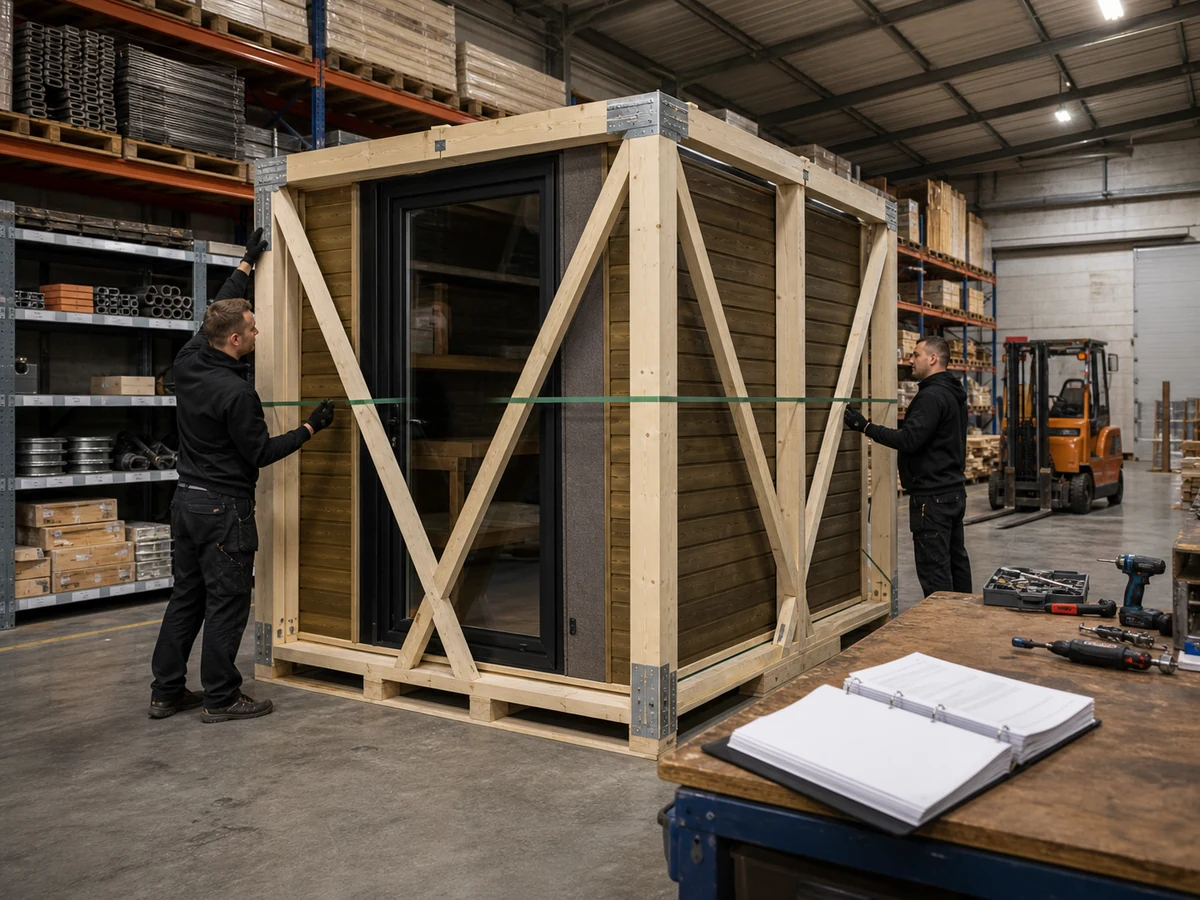
Use the assortment RFQ as a release gate
A distributor RFQ should do more than send a list of model names.
It should contain enough information to determine whether a proposed route is ready for quotation, whether evidence is still missing, or whether a product should remain on hold.
Outdoor sauna assortment RFQ inputs
| RFQ input | What to provide |
|---|---|
| Target market | Country or sales region |
| Buyer segments | Residential, hospitality, glamping, gym, showroom or other groups |
| Sales channel | Project sales, stock, showroom, dealer network or another route |
| Current assortment | Existing enclosure and heat routes |
| Proposed additions | Products or categories being considered |
| Climate | Relevant rain, wind, frost, coastal, solar and drainage conditions |
| Utilities | Voltage, frequency, phase and installation context |
| Delivery | Typical access, unloading and storage conditions |
| Service | Installer, distributor, partner or other after-sales owner |
| Documentation | Drawings, manuals, labels, packing data and market-document needs |
| Display plan | Whether the route is intended for showroom display, demonstration, project quotation or another sales use |
| Expected quantities | Initial, project or repeat-order estimate or forecast, kept separate from any unconfirmed commercial commitment |
| Branding needs | Any requested branding or labeling requirement for commercial review; do not assume private-label approval |
| Order pattern | Display, project, repeat or expected ordering pattern |
| Open items | Anything not yet confirmed |
Range-release checklist
- Is the market cell defined?
- Does the SKU have a distinct role?
- Is the enclosure / heat-route classification correct?
- Are the site, climate and utility conditions sufficiently understood?
- Are destination-document questions identified?
- Is delivery and packing workable enough to quote?
- Is installation and service ownership understood?
- Are unresolved items clearly recorded?
When the important inputs are available, the product can move toward SHORTLIST / RFQ READY.
When critical inputs are missing, use HOLD / REQUEST MISSING INPUT rather than guessing.
Example: should another SKU be added?
Assume a distributor already carries an outdoor sauna that covers its main residential and showroom buyers.
A second model is proposed.
Do not ask only whether the model looks different. Ask:
- Does it solve a different enclosure, capacity, site or heating requirement?
- Does the target market support its electrical route?
- Can it reach typical customer sites?
- Are the required documents understood?
- Can the local team support installation and after-sales questions?
- Does it duplicate a product already in the range?
If several of these questions remain unresolved, the product can stay under review.
That does not mean the product is unsuitable. It means the evidence is not yet strong enough to treat it as an established range item.
Keep assortment planning separate from commercial appointment
A product-range review does not itself confirm distributor appointment, territory rights, exclusivity, pricing, MOQ, private-label approval or OEM terms.
Those belong to the relevant commercial review. Use the HACHILL Distributor Program when the discussion moves into channel and commercial qualification.
Frequently asked questions
How many outdoor sauna models should a distributor carry?
There is no universal number. Carry enough models to cover distinct customer and project jobs without creating unnecessary overlap or support burden. Role clarity, market fit and supportability matter more than catalog size.
Should every distributor carry Barrel, Cabin, Cube and Hybrid saunas?
No. Barrel, Outdoor Cabin and Cube are enclosure routes and should be selected according to demand, site fit and support capability. Hybrid Outdoor is a specialized heating configuration and should be considered when a project actually requires that operating route.
What is a lower-complexity first assortment?
Start with a narrow range whose buyer roles, documents, delivery paths and service responsibilities are clear. Expand when real enquiries, quotation patterns and support experience show that another product fills a distinct gap.
When should a distributor add another SKU?
Add a product when it solves a customer task, enclosure constraint, capacity requirement, site problem or heating requirement that the current assortment does not already cover—and when the documentation, delivery and support route can be established.
When should the assortment be reviewed again?
Review it when meaningful inputs change rather than relying only on an arbitrary calendar interval. Changes in models, components, documents, packaging, destination requirements, support arrangements or recurring buyer demand are practical triggers for another review.
Official reference scope
- IEC 60335-2-53 addresses particular requirements for sauna heating appliances and infrared cabins. Its scope does not certify a HACHILL product or replace market-specific applicability review.
- IEC 60364-7-703 addresses electrical installations in rooms and cabins containing sauna heaters within its stated scope and excludes prefabricated sauna cabins complying with a relevant equipment standard. Local adoption and the actual installation still determine applicability.
- European Commission import guidance / Access2Markets is an example of destination-specific import and product-requirement review for the EU; it is not a global rule.
- IPPC / ISPM 15 defines the scope of phytosanitary measures for wood packaging material in international trade; applicability depends on the actual packaging material and destination.
Prepare an outdoor sauna assortment review
Before requesting an assortment review, prepare the target markets, buyer segments, sales channel, current and proposed product roles, climate, utilities, delivery conditions, service route, expected order pattern and documentation needs.
Separate confirmed information from open items.
That gives HACHILL a clearer basis for distinguishing routes that are ready for quotation from items that still require product, market, logistics or documentation review.