
Quick answer: horsepower is not the same as cooling capacity. A cold-plunge chiller may be marketed as 1/2 HP, 1 HP or another horsepower class, but that label does not by itself tell a buyer how much heat the complete unit can remove from the water. For a technical comparison, ask for useful cooling capacity in kW or Btu/h, keep the rating conditions attached to that number, separate cooling output from electrical input, and check exactly how COP was calculated.
The useful next question is not “Which HP number is bigger?” It is “Are these two supplier performance claims defined on the same basis?” If the units can be converted but the water condition, condenser-air condition, flow, input boundary or model configuration do not match, the offers are still not fully comparable.
This page owns that comparison task. It does not calculate how much cooling capacity a specific cold-plunge project requires; that belongs to the full thermal-sizing process.
Start by Asking What the HP Number Actually Represents
A horsepower field is useful only after the supplier defines what it represents.
Horsepower can refer to different power conventions, and product listings may use HP as a motor/compressor descriptor or as a convenient product-class label. NIST lists multiple horsepower conventions rather than one universal horsepower definition. For example, mechanical horsepower is approximately 745.7 watts.
That conversion is a power-unit conversion. It is not a refrigeration-capacity conversion.
So this statement is valid:
1 mechanical hp ≈ 745.7 W of mechanical power.
This statement is not:
1 hp chiller = 745.7 W of cooling capacity.
Cooling output depends on the refrigeration system and the stated operating or rating conditions. Two chillers carrying the same HP label therefore do not automatically deliver the same useful cooling capacity.
When a quotation or product sheet shows HP, ask what that field actually names.
| Supplier field | What it may represent | What it does not prove by itself |
|---|---|---|
| Horsepower / HP | A defined power convention, motor/compressor descriptor or supplier product class | Useful cooling capacity |
| Cooling capacity | Heat-removal rate at stated conditions | Project suitability at every condition |
| Electrical input | Power consumed within a defined input boundary | Cooling output |
| COP | Ratio between defined cooling output and defined power input | Seasonal or all-condition efficiency |
The first procurement check is therefore simple:
If the supplier cannot define the HP field, keep it as an identification field rather than treating it as a contractual cooling-output value.
That does not make HP useless. It means HP should not carry a decision that belongs to a different performance quantity.
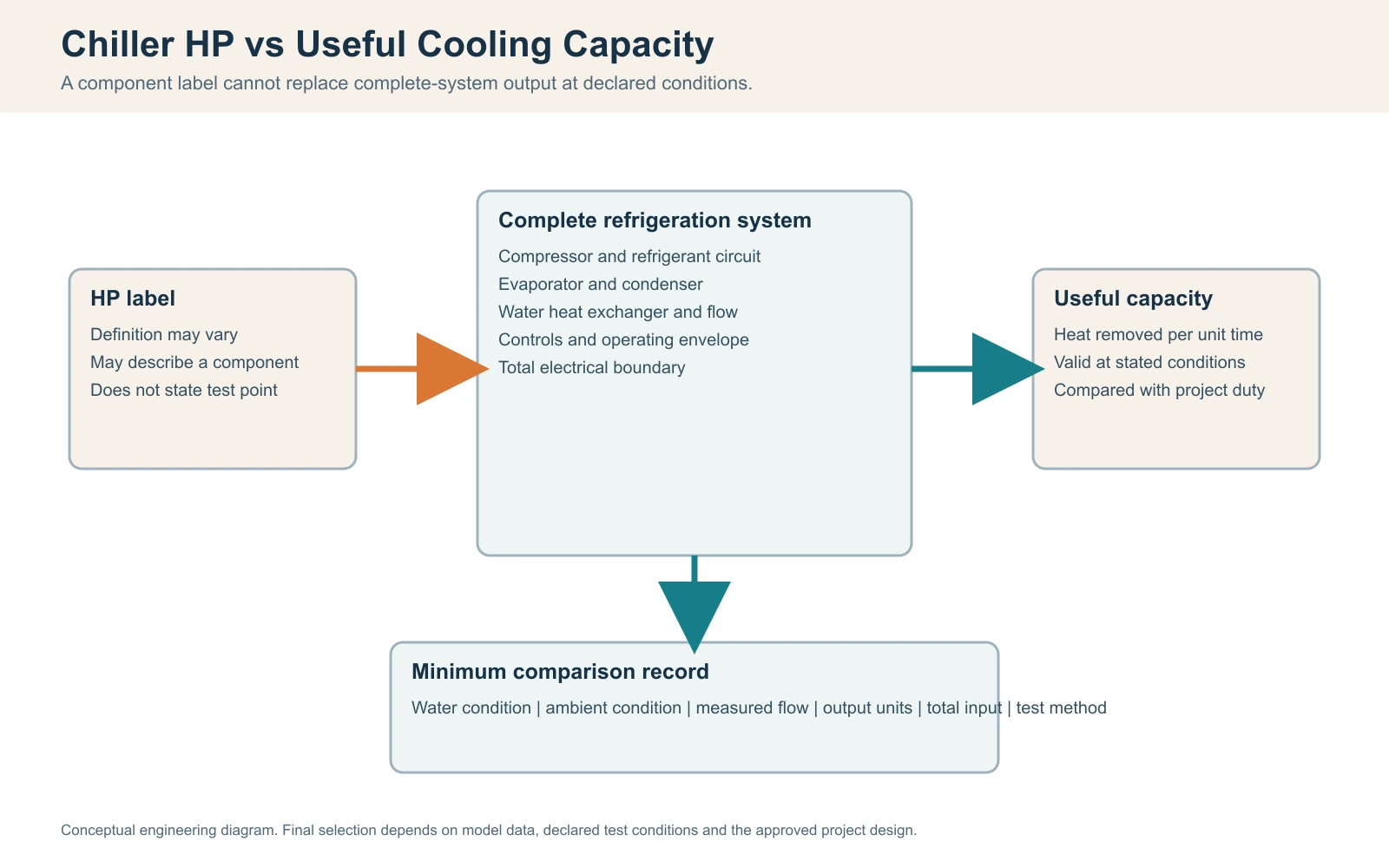
Compare Useful Cooling Capacity in kW or Btu/h, Not HP Alone
Cooling capacity is a heat-removal rate. For chiller comparisons, it is commonly expressed in units such as kilowatts of cooling (thermal output) or Btu per hour.
In this guide, useful cooling capacity is a working procurement term for the cooling output the supplier states is available to the water-side load at a declared condition. Use the supplier’s exact rated term where available; this phrase is not a substitute for a defined test or rating method.
Those units can be converted. Using the NIST heat-flow conversion basis:
1 kW of cooling ≈ 3,412 Btu/h.
That makes the output units easier to normalize across supplier quotations.
For example, if one offer states 5.0 kW of cooling and another states 17,100 Btu/h, the two numbers are close after unit conversion. That does not yet mean the chillers are performance-equivalent. It only means the output quantities have been put into comparable units.
This is the critical distinction:
Normalize the unit first. Normalize the comparison basis second.
A buyer should also distinguish a rate from an amount of energy. Btu/h and kW describe how quickly heat is being removed. They are not the same thing as a stored-energy quantity such as Btu or kWh.
For this article, useful cooling capacity answers:
“How much heat-removal rate is the supplier claiming at the declared condition?”
It does not answer:
“How much capacity does my project require?”
That second question depends on water volume, temperature change, pull-down window, ongoing heat gains and other project inputs. The project-required capacity calculation belongs in the full thermal-sizing process.
Keep Rating Conditions Attached to Every Capacity Number
A capacity value without its rating conditions is incomplete for procurement comparison.
AHRI rating terminology defines published performance in relation to stated rating conditions. In practice, that means a capacity number should remain attached to the operating conditions used to establish it.
AHRI terminology is used here as a reference framework for defining performance claims. Citing that terminology does not mean a particular cold-plunge chiller is rated under an AHRI standard or is AHRI Certified.
For an air-cooled chiller, the comparison basis can include water-side conditions and condenser entering-air conditions. Flow and exact equipment configuration can also matter. Carrier 30RB performance data provide one manufacturer example of capacity and efficiency being tied to declared water and condenser-air conditions rather than one fixed number under every operating point.
That leads to one of the most important rules in this article:
Convert units, not conditions.
You can convert kW to Btu/h. You cannot make two different rating points equivalent merely by changing the unit label.
Before two supplier capacity values are treated as matched, check at least the fields that materially define the published result:
| Capacity field | Why it must stay attached |
|---|---|
| Exact model / configuration | Prevents family or option differences from being hidden |
| Cooling-capacity value and unit | Defines the claimed output rate |
| Water-side rating condition | Identifies the water condition used for the claim |
| Condenser entering-air condition | Identifies the heat-rejection condition for an air-cooled unit |
| Flow basis | Helps define the tested or rated water-side condition |
| Revision / performance source | Shows which data set the claim came from |
If Supplier A publishes 5 kW at one water/air condition and Supplier B publishes 5 kW at a different condition, the correct status is not automatically “equal.”
It is:
UNMATCHED until the rating basis is aligned or valid condition-linked data close the gap.
The same rule applies to a single supplier across different brochures, quotations or revisions. A newer table, a different model configuration or another option set can change the evidence scope.
A rating condition is also not automatically the same as the final project condition. A published point can be perfectly valid while still being the wrong point for a particular installation.
Separate Cooling Output, Electrical Input and COP
Cooling output tells you how much heat the chiller removes. Electrical input tells you how much electrical power is consumed within a defined boundary. COP relates the two.
Those fields should not be substituted for one another.
AHRI describes chiller COP as cooling capacity divided by total power input at a stated set of rating conditions. The important phrase for a buyer is not only “COP.” It is also what counts as total power input and which operating condition the ratio belongs to. See the AHRI liquid-chiller terminology.
A quotation may show one or more of the following:
| Field | Buyer question |
|---|---|
| Cooling capacity | How much cooling output is claimed? |
| Compressor input | Does this cover only the compressor? |
| Fan / pump / auxiliary input | Are these included elsewhere? |
| Total unit input | Which electrical loads are inside the stated boundary? |
| COP | Are the output and input boundaries defined on the same basis? |
Two COP numbers should not be ranked until those boundaries are aligned.
A higher COP can indicate more cooling output per unit of included input at the stated comparison point. It does not automatically prove lower annual energy use, lower operating cost or superior efficiency at every ambient temperature, water temperature or load condition.
Likewise, lower electrical input does not automatically mean lower cooling capacity. One unit may consume less input because it is smaller; another may consume less because it is more efficient; a third quotation may simply exclude auxiliary loads that another supplier included.
For buyer comparison, the correct question is:
“What output and what input are included in this COP?”
If the supplier cannot answer that, keep the COP field open rather than treating it as a clean ranking metric.
Normalize Supplier Quotations Before Comparing Chillers
Most quotation errors come from comparing fields that look similar but are defined differently, not from difficult mathematics.
A normalized comparison sheet makes those gaps visible.
| Comparison field | Supplier A | Supplier B | Status |
|---|---|---|---|
| Exact model / configuration | MATCHED / OPEN | ||
| HP field meaning | DEFINED / OPEN | ||
| Cooling capacity | |||
| Capacity unit | NORMALIZED | ||
| Water-side rating condition | MATCHED / UNMATCHED | ||
| Condenser entering-air condition | MATCHED / UNMATCHED | ||
| Flow basis | MATCHED / UNMATCHED | ||
| Electrical / total-input boundary | MATCHED / UNMATCHED | ||
| COP boundary, if quoted | MATCHED / UNMATCHED | ||
| Evidence source | CONFIRMED / OPEN | ||
| Revision / date | MATCHED / OPEN | ||
| Overall comparison | COMPARABLE / HOLD |
The labels above are procurement working states, not formal certification terms.
MATCHED
Use this when the relevant fields are stated on a sufficiently aligned basis for the decision being made.
UNMATCHED
Use this when both suppliers provide data, but the conditions or boundaries differ.
For example:
- same capacity unit, different condenser entering-air condition;
- same COP label, different total-input boundary;
- same HP class, different cooling-capacity evidence.
OPEN
Use this when a required field is missing or undefined.
Examples:
- HP is listed but its meaning is not stated;
- capacity is shown without rating conditions;
- COP is shown without defining included input;
- model configuration is unclear.
HOLD
Use HOLD when the unresolved field is important enough that a procurement or specification conclusion would otherwise depend on an assumption.
This is a better result than filling a supplier gap with an industry average or competitor value.
Missing data is not permission to infer data.
A normalized sheet also prevents a common mistake: treating a unit conversion as if it resolved a specification mismatch. Converting 17,100 Btu/h to about 5 kW does not close an air-condition, water-condition, flow or configuration mismatch.
Decide Whether the Capacity Evidence Is Strong Enough to Use
A technically impressive number is useful only if its evidence supports the decision you want to make.
Two questions should be kept separate:
- How strong is the evidence?
- How wide is the evidence scope?
An exact-model manufacturer performance table with stated conditions is stronger for procurement than an undefined family label. A condition-linked third-party certification or test record may provide still stronger support within its stated scope. A calculation or simulation can also be useful when the method, assumptions and configuration are clear.
But stronger evidence does not automatically have broader scope.
An exact-model result at one configuration and one rating point does not prove:
- every configuration in the product family;
- every water temperature;
- every ambient condition;
- every installation;
- every field result.
A practical evidence ladder for buyer review is:
| Evidence type | Procurement value | Boundary to preserve |
|---|---|---|
| Exact-model third-party certification listing or certified rating under a named program | Strong within the stated program scope | Only the covered model, configuration, rating and certification scope |
| Exact-model independent laboratory test report at stated conditions | Strong when the method and traceability are clear | Tested configuration and conditions only; a test report is not certification unless the named program says so |
| Exact-model manufacturer published performance | Strong for supplier-declared performance | Keep stated rating conditions and revision |
| Declared calculation or simulation | Useful when transparent | Assumptions and method remain part of the result |
| Nominal/family/marketing label | Screening only | Not enough for a condition-specific performance specification |
This table is a procurement decision aid; it is not an AHRI grading system.
Standard reference is not certification
A supplier may refer to an AHRI definition, rating method or standard language. That does not by itself prove that the product is AHRI Certified. AHRI Standard 551/591-2026 keeps standards/rating scope distinct from participation in an AHRI Certification Program.
Certification is a separate claim and requires exact supporting evidence for the relevant product and certification scope.
The same boundary applies to HACHILL: no AHRI or other certification should be inferred merely because this article uses industry rating terminology.
Keep the exact model and revision attached
When evidence is supplied, retain:
- exact model;
- configuration/options where relevant;
- rating/test condition;
- source type;
- revision or date;
- whether the result is measured, certified/tested, calculated, simulated or nominal.
If a material field is missing, keep the claim OPEN or HOLD rather than broadening the evidence by assumption.
Do not force a test through a protection condition
If the comparison depends on a test with unresolved loss of flow or another active equipment-protection condition, do not bypass safety devices to complete the data record. Follow the exact equipment documentation and qualified service path; manufacturer instructions such as Carrier chiller installation and service documentation treat flow protection as equipment-specific rather than a generic field adjustment.
This page does not own commissioning procedures or refrigeration/electrical service instructions.
Know When the Question Has Become a Full Thermal-Sizing Problem
This article answers:
What does the supplier claim this chiller can deliver, and can I compare that claim fairly with another offer?
It does not answer:
How much cooling capacity does my project require?
Once the supplier data are normalized, the next task may be thermal sizing.
That is where water volume, initial and target temperature, required pull-down window, holding load, recovery events, insulation, ambient conditions and other project inputs become the controlling problem.
Use the Cold Plunge Thermal Engineering and Chiller Sizing Guide for that calculation.
A second handoff occurs when the project already has an installed or selected capacity and the real question is whether the evidence justifies changing it. That decision belongs in the Cold Plunge Chiller Duty Cycle and Oversizing Trade-Offs guide.
The boundary is deliberate:
- POST2310: Are the supplier capacity claims meaningful and comparable?
- POST2307: How much capacity does the project require?
- POST2311: Does the evidence justify changing the selected/installed capacity?
Keeping those decisions separate produces a cleaner technical shortlist and reduces the chance that an HP label is mistaken for a sizing result.
Frequently Asked Questions
Is 1 HP equal to about 746 W of cooling?
No. A mechanical horsepower is approximately 745.7 W as a power-unit conversion. That does not make a 1 HP chiller equal to 745.7 W of refrigeration cooling capacity.
Is Btu/h better than HP for comparing cold-plunge chillers?
Btu/h or kW cooling is more directly relevant because it describes heat-removal rate. But the capacity value is only comparable when its rating conditions and model/configuration scope are also clear.
Can two chillers with the same HP have different cooling capacity?
Yes. The HP field alone does not establish identical useful cooling output. Compare condition-linked capacity data instead.
Can I compare 5 kW with 17,000 Btu/h?
You can convert the units and see that they are close in nominal output rate, but you still need matching rating conditions, model scope and input boundaries before treating the two performance claims as equivalent.
Does lower electrical input mean lower cooling capacity?
Not necessarily. Electrical input and cooling output are separate quantities. Their relationship should be evaluated using comparable performance data and, where relevant, a consistently defined COP.
Is a higher COP always better?
A higher COP can indicate more cooling per unit of included input at the stated operating point. It does not by itself prove lower annual energy use or better performance across all conditions.
What if a supplier gives me only HP?
Ask for cooling capacity in kW or Btu/h, rating conditions, exact model/configuration, flow basis and the relevant electrical/input boundary. Keep the comparison OPEN rather than estimating the missing output from HP.
How much cooling capacity does my cold plunge actually need?
That is a thermal-sizing question rather than an HP-vs-capacity comparison. Use the thermal-sizing guide once the supplier performance data have been normalized.
Prepare a Capacity-Comparison Brief for Supplier Review
Before asking a supplier to compare offers, collect the fields that make the comparison auditable.
Request or provide:
- exact model and configuration;
- meaning of the HP field;
- cooling capacity and unit;
- water-side rating condition;
- condenser entering-air condition;
- flow basis;
- electrical or total-input boundary;
- COP and its boundary, if quoted;
- which auxiliary loads are included;
- source or test basis for the published performance;
- revision/date of the performance data;
- any model-specific operating limitations relevant to the comparison.
Separate the record into three states:
- CONFIRMED — directly supported by the supplier/model evidence;
- OPEN — not yet supplied or defined;
- UNMATCHED — supplied, but not on the same comparison basis.
If the next decision is the project-required cooling duty rather than the supplier-data comparison itself, move the record into the thermal-sizing workflow instead of extending this page into another sizing calculation.