Direct answer: There is no evidence-based rule that everyone should cold plunge a fixed number of times per week. Frequency has to be interpreted together with the actual exposure: water temperature, time in the water, immersion depth, purpose, health context, supervision and how the person responds during and after the session. Daily cold plunging is not proven to be better for general wellness, and research uses widely different protocols rather than one validated weekly schedule.
If you choose to use cold-water immersion, the most defensible way to adjust frequency is to keep the exposure conditions stable, repeat only after the previous session has resolved without concerning symptoms, and change one variable at a time. Do not make the water colder, stay in longer and add more sessions in the same step. For sport recovery, the goal matters: repeated cold-water immersion used alongside resistance training may reduce some strength-training adaptations, so “more often” is not automatically better.
- No universal weekly target: research does not establish one frequency that is appropriate for everyone.
- Hold the exposure stable: temperature, duration and depth must be considered before frequency can be interpreted.
- Let purpose change the plan: general wellness, post-exercise recovery and clinician-led use are different contexts.
- Symptoms override the schedule: stop for serious distress, confusion, faintness, chest symptoms, uncontrolled breathing, loss of coordination or inability to exit safely.
How Often Should You Cold Plunge? Start With the Evidence Boundary
The available research does not establish a universal “best” number of cold-plunge sessions per week. A 2025 systematic review of cold-water immersion for health and wellbeing found substantial variation in protocols and concluded that more research is needed to define long-term effects, safety and dose-response relationships. A Cochrane review of post-exercise cold-water immersion likewise found that temperature, duration and frequency varied across trials and that the optimum method and safety were not clear.
| Purpose | What evidence supports | What it does not establish | Frequency implication |
|---|---|---|---|
| General wellness | Research has examined a range of short- and longer-term cold-water exposures in healthy adults. | A validated universal weekly frequency or guaranteed benefit. | Do not treat a popular weekly number as a medical dose. |
| Post-exercise soreness | Cold-water immersion may reduce muscle soreness after exercise compared with passive recovery in some settings. | One optimum temperature-duration-frequency protocol for everyone. | Use should be matched to the training context rather than a generic streak. |
| Resistance-training adaptation | Regular cold-water immersion used with resistance-training programs has been associated with reduced strength adaptations in a systematic review and meta-analysis. | That every single post-workout plunge will impair progress. | Frequent use immediately around strength-focused training deserves a goal-specific review. |
| Clinician-led use | A qualified professional may use a protocol for a defined person and objective. | That the same protocol should be copied by the general public. | Follow the individualized plan rather than this article. |
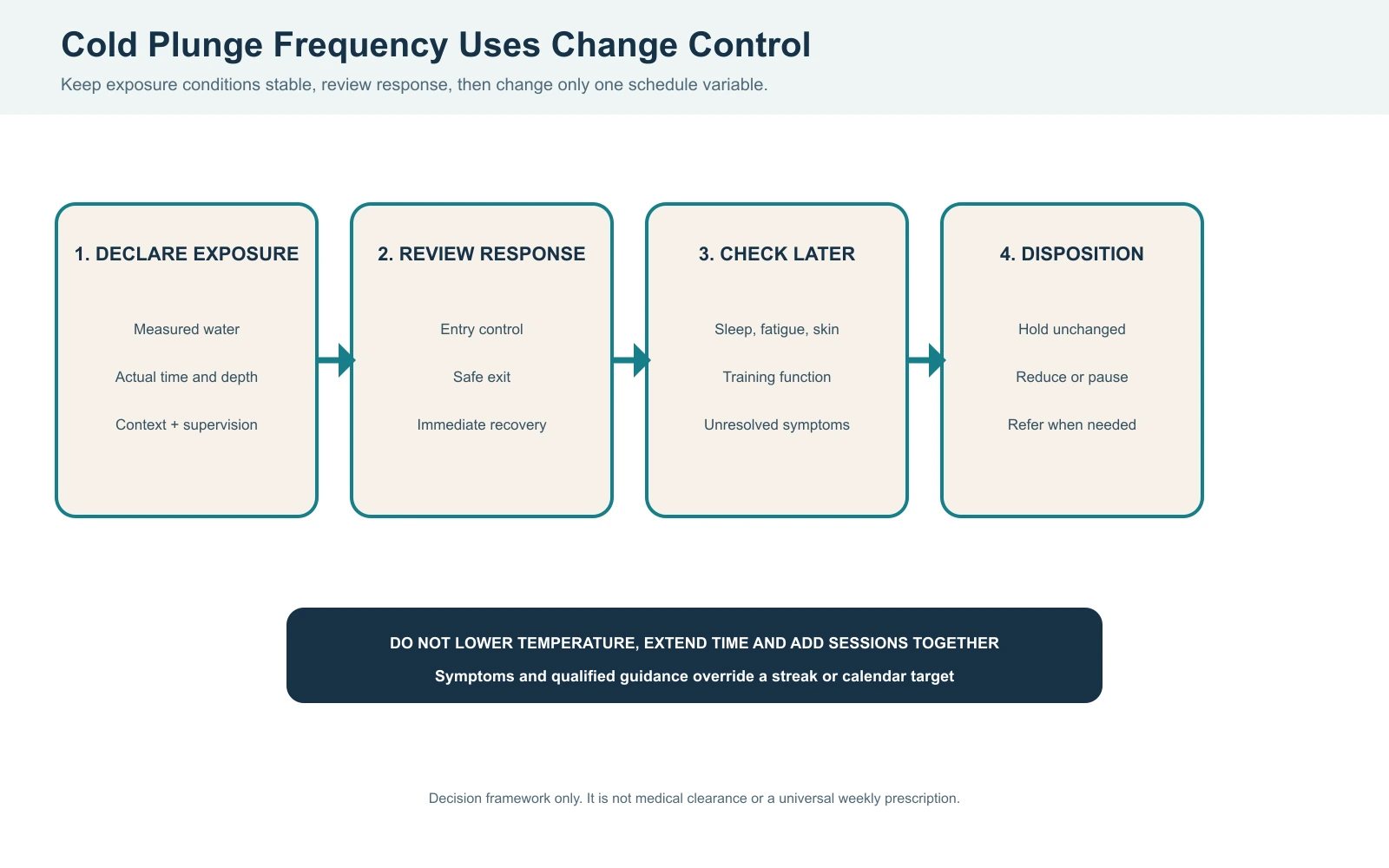
The practical rule is simple: establish one controlled exposure, observe the response, and do not increase frequency until the previous condition has been reviewed. This is a change-control method, not proof that any particular cold exposure is safe for a specific person.
Keep the Exposure Condition Stable Before Changing Frequency
A weekly count by itself is weak information. Two sessions at one measured condition are not equivalent to two colder or longer sessions. Record enough detail to know what is actually being repeated, and avoid converting the record into an invented “dose score.”
| Field | How to capture it | Why it matters | Weak evidence |
|---|---|---|---|
| Water temperature | Use a reliable measured water reading and record the unit. | Temperature changes the cold exposure being repeated. | A controller setpoint assumed to equal the actual water condition. |
| Exposure time | Record actual entry and exit time. | Planned time and completed time may differ. | Logging the planned duration after an early exit. |
| Immersion depth | Use a consistent descriptive body level. | Changing the immersed surface area changes the exposure. | Tub fill height without the user’s position. |
| Context | Note relevant exercise, sauna use, illness, unusual fatigue, travel or other major changes. | Frequency is difficult to interpret when other stressors change at the same time. | Reviewing the weekly count in isolation. |
| Response | Note breathing control, alertness, coordination, safe exit and later recovery. | A repeated schedule should not ignore a worsening response. | “Completed the timer” treated as the only outcome. |
Check Readiness Before Every Session
Previous tolerance is not permanent clearance. Suitability can change with health status, medication, illness, fatigue and the environment around the plunge. People with heart disease or other significant medical concerns, or those taking medicines that may affect cardiovascular responses, should obtain individualized guidance from a qualified health professional before using cold-water immersion.
- Know the water condition: do not start from an unknown or assumed temperature.
- Be able to exit immediately: keep the route stable, unobstructed and usable without assistance from a timer or phone.
- Do not use impairment as a test: alcohol, drugs, severe fatigue or illness can make a cold-exposure decision less predictable.
- Use appropriate supervision: where a site or individual risk assessment requires supervision, the responsible person and emergency process must actually be available.
- Do not force a scheduled session: “not today” is an acceptable outcome when the conditions for controlled use are not present.
Sudden cold-water immersion can trigger a cold-shock response that includes a rapid increase in breathing and cardiovascular stress. Habituation may reduce parts of that response after repeated exposures, but habituation should not be treated as immunity from risk or as permission to escalate exposure.
Use Immediate Response and Later Recovery as the Feedback Loop
A session does not end when the timer stops. Frequency decisions should include what happened during entry, immersion, exit and the period afterward.
During and immediately after the session, note whether breathing remained controllable, the person stayed alert and coordinated, and exit occurred safely. Later, look for an unusual or worsening recovery pattern rather than interpreting greater discomfort as proof that a denser schedule is working.

Chest symptoms, fainting, sudden confusion, severe breathing difficulty, uncontrolled shivering, loss of coordination or inability to exit safely are reasons to stop the exposure and use the appropriate emergency or medical response. The U.S. National Weather Service describes cold shock as causing dramatic changes in breathing, heart rate and blood pressure, while MedlinePlus lists confusion, uncontrolled shivering, weakness and loss of coordination among hypothermia symptoms.
Change One Frequency Variable at a Time
If you are testing whether a schedule should become more or less frequent, make the baseline and the proposed change explicit.
- Freeze the baseline: record the measured temperature, actual time, immersion depth, current frequency and relevant context.
- Name the change: if frequency is the variable, do not simultaneously make the water colder or extend the session.
- Name the purpose: general routine, sport recovery and clinician-led use need different evidence and decision owners.
- Review the complete response: include entry control, symptoms, exit and later recovery.
- Choose a disposition: keep the schedule, reduce it, pause it, or refer the decision to the appropriate qualified professional.
A short trial should not silently become a permanent daily routine. A resume after a pause is also a new decision: the reason for the pause should be resolved before the same pattern is repeated.
Match Frequency to the Purpose
The most important reason not to publish one weekly number is that different users are trying to solve different problems. Evidence from a sport-recovery study cannot automatically be converted into a general-wellness prescription, and a protocol used in a clinical setting does not become a consumer schedule simply because it contains a clear number.
General wellness
There is not yet a high-quality evidence base that defines an optimal long-term cold-plunge frequency for healthy adults. The 2025 systematic review of health and wellbeing outcomes found limited long-term data, heterogeneous protocols and a need for better dose-response research. That makes strong claims such as “daily is best” or “you need a fixed number of minutes per week” difficult to justify as general guidance.
Post-exercise soreness and short-term recovery
Cochrane found some evidence that post-exercise cold-water immersion can reduce delayed muscle soreness compared with passive recovery, but the included protocols varied and the optimum method and safety were not clear. That supports a context-specific recovery decision, not a universal weekly frequency.
Strength and hypertrophy-focused training
Frequency and timing deserve extra attention when the goal is resistance-training adaptation. A systematic review and meta-analysis reported that regular cold-water immersion used alongside resistance-training programs had a deleterious effect on several strength adaptations. This does not prove that every individual plunge is harmful, but it is a reason not to assume that frequent post-lifting cold exposure is automatically beneficial.
Keep Personal Frequency Separate From Commercial Throughput
“How often should one person cold plunge?” and “How many sessions can a facility run?” are different questions. Personal frequency concerns the individual exposure, purpose, response and health context. Facility throughput concerns water volume, treatment, filtration, cleaning, temperature recovery, staffing, supervision and the operating policy.
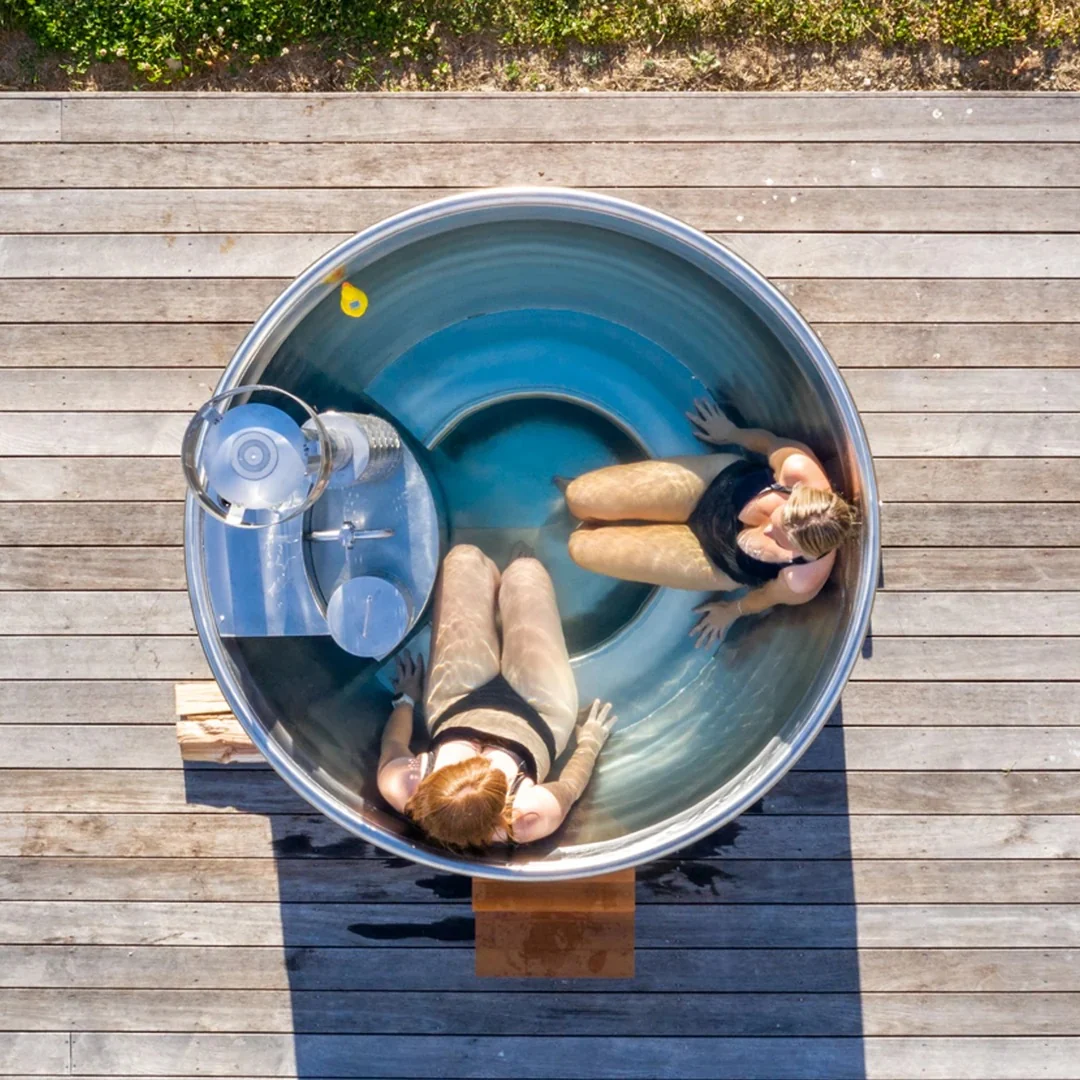
Commercial buyers who need session-capacity, water-system or operating-duty guidance should use the Commercial Cold Plunge project pathway rather than importing an individual frequency rule into facility planning.
Know When to Stop, Pause the Schedule or Seek Help
Stop the session immediately for chest symptoms, fainting, sudden confusion, severe breathing difficulty, loss of coordination, inability to exit safely or other serious distress. Uncontrolled shivering, weakness and confusion can also be signs of hypothermia. Use the appropriate local emergency or medical response rather than staying in the water to satisfy a timer or streak.
| Observation | Immediate action | What frequency decision follows |
|---|---|---|
| Serious symptoms or unsafe exit | Stop and use the appropriate emergency or medical response. | Do not resume the same schedule until the relevant health question has been addressed. |
| Unusual or worsening recovery | Pause the planned progression. | Review exposure and context before repeating or increasing frequency. |
| Temperature, duration and frequency changed together | Stop the multi-variable escalation. | Return to a reviewed baseline if use remains appropriate, then change one factor at a time. |
| Facility or water-system issue | Follow the site’s closure and operating procedure. | Do not treat equipment reopening as personal medical clearance. |
Frequently Asked Questions
Can I cold plunge every day?
There is no evidence-based rule that daily cold plunging is necessary or better for general wellness. Daily use may also be the wrong fit for a specific health condition or training goal. If you are considering frequent use, keep temperature, duration and depth stable, review your response and recovery, and get individualized medical guidance when health conditions or medications create uncertainty.
How many times per week should a beginner cold plunge?
Research does not establish a universal beginner number. “Beginner” does not define the person’s health context, water temperature, time, immersion depth or supervision. A safer approach is to begin conservatively, keep the exposure condition consistent, and avoid increasing frequency at the same time as making the water colder or staying in longer.
Should I cold plunge more often if the sessions are shorter?
Not automatically. Frequency, time, temperature and immersion depth are linked parts of the exposure. A shorter session does not create a universal allowance for more weekly sessions, especially when the water is colder or the person’s health or training context is different.
Should I cold plunge after every workout?
That depends on the training goal. Cold-water immersion can be used in some post-exercise recovery settings, but regular use alongside resistance training has been associated with reduced strength adaptations in a systematic review and meta-analysis. Athletes should match cold-water use to the training objective rather than applying it automatically after every session.
Does more frequent cold plunging guarantee better recovery?
No. Research outcomes depend on the population, exercise, temperature, immersion time, timing and outcome being measured. The evidence does not establish a universal “more sessions equals better recovery” rule.
Related HACHILL Resources
How long to cold plunge
Keep the per-session duration decision separate from weekly frequency.
How cold is a cold plunge?
Review water-temperature evidence before changing another exposure variable.
Cold plunge before or after a workout
Match cold-water timing to the training objective instead of treating every workout the same.
Commercial cold plunge planning
Move facility throughput, treatment, utilities and operating responsibility into the correct project pathway.
Cold plunge product category
Review equipment configurations after the site and operating-duty inputs are defined.
Reference Basis
- PLOS ONE: Effects of cold-water immersion on health and wellbeing — systematic review and meta-analysis (2025) — supports the conclusion that long-term effects, safety and optimal dose-response remain insufficiently defined.
- Cochrane: Cold-water immersion for preventing and treating muscle soreness after exercise — supports the sport-recovery evidence boundary and notes protocol variation and uncertainty about the optimum method and safety.
- Sports Medicine / PubMed: Regular cold-water immersion and training adaptations — supports the caution that regular CWI used with resistance training may reduce strength adaptations.
- Systematic review and meta-analysis: Habituation of the cold-shock response — supports the distinction between physiological habituation and a blanket claim of safety.
- U.S. National Weather Service: Cold Water Hazards and Safety — supports immediate cold-shock context, including abrupt changes in breathing, heart rate and blood pressure.
- MedlinePlus: Hypothermia — supports warning signs including confusion, uncontrolled shivering, weakness and loss of coordination.
Planning a Commercial Cold Plunge?
For a commercial project, prepare the water volume, intended operating condition, peak session interval, treatment approach, ambient conditions, utilities, supervision model, destination and quantity. HACHILL can review equipment and project interfaces while personal exposure decisions remain with the individual and the appropriate qualified health professionals.
Request a Project Review