Direct answer: There is no single evidence-based cold-plunge duration that is safe or optimal for everyone. For a first controlled full-body plunge, reputable health-system guidance starts very short: UCLA Health suggests about 10–20 seconds initially, Mayo Clinic describes many beginners starting around 30–60 seconds, and Cleveland Clinic advises beginners to limit early sessions to about 1–2 minutes. These are practical starting references, not universal safety limits. Water temperature, the immediate cold-shock response, health context, supervision, safe exit and recovery all matter more than completing a target time.
If you are new to cold-water immersion, think in seconds to low single-digit minutes, not endurance targets. Longer is not automatically better, and a duration copied from a study, athlete, influencer or another user does not become appropriate just because it is popular.
How Long Should You Cold Plunge? A Practical Starting Point
For a healthy adult who has already decided that cold-water immersion is appropriate to try, the most defensible beginner approach is to start with a short, controlled exposure rather than aiming for a fixed multi-minute target.
| Source | Published starting guidance | How to interpret it |
|---|---|---|
| UCLA Health | Start full-body immersion with brief exposures of about 10–20 seconds and increase gradually if longer dips are the goal. | A very conservative first-exposure reference, not a universal minimum. |
| Mayo Clinic | Describes cold-water plungers commonly starting around 30 seconds to 1 minute and gradually extending from there. | A practical progression example; Mayo also notes that the optimal process and timing are still being studied. |
| Cleveland Clinic | Advises beginners to keep early sessions around 1–2 minutes and emphasizes listening to the body rather than pushing through warning signs. | A clinician-reviewed beginner reference, not proof that 1–2 minutes is safe for every person or every water temperature. |
The important point is not that one of these numbers is “correct.” The recommendations differ because cold-water exposure cannot be reduced to time alone. They do, however, share a useful pattern: begin brief, avoid treating discomfort as a contest, and extend only when the exposure remains controlled.
Simple rule: For a first plunge, a short exposure measured in seconds is enough to learn how your breathing, coordination and exit control respond. You do not need to prove that you can stay for several minutes.
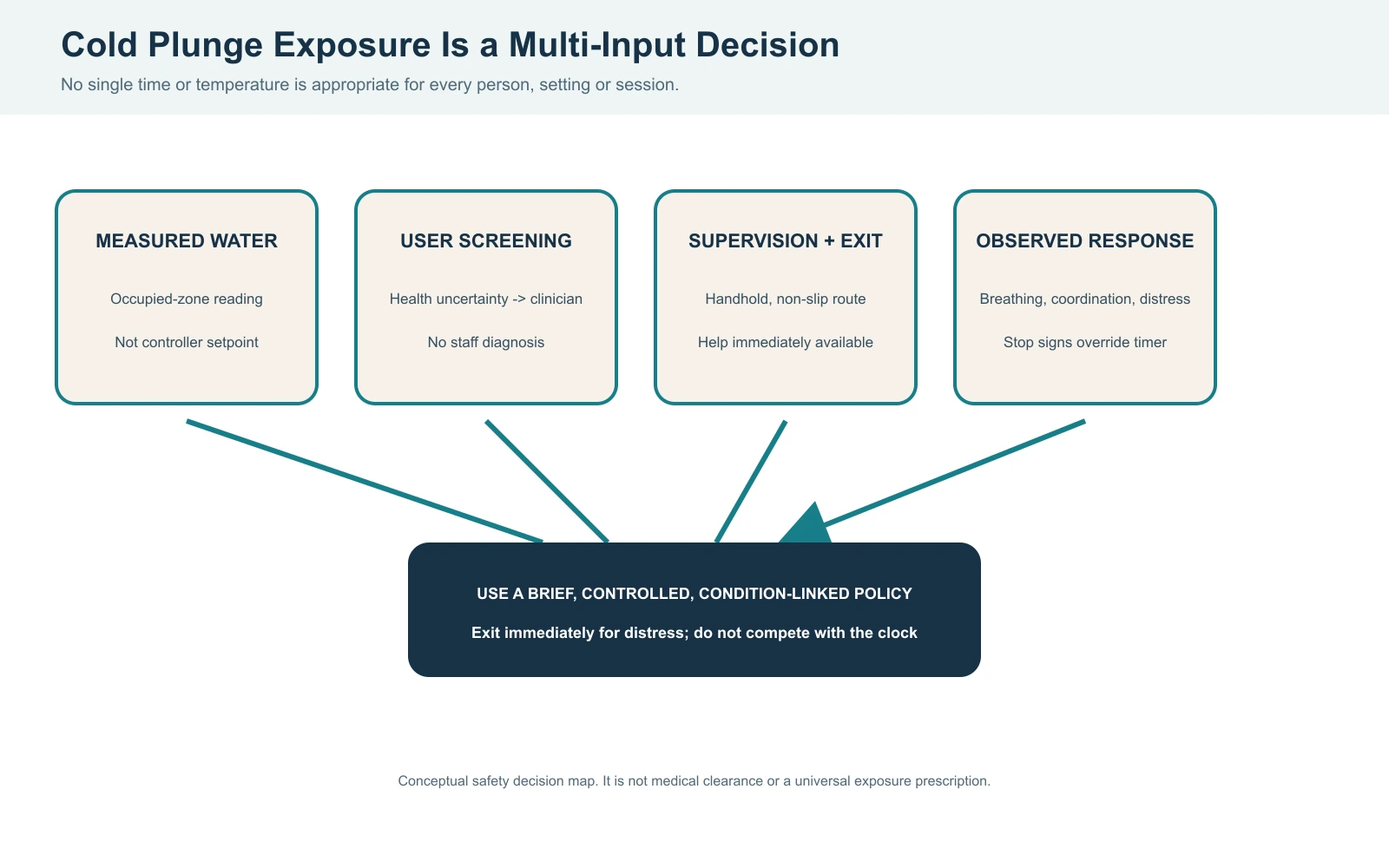
Why There Is No Universal Cold-Plunge Time
A 2025 systematic review and meta-analysis of cold-water immersion in healthy adults found substantial variation in study protocols. Included exposures ranged across different water temperatures, immersion methods, durations and outcomes, and the authors concluded that better evidence is still needed to establish optimal CWI protocols.
That means a study duration can tell you what researchers tested under defined conditions; it cannot automatically become a personal safety limit or a general wellness prescription.
| Variable | Why it changes the decision | What to do with the timer |
|---|---|---|
| Actual water temperature | Colder water generally produces a stronger thermal and cold-shock challenge. | Do not compare durations unless the water condition is also known. |
| Immersion depth | Chest-level or deeper immersion is not equivalent to exposing only the legs or taking a cold shower. | Do not transfer a timing protocol between different exposure methods without context. |
| Immediate response | Sudden immersion can trigger gasping, rapid breathing and cardiovascular stress. | End the exposure when the response is not controlled, even if very little time has elapsed. |
| Prior cold exposure | Repeated exposure can reduce part of the cold-shock response, but adaptation is variable. | Experience can inform progression; it is not medical clearance and does not justify unlimited duration. |
| Health context | Cardiovascular, circulatory, neurological, metabolic, pregnancy and medication-related factors may change suitability. | A generic timer cannot resolve individual medical risk. |
| Exit and supervision | A person who becomes faint, confused or poorly coordinated may not be able to leave safely. | Plan exit before starting and do not use time as permission to continue. |
A systematic review of cold-shock-response habituation found that repeated immersion can reduce components of the cold-shock response, while also showing meaningful variation between studies. That supports gradual familiarization, but not the assumption that an experienced user is automatically safe at a longer time or lower temperature.
How Water Temperature Changes the Duration Decision
“How long?” and “how cold?” are separate questions, but they cannot be interpreted independently. A time recommendation without a measured water condition is incomplete.
Cold-water research often uses temperatures around 10–15°C (50–59°F), but studies also use colder conditions. HACHILL’s separate cold-plunge temperature guide explains why that commonly studied range is evidence context rather than a universal personal target.
Do not build a universal time-temperature chart. Current evidence does not validate a formula such as “X minutes at Y temperature” for every user, purpose and health profile.
For beginners, Cleveland Clinic specifically recommends a starting temperature range around 50–59°F (10–15°C) and cautions against going below 40°F (4°C). That is useful clinician-reviewed guidance, but it should still be treated as source-specific advice rather than an international safety standard.
The practical engineering point is simpler: verify the water the user is actually exposed to. A chiller setpoint is equipment information; it is not automatically the same as representative water temperature and it is never a personal duration prescription.
How Beginners Can Progress Without Turning Time Into a Challenge
Progression is better handled as a control problem than as a weekly endurance schedule. Keep the exposure understandable, change one major variable at a time, and stop extending duration if control gets worse.
- Measure the water condition. Know the actual water temperature rather than relying only on “ice bath,” “cold setting” or the chiller setpoint.
- Make the first exposure brief. Use a short duration to learn the entry response, not to prove tolerance.
- Keep breathing controllable. Do not treat prolonged hyperventilation, panic or gasping as something that must be pushed through.
- Keep the head and face out during ordinary beginner immersion. Deliberate facial immersion or breath-holding introduces a different autonomic response and should not be used as a routine intensity trick.
- Exit while movement and judgment remain normal. Do not wait for coordination to deteriorate before deciding the session has gone far enough.
- Review recovery. A session that appears tolerable in the water but produces a concerning response afterward should not automatically be repeated at the same or greater exposure.
- Increase only one variable at a time. Do not simultaneously make the water colder and the session longer, because you lose the ability to interpret what changed the response.
Research on cold-water immersion and autonomic conflict is one reason to keep breath-holding and deliberate facial submersion separate from ordinary beginner timing advice. It describes competing cardiovascular reflexes that can increase arrhythmia risk in susceptible circumstances.
When Should You Stop a Cold Plunge Immediately?
The timer should stop mattering as soon as the exposure no longer remains controlled.
The U.S. National Weather Service describes cold shock as capable of causing involuntary gasping, rapid breathing and abrupt changes in heart rate and blood pressure. Those effects are especially important at entry, when a person may still be focused on “making it to” a planned time.
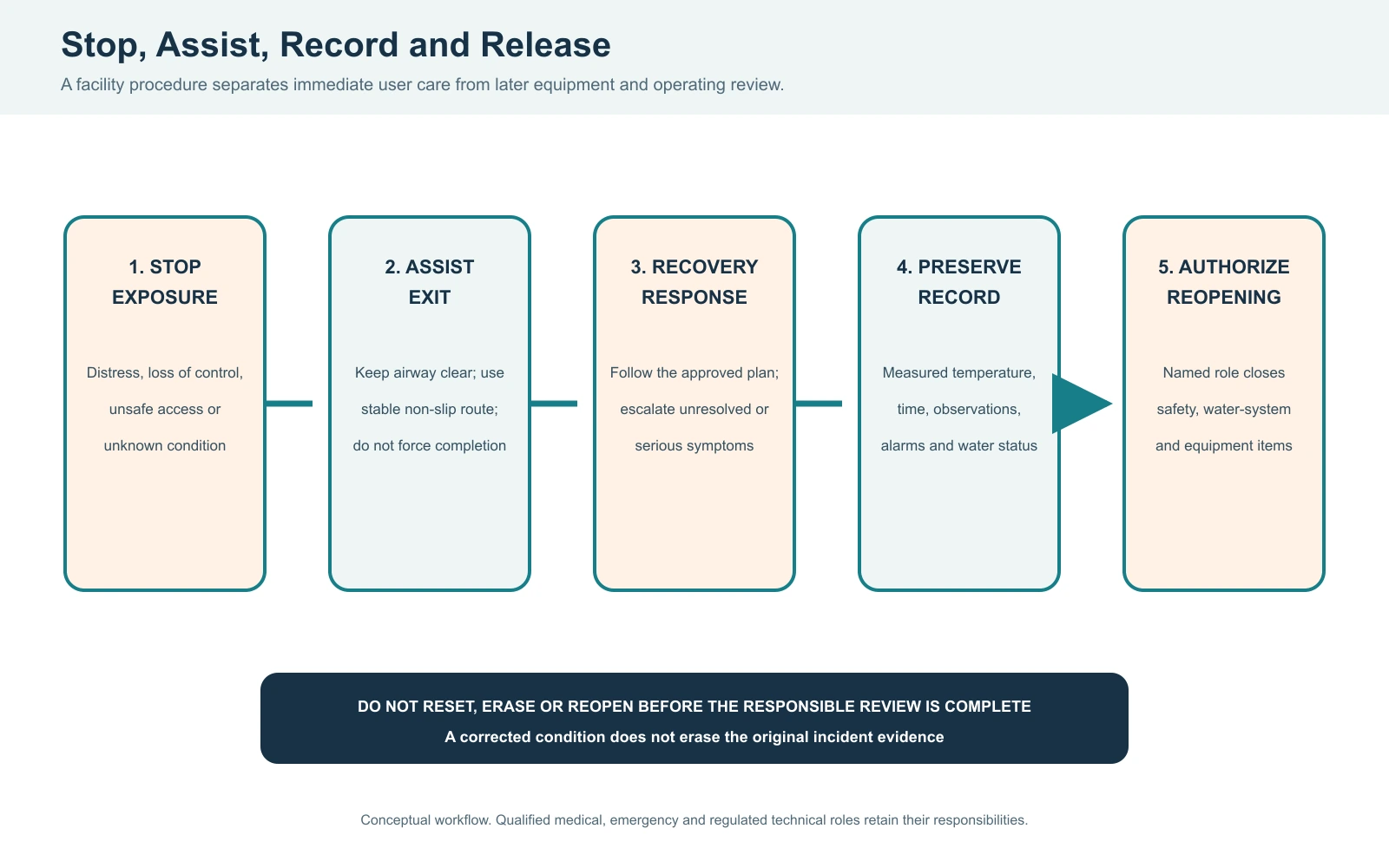
End the exposure and get out safely for uncontrolled breathing, faintness, serious chest pain or pressure, confusion, loss of coordination, inability to respond normally, or inability to exit safely. Severe or persistent symptoms require appropriate emergency response and qualified medical care rather than online troubleshooting.
MedlinePlus hypothermia guidance lists confusion, uncontrolled shivering, weakness and loss of coordination among important warning signs in a hypothermia context. That emergency reference should not be misread as evidence that every brief wellness plunge causes hypothermia; it is useful here because it shows why deterioration in thinking or movement is not something to “push through.”
| What you observe | What it means for the timer | Action |
|---|---|---|
| Breathing remains uncontrolled | The entry response has not become controlled. | End the exposure rather than waiting for the planned time. |
| Faintness, confusion or unusual difficulty thinking | Continuing for a time target is no longer appropriate. | Exit safely and escalate if symptoms are serious or persistent. |
| Loss of coordination or difficulty exiting | Safe self-exit is being compromised. | Stop immediately and provide assistance appropriate to the setting. |
| Serious chest symptoms | This is not an endurance cue. | End exposure and seek urgent medical evaluation as appropriate. |
Who Should Get Medical Guidance Before Cold Plunging?
Cold-water immersion creates acute respiratory and cardiovascular stress. General web guidance cannot determine whether that stress is appropriate for a particular person.
Cleveland Clinic advises people to speak with a healthcare professional before cold plunging when they have conditions such as heart disease, high blood pressure, diabetes, peripheral neuropathy, poor circulation, venous stasis or cold agglutinin disease, and also during pregnancy. Harvard Health likewise cautions people with cardiovascular disease, especially rhythm problems, about cold-water exposure.
A waiver, product manual, timer or equipment supplier cannot provide medical clearance. Their roles are different: medical professionals address personal suitability, while equipment documentation addresses the product within its stated operating scope.
Plan Entry, Exit and Recovery Before Starting the Timer
A cold plunge is not only the time spent in the water. Entry, the ability to end the exposure and the recovery environment are part of the session.
Enter under controlled conditions
Use a stable access route and avoid starting an exposure when a slip, fall or difficult exit would turn an ordinary cold response into an access emergency. In a managed facility, surrounding wet-area conditions and supervision responsibilities should already be defined.
Do not rely on willpower for exit
The best time to decide how you will get out is before you enter. A person should not need to climb over an obstacle, wait for assistance that is not available, or continue because a challenge timer is still running.
Include recovery in the plan
After exiting, dry off, move to an appropriate recovery environment and continue to pay attention to how you feel. Cleveland Clinic recommends focusing on warming back up after the plunge. If symptoms are abnormal, severe or persistent, treat that as a health issue rather than evidence that a “hard session” was successful.
Does Your Goal Change How Long You Should Stay In?
Yes—but goal-specific research should not be converted into one universal personal dose.
Many cold-water-immersion studies are designed around post-exercise recovery, heat management or another defined outcome. Those studies may use longer exposures than a beginner wellness plunge, but the protocol reflects the research question, participant group, water temperature, immersion depth and monitoring used in that study.
The 2025 systematic review of healthy adults included a wide range of durations and concluded that more high-quality research is needed to define optimal CWI protocols. For that reason, “a study used 10 or 15 minutes” is not enough evidence to tell a general reader to copy that duration.
Use research to understand context, not to create a personal challenge. The relevant question is whether a protocol studied your intended outcome under conditions that meaningfully resemble yours.
If your main question is exercise timing rather than duration, keep that as a separate decision. The same applies to weekly frequency, which is covered in How Often Should You Cold Plunge?
Commercial Facilities Should Separate Personal Duration From Operating Policy
A gym, hotel, spa or wellness center may use timed sessions for scheduling, supervision and turnover, but a booking slot is not a universal medically safe exposure duration.
- Personal exposure: stop signs and individual suitability still override a posted session time.
- Water operation: verify the operating water condition using the facility’s defined measurement and equipment procedures.
- Access: maintain controlled entry and exit, wet-area management and any required supervision.
- Emergency response: define who can stop a session and how abnormal responses are escalated.
Detailed water-system, sanitation, service, throughput and project requirements belong to the dedicated Commercial Cold Plunge Planning route rather than this personal-duration guide.
Frequently Asked Questions
How long should a beginner cold plunge?
Start brief. Reputable health-system guidance ranges from about 10–20 seconds for a first full-body exposure to roughly 30–60 seconds or 1–2 minutes for beginners. The variation is important: these are practical references, not a universal safe dose. Stop sooner if breathing, coordination, alertness or safe exit is compromised.
Is five minutes in a cold plunge safe?
Five minutes cannot be declared universally safe from the timer alone. Cleveland Clinic advises keeping sessions to no more than five minutes, while other health-system guidance uses different upper ranges. Water temperature, individual health, response and exit conditions still matter, so “five minutes” should not be treated as automatic permission to continue.
Is 10 minutes too long for a cold plunge?
Ten-minute protocols appear in some research and clinical education, but they are not a universal beginner target. If you are using a longer research or recovery protocol, the temperature, population, purpose and monitoring conditions need to match the context. For general wellness, there is no evidence that everyone needs to build toward 10 minutes.
What temperature should I use if I am deciding how long to stay in?
There is no validated universal time-temperature formula. Around 10–15°C (50–59°F) is common in cold-water-immersion research and is also used by Cleveland Clinic as a beginner reference range, but it is not a universal personal target. See How Cold Is a Cold Plunge? for the full temperature decision.
Should I put my head underwater or hold my breath during a cold plunge?
Do not use deliberate breath-holding or facial submersion as a routine way to make a plunge more intense. Facial immersion and breath-holding add physiological responses that are different from ordinary neck-down immersion and can increase cardiovascular risk in susceptible circumstances.
How often should I cold plunge?
Frequency is a separate exposure decision. Do not increase duration, lower temperature and increase weekly frequency at the same time if you want to understand how you respond. See How Often Should You Cold Plunge? for the dedicated frequency guide.
Related HACHILL Resources
How Cold Is a Cold Plunge?
Use the temperature guide when the next decision is measured water temperature rather than exposure time.
How Often Should You Cold Plunge?
Move from per-session duration to repeat-session frequency without mixing the two decisions.
Commercial Cold Plunge Planning
Continue into facility, water-system, access, service and project planning for managed environments.
Cold Plunge Products
Review current upright, laydown and commercial product routes after the site and operating requirements are defined.
Reference Basis
- 2025 systematic review and meta-analysis of cold-water immersion in healthy adults — protocol variability, evidence limits and the need for better dose-response research.
- UCLA Health: cold plunge and whole-body cryotherapy — very brief beginner exposure and gradual progression guidance.
- Mayo Clinic: cold-water plunging after exercise — practical starting-duration context and acknowledgement that optimal timing is still being studied.
- Cleveland Clinic: cold plunge guidance — beginner time and temperature references, stop advice and health-screening context.
- U.S. National Weather Service: Cold Water Hazards and Safety — cold-shock breathing and cardiovascular context.
- Systematic review of cold-shock-response habituation — adaptation evidence and limits.
- Cold-water immersion and autonomic conflict — breath-holding and facial-immersion risk context.
- MedlinePlus: Hypothermia — emergency warning-sign context, not a wellness-plunge duration prescription.
Use Time as a Measurement, Not a Test of Tolerance
The most useful answer to “how long should you cold plunge?” is not a single number. A beginner should start with a brief, controlled exposure, verify the water condition, keep breathing and movement under control, and exit before the session becomes an endurance test.
Published clinical guidance starts anywhere from seconds to about 1–2 minutes for beginners, which is another reason not to pretend that one universal timer exists.
If a meaningful stop condition appears, the target time stops being the target.
Planning a Commercial Cold-Plunge Project?
If your question has moved from personal exposure duration to equipment or facility planning, define the venue, target operating water condition, selected tub or water volume, use schedule, access, drainage, cooling-system status, utilities and service requirements before model-level review.
Request a Project Review