For a conventional traditional electric sauna, a useful planning expectation is roughly the mid-30-minute range to about an hour under suitable conditions—but there is no universal heat-up time.
That planning band is a synthesis of current Harvia guidance, not a category-wide guarantee: one Harvia timer example says the sauna takes about one hour to heat, while Harvia’s slow-heating diagnostic says the desired temperature is usually reached in 35–45 minutes in that troubleshooting context. Actual sauna heat-up time changes with room volume, heater-to-room fit, glass or other uninsulated surfaces, insulation, starting temperature, ventilation, door openings, stone condition, control behavior and—most importantly—what “ready” means and where temperature is measured.
Do not compare two sauna warm-up times until both claims use the same start condition, end condition and measurement point.
This guide focuses on traditional electric sauna room warm-up. Infrared cabins, wood-burning saunas and steam rooms use different heat sources, control logic and readiness criteria, so their warm-up claims should not be compared directly with the figures on this page. For operating-temperature context, use HACHILL’s sauna temperature guide.
How Long Does a Sauna Take to Heat Up? Start With the Test Conditions
Search results often collapse sauna warm-up into one number. That is useful for rough planning, but technically incomplete. A cold outdoor cabin with large glazing, a compact insulated indoor room and an “ever-ready” heater can all produce very different answers even when each source uses the phrase “heat-up time.”
Current Manufacturer Reference Points
Harvia timer example
About one hour
Harvia’s current quick instructions for mechanically controlled heaters use a timer example in which the sauna takes about one hour to heat before bathing.
Harvia troubleshooting context
Usually 35–45 minutes
Harvia’s current slow-heating diagnostic states that the desired temperature is usually reached in 35–45 minutes in its thermostat-check context, while also directing users to check heater power, stones, ventilation and sensor or thermostat behavior when heating takes significantly longer.
Special architecture
Not every clock is a cold start
Harvia’s Forte “ever-ready” design keeps the stone chamber warm in standby, so its published few-minute readiness behavior starts from a fundamentally different state than a conventional cold-start heater.
Why a Published Range Is Not a HACHILL Performance Promise
A third-party heater manufacturer’s warm-up reference describes that manufacturer’s equipment and stated conditions. It does not establish the heat-up time of every sauna, every heater architecture or any untested HACHILL model.
For project planning, treat warm-up as a room-system outcome. Define the room, heater, glass, insulation, site climate, ventilation, operating pattern and measurement method before using a time value for procurement, sales literature or commissioning acceptance.
For model and heater selection, use the Sauna Heater Buying Guide and the more detailed heater sizing and thermal-design guide.
Define the Clock Before You Compare Sauna Warm-Up Times
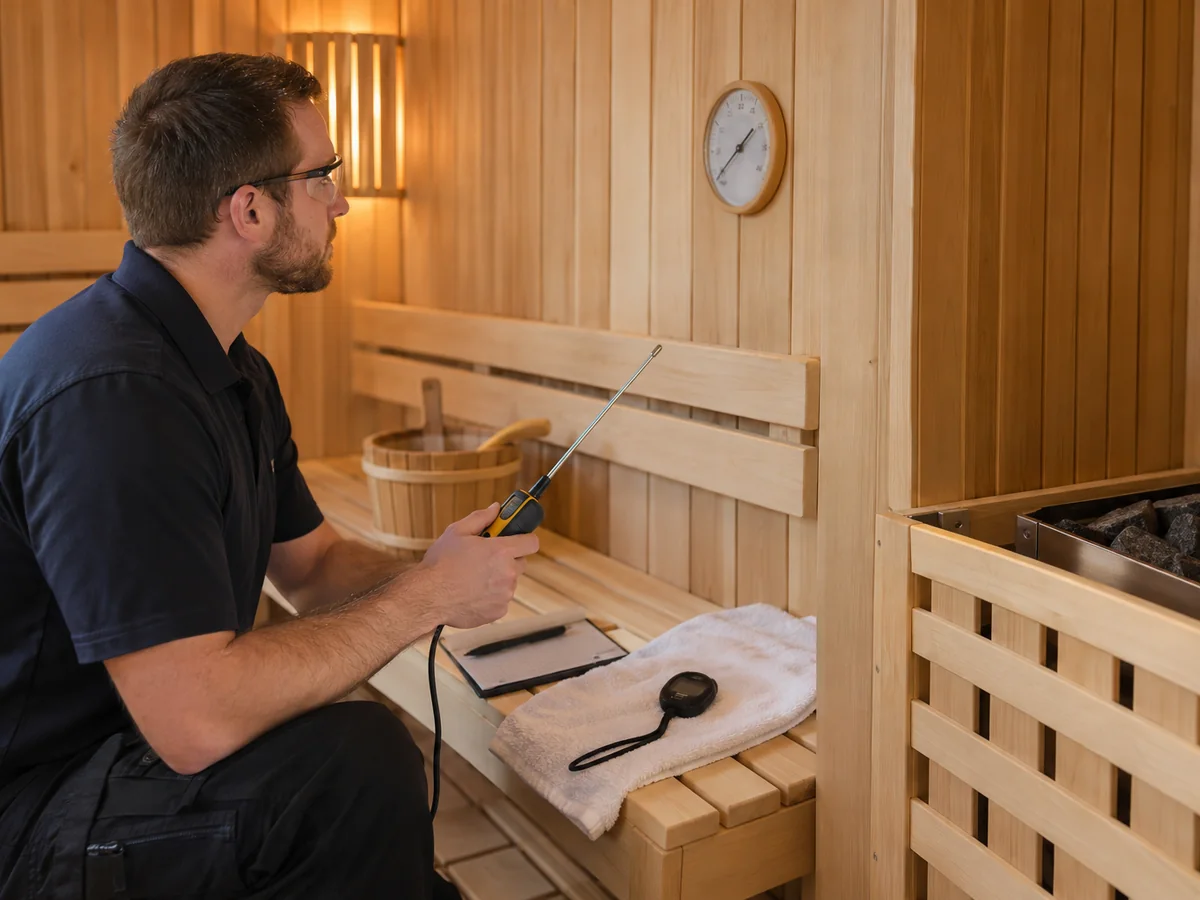
The strongest way to compare sauna heat-up claims is to define three pieces of the test before looking at the result.
Start Condition: Cold Start, Standby or Pre-Heated Stones?
A room starting near indoor ambient temperature does not face the same load as an outdoor sauna that has spent hours in cold weather. Likewise, an ever-ready heater with a hot stone chamber does not begin from the same state as a conventional cold-start heater.
Record starting ambient temperature, whether the room and stones were already warm, door condition, ventilation mode and heater state at time zero.
End Condition: What Does “Ready” Mean?
“Ready” can mean the controller has reached its setpoint, the occupied upper-bench zone has reached the project’s agreed operating condition, the stones are ready to produce the intended steam response, or the facility has met a defined commissioning release point.
These endpoints can occur at different times. Harvia maintains a separate troubleshooting path for the case where the sauna heats quickly but the stones are not hot enough, which is a useful reminder that room-air temperature alone does not prove identical stone readiness.
Measurement Point: The Sensor Is Not the Whole Room
Sauna air stratifies vertically, and readings near the heater, ceiling, door, inlet, upper bench and lower bench can differ. The control sensor is part of the heater system; it is not automatically the same measurement point used for a room-performance comparison.
For a useful warm-up log, keep the measurement location fixed and documented. Do not move a safety or control sensor to make a heat-up claim look better.
What Changes Sauna Warm-Up Time?
Room Volume and Heater-to-Room Fit
Heater output matters, but the label on the heater is only useful when it is matched to the actual room. Current Harvia sizing guidance explicitly uses room volume and adds load for glass and other uninsulated or heat-storing surfaces. Final heater selection should still follow the approved room range and instructions for the exact model.
An undersized heater can take longer to reach the intended condition and may run at high output for longer periods. Oversizing is not a universal shortcut either; final selection still needs the exact manufacturer’s approved room range, clearances, controls and electrical context.
Glass, Insulation and Outdoor Climate
Glass doors and glass walls can materially change the heater-sizing basis. Harvia’s current sizing guidance treats glass and other non-insulated or heat-storing surfaces as added effective load, which is why two rooms with the same geometric volume may not require the same heater selection.
That is why two saunas with the same physical dimensions can warm differently. One may have insulated timber surfaces in a stable indoor environment; another may have a large glass front, more exposed surfaces and a cold outdoor start.
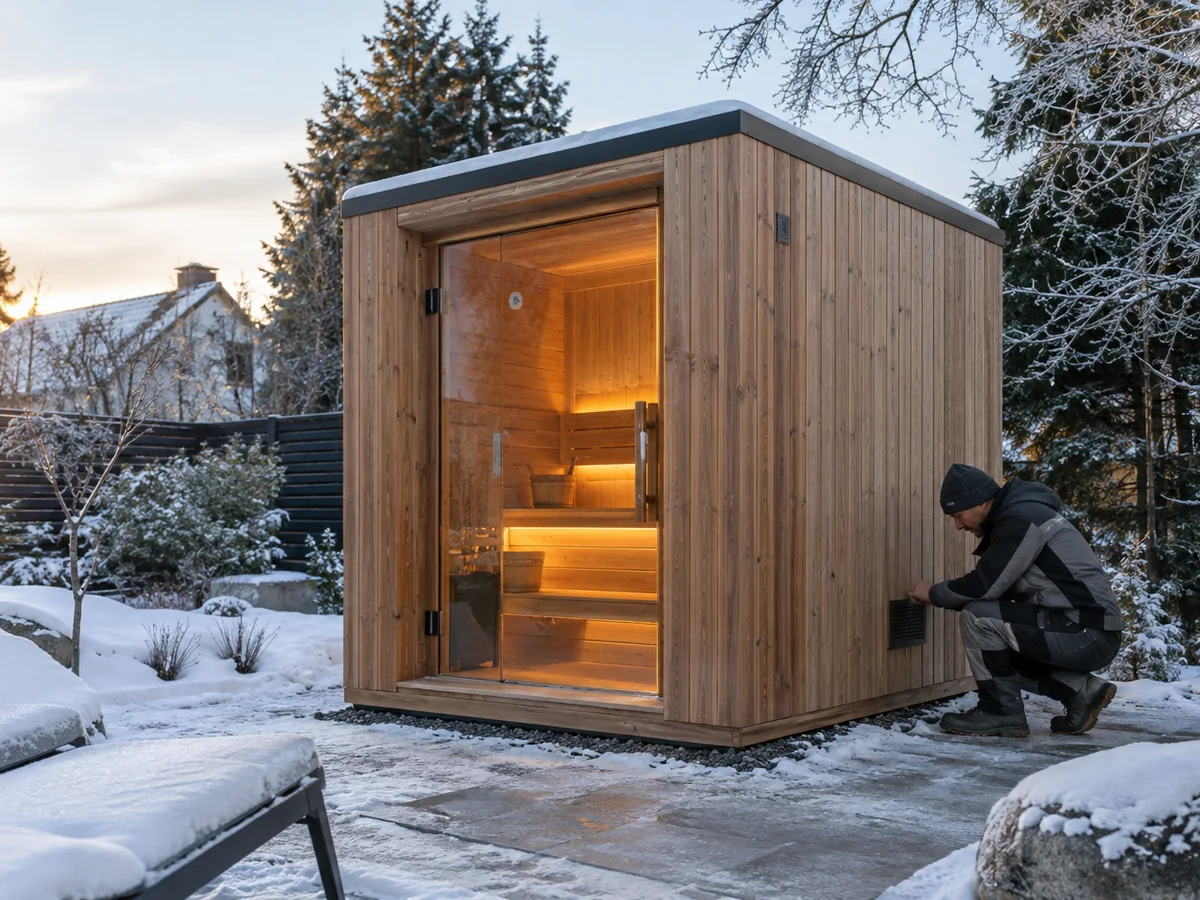
For outdoor projects, compare the enclosure and heater route against the real site conditions rather than transferring an indoor warm-up expectation. HACHILL’s outdoor sauna range should be evaluated with the actual climate, glazing, utility and site inputs.
Ventilation, Door Use, Stones and Sensor Behavior
Observed warm-up performance can also change when air leaves the room faster than expected, the door is opened repeatedly, stones restrict airflow through the heater, or control sensing causes the heater to cycle before the intended occupied zone reaches the project target.
Harvia’s current slow-heating guidance directs users to check heater capacity, stone condition and stacking, ventilation and thermostat/sensor behavior rather than assuming the only answer is to wait longer.
Do not bypass a high-limit device, relocate a safety sensor outside the equipment instructions, close required ventilation blindly or alter fixed electrical work to chase a faster warm-up time. Use the exact heater/controller documentation and qualified local trades where required.
How to Compare Published Sauna Heat-Up Claims Without Being Misled
Warm-Up Claim Comparison Matrix
| Source / system | Published reference | Conditions stated or implied | What you may conclude | What you should not conclude |
|---|---|---|---|---|
| Harvia quick mechanical-control guidance | About one hour in its timer example | Conventional electric sauna-heater use case | About one hour is Harvia’s stated planning example for that timer-use context | Every sauna or every Harvia model heats in exactly one hour |
| Harvia slow-heating diagnostic | Usually 35–45 minutes to the desired temperature in its thermostat-check context | Diagnostic procedure with the heater operating and the room being checked for normal heating behavior | A shorter reference can be valid in a defined troubleshooting context | 35–45 minutes is a universal acceptance limit for every electric sauna |
| Harvia Forte ever-ready architecture | Sauna-ready within a few minutes after HI is selected | Stone chamber is maintained warm in standby | Starting heater state can fundamentally change the clock | A few minutes is comparable to a cold-start conventional heater |
If two heat-up claims do not use the same start state, room basis, heater architecture, end condition and measurement location, treat the comparison as not yet equivalent.
Industry Test Case: Stone Packing Changed the One-Hour Result
Harvia tested the same 10 m³ sauna and 7 kW heater with different stone conditions
Harvia reports a test using a 10 m³ sauna with a Cilindro PC70E 7 kW heater. After one hour, the room-temperature result differed by roughly 10°C between new stones packed tightly and new stones laid loosely according to the test method. Harvia attributed the better result to improved airflow through the heater.
Why this matters: even when room volume and heater rating stay the same, maintenance and stone arrangement can change warm-up behavior. A slow sauna is therefore not automatically an undersized-heater problem.
Evidence boundary: this is Harvia’s published test with its stated room, heater and stone configurations. It is not a universal 10°C rule and is not HACHILL test data.
Source: Harvia — Changing sauna stones makes the sauna heat up faster.
Industry Applications: Home, Outdoor and Commercial Saunas
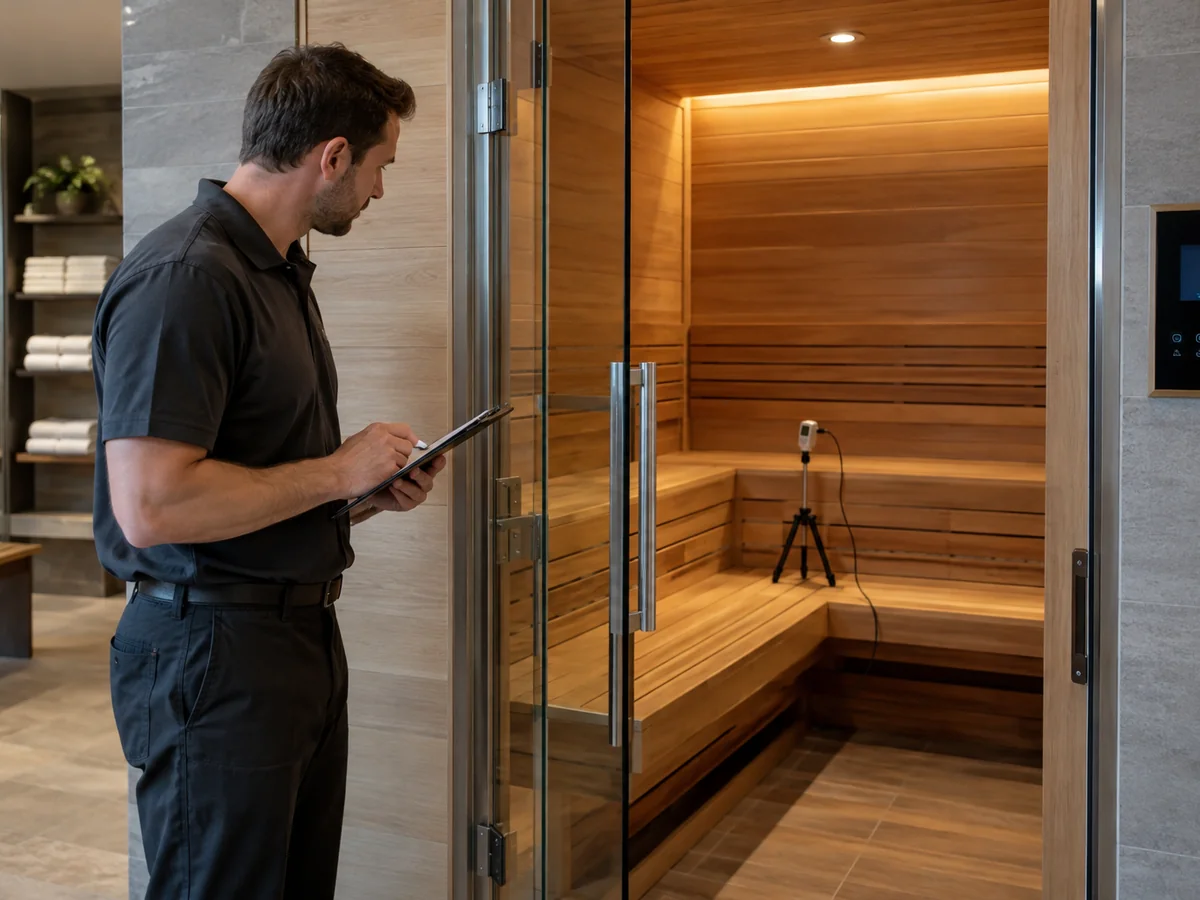
Residential and Outdoor Projects Need Different Planning Margins
Indoor residential
Stable starting conditions
A compact, insulated indoor sauna with a correctly matched electric heater can be scheduled around a repeatable preheat routine once the owner has verified the room’s actual behavior.
Outdoor / glamping
Cold starts and glazing matter
An outdoor cabin or cube sauna may begin much colder and may use more glass. Planning should use the real seasonal starting condition rather than the warm-weather or indoor commissioning result.
Dealer / project supply
Do not sell a time without a test basis
For quotations and project documents, state the heater, room, climate, glass, test endpoint and measurement basis behind any warm-up statement instead of publishing one category-wide number.
Glass-front redesign after heater selection
Situation: a sauna is originally selected with a mostly insulated front, then the project changes to substantially more glazing without reopening the thermal review.
Why the warm-up result can change: Harvia’s current sizing guidance explicitly treats glass and other non-insulated or heat-storing surfaces as additional effective load for heater selection.
Correct project response: reopen the heater-sizing basis, electrical/site review and warm-up acceptance plan. Do not promise the old heat-up time simply because the external room dimensions did not change.
Commercial Facilities Need Recovery Data, Not Only Cold-Start Warm-Up
Hotels, resorts, gyms and shared wellness facilities have a different operational question. A sauna may reach its opening setpoint successfully and still struggle after repeated door openings and user turnover.
That means initial warm-up, stable holding and occupied recovery should be treated as separate performance questions. The commercial operator cares about whether the room returns to its agreed operating condition under the actual schedule—not only whether it reached temperature once before opening.
Hotel sauna reaches setpoint before opening but falls behind during busy periods
Do not jump straight to a higher setpoint. First compare synchronized readings, heater cycling, door events, ventilation state and occupied-zone temperatures. The result may point to recovery load, ventilation, envelope loss or sensing—not simply “a slow heater.”
When Slow Warm-Up Means You Should Troubleshoot Instead of Waiting Longer
A longer-than-expected warm-up is useful diagnostic information when the comparison basis is known. It becomes much less useful when the original expectation came from a different heater, room, climate or measurement point.
Use a System Check Before Changing the Heater or Setpoint
- Confirm the clock: same starting ambient, same target/end condition and same measurement point.
- Confirm the room: actual internal volume, glazing, insulation and other uninsulated surfaces.
- Confirm the heater: exact model, manufacturer-approved room range and operating state.
- Confirm the site: indoor/outdoor condition and representative seasonal ambient.
- Confirm the air path: approved ventilation arrangement, door condition and obvious leakage.
- Confirm the stones: correct type, condition and placement according to the heater instructions.
- Confirm controls and sensing: approved sensor position and normal controller/protective-device behavior.
- Retest the same duty: after a verified correction, repeat the same start state and measurement method.
the exact heater is unknown, glass/insulation changed after selection, outdoor starting conditions were not recorded, the measurement point moved, ventilation or door use changed, protective devices are tripping, or the comparison relies on another manufacturer’s room/test conditions.
For a project-level review, record the information below before requesting a warm-up commitment or troubleshooting recommendation.
| Input | Record | Why it matters |
|---|---|---|
| Room | Finished internal dimensions, glass/uninsulated surfaces, insulation basis | Defines the thermal load being heated |
| Heater | Exact model, control/sensor configuration and operating state | Prevents category-level comparisons |
| Start | Ambient temperature, room/stone state, door and ventilation state | Defines time zero |
| End | Declared target or bathing-ready criterion | Defines when the clock stops |
| Measurement | Instrument and fixed location | Keeps retests comparable |
| Events | Door openings, water use, control changes, alarms or interruptions | Explains disturbances in the curve |
Start with HACHILL’s sauna product routes, then send the finished internal dimensions, glazing, insulation basis, site climate, heater preference, available electrical supply, intended operating duty and proposed test method through the project quote route. Any project warm-up target should be tied to the selected configuration and stated acceptance conditions rather than a generic category promise.
This article uses current manufacturer support material and manufacturer-published test material to explain how traditional electric sauna warm-up claims should be interpreted. External tests are identified as external tests; illustrative scenarios are identified as scenarios. This article does not claim independent HACHILL warm-up test results, customer outcomes, physician review or universal heater performance.
- Harvia — Quick heater instructions for models with mechanical controls
- Harvia — The sauna heats up slowly
- Harvia — The sauna heats up quickly, but the stones are not hot enough
- Harvia — Heater power selection: room volume and uninsulated surfaces
- Harvia — Published stone-condition warm-up test
- Harvia — Forte Ever-Ready heater: different starting-state architecture
Evidence check: September 26, 2026. Manufacturer instructions and model documentation can change; verify the current document for the exact equipment before treating a warm-up time as a project acceptance requirement.