\n\n
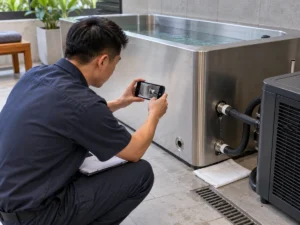
Yes—salt water can be feasible in a cold plunge, but only when the complete wetted system is compatible with the intended water chemistry. The tub material alone is not enough to answer the question. The liner, heat exchanger, pump, filter housing, fittings, seals, sensors and any salt-treatment equipment that actually contact the water can each impose a different compatibility limit.
\n\n\n\n\n\n\n\n\n\n\n\n\n
That distinction matters especially when evaluating an existing plunge or specifying a new commercial system. A stainless-steel tub does not automatically make the chiller salt-water compatible, and a chiller with adequate cooling capacity does not automatically have suitable wetted materials. If a critical component cannot be verified against the proposed water chemistry, the appropriate conclusion is not confirmed rather than an assumed yes or no.
\n\n\n
\n\n
First Define What You Mean by Salt Water
\n\n
“Salt water” can describe more than one system condition.
\n\n
One arrangement simply adds dissolved salt to the water for a particular water chemistry or user preference. Another uses a salt chlorine generator, where dissolved salt passes through an electrolytic cell and is converted into chlorine as part of the sanitation process. Those two arrangements should not be treated as technically identical.
\n\n
For compatibility checking, the useful question is therefore not merely, “Will this cold plunge take salt?” It is:
\n\n
What salt-based water condition is being proposed, at what chemistry, and which components will be exposed to it?
\n\n
That information establishes the service condition for the rest of the review. Without it, a material or chiller compatibility statement becomes too broad.
\n\n
It is also important to separate salt compatibility from water sanitation. Even where salt is used in an electrolytic chlorination system, the equipment still has to be operated and monitored as a water-treatment system. The presence of salt does not by itself establish that the water is adequately disinfected or that a commercial installation satisfies local public-health requirements.
\n\n
Check the Entire Wetted Loop, Not Just the Tub
\n\n
A cold plunge should be evaluated as a water-contact system rather than as a single vessel.
\n\n
Depending on the configuration, the wetted path may include:
\n\n
- \n
- the tub or liner;
- the heat exchanger or evaporator on the water side of the chiller;
- the circulation pump;
- the filter housing;
- piping, unions and fittings;
- exposed fasteners or metallic inserts;
- seals, gaskets and O-rings;
- temperature or water-quality sensors;
- and any electrolytic or other treatment equipment connected to the loop.
\n
\n
\n
\n
\n
\n
\n
\n
\n
\n\n
Not every cold plunge contains all of these components, and the exact bill of materials must come from the selected configuration. The engineering point is that the least-compatible critical wetted component can determine the practical limit for the whole system.
\n\n
This is why checking only the visible tub material is incomplete. A tub could use a corrosion-resistant liner while the external heat exchanger, pump internals, fittings or seals have different water-chemistry restrictions.
\n\n
The reverse is also true. A chiller may use a heat exchanger specifically intended for salt-water service, but that does not establish the suitability of the tub, pump, fittings or treatment hardware connected to it.
\n\n
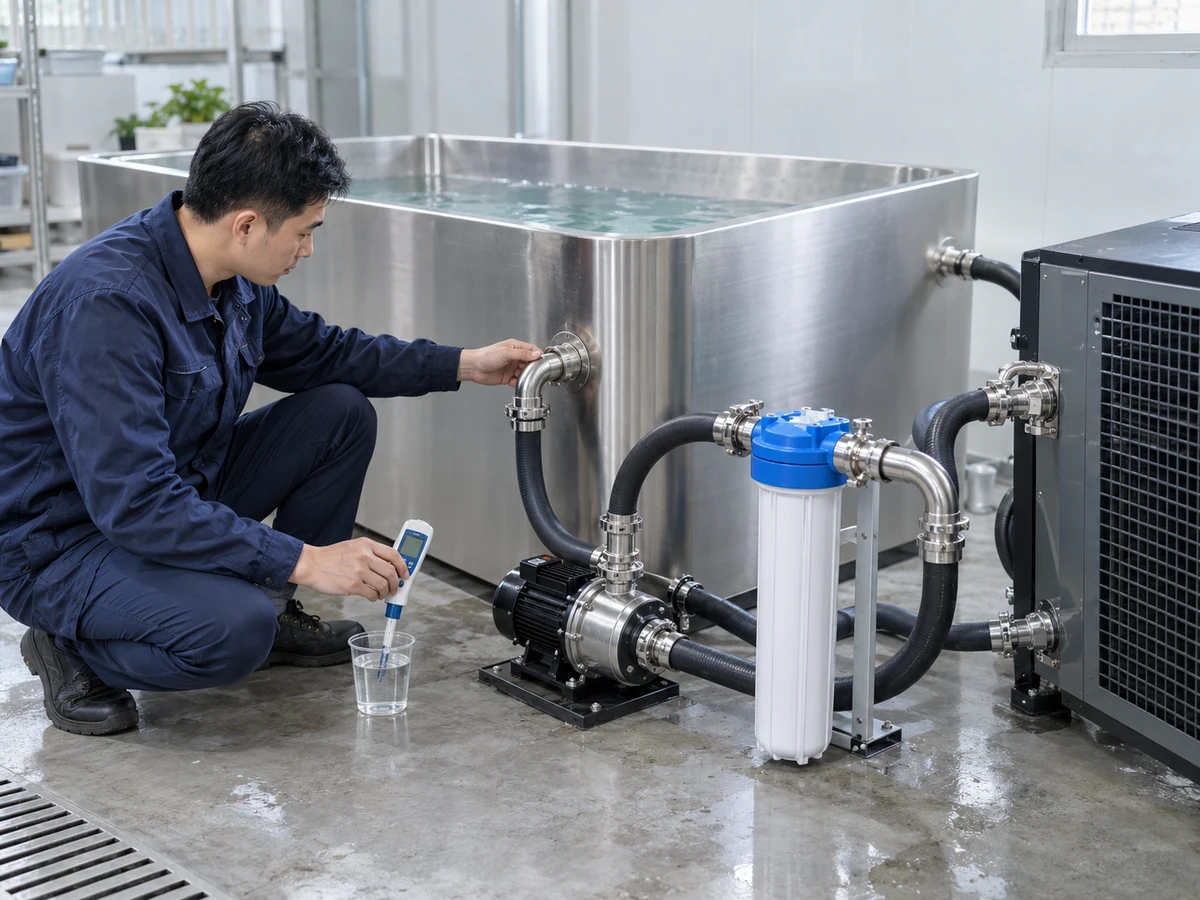
A useful compatibility review therefore follows the water path component by component.
\n\n
\n\n
| Component area | What needs to be confirmed | What should not be assumed |
|---|---|---|
| Tub / liner | Exact water-contact material and applicable chemistry limits | Exterior cladding proves liner compatibility |
| Chiller / heat exchanger | Exact model, wetted exchanger material and manufacturer water-chemistry limits | Cooling capacity or compressor HP proves salt compatibility |
| Pump / filter | Wetted materials, seals and manufacturer restrictions | General pool or cold-plunge use means salt-water approval |
| Piping / fittings | Materials and exposed interfaces | Similar size or appearance means equivalent service suitability |
| Seals / gaskets | Exact elastomer or seal specification where compatibility matters | All seals respond the same way to the proposed chemistry |
| Sensors / treatment equipment | Manufacturer-approved operating chemistry | Presence of treatment hardware proves whole-system compatibility |
\n
\n\n
The purpose of this check is not to turn the article into a complete materials specification. It is to identify which component identities must be known before a confident decision can be made.
\n\n
\n\n
Screen Materials by Component and Water Contact
\n\n
Terms such as “stainless steel,” “corrosion resistant” or “marine grade” are not complete service specifications.
\n\n
Stainless steels resist corrosion because their alloy chemistry supports a protective passive surface film. Chloride-containing environments can challenge that passive condition and, in susceptible materials and environments, contribute to localized forms of attack such as pitting or crevice corrosion.
\n\n
The practical implication is not that stainless steel and salt water are inherently incompatible. It is that compatibility depends on more than the word “stainless.”
\n\n
Important variables can include:
\n\n
- \n
- the actual alloy used in the exposed component;
- chloride concentration and the broader water chemistry;
- pH;
- temperature;
- oxidizing conditions, including chlorination chemistry;
- crevices, joints and shielded areas;
- deposits or stagnant regions;
- surface and fabrication condition;
- and electrically connected dissimilar metals.
\n
\n
\n
\n
\n
\n
\n
\n
\n
\n\n
These factors interact. A material that performs acceptably in one chemistry cannot automatically be transferred to a different chloride level, temperature, pH, fabrication detail or treatment regime.
\n\n
Why crevices and interfaces deserve attention
\n\n
Bulk surfaces are not always the only concern. Joints, threaded interfaces, gasketed connections and areas beneath deposits can create local conditions that differ from the main body of water. These localized environments can make crevice-sensitive corrosion more important than a simple material-name comparison suggests.
\n\n
Mixed-metal construction can introduce another issue. If dissimilar conductive metals are electrically connected while exposed to an electrolyte, a galvanic couple may form and accelerate corrosion of the more anodic material. That does not mean every mixed-metal cold plunge has a galvanic-corrosion problem. It means the actual materials, electrical contact and water exposure need to be understood before dismissing the possibility.
\n\n
For a buyer or operator, the better question is therefore:
\n\n
Which material is used in which wetted component, and is that component documented for the intended water chemistry?
\n\n
That is more useful than trying to identify a universally “salt-safe” cold-plunge material.
\n\n
Verify the Chiller and Heat-Exchanger Water-Chemistry Limits
\n\n
The chiller deserves its own compatibility check because cooling performance and water-chemistry compatibility are different engineering responsibilities.
\n\n
Cooling-capacity data tells you how the equipment performs thermally under stated conditions. It does not, by itself, tell you whether the water-side heat exchanger, pump or internal fittings are suitable for a particular chloride or salt-water environment.
\n\n
Some chiller manufacturers explicitly specify water-contact materials and identify models intended for fresh- and salt-water service. That type of statement is useful because it is tied to an exact product and its actual exchanger construction.
\n\n
The same reasoning cannot be transferred automatically to another chiller.
\n\n
For the selected cold plunge, check:
\n\n
- \n
- Exact chiller model. Do not validate compatibility from horsepower or cabinet appearance.
- Water-side exchanger material. The exposed exchanger or evaporator material matters more to chemistry compatibility than the compressor designation.
- Manufacturer water-chemistry limits. Look for explicit salt, chloride or approved-water guidance in the current technical documentation.
- Integrated pump and plumbing. If the chiller package contains additional wetted components, determine whether the manufacturer’s compatibility statement covers them as well.
- Cleaning and maintenance restrictions. Chemicals used during cleaning or sanitation may create a different material condition from ordinary operation.
\n
\n
\n
\n
\n
\n\n
If the chiller documentation is silent on the proposed salt-water condition, the compatibility should remain unconfirmed until the manufacturer or applicable technical documentation closes that gap.
\n\n
This also prevents a common specification error: using thermal adequacy as a substitute for chemistry compatibility. A chiller may have enough cooling capacity for the water volume and operating load while still being unsuitable for the proposed water chemistry.
\n\n
\n\n
Treat Corrosion as a Service-Condition Problem
\n\n
Corrosion questions are often oversimplified into a material ranking: one alloy is described as “good,” another as “bad,” and the decision appears finished.
\n\n
Real service conditions are more conditional.
\n\n
For chloride-containing water, the corrosion judgment can change with alloy composition, chloride condition, pH, temperature, oxidizing chemistry, local geometry, flow or stagnation, deposits and fabrication details. This is why a universal chloride number for “all cold plunges” would be misleading.
\n\n
Temperature is one example of an important variable, but it should not be used as a shortcut. Cold water may change corrosion kinetics and operating conditions, yet it does not make chloride-related material limits disappear. The actual alloy and complete exposure condition still govern the decision.
\n\n
The same caution applies to maintenance. A system may accumulate deposits or develop poorly flushed crevices even when the bulk water chemistry appears stable. Conversely, aggressive cleaning chemistry can create a different exposure from normal operation.
\n\n
For procurement and project review, this means the buyer should avoid specifications such as:
\n\n
- \n
- “stainless steel construction, therefore salt-water safe”;
- “cold operating temperature prevents corrosion”;
- or “corrosion resistant, therefore maintenance-free.”
\n
\n
\n
\n\n
Those statements compress too many variables into one label.
\n\n
A stronger specification asks for the actual wetted materials and the manufacturer’s applicable service limits, then compares those limits with the intended water chemistry and operating conditions.
\n\n
Keep Salt Compatibility Separate from Water Care and Sanitation
\n\n
A system can be materially compatible with salt water and still have an inadequate water-treatment strategy.
\n\n
Those are different questions.
\n\n
If an electrolytic salt system is used, salt acts as the source material from which the cell generates chlorine. That does not remove the need to manage disinfectant conditions, pH, filtration, contamination load, cleaning and testing as appropriate for the installation.
\n\n
Likewise, a pump, filter, UV device, ozone system or salt generator should not be treated as a universal hygiene guarantee merely because the component is present.
\n\n
For private installations, the applicable operating approach should follow the actual equipment instructions and water-care requirements.
\n\n
For shared or commercial facilities, the boundary becomes more important. Public-health and aquatic-facility requirements can depend on jurisdiction, facility type and operation. A cold plunge being described as “commercial” does not by itself establish public-facility approval or prove that a specific sanitation design is accepted locally.
\n\n
Safety and compliance boundary: this article can explain equipment and material compatibility, but it does not establish a universal sanitation program or local approval. Where a plunge is used in a shared or regulated facility, confirm the applicable water-quality and operating requirements for that site separately.
\n
\n\n
\n\n
Use a Pre-Salt Compatibility Check Before Filling or Converting the System
\n\n
Before salt is introduced into a new cold plunge—or before an existing unit is converted—build the decision from the actual configuration.
\n\n
A practical review should answer the following.
\n\n
1. What is the exact cold-plunge configuration?
\n\n
Record the tub or liner model, current construction revision and any relevant water-contact material information. Exterior cladding is not a substitute for liner identification.
\n\n
2. What is the exact chiller?
\n\n
Record the chiller model and current technical documentation. Identify the water-side exchanger material and any manufacturer statement covering the intended water chemistry.
\n\n
3. Which other components contact the water?
\n\n
Include the pump, filter housing, piping, fittings, exposed fasteners, seals and treatment equipment that are actually present. Avoid assuming that a material statement for one component extends to the rest of the loop.
\n\n
4. What does “salt water” mean for this project?
\n\n
Define whether salt is simply being added to the water or whether the project includes electrolytic chlorine generation. Record the intended water chemistry rather than relying on the label “saltwater system.”
\n\n
5. Is the complete system documented for that chemistry?
\n\n
Compare the intended condition against the applicable documentation for each critical wetted component.
\n\n
- \n
- Compatible: applicable documentation supports the proposed condition for the relevant components.
- Conditionally compatible: compatibility depends on defined chemistry, operating or maintenance conditions that can be maintained.
- Not confirmed: one or more critical components lack applicable evidence.
- Not suitable: use this only when applicable product or material documentation actually establishes the incompatibility.
\n
\n
\n
\n
\n
\n\n
The distinction between “not confirmed” and “not suitable” is important. Missing documentation should not be converted into a negative claim without evidence.
\n\n
Existing cold plunges need the same review
\n\n
Converting an installed cold plunge to salt water is not simply a matter of changing the water.
\n\n
An existing system may contain a chiller revision, pump, fittings, seals or treatment components that differ from a new product configuration. Even if the tub material appears suitable, those other components still need to be identified and checked.
\n\n
The safest engineering approach is therefore to treat conversion as a configuration revalidation, not as an automatic water-treatment upgrade.
\n\n
\n\n
Frequently Asked Questions
\n\n
Can I convert an existing cold plunge to salt water?
\n
Possibly, but the tub material alone is not enough to approve the conversion. Identify the existing chiller or heat exchanger, pump, filter, fittings, seals and other wetted components, then compare their current manufacturer documentation with the proposed salt-water condition. If a critical component cannot be verified, treat the conversion as not confirmed until the missing compatibility information is resolved.
\n
\n\n\n\n\n\n\n\n\n\n\n\n\n
Does stainless steel automatically make a cold plunge salt-water compatible?
\n
No. “Stainless steel” identifies a material family, not a universal salt-water service approval. Chloride-related corrosion resistance depends on the actual alloy, component design and exposure conditions such as water chemistry, pH, temperature, crevices and other environmental factors. The chiller and other wetted components also require their own compatibility checks.
\n
\n\n\n
\n\n
What to Send for a Configuration Review
\n\n
If you are specifying a new system or cannot close the compatibility checks for an existing one, prepare:
\n\n
- \n
- the cold-plunge model and configuration;
- the chiller or heat-exchanger model;
- current manuals or datasheets;
- available wetted-material information;
- pump, filter and treatment-system details;
- the intended salt-water method;
- the intended water chemistry or salinity if already defined;
- whether the installation is private or shared/commercial;
- and the destination or facility context if regulatory requirements may affect the decision.
\n
\n
\n
\n
\n
\n
\n
\n
\n
\n\n
HACHILL can use those inputs to review the proposed product and project configuration against the information available for the selected equipment. Exact salt-water compatibility, corrosion life, warranty coverage and facility approval should remain subject to the applicable model documentation and project requirements rather than being assumed from a product-family description.
\n\n
Need a model-level compatibility review?
\n
Send the cold-plunge configuration, chiller or heat-exchanger model, intended salt-water method, available wetted-material information and project context so the unresolved compatibility checks can be reviewed against the applicable equipment documentation.
\n Send Your Cold Plunge and Salt-Water Configuration for Review\n
\n\n
\n