A sauna works by adding heat to an enclosed room, controlling how that heat moves through the air and surrounding surfaces, limiting how quickly the room loses that heat, and—in systems with automatic controls—using temperature feedback to regulate the heat source. The heater matters, but it is only one part of the system. Room construction, glazing, ventilation, stones or emitters, sensor location and control architecture all influence what happens after energy enters the sauna.
That is also why there is no single mechanism that describes every sauna. A traditional electric sauna, a wood-fired sauna and an infrared cabin all produce a heated environment, but they do not generate and transfer heat in exactly the same way. Understanding those differences is more useful than thinking of a sauna simply as a wooden room with a temperature setting.
| Part of the system | What it does | What it does not determine by itself |
|---|---|---|
| Heater or emitter | Supplies thermal energy | Whole-room performance |
| Sauna stones, where used | Store and release heat and influence airflow through some heater designs | A universal warm-up time |
| Room enclosure | Retains heat and defines important heat-loss paths | Final heater size from geometry alone |
| Ventilation | Moves and exchanges air and influences heat distribution | One universal inlet/exhaust arrangement |
| Temperature sensor | Measures conditions at a particular location | Temperature everywhere in the room |
| Controller | Responds to sensor information according to its control logic | The complete thermal behavior of the sauna |
How a Sauna Turns Energy Into a Heated Environment
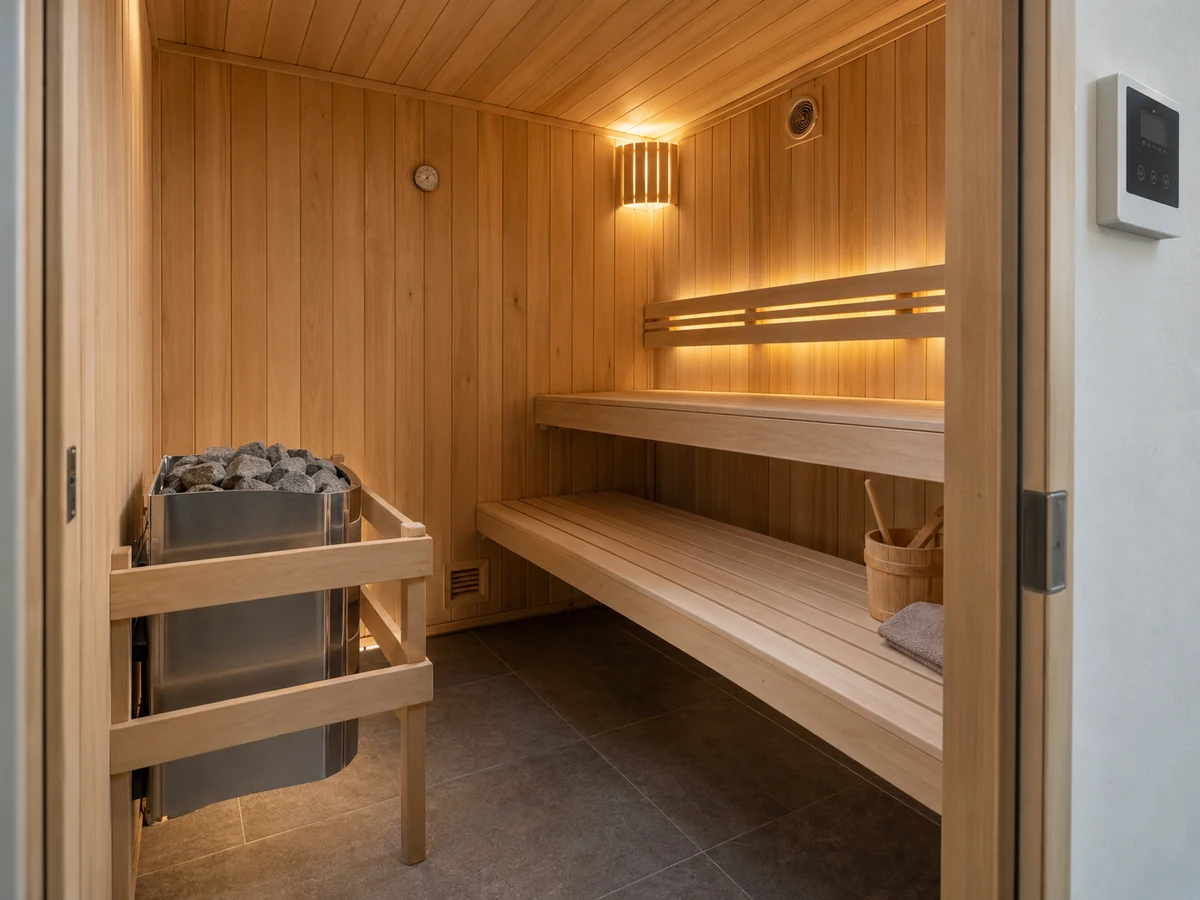
The first step is energy input. In a conventional electric sauna heater, electrical energy is converted to heat by the heater elements. In a wood-fired sauna, combustion supplies the heat. From there, the heater, stones where present, room air and interior surfaces become part of the heat-transfer process.
This is an important distinction: producing heat is not the same thing as establishing the final room condition.
Traditional stone-heater systems
In many traditional sauna heaters, stones form a significant part of the heater assembly. They absorb heat from the heater and release it over time. Air can move through and around the heater and stone mass, carrying heat into the room, while hot surfaces also exchange radiant heat with their surroundings.
The arrangement of the stones matters because the heater still needs an appropriate path for air to move through the assembly. Filling a heater with stones is therefore not simply a matter of adding as much thermal mass as possible. Stone type, size, quantity and placement depend on the heater design and should follow the relevant manufacturer instructions.
Water thrown onto sufficiently hot sauna stones can evaporate rapidly and temporarily change the humidity and heat sensation in the room. That function does not mean the stones are the original energy source; they are part of the way heat is stored, transferred and used within a traditional sauna system.
Wood-fired sauna heaters follow a related room-heating principle but use a different primary energy source. Fuel combustion, firebox airflow, heater construction, stones and flue draft all influence how the heat source behaves. That makes it inaccurate to apply an electric heater’s control logic automatically to a wood-fired stove.
Infrared systems take a different heat path
Infrared sauna systems require a separate explanation. Instead of relying on a conventional stone-heater assembly as the central heating architecture, an infrared cabin can use dedicated radiators or emitter panels that deliver radiant energy to exposed surfaces and occupants.
The cabin air and enclosure still matter, but the energy-transfer path is different enough that an infrared sauna should not simply be described as a traditional sauna with another kind of heater.
This distinction is about equipment and heat transfer—not about claiming that one system is healthier, safer or more effective than another. Those are separate questions that require different evidence.
The Room Is Part of the Heating System
A heater operates inside a thermal enclosure. That enclosure can make the heater’s job easier or harder.
Room dimensions are part of the equation, but geometric volume alone does not tell the whole story. Insulated wall and ceiling assemblies, glazing, doors, exposed masonry or other massive surfaces, air leakage and surrounding ambient conditions can all change how much heat must be supplied to establish and maintain the desired room condition.
Consider glazing. A glass door or large window changes the thermal boundary compared with a fully insulated wall. The exact adjustment used for heater sizing depends on the heater manufacturer or engineering method, but the underlying point is straightforward: two rooms with the same floor dimensions can impose different thermal demands.
The same applies to insulation. Better control of heat loss generally allows more of the heater’s output to remain available to warm the room rather than continuously replacing energy escaping through the enclosure. A poorly insulated or unusually exposed room can therefore behave differently even when the heater nameplate is unchanged.
Room surfaces also absorb heat as the sauna warms. Benches, wall finishes, ceilings, stones and other materials do not instantaneously reach their final condition when the heater is energized. The sauna develops thermally over time as these parts exchange energy with the heater and room air.
That is why heater rating and room behavior should not be treated as synonyms. Heater input is one specification. Actual room response is the result of that input interacting with the enclosure and operating conditions.
For final heater selection, this general explanation is not a substitute for the applicable sizing method. Effective sizing volume, glazing or uninsulated-surface adjustments and heater selection should be checked against the exact heater documentation and project conditions.
Ventilation Changes Both Air Quality and Thermal Behavior
Ventilation may seem contradictory in a sauna: if the objective is to create and retain a hot environment, why intentionally exchange air?
Because a sauna is an occupied room, not a sealed thermal container.
Ventilation provides air exchange, but it also affects how air moves through the room. That movement can influence temperature distribution, heat loss and, in some configurations, the temperature information received by the control system.
Incoming cooler air adds a thermal load. Air leaving the room carries energy with it. The locations of supply and exhaust openings can also influence how heated air circulates around the heater, benches and sensing equipment.
This does not mean ventilation should simply be minimized. A system needs to satisfy its ventilation requirements while still allowing the heater and room to operate as intended. The useful engineering question is therefore not “How do we keep all the hot air inside?” but “How does the intended air path interact with this heater, this room and this control arrangement?”
Ventilation details are particularly sensitive to configuration. Electric and wood-fired sauna systems can have different airflow and installation requirements, and mechanically ventilated rooms can behave differently from naturally ventilated ones.
Air supply location can also matter to the temperature sensor. If cooler incoming air reaches the sensor in a way the heater manufacturer did not intend, the control system may receive a reading that does not represent the condition it is designed to monitor.
For that reason, a general article can explain why ventilation matters, but it should not prescribe one universal vent size, airflow rate or inlet/exhaust location. Those decisions belong to the specific heater instructions, room design and applicable project requirements.
Controls and Sensors Close the Feedback Loop
In an automatically controlled electric sauna, the control system adds a feedback loop to the thermal system.
A temperature sensor measures the condition at its installed location. The controller uses that information, together with the selected setpoint and its own control logic, to determine how the heater should operate.
The important phrase is at its installed location.
A sensor does not measure the temperature everywhere in the sauna. Temperature can vary with height, distance from the heater, airflow, nearby doors or glazing, and the geometry of the room. The value detected by the sensor is therefore a local measurement used by a particular control system—not a perfect map of every bench and surface.
This leads to three concepts that should not be collapsed into one:
The setpoint is the target selected through the control system.
The sensor reading is the condition detected where the sensor is installed.
The room condition is the actual temperature field developing throughout the sauna.
They are related, but they are not identical.
Sensor location therefore matters. Heater manufacturers specify sensor arrangements for particular heater and controller combinations because moving the sensor can change what the control system sees. Supply air, doors, corners, nearby glazing and distance from the heater can all influence the local reading.
Control behavior itself is also system-specific. One electric controller may switch heater elements according to one control strategy, while another uses a different algorithm or equipment architecture. A general explanation should not assume identical cycling, hysteresis or modulation across all products.
Wood-fired heaters reinforce this boundary. Their primary heat output comes from fuel combustion rather than an electronically switched heating element. Firebox airflow, fuel condition, stove design and chimney draft affect heat production. An electronic room sensor and automatic electric-heater controller therefore cannot be presented as a universal feature of every sauna.
The broader lesson is simple: the controller does not create the room condition on its own. It reacts to information from one part of a larger thermal system.
Why Two Saunas With Similar Heaters Can Behave Differently
Imagine two sauna rooms using heaters with similar nominal power ratings. This is a representative engineering example, not a measured HACHILL test.
The first room is compact, well insulated and has limited glazing. Its ventilation is arranged according to the selected heater system, and its temperature sensor is located where the control manufacturer intends.
The second room has the same approximate geometric volume but more glass, additional exposed surfaces and a different air path. Cooler supply air passes nearer the sensor, and the room loses heat differently through its enclosure.
The two heaters may have similar nameplate ratings, yet there is no engineering reason to assume that the rooms will warm at the same rate, cycle identically or develop the same temperature distribution.
The difference does not require one heater to be “better.” The systems surrounding the heaters are different.
This is why simplified comparisons can be misleading:
- the same heater kW does not prove the same room performance;
- the same controller setpoint does not prove the same temperature everywhere in two rooms;
- the same geometric room volume does not prove the same effective thermal demand;
- the same heater appearance does not prove the same control architecture;
- the same ventilation opening size does not prove the same airflow behavior.
The practical unit of analysis is therefore not the heater by itself. It is the heater-room-ventilation-control system.
That system view also explains why troubleshooting a sauna that heats slowly or behaves inconsistently should not begin with the assumption that the heater alone is defective. Room construction, stones, airflow, sensor context, control configuration and operating conditions may all change the observed result.
It does not follow that any one of those factors is automatically the cause. Diagnosis requires checking the actual configuration and comparing it with the relevant manufacturer documentation.
What to Verify Before Moving From “How It Works” to Selection or Installation
Understanding the system mechanism is the first step. Selecting equipment or approving an installation requires more specific information.
Before using general sauna principles to make a product or project decision, confirm the factors that can materially change that decision:
- Sauna heating architecture: traditional electric, wood-fired, infrared or an explicitly documented combined configuration.
- Room geometry: internal dimensions, ceiling height and the actual heated space.
- Room construction: insulation condition, glazing and other exposed or heat-storing surfaces that affect the thermal load.
- Heater information: exact model, rated input and the manufacturer’s applicable room-sizing basis.
- Ventilation arrangement: intended supply and exhaust paths and whether ventilation is natural or mechanical.
- Control architecture: controller, sensor and heater combination, including the manufacturer-defined sensing arrangement.
- Site conditions: electrical supply, surrounding ambient conditions and other installation interfaces that affect the selected equipment.
- Applicable documentation: current heater, controller and installation instructions for the exact configuration.
Those inputs turn a general explanation into a real engineering or purchasing decision.
Installation boundary
The relationships described in this article explain how the system works; they are not universal installation dimensions. Sensor positions, heater clearances, ventilation locations, electrical requirements, stone loading and other safety-critical details can vary by product and project. Use the current documentation for the exact heater and control configuration, together with applicable site requirements and qualified installation responsibility, before treating any general principle as an installation specification.
For readers still defining the product direction, the next useful step is to compare the available sauna families and then move into the appropriate heater-selection, thermal-sizing or construction guidance. HACHILL’s sauna range can serve as that product-family starting point without assuming that one heater, control package or room design fits every project.