Quick answer: buy the operating concept, not the hybrid label
A hybrid outdoor sauna is a project fit only when the buyer has a defined reason to use more than one heat route. Start with the operating concept: which heat experience is required, which modes must be available, who will operate the room, and what equipment, controls, electrical context, ventilation, site exposure and service access still need confirmation?
For HACHILL, Barrel, Cube and Outdoor Cabin are enclosure directions. Hybrid Outdoor is a heating-configuration route. The current range includes CS29, CS23 and CS21. Their public stove and infrared references support shortlisting, but they do not by themselves prove simultaneous operation, a shared controller, identical supplied equipment or one combined electrical load.
Use this sequence: project need → model route → required modes → supplied equipment and controls → electrical basis → layout and ventilation → outdoor site → RFQ readiness.
Keep any configuration-changing unknown open until the quoted equipment and approved documents close it.
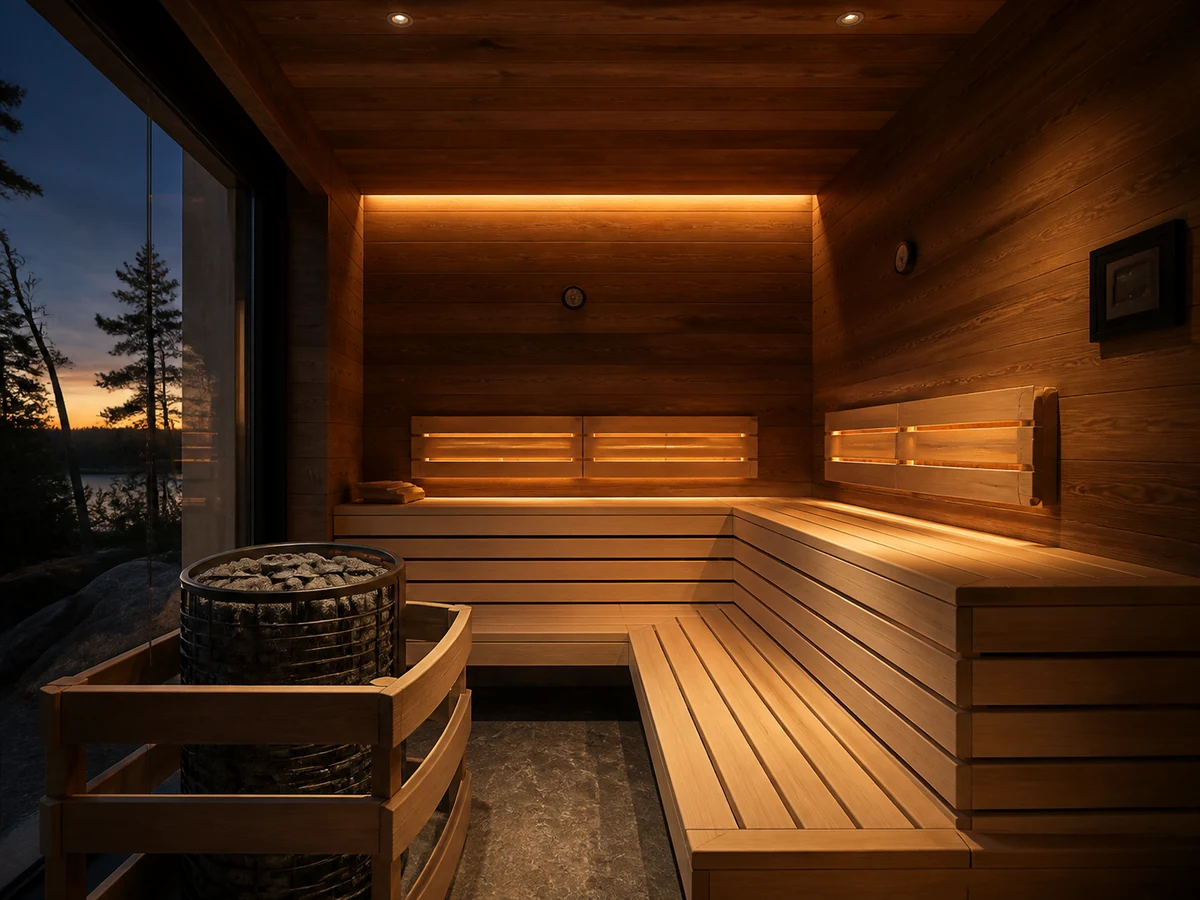
Decide Whether the Project Actually Needs a Hybrid Outdoor Sauna
Hybrid should solve a real project requirement.
That may be a defined need for different heat experiences, a hospitality concept that intentionally requires more than one heat route, or a product program where the additional configuration fills a clear gap.
If the buyer cannot explain why the Hybrid route is needed, the project is not yet ready to treat “Hybrid” as a specification.
Separate enclosure choice from heat-route choice
On the current HACHILL range, Hybrid identifies a heating-configuration distinction. It does not describe the physical shape of the sauna.
| Decision | Question |
|---|---|
| Enclosure | Does the cabin size, geometry and site route fit the project? |
| Heating configuration | Does the project actually require the Hybrid route? |
Keeping them separate prevents a common selection error: choosing additional technical complexity before establishing a real use for it.
Choose Hybrid when the additional route has a defined job
The requirement should be clear enough to explain the intended heat routes, required operating experience, operator, user instructions and site implications.
The buyer does not need a finished electrical design at the beginning of the selection process. But the requirement should be more specific than “we want the premium version.”
Know when not to choose Hybrid
A conventional sauna route may be the better decision when capacity, footprint and enclosure needs are already satisfied and the project has no defined Hybrid requirement.
HACHILL’s current CS29 and non-Hybrid CS04, for example, occupy the same listed 1–2 person capacity and planning envelope. If both fit the site, size alone does not create a reason to choose Hybrid.
A similar decision exists around the larger CS21 route and the non-Hybrid CS22: both are listed in the 4–6 person class with the same 2000 × 2000 × 2000 mm external envelope, so the meaningful question becomes whether the Hybrid heating configuration solves an additional requirement.
The useful buying question is therefore not “Which Hybrid model has more features?” but “What project problem does Hybrid solve that a simpler route does not?”
Hybrid is not automatically better. It is appropriate when its additional configuration is useful, verifiable and supportable.
Choose the HACHILL Hybrid Outdoor Sauna Model by Project Fit
The current HACHILL Hybrid Outdoor family includes three shortlisting routes: CS29, CS23 and CS21.
Capacity and external dimensions can narrow the range, but neither should be treated as the final specification.
| Model | Current listed capacity | Current external envelope | Separate public heat references | Best use in the shortlist |
|---|---|---|---|---|
| CS29 | 1–2 person | 1350 × 1300 × 2000 mm | 4.5 kW stove / 3250 W infrared | Compact Hybrid route |
| CS23 | 2–4 person | 1930 × 1300 × 2100 mm | 6 kW stove / 4200 W infrared | Mid-size route requiring drawing verification |
| CS21 | 4–6 person | 2000 × 2000 × 2000 mm | Category: 8–9 kW stove; product page: 9 kW / 5600 W infrared | Larger Hybrid route requiring quoted-configuration confirmation |
These values are current public shortlisting references. They are not substitutes for approved order documents.
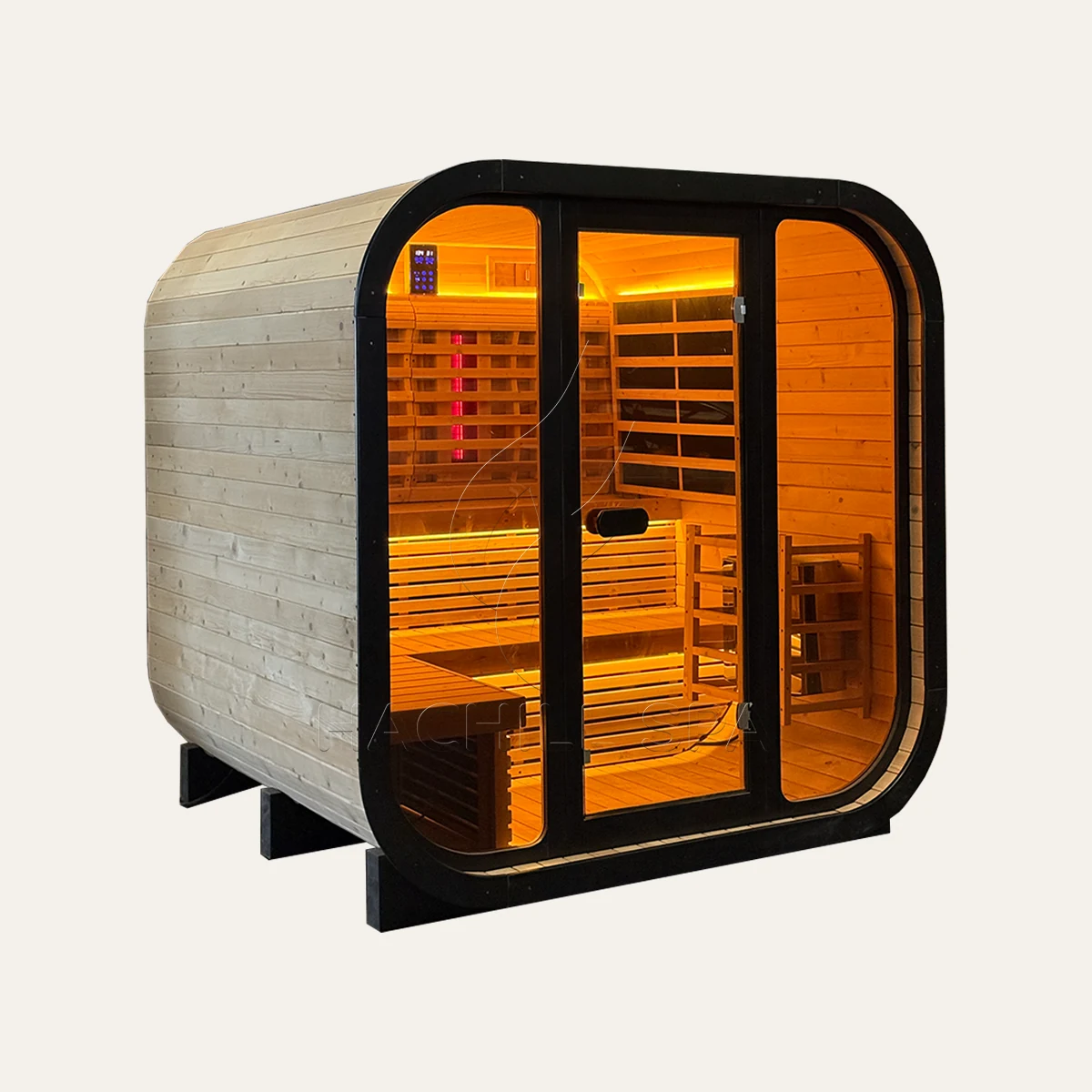
CS29: compact Hybrid route
CS29 is the compact option in the current Hybrid family. Its listed capacity and envelope make it useful when space is limited. The next question is whether the project actually needs the Hybrid configuration.
If a conventional model satisfies the same space and capacity requirement, the heat-route requirement becomes the meaningful discriminator.
CS23: mid-size route with a drawing-verification requirement
CS23 occupies the middle of the current Hybrid range. Its external dimensions can be used for early site screening, but the current public product information contains conflicting internal-height figures.
Do not silently select one value. For any height-dependent layout, heater, infrared, clearance or installation decision, use the approved drawing to close the conflict.
Public dimensions can start a shortlist; conflicting dimensions cannot finish one.
CS21: larger Hybrid route
CS21 is the larger listed Hybrid option at 4–6 people. Its current public information also demonstrates why category data should remain separate from the final quoted specification. The Hybrid category lists an 8–9 kW stove reference while the dedicated CS21 product page lists 9 kW.
That discrepancy should not be “fixed” by choosing whichever number looks more convenient. Use the range information for comparison, then confirm the actual supplied stove and configuration for the order.
Verify Heat Routes, Operating Modes, Controls and Electrical Scope
The most important technical distinction in this guide is: separate heat references are not a complete Hybrid system specification.
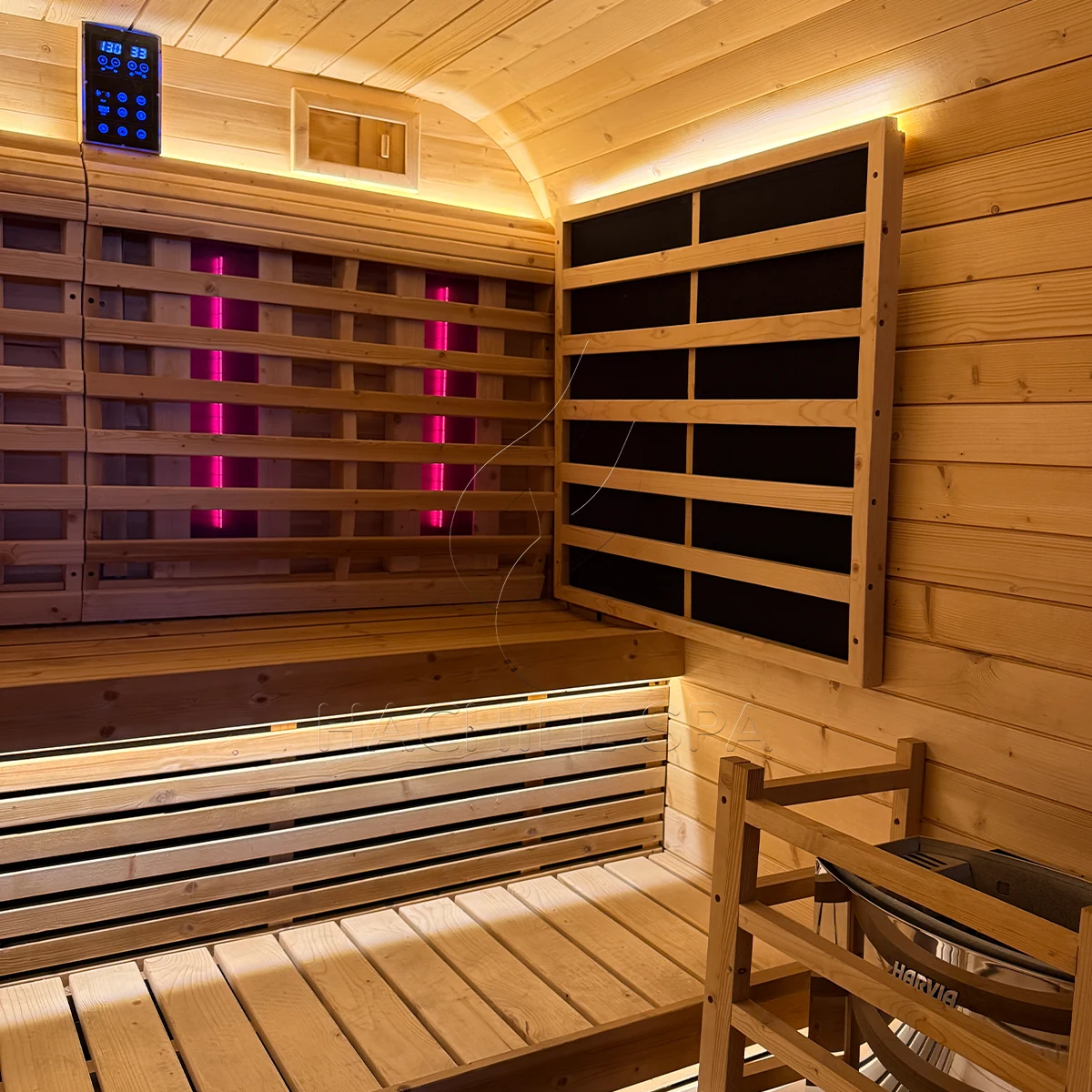
A public model page may identify a stove reference and an infrared reference. Those figures help describe the product route, but they do not automatically establish the final equipment, operating modes, control architecture or connected electrical load.
| What the public references can help with | What they do not automatically prove |
|---|---|
| Comparing current Hybrid models | Both systems are included in every order |
| Identifying separate heat references | Both may operate simultaneously |
| Early project planning | One shared controller |
| Preparing technical questions | Final connected electrical load |
| Building an RFQ | Final circuit, protection or installation design |
Do not create a combined electrical load from two public references
Do not add the published stove and infrared values together and call the result “Hybrid power.”
The electrical basis must start from the actual supplied equipment and permitted operating configuration.
Safer verification chain: supplied equipment → required modes → permitted modes → controller and sensors → voltage / frequency / phase → connected load → protection and installation basis.
If the chain is incomplete, the electrical specification remains incomplete.
Confirm permitted operating modes
Two heat routes do not prove every possible operating combination. A project may require traditional stove heating, infrared heating, different modes used separately, or concurrent operation.
If simultaneous operation matters, state it explicitly in the enquiry and confirm whether the selected configuration supports it. Do not infer it from the word “Hybrid.”
Confirm controls and sensors from the supplied equipment
Controller behavior is equipment-specific. The selected system may have its own outputs, sensor requirements, switching logic, protective functions and operating limitations. Those details cannot be assigned to CS29, CS23 or CS21 from the Hybrid label alone.
The useful buyer questions are: What controller is supplied? What does it control? What sensors are required? Which operating states are permitted?
If those answers remain open, the control architecture remains open.
Keep equipment safety and site electrical scope separate
IEC 60335-2-53 addresses safety requirements for sauna heating appliances and infrared cabins within its stated scope.
IEC 60364-7-703 addresses certain electrical installations in rooms and cabins containing sauna heaters. Its published scope states that it does not apply to prefabricated sauna cabins complying with a relevant equipment standard, so it should not be applied indiscriminately to every prefabricated product.
Neither reference is proof that HACHILL or a specific HACHILL model holds a particular certification, and neither replaces destination-specific electrical review.
Because this guide is not tied to one jurisdiction, it does not prescribe breaker size, conductor size, disconnect type or GFCI/RCD arrangement. Final conductor sizing, overcurrent protection, disconnect, protective measures and connection requirements must follow the actual equipment nameplate, the manufacturer’s instructions and applicable local electrical rules. Fixed wiring and final electrical approval should be handled by appropriately qualified personnel for the destination.
For the buyer, the practical rule is: identify the actual supplied equipment first, then establish which equipment instructions, electrical requirements and local rules apply.
This article does not approve a final electrical design. For deeper load-planning logic, use the sauna thermal design and heater sizing guide.
Check Capacity, Layout, Ventilation and Serviceability
A capacity label helps narrow the shortlist. It does not prove that the final room arrangement will work for every project.
Keep three layers separate: product envelope → usable layout → equipment and service interfaces.
Treat capacity as a shortlisting class
CS29, CS23 and CS21 are grouped into different marketed capacity ranges. Those classifications help buyers identify an initial route, but they do not guarantee comfortable occupancy, commercial throughput, final bench arrangement or equipment clearance.
The selected model drawing and intended use still control the project review.
Do not confuse cabin dimensions with equipment clearances
Cabin width, depth and height describe the product envelope. They do not automatically establish required clearances around a heater, infrared equipment, controls or sensors.
Those requirements belong to the actual supplied equipment and its applicable documentation. This distinction becomes more important in a Hybrid installation because multiple heating-system interfaces may need to coexist with seating, doors, glazing, circulation and service access.
Coordinate ventilation with the selected configuration
Ventilation should not be finalized independently from the actual heating and control arrangement. Air paths, equipment locations and sensor/control behavior can interact.
Final vent positions and equipment relationships therefore belong to the selected configuration and its approved documentation. Do not copy vent positions, sensor distances or equipment clearances from another sauna or another manufacturer.
Keep future service access in the layout
A layout can be physically installable and still become unnecessarily difficult to maintain.
Before freezing the project, check whether the arrangement leaves practical access to controls, heating equipment, electrical service points and components that may need inspection or replacement.
This is a planning criterion, not a universal clearance dimension.
Qualify the Outdoor Site Before Releasing the Hybrid Route
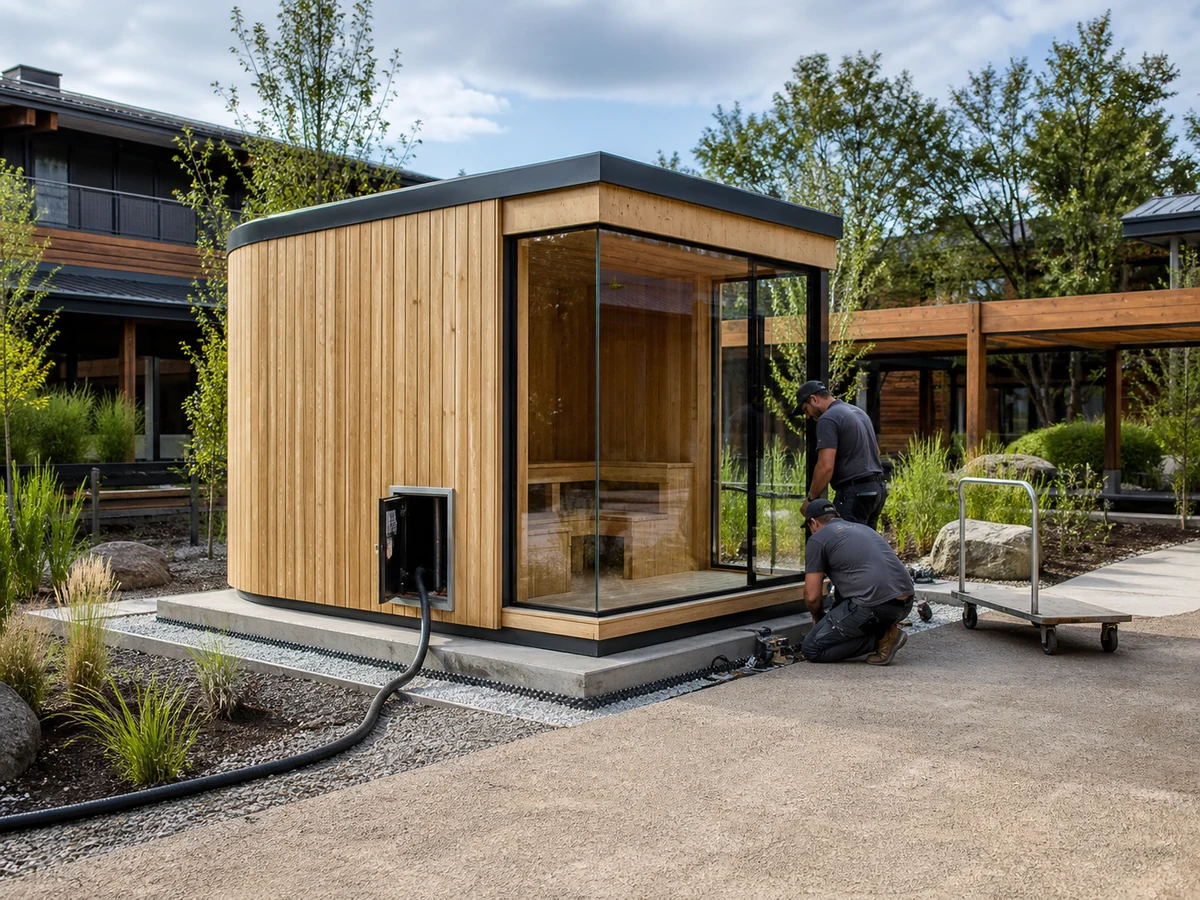
Hybrid does not replace normal outdoor-site planning. The sauna still has to work with the actual exposure, base, drainage, utilities, delivery route and service conditions.
The Hybrid configuration adds equipment and control questions to that site review.
| Site check | Why it matters | Next owner when deeper review is needed |
|---|---|---|
| Rain, runoff, splash and exposure | Affects enclosure and site interfaces | Climate guide / weatherproofing guide |
| Base and foundation context | Affects support and installation planning | Approved project/site design |
| Drainage | Helps avoid uncontrolled water around the installation | Weatherproofing/site review |
| Electrical and control entry | Must suit the final equipment arrangement | Qualified project electrical review |
| Delivery access | Product must physically reach the installation area | Measured route and logistics review |
| Service access | Equipment must remain reachable after installation | Selected layout and project documentation |
Screen actual exposure instead of relying on the word “outdoor”
“Outdoor” is not one environmental condition. The project may need to account for wind-driven rain, runoff, ground splash, freeze-thaw exposure, snow, strong solar exposure or coastal conditions.
These are project-screening inputs. They are not evidence that every Hybrid model has a universal wind, snow, waterproofing or service-life rating.
Coordinate base, drainage and utility entry
Base conditions and drainage should be reviewed together with the selected location. Electrical and control interfaces also need a deliberate route into the installation rather than being improvised after the sauna position has been fixed.
Useful sequence: exposure → base and drainage → utilities → delivery access → service access.
If an item can change the configuration, keep it open until the responsible project party closes it.
Plan for service after installation day
A sauna that fits the final footprint may still be difficult to deliver or maintain. Review the measured access path, unloading approach, turns, slopes and temporary handling conditions.
Then check whether the installed location still leaves access for future inspection or replacement of relevant components.
Use a Hybrid Configuration Release Gate Before RFQ
A strong RFQ separates confirmed requirements from open questions.
The buyer does not need every engineering detail finalized before contacting HACHILL. But missing information should not be converted into assumed product specifications. Public category and product-page values should remain shortlisting inputs until the quoted configuration and approved order documents confirm the equipment that will actually be supplied.
For this guide, use two working outcomes:
READY FOR RFQ means enough information exists to submit the project for quotation and configuration review.
HOLD / REQUEST MISSING INPUT means an unresolved item can still change model, equipment, electrical, layout or site decisions.
These are editorial project-planning labels, not HACHILL certification or product-approval statuses.
Hybrid configuration release gate
| Decision question | READY direction | HOLD / clarify when |
|---|---|---|
| Why does the project need Hybrid? | Operating purpose is defined | Hybrid is being selected only as a feature label |
| Which model route fits? | CS29, CS23 or CS21 is shortlisted from confirmed information | A critical dimension or requirement remains unresolved |
| Which heat routes are required? | Intended heat experience is described | Buyer assumes every possible mode is available |
| Is simultaneous operation needed? | Requirement is explicitly stated for confirmation | It is inferred from separate stove/IR references |
| Are controls understood? | Required behavior is stated and exact equipment will be confirmed | Shared controller or sensor arrangement is assumed |
| Is electrical context available? | Voltage, frequency, phase and site context are known | Public kW references are treated as final connected load |
| Does the layout work? | Model envelope and major interfaces have been reviewed | Cabin dimensions are treated as equipment clearances |
| Is the outdoor site sufficiently defined? | Exposure, base, drainage, access and utilities are understood | Site conditions may still change the solution |
| Are required documents identified? | Drawing, manual, label or other document needs are listed | Critical documentation requirements remain unknown |
What to include in a Hybrid outdoor sauna RFQ
A useful enquiry can identify the preferred model or required capacity, intended application, heat-route requirement, required operating modes, whether concurrent operation matters, destination market, electrical context, site conditions, access, foundation and drainage context, quantity, branding or labeling request, packaging needs, required documents and open technical questions.
Quantity is an enquiry input, not evidence of a confirmed MOQ. A branding request is an input for commercial review, not proof that private-label approval has already been granted.
Keep supplier-confirmation items visible
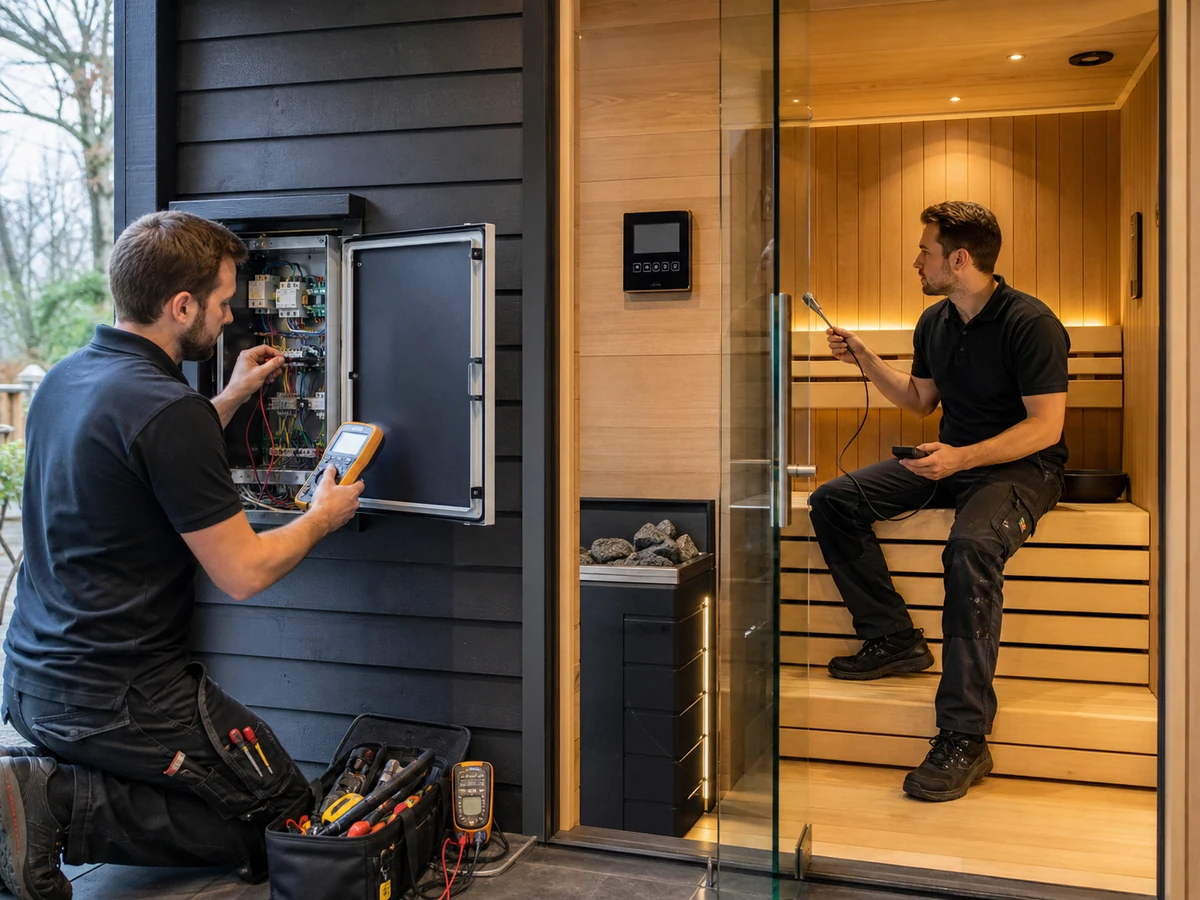
Depending on the selected project, HACHILL may still need to confirm the supplied heater and infrared equipment, operating modes, controller, sensors, electrical load, ventilation arrangement, clearances or approved drawings.
The objective is not to eliminate every unknown before the RFQ. It is to prevent an unknown from quietly turning into an assumed specification.
Any equipment-specific functional checks or handover requirements should come from the approved supplied-equipment and project documentation. This guide does not establish a universal Hybrid commissioning or retest protocol.
Frequently Asked Questions
Is a hybrid sauna always better than a traditional sauna?
No. Hybrid is useful when the project has a real need for the additional heating configuration and can support the required equipment, controls, electrical and operating requirements.
If a conventional sauna already solves the enclosure, capacity and use case, Hybrid may add complexity without solving another project problem.
Can hybrid sauna power be finalized from public kW references?
No. Published stove and infrared references can help compare product routes, but they do not establish the final equipment schedule or connected electrical load.
Do not add the separate references together and treat the result as final Hybrid power.
Can the stove and infrared heat routes run at the same time?
Do not assume so. The existence of two heat references does not prove that simultaneous operation is permitted in the selected configuration.
If concurrent operation matters, include it as a requirement and ask HACHILL to confirm the quoted equipment, controls and permitted modes.
Which HACHILL Hybrid model should I compare first?
Start with the required capacity and available site envelope, then ask whether Hybrid actually changes the decision.
CS29 is the compact current route, CS23 covers the middle range and CS21 is the larger current Hybrid option. Use each model page for current public product evidence and treat conflicting or order-specific information as confirmation items.
What should be confirmed before ordering a Hybrid Outdoor Sauna?
Confirm the selected model, intended heating concept, required operating modes, supplied heating equipment, controls, electrical context, major layout and ventilation interfaces, outdoor site conditions, delivery and service access, and required project documents.
If an unknown item can change the equipment, installation or site decision, keep it open instead of guessing.
Prepare a Hybrid Outdoor Sauna RFQ
A useful Hybrid enquiry starts with the operating concept, not just the model name.
Share the preferred model route if known, intended heat routes and operating requirements, destination, site conditions, electrical context, access, quantity, documentation requirements and any unresolved control or configuration questions.
Keep confirmed requirements and open items separate. That gives HACHILL a clearer basis for identifying what is already defined and what still requires product, electrical, site or commercial confirmation before the project moves forward.