Sauna Heater Selection & Procurement Guide
Choose a sauna heater by matching the heating method and equipment requirements to the room and site—not by kW, seat count or appearance alone. Electric heaters generally fit projects with suitable electrical infrastructure and repeatable control requirements, while wood-burning heaters require a workable fuel, chimney and combustion-safety route. Room dimensions, glazing, insulation, operating duty, ventilation, controls and installation conditions can all change the final choice.
Before requesting a final model, confirm the room, heater route, utilities, controls, installation responsibility and exact manufacturer documentation. Person capacity is not heater sizing, and heater kW is not a complete electrical specification.
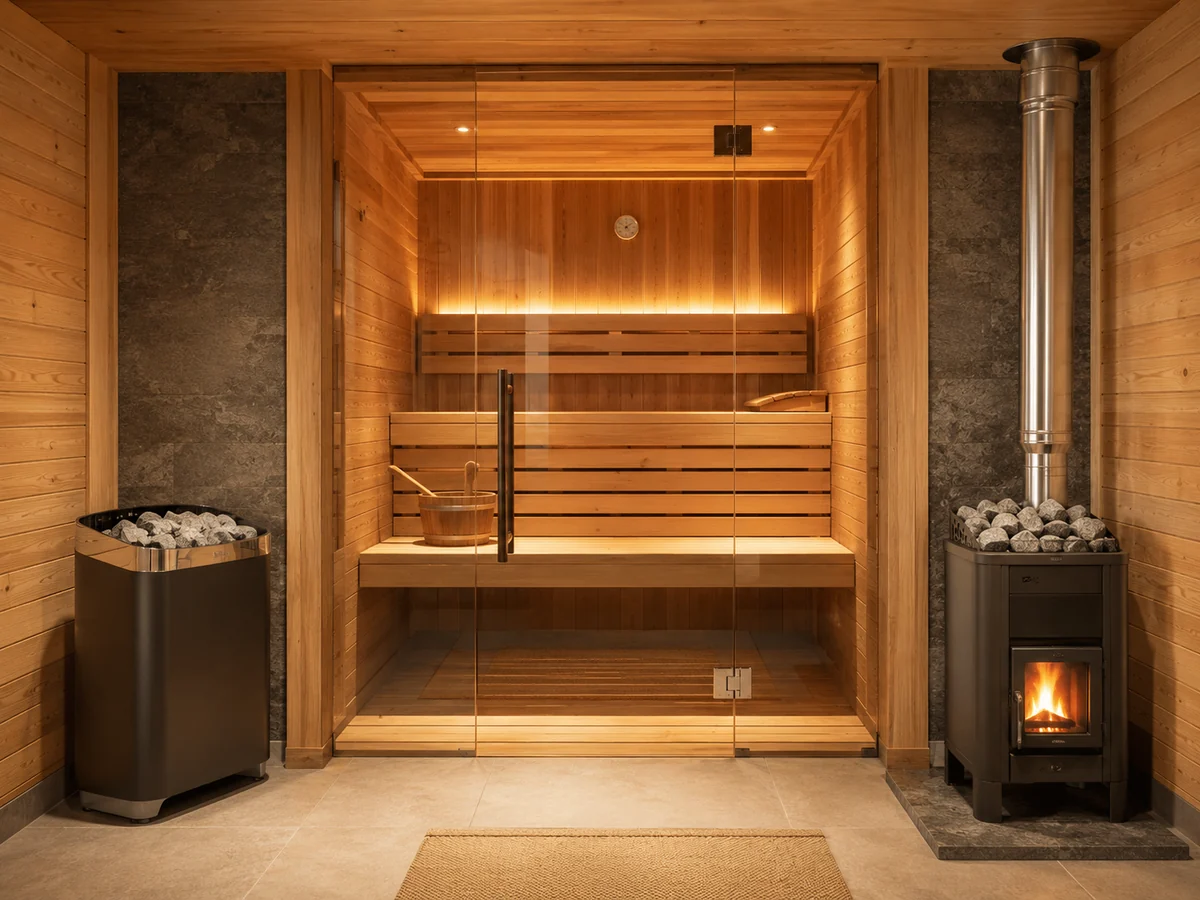
Conceptual visualization for heater-selection planning; not a representation of a specific HACHILL heater model.
Quick Answer: Which Sauna Heater Type Should You Choose?
Electric heaters generally fit projects with confirmed electrical capacity and a need for controlled, repeatable operation. Wood-burning heaters can fit projects where fuel supply, chimney routing, combustion air and fire-safety requirements can be managed correctly. Neither route should be selected from heater output or person capacity alone.
Use the actual heated room, glazing, insulation, operating frequency, controls, ventilation, site conditions and exact model documentation to approve the final heater.
Pre-Purchase Technical Gate
Treat heater selection as preliminary until the following four questions are closed.
Confirm internal dimensions, glazing, insulation, construction and indoor or outdoor exposure.
Verify electrical infrastructure for electric heaters or fuel, chimney and combustion feasibility for wood-burning heaters.
Confirm controller, sensors, ventilation, required clearances, service access and installer responsibility.
Use model-level specifications, manuals and destination-market evidence rather than category-level assumptions.
Electric vs Wood-Burning Sauna Heaters: Decision Table
Both heater types can serve traditional sauna applications, but they create different utility, operating and installation responsibilities.
| Decision Factor | Electric Heater | Wood-Burning Heater | Buyer Must Confirm |
|---|---|---|---|
| Primary energy source | Electricity | Firewood | Available utility or fuel route |
| Controls | Built-in, external or digital depending on exact model | Heat primarily managed through fuel and combustion | Exact model and operating configuration |
| Electrical planning | Core requirement | May still apply to lighting or auxiliary equipment | Voltage, phase and site capacity |
| Chimney / flue | Normally not part of the heater system | Required | Compatible route and local requirements |
| Fire-safety planning | Model clearances still matter | Stove, flue, hearth and combustible clearances require additional review | Exact equipment documentation |
| Operating workflow | Potential for repeatable or automated operation | Manual fuel loading and combustion management | Who will operate the sauna |
| Commercial maintenance | Control, sensor and heater inspection | Adds fuel storage, ash and combustion-system maintenance | Facility maintenance capability |
| Primary feasibility risk | Insufficient or incompatible electrical infrastructure | Unworkable chimney, fire or fuel route | Site review before purchase |
Electric Is Often the Better Fit When…
- The required electrical infrastructure can be confirmed.
- Repeatable operation is important.
- The heater, controls and sensors can be approved as one system.
- The operating team needs a defined control process.
Wood-Burning May Fit Better When…
- Firewood supply and storage are practical.
- A safe chimney and flue route can be established.
- Combustion-air and fire-clearance requirements can be handled.
- The operating team can manage fuel, ash and combustion checks.
For projects centered on a heater-and-stone sauna environment, compare the room, heater route, bench layout and ventilation requirements in traditional indoor saunas.
Start With the Sauna Room, Not the Heater Label
Two sauna rooms with identical physical dimensions can impose different thermal demands because of glazing, insulation, ceiling height, exposed surfaces or climate.
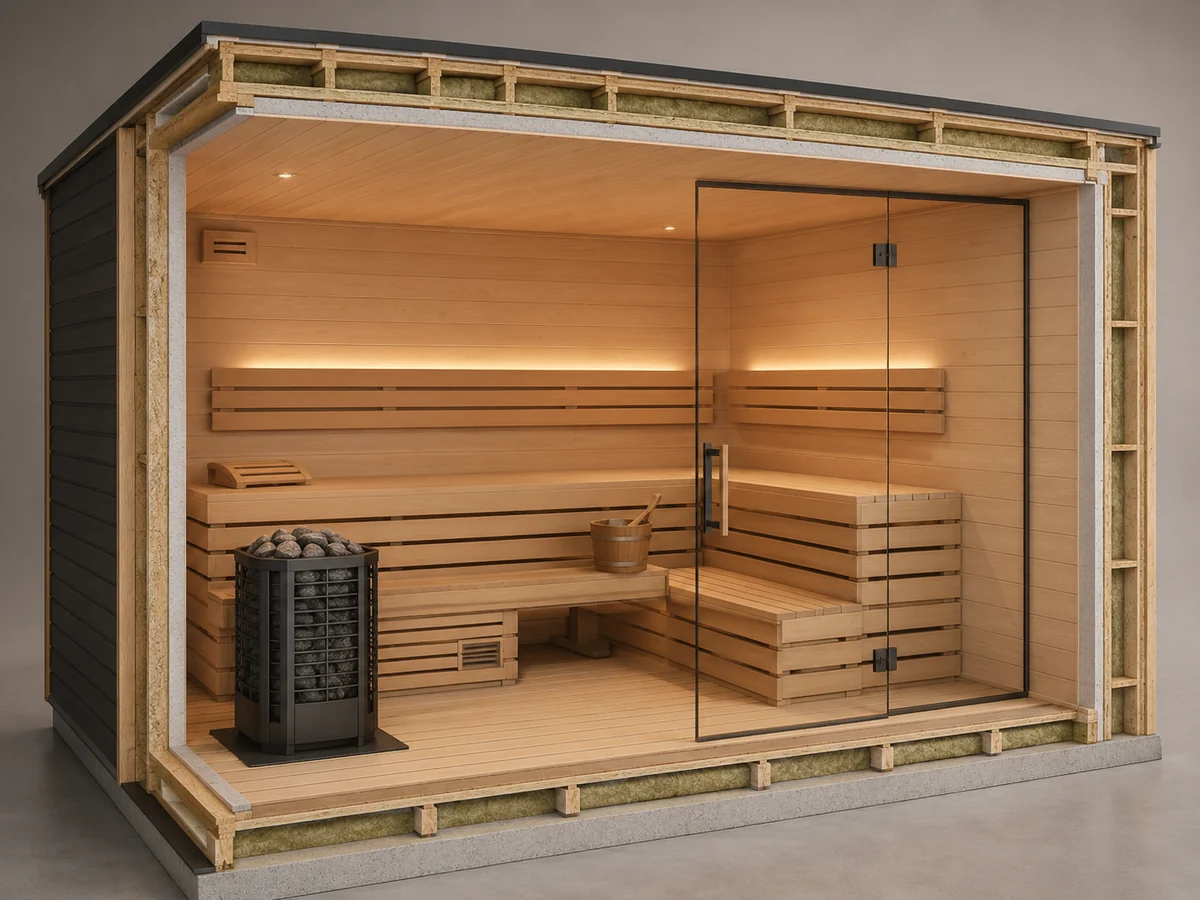
Conceptual technical visualization; exact heater sizing must follow the selected manufacturer’s current documentation.
Room Volume Is the Starting Point, Not the Final Answer
- Internal length, width and height
- Glazed doors or glass walls
- Uninsulated masonry or other exposed surfaces
- Wall and ceiling insulation
- Ceiling height
- Indoor or outdoor environment
- Climate exposure
- Ventilation arrangement
Commercial Duty Can Change the Heater Decision
A heater that appears suitable from room volume alone may still require additional review when operating frequency increases. Frequent door opening can increase heat-recovery demand, while long operating periods change service and inspection expectations. Commercial buyers should define duty, control access, cleaning and service requirements before final approval.
| Operating Context | Typical Decision Focus | Additional Checks |
|---|---|---|
| Residential / occasional | Room fit, controls and installation feasibility | Exact model sizing and local installation scope |
| Low-frequency commercial | Repeatable operation and maintenance access | Staff responsibility, cleaning and control access |
| Frequent commercial use | Operating procedure, serviceability and recovery requirement | Manufacturer-confirmed duty suitability, inspection and spare-parts planning |
When an Electric Sauna Heater Makes More Sense
Check the Electrical Supply Before Final Heater Approval
- Available voltage
- Phase
- Heater rated power
- Required circuit protection
- Cable and connection requirements
- Controller requirements
- Sensor requirements
- Service access
- Qualified electrician responsibility
Heater kW does not define the complete electrical design. The exact model documentation and applicable local electrical requirements should govern the final installation.
Built-In vs External Controls
Some electric heaters use built-in controls, while others rely on an external controller and temperature sensor. Verify the complete compatible configuration rather than assuming that all required control components are included.
Commercial Operation Considerations
- Who can change operating settings?
- Can guests access the controls?
- Who checks the room before start-up?
- How are controller or sensor faults handled?
- Can the heater and controls be serviced without major room disassembly?
For broader room, utility and installation context, compare indoor sauna configurations before approving the final heater route.
When a Wood-Burning Sauna Heater Makes More Sense
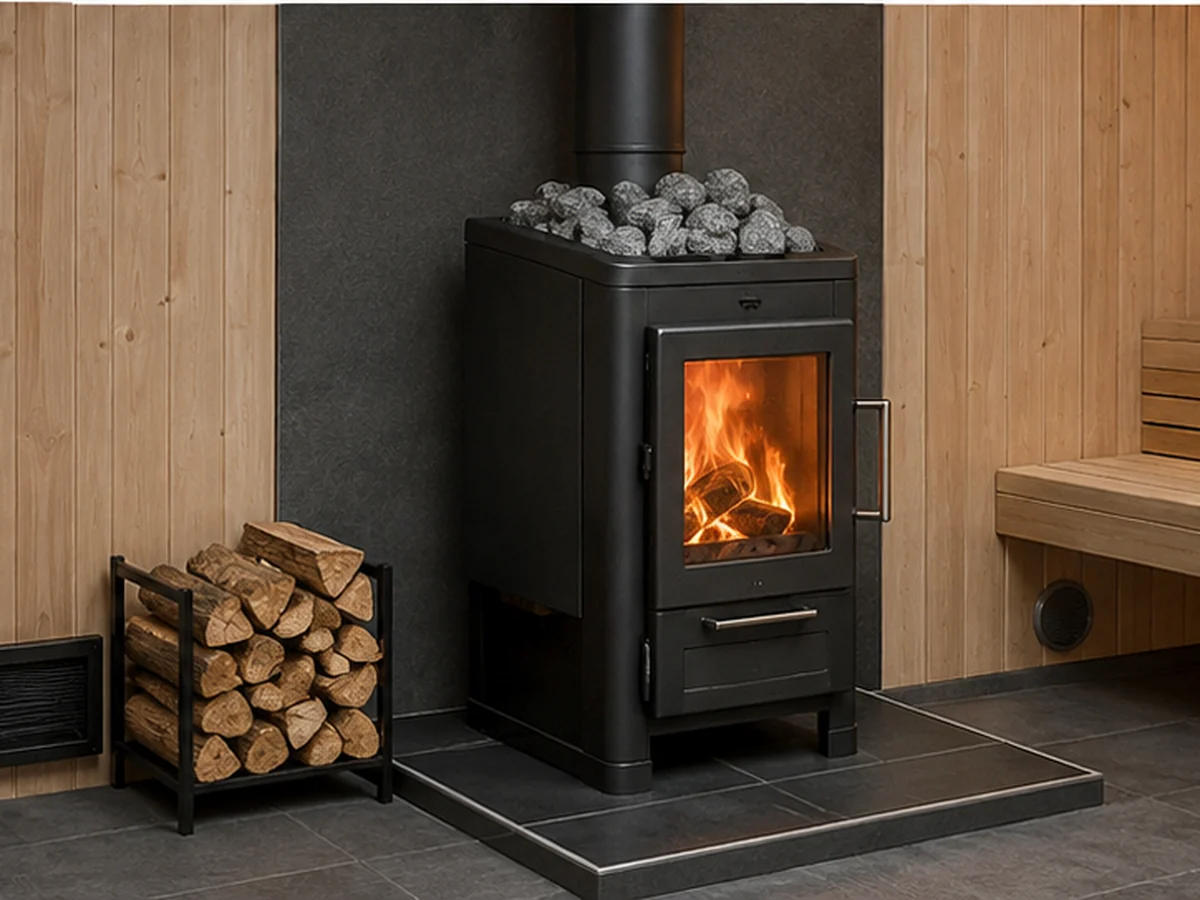
Conceptual installation visualization. Exact clearances and chimney requirements depend on the selected stove, chimney system and local regulations.
Fuel and Operating Routine
- Firewood availability and storage
- Loading access
- Ash handling
- Operator responsibility
- Combustion inspection
- Cleaning access
- Local smoke restrictions
Chimney and Flue Planning
Review the stove and chimney as one system. Confirm the smoke outlet, compatible flue components, building penetration, combustible-material clearances, combustion ventilation, weather exposure and cleaning access before purchase.
How to Size a Sauna Heater Without Oversimplifying
This buying guide helps buyers choose the heater route and prepare the inputs needed for sizing. Detailed effective-volume calculation and final heater-capacity verification belong to the dedicated heater-sizing workflow and the selected manufacturer’s model-specific sizing documentation.
For effective-volume calculations, glazing and uninsulated-surface corrections, load registers and model-range verification, continue with the sauna heater sizing guide.
| Input | Why It Matters | Buyer Should Provide |
|---|---|---|
| Internal dimensions | Establish basic heated volume | Length × width × height |
| Glass area | Can increase effective heating requirement | Door/window/glass-wall dimensions |
| Other uninsulated surfaces | Can change thermal load | Surface type and area |
| Insulation | Changes heat retention | Wall and ceiling construction |
| Indoor / outdoor | Changes environmental exposure | Installation environment |
| Use frequency | Changes operating duty | Residential or commercial pattern |
| Heater route | Changes utilities and installation | Electric / wood-burning |
| Electrical data | Determines electric feasibility | Voltage / phase / available supply |
| Fuel / chimney route | Determines wood-heater feasibility | Fuel and flue planning information |
| Destination market | Changes documentation scope | Country / region |
Why Person Capacity Is Not Heater Capacity
Seating capacity is a usability metric. Heater sizing is a thermal decision. Two “four-person” saunas can have different room volumes, glass areas, ceiling heights, insulation and outdoor exposure.
When a Detailed Heat-Load Review Is Needed
- Large glazed areas
- Substantial uninsulated surfaces
- Unusual ceiling height
- Outdoor or cold-climate exposure
- Uncertain insulation
- Frequent commercial use
- A candidate heater near the edge of its manufacturer-approved room range
Sauna Heater Controls, Sensors and User Interface
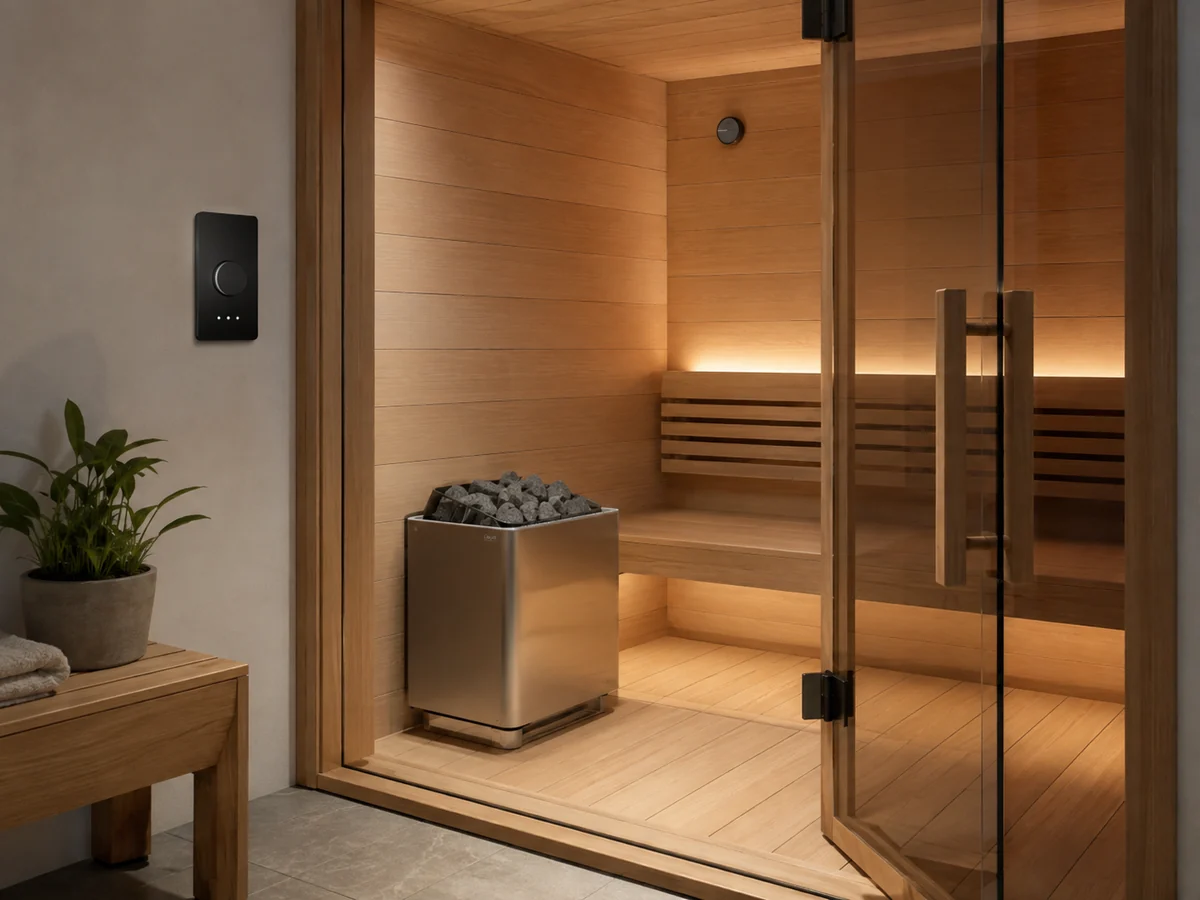
Conceptual configuration only; final controller and sensor placement must follow the exact heater manufacturer’s installation instructions.
Built-In Controls
Built-in controls can simplify selected configurations, but buyers should still verify available functions, sensor arrangement, installation environment and market availability.
External Control Panels
External controls can suit commercial projects where the user interface must be located away from the heater or where staff require controlled access.
Sensor Compatibility and Placement
Sensor position can affect temperature control and safe heater operation. Airflow near the sensor can distort the temperature reading on some systems, so the supply-air arrangement and sensor location should be reviewed together. Final placement must follow the exact heater instructions.
Remote or Smart Control Requires Model-Level Confirmation
Do not assume Wi-Fi, app control, scheduling or remote start. Some control systems include or require door sensors, safety sensors or other interlocks for remote operation; the exact architecture is manufacturer- and model-specific. Treat remote control as a complete safety-and-control system, not as a software-only feature.
Site and Utility Preflight Before Ordering
A heater can fit the room on paper yet remain unsuitable for the actual building. Complete the main site inputs before treating the equipment as purchase-ready.
Room
- Internal dimensions
- Glass and exposed surfaces
- Insulation
- Bench and heater location
- Door arrangement
Utilities
- Electrical supply
- Control route
- Fuel route where applicable
- Ventilation
- Chimney route where applicable
Project Constraints
- Indoor / outdoor environment
- Climate
- Installation access
- Commercial duty
- Local professional review
Installation Requirements to Check Before Buying
This section defines installation interfaces that should be resolved before purchase. For deeper room-envelope, insulation, vapor-control, ventilation and construction coordination, use the sauna construction and installation planning guide.
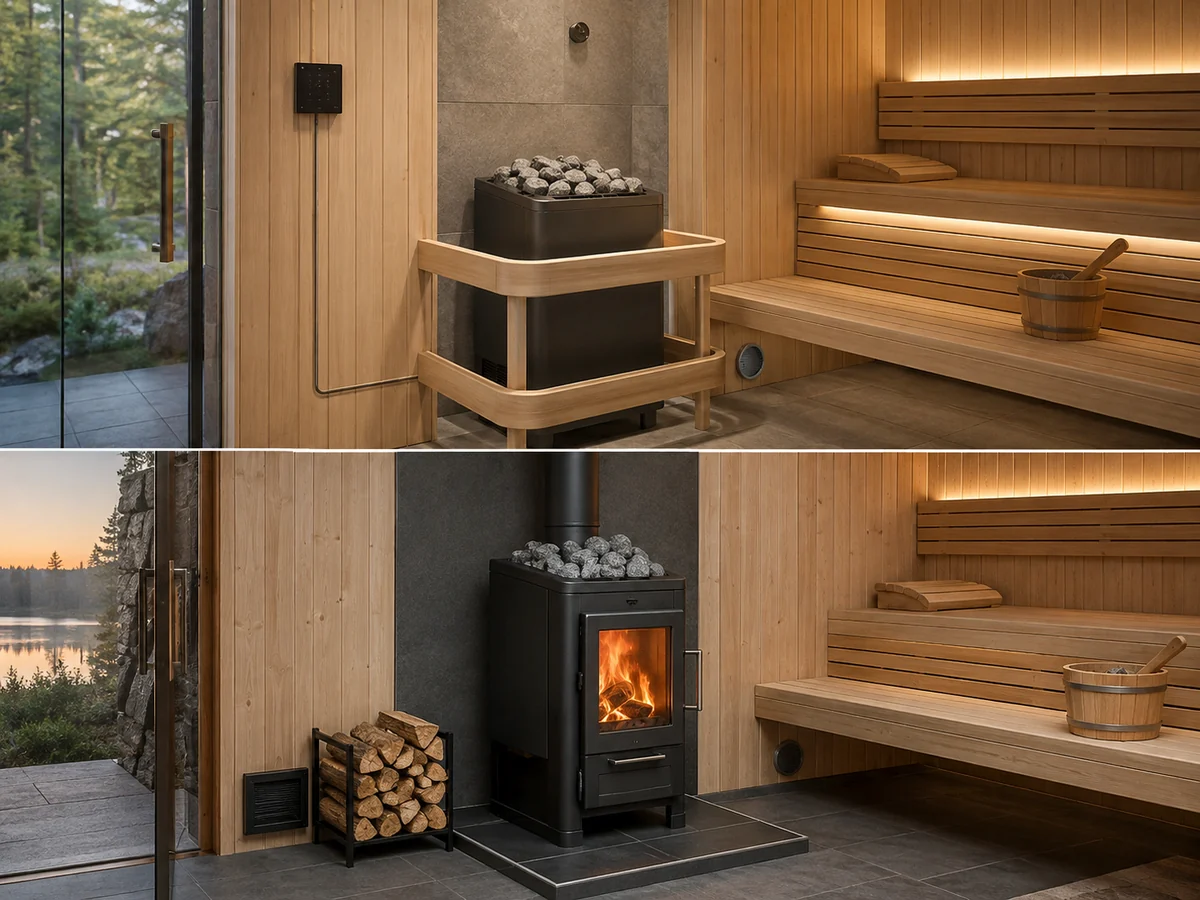
Conceptual planning image only; electrical, combustion and chimney work requires model-specific instructions and qualified local review.
Electric Heater Site Checklist
- Heater position
- Manufacturer-required clearances
- Electrical supply
- Voltage and phase
- Circuit and connection requirements
- Controller location
- Sensor location
- Ventilation
- Service access
- Qualified electrical installer scope
Wood-Burning Heater Site Checklist
- Stove position
- Base/floor suitability
- Combustible clearances
- Chimney/flue route
- Smoke-outlet compatibility
- Combustion air
- Protective surfaces
- Fuel and ash handling
- Local fire/smoke requirements
- Qualified installer responsibility
Ventilation and Layout Must Be Reviewed Together
Heater location, sensor position, air inlet, exhaust route, benches and door arrangement should not be designed independently. The final layout should follow the selected equipment documentation and project-specific ventilation requirements.
Indoor and Outdoor Installations Are Not Interchangeable
Outdoor projects can add weather exposure and exterior electrical or chimney interfaces. Keep room-envelope, foundation and construction requirements with the project installation plan rather than assuming they are determined by the heater alone.
What Can Go Wrong When the Heater Is Selected Too Early?
Illustrative Planning Scenario 1: Electric Heater Chosen Before Power Review
- Problem
- A heater is shortlisted from room size alone.
- Cause
- Electrical infrastructure is reviewed after equipment selection.
- Correction
- Check exact heater electrical data against the actual available supply.
- Prevention
- Include voltage, phase and site electrical information in the RFQ before approval.
Illustrative Planning Scenario 2: Heater Selected by Seating Capacity
- Problem
- A “four-person sauna” label is used as the sizing basis.
- Cause
- Usable seating is confused with thermal load.
- Correction
- Measure the heated room and identify glass, insulation and exposed surfaces.
- Prevention
- Lock room data before the final heater recommendation.
Illustrative Planning Scenario 3: Wood Stove Chosen Before Chimney Review
- Problem
- A preferred stove conflicts with the actual building route.
- Cause
- Chimney and combustible-clearance planning happens too late.
- Correction
- Review stove, flue and building penetration as one installation package.
- Prevention
- Include chimney feasibility in the initial technical brief.
Illustrative Planning Scenario 4: Commercial Duty Defined Too Late
- Problem
- A heater is selected using only room volume and nominal capacity.
- Cause
- Operating frequency, cleaning and service requirements are omitted from the initial brief.
- Correction
- Reassess the exact heater configuration against the intended operating duty.
- Prevention
- State expected operating frequency and commercial use before quotation.
These scenarios are generalized planning examples and are not records of specific HACHILL customers or projects.
Who Is Responsible for What?
Heater projects become risky when supplier, buyer and installer responsibilities are left implicit. Agree the main responsibility boundary before final purchase approval.
| Task | Supplier / Manufacturer | Buyer / Project Team | Installer / Local Professional |
|---|---|---|---|
| Provide exact model documentation | Primary | Review | Review |
| Define room and site conditions | Review inputs | Primary | Support / verify |
| Confirm electrical supply | Provide heater requirements | Provide site information | Primary technical verification |
| Confirm chimney / fire route | Provide stove requirements | Provide project/site information | Primary technical verification |
| Confirm local code / approval | Provide available documentation | Coordinate project requirement | Primary local verification |
| Final installation | Provide instructions | Coordinate access and scope | Primary |
| Operating procedure | Provide equipment instructions | Primary facility responsibility | Support where applicable |
Documentation and Evidence Buyers Should Request Before Final Approval
A product image, heater output number or generic category claim is not enough to release a purchase order. Important claims should be tied to the exact model and configuration.
Technical Data
- Exact heater model identification
- Heater type
- Rated output
- Manufacturer-approved room range
- Dimensions
- Stone requirements where applicable
- Installation environment
- Model-specific safety distances
Electric Heater Evidence
- Installation manual
- Electrical requirements
- Control-unit compatibility
- Sensor requirements
- Remote-control safety/interlock requirements where applicable
- Applicable safety-device requirements
Wood-Burning Heater Evidence
- Stove installation manual
- Smoke-outlet information
- Compatible chimney/flue information
- Clearance requirements
- Base/protection requirements
- Combustion ventilation requirements
- Operating and maintenance instructions
Destination-Market Evidence
| Claim or Decision | Acceptable Evidence Direction | Do Not Use as Proof |
|---|---|---|
| Room suitability | Exact manufacturer’s sizing documentation | Person capacity alone |
| Electrical suitability | Exact heater technical/manual data + site review | kW alone |
| Control compatibility | Exact controller/heater documentation | Another model’s feature list |
| Remote-operation safety | Exact control-system manual and required interlock documentation | A generic “Wi-Fi enabled” claim |
| Chimney suitability | Exact stove/chimney documentation + local review | Generic chimney diagram |
| Certification / market suitability | Exact model-level documentation | Brand-level marketing statement |
Sauna Heater RFQ Checklist
| RFQ Field | Buyer Input |
|---|---|
| Buyer / project type | Distributor, hotel, spa, gym, residential or other |
| Target market | Country / region |
| Sauna type | Indoor / outdoor / traditional |
| Internal dimensions | Length × width × height |
| Expected users | Actual operating requirement |
| Glass / exposed surfaces | Dimensions and material |
| Insulation | Confirmed construction or to be defined |
| Heater preference | Electric / wood-burning / undecided |
| Electrical supply | Voltage / phase / available supply |
| Wood-fuel route | If applicable |
| Control preference | Built-in / external / project-defined |
| Ventilation plan | Known / requires review |
| Chimney route | If wood-burning |
| Usage frequency | Residential / commercial duty |
| Required documents | Destination-market/project requirements |
| Quantity | Required units |
| Branding | OEM / private-label if applicable |
| Delivery destination | Country / project location |
| Installation responsibility | Buyer / contractor / installer / other |
| After-sales expectation | Spare parts, documentation or service requirement |
Final Buying Decision
Release the final heater model only after the room, heater route, utilities, controls, ventilation, clearances, operating duty, documentation and responsible parties have been confirmed.
- Define the sauna room and installation environment.
- Define expected users and operating frequency.
- Choose electric or wood-burning as the preliminary route.
- Confirm electrical or fuel/chimney feasibility.
- Verify controls, sensors and any required safety interlocks.
- Review ventilation, service access and clearances.
- Check the exact manufacturer’s sizing and installation documents.
- Confirm local professional and destination-market requirements.
- Confirm commercial maintenance and spare-parts expectations where applicable.
Official Reference Scope
Final heater sizing, electrical requirements, controls, sensor locations, safety clearances and chimney requirements must come from the exact selected equipment documentation. Values or features from one manufacturer or model must not automatically be applied to another.
Evidence boundary: the HUUM and Harvia references below illustrate manufacturer-specific sizing, control, sensor and chimney requirements. They do not establish HACHILL model specifications, certification scope or destination-market approval. These official pages were rechecked in September 2026; buyers and installers should still use the current manual for the exact selected model at the time of approval and installation.
- HUUM heater sizing guidance: official sizing calculator
- HUUM electric heater documentation: CORE product page and user-manual resources
- HUUM wood-burning stove documentation: HIVE Wood product page and user-manual resources
- HUUM control-system documentation: UKU control-system product page and manual resources
- Harvia sensor guidance: official temperature-sensor guidance
- Harvia chimney guidance: official chimney guidance
Frequently Asked Questions
Is an electric or wood-burning sauna heater better?
Neither is universally better. The correct choice depends on the sauna room, available utilities, desired operating routine and installation requirements.
How do I know what size sauna heater I need?
Start with actual internal room volume, then consider glazing, exposed surfaces, insulation and construction. Use the exact manufacturer’s current sizing method.
Can I size a sauna heater by the number of people?
No. Seating capacity is a usability metric; heater sizing depends on the thermal characteristics of the room.
Do electric sauna heaters need professional installation?
Electrical requirements depend on the exact heater and local rules. Fixed electrical work should be completed or reviewed by appropriately qualified local professionals.
Does a wood-burning sauna heater need a chimney?
Yes. A safe combustion-exhaust route is required. The exact chimney or flue arrangement depends on the stove, building and applicable local requirements.
Are sauna heater controls included with the heater?
It depends on the model. Confirm the exact heater, controller, sensor and safety-device configuration before purchase.
What should a commercial buyer confirm beyond heater size?
Confirm operating frequency, control access, cleaning, service access, utilities, ventilation, installation responsibility, documentation and spare-parts expectations.
Prepare Your Sauna Heater Project Brief
A useful quotation begins with the project conditions that actually change heater selection.
- Internal sauna dimensions
- Glazing and insulation condition
- Indoor / outdoor environment
- Expected users and operating frequency
- Electric or wood-burning preference
- Voltage and phase if electric
- Fuel and chimney route if wood-burning
- Control requirements
- Destination market
- Quantity
- Installation responsibility
- Required documents
- After-sales or spare-parts expectations
If the heater route is still undecided, begin with the room, available utilities and installation conditions rather than selecting heater output first.
Request a B2B Quote