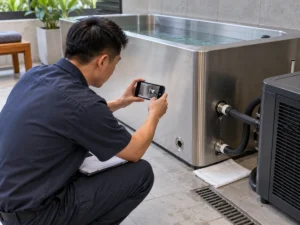
Quick answer: Cold plunge cost depends first on what the quoted price actually includes. As of September 28, 2026, current U.S.-facing manufacturer examples include a $150 tub-only product, standalone chillers around $3,490–$3,999.99, selected chiller-equipped residential packages starting around $3,590, and five-figure commercial or project equipment. These are dated examples for budgeting—not a universal market minimum, maximum or average.
Equipment: tub, chiller and supplied water-system components.
Installed project: delivery, access, utilities, drainage, site work and commissioning.
Ownership: electricity, water, consumables, maintenance, spare parts and, for commercial facilities, downtime.
For a straightforward home setup, the online equipment price may account for most of the initial buying decision. For a gym, hotel, spa or recovery facility, that same number can be only one line in a larger project budget.
How Much Does a Cold Plunge Cost in 2026?
The quickest useful answer is to start with the equipment class, because a tub, standalone chiller, integrated home plunge and commercial system are different purchases.
| Equipment class | Representative current examples | What the price means |
|---|---|---|
| TUB ONLY | Plunge Pop-Up $150; Ice Barrel 300 $1,149.99; Ice Barrel 500 $1,749.99 | Vessel only; active cooling may be separate. |
| CHILLER ONLY | Plunge Pro Chiller $3,490 current; Ice Barrel Chiller $3,999.99 | Cooling component, not a complete plunge project. |
| HOME SYSTEM | Plunge Pop-Up with chiller $3,590 current; Sun Home Vertical $3,799 sale; Ice Barrel bundles $5,149.98–$5,749.98; The Plunge $6,790 current; Plunge All-In $7,990 current | Tub plus substantially more of the cooling/water-system scope. |
| PREMIUM RESIDENTIAL | Selected Renu examples $7,200–$14,099 | Higher-priced residential systems; equipment scope differs by model. |
| COMMERCIAL / ARCHITECTURAL | Plunge commercial equipment from $12,990 / $15,990; BlueCube project-configured Modular / Limitless equipment from $29,000 | Equipment price only—not a complete commercial project budget. |
Several of these pages show promotions, comparable-value references or “from” pricing, which is why price date and price status belong next to the number. A temporary sale tells you what that configuration is being offered for on the check date; it does not prove that the price is the long-term market norm.
The table should not be read as “cold plunges cost $150–$29,000.” That would compare fundamentally different scopes and turn selected products into an invented market boundary.
Ask first: Is this price for the tub, the chiller, a complete residential system or commercial equipment?
Tub-only prices can make the category look cheaper than the complete setup
Plunge’s $150 Pop-Up is explicitly sold as tub only and does not include a chiller or filtration system. In another current product family, an Ice Barrel vessel costs less than the standalone chiller used with it. That is why a price table needs scope labels.
Classify each price before comparing it:
If you are deciding between a manually iced immersion route and purpose-built active cooling, keep that comparison with HACHILL’s Cold Plunge vs Ice Bath guide. If your budget has already moved from category research to product selection, review the current HACHILL Cold Plunge range.


Why Cold Plunge Prices Vary: Tub, Chiller, Water System and Thermal Duty
Two cold plunges can look similar while solving very different engineering requirements.
Price can change with vessel construction and insulation, refrigeration equipment, circulation and filtration, treatment components, controls, supplied connections and accessories, service architecture, and the thermal duty the system must satisfy.
The tub is only one part of the system
A vessel influences fabrication, transport, insulation, maintenance and future repair, but the tub price alone does not define the complete cold-plunge system.
One buyer may deliberately choose a lower-cost vessel and select cooling equipment separately. Another may pay more for an integrated package that moves more of the system responsibility into one purchase. Neither route is automatically better. What matters is knowing who is supplying and owning each part of the system.
A chiller can materially change the equipment budget
Current retail pricing makes this visible: in some product families, the cooling equipment costs more than the tub itself. That makes “Is the chiller included?” one of the first questions to ask about any cold-plunge price.
But chiller selection cannot be reduced to horsepower or price alone. A meaningful duty depends on operating water volume, starting and target water conditions, required pull-down time, recovery requirement, ambient conditions, insulation and cover, pipe heat gain, circulation and user load.
A system intended to cool slowly overnight is not pricing the same task as a commercial system expected to recover repeatedly during operating hours. If the question becomes which chiller can actually meet the defined thermal and hydraulic requirement, use HACHILL’s Cold Plunge Tub and Chiller Matching Guide.
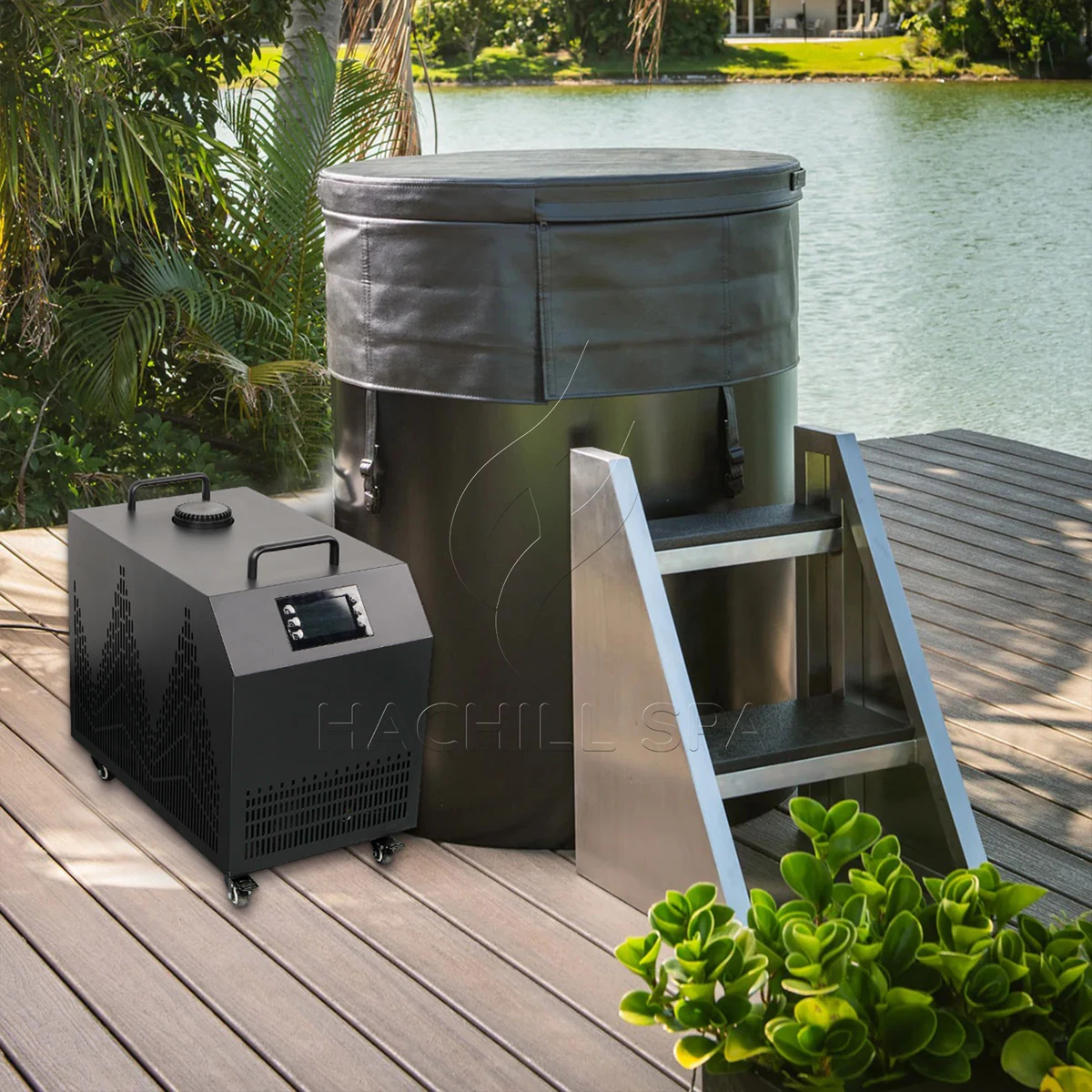
Water-system scope can also move the price
Depending on the configuration, a supplied system may include some combination of circulation pump, filtration, treatment equipment, valves and fittings, hoses or hard-pipe interfaces, controls and sensors, cover, steps, and initial filters or spare parts.
An integrated appearance does not prove that every component required for the final installation is included.
| System line | Verify before comparing price | Common omission risk |
|---|---|---|
| Vessel | Material, dimensions, access and finish | Cover, steps or drain not included |
| Thermal equipment | Declared duty and rating conditions | Horsepower treated as cooling capacity |
| Hydraulics | Flow, head, pipe and valves | Pump and pipe scope do not match |
| Water treatment | Use frequency, component scope and operating plan | Filtration presented as the complete treatment plan |
| Controls / electrical | Controls, sensors, alarms and destination electrical requirements | Local electrical protection assigned after ordering |
| Accessories / spares | Cover, steps, tools and initial spare parts | Required items priced after the main order |
The better pricing question: Which additional requirement, component or responsibility is this price solving?
Price alone should never be used as proof of better cooling performance, lower energy use, better sanitation, longer service life, easier maintenance or commercial suitability. Those conclusions require model-specific evidence.
From Online Price to Installed Budget
Once the equipment has to be delivered, placed, connected and commissioned, the online product price is no longer the complete budget.
Project boundary: Equipment price → landed cost → site work → installed-and-commissioned budget.
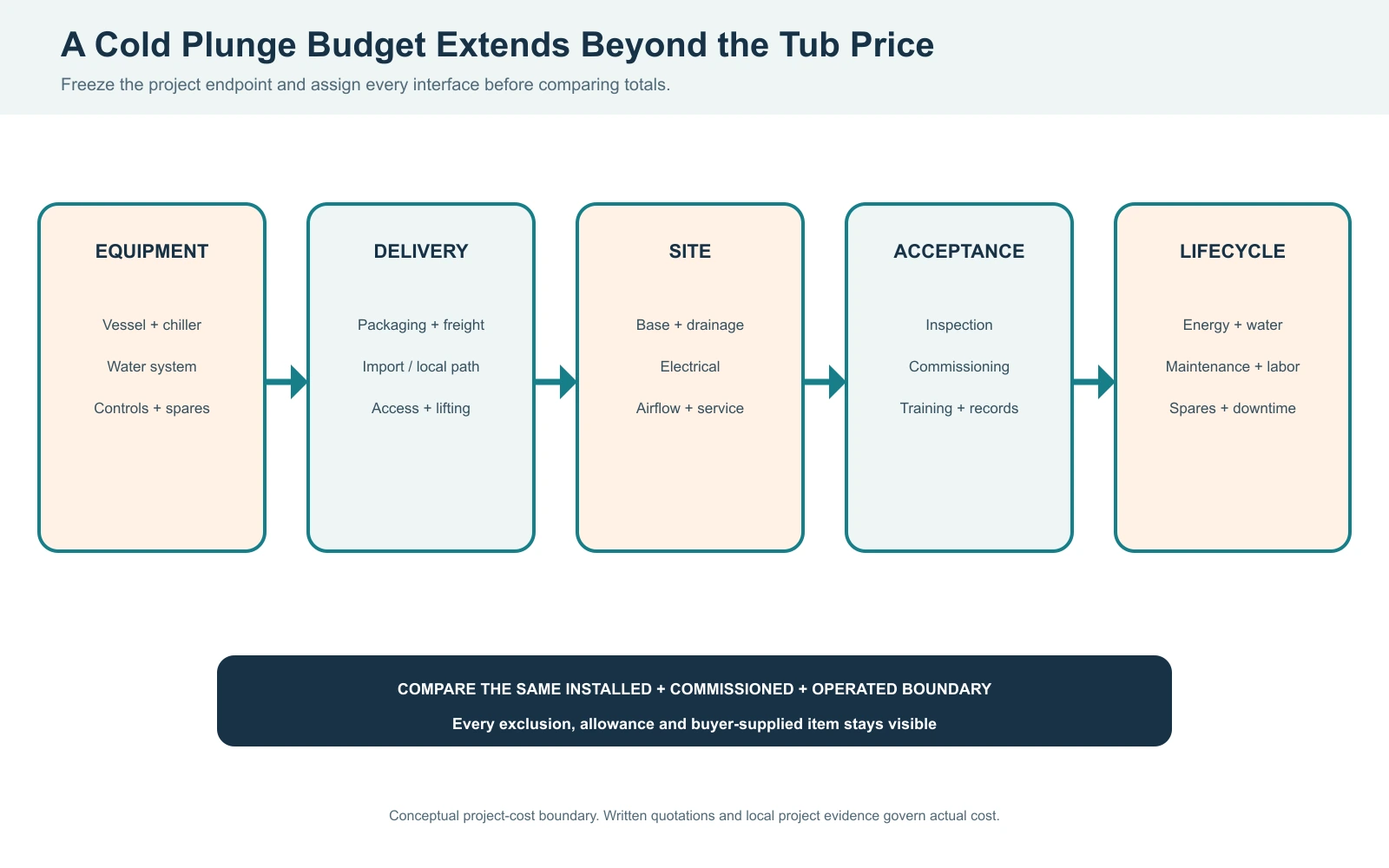
First define where the quotation ends
Two quotations can end at different points: factory, port, curbside, delivered building, delivered room, connected, commissioned, or tested and handed over.
A lower equipment price delivered to the curb is not directly comparable with a higher scope that includes additional logistics or commissioning. Freeze the same commercial endpoint before comparing totals.
Site conditions that can change the installed cost
| Interface | Verify before ordering | Why it can change cost |
|---|---|---|
| Access / lifting | Packed dimensions, route, stairs, turning space and lifting need | Special handling or revised access plan |
| Base / floor | Filled operating load and level condition | Support or structural work |
| Drainage / water | Drain, refill, overflow and cleaning route | Plumbing/site work |
| Electrical | Voltage, frequency, phase, circuit and applicable protection | Local electrical scope |
| Ventilation / heat rejection | Chiller intake/discharge and required clearance | Layout or ventilation work |
| Service access | Filter, panel and component-removal routes | Future maintenance feasibility |
| Commissioning | Test scope, instruments and responsibility | Attendance, correction or retest |
Maintain a landed-cost register
| Cost line | Basis | Evidence | Typical variation trigger |
|---|---|---|---|
| Equipment | Frozen configuration and quantity | Itemized quotation | Approved specification change |
| Freight / packaging | Route, dimensions, weight and delivery term | Current logistics quotation | Route or quantity changes |
| Import / local charges | Destination and applicable classification | Buyer / broker evidence | Rule or rate changes |
| Site / local trades | Issued design and site survey | Contractor scope | Unknown site condition |
| Commissioning | Agreed test method and attendance | Commissioning plan | Retest or revised scope |
| Contingency | Named unresolved risk | Risk register | Risk becomes defined work |
Currency, taxes, quotation validity and exclusions should remain visible. Do not reuse freight, import or labor assumptions from another destination as if they belong to the current project.
Keep authority boundaries clear
For U.S. work, NFPA 70 / the National Electrical Code is an important electrical framework. The 2026 NEC is the current edition, but the enforceable requirement for a project still depends on local adoption, the authority having jurisdiction, the selected equipment and its installation instructions.
For projects outside the United States, do not import U.S. electrical assumptions into the budget. Confirm destination requirements, equipment ratings, installer responsibilities and any refrigeration or water-system interfaces that can create local trade scope.
Budget rule: Do not price local compliance, electrical work or refrigeration interfaces from a generic blog assumption.
What Does a Cold Plunge Cost to Run?
There is no reliable universal answer such as “a cold plunge costs $30 a month.” Running cost depends on the exact system, ambient conditions, insulation, operating schedule, water management, maintenance plan and local utility prices.
Electricity: use power and actual run time
A complete system may contain multiple loads, including refrigeration compressor, condenser fan, circulation pump, treatment equipment, controls and heating where fitted.
System powered on ≠ compressor running continuously.
HACHILL’s Cold Plunge Chiller Duty Cycle and Energy Use guide owns the detailed runtime question. For costing, use actual component run time or measured whole-system energy instead of treating a nameplate maximum multiplied by 24 hours as typical consumption.
Electricity price must also be localized. The U.S. EIA Electric Power Monthly publishes state-level average electricity prices by customer sector; an individual project’s actual tariff should still come from the relevant utility or contract.
Electricity is only one lifecycle input
| Cost input | Main driver |
|---|---|
| Water / wastewater | Drain, refill and cleaning plan |
| Filters / treatment consumables | Exact system and use schedule |
| Cleaning labor | Facility procedure and user load |
| Planned maintenance | Equipment requirements |
| Spare parts | Failure criticality and replacement route |
| Service labor / travel | Location and support model |
| Commercial downtime | Real unavailable time and operational consequence |
Do not invent a universal annual maintenance percentage, product life or payback period.
Replace early assumptions with measured data
During budgeting, some figures will be assumptions. Keep them labeled. Once the system is operating, record energy, water replacement, filters and consumables, service work and downtime, then apply current utility and labor costs.
This turns an initial forecast into an evidence-based lifecycle record instead of retroactively pretending the original assumptions were guaranteed.
How to Compare Cold Plunge Quotes on the Same Scope
The cheapest visible quotation is not necessarily the lowest project cost. Before ranking proposals, normalize them against one common requirement.
Use statuses such as included, excluded, allowance, buyer supplied and not stated. Resolve every material “not stated” line before making the final price comparison.
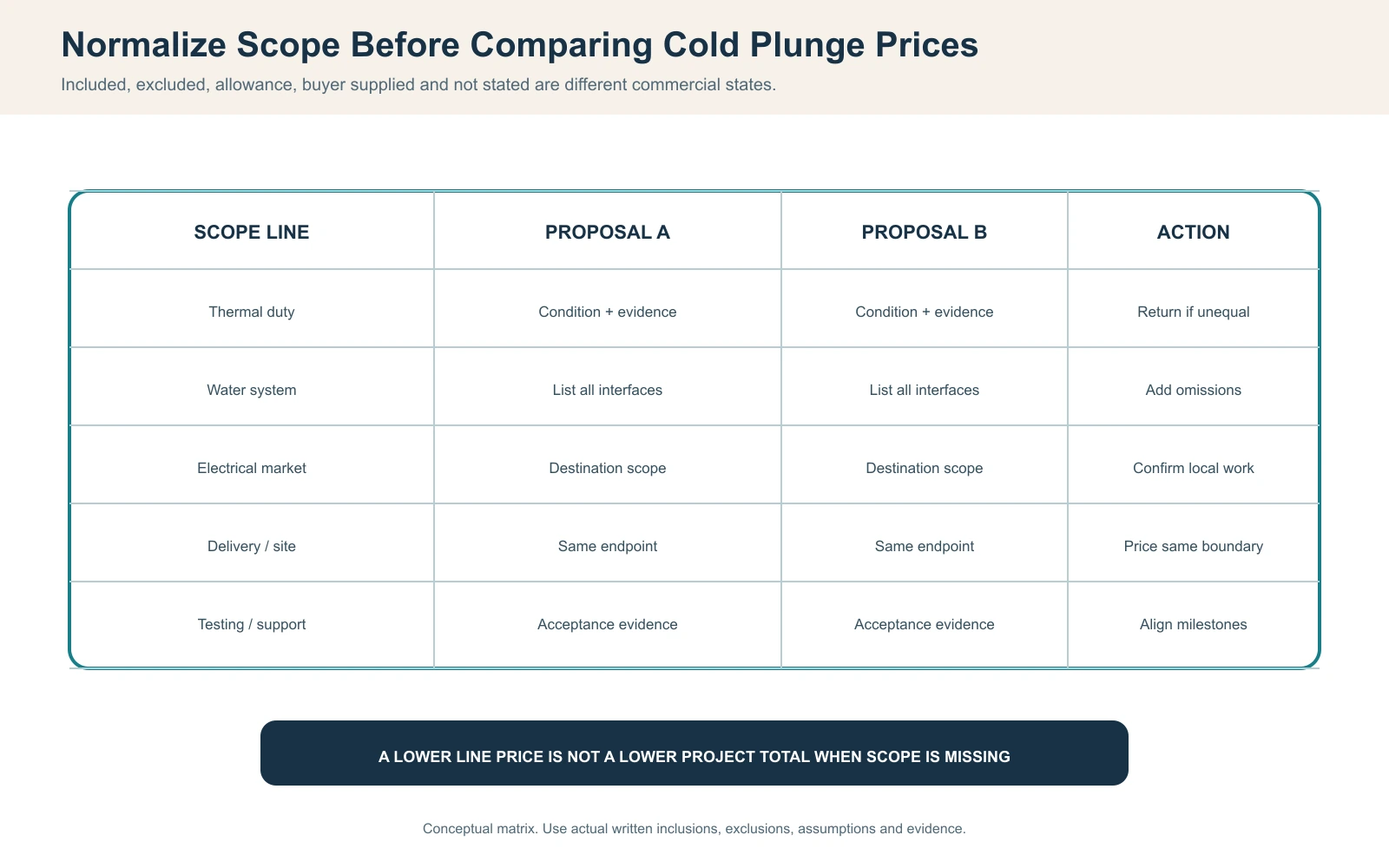
Normalize the proposal
| Comparison line | What every proposal should state |
|---|---|
| Thermal duty | Water volume, operating conditions and required performance |
| Water system | Pump, filtration, treatment and connections |
| Electrical market | Voltage, frequency and equipment requirements |
| Accessories / spares | Cover, steps, tools and initial spares |
| Delivery endpoint | Factory, port, curbside, room or installed |
| Testing / commissioning | Factory test, site test, documents and attendance |
| Support / warranty | Exact offered boundary and exclusions |
| Lifecycle support | Spare identification and service path |
Compare this: Which quote has the lowest total for the same delivered and accepted scope?
Grade the evidence as well as the number
| Grade | Evidence | Decision use |
|---|---|---|
| A | Contract / approved specification / applicable requirement | Final obligations |
| B | Exact model data and relevant test evidence | Technical comparison under stated conditions |
| C | Issued drawings, quotation and project logistics/site evidence | Project costing |
| D | Receiving, commissioning, energy and maintenance records | Installed acceptance and lifecycle update |
| E | Public online price, image or unsupported marketing statement | Early market orientation only |
Make responsibility visible
| Decision area | Supplier | Buyer / site | Other role where applicable |
|---|---|---|---|
| Product configuration | State offered scope | Approve intended use | Designer verifies interfaces |
| Logistics | Supply agreed packaging/delivery data | Supply access/import inputs | Broker / lifting role |
| Site utilities | State equipment requirements | Provide compliant site | Qualified local trades |
| Commissioning | Provide agreed evidence/support | Provide site conditions | Named commissioning lead |
| Variation | Preserve supplier records | Preserve site records | Independent role if agreed |
A supplier cannot price a lifting requirement that was never disclosed. A buyer should not classify an explicitly excluded local trade as a supplier defect. And the logistics provider does not own refrigeration performance.
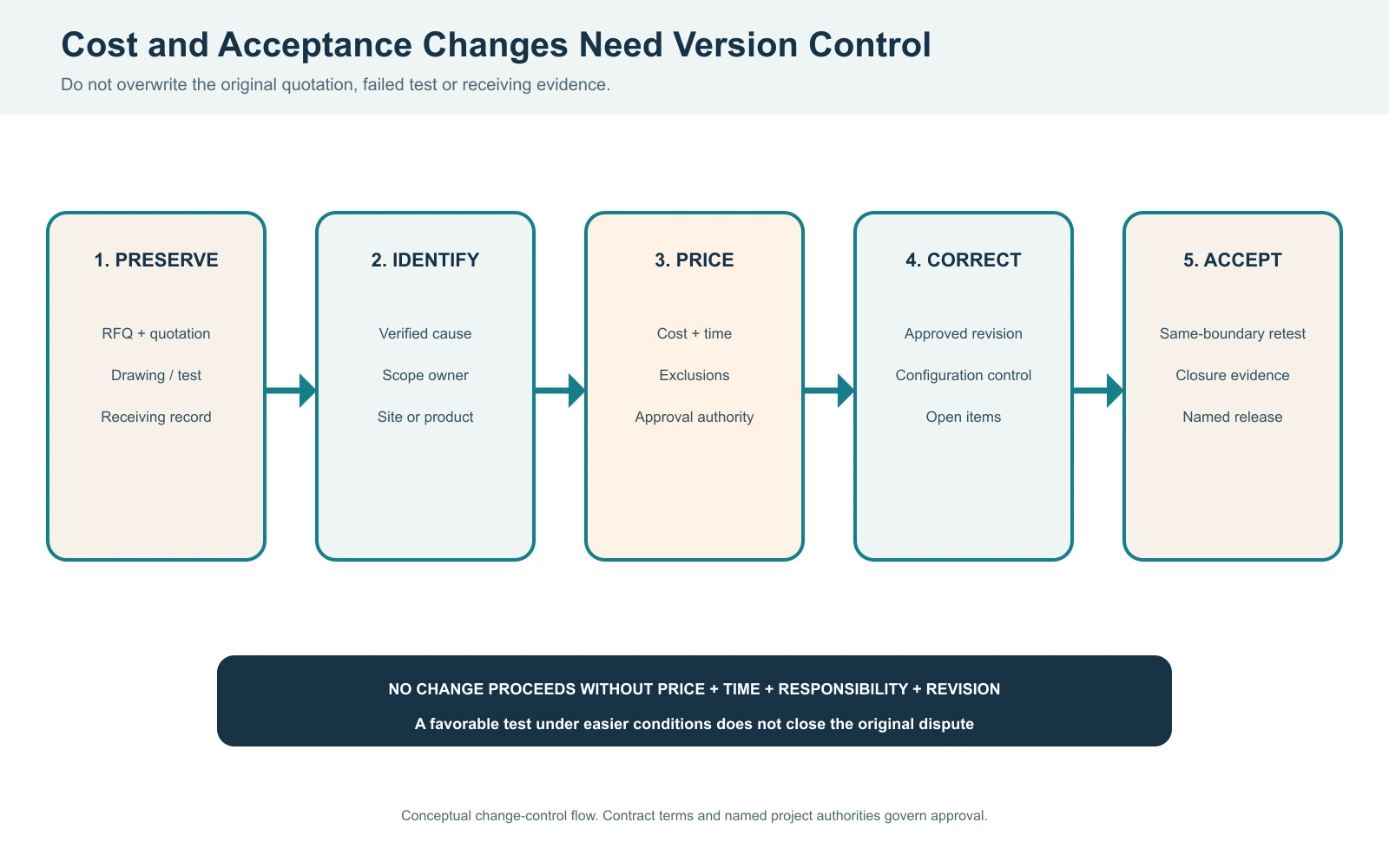
Preserve the original scope when the project changes
For each variation, record the original requirement, discovered condition or requested change, price effect, schedule effect, approving party, revised drawing or configuration, and closure evidence.
| Issue | Preserve | Immediate action | Closure evidence |
|---|---|---|---|
| Missing inclusion | RFQ, quotation, bill of materials and clarification | Hold the disputed assumption | Signed scope decision |
| Site change | Survey, drawing and discovered condition | Record price and schedule effect | Approved variation |
| Damage / shortage | Packaging, receiving photos and quantity record | Quarantine or claim as applicable | Repair / replacement acceptance |
| Performance issue | Agreed protocol, raw test data and configuration | Keep the approved acceptance boundary | Same-boundary retest or approved change |
| Operating-cost dispute | Meter data, schedule, ambient conditions and tariff | Reconcile the original assumptions | Representative operating record |
Residential vs Commercial Cold Plunge Cost
A commercial cold plunge is not simply a residential plunge with a larger price tag.
Current public pricing shows substantial overlap between premium residential and commercial-designated equipment. The cost model changes because the application and operating responsibility change.
Residential budgets are often equipment-centered
A home buyer may mainly need to resolve equipment price, delivery, available space, electrical compatibility, drainage, basic installation, energy and maintenance. When those interfaces are straightforward, the project may stay relatively close to the online buying decision.
Commercial budgets are often system-and-operation-centered
Commercial planning can add requirements around repeated or shared use, water-management architecture, cooling and recovery duty, site interfaces, documentation, service access, spare parts, commissioning, operating responsibility and downtime.
HACHILL’s Commercial Cold Plunge route owns the wider facility and project-planning task.
A commercial buyer chooses the lowest equipment quotation. Later, the team discovers that a required water-system interface was never included. The original RFQ may never have defined the operating or treatment boundary.
Decision: normalize water-system scope before comparing totals.
The finished tub fits the room, but the packaged unit does not fit the planned route into the room. A different lifting or access plan becomes necessary.
Decision: confirm packed dimensions, weight, route and lifting method before shipment.
A relatively small component fails. The facility cannot quickly identify the replacement or service procedure, so the plunge remains unavailable.
Decision: review spare identification, service access, documentation and escalation before commercial acceptance.
These are illustrative engineering scenarios, not HACHILL customer cases.
When Online Prices Stop Being Useful
Online price research is useful while you are deciding the equipment class, tub-only versus active cooling, residential versus commercial route, and the general budget level.
It becomes less useful once cost depends on a specific destination, duty, site or responsibility boundary. That is when the buyer should stop collecting more price screenshots and issue one consistent RFQ.
Build an RFQ-ready budget
Application
Thermal and system requirement
Site
Commercial / logistics
Acceptance
Receiving and commissioning protect the cost boundary
| Gate | Evidence | Decision | Cost / payment implication |
|---|---|---|---|
| Before shipment | Approved configuration, drawings and agreed tests | Release / hold | Supports the agreed shipment or payment milestone |
| Receiving | Packaging, damage, quantity and labels | Accept / quarantine / claim | Preserves evidence for shortage or damage claims |
| Installation | Base, utilities, flow, airflow and access | Ready / punch list | Assign corrective work or an approved variation before commissioning |
| Commissioning | Leak, temperature, recovery and agreed controls | Pass / correct / retest | Correction or retest precedes acceptance when the agreed criteria are not met |
| Handover | Manuals, training, spares and open items | Accept / retain | Close outstanding deliverables and any contractually applicable retention |
Factory testing proves only the agreed factory boundary. It does not prove final building electrical conditions, final drainage, installed condenser airflow, final field pipework or real venue recovery under peak use. Those conditions belong to site commissioning.
When to request a project quotation
Move beyond public price research when exact thermal duty, destination, non-standard electrical conditions, restricted site access, shared/commercial operation, water-system responsibility, custom finish or branding, installation coordination, documentation, commissioning, spare-parts requirements or acceptance criteria materially affect the decision.
At that point, another competitor price does not make the budget more accurate. Issue the same RFQ inputs to every bidder and compare the resulting offers on the same technical, delivery and acceptance boundary.
For a defined HACHILL project: once the product family, application, quantity, destination and relevant site requirements are sufficiently defined, move from market-price research to a project-specific scope review.
Request a Project QuoteFrequently Asked Questions
How much does a cold plunge cost?
Current manufacturer examples checked September 28, 2026 range from low-cost tub-only products to several-thousand-dollar chiller-equipped residential systems and five-figure premium or commercial equipment. The useful price depends first on whether the number represents a tub, standalone chiller, complete home system or commercial equipment. Online equipment price may also exclude delivery, site work, utilities and commissioning.
How much does a cold plunge with a chiller cost?
In the selected manufacturer examples researched for this guide, chiller-equipped home systems appear from roughly the mid-$3,000s through the upper-$7,000s, with premium integrated systems above that. These are dated examples, not a universal market band. Package inclusions should be checked before comparing prices.
How much does it cost to install a cold plunge?
There is no universal installation price. Installation cost can depend on delivery access, lifting, floor or base conditions, drainage, electrical work, refrigeration airflow, plumbing interfaces, service access, local trades and commissioning.
How much does a cold plunge cost to run each month?
There is no reliable universal monthly amount. Calculate electricity from actual system power and run time using the applicable local tariff, then add water, consumables, cleaning, planned maintenance, spare parts and any relevant commercial downtime.
Why can commercial cold plunge projects cost more?
Commercial project budgets can expand because the application may require different cooling duty, water-management scope, service access, documentation, commissioning, site coordination, spare-parts planning and operating responsibility. Premium residential and commercial equipment prices can overlap, so compare the required scope rather than the label alone.