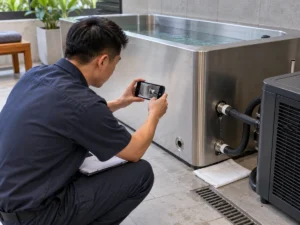
A sauna heater’s rated power and the electricity a sauna actually consumes are not the same quantity. Kilowatts (kW) describe power; kilowatt-hours (kWh) describe energy accumulated over time. A heater’s rated kW therefore does not, by itself, tell you how many kWh a sauna will use during one session, one operating day, or one month.
Actual consumption depends on the heater’s real operating profile, how long it is energized, the thermal demand of the room, the way the sauna is used, and what equipment is included in the measurement. A useful energy figure must also say whether it is calculated or measured.
For project buyers, operators, and technical teams, this distinction matters because two saunas with the same heater rating can record different energy use without either rating being wrong.
What Rated Heater Power Tells You—and What It Does Not
A heater rating expressed in kilowatts is a power value. It identifies how quickly electrical energy can be used at a particular operating condition; it is not automatically a statement of energy consumed during an entire sauna session.
The basic distinction is:
- kW = power
- kWh = energy accumulated over time
If a load actually draws 9 kW continuously for one full hour, the accumulated energy over that hour is 9 kWh. But that mathematical example does not mean every 9 kW sauna heater consumes 9 kWh during every elapsed hour of sauna operation.
Once temperature control begins regulating the heater, the elements may not remain continuously energized for the entire clock time. The exact behavior depends on the heater and controller configuration. Some systems may switch heating elements on and off; other configurations may use different control strategies. That is why elapsed session time cannot automatically be treated as full-power operating time.
The rated power also should not be confused with heater sizing. A sauna may require a particular heater rating because of its effective sizing volume, glazing, insulation, ventilation, construction, and other project conditions. Those factors help determine an appropriate sauna heater selection, but the rating alone still does not state the actual energy that will be consumed after installation.
For an exact product claim, the current heater model, electrical version, controller, and manufacturer documentation must govern the interpretation of the published rating.
Define What You Are Measuring Before You Compare kWh
A kWh number is only useful when the measurement boundary is clear.
For example, a heater-only energy reading answers a different question from a whole-sauna energy reading. A whole-sauna measurement may include other electrical loads such as controls, lighting, ventilation equipment, infrared emitters in a hybrid configuration, or other auxiliaries depending on the installation.
If one project reports heater-only consumption and another reports everything downstream of a broader electrical meter, the two numbers should not be compared as though they represent the same system.
A useful energy record should therefore identify at least these boundaries:
| Item | What should be declared |
|---|---|
| Equipment | Heater and control configuration being evaluated |
| Rated power | Published rating and the document or nameplate it came from |
| Measurement boundary | Heater only, or a defined whole-sauna/system boundary |
| Observation period | Warm-up only, one full session, operating day, or another stated interval |
| Operating condition | Starting condition, target condition, and relevant room/use state |
| Result type | Calculated estimate or measured kWh |
| Auxiliary loads | What is included and excluded |
This prevents false precision. A value such as “6.8 kWh per session” may look exact, but without a defined session, equipment boundary, room condition, and measurement method, another buyer cannot know whether it is comparable to their own project.
Warm-Up, Holding and Recovery Do Not Represent the Same Operating State
A sauna does not necessarily have one uniform electrical demand from switch-on to shutdown.
During warm-up, the heater is bringing the room and its interior surfaces from the starting condition toward the control target. During temperature holding, the control system responds to ongoing heat loss and use conditions. If the door is opened repeatedly or the room experiences other additional heat loss, the heater may need to supply more heat again during a recovery period.
These operating states matter because the heater’s cumulative energized time can change between them.
Manufacturer guidance for thermostat-controlled electric sauna heaters confirms that heating elements may be switched on and off after the sauna reaches the target condition. This means the simple calculation:
can overstate actual heater energy when it assumes full rated power for periods in which the heating elements are not continuously energized.
The reverse problem is also possible in a poorly defined comparison: measuring only a short holding period after the sauna is already hot can underrepresent the energy required for a complete operating cycle that also includes warm-up.
A more useful operating record therefore separates the phases when the objective is to understand why energy use changed:
- starting condition;
- warm-up interval;
- temperature-holding interval;
- recovery events where relevant;
- shutdown or end of the observation period.
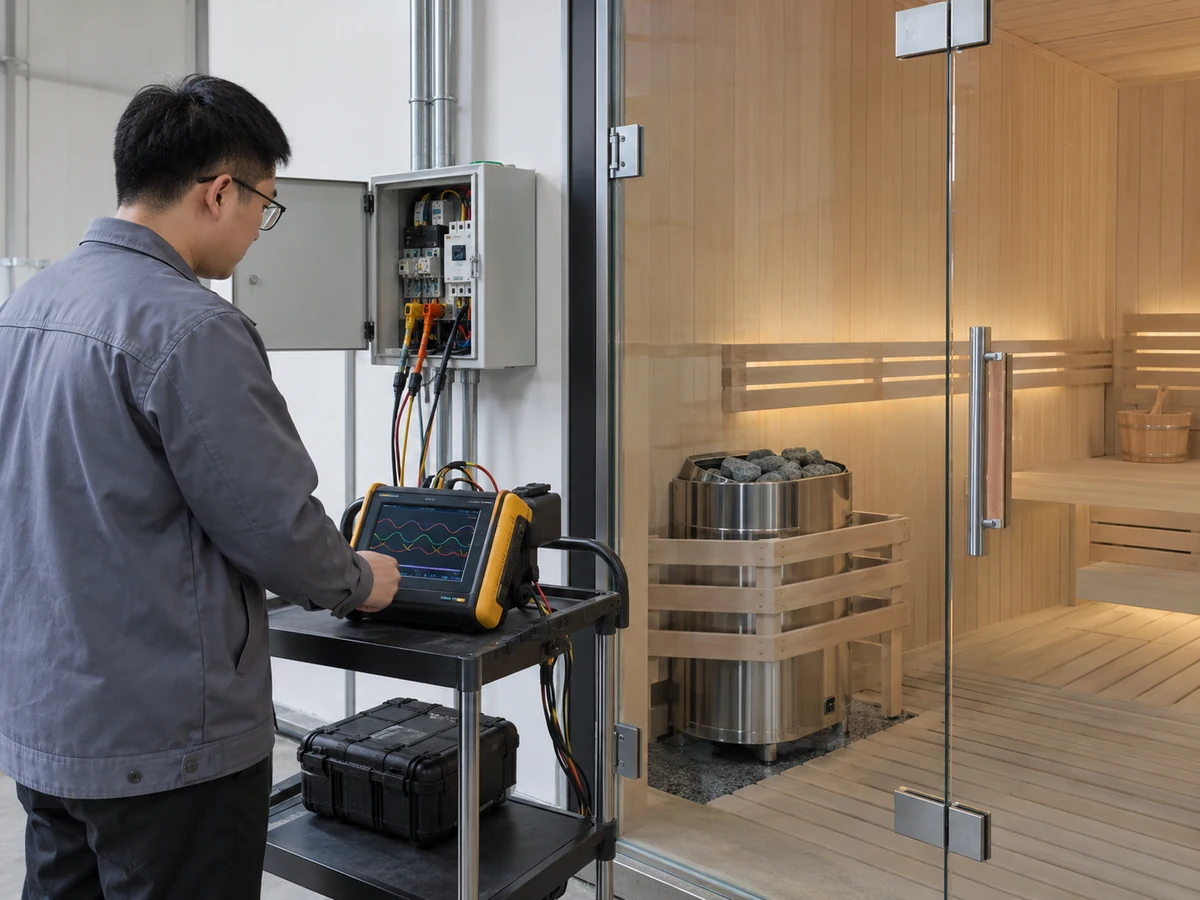
There is no universal percentage that can be assigned to each phase. Heater design, controller logic, room conditions, temperature target, and use pattern can all change the result.
For the separate question of elapsed sauna warm-up time, the applicable starting conditions, room construction, heater configuration, measurement point, and test basis should be reviewed independently rather than inferred from a consumption figure.
Why the Same Rated Heater Can Produce Different Recorded Energy Use
The rated kW can remain unchanged while the thermal demand on the heater changes.
Consider two rooms using heaters with the same published power rating. If one room loses heat faster because of differences in glazing, insulation, construction, ventilation, or door use, the control system may need to energize the heater for a different cumulative amount of time. The resulting kWh can therefore differ even though the nameplate power is the same.
Several variables can matter.
Starting and target conditions. A colder starting condition or a different operating target changes the thermal task performed during warm-up.
Room construction. Glazing and other uninsulated or heat-storing surfaces affect heater selection and thermal behavior. They should not be reduced to a universal kWh correction factor unless the applicable calculation basis supports one.
Insulation and heat loss. A room that retains heat differently can require a different heating profile to maintain the same control target.
Ventilation. Ventilation is necessary for the sauna system, but airflow also forms part of the room’s thermal balance. The correct arrangement should follow the applicable sauna and heater documentation rather than being adjusted simply to reduce energy use.
Door opening and actual use. Opening the door releases heated air and changes the room condition. In commercial or repeated-use operation, recovery demand can therefore differ from a lightly used private session.
These relationships explain why a consumption comparison needs more context than heater kW alone. Readers who need the full room-load and sizing method should review sauna heater sizing and thermal design separately from this energy-use measurement question.
They do not prove that a larger heater always uses more total energy, that a smaller heater always saves energy, or that one heater size is inherently more efficient. Those conclusions require a matched heater-selection basis and comparable operating evidence.
Estimated Consumption and Measured Consumption Are Different Evidence
Energy use can be estimated or measured, but the two results should be labeled differently.
For a constant load, the familiar relationship is:
For a load whose power changes over time, the more complete concept is:
For a simple on/off heater, an estimate may use the heater’s power while energized multiplied by cumulative energized time. But substituting the published rated power for actual energized power still requires the selected heater and control configuration to support that assumption.
This creates three different levels of evidence.
| Evidence type | What it can tell you | Main limitation |
|---|---|---|
| Rated-power calculation | A theoretical full-load energy value over a stated time | Does not establish actual duty behavior |
| Operating estimate | Expected energy based on stated runtime or duty assumptions | Depends on the quality of those assumptions |
| Metered result | Electrical energy recorded within a defined measurement boundary | Only transfers when the boundary and operating conditions are known |
A calculation is not a test result. If a supplier multiplies heater rating by an assumed runtime, that result should remain labeled as an estimate.
Likewise, a meter reading is not automatically a heater-only result. The meter location determines which loads are included.
Electrical measurement boundary
Energy monitoring does not require the article reader to perform live electrical work. Where obtaining an equipment-level measurement would require access to energized electrical equipment, connection of test instruments, installation of metering hardware, or modification of the electrical system, that work should be handled by appropriately qualified personnel under the applicable local requirements and the equipment manufacturer’s instructions.
Existing utility-meter data, installed submeters, or validated controller/energy-monitoring records may sometimes provide the required information without creating a new electrical measurement task.
Build a Consumption Record That Can Actually Be Compared
The most useful consumption record is not the one with the most decimal places. It is the one that lets another person understand the operating conditions behind the number.
For a supplier review, facility comparison, or internal operating study, record the inputs that materially affect the interpretation.
| Record field | What to capture |
|---|---|
| Test or observation ID | Date, session, shift, or another stable identifier |
| Heater identity | Model/configuration where confirmed |
| Controller identity | Where relevant to heater operation |
| Rated power | Published rating and its source |
| Measurement boundary | Heater only or defined whole-sauna/system loads |
| Starting condition | Room condition at the beginning of the observation |
| Target condition | Control target used for the observation |
| Warm-up interval | Start and end of the warm-up period |
| Holding interval | Time spent maintaining the operating condition |
| Recovery events | Door opening or repeated-use events where material |
| Total observation period | Complete elapsed period represented by the result |
| Energy result | Measured kWh, if available |
| Result type | Measured or calculated |
| Relevant room notes | Glazing, insulation, ventilation, or use-pattern differences that affect comparison |
This structure is especially useful when investigating why one site appears to consume more electricity than another. Instead of beginning with the assumption that the heater is inefficient, the reviewer can first determine whether the two records actually represent the same boundary and comparable operating conditions.
For example, one record may include a cold start and a complete warm-up while another begins after the sauna is already hot. One may measure only the heater while another includes ventilation and lighting. A comparison between those two headline kWh values would answer very little until those differences are normalized or at least disclosed.
Convert Energy to Cost Only After the kWh Basis Is Clear
Electricity cost is a downstream calculation.
Once a defensible kWh figure exists, a simple energy-charge estimate can use:
But the electricity rate does not determine how much physical energy the sauna consumed.
This distinction matters because utility pricing can vary by location, customer class, time of use, demand structure, taxes, fixed charges, and other tariff components. A published regional or national average price should not be presented as a project’s actual utility rate.
For that reason, this article stops at the energy-use basis. Broader capital cost, installation cost, electricity-price assumptions, maintenance, and lifecycle budgeting belong in a full sauna-cost analysis rather than being mixed into the measurement discussion.
What to Send for a Project-Specific Energy Review
A project-specific energy discussion becomes much more useful when the equipment identity and operating conditions are supplied together.
For a sauna heater or room configuration review, useful inputs include:
- heater and controller model or proposed configuration;
- rated heater power and electrical version where confirmed;
- room dimensions and construction information relevant to thermal demand;
- glazing or other significant uninsulated surfaces;
- intended ventilation arrangement;
- starting and target operating conditions;
- expected warm-up and operating schedule;
- private, repeated-use, or commercial operating pattern;
- the exact question being evaluated: heater-only consumption or whole-sauna consumption;
- any existing energy-meter or submeter record;
- the observation period and measurement boundary behind that record.
These inputs help separate three questions that are often mixed together: Is the heater correctly specified for the room? What energy does the installed system actually consume? What will that consumption cost under the project’s electricity tariff?
They are related questions, but they are not the same engineering decision.
HACHILL-specific consumption, duty-cycle, efficiency, or savings figures should not be assumed from a product-family description or a recommended heater-power reference. Exact claims require the selected heater/control configuration and applicable product or measurement documentation.
Frequently Asked Questions
Does a 9 kW sauna heater use 9 kWh every hour?
Not automatically. A 9 kW load would accumulate 9 kWh if it actually drew 9 kW continuously for a full hour. A thermostat-controlled sauna heater may not keep its heating elements continuously energized after the target condition is reached, so actual consumption over an elapsed hour depends on its real operating profile.
Why can two saunas with the same heater rating use different amounts of electricity?
The same rated power does not mean the heater will be energized for the same cumulative time. Starting conditions, room construction, glazing, insulation, ventilation, door use, operating target, and use pattern can change the thermal demand and therefore the operating profile.
Should sauna energy use be calculated from the nameplate or measured?
Both approaches can be useful for different purposes. Nameplate power combined with stated runtime or duty assumptions provides an estimate. A correctly bounded meter or submeter provides measured consumption. The two should be labeled separately.
Should warm-up energy and temperature-holding energy be recorded separately?
Separating them can make an energy record more useful, especially when comparing installations or investigating why consumption changed. Warm-up and temperature holding represent different operating conditions, but there is no universal percentage split that applies to every heater, room, controller, or use pattern.
Technical basis
The power-versus-energy distinction used in this guide follows the standard electrical distinction between watts or kilowatts as units of power and watt-hours or kilowatt-hours as units of energy. Energy-management guidance from the U.S. Department of Energy also distinguishes nameplate-based estimates from equipment-level metering and emphasizes defining the measurement boundary. Sauna-specific discussion of thermostat cycling and operating variables is based on current manufacturer technical guidance rather than being treated as a universal HACHILL performance test.
- U.S. Energy Information Administration — Measuring electricity: power, energy and electricity-metering terminology.
- NIST — SI unit references: watt as power and kilowatt-hour as an energy unit.
- U.S. Department of Energy AMO eGuide: nameplate data, operating information, meters and energy-use boundaries.
- U.S. Department of Energy — equipment energy measurement guidance: estimated versus directly metered energy use.
- Harvia — sauna energy-consumption guidance: thermostat cycling and sauna operating variables; manufacturer-specific numerical examples are not generalized here.
- OSHA 29 CFR 1910.333: U.S. workplace electrical-safety boundary for work involving energized parts.
For configuration-specific consumption planning, send the heater/control information, room conditions, intended operating schedule, and any existing measurement record with its measurement boundary. That allows the energy-use question to be reviewed without treating a nameplate power value as a guaranteed consumption figure.
Need a project-specific review?
Provide the heater or proposed configuration, room conditions, operating schedule, and any available energy record so the consumption question can be reviewed against a defined project basis.