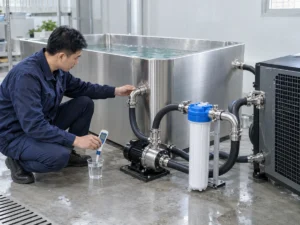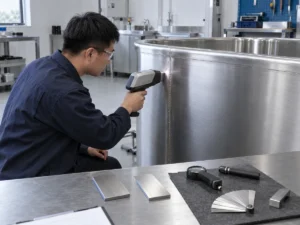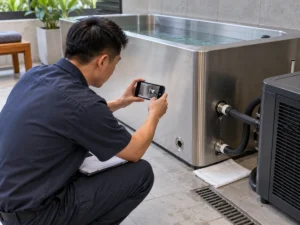
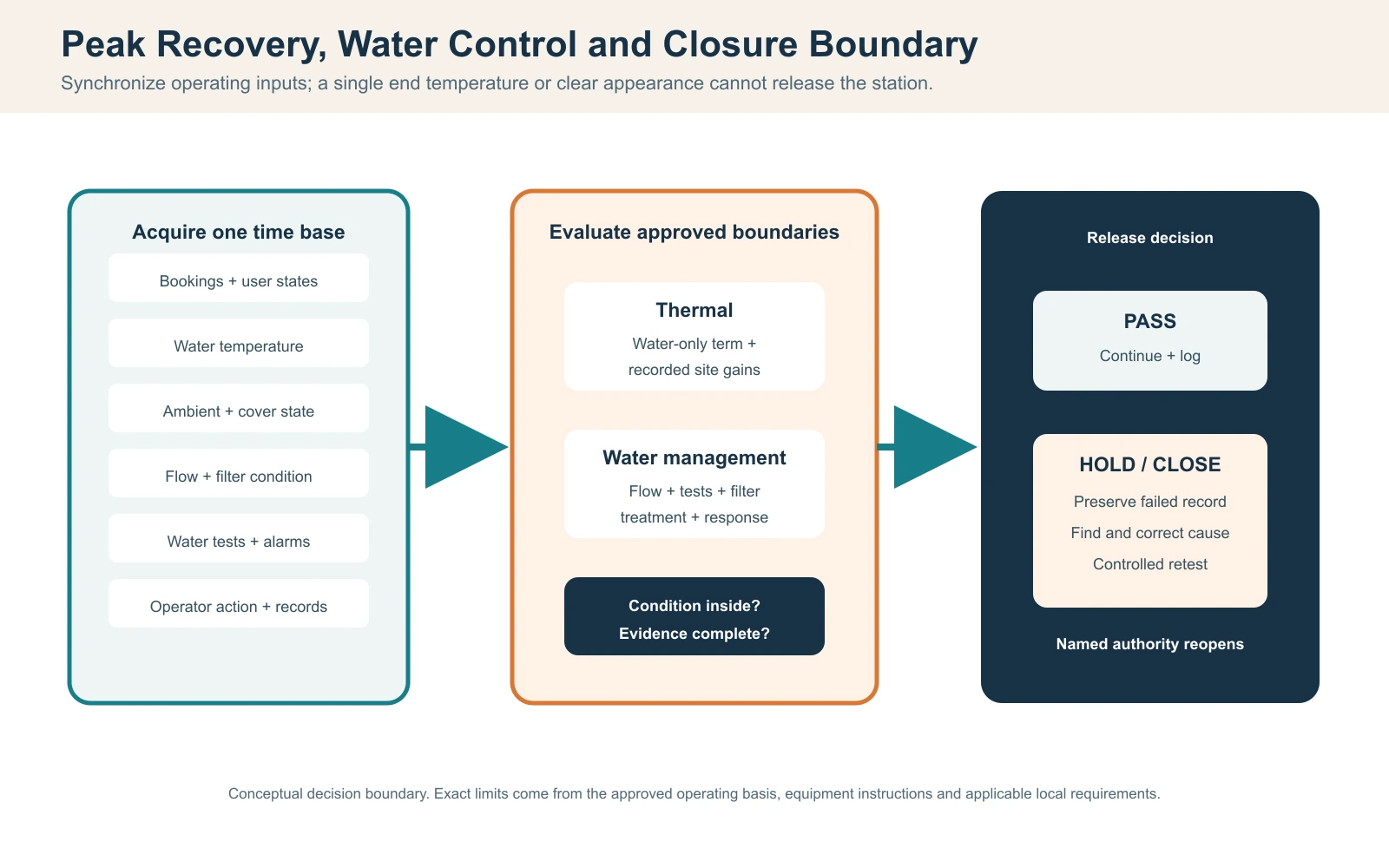
Direct answer: after the laydown format has been chosen, validate a recovery-center cold plunge station against a representative peak operating block—not daily visitor count, vessel size or nominal chiller horsepower. Map overlapping user and reset states, identify the first limiting interface, verify thermal recovery for the exact configuration and declared conditions, include water-management and staff workload, then run a representative acceptance sequence before release.
This guide assumes the laydown format has already been selected. If the project is still deciding whether a laydown format is appropriate or which model geometry fits the site and user posture, use the dedicated buying guide first.
This page owns the next decision: determine whether the planned station can support the recovery center’s busiest realistic period without thermal recovery, operating work, water-management requirements, access constraints or an unresolved hold condition becoming the bottleneck.
Define the Peak Operating Case Before You Estimate Throughput
Start with the busiest representative block the recovery center expects to operate.
A daily user total is not enough. The same number of users can create very different operating demands depending on how closely bookings are grouped and which tasks overlap.
What matters is the state of the station during the peak block.
Map the Session States That Overlap
A useful operating map can distinguish people or tasks that are:
- preparing for the plunge;
- waiting for access;
- actively using the station;
- exiting;
- moving into the next recovery area;
- waiting for reset work to finish;
- affected by a temporary hold or service interruption.
The exact labels can follow the facility’s own operating model. The point is to expose concurrency.
For example, the next user may already be waiting while the previous user is exiting, staff are resetting the area and the cooling system is still returning toward the declared operating condition. A booking calendar that looks workable on paper may therefore place more simultaneous demand on the station than the appointment count suggests.
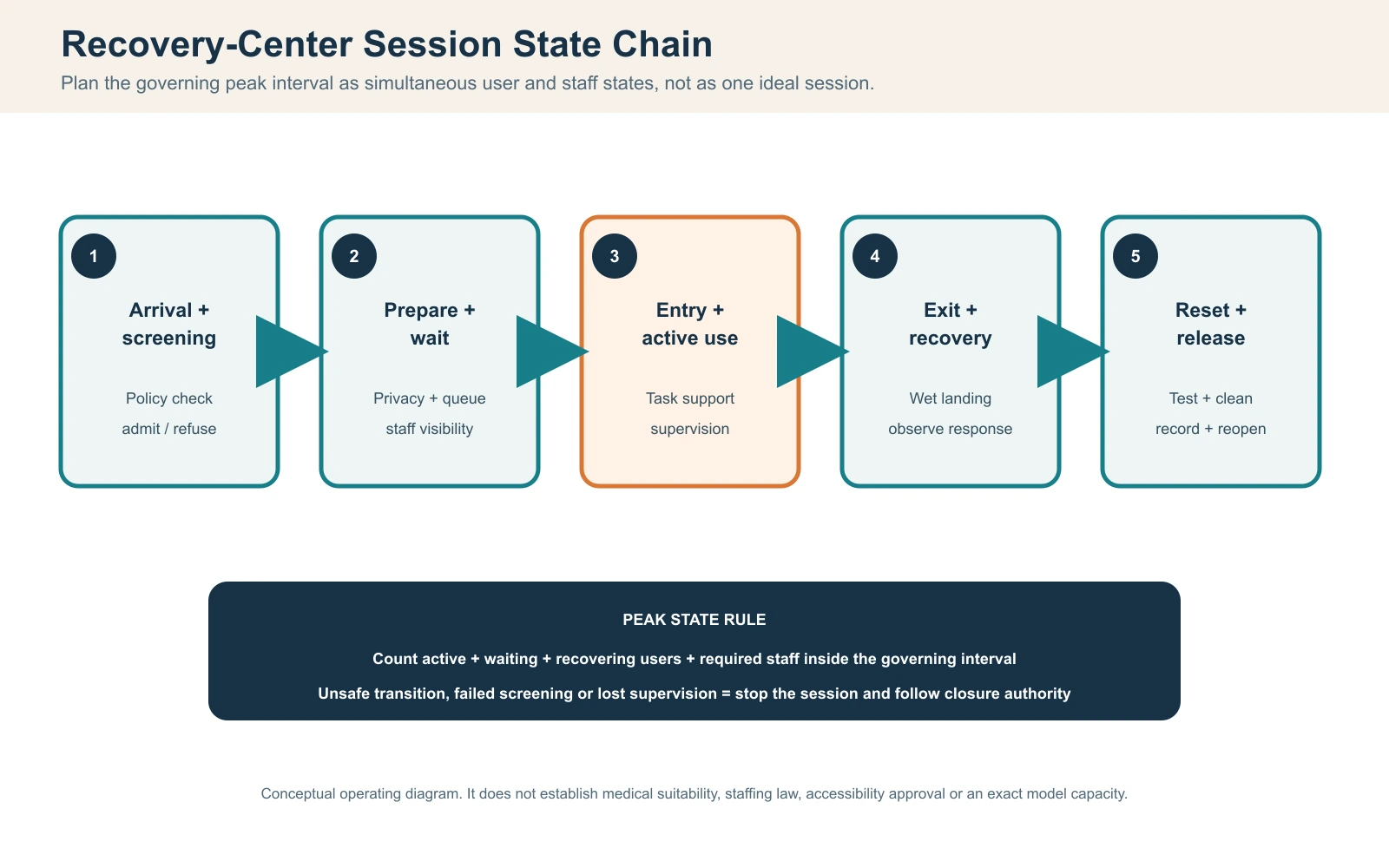
Venue-wide questions such as access policy, staffing presence, supervision and recovery-zone layout belong to the recovery-center facility plan. This article uses those inputs only where they affect the plunge station’s operating capacity.
Freeze the Declared Operating Condition
Before comparing evidence, record what the proposed capacity is supposed to mean.
| Input | What to record |
|---|---|
| Intended operating use | The facility context being evaluated |
| Peak booking block | The representative busiest period |
| Session sequence | Which user and reset states overlap |
| Equipment configuration | The exact configuration under evaluation |
| Thermal condition | The condition against which recovery is checked |
| Staffing assumption | Which required tasks have an available owner |
| Site interfaces | Relevant access, service and operating constraints |
| Evidence status | Measured, confirmed, planned, estimated or still open |
The distinction between those evidence states matters. An estimate should not silently become a confirmed project fact later in the process.
Likewise, evidence from one equipment revision, operating condition or installation should not automatically be applied to another.
For U.S. installations that fall within public-aquatic rules, the CDC Model Aquatic Health Code can provide model guidance for public aquatic-facility design, operation and management. The MAHC is not federal law; whether any provision applies depends on facility classification and adoption by the relevant jurisdiction.
Working rule: define the operating case first; judge the station against that case second.
Find the Constraint That Limits Usable Throughput
Usable throughput belongs to the complete operating station, not to the vessel alone.
A plunge may physically be available for another user while some other part of the system is not.
| Constraint | Question that must close |
|---|---|
| User flow | Can entry, use, exit and recovery occur without creating an operating conflict? |
| Thermal recovery | Does the exact configuration recover under the declared peak condition? |
| Water-management state | Can required operating checks and actions be completed? |
| Staff and reset work | Can staff complete the necessary work within the booking sequence? |
| Site / service access | Can the system be operated, inspected and serviced without an unresolved obstruction? |
| Safety / project gate | Is any condition still open that should prevent release? |
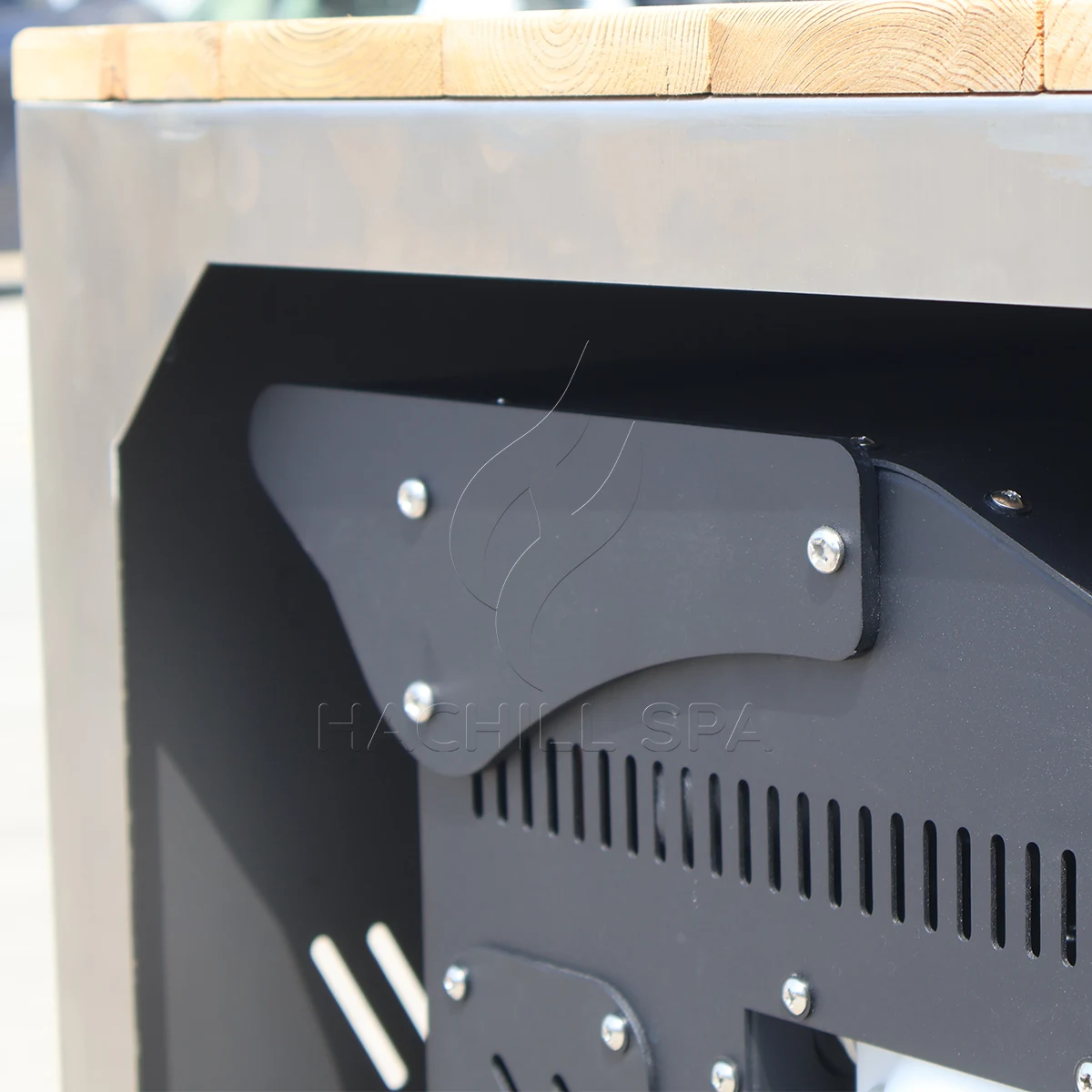
That interface limits the usable operating case.
A larger vessel does not prove greater operational throughput. A higher electrical or horsepower rating does not by itself prove faster usable thermal recovery. A broad “commercial” label does not establish a specific duty cycle.
Detailed product-format selection should remain with the laydown buying guide and the current laydown cold plunge range. Detailed drainage engineering should remain with the laydown drainage planning guide.
Gate first; score second. A critical unresolved condition should not disappear inside a strong weighted total.
Verify Thermal Recovery Under the Declared Peak Condition
Thermal recovery is meaningful only when its configuration and test conditions are visible.
Cooling-system output can change with operating conditions. Flow, water condition, ambient condition, equipment configuration and actual heat load can all affect how a system behaves.
That does not support a universal recovery number for HACHILL equipment. It supports a more important procurement rule:
A project record may therefore need to identify:
- the exact equipment configuration;
- initial water condition;
- declared operating target;
- relevant site or ambient condition;
- confirmed operating water volume where required;
- flow or system state where relevant;
- representative peak user/load sequence;
- timestamped temperature observations;
- relevant operating or cover state.
If operating water volume is still an estimate, close that input before treating the recovery test as comparable; the laydown cold plunge water-volume guide covers that measurement and evidence boundary in more detail.
The purpose is not to manufacture a generic “recovery in X minutes” claim. It is to answer: Does this exact configuration recover in a way that supports this declared peak sequence?
If a supplier provides a cooling-capacity or recovery figure, ask for the conditions behind it. Evidence from another configuration, another ambient condition or an undefined test should not be treated as equivalent.
Do Not Use Horsepower as a Recovery Result
Horsepower, electrical input and useful cooling output are different decision fields.
A nameplate number can help identify equipment. It does not show, by itself, how the complete installed system will perform at the operating condition being evaluated.
For detailed tub-to-chiller compatibility—including thermal duty, flow, controls and site interfaces—use the cold plunge tub and chiller matching guide.
Count Staff, Reset, Water Checks and Closure Work as Capacity Constraints
The equipment can be ready while the facility is not.
Shared-use aquatic operation can involve inspections, water-quality tasks, cleaning, preventive maintenance, operating records and response to abnormal conditions. ANSI/PHTA/ICC-2 2026, the current PHTA standard for public pool and spa operations and maintenance, covers operational topics for public aquatic venues including inspections, permits, water quality and facility operation. Which provisions apply—and how often tasks must occur—depends on the facility, adopted requirements, operating plan and project scope.
Those tasks consume real operating time.
Normal Operation
Normal work may include user transition, routine observation, reset, cleaning and required records.
Peak Operation
During the peak block, tasks begin to overlap. A staff member may be managing the next user while the station needs resetting or another required operating check becomes due.
Capacity question: Can all required tasks still be completed while the declared booking sequence is running?
Abnormal Operation
A different workload appears when a condition falls outside the accepted operating boundary.
A leak, system alarm, unacceptable water-management condition, unsafe access condition or another unresolved problem may stop normal booking flow. Someone then has to record the issue, control access where required, coordinate corrective action and establish whether the hold can be released.
| Task | Trigger | Responsible role | Competes with peak bookings? | Potential hold? |
|---|---|---|---|---|
| User transition / reset | Between sessions | Facility-defined | Yes | Project-defined |
| Required operating check | Operating-plan trigger | Facility-defined | Potentially | Depends on result |
| Cleaning / housekeeping | Facility procedure | Facility-defined | Potentially | Depends on condition |
| Abnormal-condition response | Condition detected | Named responsible role | Yes | Potentially |
| Service intervention | Maintenance or fault | Qualified responsible party | Yes | Potentially |
This table does not create universal staffing ratios or testing frequencies. Those belong to the applicable operating plan, product instructions, project requirements and jurisdiction.
If required operating work cannot be completed within the planned booking pattern, theoretical equipment capacity is not the facility’s usable capacity.
Operational acceptance also does not establish that cold-water exposure is appropriate for an individual user. Personal health suitability remains outside this equipment-capacity decision.
Build a Representative Peak-Sequence Acceptance Test
Once the operating case is defined, test the station against that case rather than against an undefined idea of “normal use.”
A representative peak-sequence test is a project acceptance method, not the name of a universal regulatory test.
- Identify the configuration. Record the actual equipment and revision being tested.
- Confirm the declared condition. Freeze the assumptions that make the result interpretable.
- Run the representative peak sequence. Exercise the user/load and transition pattern the facility plans to operate.
- Synchronize observations. Keep relevant thermal, equipment, staff and timing observations on one timeline.
- Complete applicable operating checks. Verify the project-specific conditions that must be acceptable before release.
- Record deviations. Preserve delays, alarms, failed checks, configuration differences and other open items.
- Make a named release decision. State who can accept the result and who must close each remaining issue.
Where the installation falls under adopted public/shared aquatic requirements, additional inspection, permitting, operating-record or pre-opening requirements may apply. Those requirements remain with the applicable authority and project team.
Grade Evidence by Configuration, Condition and Revision
For project screening, evidence can be considered in the following order:
- exact project evidence under representative declared conditions;
- current technical documentation for the exact configuration;
- properly scoped project or planning information;
- generic category or marketing material.
This is an evidence-screening framework, not an official regulatory or certification grading system.
The farther the evidence moves from the actual configuration and condition being decided, the less confidently it should be used for release.
Assign Responsibility Before Release
Acceptance also needs a visible owner for every open item.
| Role | Typical information / decision boundary |
|---|---|
| Supplier | Supplied configuration and applicable product documentation |
| Installer / qualified trade | Work inside the agreed installation scope |
| Operator | Facility procedures, operating records and daily controls |
| Designer / project professional | Items within the professional design scope |
| AHJ / applicable authority | Matters within its regulatory authority |
| Buyer / owner | Project acceptance and commercial record |
This is not a universal assignment of legal liability. Contracts, professional scope and local requirements control the actual responsibility.
Put the Station on Hold, Correct the Cause and Retest
A critical failed condition should remain visible.
Where an applicable rule or project criterion requires closure or correction, reopening should occur only after the responsible condition has been addressed. For covered public aquatic venues, the CDC Model Aquatic Health Code includes model closure and reopening provisions. Separately, within U.S. workplace scope, OSHA 1910.22 requires hazardous walking-working surface conditions to be corrected or repaired before employee reuse, or guarded until corrected when immediate repair is not possible. OSHA 1910.22 does not define all cold-plunge closure criteria; it is relevant only to walking-working surface hazards within its scope.
Possible hold categories include:
- unresolved water-management condition;
- active leak;
- unsafe support or access;
- unresolved electrical concern;
- failed applicable operating check;
- missing release evidence;
- mismatch between tested and ordered configuration;
- inability to perform a required operating task.
These are screening categories, not substitutes for the actual equipment manual, project documents, qualified trades, operator procedures or AHJ requirements.
Define the Hold Before the Test
Acceptance criteria are more useful when they are established before the peak test.
If the booking sequence depends on restoring a declared operating condition before the next session, failure to reach that condition should remain a failed condition until it is properly resolved.
Likewise, a safety-related or jurisdictional open item cannot be offset by good performance elsewhere.
Preserve the Failure and Control the Retest
Do not erase a failed record and repeat the test until the result looks better.
Record failure → identify suspected cause → make corrective change → document what changed → repeat affected verification → release only after the responsible owner closes the hold
Where practical, keep unaffected test conditions stable. That makes it easier to judge whether the corrective action actually addressed the failure.
If the configuration or another important operating variable changes materially, record the new condition instead of silently treating the result as directly comparable with the earlier test.
Turn the Accepted Operating Case Into a Model Brief and RFQ
Once the operating case is defined and its major interfaces are closed, transfer those assumptions into the product brief.
Do not restart with “Which commercial laydown cold plunge is best?” Give the supplier and project team the conditions that actually affect the model decision.
| RFQ input | What needs to be clarified |
|---|---|
| Venue and intended use | Whether the proposed configuration fits the declared application |
| Peak operating case | Which booking/load assumptions the proposal is based on |
| User / operating flow | Interfaces affecting access, reset and station operation |
| Required thermal duty | Configuration-specific evidence and stated conditions |
| Utilities / site interfaces | Requirements that still need site confirmation |
| Water-management arrangement | Equipment scope and facility/project responsibilities |
| Service-access constraints | Whether inspection and service access remain workable |
| Required documents | Manuals, drawings, configuration records and relevant evidence |
| Acceptance conditions | What must close before release |
| Open items / deviations | What is still unknown and who must resolve it |
| Destination / project details | Inputs that may affect project scope or supplied configuration |
Keep unknowns visible. A quotation should not silently turn an estimate into a confirmed technical fact.
The same applies to certification. If a project requires certification to a named standard, request evidence for the exact product or component and configuration within that standard’s scope. NSF/ANSI/CAN 50 covers many recreational-water equipment categories, but citing the standard or an NSF overview does not establish certification for a specific HACHILL product.
Once the operating brief is normalized, continue to the current laydown cold plunge range and model documentation for product-specific comparison.