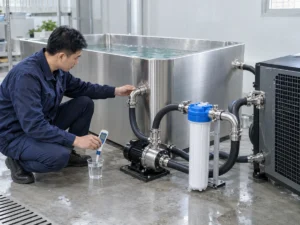
Outdoor Thermowood Cold Plunge Climate Guide
This guide helps commercial and project buyers decide whether a Thermowood cold plunge can operate outdoors at a specific site and what must be verified before year-round or seasonal use.
Direct answer: A Thermowood cold plunge can be used outdoors in a suitable configuration, but outdoor suitability is a complete-system decision, not a wood-cladding claim. Check the exact tub, chiller, pipework, controls, cover and site against local heat, humidity, rain, solar exposure, freeze risk, wind, debris and salt exposure. Thermowood can be appropriate for exterior applications when specified and maintained for the exposure, but the wood does not make the chiller, electrical equipment, joints or drainage weatherproof. Use actual site conditions and model-specific limits, define wetting/dry-back and freeze procedures, and keep any unverified environmental limit open before purchase or seasonal reopening.
Primary decision: Do exact product limits and site controls close every local climate driver?
Data rule: Use conditions at the tub and equipment location, not a city label or outdoor photograph.
Stop boundary: Uncontrolled water, unresolved freeze inventory, unsafe site conditions or open component limits hold release.
Freeze the Exact Outdoor Operating Boundary
Outdoor suitability belongs to an exact model, equipment configuration and site condition. Record operating season, supervised or unattended periods, cover policy, power-loss response, cleaning method, closure authority and whether the tub, chiller and controls share one enclosure. Obtain each component’s approved environmental limits and installation instructions. The International ThermoWood Association handbook recommends surface treatment for weather-exposed thermally modified timber, particularly in warm and humid climates, and does not recommend ThermoWood® for structures in direct contact with soil or water. Those are material-level boundaries, not proof that a complete cold-plunge system is weatherproof. A photograph of a product outdoors does not prove weather rating, freeze protection or coastal suitability.
Separate product-supplied protection from site work. Roofs, wind screens, foundations, drains, waterproofing, electrical weather protection, ventilation and snow/rain management may belong to different parties. Mark every input approved, measured, estimated or open.
Outdoor operating-boundary register
| Boundary | Required evidence | Responsible input | Hold condition |
|---|---|---|---|
| Exact model/configuration | Order, drawing and equipment list | Supplier/buyer | Related-model evidence only |
| Operating/closure season | Approved operating plan | Operator/project | Unattended state undefined |
| Component limits | Exact manuals/data sheets | Supplier | Generic outdoor claim |
| Site protection | Final roof, screen, drain and air plan | Project team | Site work assumed |
| Power/freeze response | Isolation and drain-down procedure | Supplier/installer/operator | Residual path unknown |
| Reopening authority | Cause-specific release procedure | Operator/project | No competent role named |
Acquire Site Climate Data at the Equipment Location
Use site-relevant weather and project data rather than a city climate label. Collect dry-bulb range, relative humidity or dew point, rainfall and wind-driven rain direction, solar orientation/shading, freezing duration and cycling, wind/debris, snow where applicable and salt/chloride exposure. Historical regional data supports planning, but local walls, roofs, reflected heat and landscaping create microclimates.
For an existing site, log conditions at the proposed tub and condenser intake. State instrument, location, interval, duration and missing data. For a new site, distinguish official climate data, project design values and unverified assumptions. For U.S. projects, NOAA’s current U.S. Climate Normals can provide a planning baseline, but station normals do not replace project design values or measurements of the final microclimate. The qualified project team selects governing design conditions.
Outdoor climate data-acquisition sheet
| Driver | Source/method | Location/time basis | Decision |
|---|---|---|---|
| Air temperature/RH | Official data plus logger | Tub and condenser intake | Thermal/condensation |
| Rain/wetting | Orientation and site observation | Rim, panels and base | Drainage/dry-back |
| Solar load | Sun path/shading review | Cover, wood and equipment | Finish/surface/thermal |
| Freeze cycles | Climate/project basis | All exposed water paths | Drain-down/closure |
| Wind/debris/snow | Project environmental basis | Cover, intake and roof | Retention/obstruction |
| Coastal/chlorides | Site distance/exposure and deposits | Metal, joints and wash access | Material/inspection |
Map Climate Drivers to Components and Exact Limits
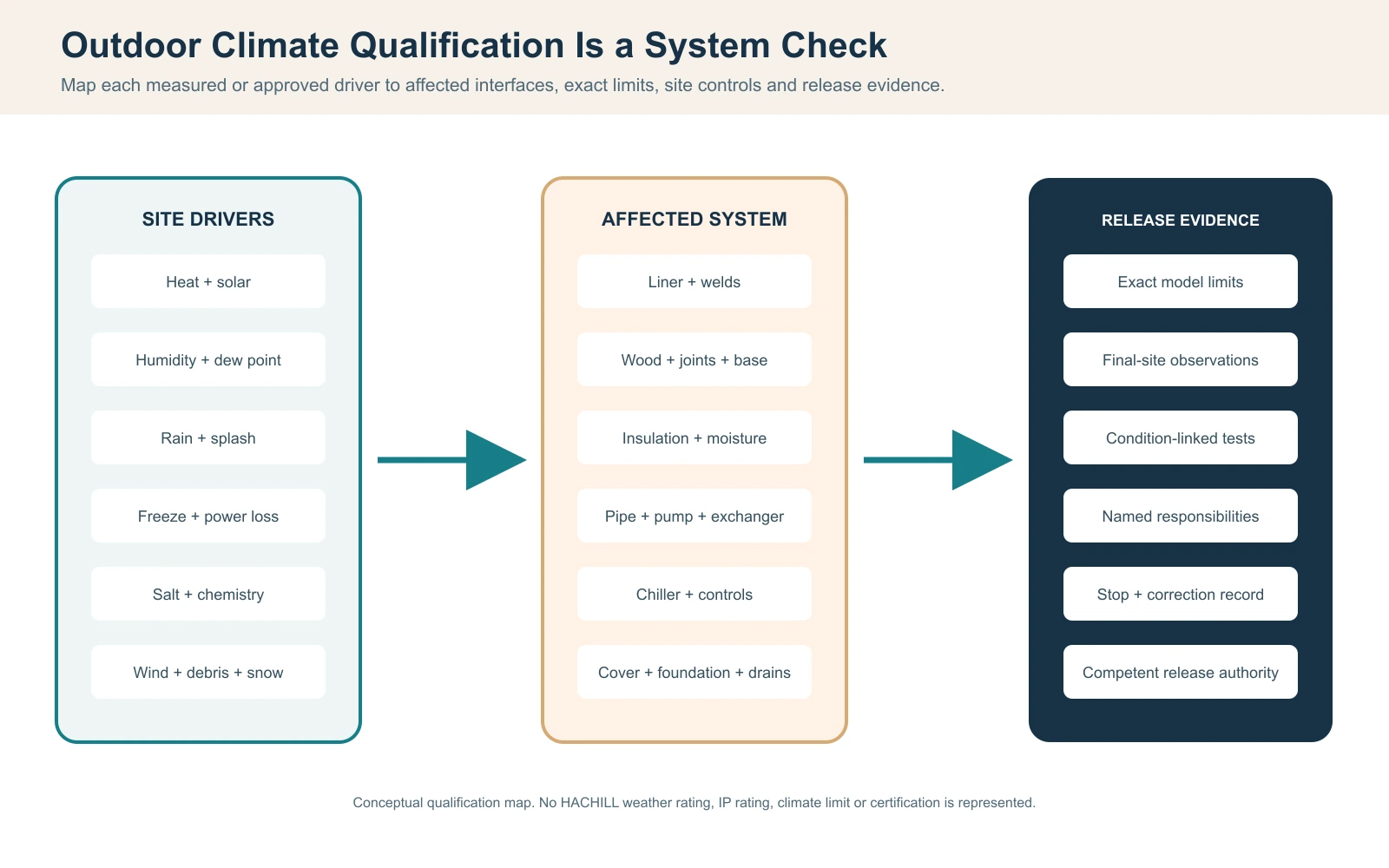
Do not ask whether Thermowood is suitable for a climate in isolation. Map each driver to liner, wood, fasteners, insulation, seals, pipes, chiller, pump, controls, cover, foundation and drainage. For every component, cite the exact approved limit or mark it open. The same cabinet can contain equipment with different ambient, ventilation or ingress boundaries.
Climate-to-component qualification matrix
| Driver | Affected interfaces | Evidence required | Release question |
|---|---|---|---|
| High ambient/solar | Cover, liner, wood, condenser | Exact limits and final-site data | Useful cooling and materials accepted? |
| Humidity/dew point | Cold surfaces, insulation, panel backs | Condition-linked observation | Condensation controlled? |
| Freeze/power loss | Tub, pipe, filter, exchanger, valves | Inventory and drain procedure | All trapped zones controlled? |
| Rain/wash water | Rim, joints, base, equipment bay | Wet path and dry-back test | No uncontrolled migration? |
| Salt/chlorides | Metals, welds, fasteners, deposits | Material and cleaning evidence | Exposure/maintenance compatible? |
| Wind/debris/snow | Cover, intake, roof and drains | Qualified site design and inspection | No unsafe load/obstruction? |
A green cell needs evidence, not confidence. If one critical limit is unknown, keep the climate qualification open rather than averaging strengths elsewhere.
Trace Rain, Splash and Dry-Back Paths
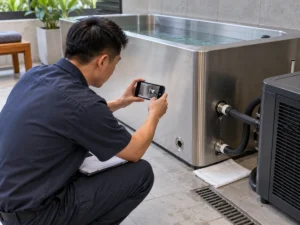
Draw water movement from sky, user, cleaning and overflow through rim joints, panel faces, end grain, fasteners, panel backs, base and equipment bay. Verify that the installed product can drain and dry under the accepted roof, foundation and airflow. Thermowood cladding is not the building waterproofing system, and a floor drain does not prove that water reaches it.
Use a controlled wetting observation with declared source, duration or quantity method, wind/roof condition, observation points and follow-up time. Inspect concealed paths before closing panels. Do not invent a universal dry time; finish, joint geometry, temperature, humidity and ventilation control it.
Outdoor wetting and dry-back record
| Checkpoint | Acquisition | Pass evidence | Stop/retest |
|---|---|---|---|
| Rim/joints | Controlled rain/splash method | Water sheds to intended face/path | Water enters blind joint |
| Panel back/subframe | Pre-closure and follow-up inspection | Drain/vent path remains open | Persistent trapped moisture |
| Base/foundation | Level and wet observation | No wood contact with ponding | Standing water |
| Equipment bay | Final-panel wet test | No uncontrolled water at equipment | Electrical/equipment wetting |
| Dry-back | Timestamped condition follow-up | Accepted condition reached | Unknown concealed state |
| Building wet zone | Project waterproofing/drain record | Separate qualified acceptance | Product used as waterproofing proof |
Engineering scenario: a roofed installation stays wetter than an exposed one
Observed problem: Panel backs remain damp even though direct rain rarely reaches the tub.
Likely cause: Deep shade, blocked base ventilation and repeated splash prevent dry-back; the roof-only assumption ignored humidity and airflow.
How to check: Record wetting events, air/RH, panel-back observations, base clearance and dry-back time without removing evidence first.
Prevention or corrective path: Restore the approved drainage/ventilation path or revise the site/product detail, then repeat the same wetting and follow-up observation.
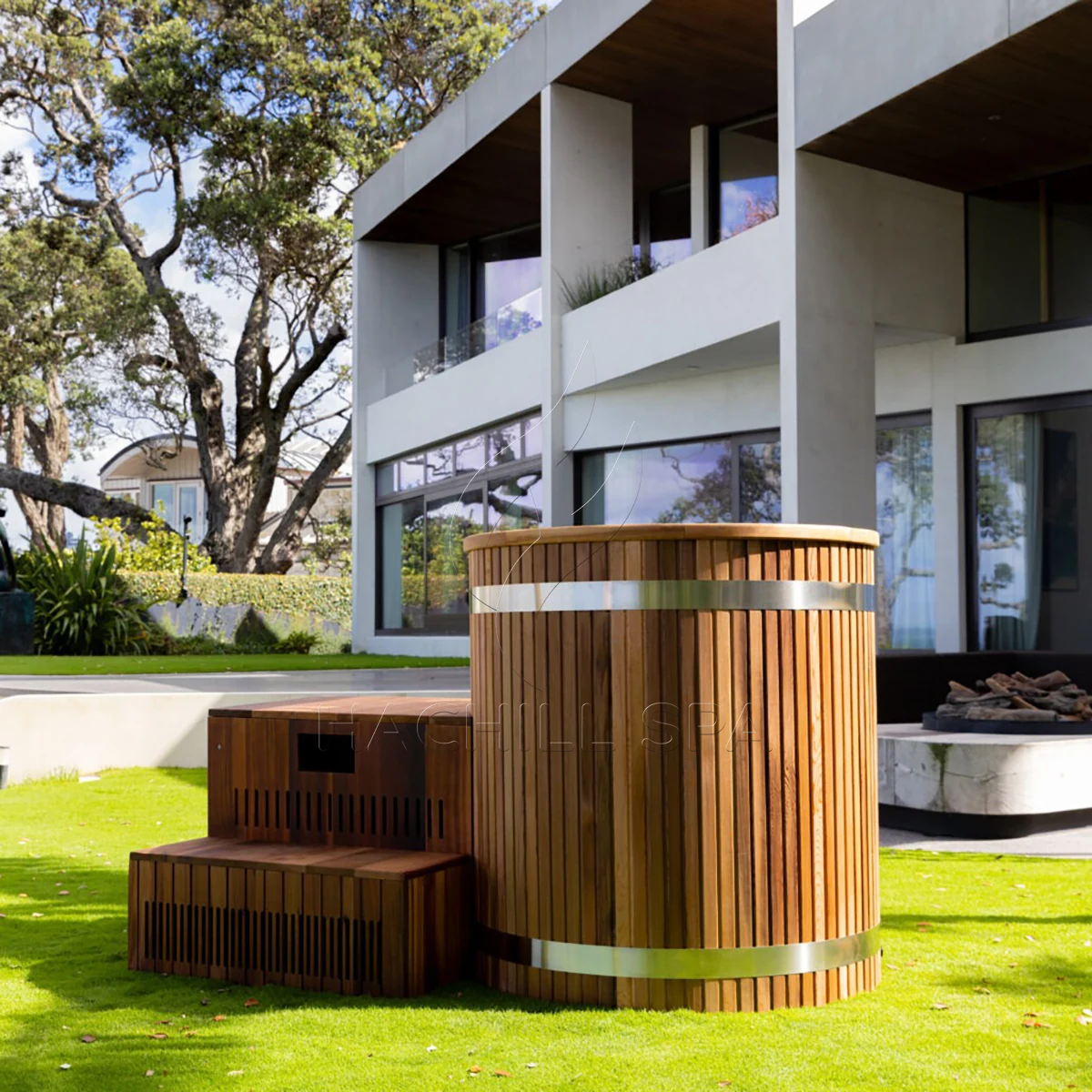
Qualify Solar Load, High Ambient and Condenser Air
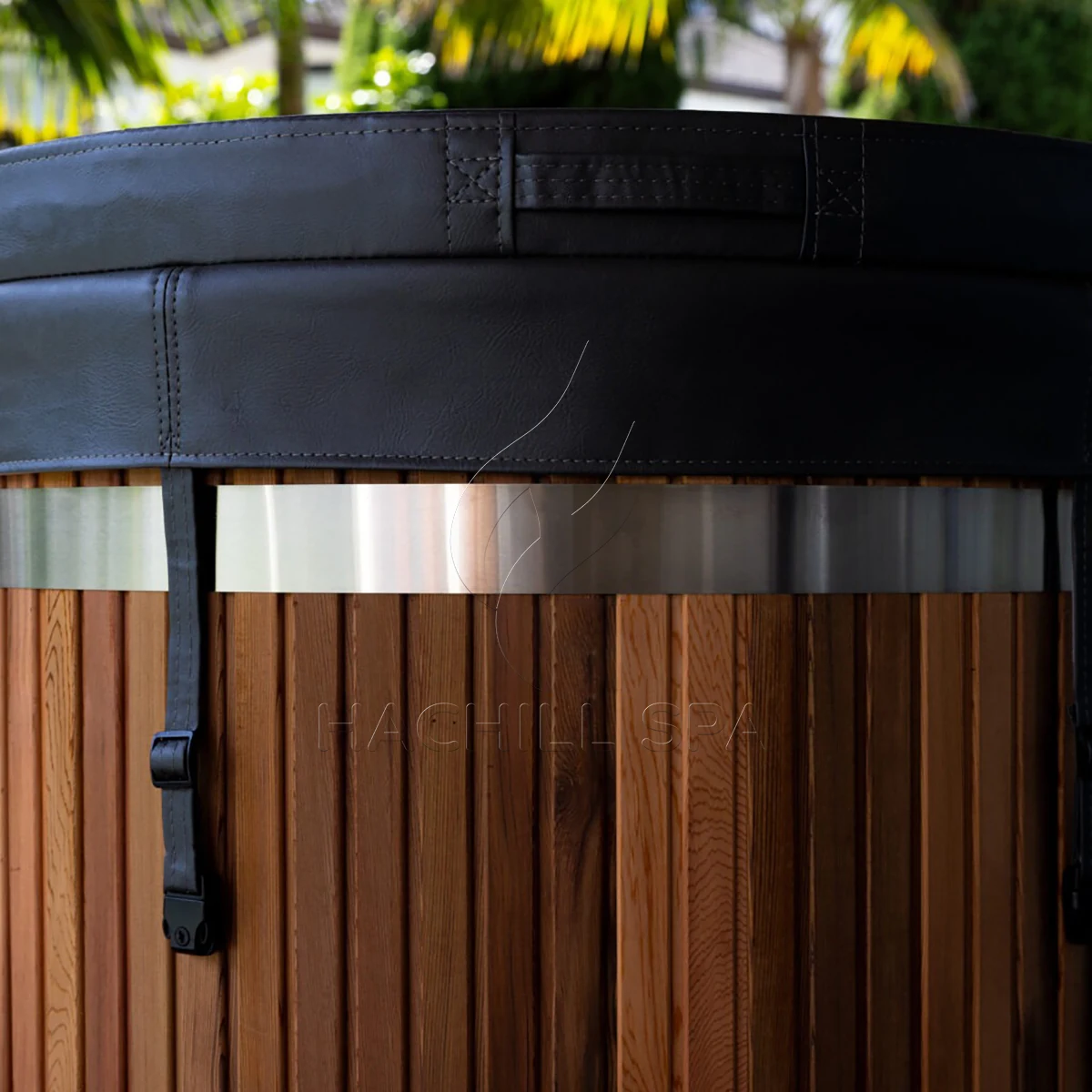
Solar exposure affects surface temperature, colour change, cover condition, water heat gain and local equipment air. The International ThermoWood Association notes that untreated ThermoWood® greys under UV exposure and recommends protective surface treatment for weather-exposed thermally modified timber; if appearance retention matters, agree the finish system and maintenance expectation before ordering. Chiller selection must use useful cooling at relevant water, ambient and flow conditions; compressor horsepower or input power is not cooling capacity. Measure condenser-inlet air at the actual intake, not a distant weather station, and check whether discharge air recirculates behind screens or planting.
Hot-weather thermal and airflow test record
| Input | Acquisition | Why needed | Invalid condition |
|---|---|---|---|
| Bulk-water temperatures | Named calibrated sensors | Pull-down/holding trend | Single unmixed wall reading |
| Condenser-inlet ambient | Logger at actual intake | Available cooling condition | Weather app only |
| Loop flow/filter state | Approved field method | Heat exchanger duty | Clean/nameplate assumption |
| Solar/cover state | Timestamped observation | Concurrent heat gain | Different from accepted use |
| Compressor/pump/control | Control/electrical log | Separate trip/cycling/capacity | State missing |
| Discharge recirculation | Final-site air observation | Local intake temperature | Panels/landscape absent |
Engineering scenario: a fair-weather chiller test passes but summer operation fails
Observed problem: The plunge reaches target during shaded commissioning but drifts or trips during afternoon operation.
Likely cause: The acceptance test omitted condenser-inlet solar microclimate and hot-air recirculation after screens and planting were installed.
How to check: Synchronize intake ambient, water temperatures, flow, cover, solar and control-state data in the final site arrangement.
Prevention or corrective path: Correct airflow/shading within approved limits or revise equipment selection, then repeat the declared hot-condition test before release.
Separate Humid-Climate Condensation from Leakage
Condensation is plausible when a cold surface is below surrounding-air dew point. Log air temperature and RH, named surface temperatures, water temperature, ventilation state and time. Use an identified calculation or instrument method. This supports diagnosis but does not exclude a simultaneous fitting leak.
Inspect insulation continuity, vapour path, seams, valves, supports and penetrations. Water can migrate from a cold bridge to another location. Corrective choices require actual conditions and approved materials, not a generic promise that Thermowood prevents condensation.
Condensation and leak-source evidence
| Input/observation | Method | Decision | Limitation |
|---|---|---|---|
| Air temperature/RH | Calibrated logger/location | Dew-point basis | Microclimate may vary |
| Surface temperature | Named point/method | Condensation plausibility | Emissivity/contact matters |
| Water temperature/time | Verified time series | Cold-surface driver | Placement recorded |
| Joint isolation | Dry observation/tissue or approved method | Active leak evidence | Concealed migration possible |
| Insulation/vapour state | As-built inspection | Cold bridge/path | Hidden areas remain open |
| Rain/splash events | Timestamped operating log | External source correlation | Overlapping sources possible |
Map Freeze-Prone Water Inventory and Response Time
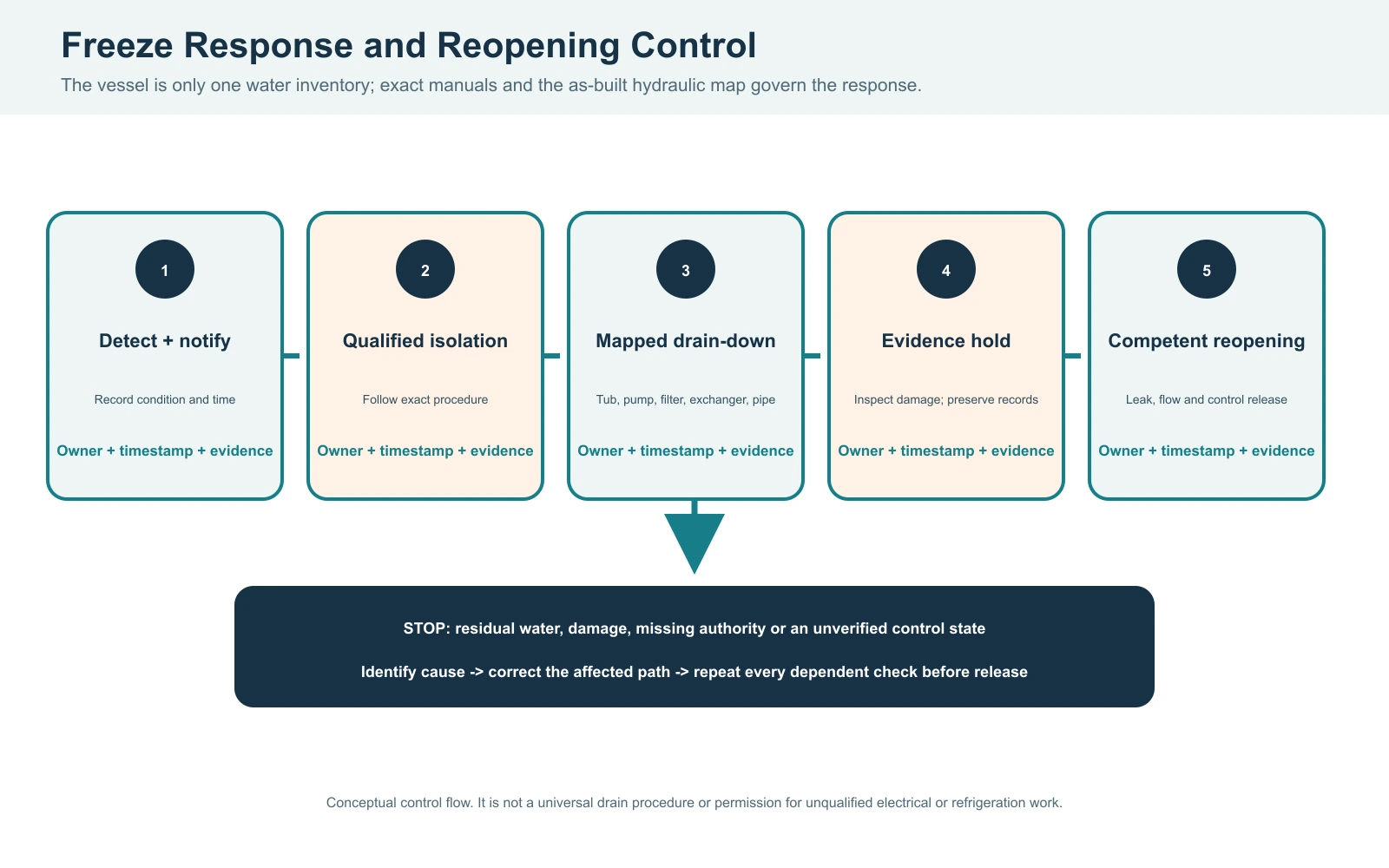
A tub that looks empty can retain water in filters, heat exchangers, pumps, check valves, high loops and site piping. Freeze planning begins with the exact hydraulic schematic and component manuals. Manufacturer winterization guidance such as the Pentair Max-E-Pro pump manual illustrates why pump and piping water paths must be handled explicitly when freezing conditions are possible; it is an example of component-level guidance, not a HACHILL winterization procedure. Mark every isolation and drain point, gravity limitation, residual volume and required qualified action. Do not call a system freezeproof unless verified evidence supports the exact configuration and condition.
Record detection and isolation/drain time under a controlled drill. A planning relationship is uncontrolled freeze exposure time = detection time + competent response time + isolation/drain time. This does not predict damage temperature; it exposes the operating dependency during power loss or closure.
Freeze shutdown and reopening map
| Element | Required evidence | Hold condition | Reopening check |
|---|---|---|---|
| Tub and low drain | Exact procedure/level | Residual path open | Visual/approved inspection |
| Pump/filter/exchanger | Component drain instructions | One low point assumed | Integrity/leak/flow checks |
| Site pipe/valves | As-built high/low points | Trapped branch unknown | Qualified inspection |
| Power/control | Alarm and outage response | Unattended dependency | Control and sensor test |
| Cover/enclosure | Approved winter condition | Snow/wind/vent conflict | Physical/access check |
| Operator response | Timed drill and authority | No competent responder | Record and retraining |
Engineering scenario: the vessel drains but the heat exchanger freezes
Observed problem: The tub appears empty after shutdown, yet a downstream component later leaks during restart.
Likely cause: The drain-down checklist covered the vessel only and omitted trapped component and site-pipe volumes.
How to check: Compare the as-built circuit with exact manuals and trace every valve, check valve, high loop and drain point before pressurizing.
Prevention or corrective path: Issue a configuration-specific shutdown map, correct the trapped path and repeat leak, flow and control checks under competent reopening authority.
Treat Coastal Salt and Water Chemistry as Combined Exposures
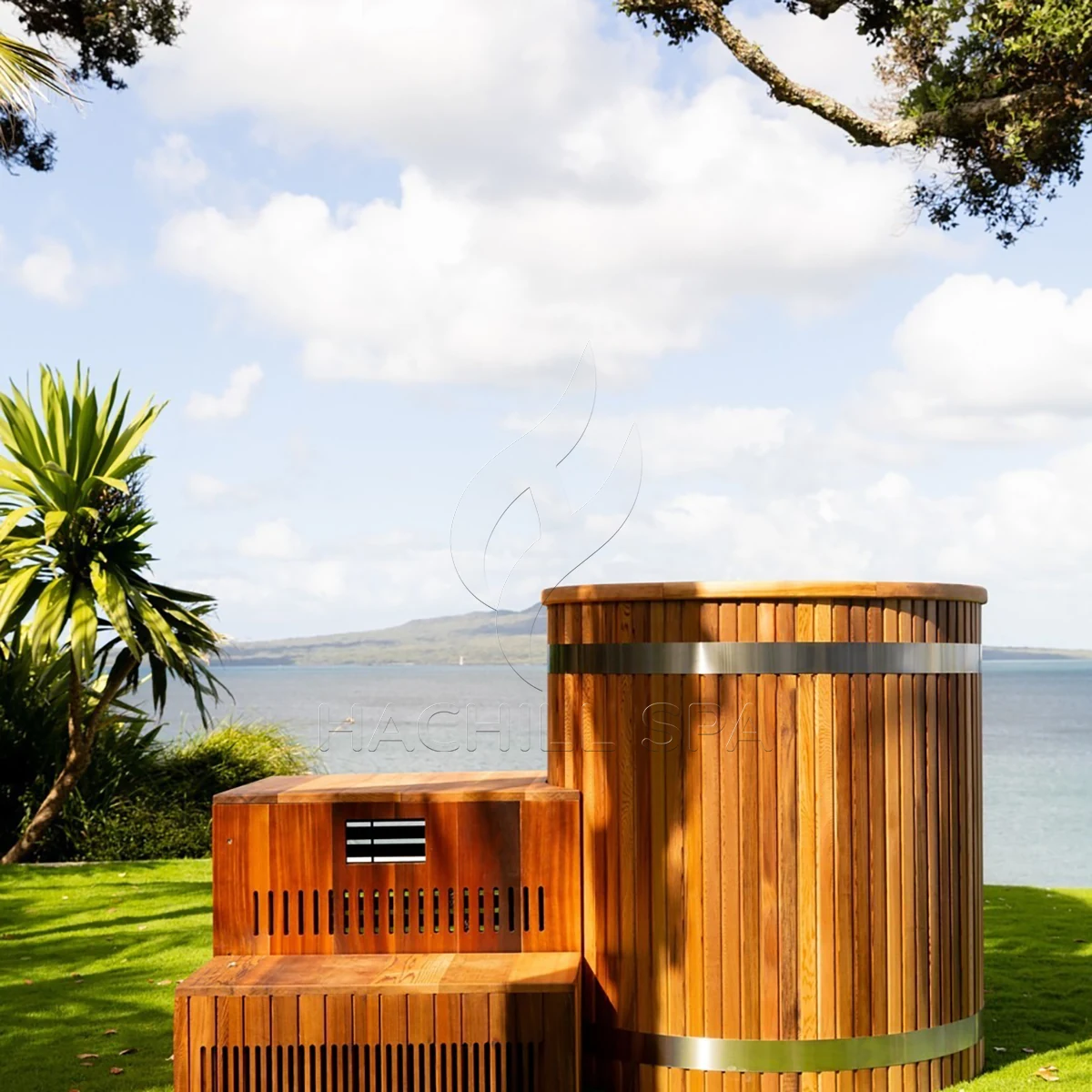
Coastal exposure can deposit salts on metal, wood, fasteners and equipment even without direct seawater contact. Review liner alloy/fabrication, weld treatment, fastener material, dissimilar-metal contact, crevices, drainage and access for deposit removal. Outokumpu’s corrosion guidance explains that chloride-containing environments can increase pitting and crevice-corrosion risk in stainless steel. Do not treat a stainless grade designation as proof of coastal immunity; exact alloy, fabrication, temperature, chemistry, deposits and cleaning conditions all matter.
Separate atmospheric deposits from treated-water chemistry and cleaning agents, then consider where they combine at the rim and waterline. Define inspection and approved cleaning access without inventing universal frequencies. Record actual deposits, chemistry and condition before repair.
Coastal exposure and corrosion evidence
| Interface | Evidence | Inspection/data | Stop/escalation |
|---|---|---|---|
| Liner/weld/finish | Exact material/fabrication record | Waterline and heat-affected zones | Pitting/crack/open material |
| Fasteners/metals | Material/contact schedule | Staining and crevice inspection | Unapproved substitution |
| Wood/finish | Approved sample/system | Salt/deposit and wet-dry state | Persistent contamination |
| Equipment air side | Manual/environmental boundary | Coil/intake deposits | Blocked/corroded condition |
| Water chemistry | Approved operator records | pH/sanitizer/chloride as applicable | Out-of-control water |
| Cleaning access | Approved procedure/task trial | Removal and dry-back | Inaccessible deposits |
Coordinate Wind, Debris, Foundation and Drainage
Wind can lift or displace covers, drive rain into joints and carry debris into condenser coils and drains. Snow or roof runoff can block access or add loads. Qualified project professionals determine structural wind/snow loads; this guide does not provide universal anchors or load values.
Verify foundation level and support reactions using exact filled mass and base geometry. Coordinate floor or pad falls, waterproofing, drainage route, electrical weather protection, condenser clearances and future component removal. Keep vegetation, screens and enclosures outside the exact equipment air and service envelopes, and resolve local structural, drainage and electrical requirements with the appropriate project professionals.
Outdoor site interface acceptance
| Interface | Project evidence | Field check | Hold condition |
|---|---|---|---|
| Foundation/support | Qualified design and base drawing | Level/support survey | Unapproved reaction/load path |
| Drainage/waterproofing | Qualified route/system | Controlled wet event | Ponding/unapproved discharge |
| Electrical/weather | Exact rating and local design | Qualified installation/test | Protection/entry open |
| Wind/cover/debris | Project design and operating procedure | Final-site inspection/drill | Uncontrolled cover/intake |
| Condenser/service | Required envelope | Final panels/landscape check | Recirculation/no removal path |
| Access/egress | Approved layout | Wet and seasonal route | Blocked/unsafe approach |
Plan Seasonal Inspection and Closure Workload
Outdoor suitability depends on operator capacity. List storm inspection, debris clearing, salt/deposit inspection, cover management, drainage-path checks, freeze shutdown, seasonal reopening and finish tasks. Measure representative hands-on time and separate required closure, dry or cure time.
Use seasonal workload = sum(event frequency x observed task time) + setup + closure/dry/cure time + records as a project planning method, not a universal labour promise. Detailed maintenance methods come from post 2252 and exact manuals.
Seasonal operating workload sheet
| Task/event | Acquisition | Closure dependency | Release evidence |
|---|---|---|---|
| Rain/storm check | Post-event task timing | Safe access/weather | No trapped water/damage |
| Debris/intake clearing | Final-site demonstration | Equipment isolation | Air/drain path restored |
| Coastal deposit check | Exposure-linked inspection | Approved cleaning/dry-back | Condition accepted |
| Freeze shutdown | Timed qualified drill | Power/water isolation | All mapped zones drained |
| Seasonal reopening | Cause-specific checklist | Qualified leak/flow/control tests | Named authority |
| Finish/panel work | Approved maintenance method | Dry/cure and guest closure | Sample/condition record |
Write a Condition-Linked Commissioning Plan
A commissioning result is useful only for the condition it represents. Before testing, declare whether the objective is pull-down, temperature holding, wetting control, condenser airflow, power-loss response or seasonal reopening. Record the exact product configuration, software or control settings, filter state, pipe arrangement, cover position, user load and final screens or landscaping. A test with temporary open panels cannot close an airflow claim for the finished enclosure.
Build a synchronized timeline rather than collecting isolated readings. Name every instrument, calibration or verification status, sensor location, logging interval, start and stop condition, missing-data rule and person controlling the test. Water temperature should represent the mixed bulk condition; a single wall reading can be biased by inlet flow, solar exposure or sensor contact. Condenser-inlet air must be measured where the unit actually draws air. Flow evidence must use the approved field method and the accepted filter condition.
Separate environmental performance from equipment protection. A high-pressure trip, low-flow alarm, sensor fault, pump interruption or power loss is not merely an inconvenient data point. Preserve the control state and time sequence, identify the cause and inspect affected equipment before resetting. If a protection device trips, follow the exact equipment manual and do not defeat protection merely to complete a test. Fixed electrical work, refrigerant work and regulated commissioning stay with appropriately qualified personnel.
Condition-linked outdoor commissioning plan
| Test objective | Declared inputs | Required record | Release boundary |
|---|---|---|---|
| Pull-down/holding | Water volume, start/target, ambient, solar, cover, user load | Synchronized water/air/flow/control trend | Only declared condition and configuration |
| Condenser airflow | Final panels, screens, planting and service clearances | Intake/discharge temperatures and recirculation observation | Temporary open arrangement is invalid |
| Wetting/dry-back | Rain/splash method, wind/roof, follow-up condition | Path, concealed inspection and timestamps | No uncontrolled migration or trapped state |
| Condensation diagnosis | Air/RH, water and named surface temperatures | Dew-point method plus independent leak checks | Plausibility does not exclude leakage |
| Freeze response | Mapped inventory, detection and competent response | Timed isolation/drain and residual inspection | No winter release with open trapped path |
| Reopening | Cause, correction, leak/flow/control/drain checks | Named competent authorization and retained evidence | Separate from shutdown completion |
Define the acceptance window before the test. The plan should state which conditions must remain within approved limits, how long the observation continues, what data invalidate the run and who can stop it. If weather prevents the governing condition, close only the portions actually demonstrated and carry the remaining seasonal gate as an open item. A mild-day result can support workmanship and controls, but it cannot prove hot-afternoon holding, freeze response or wind-driven wetting.
When comparing suppliers or sites, normalize the records before drawing conclusions. Compare the same water volume, initial and target temperature, ambient and solar condition, flow/filter state, cover policy and measurement method. If those inputs differ, describe the records as separate operating observations rather than ranking one system as more efficient. This prevents a favourable test window from becoming an unsupported product-wide performance claim.
Engineering scenario: a commissioning log looks complete but cannot support release
Observed problem: The report contains many temperature readings, yet the final screen, cover policy, flow condition and sensor locations are absent.
Likely cause: The team recorded values before freezing the test method and final installed configuration.
How to check: Reconstruct the timeline from photographs, control logs, installer records and instrument locations; mark every unavailable input instead of estimating it.
Prevention or corrective path: Repeat only the affected test under the final arrangement with a preapproved method, stop conditions and named release authority.
Accept Climate Conditions and Seasonal Reopening Separately
Document acceptance closes the model, configuration, exact environmental limits, site climate basis and responsibilities. Construction acceptance closes foundation, drainage, electrical and air paths. Wetting, thermal, condensation, freeze-response and seasonal reopening are separate tests because their methods and authorities differ.
When a condition fails, preserve timestamps, instruments, locations, weather, water/air temperatures, configuration, photographs and control state. Identify cause before changing multiple variables. Record correction and dependent tests. Do not overwrite the failed event with a fair-weather retest.
Outdoor climate acceptance and dispute schedule
| Gate | Pass evidence | Hold/stop condition | Controlled retest |
|---|---|---|---|
| Documents | Exact limits, climate and roles | Generic outdoor claim/open limit | Reissue approved basis |
| Construction | Foundation, drain, power, air, access | Site interface open | Qualified reinspection |
| Wet/condensation | Declared event and source evidence | Migration/uncontrolled water | Repeat same accepted condition |
| Thermal/airflow | Condition-linked water/intake/flow log | Trip/drift/invalid test | Correct cause and repeat |
| Freeze response | Inventory, drain and timed drill | Residual/open competent response | Repeat full mapped process |
| Reopening | Leak, flow, control, drainage and records | Damage/missing authority | Cause-specific release |
Engineering scenario: a passing spring test is used to close a winter claim
Observed problem: The system is accepted after mild-weather commissioning even though freeze shutdown and restart were never demonstrated.
Likely cause: One operating test was incorrectly treated as evidence for every seasonal condition.
How to check: Compare the accepted climate matrix and test plan with actual conditions and identify untested freeze, power-loss and residual-water states.
Prevention or corrective path: Keep winter release open, conduct the qualified shutdown/reopening evidence at an appropriate declared condition and preserve separate approvals.
Grade Evidence and Assign Climate Responsibilities
Outdoor climate evidence ladder (project working scale; not an industry standard)
| Grade | Evidence | Permitted use | Boundary |
|---|---|---|---|
| A | Witnessed exact-site/configuration test | Condition-specific acceptance | Declared duration/method only |
| B | Approved exact-model limit and project design | Selection/submittal | Field state verified separately |
| C | Traceable component record/site calculation | Interface support | Complete system not proven |
| D | Qualified estimate with assumptions | Planning | Cannot close release |
| E | Outdoor photo/generic claim | Orientation | No environmental proof |
The supplier provides exact component and configuration limits. The project team defines climate/site design. The installer records as-built interfaces and commissioning. The operator owns seasonal procedures and logs. Qualified local parties approve structural, electrical, drainage and regulated public-use work. HACHILL Product Engineering can review exact product inputs; it cannot replace those authorities.
Issue a Climate-Normalized RFQ
Send exact model/format, site location, climate data source, roof/shade, rain and solar orientation, humidity, freeze plan, coastal exposure, operating season, water/thermal case, power, foundation, drainage, airflow, quantity, maintenance capability, evidence and acceptance needs. Mark open values rather than letting suppliers assume them.
Outdoor Thermowood cold plunge RFQ fields
| Field | Why required | Supplier/project response | Closure |
|---|---|---|---|
| Climate/exposure basis | Defines real drivers | Limits, assumptions and options | Technical bid |
| Exact configuration | Prevents related-model transfer | BOM/drawings/manuals | Submittal |
| Thermal/air conditions | Controls useful cooling | Condition-linked selection/test | Commissioning plan |
| Freeze/closure | Controls trapped water and response | Exact procedure/interfaces | Seasonal release |
| Site works | Separates foundation/drain/power/air | Included/excluded boundary | Coordination |
| Evidence/acceptance | Makes offers comparable | Documents, tests, witnesses | PO/opening |
Frequently Asked Questions
Can every Thermowood cold plunge stay outdoors year-round?
No universal answer applies. Verify the exact tub, chiller, controls, piping and cover limits against local heat, humidity, rain, freeze, wind, salt exposure, site protection and the operator’s closure capability.
Does Thermowood make a cold plunge weatherproof?
No. Thermowood is one material layer. Outdoor qualification also depends on liner, structure, joints, fasteners, insulation, equipment ratings, drainage, ventilation, foundation, electrical work and site design.
How can condensation be distinguished from a leak outdoors?
Record synchronized air temperature/RH, surface and water temperatures, ventilation and isolated joint observations. Condensation may be plausible below dew point, but a simultaneous leak must still be checked.
What must be drained before freezing weather?
Follow exact manuals and an as-built hydraulic map. Tub, pumps, filters, heat exchangers, valves, high loops and site piping may retain water even when the vessel looks empty.
What climate data should be sent with an RFQ?
Provide site temperature/humidity basis, rain and solar orientation, freeze duration, wind/debris or snow considerations, coastal exposure, roof/shade, operating season, thermal case, drainage, power and maintenance capability.
Reference Basis and Limits
NOAA U.S. Climate Normals provides station and gridded climate normals for U.S. planning; local microclimate and project design conditions still require review.
International ThermoWood Association Handbook provides ThermoWood-specific background on weather exposure, surface treatment and service conditions; exact installed-system suitability still depends on the complete product and site.
Outokumpu corrosion-resistance guidance supports the chloride-localized-corrosion boundary used in the coastal section; it does not establish a universal corrosion rating for a HACHILL product.
Pentair pump winterization guidance illustrates why retained water in equipment and piping must be addressed before freezing conditions; exact HACHILL procedures remain model-specific.
Technical boundary: No exact HACHILL environmental limit, IP rating, freeze-protection rating, corrosion-resistance rating, cooling result, wood-process claim, service life or certification is inferred here. Approved product records, exact manuals, site evidence and applicable local rules control.
Turn the climate data into an outdoor project review
Send HACHILL the exact format, site climate basis, roof and solar orientation, freeze and coastal exposure, operating season, thermal case, power, foundation, drainage, airflow, quantity and evidence needs. The team can review product interfaces while qualified project parties retain local design authority.