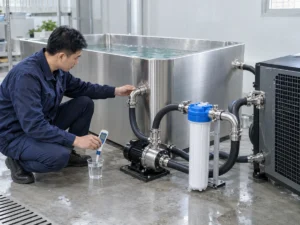
Commercial Thermowood Cold Plunge Maintenance
A commercial maintenance plan should tell an operator what to inspect, what triggers action, what evidence closes the task and when the plunge must stay out of service.
Direct answer: Commercial Thermowood cold plunge maintenance should be built around the exact installed system and operating duty, not a generic weekly or monthly checklist. Start with a commissioning baseline, then control water and cleaner compatibility, Thermowood finish and joints, stainless liner and weld condition, drainage and dry-back, filtration, flow, cooling, controls and service access. Each task should have a trigger, approved method, responsible role, record and release condition. Use manufacturer instructions and applicable local requirements when they define maintenance or water-treatment limits, and revise provisional triggers from recorded condition over time.
What changes the plan: User load, cleaning load, indoor or outdoor exposure, water-treatment system, chiller and filter configuration, finish system, site drainage, service access and local operating requirements.
Stop boundary: Active leakage, unsafe isolation, uncontrolled chemistry, critical alarms, compromised containment or unknown critical substitutions require hold and escalation before reopening.
Freeze the Installed Asset and Maintenance Boundary
A maintenance plan belongs to an exact installed configuration, not to the phrase Thermowood cold plunge. Record the tub and equipment identity, drawing and bill-of-material revision, liner and finish records, water-treatment arrangement, chiller and pump, filter, controls, cover, site pipework, foundation, drain and approved manuals. Mark every item supplied, site-provided, substituted, unknown or not applicable.
Define operating duty before choosing tasks: private or public/commercial use, supervised hours, user and cleaning load, indoor or outdoor exposure, planned closures, water-change policy and local regulated requirements. Separate routine operator inspection from work requiring isolation, qualified electrical or refrigeration service, structural review or public-health authority. OSHA control-of-hazardous-energy guidance provides the U.S. workplace framework for servicing hazards from unexpected energization or stored energy; the responsible employer and local rules determine the exact procedure. A generic supplier checklist cannot transfer those responsibilities.
Installed-asset maintenance passport
| Asset/interface | Identity and revision | Approved source | Open/hold condition |
|---|---|---|---|
| Tub, liner and cladding | Exact model/order/BOM | Released drawings and records | Related-model data only |
| Water loop/treatment | As-built schematic and component list | Manuals and commissioning | Unmapped branch or substitution |
| Chiller/pump/filter/controls | Nameplate and revision | Exact data and procedures | Unknown equipment state |
| Finish/cleaning system | Approved product and application record | Manufacturer/project approval | Unidentified coating or cleaner |
| Site works | Pipe, power, drain, foundation, air | Qualified as-built records | Ownership or access open |
| Operating duty | Use, closure and supervision plan | Operator/local requirements | Household assumption for commercial duty |
Capture a Condition Baseline Before Routine Maintenance
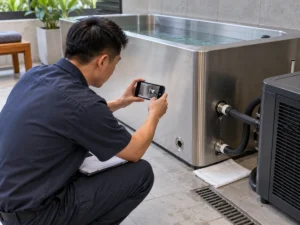
Receiving and commissioning evidence should show the condition before repeated cleaning, chemistry changes, weather and user load obscure the starting point. Photograph and map the liner, waterline, welds, penetrations, rim, cladding faces, end grain, joints, fasteners, panel backs where accessible, base, equipment bay, filters, pipe connections and controls. Use stable location names and a scale or reference where size matters.
Record water and air conditions, treatment state, filter condition, approved flow measurement or proxy, bulk-water temperatures, condenser-inlet air, alarm/control state, wet-test result and drainage/dry-back observations. State instrument, location, time and method. A photograph without the asset ID, surface condition and location is orientation evidence, not a baseline.
Receiving and commissioning baseline
| Checkpoint | Acquisition method | Baseline evidence | Invalid evidence |
|---|---|---|---|
| Liner/weld/waterline | Location grid and controlled images | Condition, lighting, wet/dry state | Unlocated phone photo |
| Thermowood/joints | Face/end/joint/fastener map | Sample/finish and condition record | Colour description alone |
| Hydraulic loop | As-built trace and operating record | Filter, flow proxy, leak and control state | Nameplate only |
| Equipment air side | Final-panel observation | Intake/discharge and access state | Temporary open cabinet |
| Drain/dry-back | Declared wet event and follow-up | Paths, timestamps and concealed checks | Floor drain assumed |
| Handover | Owner, method and record location | Signed open-item list | Verbal maintenance promise |
Use Task Triggers Instead of One Universal Calendar
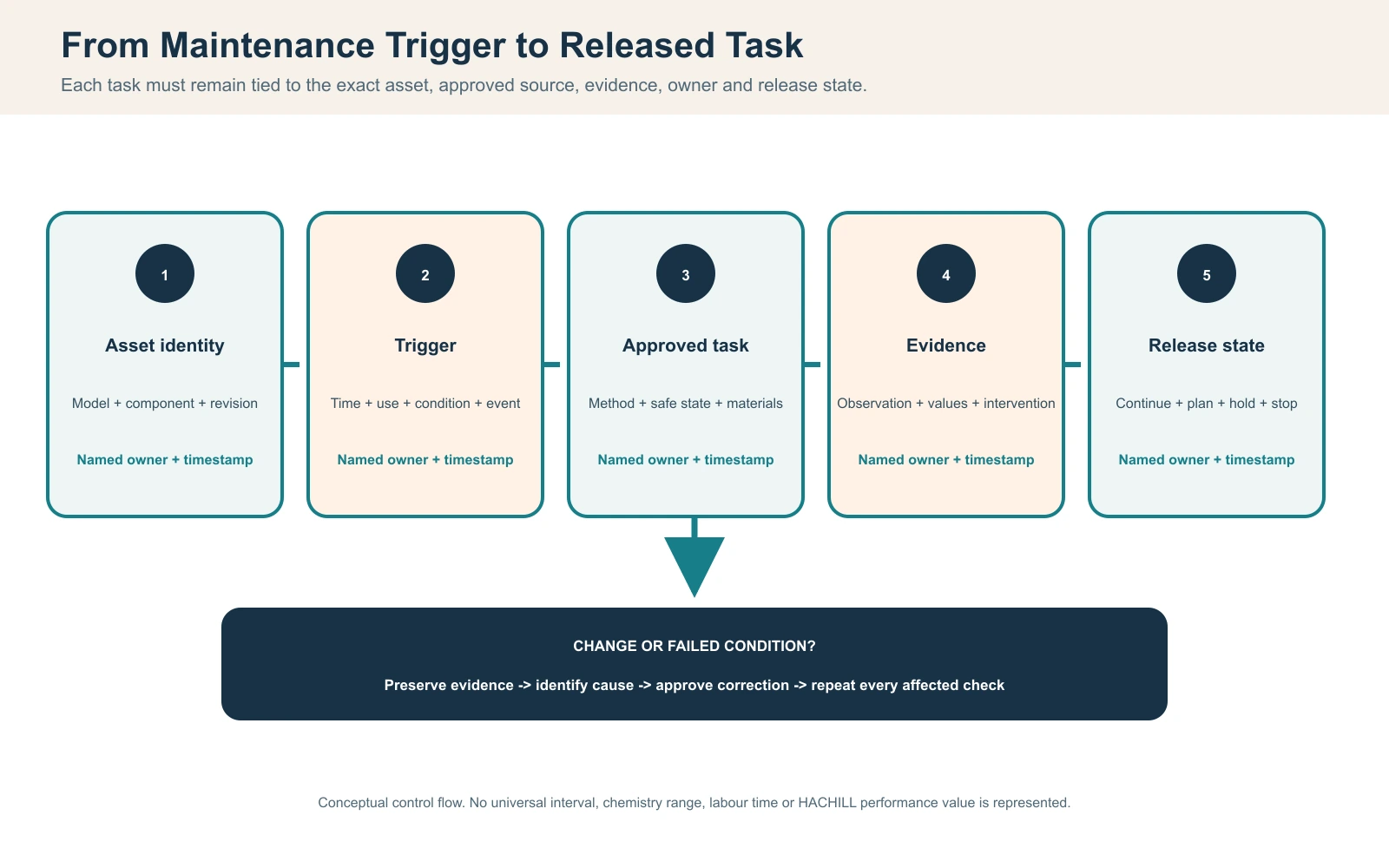
Maintenance can be triggered by elapsed time, operating hours, user or cleaning count, measured condition, alarm, weather or contamination event, shutdown or a change in chemistry, component or site arrangement. Use exact manuals and local rules where they prescribe an interval. Where they do not, establish a provisional trigger from the accepted baseline and revise it with recorded condition, not convenience.
A commercial facility may need checks before opening, during a shift, after a declared number of uses, after storms or chemical excursions and at seasonal closure. That does not justify publishing one interval for every site. Record why the trigger exists, the evidence that closes it and who can change it.
Maintenance trigger classification
| Trigger type | Example input | Required response | Review rule |
|---|---|---|---|
| Time/operating hour | Approved manual interval | Named task and evidence | Exact component/revision |
| Use/load | User or cleaning count | Inspect or service affected interface | Validate against condition trend |
| Condition | Change from accepted baseline | Classify and investigate | No cosmetic assumption |
| Alarm/performance | Control, flow or temperature event | Preserve state; qualified diagnosis | Do not reset away evidence |
| Exposure/event | Storm, leak, spill, power loss, freeze risk | Event-specific inspection/closure | Climate page controls site case |
| Change | Cleaner, finish, filter, pipe or software revision | Compatibility and dependent retest | Named approval before use |
Build a Component-Based Maintenance Checklist and Task Register
Each row should name the exact asset location, trigger, approved method source, safe state, tools or consumables, observations, pass/hold result, evidence, owner and release authority. “Clean wood” or “check chiller” is not executable. A technician needs to know which face, joint, filter, sensor or connection and what condition requires escalation.
Keep planned work separate from corrective work. Routine inspection may identify staining, movement, leakage, restriction or an alarm, but the cause can cross interfaces. The record should preserve the observed condition before repair and link the intervention to affected tests.
Component-based maintenance task register
| Component/task | Trigger and condition | Method/evidence | Owner/release |
|---|---|---|---|
| Liner/rim/weld inspection | Approved interval plus chemistry event | Location images and condition code | Operator; specialist escalation |
| Thermowood/finish check | Use/exposure and baseline change | Dry-state map and approved sample | Operator/service; finish authority |
| Joint/base moisture path | Cleaning, storm, splash or leak event | Wet path and follow-up timestamps | Operator/installer |
| Filter and loop state | Approved interval, load or flow symptom | Filter condition, flow proxy and alarm log | Operator/qualified service |
| Condenser/air path | Debris, high ambient or cooling symptom | Final-site intake/discharge observation | Operator/qualified service |
| Drain/cover/site access | Opening, event and closure | Functional observation and open items | Operator/project owner |
Control Water Care and Cleaner Compatibility
Water chemistry affects users, sanitation, liner, welds, seals, pipework, filter, treatment equipment and adjacent finish. Use exact equipment instructions and applicable local public-facility requirements. Do not copy a range from another tub, pool or country and call it approved. Record the method, sampling location, time, operating state, result, corrective action and release authority.
Approve cleaning products against every contacted material and the final dilution, application, dwell, rinse and drying method. Consider overspray and runoff at the rim, joints, panel backs, fasteners and equipment bay. Do not mix different pool or treatment chemicals together; follow each product label and the approved procedure for any required dilution or preparation. The CDC pool-chemical safety guidance supports keeping chemical handling controlled rather than improvising combinations on site. Keep safety data and operator controls available, and isolate hazardous work as required by the responsible authority.
Water and cleaner compatibility record
| Input | Acquire/verify | Affected interfaces | Hold condition |
|---|---|---|---|
| Water-control limits | Exact manuals and local rules | Users, liner, seals, equipment | Generic range only |
| Test method/location | Approved kit/instrument and named sample point | Trend comparability | Unknown method or stale sample |
| Cleaner identity/lot | Label, SDS and approval record | Metal, wood, finish, seals | Decanted/unidentified product |
| Application method | Dilution, dwell, rinse and dry process | Joints, runoff and residue | Unapproved contact path |
| Corrective action | Cause-linked operator record | Chemistry and affected materials | Repeated dosing without diagnosis |
| Return to service | Required verification and authority | Users and complete system | No release record |
Engineering scenario: staining returns after refinishing
Observed problem: Dark marks reappear near the rim and lower joint shortly after a cosmetic repair.
Likely cause: The intervention treated appearance but did not close repeated splash, trapped moisture, chemistry runoff or a metal-staining source.
How to check: Preserve pre-cleaning images, map the wet path, review chemistry and cleaner records, inspect adjacent fasteners and concealed dry-back, and compare with the accepted baseline.
Prevention or corrective path: Correct the confirmed source and approved drainage or cleaning method before repeating finish work; then record the treated area, product, conditions, dry/cure state and release.
Inspect Thermowood Cladding, Finish, Joints and Fasteners
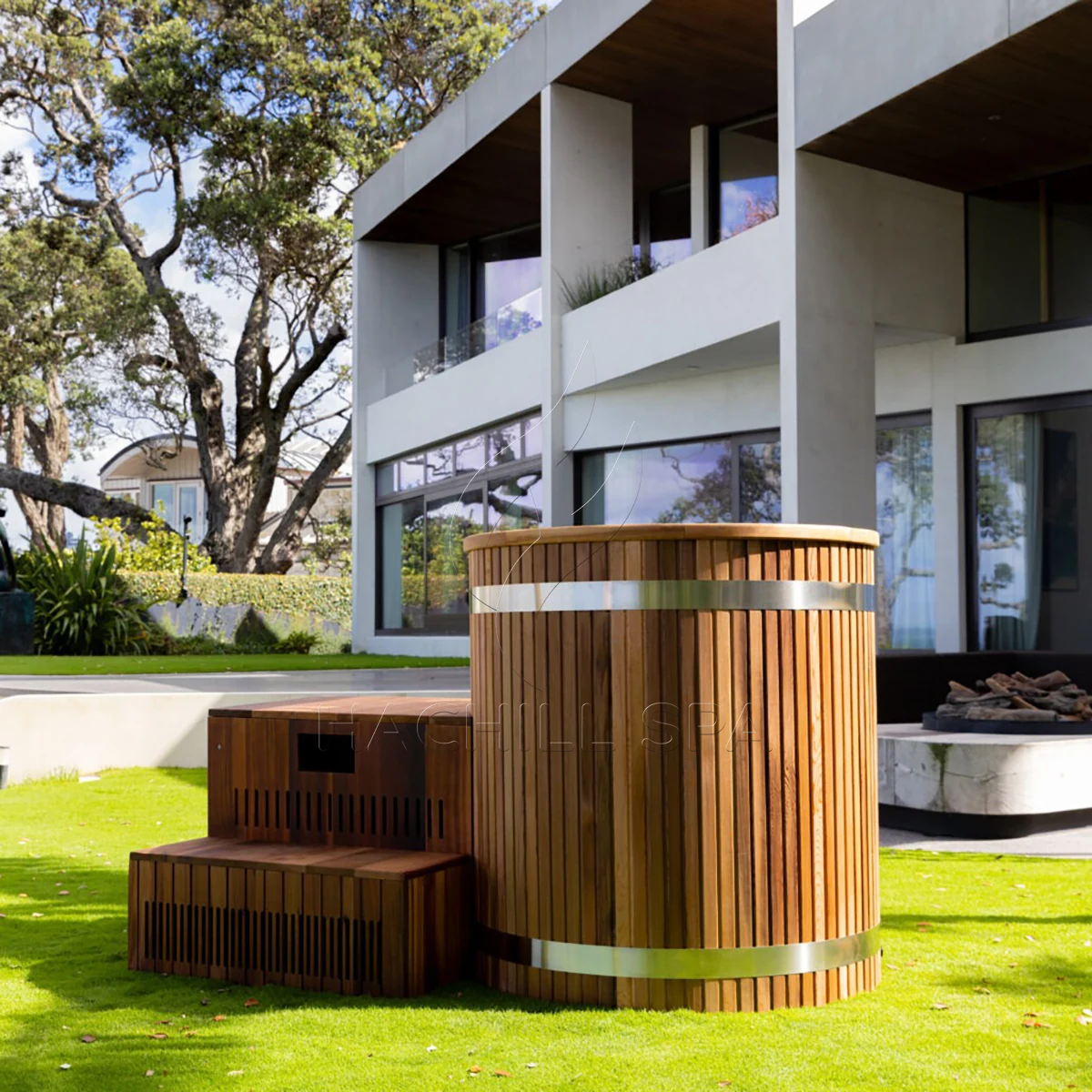
Thermowood condition is influenced by species/product, thermal-modification evidence, profile, grain, finish, cut-edge treatment, assembly detail, UV, wet/dry cycling and maintenance method. The International ThermoWood Association handbook treats surface protection and maintenance as exposure- and treatment-dependent rather than maintenance-free. Colour change alone is not structural failure, while a small dark area may require investigation if it is persistent, wet or associated with a joint or fastener. Compare against a controlled baseline under similar lighting and dry-state conditions. For the construction boundary between external timber and the water-retaining shell, see Thermowood cladding and stainless liners explained.
Map faces, edges, end grain, corners, horizontal ledges, joints, fastener locations and lower zones. Record cracking, checking, movement, coating loss, roughness, staining, softness, odour, persistent moisture or loose hardware without assigning a cause from appearance alone. Sanding, coating removal and refinishing can change dimensions and evidence; use the approved system and isolate dust, chemicals and cure time from operation.
Thermowood condition and finish map
| Location/condition | Acquisition | Decision | Escalation |
|---|---|---|---|
| Face/colour/finish | Controlled dry-state image and sample comparison | Monitor or approved finish task | Rapid/localized change |
| End grain/cut edge | Close inspection after wetting or service | Accepted protection intact | Open/unapproved edge |
| Joint/movement | Gap and alignment reference method | Within approved condition | Interference, loose or water-trapping joint |
| Fastener/contact | Material record and staining/movement check | Secure and compatible | Loose, substituted or crevice staining |
| Lower/base zone | Wet-path and dry-back observation | No persistent trapped state | Softness, odour or standing water |
| Post-refinish | Product/lot, preparation, conditions and cure | Released sample/area | Unknown compatibility or cure |
Inspect the Stainless Liner, Welds and Waterline as a Separate System
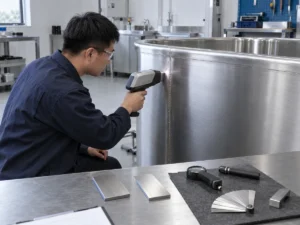
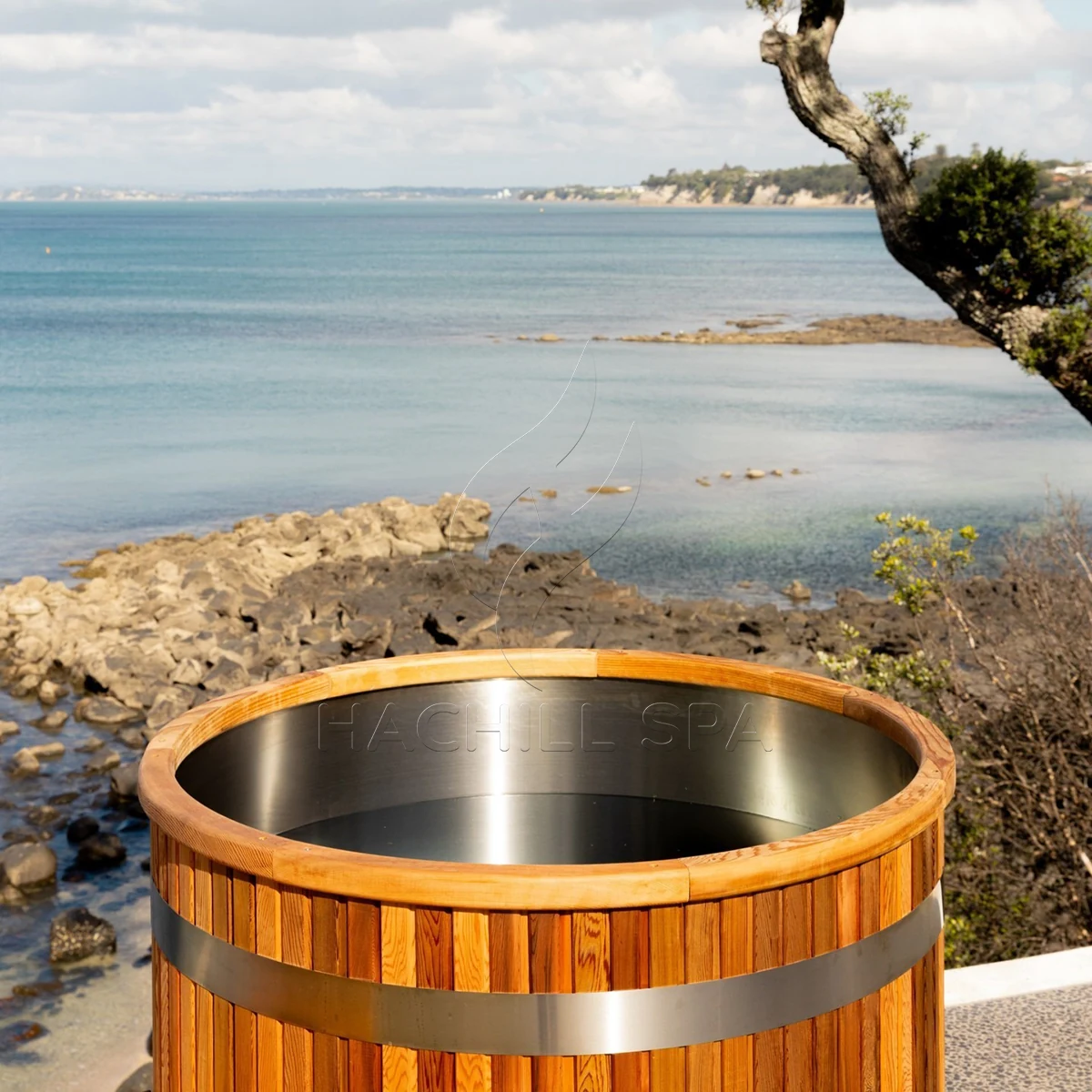
Stainless steel is corrosion resistant under conditions, not maintenance free. Grade, fabrication, weld treatment, surface finish, crevices, chloride exposure, chemistry, cleaners, deposits and dissimilar-metal contact all affect condition. Outokumpu corrosion guidance explains the localized-corrosion risk of chloride-containing environments. Do not infer alloy or treatment from appearance, and do not claim that 316 is immune to pitting or poor fabrication.
Inspect the waterline, welds and heat-affected zones, penetrations, drains, fittings, corners and shielded crevices. Record deposits, staining, pitting-like features, scratches, distortion and active leakage by location and condition. Use an approved cleaning method and preserve evidence before abrasive work. If a feature may affect containment or safety, remove the asset from service and obtain qualified assessment.
Liner, weld and penetration inspection
| Zone | Evidence method | Routine boundary | Stop/escalate |
|---|---|---|---|
| Waterline/deposits | Location image plus chemistry/cleaning record | Approved cleaning and trend | Persistent localized attack |
| Weld/heat-affected zone | Controlled visual and fabrication record | Condition comparison | Crack, leak or open fabrication evidence |
| Penetration/fitting | Dry/wet observation and connection identity | Accessible inspection | Active leak or movement |
| Drain/corner/crevice | Deposit and water-retention check | Approved removal/access | Inaccessible or recurring trapped deposit |
| Surface scratch/mark | Lighting/reference and intervention history | Cosmetic classification by authority | Depth/integrity uncertain |
| Dissimilar contact | Material and installation record | Approved interface | Substitution or corrosion product |
Verify Drainage and Dry-Back After Wet Events
Trace water from user splash, cleaning, overflow, rain, condensation and leaks through rim joints, panel faces, fasteners, panel backs, base, equipment bay and site drain. A dry floor does not prove concealed interfaces are dry, and a floor drain does not prove the product sheds water to it. Use a declared event and follow-up observations at repeatable points.
Do not invent a universal drying time. Airflow, temperature, humidity, finish, joint geometry and wetting amount change dry-back. Record event source, duration or amount method, wet and concealed locations, time, ventilation and the accepted release condition. Persistent wetting can be a site, product, plumbing or operating issue and needs ownership before repair.
Wetting, drainage and dry-back record
| Checkpoint | Event/method | Pass evidence | Hold condition |
|---|---|---|---|
| Rim and panel face | Declared splash/cleaning/rain event | Sheds to intended path | Migration into blind joint |
| Panel back/subframe | Accessible inspection and timestamps | Drain/vent path open | Persistent concealed moisture |
| Base/foundation | Level and wet observation | No standing contact | Ponding at wood or frame |
| Equipment bay | Dry observation after event | No uncontrolled water | Electrical/equipment wetting |
| Site drain | Controlled route observation | Accepted discharge path | Blocked/unapproved discharge |
| Release | Condition-linked follow-up | Named accepted dry state | Time-only assumption |
Engineering scenario: a suspected cleaning splash is an active connection leak
Observed problem: Water repeatedly appears at the base after wash-down and is dismissed as operator splash.
Likely cause: The follow-up inspection occurs only immediately after cleaning, so a slow fitting leak and concealed migration remain untested.
How to check: Dry and isolate the area under an approved procedure, record connection and water-path conditions over time, and compare with no-cleaning and controlled-wetting observations.
Prevention or corrective path: Qualified service corrects the confirmed source, then repeats leak, wet-path, dry-back and affected electrical/equipment checks before release.
Trend Filtration, Flow, Chiller Performance and Controls Together
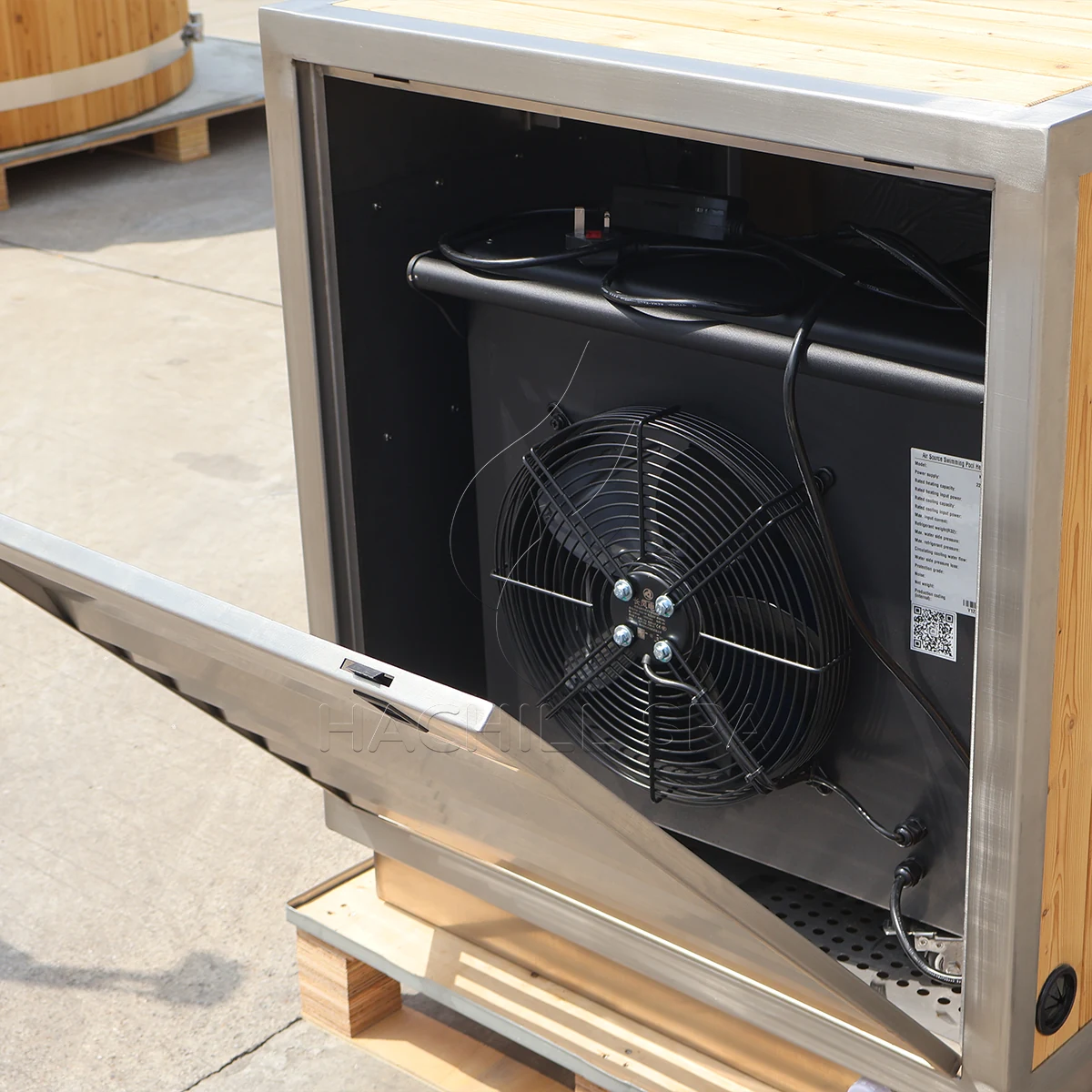
A cold plunge can miss temperature because of high load, high condenser-inlet temperature, blocked airflow, dirty filter, low flow, air in the loop, pump condition, control state, insulation or equipment capacity at the actual operating point. Do not diagnose an undersized chiller from one water-temperature reading. Synchronize bulk-water temperature, inlet air, filter/flow condition, pump and compressor or control state, cover and user load.
Use the approved flow measurement or a qualified proxy; name the method and baseline. A clean-looking filter can still restrict flow, and replacing it without recording the before/after state loses useful evidence. Do not bypass flow, pressure, temperature or electrical protection. Fixed electrical, refrigeration and invasive equipment work remains with qualified personnel.
Hydraulic and cooling maintenance trend
| Input | Acquisition | Decision use | Invalid comparison |
|---|---|---|---|
| Bulk-water temperature | Named sensor/location and time series | Holding/pull-down trend | Single wall reading |
| Condenser-inlet air | Logger at final intake | Available cooling condition | Weather app only |
| Filter/flow state | Approved measurement or proxy | Restriction and heat exchange | Visual cleanliness alone |
| Pump/control/alarm | Control and qualified service log | Separate interruption from capacity | Reset state missing |
| Cover/user load | Timestamped operating record | Concurrent heat gain | Different operating policy |
| Configuration | Pipe, valve, panel and software revision | Comparable baseline | Unrecorded change |
Engineering scenario: cooling declines after several busy days
Observed problem: Water temperature drifts and the chiller runs longer after a high-use period.
Likely cause: The operator assumes equipment capacity has failed, but user load, filter restriction, reduced flow, warm intake air and cover practice were not recorded together.
How to check: Capture synchronized water and intake temperatures, filter and approved flow state, pump/control state, cover and load; compare them with the accepted baseline under a comparable condition.
Prevention or corrective path: Correct the confirmed maintenance or site cause and repeat the same condition-linked test. Escalate capacity only if the verified operating point remains outside the approved equipment case.
Calculate Commercial Maintenance Labour, Closure and Record Burden
Commercial buyers need more than a list of tasks. Measure representative hands-on time for inspection, testing, cleaning, filter work, panel access, draining, refilling and record completion. Add setup, isolation, guest-area closure, dry or cure time, verification and reopening. Keep outsourced qualified service and consumable cost separate from operator labour.
A planning relationship is maintenance workload per period = sum(trigger count x observed hands-on time) + setup + closure + drain/refill + dry/cure + verification + records. This is a data-acquisition method, not a HACHILL labour or uptime promise. Recalculate when duty, chemistry, finish, component or site access changes.
Commercial maintenance workload sheet
| Work element | Acquire | Operating impact | Planning output |
|---|---|---|---|
| Routine inspection/testing | Observed representative task time | Open or supervised state | Operator hours |
| Cleaning/filter work | Task time and consumables | Partial/full closure | Service hours/material |
| Drain/refill/heat removal | Measured site process | Water and reopening delay | Closure dependency |
| Dry/cure time | Approved product/condition record | No user access | Calendar closure |
| Qualified service | Actual call/task scope | Isolation and retest | External resource |
| Records/release | Observed documentation time | Named authority | Administrative load |
Control Consumables and Critical Spares by Revision
Filters, seals, lamps or treatment components, sensors, cleaning products, finish products and replacement hardware must match the exact model and approved revision. A physically similar part can change flow, chemistry compatibility, electrical protection, fit or maintenance interval. Record manufacturer part identity, approved substitute authority, shelf or storage requirement, lot where relevant and installation history.
Use failure consequence and lead-time evidence to decide critical stock; do not invent a universal spare quantity. Separate operating consumables from safety-critical or qualified-service parts. Quarantine damaged, expired, unidentified or unapproved items and preserve the substitution decision.
Consumable and spare-parts control
| Item class | Identity evidence | Stock decision input | Hold condition |
|---|---|---|---|
| Filter/flow component | Exact part and performance basis | Use/load, lead time, failure effect | Look-alike substitute |
| Seal/fitting/hardware | Material, size and interface | Leak consequence and service access | Unknown compatibility |
| Sensor/control part | Exact revision and calibration needs | Failure mode and qualified service | Unapproved software/electrical change |
| Cleaner/water product | Identity, lot, SDS and approval | Usage and storage | Expired/unlabelled product |
| Finish/repair system | Product/lot/sample and conditions | Area, shelf life and cure burden | Colour match only |
| Critical stock review | Consumption and event history | Lead time and closure exposure | Quantity without basis |
Assign Maintenance Responsibilities and Evidence Requirements
Maintenance evidence ladder
| Grade | Evidence | Permitted use | Boundary |
|---|---|---|---|
| A | Witnessed exact-asset task/test under declared condition | Task and condition-specific release | Method/duration only |
| B | Approved exact-model manual, drawing or record | Task planning and identity | Field condition still verified |
| C | Traceable component record or calibrated observation | Interface diagnosis | Complete system not proven |
| D | Qualified estimate with assumptions | Planning/open item | Cannot close release |
| E | Generic checklist, photo or product claim | Orientation | No asset-specific proof |
The supplier controls exact supplied-component information and approved product substitutions. The buyer or facility owner approves the operating plan and resources. The installer preserves as-built site interfaces. The operator executes authorized routine tasks and records conditions. Qualified service providers handle isolated electrical, refrigeration, structural and other specialized work. Local authorities and qualified professionals control regulated public-use, water, electrical and building requirements. For U.S. workplace servicing, OSHA 29 CFR 1910.147 addresses control of hazardous energy where its scope applies; it does not replace equipment-specific procedures or other local requirements.
Thermowood cold plunge maintenance responsibility matrix
| Decision/task | Supplier | Facility/operator | Qualified/local role |
|---|---|---|---|
| Exact model/manual/BOM | Issue controlled evidence | Retain and identify asset | Review regulated interfaces |
| Routine task/trigger | Define supplied-product boundary | Execute, record and escalate | Approve specialized method |
| Water/cleaner control | State compatible equipment limits | Operate to approved plan | Public-health/chemical authority |
| Site drain/power/air | Provide product interface | Keep accessible and monitor | Design/install/verify |
| Defect/substitution | Review supplied product impact | Preserve evidence and hold | Diagnose/approve affected work |
| Return to service | Provide affected test inputs | Apply operating hold | Named competent release |
Define Hold Points and Return-to-Service Checks
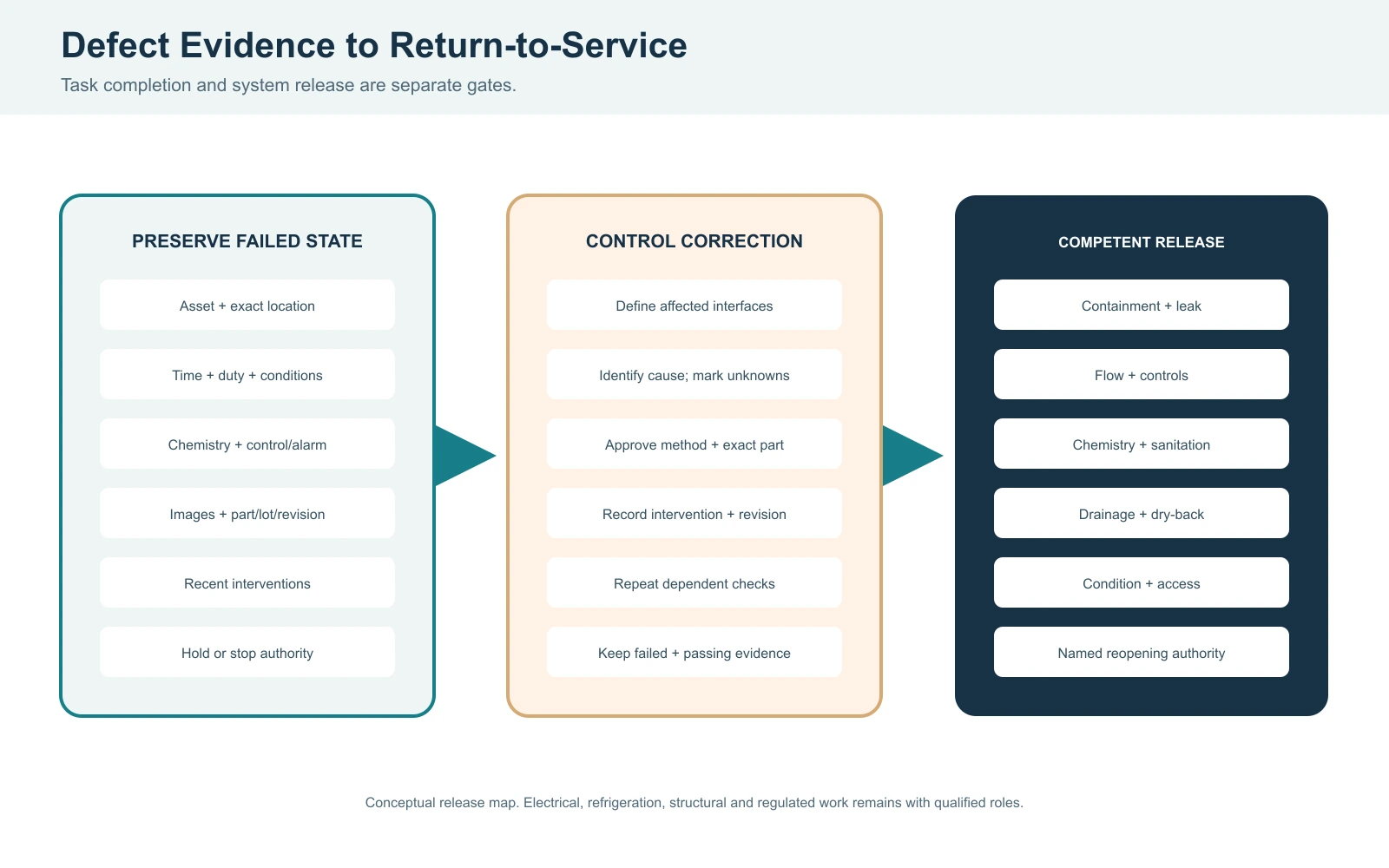
Use four states: continue with normal records; plan a bounded task; hold a component, area or operating mode; or stop the asset. The exact authority defines thresholds. Active leakage near equipment, compromised containment, unsafe access, electrical protection concerns, uncontrolled chemistry, persistent concealed moisture, failed safety/control functions or unknown critical substitutions require escalation rather than cosmetic closure.
Preserve the failed state before cleaning or repair: asset and location, date/time, operating duty, water and air conditions, chemistry, control/alarm state, photographs, part/lot/revision and recent interventions. Identify cause before changing multiple variables. Record correction and repeat every affected test. A completed work order does not by itself release the plunge.
Defect, hold and return-to-service record
| State | Evidence/action | Release requirement | Dispute protection |
|---|---|---|---|
| Continue | Accepted condition and routine record | Normal authority | Baseline comparison |
| Plan | Bounded noncritical change/task | Scheduled owner and due condition | Open-item identity |
| Hold | Affected component/operation isolated | Cause and dependent checks closed | Preserve failed evidence |
| Stop | Safety, containment, chemistry or critical control concern | Named competent authorization | No reset/clean-away |
| Correct | Approved repair or operating change | Revision and affected retest | Part/lot/method linked |
| Reopen | Leak, flow, control, drainage, chemistry and condition as applicable | Cause-specific release | Failed and passing records retained |
Engineering scenario: maintenance is complete but reopening evidence is missing
Observed problem: A work order is closed after filter and connection service, yet no leak, flow, control or water-condition record follows.
Likely cause: Task completion was treated as system acceptance and the affected interfaces were never identified before work.
How to check: Review the observed fault, changed parts, isolation state and exact procedure, then map which containment, hydraulic, control, chemistry and drainage checks were affected.
Prevention or corrective path: Keep the asset on hold until the named competent role completes and records the cause-specific checks; retain both the failed and passing evidence.
Close O&M Handover and Maintenance Requirements in the RFQ
Before opening, hand over the exact asset passport, manuals, as-built schematic, product and site boundaries, approved cleaners and finishes, baseline photographs, task register, triggers, record forms, isolation limits, spares identity, escalation route and return-to-service authority. Demonstrate representative tasks at the final access condition; a panel that opened in the factory may be blocked after installation.
For an RFQ, provide exact configuration, operating duty, user and cleaning load, indoor/outdoor condition, water-treatment plan, local requirements, closure window, operator skill, service access, documentation language, spare expectations, record format and acceptance needs. Ask suppliers to mark included evidence and exclusions rather than promise “low maintenance.”
Commercial maintenance RFQ and handover fields
| Field | Why required | Evidence/response | Closure |
|---|---|---|---|
| Exact asset/configuration | Controls task applicability | BOM, manuals and drawings | Submittal |
| Duty and operating plan | Sets trigger/load context | Use, cleaning and closure assumptions | Maintenance plan |
| Water/cleaner system | Controls compatibility and regulation | Limits, products and local authority | Operator procedure |
| Access/site interfaces | Controls task feasibility | Final panel, drain, air and isolation review | Task demonstration |
| Spares/support | Controls closure exposure | Exact parts, lead-time basis and escalation | Handover |
| Acceptance/records | Makes service comparable | Forms, witnesses and release gates | Opening approval |
Frequently Asked Questions
How often should a commercial Thermowood cold plunge be maintained?
Use exact manuals, applicable local requirements, operating duty and recorded condition. Combine time, use, event, alarm and condition triggers; do not transfer one universal interval between facilities or models.
Can the same cleaner be used on the stainless liner and Thermowood?
Only after compatibility is confirmed for every contacted material, finish, seal and component at the actual dilution, dwell, rinse and drying method. Control overspray and runoff at joints and equipment.
Does 316 stainless steel eliminate corrosion maintenance?
No. Corrosion behaviour also depends on fabrication, weld treatment, surface finish, chlorides, chemistry, cleaners, deposits, crevices and dissimilar-metal contact. Inspect and record the exact condition rather than treating the alloy designation as immunity.
What data helps diagnose reduced cold-plunge cooling?
Synchronize bulk-water temperature, condenser-inlet air, filter and approved flow state, pump/control/alarm state, cover, user load and configuration. A single temperature or horsepower value is insufficient.
When can a cold plunge return to service after maintenance?
After the cause is addressed and every affected containment, hydraulic, control, chemistry, drainage and condition check is completed under the named authority. A closed work order alone is not release evidence.
Reference Basis and Limits
CDC Model Aquatic Health Code is a US public aquatic-facility reference; adoption and local applicability vary.
Outokumpu corrosion-resistance guidance supports the chloride/localized-corrosion boundary used for liner inspection; it does not establish a universal corrosion rating for a HACHILL product.
International ThermoWood Association Handbook provides ThermoWood-specific background on exposure, surface treatment and maintenance; exact installed-product behaviour remains detail- and condition-dependent.
OSHA control of hazardous energy describes a US workplace safety framework; the responsible employer and local rules determine applicability and procedure.
Technical boundary: No exact HACHILL maintenance interval, chemistry limit, wood process, finish system, alloy, cooling result, spare quantity, labour time, lifespan, warranty or certification is claimed here. Approved product records, manuals, site evidence and applicable local rules control.
Turn operating duty into a maintenance brief
Send HACHILL the exact configuration, operating duty, user and cleaning load, water-treatment plan, site exposure, local requirements, closure window, access, spares and evidence needs. The team can review supplied-product interfaces while qualified facility and local parties retain operating authority.