Thermowood Cold Plunge Buying Guide
A system-level method for exposure, liner and cladding evidence, moisture paths, equipment, maintenance workload, production control and acceptance.
Direct answer: Buy a Thermowood cold plunge as a layered water-and-equipment system, not as a wooden cabinet. Qualify the exact water-retaining liner, support, insulation and vapour path, Thermowood product and finish, drainage/ventilation details, fasteners, cooling and treatment equipment, service access, site interfaces and production evidence. The decisive buying record links the real exposure and operating case to approved samples, drawings, batch controls, named responsibilities and separate production, receiving and opening acceptance.
Primary decision: Can every layer and interface survive the declared exposure and operating case?
Evidence rule: Appearance cannot prove liner material, hidden moisture paths or system performance.
Release boundary: Unapproved substitutions, leaks, trapped water or blocked service access hold release.
Classify the Real Exposure Before Choosing Thermowood
A Thermowood cold plunge should be purchased for an exposure and operating case, not from a colour sample alone. Define indoor or outdoor placement, roof cover, rainfall and splash, solar orientation, ambient range, freeze exposure, coastal or chloride conditions, cleaning agents, user turnover, opening hours and expected appearance policy. State whether natural colour change is acceptable or the operator expects a maintained finish.
Acquire the brief from site climate records, architectural drawings, water-treatment plan, cleaning procedure, operating schedule and a wet-route walk-through. For a new project, mark each input approved, measured, estimated or open. The word outdoor does not describe wind-driven rain, trapped shade, reflected sun or freeze-thaw exposure. Commercial does not define bather load, staff skill or closure time.
Thermowood cold plunge exposure brief
| Exposure/input | Acquisition | Decision affected | Hold condition |
|---|---|---|---|
| Rain/splash/washdown | Site and operating sequence | Joint, drainage and finish detail | Wetting path unknown |
| Solar/UV orientation | Layout and shading record | Colour/finish expectation | Approved sample lacks exposure context |
| Ambient/freeze range | Project climate basis | Insulation, drain-down and components | Minimum condition open |
| Water chemistry/cleaners | Approved treatment and SOP | Liner, seals, metal and coating | Compatibility unreviewed |
| User/cleaning duty | Peak schedule and task timing | Access, reset and maintenance | Daily average only |
| Appearance policy | Buyer/operator approval | Sample range and refinishing | One perfect board used as standard |
Detailed climate qualification belongs to Using Thermowood Cold Plunges Outdoors in Different Climates, and detailed maintenance procedures belong to Thermowood Cold Plunge Maintenance for Commercial Buyers. This buying guide uses those inputs only to qualify the product system and supplier evidence before purchase.
Separate the Product into Verifiable Layers
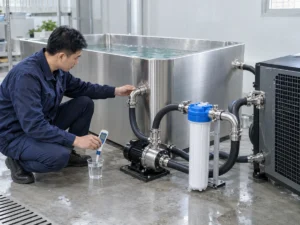
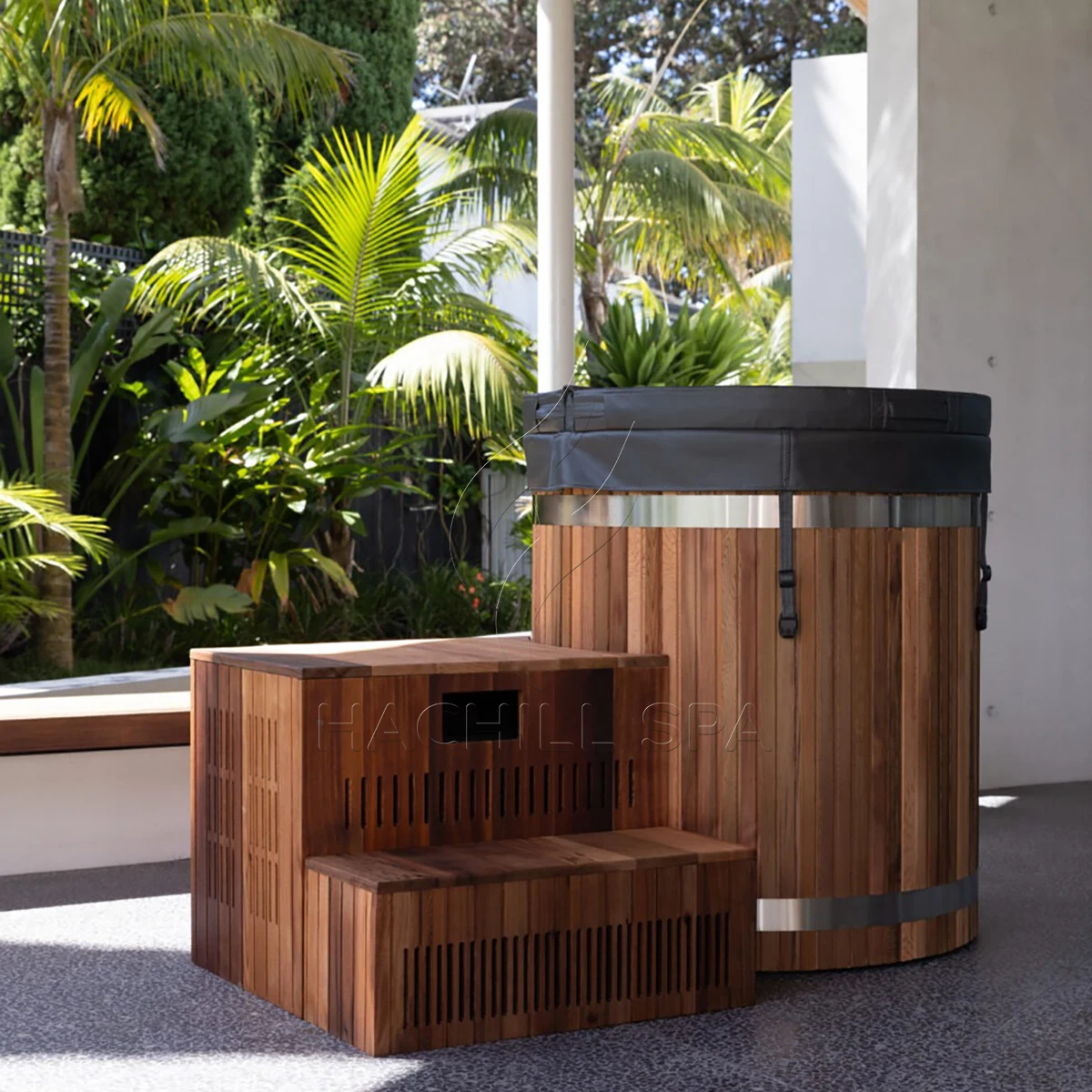
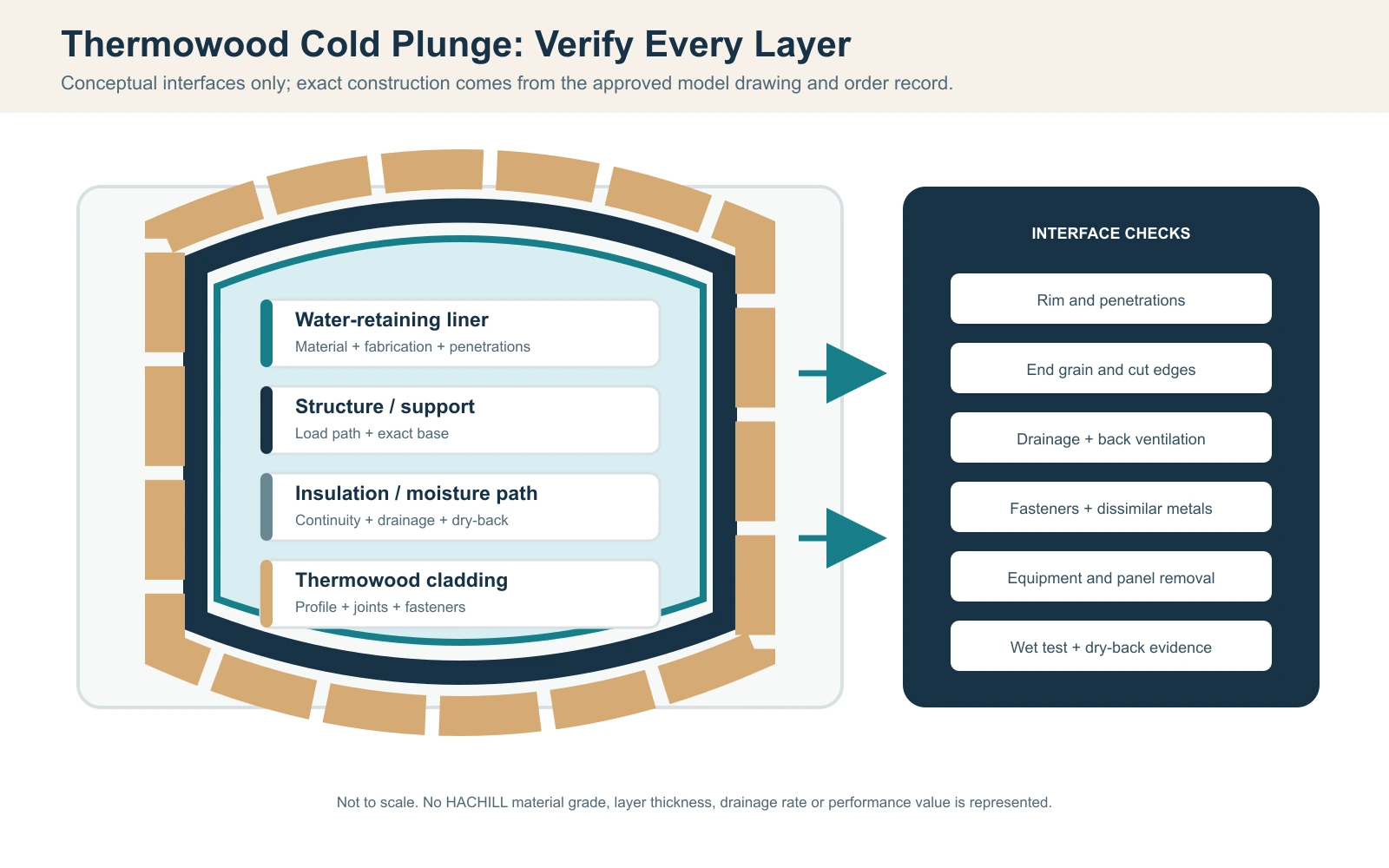
Thermowood is normally a cladding or exterior design layer, not proof of the water-retaining vessel. Draw the full product boundary: liner, supporting structure, insulation, vapour-control path where applicable, cladding and subframe, rim and penetrations, fasteners, cover, circulation equipment, drainage and controls. Record which parts are factory supplied, optional, shipped loose or site supplied.
Each layer has a different job and failure path. The liner contains treated water. The structure carries water and user loads. Insulation limits heat gain and can affect condensation. Cladding manages appearance and weather exposure but must dry and remain serviceable. Interfaces transfer movement, moisture and load between layers. A strong cladding specification cannot compensate for an unsupported liner, inaccessible leak or blocked condenser. For the deeper liner-to-cladding fabrication interface, use Thermowood Cladding and Stainless Liners Explained.
Thermowood cold plunge layer and interface schedule
| Layer/interface | Primary function | Evidence to request | Typical open risk |
|---|---|---|---|
| Water-retaining liner | Contain water and resist approved chemistry | Exact material/fabrication record | Alloy/finish inferred from appearance |
| Structure/support | Carry operating loads | Frame/base drawing and scope | Load path or corrosion protection open |
| Insulation/vapour path | Limit gain and moisture migration | Section/detail and material boundary | Gaps at penetrations |
| Thermowood cladding | Exterior envelope and appearance | Product definition, profile and sample | Generic name only |
| Fasteners/joints | Retain panels and allow movement/service | Material, spacing and detail | Trapped water or staining |
| Equipment/service | Circulate, cool, filter and control | Exact supplied-system schedule | Performance or removal access assumed |
Version-control the schedule because a liner, fastener, subframe, insulation, coating or chiller substitution can affect several interfaces even when the finished product looks unchanged.
Qualify the Water-Retaining Liner Independently
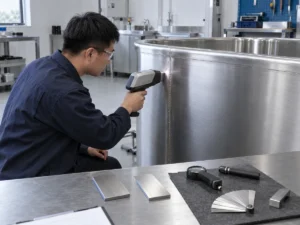
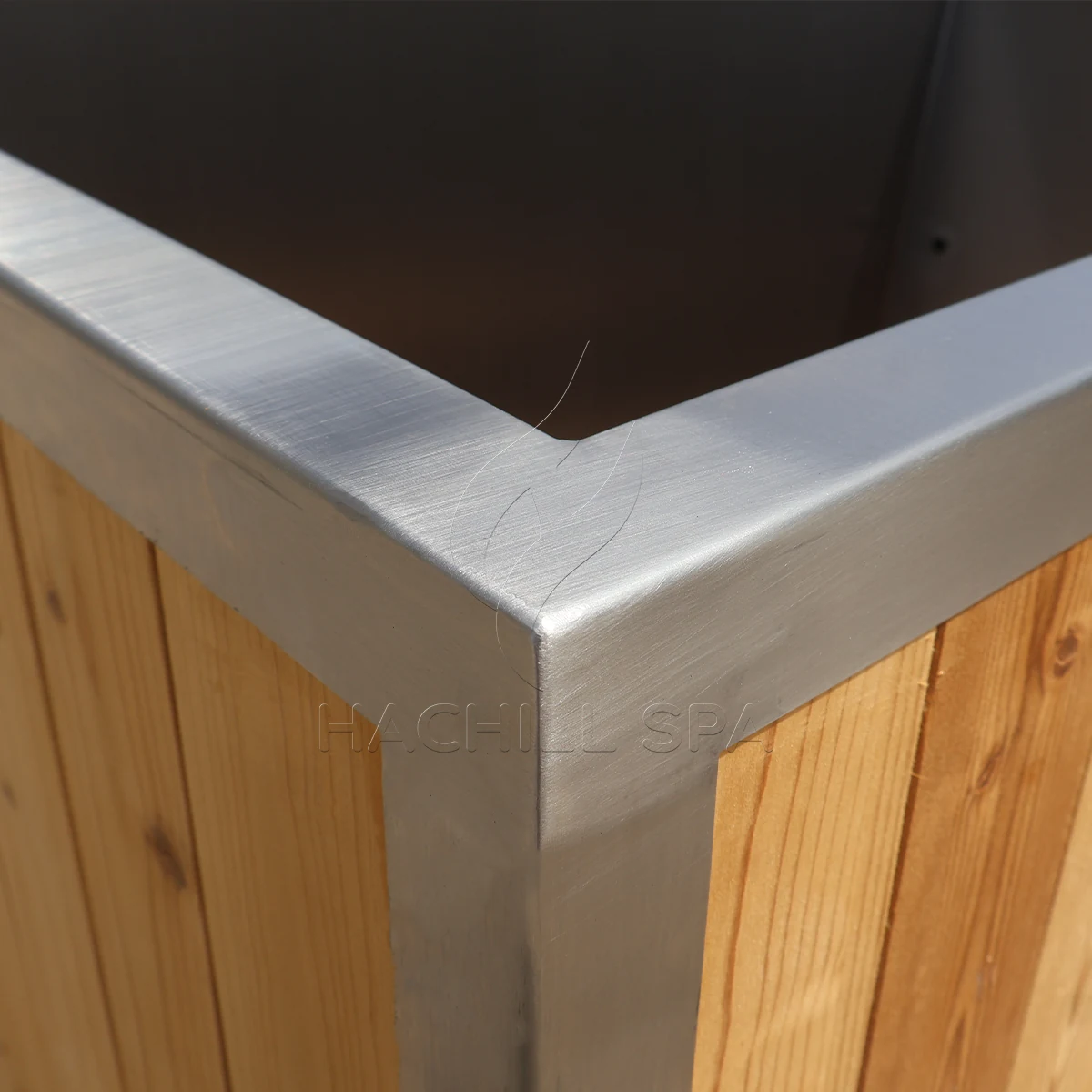
Request the exact liner material, forming/fabrication route, surface finish, weld treatment where applicable, penetrations and repair boundary for the ordered model. If stainless steel is proposed, do not accept statements such as stainless never rusts. Stainless-steel corrosion guidance identifies pitting and crevice corrosion as risks in chloride-bearing environments and notes that temperature, pH and oxidizing conditions also influence susceptibility. Alloy, fabrication, heat-tint condition, crevices, surface contamination, disinfectants, cleaners and maintenance therefore need to be reviewed together. 316 is not immune to localized corrosion, and 304 is not automatically suitable for every water chemistry or exposure.
Inspect weld continuity, accessible heat-affected zones, drainability, waterline details, dissimilar-metal contact and locations where cleaners can remain. Ask how pickling/passivation or other specified post-fabrication treatment is recorded when required. For nonmetallic liners, review support, UV/cleaner compatibility, surface repair and transport protection. Exact thickness or alloy must come from approved product evidence, not this guide.
Water-retaining liner qualification record
| Checkpoint | Supplier evidence | Buyer/field check | Reject/hold trigger |
|---|---|---|---|
| Exact material | Approved model/batch record | Identity and revision | Generic stainless/composite claim |
| Fabrication/welds | Process and inspection record | Accessible visual inspection | Crack, pinhole or unresolved heat tint |
| Surface/finish | Approved sample/finish definition | Lighting and wet/dry inspection | Uncontrolled abrasive or contamination |
| Penetrations/drain | Exact drawing and seal detail | Leak and access test | Hidden or inaccessible joint |
| Chemistry/cleaner boundary | Manual/material compatibility | Operator procedure alignment | Conflicting chemical instructions |
| Repair/service | Approved procedure and parts | Access/disposition plan | No recoverable defect route |
Engineering scenario: beautiful cladding hides a liner dispute
Observed problem: Receiving staff approve the exterior, but the wet test later reveals a leak at a concealed penetration.
Likely cause: Inspection focused on Thermowood colour and never froze the liner penetration detail, access route or pre-shipment leak evidence.
How to check: Preserve crate and wet-test records, trace the exact drawing and batch, then inspect the concealed joint without altering it before cause review.
Prevention or corrective path: Make liner identity, penetrations and controlled leak testing separate hold points; do not release appearance while water-retaining evidence remains open.
Turn the Word Thermowood into a Controlled Specification
Thermally modified timber is a generic material category; ThermoWood® is not a generic name. The International ThermoWood Association states that ThermoWood® is its registered trademark for products made under its defined process and quality-control framework. If a quotation uses the word Thermowood, ask whether it refers to traceable ThermoWood® material or to a generically described thermally modified wood product, then record the exact declared species/product, modification evidence, profile, machining, storage condition and finish. The ordered product—not the category name—controls acceptance. Do not invent a treatment temperature, moisture percentage, product class or durability class when the supplier record is absent.
Approve a representative range rather than one selected board. Record sample ID, board/profile dimensions, face orientation, colour and grain range, knot/defect policy, machining quality, coating system if any, sheen, edge treatment and lighting/viewing condition. Natural variation is not automatically a defect, but an undefined variation range makes receiving disputes unavoidable.
Thermowood cladding specification and sample record
| Field | Required definition | Evidence | Change authority |
|---|---|---|---|
| Species/product identity | Exact declared material | Supplier/batch record | Buyer technical approval |
| Modification evidence | ThermoWood® traceability or declared thermal-modification record, as applicable | Traceable declaration tied to the ordered material | Approved substitution only |
| Profile and face | Drawing, dimensions and orientation | Approved production drawing | Drawing change control |
| Moisture/condition | Specified method and acceptance if required | Instrument/method record | Named quality authority |
| Finish system | Product, coats and preparation if used | Approved sample/process | Compatibility review |
| Visual range | Colour, grain and defect boundaries | Numbered sample set | Buyer-approved concession |
For private-label or multi-batch purchasing, define whether the approved sample controls the first unit, every production batch or only design intent. Keep samples protected and identified. A phone photograph cannot reliably control colour, gloss or texture across lighting and devices.
Inspect End Grain, Joints, Fasteners and Replaceability
Detail risk concentrates at end grain, cut edges, mitres, corners, horizontal ledges, rim transitions, fastener penetrations, panel backs, base clearance and service-door edges rather than on uninterrupted board faces alone. Water should not be encouraged into blind pockets. The USDA Forest Products Laboratory Wood Handbook explains that wood changes dimension as moisture content changes below the fibre-saturation range; thermal modification can reduce dimensional movement, but it does not remove the need for appropriate joint and fixing design. Rigidly trapping boards can still create splitting, cupping or fastener stress when movement or installation tolerances are not accommodated.
Fastener material and finish must suit the wood, subframe, wetting and nearby metals. Review dissimilar-metal contact, staining, accessible tightening and whether removal damages adjacent panels. If the cladding is intended to be replaceable, demonstrate the sequence with the final rim, steps and service equipment installed. A nominal removable panel that requires draining and lifting the whole product is not routine service access.
Cladding detail inspection map
| Detail | Inspection question | Evidence method | Failure/hold signal |
|---|---|---|---|
| End grain/cut edge | Is preparation/finish consistent with approved system? | Close visual and sample comparison | Raw/unapproved exposed cut |
| Corner/joint | Can movement occur without trapping water? | Drawing plus wet observation | Closed pocket or split |
| Base clearance | Can splash/rain drain and the back dry? | As-built level/clearance record | Standing water/soil contact |
| Fastener | Is material, location and finish approved? | Schedule and sample inspection | Staining, overdrive or mismatch |
| Service panel | Can it be removed and reinstalled safely? | Timed demonstration | Hidden fastener or damaged panel |
| Rim/penetration | Is water directed away from concealed layers? | Controlled wet test | Migration behind cladding |
Engineering scenario: a service panel binds after outdoor wetting
Observed problem: A panel that opened during factory inspection cannot be removed after rain and repeated splash exposure.
Likely cause: The fit and fastener pattern were approved only in the dry factory condition, without enough allowance for material movement, coating build, installation tolerance or the final wetting/drying environment.
How to check: Record panel moisture/exposure state where specified, inspect edge clearances and fasteners, and repeat the removal task without forcing or damaging the panel.
Prevention or corrective path: Revise the approved joint or panel system, protect cut edges as specified and repeat dry/wet service-access acceptance before shipment or opening.
Trace Every Moisture and Drying Path
Draw rain, splash, wash water and condensation paths from the rim to the base. Identify where water drains, where air can circulate and which concealed materials may absorb or retain moisture. Decorative cladding should not be treated as the building waterproofing system. Site drainage, wet-room membranes and permitted discharge remain project responsibilities unless explicitly included and accepted.
A controlled wetting observation can reveal capillary bridges, horizontal traps and drainage into the equipment compartment. Use the final panel joints, rim, steps and base arrangement. Record water source, duration, amount or repeatable method, environmental condition, observation points and dry-back period. Do not make a universal dry-time claim; geometry, finish, ventilation and climate control it.
Moisture-path and drying verification
| Path | Required condition | Acquisition | Stop/retest boundary |
|---|---|---|---|
| Rim to cladding face | Water sheds without entering blind joint | Controlled splash/wetting | Water enters concealed layer |
| Panel back/subframe | Drainage and ventilation path open | Inspection before closure | Blocked cavity or absorbent debris |
| Base/feet | No standing water against wood | Level and wet observation | Ponding or ground contact |
| Equipment bay | Separated from uncontrolled wetting | Final-panel wet test | Water reaches electrical/equipment risk |
| Condensation path | Cold surfaces insulated/managed as designed | Condition-linked observation | Source confused with leak |
| Dry-back/access | Inspectable under accepted operation | Timestamped follow-up | Persistent concealed moisture |
Review Insulation and Condensation at Every Penetration
Insulation performance cannot be judged from thickness alone. Request the covered areas, material boundary, joint treatment, service-opening detail and relationship to the liner, structure and cladding. Gaps at drains, pipe penetrations, valves, supports and access doors can create cold bridges. Moisture inside some insulation systems can reduce performance and make diagnosis difficult.
Condensation is plausible when a surface is below the surrounding air dew point. A project review should log air temperature and relative humidity, named surface temperatures, water temperature, ventilation state and time. This check does not rule out a simultaneous leak. Corrective choices such as insulation, vapour control, ventilation or dehumidification require actual conditions and approved materials.
Insulation and condensation interface record
| Input/check | Evidence | Why it matters | Open boundary |
|---|---|---|---|
| Coverage/continuity | Section and pre-closure inspection | Heat gain and cold bridges | Hidden gap |
| Joint/vapour detail | Approved material/detail | Moisture migration | Direction/compatibility unverified |
| Penetrations/supports | Exact as-built detail | Local condensation path | Generic section only |
| Air temperature/RH | Identified meter/logger and measurement location; calibration/verification where required by the project | Dew-point basis | One reading not representative |
| Surface/water temperature | Identified instrument, method and measurement points | Condensation plausibility | Instrument setup or point location open |
| Ventilation state | Operating log | Actual humidity condition | Test differs from accepted use |
Use the supporting climate and maintenance guides for deeper operating treatment. At purchasing stage, the goal is to close the construction boundary, evidence and access needed to manage moisture without promising a universal energy or condensation result.
Qualify Cooling, Circulation and Controls as a Separate System
Thermowood cladding does not establish cooling capacity, flow, filtration or commercial duty. Record and approve the operating water volume, initial and target temperatures, ambient range, required pull-down and recovery, user schedule, cover state, voltage/frequency and indoor/outdoor equipment location. Request useful cooling at matching conditions rather than relying on compressor horsepower or electrical input. Full project-duty calculation belongs to the Cold Plunge Thermal Engineering and Chiller Sizing Guide.
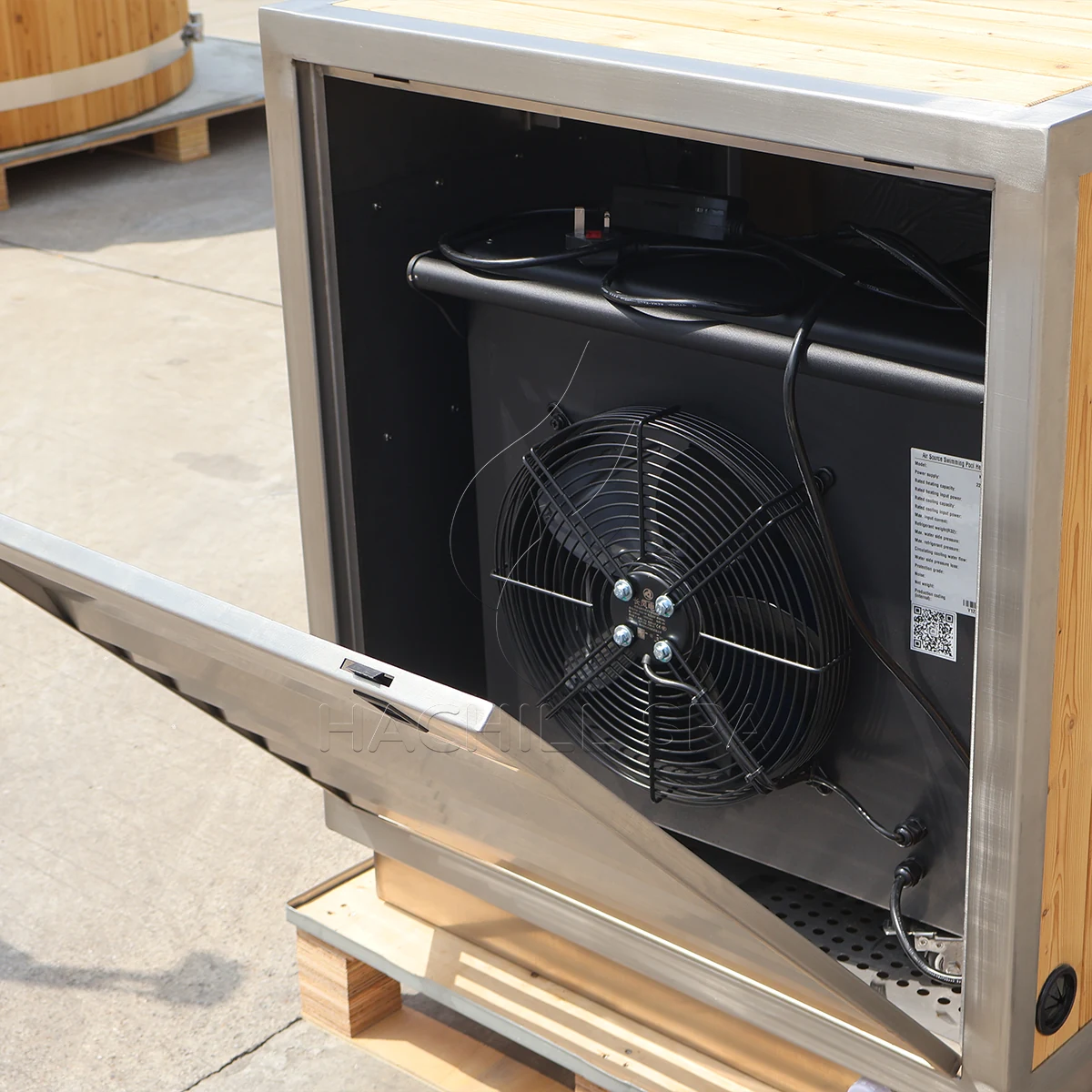
Review pump operating point, complete-loop pressure loss, heat-exchanger flow boundary, filter state, air removal, drain-down, controls, sensors, alarms and condenser airflow. Ensure service panels allow filter, pump, chiller and controller removal without destroying the cladding. Product photographs identify visible components only; they do not prove included scope or performance.
Thermowood cold plunge supplied-system schedule
| System input | Required evidence | Acceptance use | Do not infer from |
|---|---|---|---|
| Operating volume/thermal case | Approved basis and condition data | Pull-down/recovery selection | Cabinet size |
| Useful cooling | Condition-linked capacity/test | Thermal decision | HP/input power |
| Loop flow/pressure | Curve and field/test evidence | Heat exchanger/filter operation | Pump nameplate maximum |
| Treatment scope | Exact included components/interfaces | Operating plan | Ozone/UV marketing label |
| Controls/electrical | Diagram, voltage/frequency and logic | Site coordination | Plug photograph |
| Service removal | Final-layout demonstration | Lifecycle access | Door presence alone |
Engineering scenario: the chiller works until the decorative enclosure is installed
Observed problem: Cooling performance degrades and high-pressure protection occurs after final cladding and landscaping close the equipment bay.
Likely cause: Condenser intake, hot-air discharge and service clearance were reviewed before the final exterior envelope and site planting were installed.
How to check: Log condenser-inlet ambient, airflow path, control state and water temperatures with panels and surroundings in the accepted configuration.
Prevention or corrective path: Restore or redesign the approved airflow/service envelope, then repeat condition-linked thermal testing before opening.
Calculate the Maintenance and Appearance Workload
Maintenance suitability is a purchasing input. List liner cleaning, waterline wiping, panel inspection, fastener check, drainage-path clearing, finish inspection, refinishing where specified, cover care and equipment access. Measure representative task time with the final product and installed clearances. Separate hands-on time from drying, curing or required closure.
A transparent planning relationship is maintenance workload per period = sum(task frequency x observed hands-on time) + setup + closure/curing + records. It is not a universal labour allowance. Frequency depends on exposure, finish system, user duty, cleaning procedure and appearance policy. Detailed methods belong to the model manual and maintenance guide.
Thermowood system maintenance workload
| Task | Acquisition | Closure/access input | Buying decision |
|---|---|---|---|
| Cladding inspection | Timed final-product walk-around | All faces/base visible? | Panel/detail suitability |
| Cleaning/waterline | Observed approved procedure | User closure and drying | Surface/access fit |
| Drainage/vent paths | Inspection/clearing trial | Panel or tool removal | Moisture-control workload |
| Finish/refinishing | Approved system trial/data | Preparation and cure closure | Appearance policy cost |
| Fastener/panel service | Timed removal/reinstall | Replacement parts/tools | Replaceability |
| Equipment service | Filter/component task trial | Water/electrical isolation | Commercial operating burden |
If the operator cannot provide the required skills, space or closure time, choose a different finish system or service plan. Calling Thermowood low maintenance without conditions is not an engineering conclusion.
Verify Delivery, Foundation, Drainage, Power and Replacement Routes
Compare packed dimensions, weight, centre of gravity, permitted orientation and lifting points with every gate, corridor, turn, threshold, lift and crane zone. Then verify the installed envelope, steps, cover movement, approach, drainage, condenser air and component removal. A product can fit the final location yet fail the delivery or future replacement route.
Calculate the filled operating mass from the exact empty product, approved operating water, users and included accessories; transfer the resulting load inputs, support reactions and base geometry to the qualified structural/project party. Electrical protection, disconnecting means, grounding/bonding and fixed wiring must follow the exact equipment instructions and applicable local electrical rules. Plumbing, drainage, waterproofing, structural approval, accessibility and public-use requirements are likewise jurisdiction- and project-specific and should be assigned to the qualified parties responsible for them.
Thermowood cold plunge site-release inputs
| Interface | Required input | Verification | Hold condition |
|---|---|---|---|
| Packed route | Crate envelope, mass, orientation | Measured route/swept path | Unverified turn/lift |
| Foundation/support | Filled mass and base reactions | Qualified project review | Generic kg/m2 assumption |
| Wet zone/drainage | Drain event and site system | Controlled wet test | Ponding/unapproved destination |
| Power/electrical | Exact rating and diagram | Qualified installation/test | Voltage/frequency/protection open |
| Condenser air | Intake/discharge/service envelope | Final-site observation | Recirculation/obstruction |
| Future replacement | Component/product removal path | Final-layout demonstration | Destructive access required |
Freeze Samples, Drawings and Substitution Authority
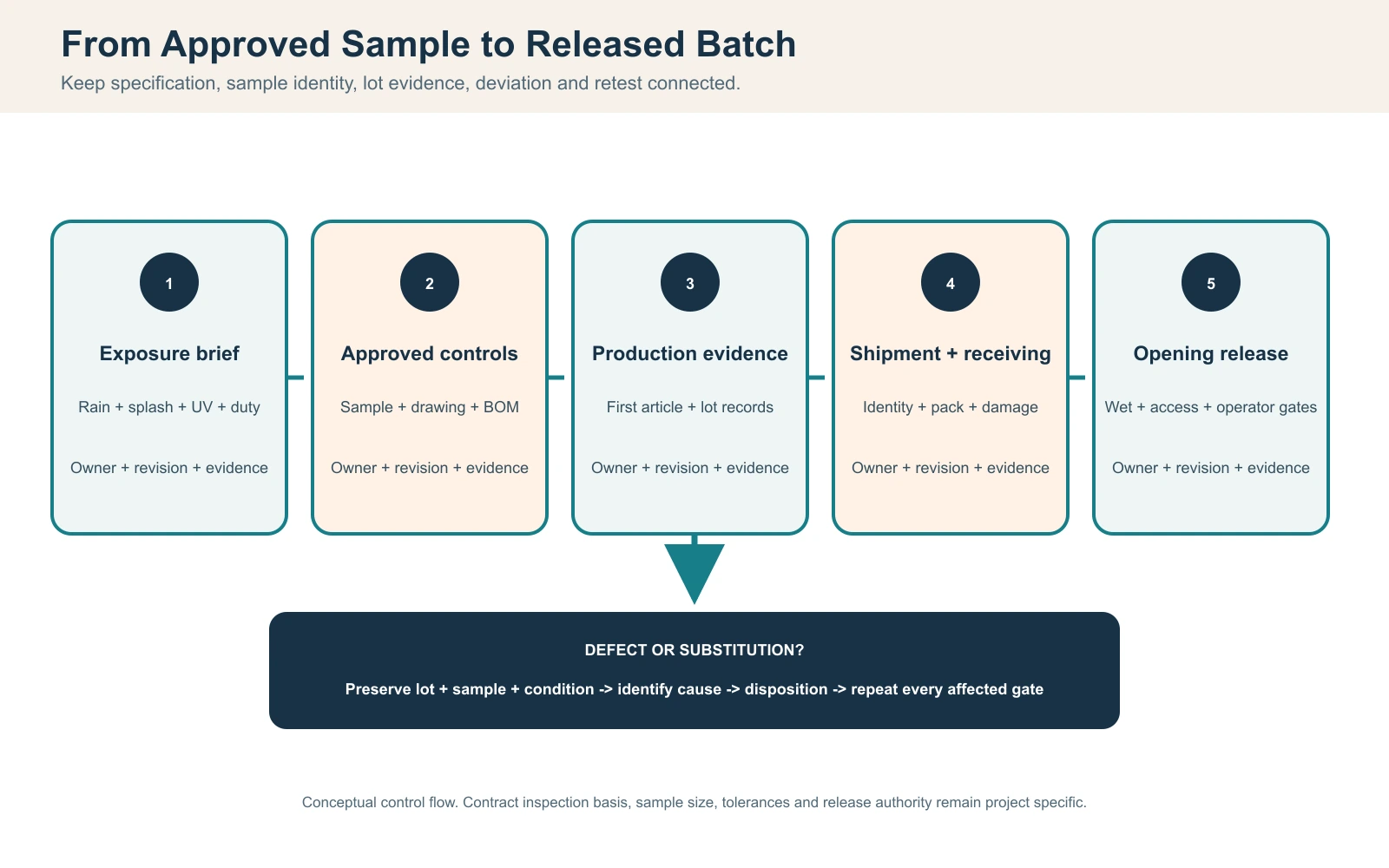
Before production, approve the exact specification hierarchy: order schedule, drawings, material records, numbered Thermowood sample range, liner finish sample, fastener schedule, coating process, equipment list, label/manual language and packaging. State which document controls when they conflict. Assign who may approve a substitution and which downstream reviews it reopens.
Use pre-production, in-process and pre-shipment hold points appropriate to order risk. Record batch/lot identity, sample selection method and defect classification. Do not claim a universal sample size without the contract, order quantity, risk and inspection standard. The buyer and supplier should agree critical, major and minor defect definitions and disposition authority before inspection.
Sample-to-production and substitution controls
| Control | Approved evidence | Production check | Change consequence |
|---|---|---|---|
| Thermowood sample range | Numbered physical set | Batch comparison under stated light | Buyer concession or correction |
| Profile/joint drawing | Released revision | First-article dimensional check | Interface review |
| Liner/material record | Exact specification/batch identity | Traceability and fabrication check | Chemistry/fabrication review |
| Finish/coating process | Product/process/sample | Preparation and batch record | Appearance/compatibility review |
| Equipment BOM | Approved brands/models or boundaries | Serial/component verification | Thermal/electrical/service review |
| Packaging/labels | Approved pack and market files | Pre-shipment inspection | Logistics/market compliance review |
Engineering scenario: production matches the photo but not the approved system
Observed problem: A batch arrives with similar colour but a changed fastener, finish product and service-panel joint.
Likely cause: The purchase order approved a rendered image rather than a controlled sample, drawing and substitution route.
How to check: Compare lot records, physical samples, released drawings and BOM revisions; isolate the affected batch before installation.
Prevention or corrective path: Disposition each change through the named authority, correct or concede it in writing, and repeat affected wetting, service and appearance checks before release.
Grade Evidence by Exact Model, Batch and Method
Project-use framework: The A–E levels below are a procurement aid for this guide, not an industry standard or certification scheme. Grade A is witnessed exact-configuration or batch testing with a declared method and condition. Grade B is an approved exact-model drawing, material record or physical sample. Grade C is a traceable component record from the exact BOM. Grade D is a qualified planning estimate. Grade E is a category photo, generic claim or undocumented statement. A higher level does not remove scope limits: a sample proves only the attributes it was approved to control.
Thermowood cold plunge evidence ladder
| Grade | Evidence | Permitted decision | Limitation |
|---|---|---|---|
| A | Witnessed exact configuration/batch test | Contract acceptance | Method and condition only |
| B | Approved exact drawing/material/sample | Production and receiving basis | Field state still verified |
| C | Traceable exact-BOM component record | Interface support | Complete system not proven |
| D | Qualified estimate with assumptions | Early planning | Cannot close release |
| E | Photo, category copy, undocumented claim | Orientation | No material/performance closure |
Preserve superseded evidence and mark status. A new sample or drawing revision should not silently replace the contract basis. Link deviations and concessions to affected quantities and serial/batch identities.
Assign Supplier, Buyer, Installer and Operator Responsibilities
Assign responsibility by contract and project scope. The supplier should own accurate exact-product documentation, agreed production controls and evidence for the supplied system. The buyer/project team should own the application brief, appearance policy, site-design inputs and acceptance hierarchy. The installer should own the installed configuration, site interfaces and commissioning records within its scope. The operator should own the approved water, cleaning, inspection and closure procedures. Qualified local parties remain responsible for structural, electrical, plumbing, accessibility, public-health and code decisions within their authority.
Thermowood cold plunge responsibility matrix
| Output | Primary owner | Required evidence | Release authority |
|---|---|---|---|
| Exposure/application brief | Buyer/project/operator | Approved inputs and open items | Buyer technical authority |
| Exact product/BOM | Supplier | Drawing, material and scope records | Buyer/supplier approval |
| Sample/appearance range | Buyer plus supplier | Numbered physical samples | Named buyer authority |
| Site interfaces | Project/installer | Foundation, drainage, power, airflow | Qualified project parties |
| Commissioning | Installer/supplier/operator | Leak, flow, control and task records | Named commissioning authority |
| Routine operation | Operator | Water, cleaning and inspection logs | Duty manager |
| Deviation/retest | Named issue owner | Cause, disposition and passing record | Original release authority |
Replace "by others" with a named role, deliverable and due stage. HACHILL Product Engineering can review exact product and supplied-system inputs when a selected model, destination and project brief are provided; it cannot approve site-regulated work on behalf of local professionals.
Accept Samples, Production, Receiving and Opening Separately
Sample acceptance closes only the declared visual and material attributes. Pre-production acceptance closes released drawings and BOM. In-process checks preserve batch control. Pre-shipment acceptance verifies the agreed inspection state and packaging. Receiving acceptance records crate condition, identity, quantity, visible damage and document revision. Installation and opening require separate leak, drainage, flow, control, wetting, access and operator checks.
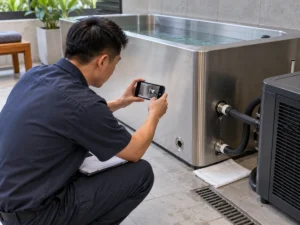
When a defect is found, preserve photographs, lighting, measurement method, sample ID, drawing revision, lot/serial identity and affected quantity before repair. Classify the issue against the agreed standard. Identify cause and disposition: correction, replacement, concession or rejection. Repeat every affected check; a cosmetic repair does not close a leak, moisture-path or service-access issue.
Thermowood system acceptance and dispute schedule
| Gate | Pass evidence | Hold/stop condition | Controlled retest |
|---|---|---|---|
| Sample/specification | Numbered range, drawings and hierarchy | Generic or conflicting basis | Reissue approved controls |
| Pre/in-process | First article, batch and change records | Unapproved substitution | Correct and resample affected lot |
| Pre-shipment | Inspection, wet/leak and packaging evidence | Critical defect/open deviation | Cause-specific reinspection |
| Receiving | Identity, crate, quantity and damage record | Mismatch/transport damage | Disposition then reinspection |
| Installation/commissioning | Site, wet, flow, control and access checks | Leak, unsafe support, blocked drainage/air | Restore declared configuration |
| Opening | Operator procedure and all releases | Missing authority or uncontrolled risk | Named authority reopens |
Do not overwrite failed records with the passing retest. Link both through an issue and change record so buyer and supplier can distinguish manufacturing defect, transport damage, site exposure, maintenance state and accepted natural variation.
Issue a Normalized Thermowood Cold Plunge RFQ
Send application, indoor/outdoor exposure, destination climate, user duty, water/treatment plan, appearance policy, dimensions/volume, thermal case, power, site interfaces, quantity, OEM scope, documentation language, target evidence, inspection plan, packaging and project dates. Require every bidder to state inclusions, exclusions, assumptions and alternatives on the same schedule.
Thermowood cold plunge RFQ fields
| RFQ field | Why required | Supplier response | Closure |
|---|---|---|---|
| Exposure/appearance policy | Defines envelope and sample range | Suitable system and limitations | Technical bid |
| Layer/material schedule | Separates liner, frame, insulation and cladding | Exact BOM/evidence | Submittal |
| Thermal/hydraulic case | Prevents cabinet-led selection | Condition-linked system basis | Selection/test plan |
| Site/service interfaces | Closes foundation, drainage, power and air | Included/excluded boundary | Coordination |
| Maintenance/parts | Tests operator fit | Tasks, access and spares | Operating plan |
| Samples/QC/inspection | Controls production and disputes | Hold points and traceability | PO/production |
| Packaging/market files | Controls delivery and destination | Pack, labels, manuals | Shipment release |
Compare total supplied scope and evidence, not only exterior price. A lower quotation is not normalized if liner grade, equipment, finish process, service panels, packaging or commissioning remain open.
Frequently Asked Questions
Is Thermowood the water-retaining part of a cold plunge?
On the product architecture discussed in this guide, Thermowood is an exterior cladding/design layer rather than proof of the water-retaining vessel. The exact ordered product still controls. Request a layer schedule showing the liner, structure, insulation, cladding, fasteners and equipment instead of assuming the wood contains the water.
Is ThermoWood® the same as any thermally modified wood?
No. The International ThermoWood Association identifies ThermoWood® as its registered trademark rather than a generic name for all thermally modified timber. In an RFQ, record the supplier’s exact declared material identity and request traceable product/process evidence instead of treating the terms as automatically interchangeable.
Does Thermowood require no maintenance?
No material should be purchased on that promise. Inspection, cleaning and finish needs depend on species/product, modification, coating, rain, UV, splash, ventilation, cleaning procedure and appearance expectations. Use the approved model instructions and project exposure.
How should buyers control Thermowood colour variation?
Approve a numbered physical sample range under a stated viewing condition, not one ideal board or a phone photo. Define grain, defects, profile, finish, sheen and who can accept a concession or substitution.
What should be checked behind Thermowood cladding?
Check drainage and ventilation paths, subframe, fasteners, insulation continuity, penetrations, service access and whether moisture can reach the equipment bay. Concealed layers need pre-closure evidence and controlled wet observation where applicable.
What information belongs in a Thermowood cold plunge RFQ?
Include exposure, appearance policy, operating case, layer/material requirements, thermal and electrical inputs, site interfaces, quantity, samples, QC hold points, packaging, manuals, evidence and acceptance responsibilities.
Reference Basis and Limits
International ThermoWood Association: What is ThermoWood®? provides the trademark, process and product-class context. It does not verify which wood product or process is used in a specific HACHILL model or purchase order.
USDA Forest Products Laboratory Wood Handbook provides wood/moisture and dimensional-behaviour background; exact product behaviour remains species-, process-, detail- and exposure-dependent.
Outokumpu stainless-steel corrosion guidance provides general pitting/crevice-corrosion context for chloride-bearing and oxidizing environments; exact liner suitability still requires the ordered alloy, fabrication, water chemistry and operating conditions.
CDC Model Aquatic Health Code (current-edition page) is U.S. guidance for public aquatic venues, not a globally binding cold-plunge code. Local adoption, venue classification and applicability must be checked. CDC also maintains cold-plunge resource links for public cold-water venues.
Technical boundary: No exact HACHILL wood species, ThermoWood® status, thermal-modification schedule, moisture value, liner alloy/thickness, cooling time, flow, lifespan, warranty or certification is claimed here. Approved product records, physical samples, manuals, project evidence and applicable local rules control.
Turn the Thermowood specification into a project review
Send HACHILL the exposure, application, operating case, preferred format, water and thermal inputs, site interfaces, destination, quantity, samples, OEM scope and required evidence. The team can review exact product and supplied-system options while keeping local regulated work with qualified project parties.