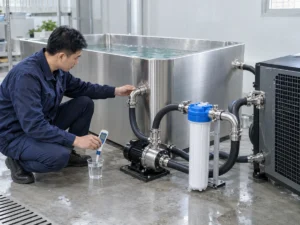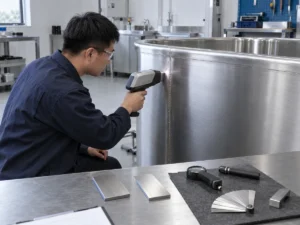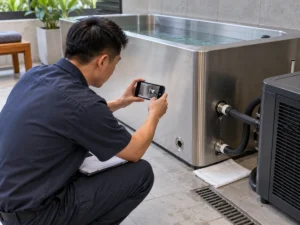
Direct answer: In a Thermowood-clad cold plunge, the wood exterior and stainless liner are separate systems with separate failure modes. The stainless liner contains the water, so its exact alloy, fabrication, weld condition, surface finish, drain geometry and compatibility with the approved water-care program matter. Thermowood is normally an exterior cladding layer; it needs a detail that can shed splash or rain, dry after wetting, accommodate normal wood movement and remain removable where service access is required.
The most important inspection points are not the broad material labels but the interfaces: the liner rim, corners, panel joints, fasteners, penetrations, base and service openings. A useful specification shows how water is kept out of concealed layers, how trapped moisture can escape, which materials are used at each interface, and how the assembly will be cleaned and inspected without damaging either surface.
Scope: This page explains the cladding-to-liner construction interface. For whole-product selection, use the Thermowood cold plunge buying guide. For broader material comparison, use the cold plunge material comparison. Stainless grade selection should be confirmed separately for the exact model and operating water.
What the cladding and liner each do
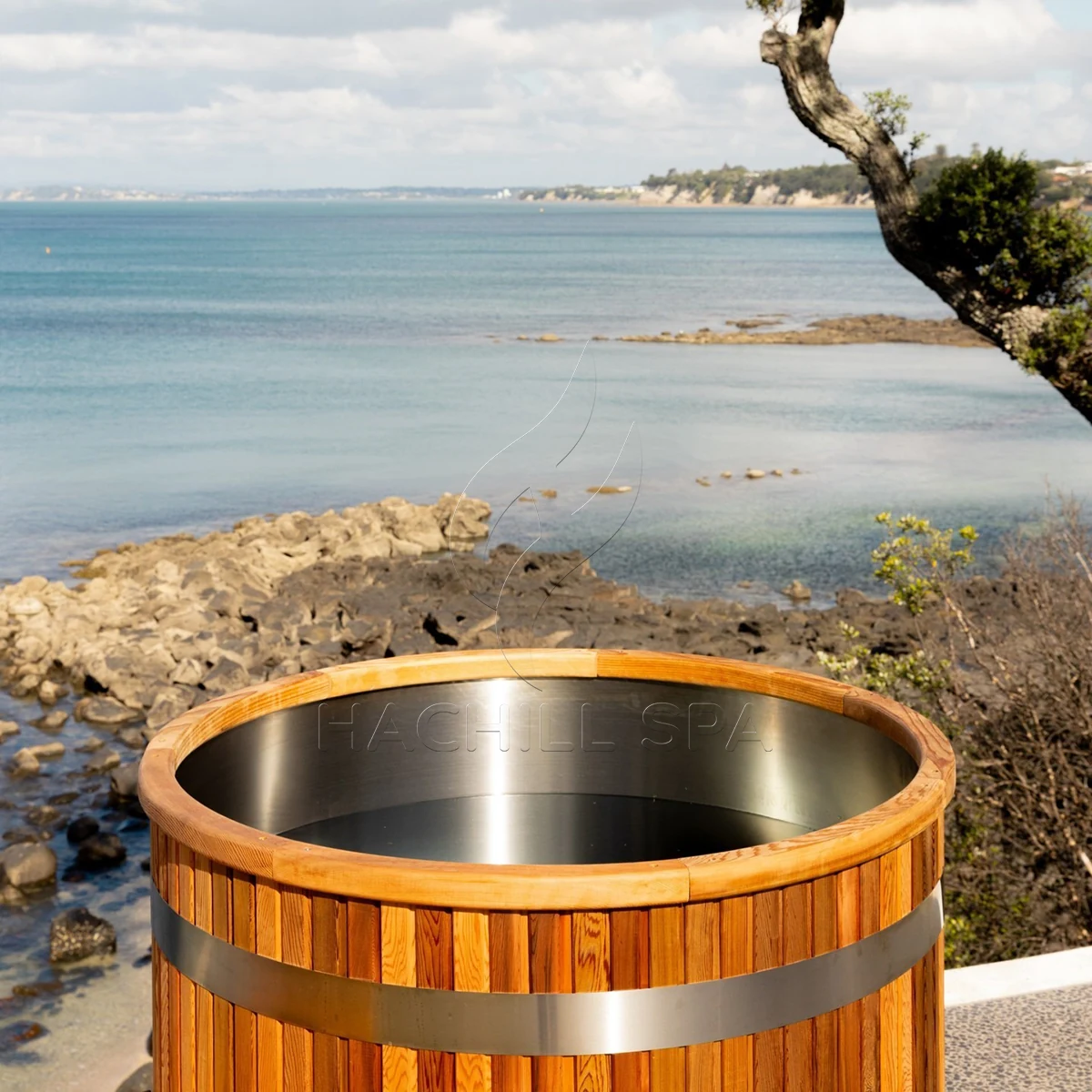
Start by separating the layers. A cold plunge that looks like a wood tub may use Thermowood only as the visible exterior enclosure, while a stainless liner forms the water-retaining vessel. Between them may be a structural frame, insulation, a service void, seals, brackets and pipe penetrations. These layers should not be treated as one material system simply because they arrive as one product.
The liner must contain water and provide cleanable, serviceable water-contact surfaces. The cladding manages appearance, touch surfaces and external exposure, but it should not be assumed to carry vessel loads or provide corrosion resistance to the wetted system. Ask for a section drawing that identifies the function of each layer and shows how fittings pass through the liner and enclosure without transferring service loads into decorative panels.
How to review the stainless liner
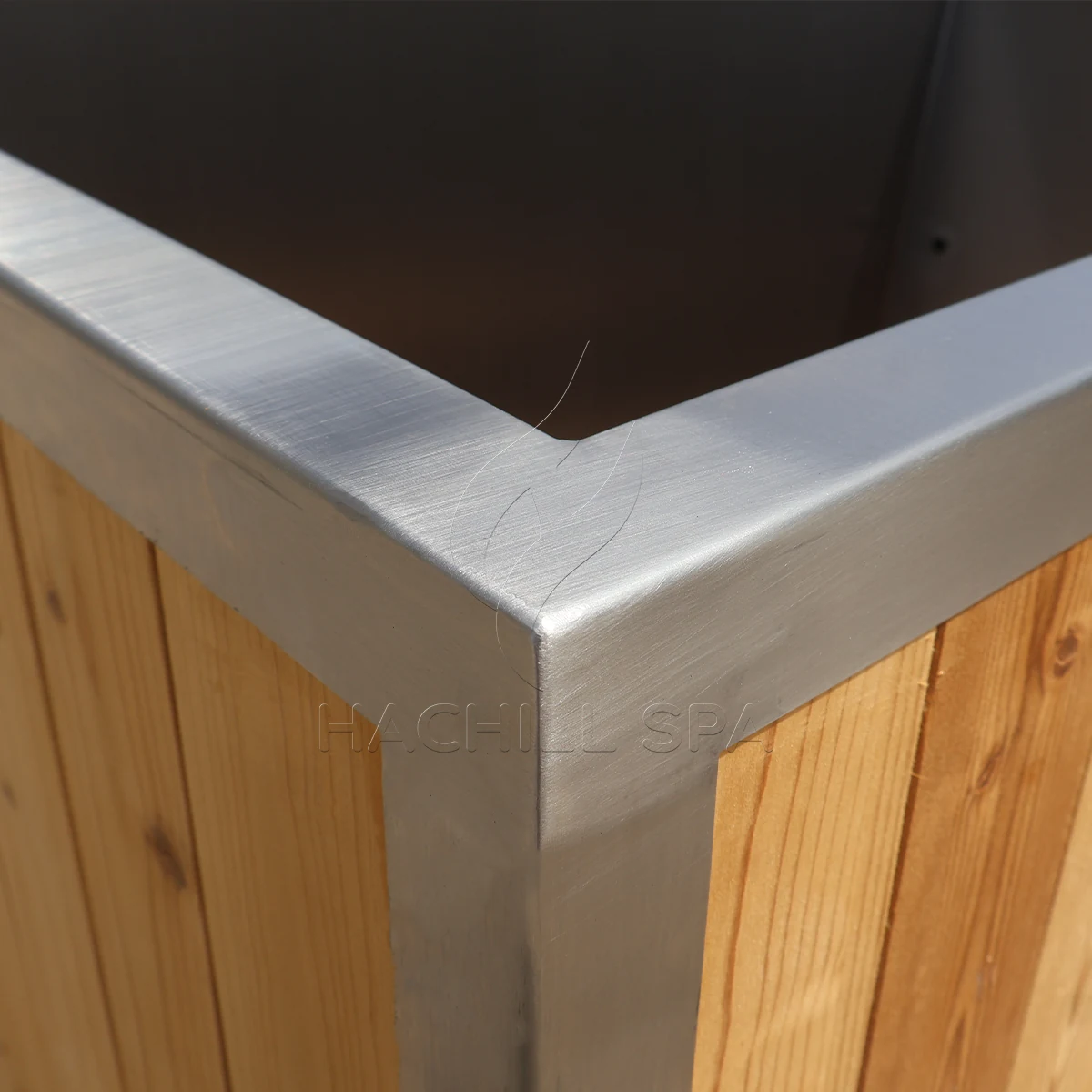
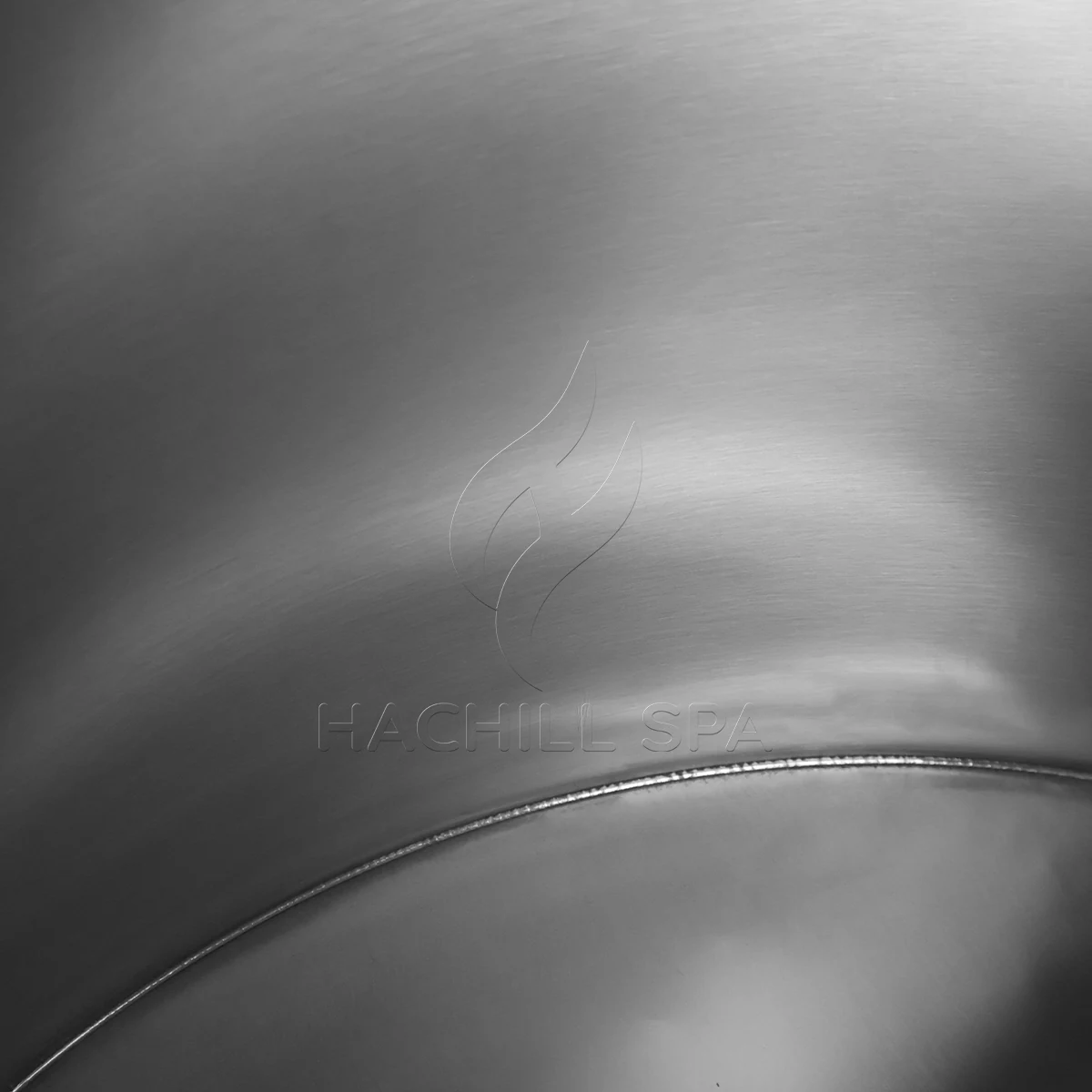
A stainless liner should be reviewed as a fabricated water-contact component, not only by grade name. Confirm the exact stainless designation for the ordered model, the sheet or formed construction, weld method and finishing basis, surface finish, drain geometry, penetrations and fitting materials. A material label does not by itself prove weld quality, cleanliness or suitability for the intended chemistry.
Stainless steel relies on a passive chromium-rich surface film for corrosion resistance. Chloride-bearing environments, crevices, surface contamination and unsuitable fabrication or finishing can reduce local corrosion resistance. The worldstainless corrosion overview describes pitting, crevice and galvanic corrosion as condition-dependent mechanisms, while the Nickel Institute guidance on pickling and passivating stainless steel explains why visible weld heat tint can be relevant to post-weld surface condition.
For a cold plunge, the practical question is therefore not “Is it stainless?” but “What stainless, how was it fabricated, what surface condition was specified, and what water and cleaning exposure will it see?” Exact allowable chemistry and cleaning limits should come from the ordered product documentation and approved treatment program rather than a generic web value.
Engineering scenario: brown staining appears near a fixing
Observed problem: A brown mark runs down the wood below a metal fixing, but the liner itself appears clean.
Possible causes: The stain may come from a contaminated or incompatible fixing, runoff from another metal component, retained water, or transferred iron contamination. Colour alone does not identify the source.
What to check: Trace the wetting path; identify the fixing and adjacent metals; inspect whether moisture is trapped; and compare the mark with the liner, brackets and panel back face before deciding that the stainless liner is corroding.
How to review Thermowood cladding
Thermowood cladding should be specified by the actual wood product, profile, finish system, exposure and attachment detail. The International ThermoWood Association notes that weather-exposed ThermoWood can change colour and that surface treatment is recommended where protection from humidity, erosion and UV is required. That guidance does not make every finish or installation detail interchangeable; the approved product and exposure still control.
Inspect board orientation, end-grain exposure, panel joints, fastener placement, lower-edge clearance and the back side of removable panels. The assembly should allow water to leave rather than collect on horizontal ledges or in a closed base. Where panels must be removed for service, the joint and fastening method should remain practical after normal wetting and drying rather than being designed only for a dry factory fit.
Thermowood is not “maintenance-free” simply because it has been thermally modified. Outdoor appearance, surface protection and maintenance expectations should be agreed before ordering, especially where the buyer expects a controlled colour rather than natural weathering. For climate-specific planning, see the Thermowood cold plunge outdoor-use guide.
For material background, the ThermoWood Handbook 2025 is the appropriate reference for ThermoWood-specific weathering and surface-protection guidance; the exact HACHILL product record still controls the supplied species, profile, finish and construction.
Where the two systems meet
Most avoidable problems occur at interfaces rather than in the middle of a stainless sheet or a wood board. The rim must shed splash without directing water behind the cladding. Panel joints need enough detailing to drain and dry. Penetrations need sealing and mechanical support without making a decorative panel carry plumbing loads. The base needs a route for cleaning water, rain or condensation to leave the enclosure.
Do not solve every visible gap by adding sealant. A sealed joint can be useful where the approved design requires it, but indiscriminate sealing may block drainage or trap moisture. The correct detail depends on the section design, finish system, exposure and whether the panel is intended to move or be removed.
| Interface | Why it matters | What to verify |
|---|---|---|
| Rim / liner lip | Splash can migrate behind cladding | Water-shedding geometry, finish edge, seal detail and access |
| Panel joint | Repeated wetting can leave debris or persistent dampness | Joint gap, drainage/drying path and movement allowance |
| Fastener / bracket | Wrong material or contamination can create staining or corrosion at the less resistant component | Material, location, isolation where required and clean installation |
| Base / lower edge | Standing water keeps wood and hardware wet | Clearance, drainage path, support condition and cleaning access |
| Pipe or service penetration | Leaks can remain concealed behind finished panels | Support, sealing, inspection access and replaceability |
| Removable service panel | A tight wet panel can become difficult to remove without damage | Fastening method, edge clearance and repeatable access after exposure |
Engineering scenario: wood darkens below the stainless rim
Observed problem: A dark band forms repeatedly below the liner lip.
Possible causes: Splash or cleaning water may be retained at the interface, the finish may be damaged, or the detail may not dry between uses.
What to check: Inspect the rim geometry, seal condition, panel clearance, back face, finish record and actual cleaning method. Correct the wetting or drying problem before refinishing; coating over persistently damp material does not remove the moisture path.
Cleaning and water-chemistry compatibility
The liner, seals, fittings, fasteners and wood finish do not necessarily tolerate the same chemicals. The approved water-treatment range and cleaning products should therefore be checked against the complete assembly, not selected for one surface in isolation. A chemical that removes a liner stain may damage a wood coating, while an exterior wood-care product should not be allowed to contaminate the water system.
Keep liner cleaning and wood care as separate procedures with separate tools where practical. Staff should know which products are approved, where they may be applied, what rinsing is required and which symptoms require escalation rather than stronger cleaning. The cold plunge water-care guide covers the broader circulation, sanitation and maintenance route; this page stays focused on material compatibility at the cladding-to-liner interface.
Evidence to request before approval
For a B2B or project purchase, ask for evidence that is specific to the ordered configuration. Product photos help identify visible construction, but they cannot prove hidden layers, alloy identity, weld treatment, finish system or service access behind the panels.
| Item | Useful evidence | What the evidence should close |
|---|---|---|
| Stainless liner | Model-specific material and fabrication schedule | Declared alloy, construction and surface-finish basis |
| Welds | Declared weld/finishing method and inspection basis | How visible and water-contact weld areas are accepted |
| Thermowood cladding | Wood product, profile and approved sample/finish range | What exterior material and appearance are actually supplied |
| Fasteners and brackets | Material schedule and location on the section drawing | Compatibility, attachment and replaceability |
| Rim, base and penetrations | Section details or controlled drawings | Drainage, sealing, support and inspection access |
| Cleaning / water care | Approved product list and operating instructions | Compatibility across liner, seals, fittings and wood finish |
Keep assumptions open when evidence is not yet available. Do not turn a generic category statement, rendering or preliminary sample into an order-specific material claim.
Receiving and maintenance checks
At receiving, compare the product and documentation with the approved order record. Check crate condition, trapped packaging moisture, visible panel damage, alignment, rim condition, accessible fittings and service-panel operation. Photograph staining, impact or wet packaging before installation so later inspection can distinguish receiving damage from operating exposure.
During operation, investigate persistent wet areas, rust-coloured staining, loose boards, opening joints, damaged finish and leakage early. Record where the symptom appears and what water or cleaning exposure preceded it. “Stainless stain,” “wood stain” and “water leak” are different diagnoses; tracing the path is more useful than choosing a repair from colour alone.
Handover record
The handover pack should identify the approved drawing revision, liner material declaration, cladding/finish specification, compatible cleaning products, receiving photographs and any agreed repair or concession. For commercial operation, also assign who records water-care conditions, who maintains the wood finish and who decides when a stain, leak or damaged panel requires supplier or installer review.
Project checklist
- Obtain a section drawing that separates liner, structure, insulation, cladding and service space.
- Confirm the ordered liner material, fabrication and surface-finish basis.
- Review weld condition, formed corners, drain geometry and penetrations.
- Confirm the Thermowood product, profile, finish system and appearance expectations.
- Inspect rim, panel joints, lower edges and service openings for drainage and drying.
- Confirm fastener and bracket materials and keep concealed fittings serviceable.
- Separate stainless-liner cleaning from wood-finish maintenance.
- Record receiving condition before installation and keep approved revisions with the handover pack.
Information to include in an RFQ
For a Thermowood-clad cold plunge, include the inputs needed to close the material interfaces rather than asking only for “wood outside, stainless inside”:
- Exact model or required body format
- Stainless liner material, fabrication and surface-finish requirements
- Thermowood product/profile and finish expectations
- Indoor or outdoor exposure, including splash, rain, UV or coastal context where relevant
- Rim, base, penetration and service-panel details
- Fastener and bracket materials
- Water-treatment and cleaning compatibility requirements
- Required drawings, material declarations, inspection records and handover documents
- Quantity, destination and any OEM or packaging requirements
Use the current Thermowood cold plunge range to identify the model direction before requesting model-specific construction evidence.
Frequently asked questions
Is Thermowood the water-retaining liner in a cold plunge?
Not necessarily. In the construction discussed here, Thermowood is exterior cladding and stainless steel forms the water-contact liner. Construction can vary, so confirm the exact model with a section drawing and material schedule.
Why do stainless liner welds matter?
Welding changes the local surface condition. Weld geometry, heat tint, contamination and post-weld finishing can affect cleanability and local corrosion resistance. The acceptance basis should be defined for the actual liner and service environment rather than judged from alloy name alone.
Can stainless steel stain Thermowood?
A brown or dark mark beside a metal component does not prove that the liner caused it. Possible sources include contaminated fasteners, runoff from another metal, trapped water, cleaning residue or transferred iron. Trace the wetting path and identify the affected material before choosing a repair.
Should every Thermowood joint be sealed?
No universal rule applies. Some joints are intentionally sealed, while others need drainage, drying, movement or service access. Follow the approved section and finish system; adding sealant without understanding the moisture path can trap water.
What should be included in the cleaning handover?
Identify approved liner cleaners, wood-finish care products, application and rinse instructions, prohibited products, inspection points and escalation conditions. Water-treatment limits and cleaning compatibility should be tied to the exact ordered materials and equipment.
Reference basis
- International ThermoWood Association — ThermoWood Handbook 2025: ThermoWood-specific background on weather exposure, colour change and surface protection. Exact installed-product details still control.
- worldstainless — Corrosion properties: background on stainless passive-film behaviour and condition-dependent pitting, crevice and galvanic corrosion mechanisms.
- Nickel Institute — Pickling and Passivating Stainless Steel: technical background on weld heat tint, surface condition and post-fabrication cleaning.
Technical boundary: This article explains general material and interface logic. It does not certify a HACHILL model, set a universal stainless grade, prescribe a universal water-chemistry limit or replace approved product drawings, manufacturer instructions, treatment-product labels, project specifications or applicable local requirements.
Turn the material interface into a project brief
For a Thermowood cladding and stainless-liner review, send the exact model or shortlist, destination, indoor/outdoor exposure, liner and finish requirements, water-care approach, rim/base/service-access questions, quantity and required documentation. HACHILL can review supplied-product information and keep unverified fields open until model-specific evidence is available.