Choose a traditional sauna when you want a heater-and-stone room environment and, where the heater is designed for it, the option to create löyly by applying water to hot stones. Choose an infrared sauna when you specifically want an emitter-based radiant cabin. Neither route is universally better, cheaper, healthier or easier to install.
The systems create and distribute heat differently. A traditional sauna centers on a sauna heater that warms the room air, surrounding surfaces and sauna stones where applicable. An infrared sauna uses electrically powered emitters positioned around the occupied cabin, so emitter location and user geometry become part of the system decision.
For a useful comparison, check four things in order: the heat experience you want, whether the site can support the exact equipment, whether performance claims match documented test conditions, and whether the selected system fits the intended residential or commercial duty.
Infrared Sauna vs. Traditional Sauna: What Is the Practical Difference?
The practical difference starts with the heating architecture.
A traditional sauna is built around a sauna heater. The heater warms the air, surrounding surfaces and, in a heater-and-stone arrangement, the sauna stones. The heated room itself is a major part of the experience.
An infrared sauna uses electrically powered emitters positioned around the cabin. Radiant transfer from those emitters plays a larger role in heating the occupied space, although the cabin air and interior surfaces also warm during operation.
On smaller screens, swipe or scroll horizontally to view the full comparison.
| Decision Point | Infrared Sauna | Traditional Sauna |
|---|---|---|
| Primary heat route | Infrared emitters integrated into the cabin | Sauna heater integrated with the room and stones where applicable |
| Heat emphasis | Greater emitter-to-occupant radiant component | Heated air, room surfaces, heater and stones |
| Main layout question | How do emitters relate to normal occupied positions? | Does the heater and room configuration match the intended sauna environment? |
| Key project interfaces | Cabin configuration, electrical context, controls, ventilation and service access | Room, heater, stones, controls, ventilation, clearances and service access |
| Experience focus | Emitter-based radiant sauna experience | Traditional heater-and-stone sauna experience |
This is why describing infrared as simply a “lower-temperature traditional sauna” is misleading. Air temperature may differ between particular systems, but a thermometer does not explain the equipment architecture or how heat is distributed around the user.
For deeper infrared-system terminology, emitter layout and buying criteria, use HACHILL’s infrared sauna guide rather than turning this comparison into a second infrared definition page.
How Do the Heat Experience, Temperature and Löyly Differ?
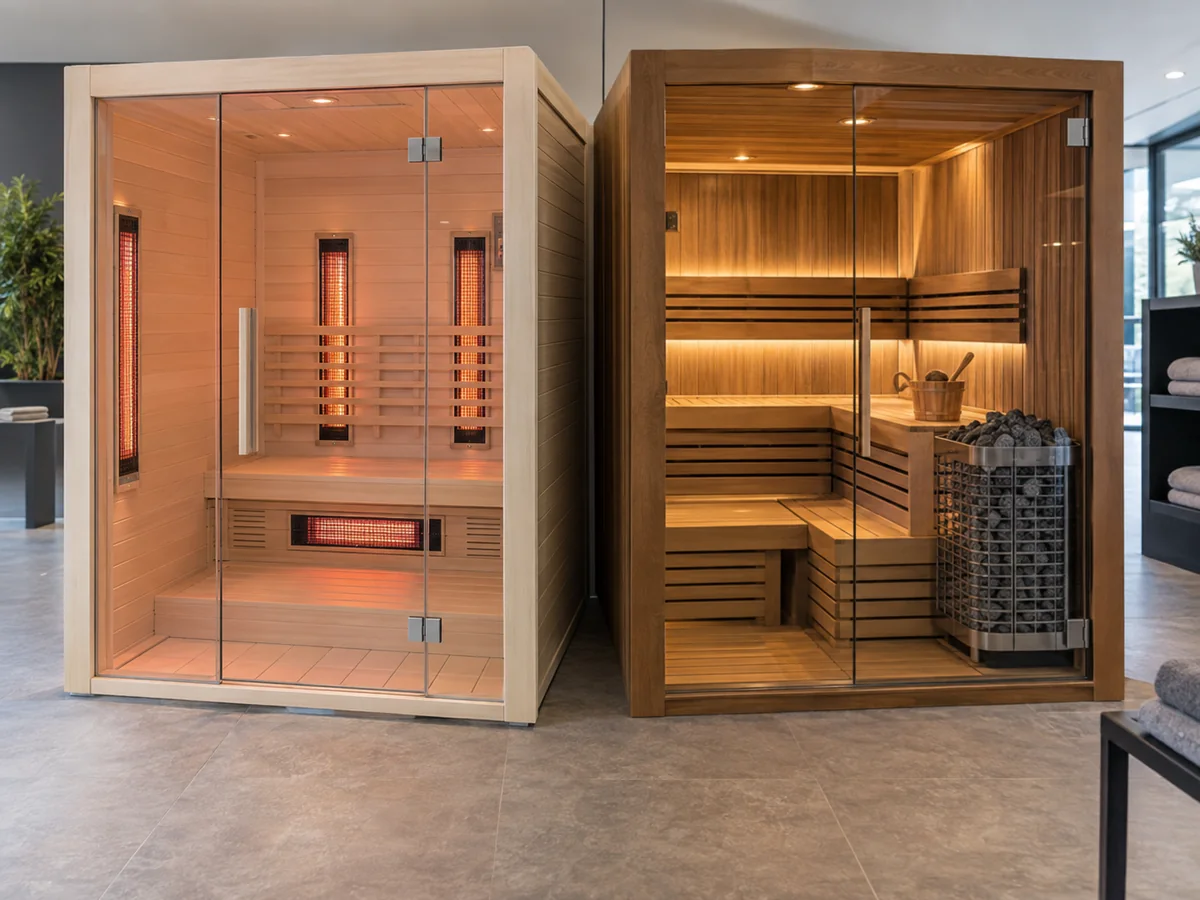
Air temperature is only one part of the comparison because infrared and traditional saunas distribute heat through the occupied space differently.
In a traditional sauna, the heater, heated air, interior surfaces and sauna stones work together to create the room environment. Where the selected heater and its instructions allow it, water applied appropriately to heated stones can create a short steam and humidity event known as löyly.
That does not turn a traditional sauna into a steam room. Löyly is a temporary humidity change within a traditional heater-and-stone sauna, not sustained steam-room operation.
Infrared cabins place greater emphasis on radiant transfer from emitters positioned around the user. That makes emitter geometry important. Total installed wattage by itself does not show how the emitters relate to the back, sides, legs or other occupied positions in the exact cabin.
On smaller screens, swipe or scroll horizontally to view the full table.
| Shortcut | Why It Fails |
|---|---|
| “More infrared wattage means better coverage.” | Occupied radiant exposure also depends on emitter position, distance and cabin geometry. |
| “More seats mean a larger traditional heater.” | Heater sizing depends on the actual room and manufacturer requirements, not seating count alone. |
| “Traditional sauna is completely dry.” | Suitable heater-and-stone systems can create short löyly humidity pulses. |
| “Lower air temperature means a weaker experience.” | Air temperature alone does not describe the complete occupied thermal environment. |
Traditional saunas commonly use hotter room-air conditions than many infrared cabins, but this is a broad pattern rather than a universal equipment limit. Exact operating conditions remain system-specific.
Detailed temperature ranges and measurement questions belong in HACHILL’s sauna temperature guide. Traditional heater sizing belongs in the sauna heater buying guide.
For comparison: use the heat route and actual system configuration, not a thermometer reading, total wattage or person-capacity label in isolation.
Which Is Easier to Install: Infrared or Traditional Sauna?
Neither route is universally easier to install.
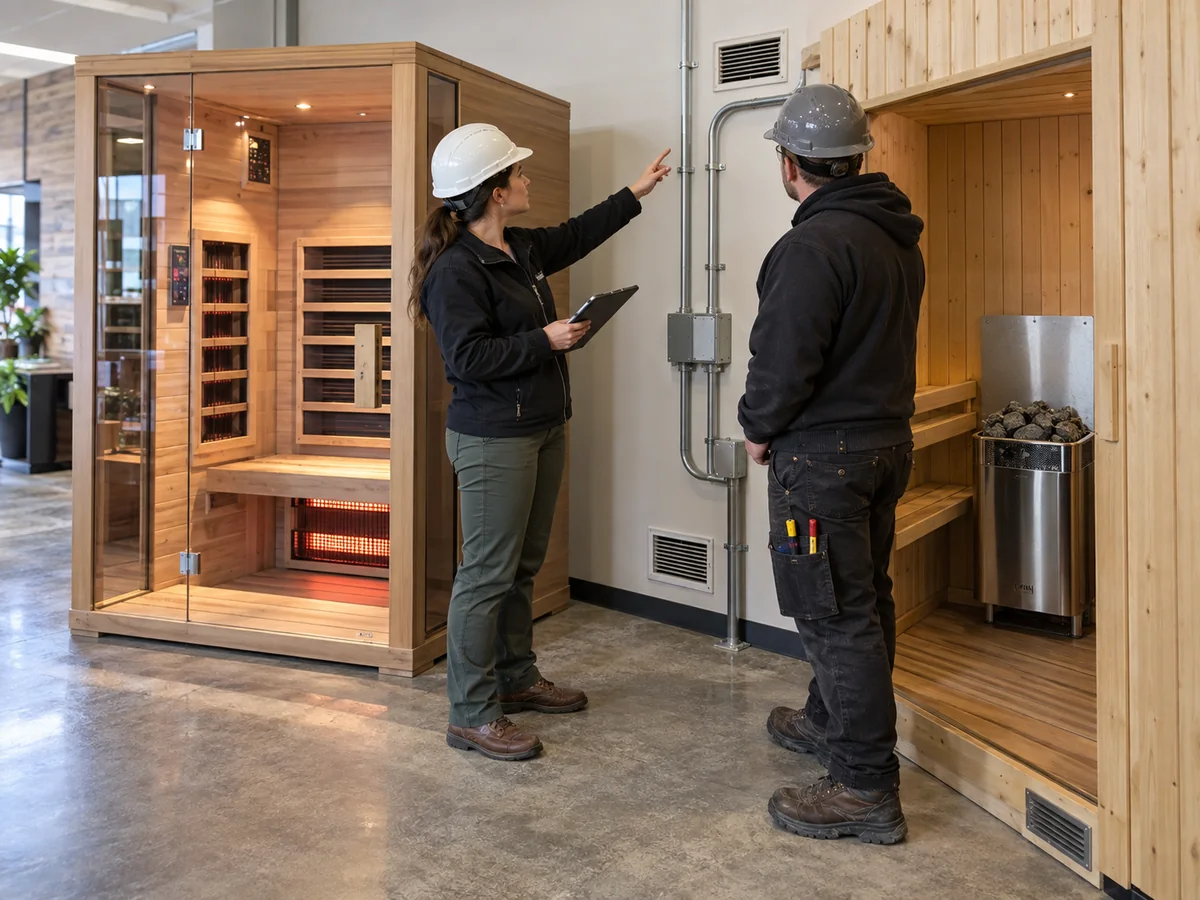
An infrared cabin may contain more of its heating system within the cabin package, but product-contained does not mean site-independent. The selected cabin still needs to match the destination electrical environment, ventilation context, controls, assembly conditions and future service access.
Infrared installation checks
- electrical compatibility for the exact cabin;
- emitter arrangement and normal seating positions;
- controls and sensor configuration;
- ventilation and installation requirements;
- access to serviceable components.
Traditional installation checks
- heater selection based on the actual room rather than seat count;
- heater position and required clearances;
- electrical or other approved heater route;
- controls and sensors;
- ventilation;
- future heater and component access.
This is why “infrared is plug-and-play” and “traditional sauna always uses the same electrical setup” are poor category-level buying rules.
Exact electrical requirements belong to the exact equipment and destination installation. Final supply configuration, conductor sizing, overcurrent protection, disconnection, grounding or earthing, and connection method must follow the equipment nameplate, the manufacturer’s instructions and applicable local electrical requirements.
Installation rule: the easier route is the one that leaves fewer unresolved interfaces at the actual site. Do not transfer wiring, clearance or sensor assumptions from one model to another.
Warm-Up Time and Performance Claims: What Should Buyers Actually Compare?
Warm-up speed can influence a buying decision, but a minute value without test conditions is weak evidence.
A specific infrared cabin may legitimately reach its manufacturer-defined ready condition quickly. A traditional system may be evaluated against a different target involving the room and heater-and-stone environment. Those numbers are not automatically comparable.
- What exact system was tested? A result from one cabin or heater configuration should not automatically represent another.
- What was the starting condition? A system starting in a warm indoor environment is not equivalent to one beginning from a colder condition.
- What does “ready” mean? One test may use an air-temperature target; another may use a manufacturer-defined operating condition.
- Where was the condition measured? One air reading does not describe surfaces, radiant exposure or every occupied position.
- What enclosure was used? Construction, glazing and heat loss can change warm-up behavior.
- What was the operating state? Door position, ventilation and other test conditions can change the result.
A precise-looking time is not automatically strong performance evidence.
Which Costs More to Install and Maintain?
There is no reliable universal cost winner between infrared and traditional sauna.
The correct comparison is total installed scope, not the equipment price in isolation.
Depending on the project, the cost boundary can include:
- core sauna equipment;
- room or enclosure work;
- electrical interfaces;
- controls;
- ventilation;
- delivery;
- local installation work;
- future service access.
On smaller screens, swipe or scroll horizontally to view the full comparison.
| Cost Layer | Infrared Sauna | Traditional Sauna |
|---|---|---|
| Core system | Cabin, emitters, controls and related components | Room/cabin, heater, controls and stones where applicable |
| Electrical/site work | Exact model and destination dependent | Exact heater/control configuration and destination dependent |
| Room integration | Cabin/configuration dependent | Heater and room integration is central to the system |
| Maintenance focus | Emitters, controls, sensors, cabin components and serviceable areas | Heater, stones, controls, sensors, ventilation and room components |
| Final installed cost | Quote and site specific | Quote and site specific |
Energy comparisons need the same discipline. Nameplate power does not tell a buyer what the actual electricity bill will be. Warm-up behavior, control cycling, enclosure conditions, operating schedule and actual use all influence consumption.
Maintenance also differs by component rather than by a simple “infrared versus traditional” label. Traditional systems can add heater and stone maintenance. Infrared systems have a different component and emitter service boundary.
For a deeper quotation-normalization and lifecycle-cost framework, use HACHILL’s sauna cost guide.
Cost rule: normalize the project scope and operating conditions before deciding which sauna is cheaper.
Which Fits Residential and Commercial Use Better?
Residential and commercial projects should not use exactly the same selection logic.
A residential buyer may place more weight on:
- preferred heat experience;
- room and utility fit;
- installation practicality;
- personal operating routine;
- controls and convenience.
A hotel, spa, gym or other commercial facility needs another layer of verification:
- operating frequency;
- staff and user control access;
- cleaning routine;
- component serviceability;
- maintenance planning;
- acceptable downtime;
- exact equipment suitability for the intended duty.
A three-person or four-person label describes occupancy or layout intent. It does not prove that the equipment is suitable for repeated commercial operation.
Infrared should therefore not be chosen for a facility simply because a cabin looks self-contained. Traditional should not be chosen simply because heater-and-stone systems are familiar in commercial settings.
For hotels, gyms, spas and other repeated-use installations, HACHILL’s Commercial Sauna Solution owns the deeper venue-planning task.
For commercial selection: residential buyers compare experience and fit; commercial buyers must also verify operating duty, cleaning, controls, serviceability and downtime.
What About Infrared vs. Traditional Sauna Health Benefits?
Current evidence does not justify declaring infrared or traditional sauna universally healthier.
Research on the two modalities uses different equipment, thermal conditions, exposure protocols, populations and outcomes. A finding observed under one type of sauna exposure should therefore not automatically be treated as evidence for the other, and short-term physiological responses should not be converted into long-term clinical claims.
A 2025 controlled comparison of traditional and far-infrared sauna exposure studied single acute heat exposures in 20 healthy young adults and reported different thermoregulatory responses under the study’s traditional-sauna and far-infrared protocols. That supports treating the modalities as distinct exposures; it does not establish long-term health superiority for either sauna type.
A 2009 peer-reviewed review of far-infrared sauna research was not a head-to-head comparison with traditional sauna. It found that evidence supporting several far-infrared health claims was limited or based on small bodies of research, so it should not be used to generalize broad therapeutic benefits.
This article does not use detox, weight-loss, disease-treatment or generalized safety claims to rank the systems.
Health evidence is therefore a boundary in this comparison, not the primary equipment-selection criterion.
Infrared or Traditional Sauna: Which Should You Choose?

Start by choosing the experience you actually want. Then eliminate any route the site or intended operating duty cannot support.
On smaller screens, swipe or scroll horizontally to view the full decision matrix.
| Decision | Infrared Candidate | Traditional Candidate |
|---|---|---|
| Desired experience | Emitter-based radiant sauna | Heater-and-stone sauna |
| Stones / löyly | Not the defining experience | Important when traditional löyly is desired |
| Layout review | Emitter positions and occupied coverage | Room load, heater position and heater integration |
| Installation | Exact cabin, electrical, ventilation and service fit | Room, heater, electrical/heat route, ventilation, clearances and service fit |
| Performance evidence | Exact cabin and test conditions | Exact heater/room system and test conditions |
| Commercial duty | Must be confirmed for the selected equipment | Must be confirmed for the selected equipment |
Shortlist infrared when
Infrared is the stronger candidate when the buyer deliberately wants an emitter-based radiant sauna, the cabin layout fits the intended users, the electrical environment is compatible and the selected equipment fits the intended duty.
Shortlist traditional when
Traditional is the stronger candidate when a heater-and-stone experience is the goal, löyly matters to the intended use, and the room, heater, controls, ventilation, clearances and service requirements can be resolved.
Hold the decision when
- actual room conditions are still unknown;
- the destination electrical context has not been confirmed;
- exact product documentation is unavailable;
- infrared emitter layout is unavailable;
- traditional heater sizing has not been checked against the room;
- residential or commercial operating duty is unclear;
- installation responsibility has not been defined.
- Experience: choose the intended heat route.
- Feasibility: check the room, utilities, ventilation and installation.
- Evidence: verify performance claims against the exact system.
- Scope: compare equivalent installed cost and maintenance responsibility.
- Duty: verify the selected equipment for the intended use.
Once the route is clear, continue to the Infrared Sauna or Traditional Indoor Sauna category for model-level review.
Next step
If you are still choosing the heating direction, compare the HACHILL Indoor Sauna routes. After the route is clear, move to the relevant product family for model-level review.