
Quick answer: If your question is which order is more directly represented in combined sauna-and-cold-water research, sauna followed by cold-water immersion or a cold-water cooling break is the clearer research-matched sequence. Studies published in 2016, 2020, 2025 and 2026 all used heat before cold when examining acute cardiovascular or thermal responses. None of those cited studies directly compared sauna-first with cold-first to determine a universally superior order for health, recovery, sleep or general wellness. The defensible conclusion is therefore narrow: sauna → cold is better represented in the available combined protocols, not proven best for every person. Your goal, medical suitability, response to heat and cold, exposure dose and ability to stop safely matter more than copying one experiment. Workout timing, plunge temperature, duration and commercial facility flow are separate decisions.
Sauna Before or After Cold Plunge? What the Studies Actually Tested
The strongest answer this page can support is about which combined order has actually been studied, not which order is universally best. In the human studies reviewed below, sauna exposure came before cold-water immersion or a cooling break that included cold water.
| Study | What the protocol tested | What it does not establish |
|---|---|---|
| Radtke et al., 2016 37 men with heart failure, coronary artery disease or neither | Finnish sauna exposures followed by a final cold-water immersion; haemodynamic and autonomic responses were measured. PubMed record | No cold-first comparison; not a general-population order trial. |
| Podstawski et al., 2020 55 young sedentary men | Sauna followed by cold-water immersion was compared with sauna followed by a brief shower/rest cooling condition. Journal abstract | No sauna-first versus cold-first comparison. |
| Szafraniec et al., 2025 28 normotensive women | Repeated Finnish-sauna heating phases were followed by cooling periods that included cold-water immersion; cardiovascular responses were tracked. Scientific Reports study | No reverse-order arm and no claim that one sequence is best for all outcomes. |
| Owen et al., 2026 16 healthy adults | In a crossover design, sauna with air cooling was compared with sauna cooling that included a brief cold-water immersion. Experimental Physiology study | It isolates a cooling-method effect within a sauna-first protocol; it does not compare cold-first with sauna-first. |
These studies make sauna → cold a defensible research-matched sequence when someone wants to mirror the order that has been investigated. They do not prove that the reverse order is ineffective, unsafe or inferior, and they do not establish a universal finishing rule.
That distinction is the core of this article: use the research to describe what has been tested, without converting a study protocol into a personal prescription.
Common Sequence Does Not Mean Proven Best Sequence
Three different ideas are often blended together in sauna-and-cold advice: a traditional practice, a protocol used in a study, and comparative evidence that one protocol produces a better outcome. They are not the same level of evidence.
A study can examine one sequence without comparing sequences
If researchers have participants use a sauna and then enter cold water, they can measure what happens during that protocol. Unless the study also compares the reverse sequence with an appropriate design, it cannot show that sauna-first produces a better overall outcome than cold-first.
Studied sequence ≠ superior sequence.
Søberg 2021 does not prove that everyone should finish cold
The 2021 Søberg study is frequently cited online in support of the idea that contrast sessions should always end in cold exposure. The original research examined experienced winter-swimming men and focused on thermoregulation, cold adaptation and brown-adipose-tissue-related responses. It did not randomize participants to sauna-first versus cold-first, and it did not test finishing cold against finishing warm as competing consumer routines. The original study record shows the actual population and research question.
Søberg 2021 was not an “always finish cold” trial.
A mechanism is not the same as an outcome
Heat and cold produce real acute physiological responses. That does not mean every plausible mechanism proves a consumer benefit.
| Evidence level | What it can tell you |
|---|---|
| Acute physiological response | What changes during or shortly after exposure |
| Study protocol | What conditions researchers actually tested |
| Comparative outcome evidence | Whether one intervention outperformed another for a defined outcome |
| Personal-use recommendation | Requires the evidence and safety boundary to match the individual question |
Physiological response ≠ proven outcome.
Start Order, Finish Order, Transition Time and Number of Rounds Are Different Questions
Knowing which modality comes first does not give you a complete contrast-therapy routine.
| Protocol variable | The actual question |
|---|---|
| Start order | Sauna or cold plunge first? |
| Finish order | Which exposure comes last? |
| Transition time | How quickly do you switch? |
| Cycle count | How many times do you alternate? |
| Temperature | How hot or cold is each exposure? |
| Duration | How long is each exposure? |
Published sauna-and-cold-water studies use different heating durations, cooling structures, immersion conditions and cycle designs. For example, the 2025 repeated sauna-and-CWI study and the 2026 crossover study of CWI during sauna cooling breaks used different protocols and answered different acute physiology questions. Neither is a universal routine, and neither compares sauna-first against cold-first as competing sequences.
Sauna-first does not automatically mean you must finish cold
Beginning with heat does not itself establish what the final exposure should be. The research reviewed for this article does not justify a universal rule that everyone should always finish cold, always reheat afterward, or use one specific final state for metabolism, recovery or sleep.
There is no universal immediate-transition deadline established here
Some research protocols use cold-water immersion as part of a structured cooling break; others include additional cooling or rest. That does not justify converting one protocol into a rule that everyone must enter cold water within a specific number of minutes.
Order also does not determine how many rounds to do
A study may use repeated heating and cooling because researchers need a standardized intervention. That cycle count belongs to the experiment, not automatically to a general reader.
Similarly, studies of contrast water therapy—alternating hot and cold water—should not be treated as direct evidence for a sauna-plus-cold-plunge sequence.
Contrast water therapy ≠ sauna-and-cold-plunge order evidence.
For exact exposure questions, use HACHILL’s separate owners: Sauna Duration Guide, Cold Plunge Duration Guide, and Cold Plunge Temperature Guide.
An order answer is not a dose prescription.
When Should You Pause, Stop or Avoid the Next Heat–Cold Transition?
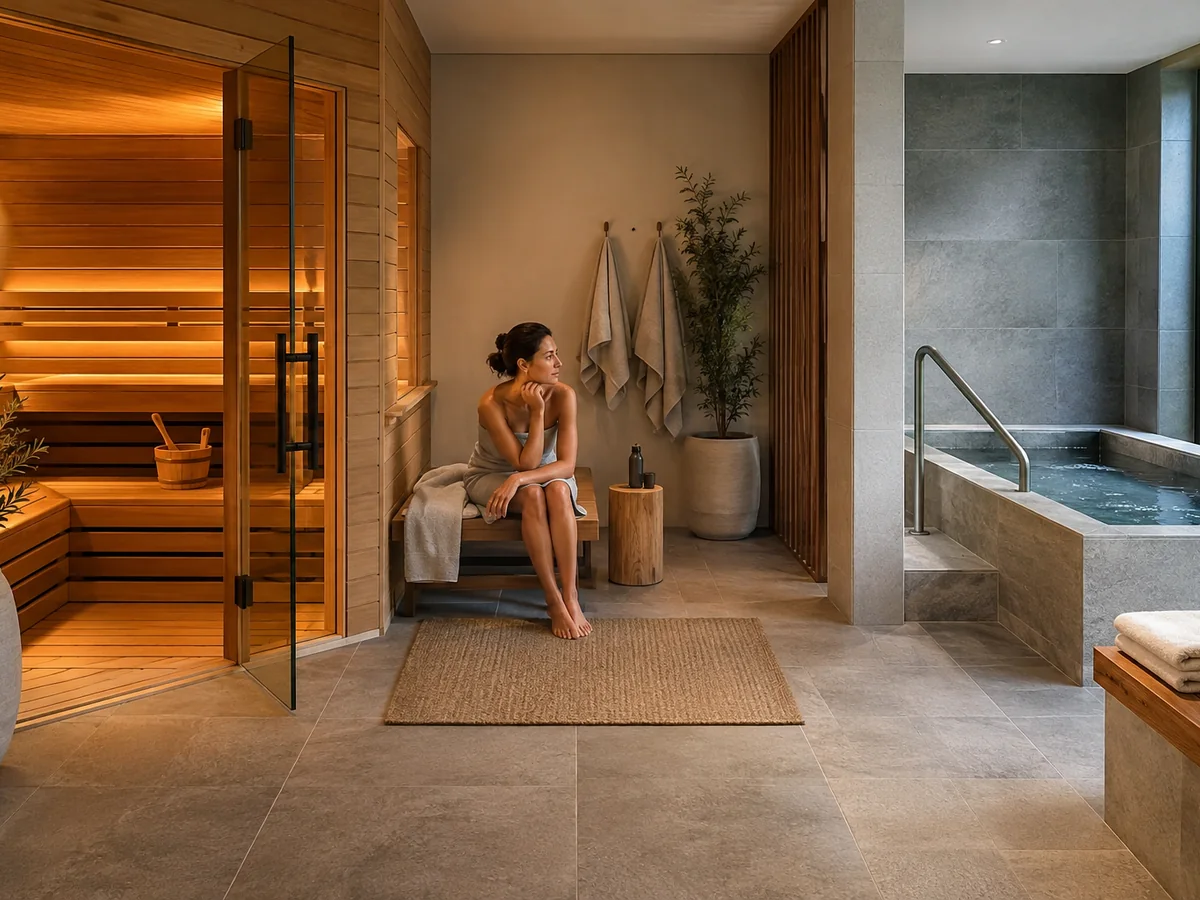
The planned sequence should never outrank your actual response to heat or cold.
Cold-water immersion can trigger an acute cold-shock response involving rapid changes in breathing and cardiovascular activity. A 2024 systematic review and meta-analysis of cold-shock habituation found that repeated immersion can reduce several components of that response on average. Habituation, however, is not proof of individual safety and does not remove the need for an easy exit and symptom-based stop rules.
Sauna creates a separate heat and fluid-loss stress. Cleveland Clinic sauna guidance advises leaving if dizziness, weakness, breathing difficulty or significant discomfort develops and recommends medical guidance in relevant circumstances. Its cold-plunge guidance likewise advises exiting for lightheadedness or concerning discomfort and highlights cardiovascular and breathing stress from cold exposure.
IF NO WARNING SIGNS ARE PRESENT
The absence of a concerning symptom does not itself establish medical suitability. Remain alert to how you are responding, and do not use this section as a medical green light.
PAUSE OR STOP
Do not force the next planned exposure if you develop dizziness, faintness, unusual weakness, major breathing difficulty, uncontrolled breathing on cold entry, confusion, poor coordination, chest discomfort or marked distress.
NO GENERIC PROTOCOL
If medical suitability is uncertain because of a relevant health circumstance, pregnancy, medication, prior fainting or previous advice to restrict heat or cold, individualized healthcare guidance is more appropriate than an online sequence.
Familiarity does not eliminate risk
Repeated cold exposure can reduce some components of the average cold-shock response, but habituation is not immunity. Familiar sauna use likewise does not make dehydration, overheating, faintness or an unusual response impossible.
Familiarity ≠ no heat or cold stress.
Alcohol should not be used to make the routine feel easier
Sauna safety guidance recommends avoiding sauna use after drinking alcohol, and sweating increases fluid loss. A cold plunge afterward does not reverse impaired judgment, dehydration or another reason the heat session was inappropriate.
Does Your Goal or Workout Context Actually Change the Order?

Sometimes the goal changes the decision. But often it changes which evidence page you need, rather than creating a new sauna/cold-plunge sequence.
Strength training is a good example
A 2024 systematic review and meta-analysis found that cold-water immersion used immediately after resistance-training sessions may modestly attenuate hypertrophy gains, while rating the underlying studies as generally fair to poor quality. The authors also note that the analyzed evidence applies to CWI performed within about 15 minutes of exercise cessation; it does not establish the effect of occasional plunging several hours later.
That finding is about cold-exposure timing relative to resistance training. It does not prove that cold-first is better after lifting, and placing a sauna before the plunge does not erase the timing question.
Workout timing ≠ general sauna/cold-plunge sequence.
Readers making a training-specific decision should use HACHILL’s Cold Plunge Before or After Workout guide rather than treating sauna-first as a workaround.
Recovery claims also need an outcome, not just a mechanism
A person may feel less sore or prefer the sensation after cold exposure. That does not automatically establish better long-term adaptation. Likewise, the fact that heat and cold create different acute physiological responses is not enough to claim that one finishing state produces universally superior recovery.
Feeling better ≠ proven better adaptation.
Relaxation, sleep and alertness are not universal order rules
Some people prefer finishing warm because they find it relaxing. Others prefer the sensation of finishing cold. Those are valid preferences when described as preferences.
The evidence reviewed for this article does not justify turning them into universal claims such as finish warm for scientifically optimal sleep, finish cold for superior alertness, cold-first is best in the morning, or sauna-last is always better in the evening.
Preference can break the tie—but preference ≠ medical superiority.
Choose a Sequence: Research-Matched Pattern, Personal Preference or No Generic Protocol
Once order, dose and safety are separated, the decision becomes much clearer.
| Your situation | Evidence-aware route | What the route does not mean |
|---|---|---|
| You want the combined order most directly represented in current sauna+CWI research | RESEARCH-MATCHED SEQUENCE — Sauna → cold | Not proven universally best and not a personal prescription |
| Both orders are otherwise appropriate and no goal-specific evidence establishes superiority | PREFERENCE / CONTEXT | Preference is not a health claim |
| Medical suitability is uncertain or concerning symptoms appear | NO GENERIC PROTOCOL | Do not force an internet routine |
| Your question is primarily about training adaptation or exercise recovery | WORKOUT-TIMING OWNER | Sauna order does not solve the training-timing question |
| Your question is minutes, water temperature or number of rounds | DOSE / SAFETY OWNER | Sequence does not establish exposure dose |
RESEARCH-MATCHED SEQUENCE
If your goal is to mirror the combined order represented by the studies reviewed here, sauna followed by cold-water immersion is the closer research match. That does not establish superiority or personal suitability.
PREFERENCE / CONTEXT
When both modalities are otherwise appropriate and direct outcome evidence does not establish a winner for your goal, finish preference and practical context may break the tie.
NO GENERIC PROTOCOL
Use individualized guidance instead of an internet sequence when medical suitability is unresolved, concerning symptoms occur, impairment is present or the routine would require unsupported exposure assumptions.
The sequence is not always the first question that needs to be resolved.
Once the evidence and safety question is resolved: explore the equipment families that fit the intended setup. For a defined commercial venue, continue into the facility-planning route rather than turning a public sequence article into an operating protocol.
For Facilities: Plan the Hot–Cold User Flow Without Prescribing One Universal Protocol
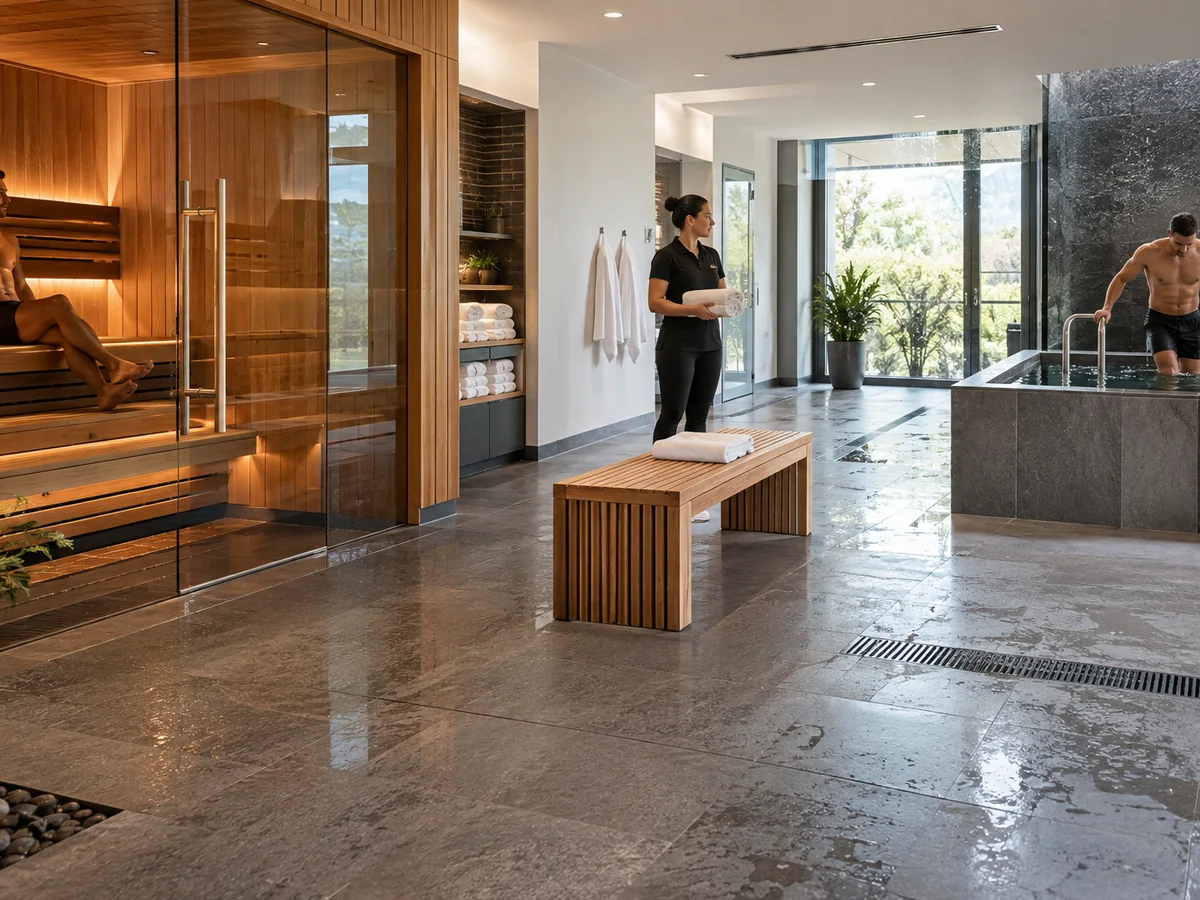
A commercial sauna-and-cold-plunge venue has a different problem to solve: people must be able to move through the space safely whether the facility’s reviewed operating journey is heat → cold, cold → heat or includes a separate recovery step.
A facility layout should support the operating journey; it should not be treated as medical evidence that every guest needs the same exposure order.
- Can wet users move between thermal zones without an unnecessarily hazardous walking route?
- Is there a credible drainage strategy along wet circulation areas?
- Is there a place to pause or recover instead of forcing an immediate transition?
- Do staff visibility and circulation suit the operating model?
- Can privacy and user movement coexist?
- Can cleaning and servicing occur without conflicting with guest flow?
For U.S. workplace contexts, OSHA walking-working-surface rules require workroom floors to be kept dry to the extent feasible and require drainage where wet processes are used. That is useful support for deliberate wet-area management, but its scope is workplace safety—not a universal spa-design code. Building, accessibility, public-health, electrical and other facility requirements remain jurisdiction- and project-specific.
HACHILL’s Contrast Therapy Studio Equipment Planning page owns the deeper facility task, including circulation, wet/dry interfaces, staff routes and operational planning.
A facility can therefore design for a clear journey without turning architecture into a universal health protocol.
Frequently Asked Questions
Should you sauna before or after a cold plunge?
If you want to mirror the order used in the combined studies reviewed here, sauna followed by cold-water immersion is the closer research match. Those studies did not directly compare sauna-first with cold-first as competing routines, so they do not prove a universally superior sequence.
Should you finish with the sauna or cold plunge?
The evidence reviewed here does not establish one universal finish state. The Søberg winter-swimming study does not prove that everyone must finish cold, and personal finish preference should not be converted into an unsupported metabolism, recovery or sleep claim.
Do you need to go straight from the sauna into cold water?
No universal immediate-transition deadline is established by the evidence reviewed here. Research protocols use different cooling structures and transition timings, so one study’s timing should not be treated as a rule for every user.
Does choosing the order tell you how many rounds to do?
No. Start order, finish order, transition time, cycle count, temperature and duration are separate decisions. A study’s cycle design is part of that study, not automatically a personal-use prescription.
Who should avoid following a generic sauna-and-cold-plunge sequence?
Anyone whose medical suitability is uncertain should not rely only on a generic online sequence. Relevant cardiovascular concerns, pregnancy, medications or conditions that may affect heat or cold tolerance, previous fainting, unexplained symptoms, or concerning symptoms during a session are reasons to use individualized healthcare guidance rather than forcing the next planned exposure.