Cold-water immersion timing guide
Quick answer: There is no universal “before” or “after” winner. If long-term strength or hypertrophy is the priority, repeated cold-water immersion immediately after resistance training deserves caution because current evidence suggests it may modestly attenuate hypertrophy and, under some conditions, strength adaptation. If you need to perform again soon, post-exercise CWI can have a different recovery trade-off. Before exercise, its clearest performance evidence is as pre-cooling for endurance activity in hot conditions—not as a universal gym-performance booster.
The decision starts with the outcome you are trying to protect: acute recovery, long-term adaptation, short-turnaround performance or heat management. Those are different goals. Feeling less sore today does not prove that strength, power or hypertrophy improved, and evidence from immediate post-lifting CWI should not be converted into a universal several-hours-later rule.
Cold Plunge Before or After a Workout? Start With the Training Goal
Cold-water immersion timing should follow the training goal, not a generic idea that cold is “good for recovery.” A lifter trying to maximize hypertrophy has a different decision from an athlete who must compete again soon. An endurance athlete preparing for a hot event has another.
That is why simple rules such as “always plunge after cardio” or “wait six hours after lifting” are too broad. CWI research measures different outcomes under different exercise, timing and exposure conditions. A better first question is: What result matters most from this session?
Acute Recovery Is Not the Same as Long-Term Adaptation
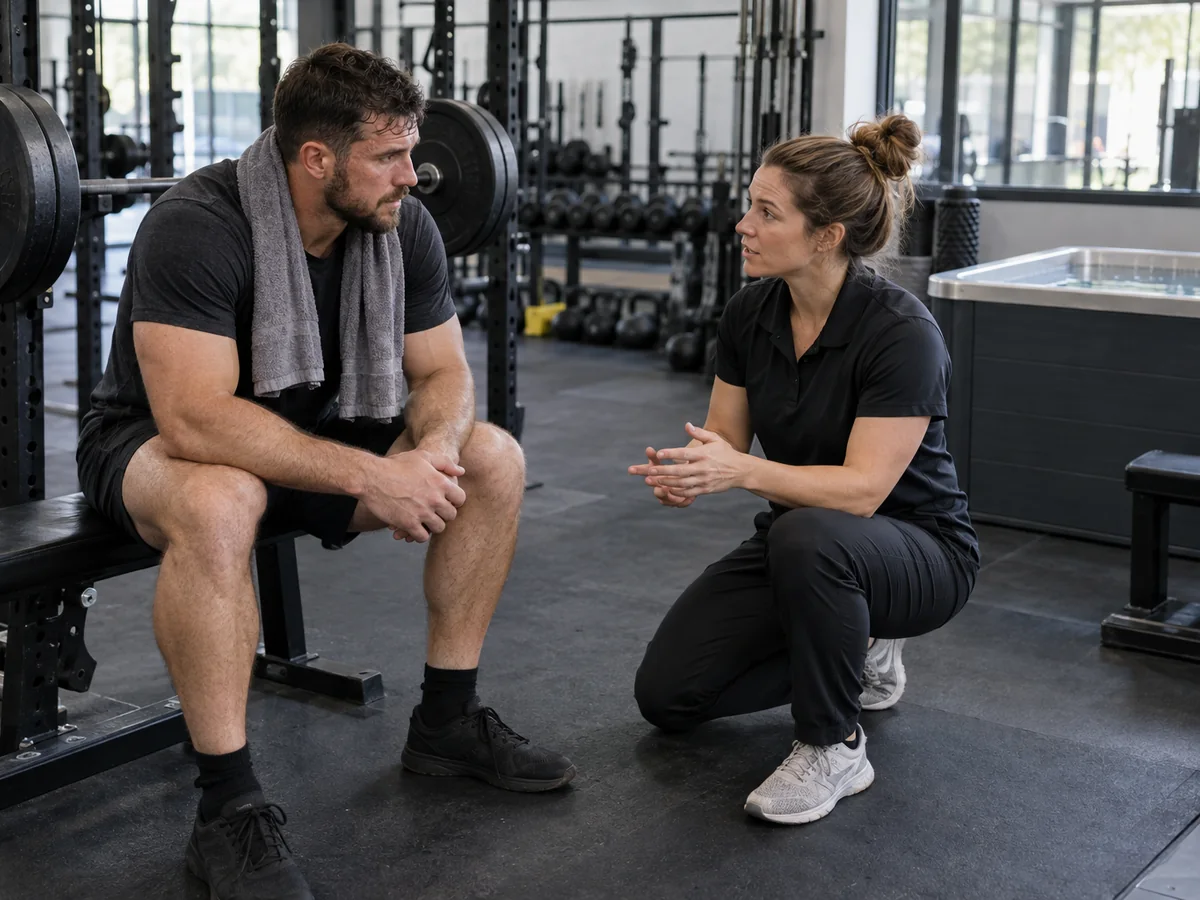
Acute recovery asks what happens over the next hours or days: soreness, perceived recovery, strength or power restoration, biomarkers, or readiness for another performance. Long-term adaptation asks what happens after repeated training over weeks or months to outcomes such as muscle size, strength or endurance capacity.
Those questions can point in different directions. A post-exercise cold plunge may improve selected short-term recovery measures while repeated immediate CWI after resistance training may work against some of the adaptations a lifter is trying to preserve.
This is not a contradiction. It is an outcome difference.
Less Soreness Does Not Automatically Mean Better Performance or Better Gains
Soreness is useful information, but it is not a complete recovery metric. A large systematic review of post-exercise CWI found that recovery effects vary by the previous exercise, the outcome measured and the time point: endurance recovery improved at some points, while sprint and jump performance could be worse early after immersion, with other strength or power outcomes improving later. See the systematic review of physical-performance recovery after CWI.
So keep these questions separate:
- Do I feel less sore?
- Has the performance quality I need next recovered?
- Am I trying to maximize long-term adaptation from this training block?
- Do I have another important performance soon enough that short-term recovery deserves more weight?
DOMS ≠ complete performance recovery ≠ long-term adaptation.
After Strength Training: Immediate Cold Plunging, Muscle Growth and the Limits of the 4–6-Hour Rule
If strength or hypertrophy is the priority, the strongest reason for caution is repeated CWI used immediately after resistance training. Current systematic-review evidence suggests that this pattern may modestly attenuate hypertrophy, with separate evidence also pointing toward reduced strength adaptation under some conditions.
The scope is critical. The research does not justify saying that one plunge destroys muscle growth, that every cold plunge on a lifting day reduces gains, or that a specific later hour is proven safe.
What the Evidence on Immediate Post-Lifting CWI Actually Addresses
A 2024 systematic review and meta-analysis on resistance training and hypertrophy found that CWI used immediately after resistance exercise may attenuate hypertrophic changes. In the included studies, immersion began immediately or within about 15 minutes after training and was generally repeated across the training program. The review also judged the underlying evidence quality as relatively limited, so the finding should be interpreted with caution. See the 2024 hypertrophy systematic review and meta-analysis.
That gives this evidence a clear boundary:
| Evidence Scope | What It Can Support | What It Does Not Prove |
|---|---|---|
| Repeated CWI started immediately or within about 15 minutes after resistance training | Caution when hypertrophy is a major long-term goal | That every same-day cold plunge reduces hypertrophy |
| Chronic resistance-training studies | Possible interference with selected adaptations | That one isolated plunge causes measurable loss of gains |
| Strength meta-analysis | Some evidence of attenuated strength adaptation | That all CWI methods reduce strength equally |
| Delayed use several hours after lifting | Evidence remains incomplete | A universal “safe after X hours” threshold |
Strength adaptation needs separate wording. A meta-analysis of 10 studies found a small overall attenuation in strength gains, but the result was not uniform: the single-limb subgroup showed attenuation, while the whole-body CWI subgroup did not show a significant difference. The pooled sample was also 92% male, which limits how broadly the result should be generalized. See the strength adaptation meta-analysis.
The defensible conclusion is therefore:
Repeated immediate post-resistance CWI deserves caution when long-term hypertrophy or strength adaptation is a priority.
It is not:
every use of cold water after lifting is harmful.
Why “Wait 4–6 Hours” Should Not Be Treated as a Proven Universal Threshold
The popular 4–6-hour rule is more precise than the direct evidence allows.
An ACSM practitioner article notes that some athletes and practitioners move CWI four to six hours away from strength or hypertrophy training, while also acknowledging that only a few studies have directly examined post-exercise timing. See the ACSM practitioner discussion of CWI timing. That makes the 4–6-hour interval a practical programming heuristic—not a validated physiological cutoff.
More importantly, the 2024 hypertrophy review limits its conclusion to the immediate post-exercise timing actually studied and states that the effects of CWI used several hours later remain unknown.
That leaves a clean evidence boundary:
Supported: repeated immediate post-lift CWI may attenuate hypertrophy.
Not established: that one delayed-hour cutoff separates harmful from safe use or guarantees adaptation is protected.
If preserving resistance-training adaptation is the priority, separating CWI from the immediate post-lifting window is a reasonable programming choice when practical. The evidence still does not establish a specific later hour that guarantees the interference question is resolved.
If you are deciding how long one session should last, use HACHILL’s cold-plunge duration guide. If the question is how often to repeat CWI across a training week, use the cold-plunge frequency guide.
After Endurance or Team-Sport Training: When Short-Turnaround Recovery Matters
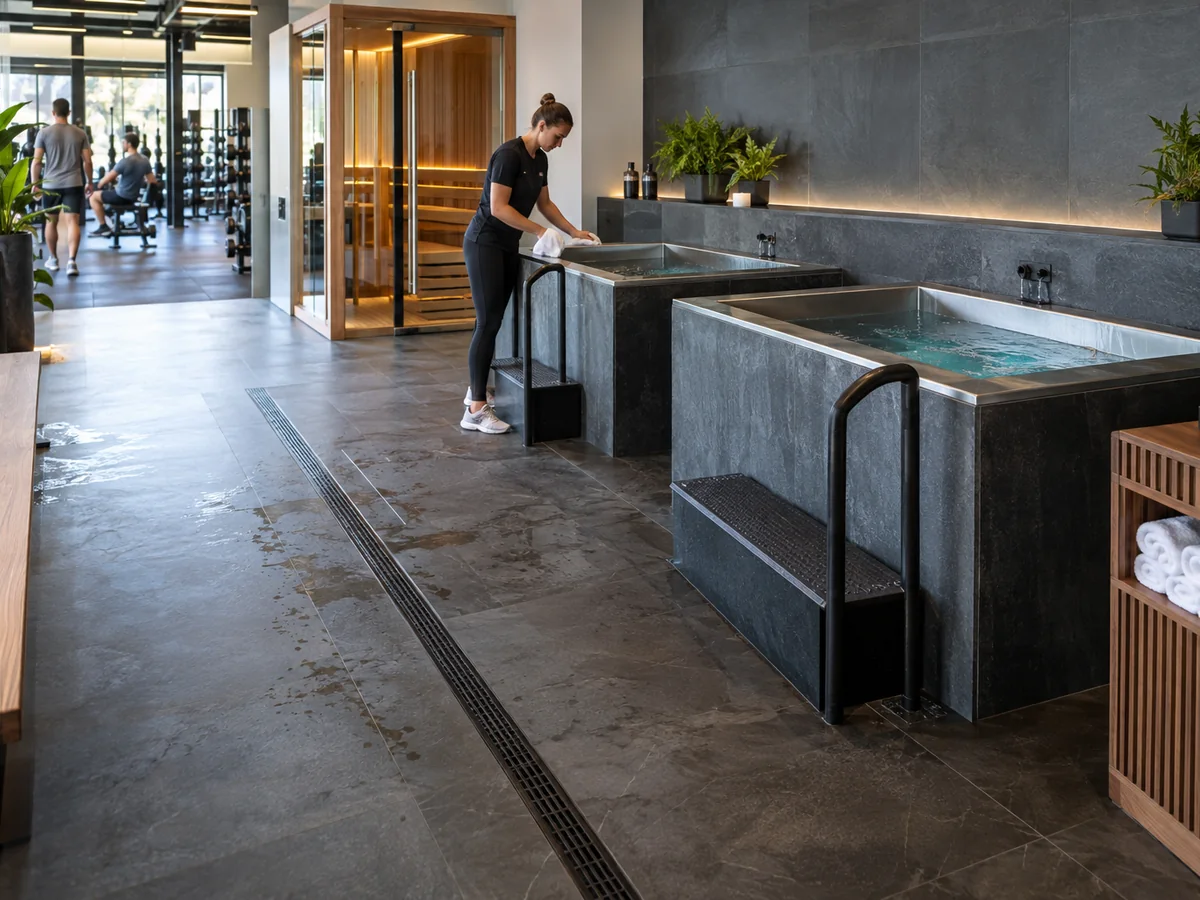
Post-exercise CWI can have a stronger rationale when the immediate goal is to restore selected qualities before another demanding performance. That is different from saying endurance or team-sport athletes should always cold plunge after training.
A 2026 modality-specific systematic review and network meta-analysis covering resistance, endurance and team-sport applications found that CWI effects differ by exercise type, outcome and protocol. The review included 87 studies and 2,313 participants, with certainty varying across outcomes, and its results do not support one universal post-exercise CWI prescription. See the 2026 modality-specific network meta-analysis.
A 2026 soccer-specific systematic review adds a useful short-turnaround example: CWI was associated with better recovery of some measures, including maximal voluntary contraction and delayed-onset muscle soreness, while sprint performance was not clearly improved and prediction intervals for the pooled outcomes included the null. See the 2026 systematic review of post-match CWI in trained soccer players. The practical point is not that soccer proves a universal protocol; it is that recovery outcomes can move differently even within one sport.
Acute Recovery and Next-Session Readiness Are Different From Endurance Adaptation
Acute recovery can include:
- soreness;
- perceived recovery;
- strength or power restoration;
- sprint or jump performance;
- aerobic performance;
- muscle-damage biomarkers.
Those outcomes do not move together.
Long-term endurance adaptation is another question. A systematic review with meta-analysis of regular CWI during training found that CWI was associated with worse resistance-training adaptations but did not show a clear effect—positive or negative—on the aerobic performance adaptations measured in the endurance studies. See the 2021 chronic training-adaptation meta-analysis.
That supports two distinctions:
Short-term recovery benefit ≠ better long-term endurance adaptation.
and
No clear endurance-adaptation impairment detected ≠ endurance adaptation improved.
Competition Turnaround Can Change the Decision
Consider two athletes after demanding sessions.
One is in a development block with no important performance soon. The other must perform again within a short turnaround. Their priorities are different even if the cold plunge is identical.
For the second athlete, selected acute recovery outcomes may deserve more weight. That does not mean every performance measure will recover better, and it does not mean the same routine should automatically be repeated after every training session throughout an adaptation-focused block.
Illustrative scenario — not a HACHILL athlete case: A team-sport athlete finishes one match with another high-demand performance approaching soon. The timing decision is based on the specific qualities needed for the next event and the available recovery window. This is a short-turnaround decision, not proof that routine post-workout CWI is optimal for long-term adaptation.
Before a Workout: Pre-Cooling in Heat Is a Special Case, Not a Universal Performance Boost
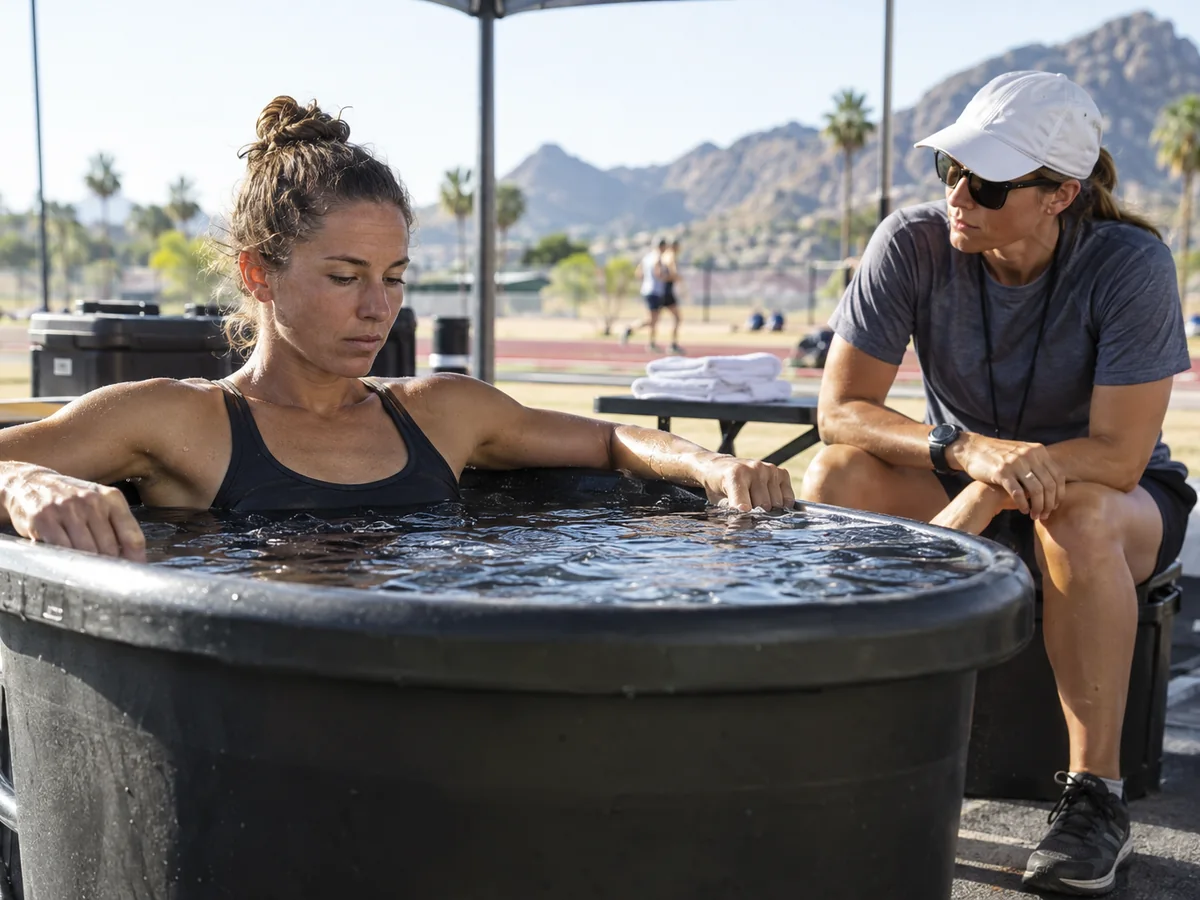
CWI before exercise has one clear evidence-backed role: pre-cooling before endurance exercise in hot conditions.
That is much narrower than claims that a cold plunge before training universally improves strength, focus, motivation or athletic performance.
When Pre-Cooling May Matter for Endurance Exercise in Hot Conditions
A CWI-specific meta-analysis of pre-cooling included endurance exercise lasting more than six minutes in ambient temperatures of at least 26°C and found a favorable overall effect on endurance-performance measures. See the meta-analysis of CWI pre-cooling before exercise in the heat.
The useful translation is:
When the performance problem is managing heat during endurance exercise, pre-cooling can be relevant.
That is an event- and environment-specific strategy. It is not a general rule that cold water belongs before every workout.
Why That Evidence Does Not Automatically Apply to Ordinary Strength or Gym Sessions
The strongest pre-cooling evidence does not establish that a cold plunge before a normal lifting session improves strength, power or training quality.
The correct scope is:
Evidence applies most clearly to: endurance performance in substantial heat.
It does not establish: a universal pre-workout benefit for resistance training, ordinary indoor exercise, mental focus or “dopamine-driven” performance.
Feeling alert after cold exposure is not the same as demonstrating better athletic output.
If water temperature itself is the question, keep that task with HACHILL’s cold-plunge temperature guide rather than copying a research temperature into a timing article as a universal consumer prescription.
Heat Acclimation and Mixed Training: When the Recovery Goal Can Conflict With the Adaptation Goal
Heat acclimation creates a different question from acute performance in the heat. Cooling may help manage thermal strain or recovery, while heat-acclimation training deliberately uses repeated heat exposure to drive adaptation.
It is tempting to conclude that post-exercise cooling must erase that stimulus. Current evidence is not strong enough for that universal claim.
Cooling for Comfort or Performance Is Not the Same as Building Heat Adaptation
A 2024 review focused specifically on recovery during exercise heat acclimation concluded that direct evidence on the effect of post-exercise cooling on heat adaptation remains limited. Its overall interpretation was that recovery-based cooling would not necessarily interfere with the physiological stimulus already achieved during heat exposure, but the authors explicitly described the conclusion as exploratory because direct data are lacking. See the 2024 review of post-exercise cooling and heat acclimation.
That makes a Known / Still Uncertain distinction more accurate than a hard rule.
- Pre-cooling can support selected endurance performance in hot conditions.
- Repeated immediate post-resistance CWI deserves caution for hypertrophy-focused training.
- Selected acute recovery outcomes can improve after CWI.
- In one controlled heat-training study, regular pre-cooling did not appear to attenuate heat adaptation.
- The exact effect of post-exercise recovery cooling on heat acclimation across different protocols.
- A universal delayed post-lifting hour that protects adaptation.
- One timing schedule that optimizes strength, endurance, short-term recovery and heat adaptation simultaneously.
That study does not establish that every pre- or post-exercise cooling protocol is neutral for heat acclimation.
Uncertainty is an evidence result, not a gap to fill with a confident rule.
Mixed Strength, Endurance and Two-a-Day Training Need a Priority Decision
Mixed training makes universal timing rules even less useful.
A day may combine lifting and endurance work, or long-term adaptation may compete with the need to perform again soon. CWI should then be evaluated against the priority of the training block or the next session—not merely labeled as “recovery.”
A practical sequence is:
- Identify the adaptation or performance outcome you are trying to protect.
- Ask whether the available CWI evidence addresses that exact exercise mode, outcome and timing.
- If the evidence only covers a different modality or an immediate post-exercise window, do not silently extend it.
- When goals conflict, use appropriate coach, sport-science or qualified healthcare input rather than inventing one universal hour.
Illustrative scenario — not a HACHILL athlete case: An athlete is in a strength-focused block but also has an endurance session later the same day. Immediate post-lifting CWI raises a different adaptation question from pre-cooling before endurance exercise in substantial heat. Those evidence categories should not be collapsed into one “cold-plunge day” rule.
Use This Cold-Plunge Timing Decision Check
A good timing decision does not have to return a single universal answer. It can return caution, consider, special case or hold.
| Decision Question | Evidence-Based Direction | Boundary |
|---|---|---|
| Is long-term strength or hypertrophy the priority? | Repeated immediate post-resistance CWI deserves caution | Evidence does not define one universal several-hours-later safe threshold |
| Do you need to perform again soon? | Selected acute recovery outcomes may make post-exercise CWI more relevant | Soreness or perceived recovery does not guarantee every performance measure is restored |
| Is the goal long-term endurance development? | Do not assume regular CWI improves endurance adaptation | Available chronic evidence does not establish an adaptation benefit |
| Are you preparing for endurance performance in substantial heat? | Pre-cooling can be a relevant special case | This does not establish a universal pre-workout benefit |
| Is heat acclimation a primary training goal? | Keep the uncertainty visible and make a program-level decision | Evidence does not justify saying recovery cooling definitely destroys acclimation |
| Are strength, endurance or two sessions competing for priority? | Decide which outcome matters most before choosing timing | No universal mixed-training schedule is established |
| Is medical suitability uncertain? | Seek individualized professional guidance before cold-water immersion | Sports-science timing evidence is not medical clearance |
Cold-water immersion also has a separate physiological-safety question. Planned cold plunging is not the same context as accidental open-water immersion, but sudden cold exposure can still rapidly alter breathing, heart rate and blood pressure; workout-timing evidence does not override individual health suitability. The U.S. National Weather Service cold-water safety guidance describes the cold-shock response, while Cleveland Clinic’s current cold-plunge guidance identifies health situations in which clinician review is appropriate.
Timing Does Not Replace Temperature, Duration or Frequency Decisions
Even a well-supported timing choice does not tell you how cold the water should be, how long the session should last or how often it should be repeated.
Keep those questions with their own page owners:
- How long? How Long Should You Cold Plunge?
- How cold? How Cold Is a Cold Plunge?
- How often? How Often Should You Cold Plunge?
A research paper may combine a particular temperature, duration, timing and participant group because those are the experimental conditions. That does not make the full protocol a universal consumer prescription.
For commercial facility planning rather than an individual athlete protocol, HACHILL’s Recovery Center planning page covers equipment, access, staffing and operating interfaces while keeping medical suitability and exposure decisions separate.
Bottom line: choose cold-plunge timing by the outcome you are trying to protect. If strength or hypertrophy adaptation is the priority, avoid treating immediate post-lifting CWI as a default recovery step. If another demanding performance is approaching, weigh the specific recovery quality you need rather than soreness alone. Use pre-cooling claims mainly for endurance exercise in hot conditions, where the evidence is materially stronger. And do not turn “4–6 hours” or any research protocol into a universal guarantee.