Upright Cold Plunge Ergonomics Guide
How to evaluate upright cold plunge entry and exit using exact model geometry, step and support interfaces, representative-user trials and controlled wet commissioning.
Direct answer: Evaluate upright cold plunge entry and exit on the exact model and installed access arrangement—not on outside dimensions, a one-person label or a product photo. Check the rim profile, internal foothold or seat, approved step or platform, hand-support positions, operating water level, wet landing and recovery space, and the full movement sequence from approach through exit. Clear unstable access components, obstructed landing space, uncontrolled floor water, unverified support interfaces and any exit task the intended users cannot complete under the planned supervision before comparative scoring or opening.
For procurement and commissioning, keep a model-specific user/task boundary, geometry ledger, movement map, project hold-condition register, dry and wet observation record, responsibility matrix and acceptance/retest file. These records support a decision only within the documented model, site, user group and operating procedure; they do not certify universal safety, accessibility, body-size fit, medical suitability or regulatory compliance.
Page scope: this article owns upright cold plunge entry, immersion, exit and recovery ergonomics. General upright-format buying, facility-type selection, cooling-system sizing, water treatment, exact model specifications, certification and health outcomes belong to their dedicated pages or controlled project records.
Define the Intended Users and the Full Entry/Exit Task
Start with the people and operating method, not a claim that a vessel is ergonomic. Record who is intended to use the station, whether use is self-directed or supervised, what assistance staff may provide, and which users require referral to qualified medical, accessibility or safety professionals. An upright plunge can reduce floor length, but its higher transition may demand more coordinated foot placement and support than another format.
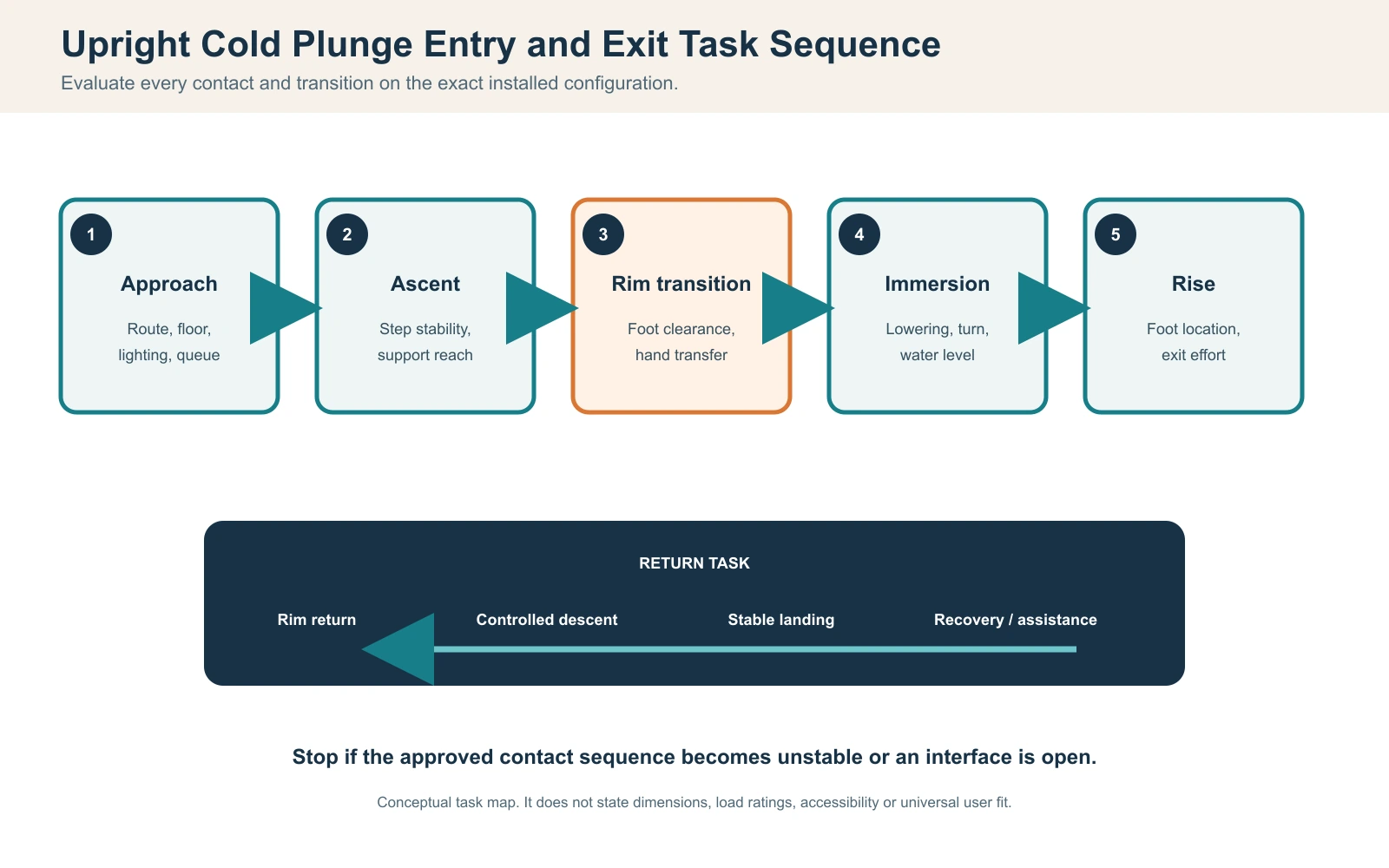
Break one cycle into approach, ascent, rim transition, lowering, immersion, turning or repositioning, rise, rim return, descent and stable recovery. Define the expected hand and foot contacts at every transition. A rail reachable during ascent may be behind the user during exit; an internal foothold visible when empty may be harder to locate through agitated water. The output is a task definition for one exact installation, not a universal body-size range.
| Input | How to obtain it | Decision affected | Status |
|---|---|---|---|
| Intended user group | Facility policy and service design | Trial group and operating restrictions | Approved / open |
| Self-directed or supervised | Operating procedure and roster | Observation, assistance and closure | Defined / open |
| Assistance method | Qualified task/risk review | Staff position and approved supports | Approved / prohibited / open |
| Clothing and footwear state | Observed service workflow | Foot contact and wet-floor route | Observed / planned |
| Operating water level | Exact model manual or approved record | Buoyancy, reach, splash and exit | Confirmed / open |
| Health/accessibility boundary | Qualified local review | Eligibility, alternatives and warnings | Confirmed / pending |
| Abnormal exit response | Drill or documented procedure | Stop-use and staff escalation | Witnessed / open |
Do not use height, age or athletic ability as a shortcut for individual fit. Two users of similar height can use different movement strategies. Define the intended population and observe the actual task under a controlled procedure. If a U.S. facility is subject to accessibility requirements, treat accessibility as a project-level classification and design question. The U.S. Access Board ADA Standards include scoping and technical provisions for swimming pools, wading pools and spas, including accessible means of entry for covered spas; whether a specific upright cold-plunge installation falls within a particular provision must be resolved by the project’s qualified accessibility/code team. This article does not determine compliance.
Measure Product Geometry and the Installed Entry/Exit Envelope
External diameter, width or one-person capacity describes only part of the problem. The installed envelope includes the vessel, step or platform, approach, hand-support reach, rim-crossing movement, clear landing, drying and recovery position, cover movement, staff assistance position and service access. These envelopes can overlap only when the operating procedure prevents conflicting tasks.
Use a scaled plan and elevation. Record the geometry from the exact ordered model and configuration; do not copy a category image or another model drawing. Mark every unknown as open. The planning expression is installed task envelope = union of product + approach + ascent + transition + exit + recovery + assistance envelopes. This is a geometric union, not a promise of suitability and not a simple sum of rectangular areas.
| Geometry field | Preferred evidence | Why it matters | Record rule |
|---|---|---|---|
| External footprint and height | Approved model drawing | Position, route and rim approach | Model/configuration/revision |
| Internal usable geometry | Section drawing or measured approved sample | Foot, knee, turn and posture task | Do not infer from outside |
| Rim height, width and profile | Controlled drawing/measurement | Weight transfer and contact | Record units and datum |
| Step/platform geometry | Included-scope drawing or site detail | Ascent, descent and stability | Identify supplier and fixing |
| Hand support | Approved product/site detail | Reach direction and load path | Do not infer load rating |
| Foothold/seat/support | Internal drawing and inspection | Lowering, rise and foot location | Record water-state visibility |
| Operating water level | Manual and commissioning record | Buoyancy, splash and reach | Record actual condition |
| Landing/recovery area | Coordinated site drawing | Controlled exit and staff access | Protect from queue/storage |
| Cover/service interfaces | Manual plus completed layout | Avoid task conflicts | Review operating states |
Measure from a defined datum and identify whether a value is nominal, maximum, minimum or observed. Photographs are useful for orientation but are weak dimensional evidence because perspective, lens distortion and unknown configuration can mislead. When supplier drawings and field conditions differ, stop and reconcile the model, revision and installation before continuing the ergonomic decision.
Map Every Hand, Foot and Body Transition
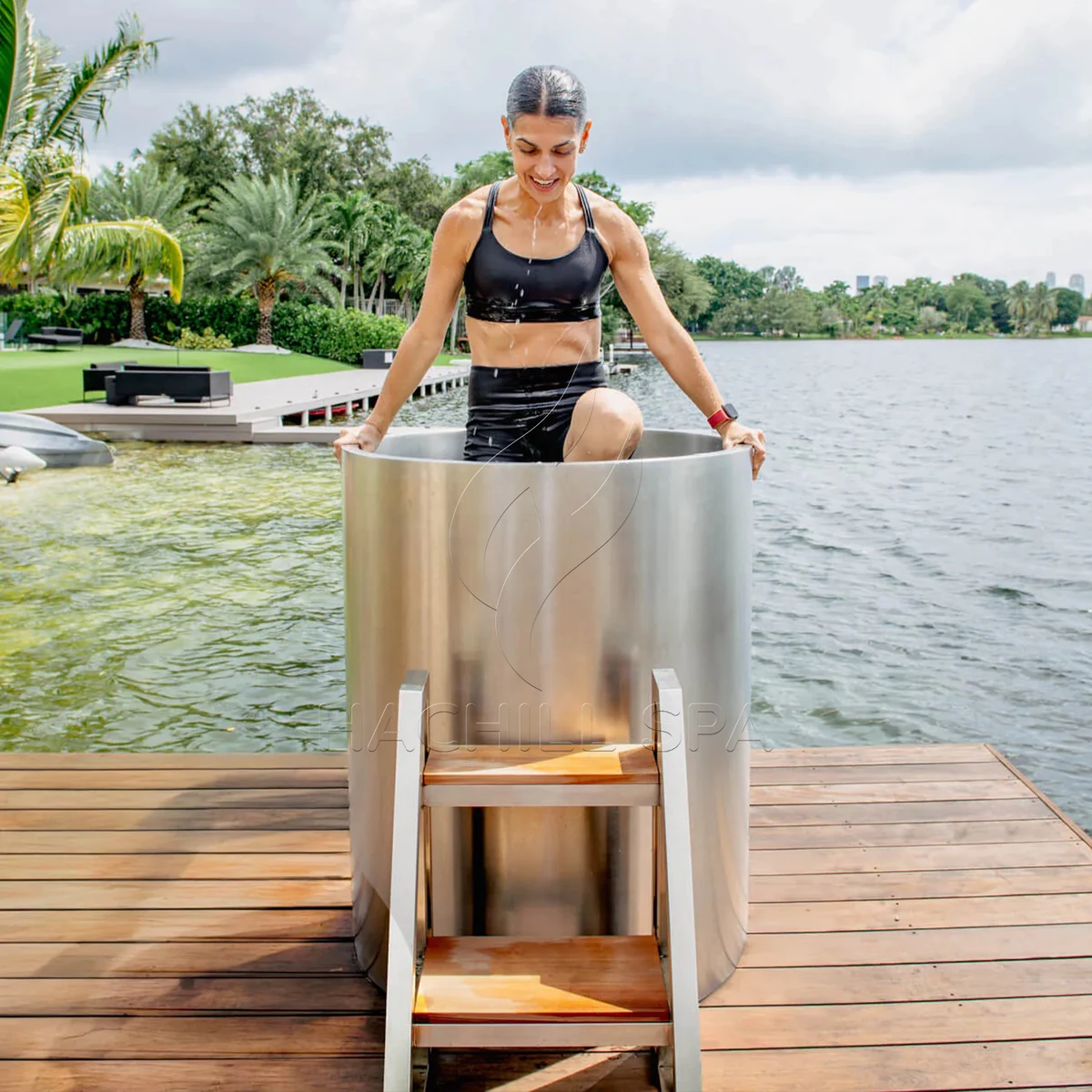
Create a movement map before trial. For each phase, identify the intended contact, direction of force, visual cue, possible obstruction and recovery position if the movement is interrupted. Review both entry and exit; exit commonly changes the load because the user moves from buoyant support to full body weight while wet. The assessment must include the cover, nearby walls, piping, furniture, towels and other users in their actual operating positions.
| Phase | Observe | Required evidence | Failure response |
|---|---|---|---|
| Approach | Floor condition, route, lighting and queue | Wet-zone plan and walk-through | Clear or redesign route |
| Ascent | Step contact, support reach and stability | Approved step plus dry trial | Hold if movement/support is unstable |
| Rim transition | Foot clearance, hand transfer and overhead space | Plan/elevation plus observation | Change approved arrangement |
| Lowering | Controlled descent and internal contact | Exact internal geometry trial | Restrict or reject configuration |
| Immersion/turn | Posture, knee/foot clearance and control access | Observed intended task | Revise user boundary/procedure |
| Rise | Hand/foot sequence and effort after immersion | Observed exit trial | Provide approved change or stop |
| Rim return | Balance while wet and transition direction | Wet-state commissioning observation | Close unresolved interface |
| Descent/recovery | Landing, drying, assistance and clear route | Completed-site observation | Protect recovery envelope |
A movement is not accepted because one trained demonstrator can complete it once. Repeatability, correct use of intended supports and the ability to stop without an uncontrolled fall or improvised grab matter more. Do not ask a person to repeat a movement that has already shown instability merely to obtain more data.
Engineering scenario: The support works on entry but disappears during exit
Observed problem: A user ascends with a reachable support, but after turning in the vessel the same support is behind the shoulder during the first exit movement.
Likely cause: The layout review treated entry and exit as mirror images and did not map hand transfer after immersion.
How to check: Mark hand and foot positions for every phase on the exact installed configuration, then observe a controlled dry task with the intended direction of travel.
Prevention or corrective path: Change the approved support, orientation or operating boundary and repeat the affected dry trial before wet commissioning.
Clear Entry/Exit Hold Conditions Before Scoring Preferences
Do not average a critical interface failure into an attractive overall score. For the project method in this guide, treat a loose or unapproved step, unresolved support load path, obstructed landing, sharp damage, uncontrolled floor water, inaccessible stop control, inadequate required observation or inability of intended users to complete the controlled exit as hold conditions until they are closed, restricted by an approved operating rule or rejected. These are procurement and commissioning decision gates, not a universal code-defined list; manufacturer instructions and applicable local requirements may add or change hold points.
| Hold condition | Evidence needed to release | Release owner |
|---|---|---|
| Step/platform moves, rocks or lacks approved scope | Approved detail, installation record and stability check | Supplier/site designer/installer as scoped |
| Hand support or load path is unverified | Approved component and attachment evidence | Design authority and qualified reviewer |
| Intended user cannot complete controlled exit | Approved change or documented user restriction | Buyer/operator with qualified review |
| Landing or recovery space is obstructed | Completed layout and operating control | Site designer/operator |
| Standing water or drainage creates uncontrolled route | Corrected floor/drainage and witnessed wet check | Installer/operator |
| Sharp, damaged or unstable contact surface | Repair/replacement and inspection | Supplier/installer/operator |
| Staff cannot observe or stop the task as designed | Revised roster, sightline or access control | Operator |
| Required local/accessibility review is open | Documented project-specific decision | Qualified professional/AHJ |
Decision rule: an unresolved project hold condition is not a low score. Do not proceed to comparative scoring, employee use, public opening or an improvised workaround until the named authority closes it. In U.S. workplaces where OSHA 1910.22 applies, walking-working surfaces must be kept clean and orderly and, to the extent feasible, dry; where wet processes are used, drainage must be maintained. That rule supports treating unresolved wet walking-surface hazards as release blockers for covered employee areas, but it is not a complete cold-plunge safety standard.
Measure the Completed Layout with a Repeatable Method
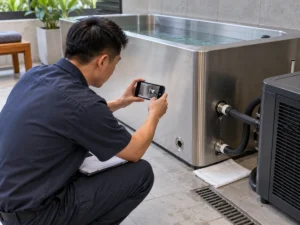
Set out the exact vessel, approved access component and surrounding interfaces at full scale before permanent services make change expensive. Use a tape or laser suitable for the surface, a level where relevant, removable floor marks, photographs from fixed viewpoints and a dated sketch. Record the instrument, datum, units, observer and revision. The purpose is traceability, not false precision.
For reach and movement observations, record where contact occurs rather than declaring a universal acceptable distance. Document whether the person leans, twists, searches for a foothold, changes grip, contacts an edge or needs assistance. Measure the landing and recovery envelope in the completed fit-out state, including doors, covers, screens, drains and service panels.
| Record | Method | Raw evidence | Decision use |
|---|---|---|---|
| Plan/elevation geometry | Measure from named datum | Values, units, sketch and photo | Compare with approved layout |
| Step/platform state | Level/stability and position check | Photo, fixing and condition | Release ascent task |
| Hand contact sequence | Controlled task observation | Contact map by phase | Find unreachable transfers |
| Foot contact sequence | Controlled task observation | Foot/foothold map by phase | Find search or interference |
| Landing/recovery | Full-scale marked envelope | Dimensions and obstruction record | Protect controlled exit |
| Staff assistance position | Procedure walk-through | Position/sightline record | Validate operating method |
| Cover and service states | Open/closed/removal simulation | Conflict photographs | Prevent envelope overlap |
| Deviation | Compare drawing to field | Owner, impact and status | Hold affected acceptance |
If a measurement changes after flooring, levelling, step replacement or product revision, update the ledger and repeat only the affected tasks plus any dependent transition. Keep the previous record; it explains why the earlier conclusion no longer controls the completed installation.
Run Representative-User Dry Entry/Exit Trials
A dry trial reduces exposure while the layout is still adjustable. Select participants from the facility’s intended user group using an approved, non-discriminatory method; the trial is not medical screening. Explain the stop signal, keep the vessel secured, use only approved supports and provide a qualified observer where the project requires one. Do not ask participants to jump, climb on unapproved surfaces or test a condition already identified as unstable.
Observe the same scripted sequence for each participant. Record completion, contact sequence, assistance, deviations and stop reason. A pass for one participant does not prove universal fit. A fail may indicate a configuration problem, an operating restriction or a need for qualified review. Preserve unsuccessful observations instead of averaging them away.
| Field | What to record | Why it matters | Result state |
|---|---|---|---|
| Participant group/code | Relevant intended-user grouping without unnecessary personal data | Links observation to declared scope | Within scope / outside scope |
| Configuration/revision | Vessel, step, support, orientation and layout | Prevents transfer to another setup | Confirmed / mismatch |
| Task phase | Standard movement sequence | Locates the interface | Complete / assisted / stopped |
| Contacts/deviation | Hands, feet, lean, twist, search or collision | Shows how the task was achieved | Expected / deviation |
| Observer/witness | Name/role and time | Supports traceability | Recorded / missing |
| Stop reason | Instability, pain, uncertainty, obstruction or procedure trigger | Protects participant and evidence | Closed / open |
| Action/retest | Approved change and affected phases | Controls iteration | Required / not required |
Engineering scenario: A single athletic demonstrator masks the real user boundary
Observed problem: The supplier demonstration looks easy, but shorter intended users search for an internal foothold and cannot reproduce the same exit sequence.
Likely cause: The decision relied on one familiar demonstrator, no scripted phases and no record of operating water level or exact configuration.
How to check: Run the approved dry sequence with representative intended users and record contacts, assistance, deviations and stop reasons by configuration revision.
Prevention or corrective path: Define the actual user boundary, change the approved entry arrangement where justified, and repeat affected tasks before acceptance.
Validate Wet Entry/Exit During Controlled Commissioning
Water changes buoyancy, visibility, surface condition, splash and the transition from supported immersion to full body weight. Wet validation therefore matters, but it is not an invitation to unsafe experimentation. Begin only after structural, hydraulic, electrical, drainage and dry-task gates are closed under the approved project procedure. Use the intended operating water level and record water and ambient conditions.
Compare wet observations with the dry baseline: whether the foot location remains visible, whether the hand sequence changes, where splash reaches the landing, how quickly the floor drains, and whether the user can reach a stable recovery position. Stop for unexpected instability, uncontrolled water, active leaks, suspected electrical exposure, damaged supports, repeated protection trips or any manual/site stop condition.
| Condition | Baseline | Wet observation | Action |
|---|---|---|---|
| Operating water level | Approved target/mark | Actual level before and after user entry | Correct before judging task |
| Internal foot/support visibility | Dry contact map | Visible, obscured or searched for | Review cue/support/procedure |
| Hand sequence | Dry contact map | Same or changed under wet exit | Reassess affected transition |
| Splash and drainage | Dry marked landing | Wet extent and drain response | Correct route or housekeeping |
| Recovery transition | Dry landing task | Stability and assistance used | Hold if uncontrolled |
| Unexpected condition | None expected | Leak, movement, trip or damage | Stop, preserve evidence, escalate |
| Retest boundary | Approved configuration | Changed variable and stable controls | Accept only controlled retest |
Do not compare different water levels, steps, support positions and user groups as if one variable changed. A defensible retest changes the identified cause, retains other valid controls, uses the same observation method and records the new revision. If that is impossible, describe the result as a new test rather than a confirmation.
Compare Configurations Only After Hold Conditions Clear
A disclosed project score can compare two configurations only after both have cleared the applicable hold conditions. It cannot certify safety, accessibility or compliance. Choose criteria that match the facility, such as repeatable hand/foot sequence, landing control, observation, assistance position, cleaning/restoration and service conflicts. Assign weights before reviewing supplier results to reduce hindsight bias.
One transparent project-specific method is weighted task score = sum(weight x rating) / sum(weights). Define the rating scale in the project record, retain the raw observations and perform a sensitivity check by varying the highest weights. If the preferred option changes with small, reasonable weight changes, the comparison is not robust and should be resolved with better evidence or explicit operating priorities rather than hidden arithmetic.
| Criterion | Example evidence | Weight basis | Boundary |
|---|---|---|---|
| Hand/foot sequence | Dry and wet contact maps | Core task repeatability | No open disqualifier |
| Exit and recovery control | Observed landing transition | Facility risk/assistance policy | Qualified review where required |
| Staff sightline/position | Completed-layout walk-through | Supervision model | Not a substitute for staffing |
| Restoration after cleaning | Timed reset observation | Operating frequency | Approved parts/positions only |
| Cover/service conflicts | Multi-state envelope drawing | Maintenance/closure duty | No live-use overlap |
| Evidence confidence | Model/revision-specific records | Procurement risk | Open facts remain open |
Keep the weights, ratings, raw observations and decision owner in the project record. Do not publish invented scores as HACHILL model ratings. Any score belongs only to the assessed configuration, site, user group, operating procedure and evidence revision.
Grade Evidence by Model, User Group, Method and Condition
Evidence strength depends on relevance, not presentation quality. An approved drawing for the exact model is stronger for geometry than a category photograph. A witnessed task trial on the completed configuration is stronger for that user group and procedure than an unrecorded showroom demonstration. Neither proves medical suitability or universal accessibility.
Evidence-grade note: the A-D labels below are a project recordkeeping convention used in this guide, not an external certification, regulatory rating or HACHILL product grade.
| Grade | Evidence | Permitted use | Limit |
|---|---|---|---|
| A – controlled | Exact model/configuration, approved method, intended group, recorded condition, witness and revision | Acceptance decision within stated boundary | Does not transfer automatically |
| B – model specific | Approved drawing/manual or controlled sample evidence | Design and trial planning | Field and user task still require confirmation |
| C – analogous | Related model, mock-up or incomplete condition | Risk discovery and provisional planning | Not release evidence |
| D – illustrative | Marketing image, generic statement or unrecorded demonstration | Orientation only | No dimension, load, fit or compliance conclusion |
| Open | Missing, conflicting or revision-unknown information | Track as action | Cannot be converted into an assumption |
Each record should name the product/configuration, site state, user group, method, observer, date, units and revision. Keep conflicting records and explain the resolution. Deleting the failed or outdated result makes later disputes harder to reconstruct and can allow an old drawing to regain authority.
Engineering scenario: A site-supplied step changes after the trial
Observed problem: Opening staff find that the replacement step is taller and sits closer to the vessel than the step used during acceptance.
Likely cause: The step was treated as loose furniture rather than a controlled part of the entry configuration, so procurement changed it without ergonomic change review.
How to check: Compare the installed item, fixing, position and revision with the accepted geometry ledger and task records; quarantine use while the mismatch remains.
Prevention or corrective path: Control site-supplied access components by drawing and revision, then repeat every affected transition under the approved method.
Assign Responsibility for Every Ergonomic Interface
The buyer/operator defines the intended users, supervision, assistance and stop rules. The supplier provides exact ordered-product drawings, included access components, manuals and agreed evidence. The project designer coordinates the landing, floor, drainage, route, lighting and support interfaces. The installer builds and records the approved arrangement. The commissioning lead witnesses the task method. Qualified professionals and the authority having jurisdiction decide regulated accessibility, structural, electrical, public-use and workplace matters.
| Decision | Lead | Required output | Approval/witness |
|---|---|---|---|
| User and operating boundary | Buyer/operator | Intended group, supervision, assistance and stop rules | Qualified reviewers as applicable |
| Product geometry/scope | Supplier | Exact model, included step/support and revisions | Buyer technical authority |
| Site movement envelope | Project designer | Coordinated plan/elevation and recovery area | Operator/qualified professionals |
| Installed access arrangement | Installer/trades | As-built position, fixing, level and drainage | Commissioning lead |
| Dry/wet task trial | Commissioning lead | Method, raw observations, deviations and retest | Buyer/operator witness |
| Opening and daily checks | Operator | SOP, logs, closure and escalation | Named operational authority |
| Change control | Party proposing change | Impact, revised evidence and approval | Original decision owners |
Contracts may combine roles, but no interface should be anonymous. A supplier statement that a step is available does not approve the floor, fixing, landing or user task. Likewise, an installer completing the physical work does not define the facility’s user eligibility or medical boundary.
Define Pass, Deviation, Stop and Controlled Retest
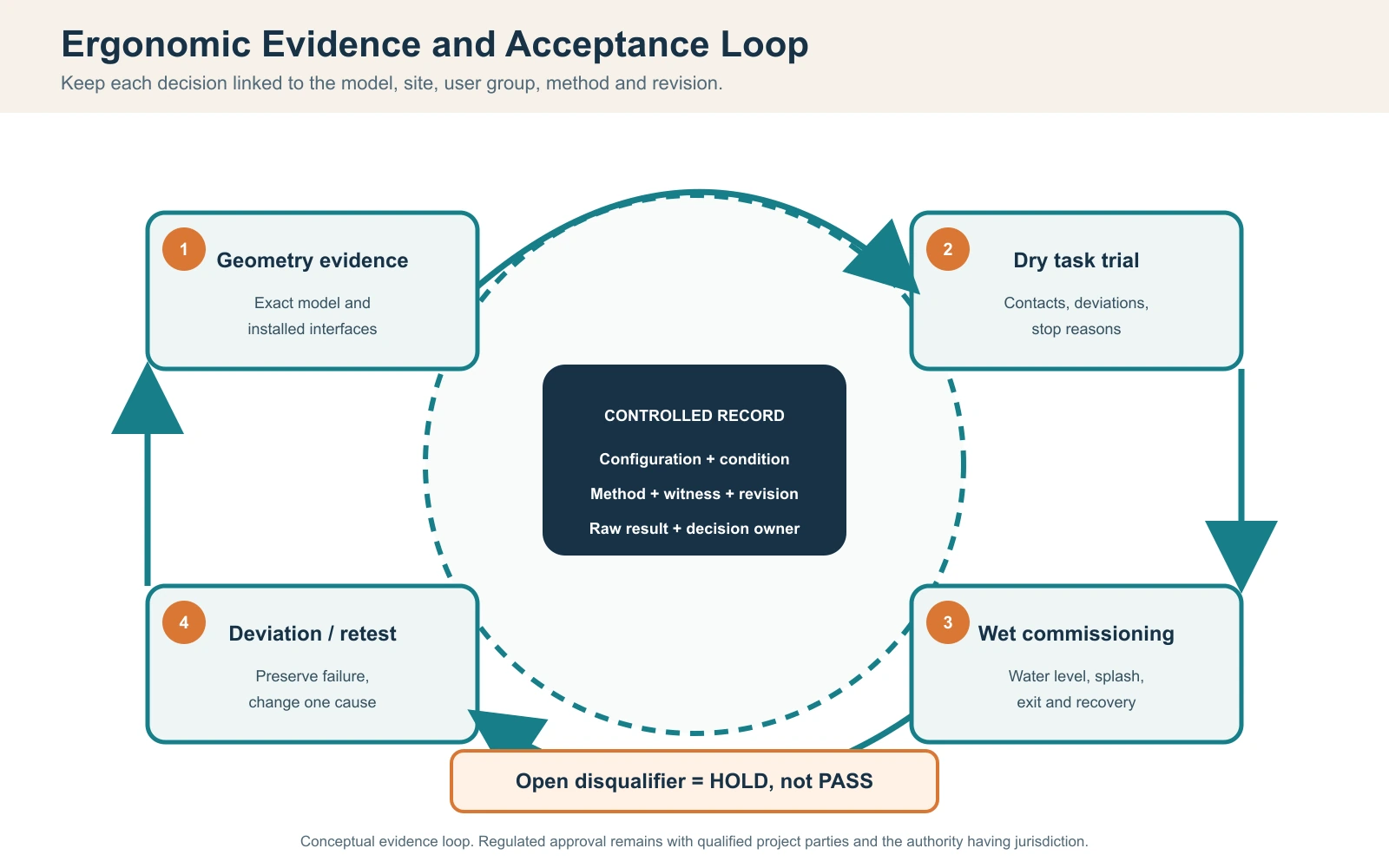
A practical project method uses four gates: evidence release, dry layout, controlled wet commissioning and opening operation. Each gate needs a method, raw record, pass boundary, witness and authority to release. A deviation should identify the affected tasks, interim restriction, owner and due date. Do not label a conditional or open result as passed.
| Gate | Method/raw record | Pass boundary | Failure/retest rule |
|---|---|---|---|
| Evidence release | Approved model, geometry and scope ledger | Critical fields and revisions closed | Hold ordering/site interfaces |
| Dry layout | Full-scale marks, measurements and scripted task trials | Intended sequence completed within approved boundary | Change identified cause; repeat affected tasks |
| Wet commissioning | Water level, contact, splash, drainage and recovery log | No uncontrolled change from accepted method | Stop, correct and controlled retest |
| Opening review | SOP, inspection, closure and response drill | Staff can inspect, close, escalate and restore | Do not open until roles/evidence close |
| Post-change review | Revision impact assessment | All dependent evidence remains valid or is repeated | Quarantine changed configuration |
| Dispute preservation | Photos, measurements, logs and revisions | Traceable condition and chain of custody | Do not overwrite original evidence |
When parties disagree, compare the agreed requirement, exact configuration, method and raw record before debating conclusions. Preserve the agreed requirement, original drawings, raw observations and failed result; do not overwrite them with the corrective revision. Preserve packaging and receiving evidence where product damage is relevant, and preserve as-built measurements and trial records where site geometry is relevant. A retest should be witnessed by the parties responsible for the disputed interface.
Keep the Accepted Entry/Exit Arrangement Controlled in Operation
Daily opening checks should cover the step/platform, supports, rim/contact surfaces, route, landing, drainage, lighting, cover and any item restored after cleaning or maintenance. Furniture, towels, hoses and temporary signs can invalidate the accepted envelope. Record defects, close the station with an effective method, and name who can authorize reopening.
| Item | Opening check | Stop-use condition | Reopen evidence |
|---|---|---|---|
| Step/platform | Correct item, position, fixing and condition | Movement, damage or mismatch | Corrected and inspected configuration |
| Support/contact surfaces | Secure, clean and unobstructed | Loose, sharp, damaged or contaminated | Repair/cleaning record |
| Route/landing | Clear, lit and protected | Queue, storage, cover or hose conflict | Restored layout |
| Floor/drainage | No uncontrolled standing water | Drain blockage or uncontrolled wet route | Drain/floor check |
| Water level/task state | Within approved operating method | Level/control changes task unexpectedly | Corrected condition and review |
| Observation/closure | Staff and closure method available | Required supervision or closure unavailable | Roster/control restored |
| Post-maintenance state | Steps, panels and covers restored | Unknown or changed configuration | Maintenance handback and inspection |
Trend repeat failures rather than treating each as isolated. Recurring step movement, blocked drains or displaced furniture indicates a design or operating-control problem. Escalate the cause and revise the accepted arrangement or procedure instead of relying on repeated reminders.
Issue an Ergonomics-Focused RFQ and Acceptance Record
Send each supplier the same user/task boundary, site drawings, supervision model, model-evidence request, access-component scope and acceptance method. Ask the supplier to mark every field comply, deviation, alternative or open. Price comparison before the step, support, drawings and responsibility are aligned rewards hidden exclusions.
| RFQ field | Buyer/project input | Supplier response |
|---|---|---|
| Application/users | Facility, intended group, supervision and assistance boundary | Declared model/use limitations |
| Exact configuration | Required format and orientation | Model, revision and option list |
| Geometry | Required drawing fields and datums | External/internal, rim, step, supports and water-level evidence |
| Access components | Included/site-supplied responsibility | Scope, fixing, limits, manuals and exclusions |
| Installed envelope | Room plan, landing, drainage and recovery | Required access/clearance and conflicts |
| Evidence | Drawing, manual, trial and revision requirements | Available grade and open items |
| Acceptance | Dry/wet tasks, witnesses, hold points and retest | Method support, deviations and boundaries |
| Commercial scope | Quantity, destination, branding and schedule | Included/excluded scope and change control |
For a model-level RFQ, provide the completed fields rather than asking whether an upright plunge is ergonomic in general. Use the exact model/configuration response to close product-side fields; site layout, accessibility, regulated work and operating approval remain with the responsible project parties.
Frequently asked questions
How do you evaluate entry and exit for an upright cold plunge?
Define the intended users and operating method, obtain exact model and access-component geometry, map every hand and foot transition, clear disqualifying conditions, then run controlled dry and wet task observations under the approved site procedure. Record the configuration, water level, participants, method, deviations, witness and revision.
Can external tub dimensions prove that an upright cold plunge will fit a user?
No. External dimensions do not establish internal movement space, rim transition, foot location, support reach, operating water level, exit effort or landing conditions. Use exact internal and external evidence plus a representative-user task trial for the intended configuration and facility boundary.
Should an entry step be supplied with an upright cold plunge?
The order should state whether the approved step or platform is included, optional or site-supplied. Its geometry, fixing, position, surface, applicable load evidence, maintenance and replacement control should be defined. A generic movable stool should not be treated as equivalent unless its design, stability, placement and intended use have been specifically approved for the task and site.
Why must wet commissioning repeat parts of the dry ergonomic trial?
Water changes buoyancy, foot visibility, splash, surface condition and the move from immersion to full body weight. Wet commissioning checks whether the accepted contact sequence and recovery route remain controlled at the approved water level. It should begin only after structural, electrical, drainage and dry-task gates pass.
When should an upright cold plunge station be closed?
Under the project method described here, stop use for a loose or damaged step or support, sharp damage, unstable installation, obstructed landing, uncontrolled standing water, active leak, suspected electrical exposure, repeated protection trips, unavailable required supervision or any manufacturer/site stop condition. Reopen only after the responsible authority records correction and any required retest.